East Regional Analysis

Posted by nvr1983 on March 18th, 2008

As I stated earlier during my live blog of the selection show, the East Regional definitely seems likely the toughest of the four regions, which seems a little unfair to #1 overall seed UNC. I also included links to the team’s ESPN pages that includes schedules and rosters.

Teams
#1 UNC: Despite all the hype that the analysts are giving UCLA, I still think UNC is the team to beat as they have Hansbrough, the most reliable player in the nation on a team that doesn’t have a #2 guy who lay a 0-for-14 in a big game, a very good if not great yet perimeter player in Ellington, and one of the best PGs in the nation in Lawson (still unsure when he will be back to his prior form). They also have Roy Williams, who despite his record of losing tournament games with superior teams has also won a national title before so at least he knows how it is done. Schedule/Roster.

#2 Tennessee: Out of all the #2 seeds, the Vols definitely got the short end of the stick. For all the talk of Wisconsin being cheated out of a #3 seed, I would almost prefer to be in Wisconsin’s position rather than Tennessee’s. The Vols have one of the most exciting/athletic teams in the country, but sometimes they just don’t show up. I’m still waiting for Chris Lofton to turn into the potential national POY that he was hyped as coming into the season. Even though their first round game should a cakewalk, the second round will be a challenge as they will end up with either Butler (much, much better than its 7th seed) or South Alabama (the game is in Birmingham, AL). This is a pretty rough bracket for the team that most would consider the best #2 seed especially since Wisconsin didn’t even get a #2 seed. Schedule/Roster.

#3 Louisville: Despite their horrendous early-season start, Rick Pitino (and the team recovering from injuries) turned the season around and has Louisville at a very respectable seed. While they lack the star power of some of the top teams, Louisville makes up for it with their depth. Their most explosive scorer (Sosa) comes off the bench and they also have solid (if somewhat anonymous) play out of the backcourt to compliment Padgett, Character, and Palacios, who actually started on their Final 4 team. Normally, I would give this group a good chance to make the Final 4, but with UNC and Tennessee in their bracket they will be hard-pressed to make it to San Antonio. Schedule/Roster.

#4 Washington State: It’s hard to believe that earlier in the season this team was ranked #4 and now they are probably getting the 4th most hype out of the Pac-10 teams in the tournament. With tons of experience and solid play from Kyle Weaver and Derrick Low, the Cougars should be competitive with almost any team in the tournament, but their lack of firepower and depth will probably cost them if they get deep into the tournament. I’m sure that all of you are also looking at Winthrop as a potential Cinderella based on their prior performance so the Cougars also have that to worry about. Schedule/Roster.

#5 Notre Dame: Led by Big East POY candidate Luke Harangody, the Irish were one of the big surprises for us out of the Big East. We didn’t get to see them play much, but when we did they looked very good. Part of their success seems to be related to their home-court winning streak. It’s too bad for the Irish the tournament isn’t played in South Bend. They play the 2006 Cinderella George Mason in the first round, which should be an interesting matchup (we’ll leave the Irish/Cinderella commentary/jokes to someone else). Like Duke, the Irish rely on the 3 although they are not completely lacking an inside presence. This makes them dangerous on a given night, but also subject to an early upset. Schedule/Roster.

#6 Oklahoma: It looks like that whole Kelvin Sampson leaving thing didn’t turn out so bad for the Sooners. Somehow they ended up a higher seed than Sampson’s more recent previous team. The Sooners are led by Blake Griffin who managed to put up big numbers (15.2 PPG and 9.2 RPG) despite injury both knees this season. Jeff Capel has done a good job replacing Sampson on the sideline while staying off the cell phone (we hope). The Sooners aren’t a force offensively so they have to rely on their defense. While that normally is a good thing for a team, we wonder how far this team can go with all the offensive firepower in this region. Schedule/Roster.

#7 Butler: Seriously, this is unbelievable. 29-3. Ranked #10 or 11 depending on which poll you believe. They’re a #7 seed?!?!? Normally with a balanced attack (4 guys average double figures), experience (a Sweet 16 trip last year), and several impressive non-conference victories, we would expect the Bulldogs to outperform their seed, but Committee Chairman Tom O’Connor must think Butler head coach Brad Stevens looks like a bitch because. . .well you know the rest of the line. This is one of the all-time great screwjobs. They play #10 seed South Alabama in the first round in Birmingham, Alabama. If they survive that, the Bulldogs will likely face Tennessee, the best #2 seed in the tournament. Schedule/Roster.

#8 Indiana: Honestly, this is the most surprising seed that I can remember. I wouldn’t have pictured the Hoosiers as anything lower than a 6. It’s amazing that the team with the Big 10 POY (DJ White) and possibly the best freshman in the nation (Eric Gordon) along with a host of other solid players could be a #8 seed. I realize they lost 3 of their last 4, but one was in OT and the other was on a last second miracle shot (I wonder if Tubby got the idea after hearing about it so much while he was at UK). We would pick the Hoosiers to go deep in the tournament, but they have lost to every elite team they played this year (Xavier, UConn, and Wisconsin). Perhaps, Dakich can work some of his magic or Dick Vitale will be calling for the return of Robert Montgomery Knight. Schedule/Roster.

#9 Arkansas: Led by new coach John Pelphrey (look for him in the background of rtmsf’s favorite March moment), the Razorbacks have had an impressive season after a few bad non-conference losses. Much like Nolan Richardson’s teams (although not nearly as good), the Razorbacks like a quick pace. After a nice run to the SEC tournament finals, Arkansas might be a trendy pick to make a run, but they have a killer draw (Indiana then UNC if they want to make the Sweet 16). While this stat won’t help you make your picks, watch for how the Razorbacks start the game for a hint at the outcome. During the regular season, they were 18-0 with a halftime lead and 2-10 when trailing at the half. Schedule/Roster.

#10 South Alabama: After failing to win the Sun Belt tournament, South Alabama was on the edge of not making the tournament. The good news: they’re in and their pod is in Alabama. The bad news: to make it out of the sub-region they will have to be Butler and Tennessee. If they are going to make a run, they will have to feed off the home crowd and need a big performance out of star Demetric Bennett. Schedule/Roster.

#11 Saint Joseph’s: Led by Pat Calathes (older brother of UF star Nick Calathes), the Hawks made the tournament by winning the Atlantic 10 tournament. It’s hard to believe that just a few years ago, St. Joe’s was on the verge of a perfect regular season and almost made the Final 4. It’s also hard to believe that Jameer Nelson and Delonte West played at St. Joe’s at the same time. If Phil Martelli wants to survive the opening weekend, the Hawks will need to step up their defense. Fortunately for them, they start off with Oklahoma, a team that isn’t know for being high-scoring. Schedule/Roster.

#12 George Mason: The Patriots (Final 4 Cinderella in 2006) are back and they start off against Notre Dame. We don’t see the Patriots making a deep run this year, but then again we never would have imagined they could beat a loaded UCONN team back in 2006. Schedule/Roster.

#13 Winthrop: If the Eagles are to pull off another upset, they will need a big night out of Michael Jenkins (14.3 PPG). Before you go out and make the Eagles a Cinderella you should realize this is a different team, which is most noticeable when you see they have a new coach on the sideline.Schedule/Roster.

#14 Boise State: It looks they know one thing at Boise State and we’re not referring to the hideous blue football field that makes you try to adjust your TV every bowl season. Like the football team, the basketball Broncos can light up the scoreboard averaging 81.2 PPG (12th nationally) and shoots 51.5% from the field (2nd nationally). They are led by first team All-WAC Reggie Larry (19.3 PPG and 9.1 RPG) along with 2 other forwards who average double figures. Side note: We loved watching replays of their Fiesta Bowl victory over Oklahoma (didn’t see live because I had to be in the hospital at 4 am for an orthopedic surgery rotation) and would love for them to meet in the 2nd round of the tournament so we can root for that. Schedule/Roster.

#15 American: I’m not going to put much time into this because well they aren’t going to be spending much time in the tournament. They like to slow the game down and they shoot 40.9% as a team from 3. Unfortunately, both of their starting guards are under 6′ tall. The result is that they might hang with the Vols for 10 minutes then it’s over. Schedule/Roster.

#16 Mount Saint Mary’s / Coppin State: Honestly, we don’t know anything about either of these teams except that Coppin State is the first 20-loss team to ever make the tournament. Nothing against either of these teams, but a detailed analysis of these teams isn’t really worth the time since they will likely be gone 5 minutes into their game with UNC. Mount Saint Mary’s Schedule/Roster. Coppin State’s Schedule/Roster.

P.S. Kelvin Sampson must love this region with his two former teams in it. I wonder how much he will be mentioned during their games. We know it’s pretty much impossible, but we would love the possibility of an Indiana-Oklahoma Elite 8 match-up.
Share this story

Late Introduction & Weekend Thoughts

Posted by rtmsf on March 17th, 2008

By way of a late introduction, we wanted to thank our buddy N-Bug for his detailed postings this past weekend on the various conference tourneys and bracket analysis.  We’ve been insanely busy with our real job(s), and haven’t been able to do much more than catch the occasional game and periodically watch Bob Knight get molested by Digger.  Somebody should call an Amber Alert on Digger and just get it over with – that dude is creepy.  As for Knight, we figure that one of these times where Digger is busily groping his arms and shoulders, he’s going to snap and dispose of Mr. Phelps in the nearest wastebasket.

Anyway, here are a few thoughts on the weekend games and brackets.

  • That tornado situation at the SEC Tourney in the ATL was crazy.  We were watching it live and the rumbling locomotive sound for anyone who grew up in flyover land (we did) was unmistakeable.
  • By the same token, penalizing Georgia/Kentucky by making it play two games in a single day, and further limiting the fan access to school administrators and families at the Alexander Coliseum was a total bush league maneuver by the SEC.  Does anyone think this would have been the same response (no fans) had the SEC football championship game been interrupted by a natural disaster?  No freakin way.
  • Props to Georgia and Dennis Felton though for sticking it right back up the SEC’s ass by winning three games in about 27 hours.
  • Seth Greenberg’s diatribe about whether the Hokies were one of the best 65 teams in America has been debated endlessly already.  Clearly, they’re one of the best 65, but that’s not the important measure.  They needed to be one of the best 34 at-large teams, and it’s arguable whether they were.  Then his follow-up response yesterday was pure idiocy, which N-Bug eloquently captured.  It’s about the “experience,” Seth?  If it’s really about the “experience,” then most of your players already got to have the “experience” last season; whereas South Alabama’s and St. Mary’s players will get that “experience” this time around.  What a joke.
  • Also can’t believe he brought up the garbage bowls at all, as if any but a handful of bowls are on par with the NCAA Tournement.
  • What is it about Pitt in the Big East Tourney?  They completely outmuscled and outhustled the Hoyas all over the court on Saturday night.
  • UNC, UCLA, Kansas, Wisconsin.  Pretty much all chalk in those tourneys.  Most likely second-round loser?  Wisky.
  • Who else thought Bob Knight was ready to rip into Vitale for the mere mention of him returning to Indiana?  We’re not sure whether Knight is on some gag order as a result of his settlement with the school, but his eyes told the tale.  He was livid, and he quite obviously sees Vitale and Digger as little more than failed coaches turned circus clowns.  He seems to respect Hubert Davis and Jay Bilas, though.  Maybe it’s a players/coaches thing.
  • Easiest bracket is the West, with UCLA only facing a serious threat from UConn, depending a) on whether the Huskies can avoid losing in the first two rounds; and b) which UConn shows up (which largely determines the first point).
  • Toughest bracket is the East, with UNC potentially facing an Indiana team with enough talent to knock them off in the second round (think: UNC 2000?), an explosive ND squad, and either Louisville or Tennessee potentially in the regional finals.  Any of those three teams are F4-worthy.

Final thing for now – thanks again to N-Bug for helping out and also setting up the Yahoo Bracket for RTC.  Be sure to sign up by Thurs. morning.

Share this story

NCAA Mock Bracket

Posted by rtmsf on February 7th, 2008

We got a cool link in the inbox today from Josh Centor, the Coordinator for New Media Communications at the NCAA.  He is live-blogging the proceedings of the NCAA’s annual Mock Bracketology event where sportswriters and other college basketball media are invited to Indianapolis to go through the grueling process of selecting 65 teams.  This way, the idea goes, the media will actually know what to blather on about when it comes time later this month to discuss bubble teams, strength of schedule ratings and stock-up/stock-down trends. 

We wonder, though, whether Josh recognizes the profound irony of his position as HBIC (Head Blogger In-Charge) for the NCAA.  But that’s another discussion for another time. 

Bracketology

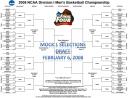
So yesterday the slovenly crew of sportswriters were invited, including such luminaries as Steve Wieberg (USA Today) and Mike DeCourcy (Sporting News).  After twelve hours of debate, several gallons of coffee, and untold levels of stink, the group came up with this bracket (you’ll have to click once here and once on the page that opens to make it large enough to view):

Mock NCAA Bracket

We don’t have time to break down the bracket at the moment, but the commenters on Josh’s page do a pretty good job. 

Today’s group are the less slovenly but more bombastic television media, including the standards Joe Lunardi, Andy Katz and Jerry Palm; but also including guys like Steve Lappas and Tom Brennan.  It’s a travesty that Ken Pomeroy isn’t invited to this thing, by the way. 

Maybe if we get some more time, we’ll do a quick and dirty comparison of how the two brackets turned out.  Our money’s on the sportswriters over the television guys. 

Share this story

Is This Really Necessary?

Posted by rtmsf on November 15th, 2007

So you’ve probably heard by now that there will be a third national postseason (after the NCAA and NIT) tournament called the College Basketball Invitational starting in March 2008 (um, great name, guys).  The Gazelle Group, the people who are bringing us all these lively preseason tourneys such as the Coaches v. Cancer and the CBE Classic have somehow paid off convinced the NCAA that giving another sixteen crappy overlooked teams more games to play is a good idea

Selection Process:
The 16 team field will consist of teams that are not selected for the 65 team NCAA Tournament. Teams will be invited based upon their performance during their conference and non-conference schedule, as well as how well the team is playing at the end of the regular season.

Format:
The College Basketball Invitational will be a single-elimination tournament, up until the Championship Series, with all games being played at campus sites. The Championship Series will be a best of three series, home-away-home, in which the higher seed will get the first and last (if necessary) home games.    

Ohhhh, so that’s how it will work, huh?  So considering 2007, what kinds of teams would have been invited to this thing?  25-8 Appalachian St.?  22-9 Bucknell?  Teams that had really good seasons from smaller conferences?  Or the same tired ninth and tenth place teams from the major conferences?  Well, we can actually answer that question.  Here’s a sample bracket based on last year’s season results provided by the Gazelle Group.

CBI Projected 2007 

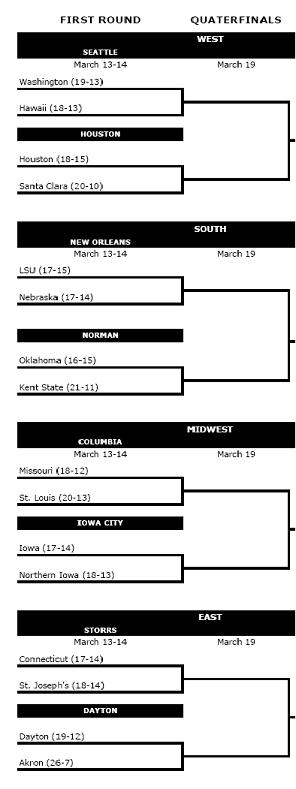
Oh.  16-15 Oklahoma.  17-15 LSU.  17-14 UConn.  17-14 Nebraska.  These teams were simply not very good last year – didn’t we see enough of them already?

Sounds thrilling.  Can’t wait.           

Share this story

Conference Primers: #22 – Ivy

Posted by rtmsf on October 22nd, 2007

Season Preview Banner 3

Predicted Order of Finish:

  1. Penn (20-10) (11-3)
  2. Yale (17-11) (10-4)
  3. Cornell (17-10) (9-5)
  4. Columbia (14-14) (7-7)
  5. Brown (15-13) (7-7)
  6. Harvard (10-19) (5-9)
  7. Princeton (9-18) (4-10)
  8. Dartmouth (6-19) (3-11)

WYN2K. For possibly the first time in two decades, the Ivy League basketball championship is wide open. The twin towers of power – Penn and Princeton – have held the Ivy title on one of their campuses each of the last twenty seasons. This year, however, Princeton will be recovering from the Joe Scott disaster (18-24 in three seasons culminating in an atrocious 2-12 debacle last year), while Penn will have to deal with the loss of the core group that won three straight Ivy championships. Penn has enough returning to make another run at the title, but don’t expect another 13-1 blitzkrieg through the league, as several other contenders will make their own push toward an NCAA bid.

Predicted Champion. Penn (#14 seed NCAA). Ok, ok, so we’re too chicken to pick anybody else here. We know that on paper there are other Ivy schools with more returning talent (ahem, Yale), but consider the weight of history that Penn has behind it – 5 of the last 6 titles… 7 of the last 9… 10 of the last 15. Every other champion during that time was Princeton. With the Tigers almost completely out of the picture, how can we not make our pick for Penn? Despite losing two-time Ivy POY Ibrahim Jabber and Mark Zoller, the Quakers still have the most depth of any team in the league to go along with the best home court advantage at the Palestra. This year’s squad will be led by Brian Grandieri and Justin Reilly, the latter of whom showed some decent post skills during the NCAA Tourney loss to Texas A&M last year. Sorry, Ivy faithful, but we just can’t pick against Penn until someone outside of Princeton knocks them off their perch.

Others Considered. Should Penn crash and burn this year, Princeton assuredly will not be the beneficiary, which means that a team not used to winning this title will be doing so for the first time in a generation. We like Yale as next in line. The Bulldogs return four starters plus their top two reserves, including prohibitive POY favorite Eric Flato, a do-it-all guard who nailed 71 treys last season. The only reason to lend a skeptic’s glance toward Yale is their maddening tendency to lose “shoulda” games, such as when they dropped a home game vs. Columbia immediately prior to a big showdown at Penn last year, effectively ending their conference title hopes. Cornell is another team that appears ready to make the leap on paper, but simply hasn’t been able to get past the monolith in Philly. Coach Steve Donahue is a tidy 0-14 in his career vs. the Quakers, which doesn’t exactly inspire confidence in winning a conference race that depends solely on regular season performance. Still, the Big Red, who was the last non-P&P team to make the NCAA Tourney back in 1988, has a nice set of guards returning (Ryan Wittman and Louis Dale) along with the 2006 ROY Adam Gore (redshirted last year) and USC transfer Collin Robinson.

Games to Watch. Since the Ivy League decides its champion via round-robin and not a conference tournament, there are a few key home-and-homes to watch this season.

  • Cornell @ Yale (02.02.08) & Yale @ Cornell (02.22.08)
  • Yale @ Penn (02.16.08) & Penn @ Yale (02.29.08)
  • Penn @ Cornell (02.09.08) & Cornell @ Penn (03.07.08)

RPI Booster Games. Last year the Ivy League went 2-17 against BCS schools, but surprisingly, middle-of-the-packers Cornell (defeated Northwestern 64-61) and Brown (defeated Providence 51-41) were the two winners. Penn, on the other hand, was 0-5 – go figure. There are 23 games on the slate this year, and here are a few highlights.

  • Yale @ Stanford (11.20.07)
  • Virginia @ Penn (11.23.07)
  • Brown @ Northwestern (11.24.07)
  • Michigan @ Harvard (12.01.07)
  • Cornell @ Syracuse (12.20.07)
  • Penn @ Miami (FL) (01.02.08)

Odds of Multiple NCAA Bids. Zippo.

Neat-o Stat. With the hiring of Tommy Amaker at Harvard and Sydney Johnson at Princeton, six of the eight head coaches in the Ivy League are now black. Unthinkable a generation ago, this means that the Ivy has a higher percentage of black head honchos (75%) than all but the two historically black D1 conferences, the SWAC and MEAC. We’re not sure if that will necessarily translate to more wins at those two schools, but it can’t be a bad thing in terms of inspring qualified minority hiring practices at other schools (ed. note – we guess that assumes Amaker is qualified. Apologies).

64/65-Team Era. The Ivy League has gone 3-23 (.115) over the era, with all three wins concentrated in the mid- to late-90s. The Ivy tends to receive a favorable seed from the NCAA committee, averaging a #12.8 over this period, which equates to an expected value of around seven wins. This shows that the league has really underperformed compared with its seed over the years. Of the three wins, two belong to Princeton (1996 – #13 Princeton 43, #4 UCLA 41; 1998 – #5 Princeton 69, #12 UNLV 57) and one to Penn (1994 – #11 Penn 90, #6 Nebraska 80). With that said, the league’s NCAA representative (well, Penn, really) has in recent years consistently played its first round opponent tough before ultimately succumbing to superior talent.

  • 2003 – #11 Penn down four to #6 Oklahoma St. with 2:25 remaining
  • 2006 – #15 Penn down one to #2 Texas with 6 mins left
  • 2007 – #14 Penn tied with #3 Texas A&M with 11 minutes to go

Nothing says thrilling like Gus Johnson, so we’ll leave you his call of 1996 Princeton-UCLA.

Final Thought. We actually look at this year’s Ivy a little bit like we look at the Big South. You have one program (Penn and Winthrop, respectively) that has clearly been the class of the league for the better part of a decade going through some serious changes, and you have a smattering of challengers ready to stake their claims on the league crown. The problem in both cases is more psychological than physical – can the likes of Yale and Cornell overcome the mental hurdles that Penn has constructed for them over the years by winning a key game in late February on the road when it really counts? It should make for an interesting winter in our nation’s smartest league, that’s for sure.

Share this story

09.11.07 Fast Breaks

Posted by rtmsf on September 11th, 2007

We’re so far behind in news that this is a must-post…

  • Huckleberry Hound Roy Williams and the entire 1966 Texas Western squad were the collegiate candidates inducted into the Basketball HOF on Friday.  No beef with the Glory Road fellas (although UK and Rupp’s ex post facto vilification is a story that still needs correcting), but has RW accomplished enough yet (five F4s, one title) to warrant inclusion?  Seems as if the committee jumped a little early on that one.
  • Come see the new inclusions in your town this fall, as the HOF is making a 30-city tour around the country over the next year.  The spokesperson of the tour is the Human Highlight Film himself. 
  • Stability in the Northeast – BC’s Al Skinner and Holy Cross’s Ralph Willard both had their contracts extended through 2013. 
  • Calipari mobilizes the entire city of Memphis to watch his players, who apparently cannot be trusted out on their own without inciting a freakin’ riot.  We knew before it even came out that The Mouth of the South, Joey Dorsey, would somehow be involved in this.  Make it rain, Joey.     
  • Not to be outdone, Mike Davis’s transfers at UAB decided to party without him, and all five were arrested on various charges.  The most disturbing in our eyes?  Walter Sharpe’s outstanding warrant for his arrest on a prior marijuana charge.  Not only did he already have a prior, but he didn’t even show up for the hearing?  And Davis didn’t know about this??  Now we know why IU fans wanted him gone.
  • Oh, and former Terp star and NCAA Champion Lonny Baxter has an unhealthy interest in firearms likes guns. 
  • From a while back, ESPN believes that nearly a third of D1 teams are eligible to become Bracket Busters.  (h/t to Awful Announcing)
  • Louisville’s new arena (due in 2010) is already bidding for future NCAA Tournament games.  Possible beneficiaries:  Kentucky, Indiana, Cincinnati, Xavier.   
  • Rivals weighs in with Alabama, Villanova, Illinois and others’ Labor Day weekend trips.  (takeaways:  Bama will struggle w/o Steele and Scottie Reynolds was on fire
  • Andy Katz also contributes with reports (here and here) of his trip to Mexico with OJ Mayo and USC.  (takeaway: OJ is the real deal)  
  • Goodman also has some summer excursion thoughts on Oklahoma, Duquesne, USC and Arkansas here; and Villanova, Marquette and James Madison here
  • Apparently Ohio St.’s Kosta Koufos was offered but did not take a Christian Drejer deal in Greece last week. 
  • Blue Ribbon’s preseason All-Americans are out – Drew Neitzel, Chris Lofton, Roy Hibbert, Tyler Hansbrough and Dominic James.  We’re lukewarm on Neitzel as a first-teamer. 
Share this story

NCAA Tourney Conference Overachievers and Underachievers (1985-2007)

Posted by rtmsf on July 11th, 2007

Today we’re ready to unleash the last installment of our analysis of NCAA Tournament stats of the 65 (64) team era… that is, unless we decide to analyze the coaches too… well, it is over three months until Midnight Madness, so ok, hold that thought.  Anyway, as you hopefully recall, during the weekend we took a look at the raw numbers of the era by conference, and essentially concluded that the ACC has been the most successful conference of the last 23 years, the Pac-10 SWAC/NEC the worst, and that the mid-major conferences may not have been as consistently good as we had hoped over the years.

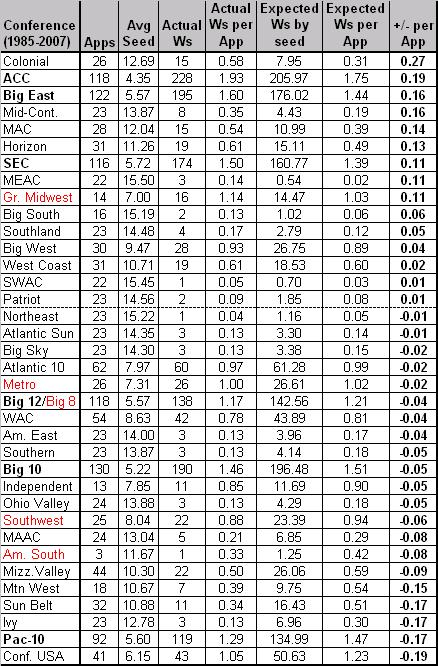
Now let’s take a look at the conferences who have overachieved and underachieved over the 65 (64) team era. In our analysis of this measure by school, you may remember that we looked at two different models – a Standard Model of expected wins by seed (e.g., a #1 seed should win 4 games per appearance), and a Historical Model of expected wins by seed (e.g., a #1 seed has actually won 3.36 games per appearance from 1985-2007). We concluded then that the true value lies in considering the Historical Model foremost because the Standard Model places too unrealistic of an expectation on high seeds and not high enough of one on low seeds, which ultimately skews its results in favor of lower-seeded schools and conferences. Given that condition, we now show the Overachiever and Underachiever conferences of the 65 (64) Team Era using the Historical Model. See Table A below.

Table A. Historical Model applied to 65 (64) Team Era

Notes: the table is sorted by “+/- per App,” which represents the number of games won above or below the expected number of wins for that seed per NCAA appearance (1985-2007). The conferences whose names are in bold are BCS conferences. The conferences whose names are in red are conferences that no longer exist.

NCAA Tourney by Conf v.3

Not Just George Mason. The first thought everyone will have (because we had it too) is that George Mason‘s miraculous run in 2006 accounts for the Colonial Conference’s rather aristocratic pedigree at the top of our list. But looking a little further inside the numbers somewhat mitigates this idea. Sure, the Masonites (as a #12 seed) won 3.52 games beyond its expected value of 0.48 wins per appearance in 2006, but that only accounts for half of the Colonial’s wins beyond expectation during this era. So where are the rest of the wins coming from? Thank David Robinson’s Navy squads of the mid-80s and Dick Tarrant’s Richmond Spiders in the immediate aftermath for the CAA’s perch as the biggest overachiever on our lofty list.

David Robinson

George Mason isn’t the only CAA School to Overachieve

BCStriation. Unlike our previous posting that used standard objective measures (wins, F4s, titles, etc.) to show that the six BCS conferences were without question the top six leagues of the era, today’s posting paints a substantially different picture. A league can be very successful objectively and still considerably underachieve, as in the strange case of the Pac-10 (and to a much lesser extent, the Big 10). Although the Pac-10 was clearly the weakest of the BCS conferences by the raw numbers, we certainly didn’t expect that it would be the second-worst underachiever of the 65 (64) team era – but it unquestionably is. The Pac-10 has won sixteen fewer games than it should have during this period, which dwarfs the negative output of any other conference – next in line for public shaming are Conference USA (7.6 wins fewer) and the Big 10 (6.5). Looking back at our list of chronic underachieving schools, we note that Stanford, Arizona and Cal all fall into the frequent NCAA underachievers list, which should have tipped us off that this was coming.

High Achievers. On the other side of things, the ACC and the Big East fall in line behind the CAA as the biggest overachievers of the era, which proves that you can get great seeds, have tremendous objective success in terms of wins and titles, and still overachieve as a conference. The ACC has won a whopping 22 games and the Big East 18 games beyond expectation; and the SEC isn’t far behind with 13. We also want to nod a tip of the hat to the Mid-Continent (+4.5 wins), MAC (+4 wins) and Horizon (+4 wins) conferences, each of which shows that leagues with consistently low seeds can do some damage on a regular basis in the NCAA Tournament.

Bradley

Missouri Valley Teams Need to Do More of This

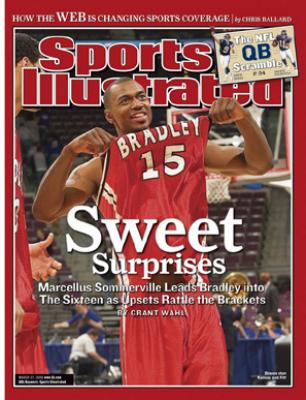
What About…? If anything, these last two posts have opened our eyes to just how traditionally overrated the Missouri Valley Conference has been. For a so-called mid-major who gets multiple teams invited every year, its performance leaves a lot to be desired (4 wins below expectations). We realize that things change – conferences get better and worse over the years – but the MVC is going to have to really start producing in the next 5-10 years to lose our proffered overrated tag. As a comparison, the Horizon and West Coast conferences have performed nearly as well (19 wins each) as the MVC (22 wins) despite earning far fewer NCAA bids and having a slightly worse average seed.

Ivy League Paradox. We suppose that if you asked a hundred college basketball fans whether they believed the Ivy League traditionally overachieves in the NCAA Tournament, 99 of them would likely agree. This is probably due to a memorable upset or two over the years in addition to a common perception that the Ivies are a “tough out” every year. But looking above, we see quite starkly that the Ivy League has been one of the biggest underachievers of this era, earning only three wins versus an expected total of seven. This is largely because the Ivy champs (usually Penn or Princeton) have consistently earned seeds ranging from #11-#13 over the last decade, but haven’t been able to earn a single win during that period. The lesson here, we suppose, is to never take an Ivy team in your brackets (we’ve heard that taking an Ivy team against the spread in the first round is a good bet, however).

Share this story

NCAA Tournament Success in the 65 (64) Team Era by Conference

Posted by rtmsf on July 7th, 2007

Hope everyone had a great 4th of July holiday… although we gotta say this midweek holiday thing kinda sucks. Give us the three-day (or four!) day weekend instead.

Anyway, we’re now ready to unveil the conference follow-up to our June analysis of the Top NCAA Performers of the 65 (64) Team Era. Once again, we’re going to take several different views of the world here. Today we’ll just look at the raw statistics and make some obvious insightful observations. In the next post, we’ll take a look at how conferences have performed versus its seeds during this era, and whether we can draw any broad conclusions from the data about overachieving and underachieving conferences.

Conference

What Kind of Conference is This?

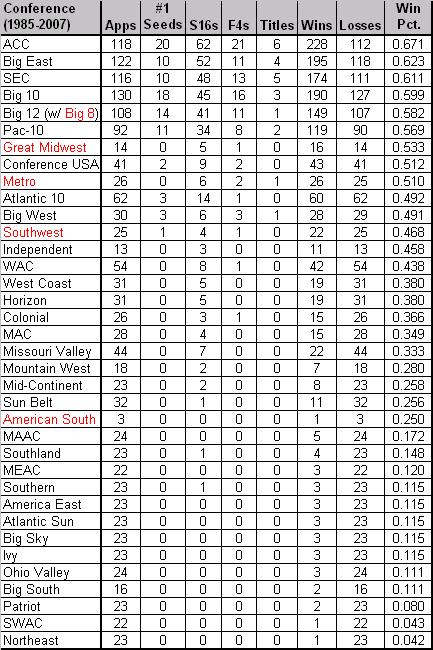
A couple of notes before rolling out the data. First, with only one notable exception, we counted a team’s performance in a given year toward the totals of its conference at the time. For example, Louisville’s 1986 national title counts toward the Metro Conference totals (the Metro disbanded in 1995), not the Big East totals. The notable exception is that all Big 8 totals were subsumed into the new Big 12 conference, since every member of the Big 8 ultimately became Big 12 members. See Table A below.

Table A. NCAA Tournament Success by Conference (1985-2007)

Notes: this table is sorted by winning percentage. The conferences whose names are in red are conferences that no longer exist.

NCAA Tournament Conferences v.5

BCS Conferences. This won’t surprise anyone, but we wanted to show the numbers in context. The following represents the percentage of each category achieved by the six BCS conferences from 1985-2007.

  • 46.4% of all NCAA Appearances
  • 60.9% Winning Percentage
  • 72.5% of all Wins
  • 76.6% of all Sweet 16s
  • 87.0% of all Final 4s
  • 90.2% of all #1 Seeds
  • 91.3% of all Titles

If you’re writing a paper on the correlation between resources, exposure, talent and success in NCAA basketball, the above numbers should be included in your first paragraph. It matters.

Best in Show

Best in Show?

Best in Show. Over this 23-year period, there can be no question that the ACC has been the strongest performer in the NCAA Tournament. This conference leads in every objective category except for appearances, which actually makes their hard numbers with respect to S16s, F4s and Titles look even more impressive. The most shocking finding for us regarding the ACC’s success was that more than half (52.5%) of its participants during this era won at least two games (i.e., made the Sweet 16). This is phenomenal, especially considering that the next-best major conference is the Big East at 42.6%. Of course, when you’re winning greater than two-thirds of your games as a conference, then it shouldn’t be that surprising.

Next Best. From our view, the next tier of conferences include the Big East, SEC and Big Ten – you can pretty much throw them all in a pot and pick any of the three as second behind the ACC. The Big East leads in S16s and winning percentage; the SEC leads in titles and mostly has middle-of-the-pack numbers otherwise; and the Big Ten leads in appearances and F4s. We rate the Big 12 slightly below this group because there seems to be a drop in most categories from the above three, most notably in winning percentage and titles (ouch – only one). But the Pac-10 clearly performs worst over this era, earning the fewest bids, having the worst winning percentage and owning by far the least wins, S16s and F4s.

Mid-Majors. From the numbers, we only recognize four true mid-major conferences during this period – the Metro/Great Midwest/CUSA and WAC/Mountain West hybrids, the Atlantic 10 and the Missouri Valley. What’s interesting is that only the Metro/GM/CUSA teams have a winning record during this period, while of course all of the BCS conferences easily have winning records. This shows once again just how large of a disparity there is between the three levels of college basketball. Remember when during the mid-90s, the A10 was supposedly overtaking the Big East in talent and performance? – the lesson here is to not believe the hype. Within that group, Metro/GM/CUSA has had the most success, led by Louisville, Cincinnati and Memphis. Now that two of those three are in the Big East, we don’t expect CUSA’s success to continue. We were also a little surprised at how low both The Valley and the Mountain West performed here – they have poor winning percentages and the Mountain West in particular has only put two teams (of 18 bids) into the Sweet Sixteen since its inception in 2000 – pathetic for an annual multi-bid league.

Tarkanian

Tark Has This Effect on Everyone

UNLV and Gonzaga Effect. The Big West and West Coast Conference exhibit how one very successful school can make a league look better than it actually is. By the numbers, the Big West looks like a mid-major league, but when broken down further, you quickly realize that the Rebels account for 21 of the conference’s 28 wins over this period. Excluding UNLV, the Big West is only 7-23 (.233) in the NCAA Tournament, which would put it on par with the Sun Belt and the Mid-Continent. The same is true with the WCC – when Gonzaga is excluded, the league is 7-21 (.250) during this period.

NEC

Stay Away from the NEC if you Want to Win in the NCAA Tournament

Low Majors. Picking a best conference among the low majors is a little like picking the prettiest ugly girl in the bar (not that we know anything about that, mind you), but if we have to choose, we’ll take the Southland Conference (note: we consider the conferences on the list above between the Great Midwest and the Sun Belt mid-majors, although the Sun Belt’s one S16 appearance with 32 bids is strong evidence that we might be giving that league too much credit). We choose the Southland because it’s one of only two of these conferences to put a team into the Sweet 16 (Karl Malone’s Louisiana Tech in 1985), and it has a better winning percentage than the others. We realize, of course, that all of these low majors are virtually equal in their NCAA ineptitude – only the Ohio Valley and the MAAC have ever received at-large bids (1987 – Middle Tennessee St.; 1995 – Manhattan) – but that’s our pick here. Our vote for the worst conference in D1 is a tie – the SWAC and the Northeast Conference. Each has the unenviable distinction of only winning one game in the NCAA Tournament during this period. Of course, maybe we’re looking at this the wrong way, and instead we should be celebrating the fact that every single conference has managed to win a game in the Dance during this period.

Final Thoughts. Can anyone catch the ACC? The Big East has a chance to tally significant gains if it continues to put eight teams into the NCAAs, as it did in 2006. But numbers alone probably isn’t enough – after all, the Big 10 has put the most teams in the Tournament since 1985. Rather, the ACC gives the obvious recipe for success by having two dominant programs that over the long haul consistently go deep into the NCAA Tournament (Duke and Carolina). Looking ahead, the Big East has an aging Calhoun at UConn and Boeheim at Syracuse so we’re not sure about its prospects. The Big 10 has Thad Matta the Recruiting Machine at OSU, but Michigan St. has regressed in recent years, and who else can rise up (Weber at Illinois? Beilein at Michigan? Tubby at Minnesota?). We’ll keep looking. The Pac-10 has an obvious supernova developing in Westwood at UCLA, but where else? Arizona will be in what kind of shape after Lute retires? Our choice for the conference to challenge the ACC in the next decade is the SEC. Billy Donovan at Florida has already proved his mettle; and with Billy Gillispie at Kentucky and Bruce Pearl at Tennessee challenging anyone to outwork them, it almost makes up for the coaching lightweights over in the SEC West (you know who we’re talking about). The youthful exuberance of these coaches at several programs willing to put forth the resources for success may give the SEC the best shot at catching the ACC, but the truth will ultimately lie in what happens to Duke after Coach K retires. If Duke manages to keep its dominance intact with their next coach, then it won’t much matter what happens with the other conferences – they’re not going to catch the ACC.

Coming Next: a look at how conferences overachieve and/or underachieve relative to their seeds over the years. Should be interesting stuff. Check back early next week.

Share this story

NBA Draft Picks by School (1949-2006)

Posted by rtmsf on June 26th, 2007

We always believed that it would be cool if someone would take the time to break down the NBA Draft by schools since its inception, figuring there must be a loose correlation between the collegiate powers of the past sixty years and the players that the NBA finds draft-worthy. We’re not saying that a player is talented simply because he’s drafted by the NBA or that he sucks if he isn’t – rather, a player being drafted is solely an imperfect indicator that, at the time, a player’s collegiate career inspired professional scouts to believe that he could ultimately contribute to their team. But it’s also the only consistent indicator we have. To that end, we tried to determine if there was a rational way to determine how much “bang for your buck” having these talented soon-to-be NBA players on a college team’s roster matters over time.

Bang for Buck

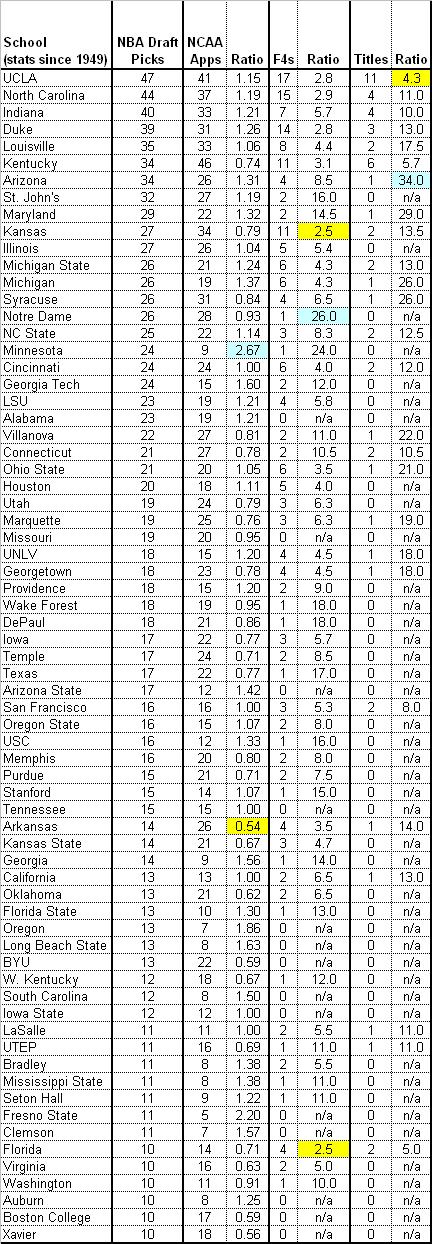
We realize there are many ways to do this analysis and a number of these are meritorious, but for us, it always comes back to NCAA Tournament success – Appearances, Final Fours, Championships. These three measures show that you’re good enough to be invited, you’re good enough to go deep, and you’re good enough to win the title. So in looking at Table A below, you’ll see that the table is sorted by the schools with the most NBA Draft Picks in the first two rounds since 1949 (the first year of the “modern” NBA Draft), and each school also lists those three measures of success next to it (also since 1949). We considered here only the first two rounds of each draft for consistency and the likelihood of a player actually making the parent team.

Table A. NBA Draft Picks (first two rounds) From 1949-2006

Notes: this table is sorted by the NBA Draft Picks column and is limited to schools with a minimum of ten NBA Draft Picks since 1949. The yellow shading refers to the lowest ratio in that column; the light blue shading refers to the highest ratio in that column.

NBA Draft Picks by School - Ratios v.2

Observations.

Talent = Success. Out of the traditional Super Six schools – UCLA, UNC, Indiana, Duke, Kentucky and Kansas – each is among the top ten schools with the most NBA Draft picks. Collectively, these six schools have accounted for over 10% (231 of 2214) of the all-time NBA draft picks, which is fairly amazing if you consider that we’re discussing nearly sixty years worth of college basketball players and hundreds of programs.

Surprises. St. John’s, Maryland and Notre Dame are in the top fourteen of NBA draft picks with 32, 29 and 26, respectively, but their historic success as programs (two F4s each for SJU and Maryland, 1 F4 for ND) is definitely a bit lower than their talent over the years might suggest. They have had numerous good players, but it hasn’t translated into NCAA Tournament success at the same level as their contemporaries on this list. At the other end of the list, Florida‘s recent ascent into the elite company is not (yet) well-represented by its number of draft picks (only 10). However, we’d expect that to change very quickly, hitting as much as 15 after this year’s draft (Horford, Brewer, Noah, perhaps Green & Richard).

Golden gOh-fers. The biggest shocker of all deserves its own paragraph. Somehow the Minnesota Golden Gophers have managed to put 24 players into the NBA Draft over the years – only fifteen other programs have put more – yet nobody would mistake Minnesota for an elite program during any era, considering its paltry nine NCAA appearances and one F4. This disconnect is exhibited by the fact that Minnesota has the highest draft pick/NCAA appearance ratio among the schools listed. Fresno St. (thanks Tark) is the only other school with a ratio greater than 2.0. We think Long Beach St. also deserves a mention, not simply due to its high ratio (1.63), but also because it has produced more draft picks than many major conference teams despite never being much of a power, even within its own conference. On the flip side of things, it was also somewhat amazing to us that Arkansas had only produced fourteen NBA picks despite a substantial amount of NCAA success (26 appearances; 4 F4s; 1 title).

Goldy Gopher

Apparently These Three Gophers Were Drafted by the NBA

Team vs. Individuals. We’re going to be careful to avoid drawing too significant of a conclusion here, but we also found it interesting that among the top ten schools, only Kentucky and Kansas had draft pick/appearance ratios under 1.0, while the other eight schools were above that marker. We wonder out loud if this shows evidence of schools that have traditionally emphasized the team concept to make up for a lack of individual talent over the years; or if UK and KU are simply an anomaly among the most talented teams. There are probably too many variables at play here to make any supportable conclusion.

F4 & Title Ratios. Reviewing the draft pick/F4 ratios, only Indiana is the outlier here, as expected schools such as Kansas, UCLA, UNC, Duke and Kentucky (along with Florida) comprise the six lowest ratios. Considering only the schools with multiple F4 appearances, St. John’s and Maryland have the highest ratios of draft picks/F4s, showing again that they’re producing a lot of good players without as much success to show for it as the others near the top of the list. Along the same lines, considering only multiple titlists, Louisville, Kansas and Duke appear to be getting the least bang for the buck from its talent, as these three schools have the highest draft pick/title ratios among multiple titlists.

Coming Next: now that we’ve looked at the overall numbers, we’ll take a snapshot look at those numbers by decade and by round to see if anything else looks interesting. View Part II (by round) and Part III (by decade) here.

Share this story

NCAA Tourney Overachievers and Underachievers of the 65 (64) Team Era

Posted by rtmsf on June 15th, 2007

We’ve received a resounding response on the post Tuesday evaluating school performance during the 65 (64) team era, so let’s waste no time in presenting Part II of our statistical profile of the NCAA Tournament during that period. As we alluded to in that post, looking at raw data in a vacuum has its limitations. From that data we got a reasonable sense of which programs have had the most success during the period, but it didn’t really give any insight as to which programs have overachieved, underachieved, or simply performed about as expected.

Ziggy

Which Schools Reach Their Potential?

Today’s post will address that issue. You might want to bookmark this page for next year’s bracket-filling, because we feel that what we’re showing today has significant value in determining those schools that tend to embrace expectations and those that tend to wither in the face of the red-hot lights of March. Stat geeks like ourselves should enjoy this post – hopefully it won’t bore the rest of you.

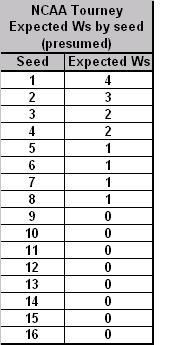
The first consideration in trying to determine which programs have overachieved and underachieved is how to answer that question. Traditionally, you often hear commentators and writers talk about “playing to your seed,” which essentially presumes that a #1 seed should make it to the Final Four, a #2 seed to the Elite Eight, and so on (see Table A below). Using this model, a team that wins any games beyond the expected wins of its seed would fairly be said to have overachieved as to the expectations of the seed (and vice versa).

Table A. Standard Model

NCAA EV by Seed (Presumed)

So let’s try to first answer that question using the Standard Model outlined in Table A. But don’t give up on the post after you review the Standard Model results, as we have another model below it that may bring up new and interesting considerations. The Standard Model as applied to the 65 (64) Team Era is Table B below.

Table B. Standard Model Applied to 65 (64) Team Era

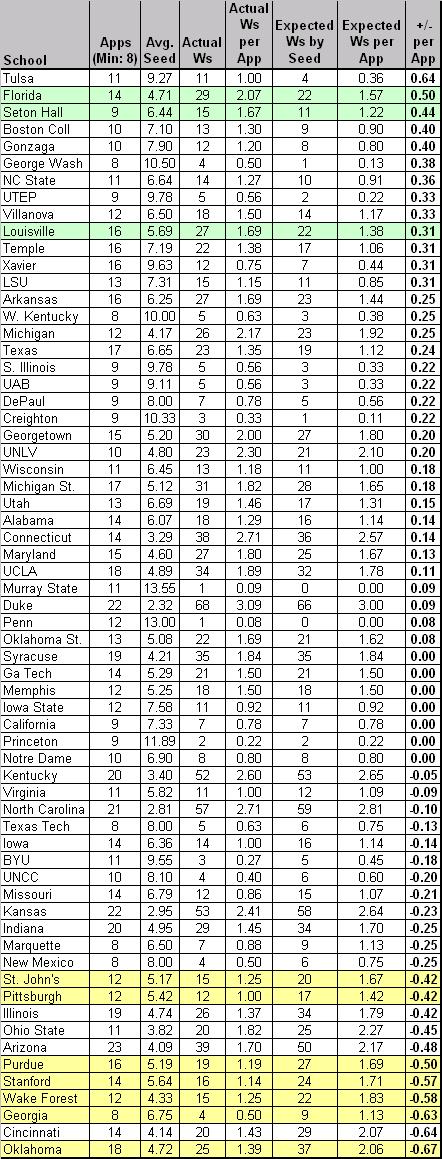
Notes: the table is sorted by “+/- per App,” which represents the number of games won above or below the expected number of wins for that seed per NCAA appearance (1985-2007). The rows colored in green highlight schools that are in the top twelve spots of both Tables B and D. The rows colored in yellow highlight schools that are in the bottom twelve spots of both Tables B and D.

NCAA EV by Seed - Detailed v.3

Inside the Numbers (Table B):

Overachievers. What first jumps out at us using this method is just how (except Florida) there are no big names near the top of the list. Tulsa, Seton Hall, GW, UTEP, Temple? Without taking away from their performance – after all, every one of those teams should be commended for overperforming versus its seed – this immediately suggests to us that the Standard Model often used by the pundits actually favors lower-seeded teams who manage to win a game or two every couple of years in the NCAA Tournament. Using the schools above +0.30 as a natural break point, only Florida, Louisville and Temple have won more than twenty games in the NCAAs during this period, and the average seed of these thirteen schools was 7.0. Are these teams chronically underseeded or are they overachieving as a general rule? Whatever the case, we’re going to think a little harder about picking Tulsa the next time they make the bracket.

Tulsa Logo

Are the Golden Hurricanes the Biggest NCAA Tourney Overachievers?

Underachievers. A brief look at the names at the bottom of the list – Oklahoma, Cincinnati, Wake Forest, Stanford, Purdue, etc. – tells us that we’re on to something here. As our good buddy MK says, “Wake and Purdue can effin’ bite me. They kill my bracket every year.” Or something like that. Using -0.42 as a natural break, the eleven teams at the bottom averaged a seed of 4.8 during this period, which is a marginally better seed than the overachievers on this list. Oklahoma, Arizona and Illinois – what do you have to say for yourselves? Each of you has had at least 18 appearances during this era, averaged a solid if not spectacular seed between #4 and #5, and consistently played below that seed to the tune of -0.42 wins per appearance or worse. This matches Tuesday’s analysis with Oklahoma as a disappointment; but under this model, Arizona and Illinois (second tier elite performers on Tuesday) have some explaining to do.

Oklahoma celebration

You May Want to Avoid These Guys in your Brackets

You’ll See Them Again on the Long Road Back to the Middle. The Big Four from Tuesday – Duke, UNC, Kentucky and Kansas – find themselves in the middle of the pack. It’s notable that Duke averaged a seed of 2.32 during this era and still overachieved by +0.09 wins per appearance relative to seed. UNC and Kentucky are verrrry slightly underachieving, whereas KU’s recent vintage teams (2005 & 2006) probably contribute to its slightly lesser position at -0.23 wins per appearance. UConn should be lauded for overachieving at a clip of +0.14 wins per appearance, which somewhat mitigates their overall lack of F4s – they do win a lot of NCAA Tournament games. Syracuse, Georgia Tech, Memphis, Iowa St., California, Princeton and Notre Dame – all of these programs have played exactly to seed in the last 23 years. Be sure to remember that fact next year when filling out your brackets.

Criticism of the Standard Model. The primary problem with evaluating NCAA Tournament success based on “playing to the seed” is that it puts an unrealistic burden on highly-seeded teams because over time they never play to their seed. In the knockout crucible that makes the NCAA Tournament so exciting, a corollary result of using this criteria is that higher seeds (#1-#4) are largely set up to fail, and lower seeds (#9-#16) are significantly overachieving simply by winning one game. Additionally, we feel that using the Standard Model assumes too much at the squishy margins – that a #4 seed should win two games, a #5 seed should win only one game, and that a #8 seed should always beat a #9 seed – when both teams are probably very similar in ability. For this reason, we now offer an alternative model, one that considers actual historical performance of the seeds.

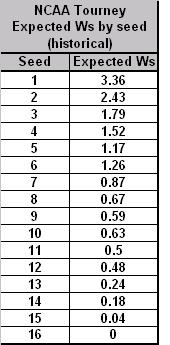
To that end, see Table C below for a historical snapshot of how well each seed actually performed in the 65 (64) team era.

Table C. Historical Model

NCAA EV by Seed - Historical

Considering Table C, we wanted to point out for a moment that we have a couple of thoughts. First, we found it interesting that #6 seeds have traditionally performed better than #5 seeds. This at first seems anathema to conventional wisdom, as a #6 likely has to get past a #3 in the second round, whereas a #5 must only defeat a #4. That is, until you remember that a #5 has the dreaded 5-12 match-up that knocks out so many higher-seeded teams (excepting 2007, of course). Also, it’s interesting that a #10 seed has a better historical expected number of wins than a #9 seed. This shows again that a better draw is to avoid the 8-9 match-up, even if you end up as a lower (but more likely to succeed) #10 seed.

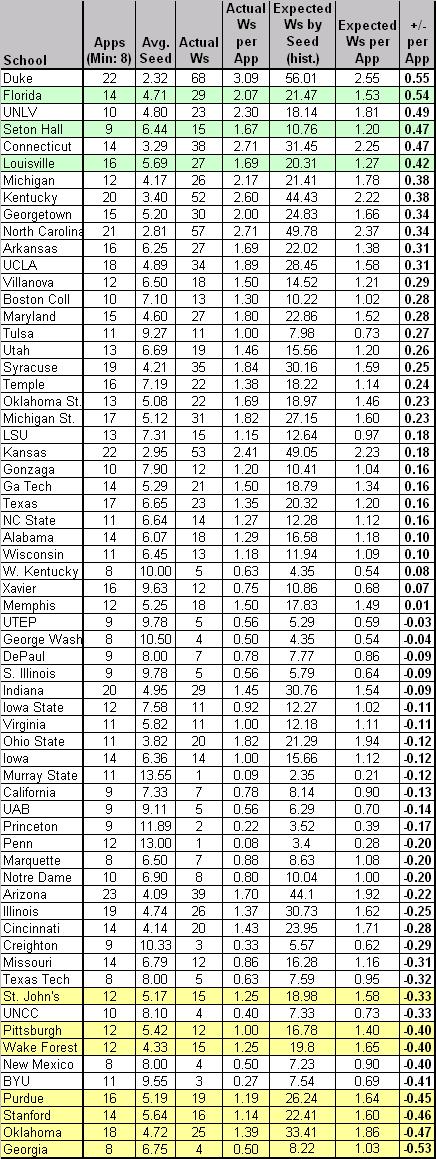
Using the 1985-2007 Historical Model as a baseline expected value for each seed, our list of 64 schools is now featured in Table D below.

Table D. Historical Model Applied to 65 (64) Team Era

Notes: the table is sorted by “+/- per App,” which represents the number of games won above or below the expected number of wins for that seed per NCAA appearance (1985-2007). The rows colored in green highlight schools that are in the top twelve spots of both Tables B and D. The rows colored in yellow highlight schools that are in the bottom twelve spots of both Tables B and D.

NCAA EV by Seed - Hist Detailed 3

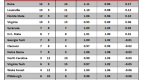
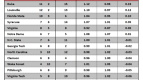
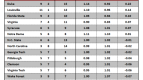
Notable Differences. Using the Historical Model, the first thing that strikes us as interesting is that many of the heavy hitters of the era have jumped considerably, including some all the way to the top of the list. In fact, the following schools – Kentucky, UNC, Duke, Kansas, UConn, UNLV, UCLA, Syracuse, Ohio St. – all rose at least fifteen places from where they were situated in Table B. Each of these schools (excluding Kansas and Ohio St.) have overachieved at least +0.25 wins per appearance above the historical performance of their seeds. Since these schools represent a total of thirteen championships and thirty-eight F4s during this era, the Historical Model viewpoint makes more sense than what the Standard Model shows.

Who Dropped? Creighton, George Washington, UAB and UTEP all went from nice-looking overachievers in Table B to slight underachievers using this model. NC State, Xavier and Gonzaga looked fantastic using the Standard Model, but look rather pedestrian using this one. The explanation for this is simple – these teams collectively averaged a #9 seed throughout this era – if we use the Basic Model, they should never win a game, so when they do, it looks as if they’re significantly overachieving. However, using the Historical Model, we see that they actually win NCAA Tournament games roughly commensurate with how a #9 seed typically performs. This again illustrates why we feel this model shows a truer snapshot of performance.

More Importantly, Who Stayed the Same? Now this is where it gets really interesting. The rows shaded in green in Tables B and D represent schools that were in the top twelve in playing beyond its seed using both models. You could accurately say that, no matter how you slice it, Florida, Seton Hall and Louisville are the truest overachievers of the 65 (64) team era. (Incidentally, Florida and Seton Hall are in the top four of both tables, with each school averaging an extra win beyond its seed for every two appearances in the NCAA Tournament.)  These three schools consistently play beyond the actual and historical expected value of the seed that the NCAA Selection Committee gives them.  

The rows shaded in yellow at the bottom of Tables B and D represent the true underachievers. These schools were in the bottom twelve in playing below its seed using both models. What’s peculiar about this statistic is that there appears to be a much greater correlation between the tables with respect to the underachievers than with the overachievers. Whereas the overachievers only had three common schools between the tables, regular NCAA disasters such as Georgia, Oklahoma, Stanford, Purdue, Wake Forest, Pittsburgh and St. John’s find themselves in both at the bottom looking up. If you are at all like us and believe that the weight of history contributes as a predictor of the future, then anyone reading this post should be extremely hesitant picking these schools to play beyond its seed to its seed in the Dance in the years going forward.

Chicken or the Egg

And Now, the Chicken/Egg Argument. Whether you buy into the Standard Model or the Historical Model or neither, we can say without a doubt that some schools appear to consistently overachieve relative to its seed, while others consistently underachieve relative to its seed. The question we want to posit to the readers is what causes this – is this simply a statistical anomaly? Are the overachievers regularly seeded too low by the NCAA committee; or, are the underachievers regularly seeded too high? Is there a self-fulfilling prophecy at work here, where schools that are known as chronic underachievers (ahem, Oklahoma) place so much pressure on themselves that they tighten up in the clutch? Conversely, do the overachievers find their wits amidst chaos to consistently come through under pressure because they are expected to do so? These are questions that we cannot answer, but we figure that there are elements of each at play here. We’d certainly like to hear your thoughts on this and any other topic. Oh, and apologies for the long post today.

Coming Next: We’ll take a look at the raw numbers again, but this time we’ll examine it by conference, which isn’t as easy as it sounds. Do you realize how many conference re-alignments and mergers and dissolutions there have been in the last 23 years of NCAA basketball?


Share this story