Thursday, March 18 (all CBS)
12:20pm - Florida vs. BYU
12:25pm - ODU vs. Notre Dame
2:30pm - Murray St vs. Vandy
2:45pm - SHSU vs. Baylor
2:50pm - St. Mary's vs. Richmond
4:45pm - UTEP vs. Butler
7:10pm - UNI vs. UNLV
7:20pm - Wash vs. Marquette
9:35pm - Wake Forest vs. Texas
9:40pm - New Mexico vs. Montana
9:45pm - SDSU vs. Tennessee
Over the next two days in a series of separate posts, RTC will break down all 32 of the first round games using our best analytical efforts to understand these teams, the matchups and their individual strengths and weaknesses. Our hope is that you’ll let us know in the comments where you agree, disagree or otherwise think we’ve lost our collective minds. Here are the Friday afternoon games.
12:15 pm – #2 West Virginia vs. #15 Morgan State (Buffalo pod)
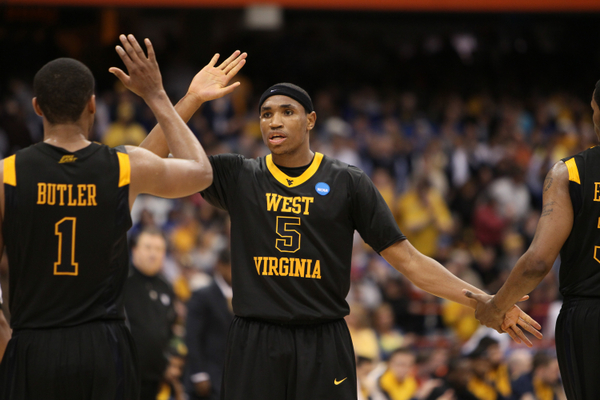
West Virginia enters the NCAA Tournament as one of the hottest teams in the nation. They squeaked out an enormous road win at Villanova to end the regular season then swept through Cincinnati, Notre Dame and Georgetown en route to a Big East championship riding the heroics of Da’Sean Butler. The Mountaineers are an extremely gifted rebounding team; in fact, sometimes their best offense comes after a missed shot. They feature multiple weapons that can step out and shoot a mid-range jumper or three from Wellington Smith to Kevin Jones to the all-around dynamo Butler. Also, few teams can match West Virginia’s intensity in the halfcourt defensively. Morgan State head coach Todd Bozeman will need a gigantic scoring output from their own star, Baltimore native Reggie Holmes. Holmes scored 25 or more points fifteen times this season, averaging 21.3 PPG and ranking in the top-50 in percentage of shots taken. The Bears also feature a rugged forward named Kevin Thompson who comes in at fifth in the nation in offensive rebounding percentage. In fact, Morgan State ranks 11th in the country as a team in that very category. Unfortunately for the underdogs, West Virginia is never outworked on the glass, not with Jones, Devin Ebanks and Bob Huggins prominently involved.
The Skinny: This one shouldn’t be close from the tip. Morgan State dominated the MEAC all season, but West Virginia is flying high at this point. Expect the Mountaineers to dominate by 25-30 points.
12:25 pm – #6 Xavier vs. #11 Minnesota (Milwaukee pod)
The answer to which team will win this game depends entirely on which Gopher team shows up to play in Milwaukee. Will it be the defensive juggernaut that held Purdue to 11 first half points last Saturday, or will it be the team that got obliterated by Ohio State 52-29 in the second half on Sunday? Tubby Smith’s team has been schizophrenic like that all year, following up strong wins with disastrous performances (two losses to Michigan? really?), which probably explains why they were a bubble team up until Sunday evening. Xavier comes into this one with the stronger resume, but it’s difficult to say if the Musketeers are the better team. When he plays under control, XU’s Jordan Crawford is a talent, and his supporting case of Jason Love on the interior and Terrell Holloway running the show makes for nice balance throughout the Xavier lineup. The question we have is who will win the defensive battle, though. Xavier defends the three really well, while Minnesota behind Blake Hoffarber and Lawrence Westbrook both shoot it equally as well. This game is essentially a tossup (Vegas agrees, setting Minny as a one-point favorite), and we really liked the first seven halves of basketball that the Gophers put up in Indianapolis on a neutral floor last week, so we’re going with the extremely mild 6/11 upset here, in a close game that comes down to the last possession.
The Skinny: Despite the seedings, this is a tossup game and we like the Gophers to win it on the last possession.
As we move through the next eight days when automatic bids will be handed out on a regular basis, we’re going to break down the teams for you so that you can start thinking about your bracket ahead of time. The pearls of wisdom are meant to help you better understand what these teams are good at and how to make fair comparisons between them — all too often, the capsules you see have a lot of information in them, but very little of it is actually helpful. If you have additional ideas, leave them in the comments. For the good/bad matchups, we’re not necessarily saying that Team X will win; we’re simply pointing out that in an ideal situation, some of that team’s strengths will be more likely to manifest against those particular opponents — so save the emails. As of Sunday morning, there have been four auto-bids handed out. Here are those primers.
#1. Cornell Big Red (27-4, 13-1 Ivy) – automatic qualifier
NCAA Seed Range: #11-#13
Three Bruce Pearls of Wisdom:
Cornell is the nation’s top three-point shooting team, hitting 43.4% of their attempts from deep and scoring nearly 39% of their total points from outside the arc. The Big Red hit twenty in their bid-clinching game against Brown on Friday night. They have five players who have made 30+ this year; you simply cannot leave these guys open.
In their five games against BCS teams this year, Cornell was 2-3. The wins were against Alabama in Tuscaloosa and St. John’s in NYC. Digging deeper, though, we find that two of the three losses were to #1 seeds Syracuse (by 15) and Kansas (by 6). In those losses, Brandon Triche and Sherron Collins tore them up, exposing a vulnerability to athletic, scoring point guards who attack the basket.
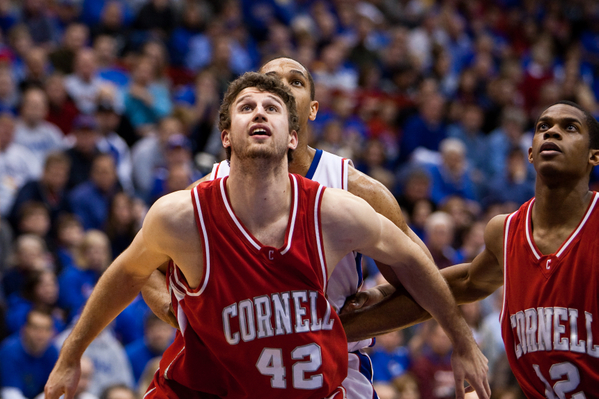
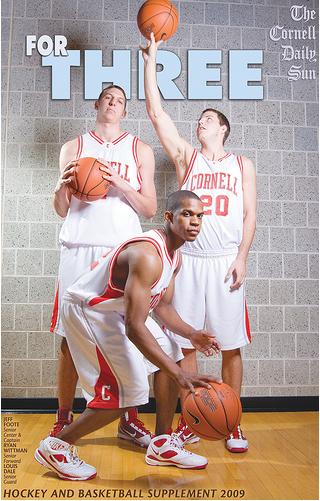
The core trio of Jeff Foote, Ryan Wittman and Louis Dale will not get rattled — they’re all seniors playing in their third straight NCAA Tournament. They have proven they can score with anyone; the problem will be if they are matched up against a team that is equally offensive minded, as the Cornell defense has trouble getting stops.
Good Matchups: Wisconsin; Gonzaga
Bad Matchups: Baylor, Georgetown
#2. Winthrop Eagles (19-13, 12-6 Big South) – automatic qualifier
Unless half of the Cornell basketball team (the starting half) suffers serious food poisoning or takes a sudden interest in the illicit pleasures of Federal Hill in Providence, we should have our first 2010 NCAA Tournament bid secured at around 9 pm eastern tonight. With the Big Red’s twelfth Ivy League victory likely this evening, Steve Donahue’s team will have clinched their third straight regular season title (and NCAA bid).
Winning is Gorges (CDS/T. Chou)
In filling the vacuum left by the Penn and Princeton boondoggles, it’s been a phenomenal run for the men from Ithaca as Cornell has won 36 Ivy games over the past three seasons. Their Ivy scoring margin of +15.6 this year is the best seen in the league since the great Quaker teams at the turn of the millennium, with eight of Cornell’s eleven wins this year virtually in the books by the first timeout. We’d love to build up some drama about tonight’s game at Brown, but Cornell has defeated the Bears by a 22-point average margin of victory in the last five games between the two teams; given that this is Donahue’s best team of his career, we doubt that tonight’s the night for the 12-19 (5-7) Rhodies to shock the world (ed. note: the previous game this year was closer than the 14-point margin indicates, but we expect Cornell to come strong tonight with their NCAA bid on the line).
The one thing Cornell has so far failed to do in their three-year reign of Ivy dominance is to win a game against an RPI top-50 opponent (0-8), which squares with their 0-2 record in the NCAA Tournament (Ls to Missouri and Stanford). But they’re getting closer, as a closely-contested January game against #1 Kansas in Allen Fieldhouse showed. The core group of seniors — guard Louis Dale, forward Ryan Wittman, and center Jeff Foote — have been playing together for so long (and so well) that they know what each other is going to do before they’ve even thought of it yet. In an era of elite teams led by young players not far removed from the Prom and Selective Service sign-ups, the opportunity is ripe for the Big Red to catch an overconfident, sloppy team in the first round of the Dance this year.
In Zach Hayes’ latest RTC Bracketology, he has Cornell as a #13 seed playing #4 seed Temple, while Joe Lunardi has the Big Red as a #12 seed playing #5 Georgetown. While neither of those particular teams fit the criteria as a young, undisciplined team, there are others in that seed range who do (Tennessee in particular comes to mind). With a little luck in the draw this year, the Ivy League champion could be on the cusp of more than just its third straight trip to the NCAAs but also its first-ever win in Tournament history.
The Harvard students changed from white shirts to black shirts at halftime.
Too bad for the Crimson faithful the ploy didn’t transfer to the hardwood.
Cornell maintained a nine-point halftime lead into a nine-point road victory at a raucous Lavietes Pavilion Friday night to hold a lead atop the all-important Ivy League regular season standings and firmly re-establish their status as the top team in the conference. Despite a remarkable 32 of 34 from the line and 48% shooting from the Crimson, Cornell used trademark three-point shooting, strong rebounding and timely scoring from Ryan Wittman and Louis Dale to eek out a victory in quite possibly the most challenging game on their Ivy slate.
Cornell Moving Toward March
The matchup was billed as a duel between the two best players in the conference- Wittman and Harvard’s point man Jeremy Lin. Lin was his usual stellar self- 24 points, 7-12 FG and 10-11 FT- but it was Wittman who stole the show with an array of clutch NBA-distance treys that stymied multiple Crimson rallies. The most importance sequence of the game came near the midway point of the second half when Harvard cut a 17-point Cornell lead to five until Wittman and Dale answered the call one more time with consecutive dagger threes that killed any remaining Harvard hope.
Cornell coach Steve Donahue remarked after the game how terrific the atmosphere was in Cambridge tonight. One could sense the urgency in the air from both sides with the Ivy League not fielding a year-end conference tournament to decide the league’s auto berth. This puts a giant magnifying glass on the regular season results and the players, coaches, fans and students all realized tonight just how crucial of a contest this happened to be.
Donahue made sure to commend a young Harvard team on their effort. Lin is their leader and anchor, but the Crimson rely on three freshman- Kyle Casey, Christian Webster and Brandyn Curry- for a good chunk of their production. Donahue correctly pointed out how vital Cornell’s experience was tonight in terms of both poise and confidence. He singled out Wittman as someone that played with a toughness and confidence unmatched by any other player on the floor for both sides.
Wittman admitted after the game there was a “lack of urgency” before the stunning upset at Penn last Friday. He said the Big Red absolutely has to bring it every night in the Ivy League and Dale remarked that it feels good to get an opposing team’s best shot every time during league play, similar to Gonzaga in the WCC or Butler in the Horizon. Dale also singled out the importance of getting out to a lead so fighting back on the road was not a necessity.
On the losing end, Harvard coach Tommy Amaker was proud of his team for their commendable effort but the Crimson just could not contain Wittman and Dale to pick up the stops in clutch situations. He was straight to the point in his assessment: Cornell just did things better. Lin also made sure to say this was the best atmosphere he’s seen at a home game in his four years as a member of the Crimson.
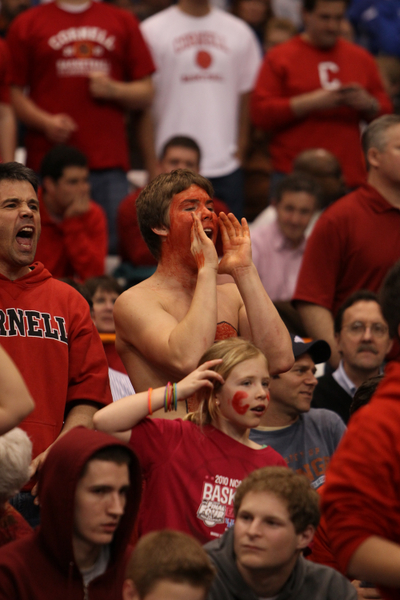
Too bad the home team could not deliver for the white-then-black-clad fans screeching, whistling, blowing horns and stomping their feet for 40 solid minutes Friday night. Then again, this was Cornell. They are on a mission to reach the NCAA Tournament as the class of this league. And it does not appear anyone will stop them from achieving that very goal, at least on this night.
After last week when we really kicked off the season, our list of games this week is a little weak to be quite blunt primarily because of the Thanksgiving holiday break. Don’t worry though. It’s not all football games and turkey. There are some interesting games this week that are worth following even if you are travelling (or like some of us here) working during the week. Today we only have one game worth Tivo-ing, but it is one of the more intriguing games so far this season.
Cornell at #9 Syracuse at 7 PM on ESPN360.com: We mentioned this game in our post naming Syracuse as our Team of the Week. Everybody has been praising the Orange (and for good reason), but those who follow college basketball closely know that they could very easily lose to the Big Red, which is something I am sure that Jim Boeheim has stressed to his players since the morning after their huge win over UNC. After their wins over Caland UNC this past week everybody knows about the Orange. They have one of the best frontcourts in the nation with Wesley Johnson, Rick Jackson, Kris Joseph, and Arinze Onuaku complimented by some outstanding perimeter play (so far) from Scoop Jardine, Andy Rautins, and Brandon Triche. The country isn’t quite as familiar with Cornell who have already notched impressive road wins at Alabama and UMass before falling by 10 at home against Seton Hall. The Big Red are led by Ryan Wittman (17 PPG and 4 APG)–one of the nation’s top players that the casual fan doesn’t know about–who is complimented by fellow seniors Louis Dale (13.7 PPG and 3.7 APG) and Jeff Foote(11.0 PPG and 8.7 RPG). If the Orange need any motivation to get up for this game, Boeheim will just have to remind them of last year when they barely outlasted Wittman and his game-high 33 points before pulling away late. We expect the Orange to win this one since they are the more talented team and are playing at home, but don’t be surprised to see Cornell hanging around as I’m sure their players have been looking forward to this game for quite some time as it is the second biggest game on their schedule trailing only their trip to Allen Fieldhouse on January 6th to take on preseason #1 Kansas. While I think that motivation will aid the Big Red, it probably won’t be enough to make up for their massive disadvantage inside where they won’t have an answer for the Orange big men and Johnson in particular.
Another intriguing “opening” day of college hoops, as mostly everybody who didn’t play yesterday played today.
Story of the Day. Manny Harris Records Michigan’s Second Ever Triple Double. These triple-double things are spreading among Big Ten players, as Michigan guard Manny Harris today dropped 18/13/10 assts in 29 minutes in a 97-50 shellacking of D2 Northern Michigan. Does it matter that Harris had his historic night (Gary Grant in 1987 was UM’s only other) against a non-D1 school? Not to us — Harris is a tremendous player and a dime is a dime. Passing the ball should always be rewarded, and Harris did his best today to make his teammates happy. DeShawn Sims could only muster a dub-dub (22/10), but his biggest crime was one of omission, as in, zero assists — share the wealth a little bit, DeShawn! Harris’ achievement joins fellow Big Ten-er Evan Turner as the second player with a trip-dub in the last week, as the Ohio State star recorded his first on Monday. These Big Ten guys can play a little bit, which is once again why we expect the league to do some great things this year. Other than Turner and Harris, who’s next? Talor Battle? Robbie Hummel? Kalin Lucas?
photo credit: AP/Mike Ding
Upset of the Day. Cornell 71, Alabama 67. Another day, another SEC team embarrasses itself at home. Did anyone in Alabama care? Probably not. Don’t get us wrong here – Cornell is a fantastic Ivy League team with all five starters returning and gobs of game experience under their collective belt. And Alabama is dealing with a new coach, a new system and a fanbase that is on its best day mildly interested in basketball, to put it nicely. But an SEC team with two top 25-type players in its lineup should never lose this game at home (sorry, Goodman, but we disagree with you here). This is not to take anything at all away from Cornell, who completely deserved the win today and will assuredly push everyone on its schedule this year, BCS team or not. The Big Red shot 10-18 from three, and when Bama made a run to cut a 15-pt second half lead to two, Ryan Wittman (23/3), Louis Dale (13/4/5 assts) and Jeff Foote (17/7/3 blks) held steady down the stretch. When Anthony Grant gets this thing going later this year, and we honestly believe he will, this win alone will probably be worth an additional seed line for Cornell. Its first win over an SEC school since 1973 (!!) is quite simply a huge boon for this program, and the forty-plus excited comments on Cornell Sports Blog seems to confirm it. Congrats, fellas.
RTC Live. We were privileged to provide online coverage for four of the top mid-major programs in America today. Here are a couple of recaps.
Dave Zeitlin is the RTC correspondent for the Ivy League and a featured columnist. Click here for all of our 2009-10 Season Preview materials..
Predicted Order of Finish (with projected records in parentheses):
Cornell (14-0)
Princeton (9-5)
Penn (8-6)
Columbia (7-7)
Harvard (7-7)
Yale (6-8)
Brown (3-11)
Dartmouth (2-12)
All-Conference Team:
Louis Dale (G), Sr., Cornell
Jeremy Lin (G), Sr. Harvard
Ryan Wittman (F), Sr., Cornell
Matt Mullery (F), Sr., Brown
Jeff Foote (C), Sr., Cornell
6th Man. Tyler Bernardini (G), Jr., Penn
Impact Newcomer. Brian Grimes (F), Jr., Columbia
What You Need to Know. Fueled by three star seniors (Louis Dale, Ryan Wittman and Jeff Foote), the reigning Ivy League rookie of the year (Chris Wrobleski), and two major transfers (Mark Coury from Kentucky and Max Groebe from UMass), Cornell is coming into the 2009-10 season as the heavy favorite to capture its third straight conference crown — and perhaps win a game or two in the NCAA tournament. Head coach Steve Donahue’s squad is so deep and talented (they also boast a pair of experienced seniors in Geoff Reeves and Alex Tyler), their toughest challenge may be finding significant minutes for all their heavy hitters. Penn and Princeton, the powerhouses that owned the Ivy League for two decades until Cornell rose to the top, are both trying to return to their glory days but might have to wait a year to make a serious run at the crown. Princeton should improve on its 8-6 league mark with the continued development of point guard Doug Davis, who averaged 12.3 points per game as a rookie last season, and the addition of Ian Hummer, who may be the best freshman in the league. This is an important year for rebuilding Penn, which clears out some mediocre seniors and hands the keys of the team to junior guard Tyler Benardini and sophomore point guard Zack Rosen, the last two Big 5 rookies of the year. Columbia has some nice incoming talent with Brian Grimes, who sat out last season with an ACL tear after transferring in from La Salle, and Loyola Marymount import Max Craig, who is 7 feet tall and not a stiff. Harvard coach Tommy Amaker has one of the best players in the league in Jeremy Lin and a couple of good recent recruiting classes, but the Crimson are coming off a 6-8 conference season. Yale has been a consistent threat under longtime coach James Jones, finishing above .500 for nine straight seasons. The Bulldogs will need to put a lot of the burden on senior guard Alex Zampier (13.2 ppg) to keep that streak alive. Matt Mullery shot a ridiculous 60 percent for Brown last year, but the Bears will be hard-pressed to significantly improve their 3-11 league record. And finally, after an impressive 7-7 Ivy season by its standards, Dartmouth should tumble back down the league standings with the loss of Alex Barnett and his 19.4 points per game.
Yesterday the calendar moved into September and we’re all foaming at the mouth around here to get started on the 2009-10 season preview materials, but we realize it doesn’t make much sense to start really gearing up on that until October. Nevertheless, one feature we want to start that we’ll be publishing weekly all the way up to the start of the season is our RTC 2009-10 Impact Players series. Each week we’re going to pick a geographic area of the country and break down the five players who we feel will have the most impact on their teams (and by the transitive property, college basketball) this season. Our criteria is once again subjective – there are so many good players in every region of the country that it’s difficult to narrow them down to only five in each – but we feel at the end of this exercise that we’ll have discussed nearly every player of major impact in the nation. Just to be fair and to make this not too high-major-centric, we’re also going to pick a mid-major impact player in each region as our sixth man. We welcome you guys, our faithful and very knowledgeable readers, to critique us in the comments where we left players off. The only request is that you provide an argument – why will your choice be more influential this season than those we chose?
Joe Trapani – Jr, F – Boston College. Al Skinner hit the jackpot when Vermont transfer Joe Trapani elected to join the BC basketball program for the 2008-09 season after a successful debut campaign with the Catamounts, averaging 11.4 points and 4.4 rebounds per game and earning America East all-rookie team honors. Trapani wanted to challenge himself at a higher level of competition, transferring to nearby Chestnut Hill where the 6’8 forward made quite an impression in his sophomore season, upping his scoring average to 13.4 ppg and rebounds to 6.6 per contest. Trapani earned a spot on this list mostly due to his all-around game; in fact, the skilled big man led the Eagles in assists in four games. His best performance may have come against Kyle Singler and Duke at home, an upset win for BC in which Trapani registered 20 points, seven rebounds and five blocks. Not many 6’8 forwards can score, rebound, dish and shoot 36% from deep. His inside-outside game reminded many of the Eagle faithful of the recently departed Jared Dudley and will be even more vital to the Eagles success in 2009-10 without leading scorer Tyrese Rice. While the rest of the roster returns, it is Trapani who must lead the way if BC wants to make a return trip to the NCAA Tournament. Rakim Sanders, Corey Raji, Biko Paris and other Eagles will contribute, but Trapani’s model of consistency and constant leadership makes him indispensable to Skinner and the BC program.
Arinze Onuaku – Sr, F/C – Syracuse. The Syracuse behemoth is one of the most puzzling players in all of college basketball. There are two statistics that jump out at you when analyzing Onuaku’s 2008-09 junior season with the Orange: 67% and 30%. Incredibly, that was Onuaku’s field goal and free throw percentage last year… in order. That’s right, Onuaku was an insanely efficient 178-267 from the floor, higher than Blake Griffin, Tyler Hansbrough, Luke Nevill, Patrick Patterson, DeJuan Blair or anyone in college basketball. On the flip side, his free throw shooting (37-124) was abysmal and downright embarrassing, meaning if Onuaku doesn’t improve in this area mightily over the summer and into the upcoming season, Hack-A-Onuaku will be explored greatly by Big East coaches in 2009-10. The big man MUST improve to at least 50% if he doesn’t want to greatly cost the Orange. Onuaku’s impact to Syracuse is mostly positive, though. The field goal percentage speaks for itself, along with 10.3 PPG, 7.3 RPG and a 19/12 double-double against Cole Aldrich and Kansas last season. With Jonny Flynn, Eric Devendorf and Paul Harris gone to riches (just kidding for two of them), Onuaku will be relied on heavily by coach Jim Boeheim to be a reliable force in the paint by blocking shots, staying out of foul trouble, scoring with efficiency and scooping up rebound after rebound. With Blair and Thabeet departed, nobody can have as much of an impact down low at Onuaku both in the Big East conference and in the entire Northeast region.
Jerome Dyson – Sr, G – UConn. When Jerome Dyson knocked knees with an unidentified Syracuse player and crumpled to the floor during a routine win for the 23-1 Huskies on Feb. 11, you could almost hear the collective groan from the UConn faithful throughout the Northeast. You see, the dirty little secret for UConn was that Dyson at 34.8% was one of the only two players on the roster (AJ Price at 40.2% was the other) who could reliably nail a three-pointer for the Huskies. UConn was never going to be confused for a team of marksmen, but it’s no coincidence that a team who was shooting a robust 36.4% from deep on the season at the time of injury shot a horrid 29.8% from outside the rest of the way. It was painfully obvious in the F4 loss to Michigan St. that once the Huskies got in the hole, the three-pointer – a useful offensive weapon in comeback attempts – simply wasn’t available to them (2-6 for the game). Dyson should be back at 100% this season, as his meniscus injury is completely healed and he has a chip on his shoulder from seasons lost. With four key contributors gone from last year’s team, Jim Calhoun will be looking at his senior guard to put the team on his back and take the lead in crunch time. This shouldn’t be much of a problem considering Dyson’s scorer’s mentality and natural abilities. If UConn is going to avoid a major letdown from its 31-win season, it’ll be largely due to the poise and play of the player who has always seemed just on the cusp of greatness, but due to some bad decisions mixed in with worse luck, has never quite made it there.
Kemba Walker – Soph, G – UConn. Kemba Walker is the latest in a long string of NYC-bred point guards who is set for stardom in the Big East. As a freshman backing up AJ Price in 2008-09, it was easily apparent to anyone watching that Walker was the player with the quicker first step, better touch around the basket, and ultimately, brighter future. As such, he’s a projected first rounder whenever he decides to come out for the NBA Draft. However, perhaps typical of many Big Apple products, his outside jumper is still a work in progress (27.1% from deep last year), but he needn’t rely on 22-footers because he can get to the cup and finish with anybody of any size (52% on twos, which is phenomenal for a six-foot guard). Walker had some ups and downs during his freshman year, but the reason he’s on our Northeast Region squad has a lot to do with his performance in the Elite Eight against Missouri where he sliced and diced the Tiger defense so effectively (23/5/5) that we should be forgiven for thinking he was the best player on the floor. Several of our braintrust believe that he could double his offensive output this season en route to becoming an all-american playmaker for the Huskies in the mold of former point guards Chris Smith and Khalid El-Amin. Regardless of postseason accolades, we should expect the UConn backcourt of Jerome Dyson and Kemba Walker to be one of the very best in the nation this year.
Ricky Harris – Sr, G – UMass. While the Minutemen may have underachieved in 2008-09, the scoring production provided by Ricky Harris on a game-by-game basis did not go unnoticed. With point guard Chris Lowe and shot-blocking extraordinaire Tony Gaffney departed, Harris will be the centerpiece for Massachusetts in Chris Kellogg’s second year as the Minutemen head coach. Harris reached the top six in scoring in both his sophomore and junior campaigns at 18.2 ppg, so predicting a 20+ ppg senior season out of Harris is not outside the realm of possibility. He could very well challenge Dayton big man Chris Wright for A-10 POY this year and should be the #1 scoring force and premier outside shooter in the entire conference. Want more proof? This past season Harris became the 40th UMass player to accumulate 1,000 points in his college career and has scored in double-figures in 61 of his last 66 games along with 28 career contests with 20+ points. He lit up ACC foe Boston College for 35 points on 12-19 FG and 6-11 3PT in an overtime loss. While his rebounding and passing game leaves much to be desired, Harris will make or break whether the Minutemen surprise in a weaker Atlantic 10 and reach a postseason tournament this season. Now that Tyrese Rice and A.J. Price are no longer amateurs, nobody in the entire Northeast region can match his scoring potential on any given night. Harris’ ability to catch fire and will the Minutemen to victory earns him a spot on our all-Northeast squad.
DJ Rivera (MM) – Sr, G – Binghamton. Our mid-major “sixth man” for this region shouldn’t be viewed as a slight of any kind. We recognize that Rivera, the 6′4 do-anything guard from upstate New York can capably play with anyone in the Northeast region. In fact, the player who was openly snubbed by America East coaches when it came to conference POY votes last season might just be the top mid-major player in the entire country in 2009-10. You know the story: the nephew of Philly legend Hank Gathers, Rivera transferred from St. Joe’s after his sophomore year, received a hardship waiver from the NCAA, and proceeded to dominate the America East unlike anyone has, um, ever? Rivera showed his clutch abilities by averaging 25/11 against league rival Vermont in two games last year, and even dropped 20/5 on 9-14 FGs against Duke in Binghamton’s first-round blowout loss to the Devils. He’s an absolute stud, and we expect that after briefly flirting with the NBA Draft, he’ll be back with an enormous chip on his shoulder this season given the way the rest of his league treated him. It’s our wager that Rivera, with a substantial amount of his team returning, will make a run at a national scoring title (#5 returning scorer in the NCAA) and another trip to the NCAA Tournament to solidify his standing.
Honorable Mention. Tim Ambrose, Albany. Will Harris, Albany. Rakim Sanders, BC. John Holland, BU. Corey Lowe, BU. Ryan Wittman, Cornell. Louis Dale, Cornell. Jeremy Lin, Harvard. Matt Janning, Northeastern. Sharaud Curry, Providence. Ryan Rossiter, Siena. Alex Franklin, Siena. Edwin Ubiles, Siena. Andy Rautins, Syracuse. Wesley Johnson, Syracuse. Stanley Robinson, UConn. Marqus Blakely, Vermont.
Marty Leon is the RTC correspondent for the Patriot and Ivy Leagues.
Predicted Order of Finish:
Cornell (20 – 9) (12-2)
Penn (19-9) (10-4)
Harvard (12-16) (8-6)
Brown (13-15) (7-7)
Yale (13-16) (7-7)
Dartmouth (14-13) (6-8)
Princeton (13-14) (4-10)
Columbia (6-22) (2-12)
What You Need to Know (WYN2K). In the conference of the true student-athlete, Cornell looks to be the heavy favorite after a 14-0 league record last season. They posess a huge home court advantage, playing their games in snowy Ithaca and return the league’s player of the year in Louis Dale. Penn will be nipping at their heels trying to regain their championship form, while Harvard, with the best freshmen crop in the league, looks to be third best. Beyond that, a logjam ensues where anyone can beat anyone on a given night. Dartmouth has a possible player of the year in Alex Barnett and Zach Rosen out of Penn should be the best rookie.
Predicted Champion.Cornell (#15 NCAA) should come away with the title, as they have all the pieces to the puzzle. Besides Dale, Ryan Whitman is one of the country’s best 3-point shooters, and 7 footer Jeff Forte provides huge frontcourt presence. Cornell will be a #15 seed at best, as they were pounded by Stanford 77-53 in the NCAA tournament last year. Here’s a video of their clinching game against Harvard last year.
Others Considered.Penn could challenge Cornell as they provide three super sophomores. Tyler Bernardini returns after a rookie of the year season, while forward Jack Eggleston and point guard Harrison Gaines are back. Though very talented, this team will need to rely too much on youth to go the distance. Harvard falls in the same boat, as Coach Amaker has recruited the Ivy League version of the “fab five.” We can’t count out Yale and Brown who are also capable of beating these three teams.
Important Games.
Penn @ Harvard (1/31/09)
Cornell @ Penn (2/7/09)
Penn @ Cornell (3/6/09)
RPI Boosters.
Penn @ UNC (11/15/08)
Villanova @ Penn (12/2/08)
Cornell @ Syracuse (12/3/08)
Cornell @ Minnesota (12/6/08)
Cornell @ St. Joseph’s (12/22/08)
Harvard @ Boston College (1/7/09)
Temple @ Penn (1/14/09)
Neat-O Stats.
1. Intensity - Every league game is crucial with no conference tourney to fall back on.
2. Scholarships – None given in this league. All need based financial aid. Coaches still successfully recruit nationwide.
3. Family Feud – Yale coach James Jones and Columbia coach Joe Jones are brothers.
4. Roots – Hall of Fame coaches Al McGuire of Marquette and Dave Gavitt of Providence began their coaching careers at Dartmouth.
5. Vermont Connection – Brown coach Jesse Agel and assistants TJ Sorrentine and Kyle Cieplicki were all part of the Vermont team that shocked Syracuse in the 2005 NCAA tournament.
65 Team Era. Since 1985, the Ivy has gone 3-24 (.111) in the NCAA Tournament, with all three of the wins coming within five seasons of each other (1994 – Penn; 1996 & 1998 – Princeton). The Ivy is now on an ten-year drought without a win in the NCAAs, and eight of those losses have been by double-digits. Ouch.
Final Thoughts. If you want to see the purest college basketball, the Ivy League is one of the few places left where true scholar-athletes are on the floor. On a rare occasion, the league winner makes a decent showing in the NCAA Tournament, but that won’t be the case this season. No team is athletic enough to compete with the big boys in March. The real story out of the Ivy this year is second year coach Tommy Amaker’s troubles at Harvard. After being vindicated of improper recruiting charges, the NY Times ran an article questioning Amaker’s coaching methods after he dismissed several players for no other reason than he passed over them. The question is, “Is Amaker trying to bring big-time coaching philosophies to a school where winning isn’t the number one priority?”
WYN2K. For possibly the first time in two decades, the Ivy League basketball championship is wide open. The twin towers of power – Penn and Princeton – have held the Ivy title on one of their campuses each of the last twenty seasons. This year, however, Princeton will be recovering from the Joe Scott disaster (18-24 in three seasons culminating in an atrocious 2-12 debacle last year), while Penn will have to deal with the loss of the core group that won three straight Ivy championships. Penn has enough returning to make another run at the title, but don’t expect another 13-1 blitzkrieg through the league, as several other contenders will make their own push toward an NCAA bid.
Predicted Champion.Penn (#14 seed NCAA). Ok, ok, so we’re too chicken to pick anybody else here. We know that on paper there are other Ivy schools with more returning talent (ahem, Yale), but consider the weight of history that Penn has behind it – 5 of the last 6 titles… 7 of the last 9… 10 of the last 15. Every other champion during that time was Princeton. With the Tigers almost completely out of the picture, how can we not make our pick for Penn? Despite losing two-time Ivy POY Ibrahim Jabber and Mark Zoller, the Quakers still have the most depth of any team in the league to go along with the best home court advantage at the Palestra. This year’s squad will be led by Brian Grandieri and Justin Reilly, the latter of whom showed some decent post skills during the NCAA Tourney loss to Texas A&M last year. Sorry, Ivy faithful, but we just can’t pick against Penn until someone outside of Princeton knocks them off their perch.
Others Considered. Should Penn crash and burn this year, Princeton assuredly will not be the beneficiary, which means that a team not used to winning this title will be doing so for the first time in a generation. We like Yale as next in line. The Bulldogs return four starters plus their top two reserves, including prohibitive POY favorite Eric Flato, a do-it-all guard who nailed 71 treys last season. The only reason to lend a skeptic’s glance toward Yale is their maddening tendency to lose “shoulda” games, such as when they dropped a home game vs. Columbia immediately prior to a big showdown at Penn last year, effectively ending their conference title hopes. Cornell is another team that appears ready to make the leap on paper, but simply hasn’t been able to get past the monolith in Philly. Coach Steve Donahue is a tidy 0-14 in his career vs. the Quakers, which doesn’t exactly inspire confidence in winning a conference race that depends solely on regular season performance. Still, the Big Red, who was the last non-P&P team to make the NCAA Tourney back in 1988, has a nice set of guards returning (Ryan Wittman and Louis Dale) along with the 2006 ROY Adam Gore (redshirted last year) and USC transfer Collin Robinson.
Games to Watch. Since the Ivy League decides its champion via round-robin and not a conference tournament, there are a few key home-and-homes to watch this season.
Penn @ Cornell (02.09.08) & Cornell @ Penn (03.07.08)
RPI Booster Games. Last year the Ivy League went 2-17 against BCS schools, but surprisingly, middle-of-the-packers Cornell (defeated Northwestern 64-61) and Brown (defeated Providence 51-41) were the two winners. Penn, on the other hand, was 0-5 – go figure. There are 23 games on the slate this year, and here are a few highlights.
Yale @ Stanford (11.20.07)
Virginia @ Penn (11.23.07)
Brown @ Northwestern (11.24.07)
Michigan @ Harvard (12.01.07)
Cornell @ Syracuse (12.20.07)
Penn @ Miami (FL) (01.02.08)
Odds of Multiple NCAA Bids. Zippo.
Neat-o Stat. With the hiring of Tommy Amaker at Harvard and Sydney Johnson at Princeton, six of the eight head coaches in the Ivy League are now black. Unthinkable a generation ago, this means that the Ivy has a higher percentage of black head honchos (75%) than all but the two historically black D1 conferences, the SWAC and MEAC. We’re not sure if that will necessarily translate to more wins at those two schools, but it can’t be a bad thing in terms of inspring qualified minority hiring practices at other schools (ed. note – we guess that assumes Amaker is qualified. Apologies).
64/65-Team Era. The Ivy League has gone 3-23 (.115) over the era, with all three wins concentrated in the mid- to late-90s. The Ivy tends to receive a favorable seed from the NCAA committee, averaging a #12.8 over this period, which equates to an expected value of around seven wins. This shows that the league has really underperformed compared with its seed over the years. Of the three wins, two belong to Princeton (1996 – #13 Princeton 43, #4 UCLA 41; 1998 – #5 Princeton 69, #12 UNLV 57) and one to Penn (1994 – #11 Penn 90, #6 Nebraska 80). With that said, the league’s NCAA representative (well, Penn, really) has in recent years consistently played its first round opponent tough before ultimately succumbing to superior talent.
2003 – #11 Penn down four to #6 Oklahoma St. with 2:25 remaining
2006 – #15 Penn down one to #2 Texas with 6 mins left
2007 – #14 Penn tied with #3 Texas A&M with 11 minutes to go
Nothing says thrilling like Gus Johnson, so we’ll leave you his call of 1996 Princeton-UCLA.
Final Thought. We actually look at this year’s Ivy a little bit like we look at the Big South. You have one program (Penn and Winthrop, respectively) that has clearly been the class of the league for the better part of a decade going through some serious changes, and you have a smattering of challengers ready to stake their claims on the league crown. The problem in both cases is more psychological than physical – can the likes of Yale and Cornell overcome the mental hurdles that Penn has constructed for them over the years by winning a key game in late February on the road when it really counts? It should make for an interesting winter in our nation’s smartest league, that’s for sure.