Recent Coverage: Coming Next:
  • 3/12 - Tulsa vs. UTEP (CUSA)
  • 3/12 - Maryland vs. Ga Tech (ACC)
  • 3/12 - G'town vs. Marquette (BE)
  • 3/12 - Notre Dame vs. WVU (BE)
  • 3/12 - Kansas vs. Texas A&M (B12)
  • 3/12 - Baylor vs. Kansas St (B12)
  • 3/12 - Cal vs. UCLA (P10)
  • 3/12 - Washington vs. Stanford (P10)
  • 3/12 - La Tech vs. Utah St (WAC)
  • 3/12 - NMSU vs. Nevada (WAC)
  • 3/12 - New Mexico vs. SDSU (MWC)
  • 3/12 - BYU vs. UNLV (MWC)
Friday, March 12
12pm - Ohio St vs. Michigan (ESPN)
2pm - Wisconsin vs. Illinois (ESPN)
3:30pm - Ole Miss vs. Tenn (ESPN360)
4pm - Tulsa vs. UTEP (CBS CS)
4:45pm - Lafayette vs. Lehigh (ESPN2)
6:30pm - Xavier vs. Dayton
7pm - Georgetown vs. Marquette (ESPN)
7pm - Maryland vs. Va Tech (ESPN2)
7pm - Kansas vs. Texas A&M (ESPN360)
9pm - Notre Dame vs. WVU (ESPN)
9:30pm - Kansas St vs. Baylor (ESPN360)
11:30pm - BYU vs. UNLV (CBS CS)
 

Atlantic 10 Tournament Preview

March 9th, 2010

Joe Dzuback of Villanova by the Numbers is the RTC correspondent for the Atlantic 10 Conference.  He will be at the A10 Tournament reporting throughout the weekend. 

Conference Offensive and Defensive Efficiencies – One Last Look

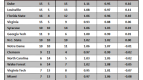
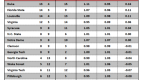
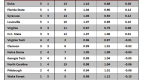
All is right in the numbers world. Almost. Temple, Xavier and Richmond sit at the top of the conference pecking order and their differentials confirm their standing. Dayton, St. Louis and Rhode Island are still tangled a bit, which could develop into an interesting story as the conference tournament plays out later this week. The won-loss records, confirmed by the gap in the efficiency differentials, suggest that the bottom four of Massachusetts, La Salle, Saint Joseph’s and especially Fordham, were simply not competitive with the rest of the conference this season (of course with respect to Massachusetts, Rhode Island disagrees).

Final Conference Standings for 2009-10

  1. Temple (14-2, 26-5, #16 AP)
  2. Xavier (14-2, 23-7, #25 AP)
  3. Richmond (13-3, 22-7)
  4. St. Louis (11-5, 20-10)
  5. Charlotte (9-7, 19-11)
  6. Rhode Island (9-7, 21-8)
  7. Dayton (8-8 19-11)
  8. St. Bonaventure (7-9, 14-15)
  9. Duquesne (7-9, 16-14)
  10. George Washington (6-10, 16-13)
  11. Massachusetts (5-11, 11-19)
  12. Saint Joseph’s (5-11, 11-19)
  13. La Salle (4-12, 12-18)
  14. Fordham (0-16, 2-26)

Predictable?

Quirky early season schedules allowed George Washington and Massachusetts to sit atop the conference briefly, but as the season wore on, Xavier, Temple, Charlotte and Richmond took turns, either alone or in company of another, as the top ranked team of the conference. Temple and Xavier were supposed to take this season to rebuild. The Owls lost Dionte Christmas and the Musketeers lost their Coach, Sean Miller. Temple landed on the national radar when they beat Big 5 rival (and #3 at the time) Villanova in December. Xavier stumbled in the Old Spice, but recovered to join with Temple to cohabit with or shadow the two other teams that took long turns at the #1 spot through the 8.5 weeks of conference play. Temple’s 77-72 win over Xavier on January 20 settled the pecking order between those two (Temple would rank higher), but it was not clear until February 28 when Xavier defeated Richmond 78-76 in two overtimes, that those two would stand alone at the top at the end.

Read the rest of this entry »


RTC Live: Villanova @ Maryland

December 6th, 2009

RTCLive
We are back tonight courtside for what might be one of the best early season games of the year with #3 Villanova travelling down to Washington, DC to take on Maryland. Coming into the season, a lot of people expected this to be a huge game, but some of the hype died down after the Terrapins lost back-to-back games in Maui against Cincinnati and Wisconsin. At the time we were down on the Terrapins, but we are willing to forgive them a little for what might have been a little jet-lag (yes, we know the other teams had to travel far except for Chaminade). And it turns out that the Bearcats and the Badgers might have been a little better than advertised coming into the season (ask Coach K about the Badgers). Tonight Gary Williams and his Terrapins have a shot at regaining some respect from the rest of the college basketball universe against Jay Wright’s Wildcats. A win over the top-ranked team in the Big East would be a big boost for the Terrapins’ chances on Selection Sunday (less than 100 days away now).

While most of the nation’s attention will be focused on the two standout senior guards Greivis Vasquez and Scottie Reynolds, the key to this game might be on the inside. Antonio Pena has filled in the void left by Dante Cunningham, but the Wildcats are very thin on the inside particularly with Mouphtaou Yarou likely out for the season with hepatitis B. That leaves Jay Wright relying on Pena and local Maryland product Maurice Sutton on the inside against a group of Maryland interior players that lacks a big name but is fairly deep with Landon Milbourne, Jordan Williams, and Cliff Tucker in frontcourt. If either Pena or Sutton gets in foul trouble, the Wildcats could be in trouble. One other interesting storyline to watch is Villanova’s 6th man Taylor King, the former Duke McDonald’s All-American who transferred after his freshman year. As you may be aware, the Maryland student body doesn’t exactly like the Blue Devils. Even though he’s no longer at Duke, King would no doubt love to stick it to the Terrapins and their fans who will certainly be ready with plenty of taunts for the former Blue Devil. Be sure to join us for another edition of RTC Live at 7:30 PM.

Update: For those of you who are interested, our correspondent is already there so he will be covering the undercard of the BB&T Classic (George Washington versus Navy).

Read the rest of this entry »


2009-10 Conference Primers: #9 – Atlantic 10

October 29th, 2009

seasonpreview

Joseph Dzuback of Villanova by the Numbers is the RTC correspondent for the Atlantic 10.

Predicted Order of Finish:

  1. Dayton (14-2)
  2. Richmond (12-4)
  3. Xavier (11-5)
  4. La Salle (11-5)
  5. Duquesne (10-6)
  6. Charlotte (9-7)
  7. Temple (9-7)
  8. Massachusetts (8-8)
  9. Rhode Island (7-9)
  10. George Washington (6-10)
  11. St. Bonaventure (5-11)
  12. St. Louis (4-12)
  13. St. Joseph’s (4-12)
  14. Fordham (2-14)

All-Conference Team:

  • Kevin Anderson (G), Richmond (36.8 MPG, 16.6 PPG, 2.8 APG)
  • Rodney Green (G), La Salle (35.3 MPG, 17.8 PPG, 5.0 RPG, 3.4 APG)
  • Levoy Allen (F), Temple (31.3 MPG, 10.9 PPG, 9.0 RPG, 1.5 BPG)
  • Chris Wright (F), Dayton (26.1 MPG, 13.3 PPG, 6.6 RPG, 1.3 BPG)
  • Damian Saunders (F), Duquesne (34.6 MPG, 13.1 PPG, 7.6 rpg, 2.4 BPG)
  • 6th Man: Kenny Frease, Xavier (14.6 MPG, 5.4 PPG, 3.7 RPG)

Impact Newcomer/All-Conference Rookie Team:

  • Carl Jones (G), St. Joseph’s
  • Christian Salecich (G), St. Louis
  • Terrell Vinson (F), Massachusetts
  • Chris Braswell (F), Charlotte
  • Aaric Murray (C), La Salle – Rookie of the Year

Atlantic10

What You Need to Know. Over the past two seasons the A10 has earned 6 NCAA bids, sending four different teams to the D1 post-season party of 64 65. That is more teams over the same period than any other non-BCS conference. Those teams garnered a higher winning percentage (6-6 or 50%) than the SEC (5-9 or 35.7%). This season should track with previous seasons as the A10 will look for 2-3 teams with enough talent and success to earn 1-2 at-large bids in addition to the conference’s automatic bid. The A10 has become a showcase for ‘tweeners and front-court players lately. The A10’s last two POYs were a pair of  undersized (for the positions they played) frontcourt players. Gary Forbes, a 6-7 PF out of Massachusetts won in 2008, and Ahmad Nivins a 6-10 235 pound C out of St. Joseph’s, won last spring. This season is no different as fans will see Dayton’s Chris Wright (a preseason Wooden nominee), Xavier’s Jason Love, Rhode Island’s Delroy James, Duquesne’s Melquan Bolding and Richmond’s Kevin Smith play a position or two “up” from their size and weight. The conference will showcase a number of very well-regarded incoming freshmen as Charlotte’s Chris Braswell, Massachusetts’ Terrell Vinson and La Salle’s Aaric Murray held offers from high-major programs, but chose A10 schools.

Predicted Champion. Dayton (NCAA Seed:  #4) Returning 84.5% of the minutes and 85.6% of the points from a team that finished 2nd in the conference and sent the Big East’s West Virginia home in the 1st round of the NCAAs before bowing out to Kansas, it is no wonder that the Flyers are the strong favorite to take the conference title and return to the NCAAs again in 2010. Dayton took the top spot in the A10 Coaches preseason poll, announced on Media Day (10/22). The squad is deep and experienced as Coach Brian Gregory brings back seven seniors and four juniors including four starters and nine of the top eleven scorers from last year’s team. Led by 6-8, 225 pound forward Chris Wright, a 2009-10 preseason Wooden Award nominee, the Flyers will try to pick up where they left off in March of 2009. Wright led the team in points per game (13.3) and rebounds per game (6.6). Dayton, however, is not a one man show. The Flyers return senior London Warren (the “Jacksonville Jet”), a 6-0 point guard  who led the team in assists (154) last season while averaging 21.5 minutes and 4.1 points per game. Gregory can play 3 guards by bringing in two 6-3 senior guards, Marcus Johnson and Rob Lowry. Johnson was the second-leading scorer (behind Wright), averaging 11.8 points per game while playing an average of 28.3 minutes. Rob Lowry, who came to Dayton via Cecil Community College (and Chesapeake Community College), watched the team’s last ten games from the bench, as he tore a tendon in his right knee on February 12th. Lowry was the team’s leading scorer 5 times in 2009 and was second to Warren in assists. If the Flyers play like they did at the end of the 2009 season they should separate themselves from the A10 pack early and pick up a #3 or #4 seed in the NCAAs. Look for their performance in the Puerto Rican Tip-Off, where they will face up to 3 high-major teams, as a gauge for where they stand in the Top 25.

Read the rest of this entry »


06.28.09 Fast Breaks

June 28th, 2009

Let’s get caught up after a glorious weekend…

  • Elliot Williams to Memphis.  Nothing surprising here, as we reported last week that Elliot Williams was leaving Duke to move closer to home to attend to his mother’s illness.  The only school that made reasonable sense was his hometown University of Memphis, and Gary Parrish reported yesterday that Williams will indeed become a Tiger.  If Williams can get the NCAA to approve his hardship waiver so that he can play next season, he should walk right into a starting position at the PG spot for Josh Pastner’s squad.  While we’re on the subject of Memphis getting new players, former Kentucky player (well, he never actually played) Matt Pilgrim is probably transferring to Memphis with the assistance of new UK coach John Calipari.  Pilgrim, a transfer from Hampton who sat out last season at UK, wasn’t part of the new regime’s plans.  Since he didn’t want to leave Lexington but was no longer welcome, Coach Cal is trying to facilitate a seamless transfer for him.
  • The NCAA Shell Game. Seth Davis wrote an article last week that illustrates just how one-sided the NCAA scholarship system can be.  When new coaches (e.g.,Isiah Thomas and John Calipari) get to their new schools, they often feel the need to run off players (such as Pilgrim, mentioned above) who don’t fit in their lofty plans for the program.  That’s all fine and well for replacing lesser players, but the whole house of cards gets exposed when a coach wants to keep a player who otherwise would like to transfer.  Meet Freddy Asprilla, a 6′10 Colombian center at FIU who had a great freshman year and wants to transfer to a major conference school, but whom isn’t being released by FIU simply because, well, they don’t have to.  There’s an adage about the deck getting stacked somewhere in here.
  • FIU Cheerleading.  We know it’s purely coincidental that FIU is enabling cost-cutting measures by cutting its cheerleaders during the same year that they hired Isiah Thomas to coach their men’s basketball team (Thomas isn’t taking a base salary this year).  Still, the rich irony of FIU wholly dismantling the cheerleading team within months of Thomas’ arrival on campus isn’t lost on anyone.  Sometimes the unintended consequences are more compelling than the intended ones.
  • NBA Draft DetritusGary Parrish: the NBA will find you wherever you play.  Luke Winn: behind the scenes at MSG, and raising legitimate questions as to Ty Lawson and DeJuan Blair’s draft positions.  Jeff Goodman: Brandon Jennings made the right choice to go to Europe.  More Parrish: like RTC, he also thinks Demar DeRozan is going to be a stud.
  • More Quick Hits.  Marquette’s Maurice Acker: done with basketballRenardo Sidney: stop delaying, NCAAJeremy Tyler: headed to Israel Brian Ellerbe: new assistant at GW.  BYU’s Dave Rose: now cancer-free and returning to coach this fall.   William & Mary: considering an asparagus mascotRoy Williams: Aw Shucks… the RW Story, on sale in November.  Antonio Anderson: those Ws are ours!

Boom Goes the Dynamite: 02.22.09 Edition

February 22nd, 2009

dynamite1

1:00pm. Welcome back to another day of BGTD.  There are only 2o games today, but there are five of particular interest that we’ll be tracking.  Villanova @ Syracuse and Illinois @ Ohio St. at 1pm, Wisconsin at Michigan St. @ 3pm, Wake Forest @ Duke at 7:45pm, and Arizona at Arizona St. at 10pm.  Pretty strong day.  Let’s get it started in upstate NY…

1:02pm.  Before we get going, we want to touch on this story from the LA Times yesterday that UCLA has stopped recruiting local 6′11 prep star Renardo Sidney even though by mid-last week the Bruins were still considered the front-runner.  Certainly UCLA could use a big man with guard skills such as those that Sidney has, so what gives?  Color us jaded, but all we could think of when we heard that UCLA so abruptly dropped Sidney was this story written by Gregg Doyel about a Pac-10 recruit who was charging $10k per on-campus visit a few years ago.  Did Sidney finally give UCLA his price?  Was there a package deal that Ben Howland wasn’t willing to stomach?  Not surprisingly, USC (of OJ Mayo, Daniel Hackett and Reggie Bush) is now considered the leader. Let’s see what happens later today when Sidney announces his college choice at 4pm PDT.
1:13pm.  Villanova looks fantastic thus far, with seven scores in eight possessions, including three threes from Dwayne Anderson.  If you’re still reflecting on yesterda’s wild Saturday, here’s Andy Katz’s article focusing on how quickly things can change.

1:23pm. Nova is getting whatever it wants offensively, and the Syracuse crowd still looks asleep (the players aren’t much better).  Uh-oh alert – Clemson is already down double-figures at Georgia Tech – remember the Tigers lost a road game last weekend at bottom-feeder Virginia.

1:45pm. Cuse is coming back here just before the half, now down 2, behind Devendorf, Rautins and Flynn.  Clemson is also back in the game, after getting down by as much as 15 to Ga Tech.  Illinois appears like they’ll hit their total from the Illini’s last game vs. OSU in the first half (up 26-24 with 2:30 left).

2:00pm.  Nova goes into the half with a six-pt lead, 46-40.  Neither one of these teams is playing much defense – both sides are shooting 55% from the field.  The key difference is that Villanova has been able to get to the line eight more times than the home team.   Clemson fought back to tie things up at Georgia Tech, and Xavier is ripping GW 36-20 at halftime.

2:05pm. Seth Davis just got on board the RTC train with the Duke Swoon at halftime of the Syracuse-Nova game, predicting that the Devils will be the highest ranked team to lose early next month.  Not sure if Duke will lose tonight, but there are two things in Wake’s favor…  1) Duke will play man-to-man, which helps Wake penetrate to the rim; and 2) Wake has shown this year a propensity to take ranked teams seriously, home or away.  The Deacs get into trouble when they’re playing teams they don’t respect.

Read the rest of this entry »


Twenty Points?

January 11th, 2008

What the hell is going on out there in the nation’s midsection? Just three short days after Savannah St. laid a second-half egg against Kansas St. to the tune of four pts in the second half (25 total for the game), Rick Majerus’ St. Louis squad put up a blistering twenty points last night in its game against George Washington. This total of sixty-nine points (49-20) set a new record for offensive futility in the shot-clock era of D1 basketball. Let’s take a quick look at the Billikens’ stats:

  • 14.6% shooting (7-48 from the field)
  • 5.3% 3FG shooting (1-19)
  • 50% FT shooting (5-10)
  • 0.35 pts per possession
  • leading scorer (Bryce Husak) came off the bench for 5 pts
  • SLU missed 23 straight shots at one point in the game

Majerus and Biliken

Hey, Coach, do you think you have some offensive issues?

“I thought GW played tough on defense. We had some issues. You have to credit GW for playing very well. We have some issues in terms of our offensive proficiency,” Majerus said. “I tried to keep coaching the game. Sometimes you miss. We are a team that has some issues. That is why we are practicing [Friday]. We did miss some good shots, yes. Anyone can look at us and see we don’t have height, we don’t have depth.”

What gets us is that St. Louis really isn’t that bad of a team. Their record is 9-6 with a win over Southern Illinois to their credit, and their RPI ranking is #144, which puts the Billikens in the range of Maryland and Oklahoma St. Still, their offensive output is troubling in their six losses – 58, 56, 40, 39, 53, 20. We realize their tempo this year is among the slowest in the nation (#336), but clearly something isn’t being communicated well between Majerus and his players. SLU was 20-13 last season and returned four starters, so what’s up? [insert joke here about Majerus spending more time eating than coaching]

Update: our blogpolling colleagues Vegas Watch and Super, Scintilliating & Sarcastic beat us to the punch on this last night, and have better takes than us. Enjoy.


09.17.07 Fast Breaks

September 17th, 2007

Can’t quite get that image below out of our head…  but we’ll try.

  • Pitt incumbent PG Levance Fields decided no he will not go quietly and in fact, he would rather be tasered, when asked to do so by the Pittsburgh PD last weekend.   
  • Ball St. found no evidence that Ronny Thompson put racially inflammatory notes under Ronny Thompson’s office door while he was still coaching there. 
  • The guy who will be responsible for throwing the ball to OJ Mayo and getting the hell outta the way is now eligible (Angelo Johnson). 
  • Coaching news.  GW’s Karl Hobbs was given an extension to 2012, and FAMU tabbed Eugene Harris (asst. at Georgia St.) to take over for Mike Gillespie. 
  • Haven’t we heard this before?  John Beilein and Bruce Weber (particularly Bruce Weber) can’t recruit. 
  • Digger for Prez.  Haven’t we had enough bumbling around/making no sense/talking in circles for one generation? 
  • UCLA fans are already talking basketball season.  Come on home, friends.  Others (ahem, Louisville, Notre Dame, Michigan, UNC, etc.) are already here.  More to come.
  • SEC Hoops:  Good, Bad & Dirty breaks down and gives predictions for the 12 SEC basketball schedules.  We’ll give odds on Mississippi St. not going 27-3! 
  • Frank Burlison at foxsports.com gives us a viewer’s guide to the best early-season tournaments to watch. 
  • MMAS gives us a list of key transfers to watch out for and teams looking to make the jump in 07-08. 
  • Finally, today Hoopwise has a Q&A with arguably the best college hoops analyst out there – Fran Fraschilla (apologies to Raff, Bilas, Tirico and others). 

NCAA Tourney Overachievers and Underachievers of the 65 (64) Team Era

June 15th, 2007

We’ve received a resounding response on the post Tuesday evaluating school performance during the 65 (64) team era, so let’s waste no time in presenting Part II of our statistical profile of the NCAA Tournament during that period. As we alluded to in that post, looking at raw data in a vacuum has its limitations. From that data we got a reasonable sense of which programs have had the most success during the period, but it didn’t really give any insight as to which programs have overachieved, underachieved, or simply performed about as expected.

Ziggy

Which Schools Reach Their Potential?

Today’s post will address that issue. You might want to bookmark this page for next year’s bracket-filling, because we feel that what we’re showing today has significant value in determining those schools that tend to embrace expectations and those that tend to wither in the face of the red-hot lights of March. Stat geeks like ourselves should enjoy this post – hopefully it won’t bore the rest of you.

The first consideration in trying to determine which programs have overachieved and underachieved is how to answer that question. Traditionally, you often hear commentators and writers talk about “playing to your seed,” which essentially presumes that a #1 seed should make it to the Final Four, a #2 seed to the Elite Eight, and so on (see Table A below). Using this model, a team that wins any games beyond the expected wins of its seed would fairly be said to have overachieved as to the expectations of the seed (and vice versa).

Table A. Standard Model

NCAA EV by Seed (Presumed)

So let’s try to first answer that question using the Standard Model outlined in Table A. But don’t give up on the post after you review the Standard Model results, as we have another model below it that may bring up new and interesting considerations. The Standard Model as applied to the 65 (64) Team Era is Table B below.

Table B. Standard Model Applied to 65 (64) Team Era

Notes: the table is sorted by “+/- per App,” which represents the number of games won above or below the expected number of wins for that seed per NCAA appearance (1985-2007). The rows colored in green highlight schools that are in the top twelve spots of both Tables B and D. The rows colored in yellow highlight schools that are in the bottom twelve spots of both Tables B and D.

NCAA EV by Seed - Detailed v.3

Inside the Numbers (Table B):

Overachievers. What first jumps out at us using this method is just how (except Florida) there are no big names near the top of the list. Tulsa, Seton Hall, GW, UTEP, Temple? Without taking away from their performance – after all, every one of those teams should be commended for overperforming versus its seed – this immediately suggests to us that the Standard Model often used by the pundits actually favors lower-seeded teams who manage to win a game or two every couple of years in the NCAA Tournament. Using the schools above +0.30 as a natural break point, only Florida, Louisville and Temple have won more than twenty games in the NCAAs during this period, and the average seed of these thirteen schools was 7.0. Are these teams chronically underseeded or are they overachieving as a general rule? Whatever the case, we’re going to think a little harder about picking Tulsa the next time they make the bracket.

Tulsa Logo

Are the Golden Hurricanes the Biggest NCAA Tourney Overachievers?

Underachievers. A brief look at the names at the bottom of the list – Oklahoma, Cincinnati, Wake Forest, Stanford, Purdue, etc. – tells us that we’re on to something here. As our good buddy MK says, “Wake and Purdue can effin’ bite me. They kill my bracket every year.” Or something like that. Using -0.42 as a natural break, the eleven teams at the bottom averaged a seed of 4.8 during this period, which is a marginally better seed than the overachievers on this list. Oklahoma, Arizona and Illinois – what do you have to say for yourselves? Each of you has had at least 18 appearances during this era, averaged a solid if not spectacular seed between #4 and #5, and consistently played below that seed to the tune of -0.42 wins per appearance or worse. This matches Tuesday’s analysis with Oklahoma as a disappointment; but under this model, Arizona and Illinois (second tier elite performers on Tuesday) have some explaining to do.

Oklahoma celebration

You May Want to Avoid These Guys in your Brackets

You’ll See Them Again on the Long Road Back to the Middle. The Big Four from Tuesday – Duke, UNC, Kentucky and Kansas – find themselves in the middle of the pack. It’s notable that Duke averaged a seed of 2.32 during this era and still overachieved by +0.09 wins per appearance relative to seed. UNC and Kentucky are verrrry slightly underachieving, whereas KU’s recent vintage teams (2005 & 2006) probably contribute to its slightly lesser position at -0.23 wins per appearance. UConn should be lauded for overachieving at a clip of +0.14 wins per appearance, which somewhat mitigates their overall lack of F4s – they do win a lot of NCAA Tournament games. Syracuse, Georgia Tech, Memphis, Iowa St., California, Princeton and Notre Dame – all of these programs have played exactly to seed in the last 23 years. Be sure to remember that fact next year when filling out your brackets.

Criticism of the Standard Model. The primary problem with evaluating NCAA Tournament success based on “playing to the seed” is that it puts an unrealistic burden on highly-seeded teams because over time they never play to their seed. In the knockout crucible that makes the NCAA Tournament so exciting, a corollary result of using this criteria is that higher seeds (#1-#4) are largely set up to fail, and lower seeds (#9-#16) are significantly overachieving simply by winning one game. Additionally, we feel that using the Standard Model assumes too much at the squishy margins – that a #4 seed should win two games, a #5 seed should win only one game, and that a #8 seed should always beat a #9 seed – when both teams are probably very similar in ability. For this reason, we now offer an alternative model, one that considers actual historical performance of the seeds.

To that end, see Table C below for a historical snapshot of how well each seed actually performed in the 65 (64) team era.

Table C. Historical Model

NCAA EV by Seed - Historical

Considering Table C, we wanted to point out for a moment that we have a couple of thoughts. First, we found it interesting that #6 seeds have traditionally performed better than #5 seeds. This at first seems anathema to conventional wisdom, as a #6 likely has to get past a #3 in the second round, whereas a #5 must only defeat a #4. That is, until you remember that a #5 has the dreaded 5-12 match-up that knocks out so many higher-seeded teams (excepting 2007, of course). Also, it’s interesting that a #10 seed has a better historical expected number of wins than a #9 seed. This shows again that a better draw is to avoid the 8-9 match-up, even if you end up as a lower (but more likely to succeed) #10 seed.

Using the 1985-2007 Historical Model as a baseline expected value for each seed, our list of 64 schools is now featured in Table D below.

Table D. Historical Model Applied to 65 (64) Team Era

Notes: the table is sorted by “+/- per App,” which represents the number of games won above or below the expected number of wins for that seed per NCAA appearance (1985-2007). The rows colored in green highlight schools that are in the top twelve spots of both Tables B and D. The rows colored in yellow highlight schools that are in the bottom twelve spots of both Tables B and D.

NCAA EV by Seed - Hist Detailed 3

Notable Differences. Using the Historical Model, the first thing that strikes us as interesting is that many of the heavy hitters of the era have jumped considerably, including some all the way to the top of the list. In fact, the following schools – Kentucky, UNC, Duke, Kansas, UConn, UNLV, UCLA, Syracuse, Ohio St. – all rose at least fifteen places from where they were situated in Table B. Each of these schools (excluding Kansas and Ohio St.) have overachieved at least +0.25 wins per appearance above the historical performance of their seeds. Since these schools represent a total of thirteen championships and thirty-eight F4s during this era, the Historical Model viewpoint makes more sense than what the Standard Model shows.

Who Dropped? Creighton, George Washington, UAB and UTEP all went from nice-looking overachievers in Table B to slight underachievers using this model. NC State, Xavier and Gonzaga looked fantastic using the Standard Model, but look rather pedestrian using this one. The explanation for this is simple – these teams collectively averaged a #9 seed throughout this era – if we use the Basic Model, they should never win a game, so when they do, it looks as if they’re significantly overachieving. However, using the Historical Model, we see that they actually win NCAA Tournament games roughly commensurate with how a #9 seed typically performs. This again illustrates why we feel this model shows a truer snapshot of performance.

More Importantly, Who Stayed the Same? Now this is where it gets really interesting. The rows shaded in green in Tables B and D represent schools that were in the top twelve in playing beyond its seed using both models. You could accurately say that, no matter how you slice it, Florida, Seton Hall and Louisville are the truest overachievers of the 65 (64) team era. (Incidentally, Florida and Seton Hall are in the top four of both tables, with each school averaging an extra win beyond its seed for every two appearances in the NCAA Tournament.)  These three schools consistently play beyond the actual and historical expected value of the seed that the NCAA Selection Committee gives them.  

The rows shaded in yellow at the bottom of Tables B and D represent the true underachievers. These schools were in the bottom twelve in playing below its seed using both models. What’s peculiar about this statistic is that there appears to be a much greater correlation between the tables with respect to the underachievers than with the overachievers. Whereas the overachievers only had three common schools between the tables, regular NCAA disasters such as Georgia, Oklahoma, Stanford, Purdue, Wake Forest, Pittsburgh and St. John’s find themselves in both at the bottom looking up. If you are at all like us and believe that the weight of history contributes as a predictor of the future, then anyone reading this post should be extremely hesitant picking these schools to play beyond its seed to its seed in the Dance in the years going forward.
Chicken or the Egg

And Now, the Chicken/Egg Argument. Whether you buy into the Standard Model or the Historical Model or neither, we can say without a doubt that some schools appear to consistently overachieve relative to its seed, while others consistently underachieve relative to its seed. The question we want to posit to the readers is what causes this – is this simply a statistical anomaly? Are the overachievers regularly seeded too low by the NCAA committee; or, are the underachievers regularly seeded too high? Is there a self-fulfilling prophecy at work here, where schools that are known as chronic underachievers (ahem, Oklahoma) place so much pressure on themselves that they tighten up in the clutch? Conversely, do the overachievers find their wits amidst chaos to consistently come through under pressure because they are expected to do so? These are questions that we cannot answer, but we figure that there are elements of each at play here. We’d certainly like to hear your thoughts on this and any other topic. Oh, and apologies for the long post today.

Coming Next: We’ll take a look at the raw numbers again, but this time we’ll examine it by conference, which isn’t as easy as it sounds. Do you realize how many conference re-alignments and mergers and dissolutions there have been in the last 23 years of NCAA basketball?