Tuesday, March 16
7:30pm - Ark-PB vs. Winthrop (ESPN)
NIT: 7pm - Northeastern @ UConn (ESPN2)
8pm - NC State @ S. Florida (ESPNU)
9pm - Texas Tech @ Seton Hall (ESPN2)
9:30pm - W&M @ UNC (ESPN)
10pm - Jackson St @ Miss St (ESPNU)
11pm - Jacksonville @ Ariz St (ESPN2)
 

Patriot League Tournament Preview

March 3rd, 2010


Michael Hurley is the RTC correspondent for the Patriot League and America East Conference.

Patriot League Tournament

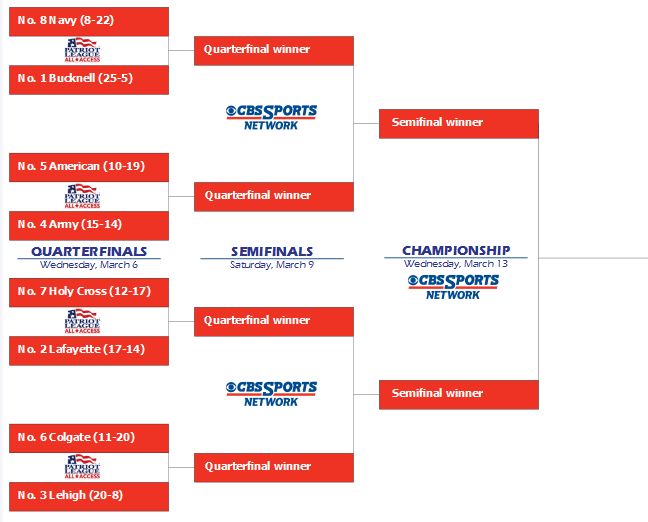
In a league in which the first five teams finished within three games of each other any team could win three games in a row to secure the NCAA bid. Lehigh was the best team throughout the year with a 10-4 record. If they face Navy in the semis there could be problems posed after dropping both against the Midshipmen this year. American could also beat Navy and ride the hot hand of Vlad Moldoveanu as far as he will take them. Holy Cross has a lot of skill for a #7 seeded team, but who knows if Coach Kearny can get them to perform. Lafayette faded huge down the stretch, but started out 5-1 in conference. Any of the teams could end up hosting the Patriot League trophy at the end of the tournament, but I will go with Lehigh, the favorite, to win it. Tune in for the league championship on ESPN2 on March 12 at 4:45 pm.

First Round Matchups

  • #8 (14-14, 4-10) Army at #1 (19-10, 10-4) Lehigh – 03/03/10 Wednesday 7 pm.  Lehigh should roll in this game against Army. Every victory Lehigh has had this year has been by double figures including both over Army. The matchup problem comes in the second round. If Navy manages to beat American, Lehigh will not be pleased. Navy beat Lehigh as many times this year as the rest of the league combined.
  • #7 (8-21, 5-9) Holy Cross at #2 (14-16, 9-5) Bucknell – 03/03/10 Wednesday 7 pm.  If Holy Cross can put together some defense this game they stand a good chance. The Crusaders beat Bucknell once at home, but lost in mid-February on the road. It seems that the Crusaders just never bought into Kearny’s system, so it will be hard to start in the playoffs. Especially after dropping four of the last five in the regular season.
  • #6 (10-18, 6-8) Colgate at #3 (17-12, 8-6) Lafayette – 03/03/10 Wednesday 7 pm.  The away team came away with a victory in each of the games this year between these two teams. Colgate’s win over Lafayette was only one of three home losses on the year for the Leopards. It was also only one of three home victories on the road for the Raiders. I can see Lafayette continuing their second half swoon and dropping this first rounder.
  • #5 (13-16, 7-7) Navy at #4 (10-19, 7-7) American – 03/03/10 Wednesday 7:30 pm.  American came out on top of both matchups during the regular season including a 80-77 overtime victory at Navy during the last week in February. Moldoveanu hit the go ahead layup, but a huge game out of Stephen Lumpkins won the Eagles that game. Moldoveanu scored 37 points the first time the two teams met. Navy is only 3-10 on the road this year, so the home court advantage was huge for American. The Eagles come in having won three out of their last four while Navy has dropped three in a row. American, 8-0, has never lost in a first round matchup since joining the league in 2002. Expect the Eagles to continue to live on.

Award Winners

Read the rest of this entry »


RTC Live: Villanova @ Maryland

December 6th, 2009

RTCLive
We are back tonight courtside for what might be one of the best early season games of the year with #3 Villanova travelling down to Washington, DC to take on Maryland. Coming into the season, a lot of people expected this to be a huge game, but some of the hype died down after the Terrapins lost back-to-back games in Maui against Cincinnati and Wisconsin. At the time we were down on the Terrapins, but we are willing to forgive them a little for what might have been a little jet-lag (yes, we know the other teams had to travel far except for Chaminade). And it turns out that the Bearcats and the Badgers might have been a little better than advertised coming into the season (ask Coach K about the Badgers). Tonight Gary Williams and his Terrapins have a shot at regaining some respect from the rest of the college basketball universe against Jay Wright’s Wildcats. A win over the top-ranked team in the Big East would be a big boost for the Terrapins’ chances on Selection Sunday (less than 100 days away now).

While most of the nation’s attention will be focused on the two standout senior guards Greivis Vasquez and Scottie Reynolds, the key to this game might be on the inside. Antonio Pena has filled in the void left by Dante Cunningham, but the Wildcats are very thin on the inside particularly with Mouphtaou Yarou likely out for the season with hepatitis B. That leaves Jay Wright relying on Pena and local Maryland product Maurice Sutton on the inside against a group of Maryland interior players that lacks a big name but is fairly deep with Landon Milbourne, Jordan Williams, and Cliff Tucker in frontcourt. If either Pena or Sutton gets in foul trouble, the Wildcats could be in trouble. One other interesting storyline to watch is Villanova’s 6th man Taylor King, the former Duke McDonald’s All-American who transferred after his freshman year. As you may be aware, the Maryland student body doesn’t exactly like the Blue Devils. Even though he’s no longer at Duke, King would no doubt love to stick it to the Terrapins and their fans who will certainly be ready with plenty of taunts for the former Blue Devil. Be sure to join us for another edition of RTC Live at 7:30 PM.

Update: For those of you who are interested, our correspondent is already there so he will be covering the undercard of the BB&T Classic (George Washington versus Navy).

Read the rest of this entry »


2009-10 Conference Primers: #29 – Patriot League

October 7th, 2009

seasonpreview

Michael Hurley is the RTC correspondent for the Patriot League and America East ConferenceClick here for all of our 2009-10 Season Preview materials..

Predicted Order of Finish:

  1. Holy Cross  (11-3)
  2. Lehigh  (10-4)
  3. Army  (9-5)
  4. Navy  (7-7)
  5. Bucknell  (6-8)
  6. Colgate  (6-8)
  7. Lafayette  (4-10)
  8. American  (3-11)

All-Conference Team:

  • Marquis Hall (G), Sr., Lehigh
  • R.J Evans (G), Soph., Holy Cross
  • Andrew Keister (F), Jr.,  Holy Cross
  • Zahir Carrington (F), Sr., Lehigh
  • Patrick Behan (F/C), Jr., Bucknell

6th Man. Chris Harris (G), Sr., Navy

Impact Newcomer. Jeff Holton (F), Fr., American

patriot logo

What You Need to Know. American’s dominance it seems will come to an end this year after back-to-back Patriot League championships.  The “American” have seven freshman on the 2009-10 team, and the current team has zero combined starts between them, so they will experience a steep learning curve. With the most well known coach in the PL gone (Ralph Willard at Holy Cross), we will have to see if Sean Kearney can carry the torch with a squad full of talented returning players in Worcester.  With his experience coaching at this level, I am willing to bet he can, which is why they are my pick for the conference champions.  As a whole, the entire league returns more talent this year than any year in recent memory.

Read the rest of this entry »


Patriot League Wrapup & Tourney Preview

March 4th, 2009

Marty Leon is the RTC correspondent for the Patriot League. 

Patrtiot League Playoff Preview

#1 American vs #8 Lafayette - Lafayette took American to overtime last week at home. American is 21-7 overall and 13-1 in league play. This is their second year in a row as #1 seed. They won 11 road games, tied for tops in the country. Like all Patriot games this will be a battle, and anything could happen but most likely will not.

#2 Holy Cross vs # 7 Bucknell – Holy Cross smoked Lehigh by 15 to end the season and are playoff sharp. Bucknell has overachieved all year but just had a tough 17 point loss to Army.  Ralph Willard’s team will march on, right into a title game with American.

#3 Navy vs #6 Colgate – This veteran Navy squad has a legit shot at a title run. Kaleno Kena had 23 as the midshipmen just beat Colgate to end the season.  Colgate too young, Navy too experienced.

#4 Army vs. #5 Lehigh – We thought Lehigh would have a better year.  They will not go to West Point and beat a determined Army team on their home turf.  Kudos to Jim Crews for a great year and the #4 seed.

Read the rest of this entry »


A Trip to West Point for Army-Navy

January 26th, 2009

Ray Floriani of College Chalktalk is an RTC correspondent for the NEC and MAAC Conferences.  He took in the Army-Navy game at West Point yesterday.

WEST POINT, NY – Everyone is familiar with the tradition, pageantry and intensity of Army-Navy. When these two distinguished service academies get together, even if its backgammon, it’s something special. On Sunday the two met for the 109th time. Navy entered Christl Arena 14-5 (3-1 Patriot League) while Army was 4-13 (0-3). It is a cliché but when these two meet you can throw out the records.

img_0067

On Sunday you could have assumed both clubs entered 0-0. Army established an early seven point lead on a pair of Julian Simmons three pointers. The remainder of the first half the Cadets kept the lead around double digits thanks to some good old fashioned Army defense. The Midshipmen shot 26% the first half and had only seven field goals as they trailed 33-26 at intermission. Shades of Bobby Knight.  And why not as Army coach Jim Crews played for the ‘General’ at Indiana.

The second half saw Army expand the lead to seventeen points. Offensively the Cadets were in a good groove on both ends. The offense ran well and defense shut down Navy. Until late.  Down the stretch the Midshipman found the range from three and made a run. They got it down to a two possession game with under a minute left. Those final seconds saw Army get enough stops and hit enough free throws to seal the 76-71 victory.

Cleveland Richard of Army led all scorers with 17 points. Adam Teague of Navy started strong and finished strong. For a better part of the game he was defended but still wound up hitting five treys and leading Navy with 16 points.  “Army played a great game,” Navy coach Billy Lange said. “They defended great which is traditional Army basketball. I think by the end of the year Army will prove to be a very good basketball team and challenge the upper echelon of our (Patriot) league.”

Crews was pleased with the offense, which had been dormant, and the defensive effort over the course of the contest. “We sustained,” Crews said in reference to the tight finish. “They (Navy) can score in bunches and when you go out to stop their three point shooters they can go right around you.”  Crews noted that Army-Navy is a rivalry ”known around the world.” He also made a very good point noting that the basketball rivalry becomes more intense because both schools share the same conference affiliation.

img_0066

A good hard fought rivalry such as Army-Navy is something special to behold. The neatly attired Cadets and Midshipman cheering their teams. Both institutions bringing bands, a mascot and cheerleaders. The post game playing of the alma mater of  both schools, with a packed house silently standing in reverence and respect. The epitome of good sportsmanship with not a verbal obscenity to be heard. Even the drive to Cristl Arena as you pass famed Miche Stadium along the winding hill with the majestic Hudson in your rear view mirror.

Yes, Army-Navy is special. Anytime. Everytime.


2008-09 Season Primers: #23 – Patriot

October 19th, 2008

Marty Leon is the RTC correspondent for the Patriot League.

Predicted Order of Finish:

  1. American  (24-5,  14-0)
  2. Navy  (19-10, 8-6)
  3. Lehigh  (18-11, 7-7)
  4. Colgate  (17-11, 7-7)
  5. Holy Cross  (16-14, 7-7)
  6. Lafayette  (13-15, 7-7)
  7. Army  (13-15, 6-8)
  8. Bucknell  (5-23, 0-14)

What You Need to Know (WYN2K).  The Patriot League is the second cousin of the Ivy, with academic standards for student-athletes tougher than 90% of the rest of the country.  Bucknell and Holy Cross have been the historical kings of this league until American emerged last year.  With four starters returning led by Garrison Carr, they are a lock to win the league again.  Navy’s Kaleo Kina and Lafayette’s Andrew Brown are two of the league’s best returnees.  Here’s a clip from American’s clincher last year versus Colgate (love the RTC footage). 


Predicted Champion.  American (#14 NCAA) should repeat as champions.  Colgate, a conference tourney finalist last year, was set to challenge until 1,000 point scorer Kyle Roemer went down for the year with an ACL tear.  The experience of American and the program’s momentum after last years great season will lead them to Selection Sunday again.  A possible #14 seed, Jeff Jones’ squad gave Tennessee all they could handle for 35 minutes in last year’s first round of the NCAA Tourney. 

Others Considered.  Navy, Lehigh, and Colgate shore up the middle of the pack.  The Midshipmen return nine of their top ten scorers.  Marquis Hall and Zahir Carrington of Lehigh are both potential all league performers and they could be a sleeper.  Emmit Davis’ Colgate five were primed for a title run until Roemer went down, but still will be a tough out.  Holy Cross is striving to return to its glory days under Ralph Willard.  Jim Crews’ Army team had a nice year in 07-08 and will compete.  Bucknell, with new mentor Dave Paulsen, has been crushed by preseason injuries and only has ten healthy bodies at this time. 

Key Games & RPI Boosters. 

  • American @ Oklahoma  (11/14/08)
  • American @ Georgetown  (12/6/08)
  • American @ Maryland  (12/22/08)
  • Colgate @ American  (2/14/09)

Neat-O Stat.  Patriot League coaches have sigificant experience at multiple levels of college basketball.  American’s Jeff Jones has been head coach at Virginia, Holy Cross’ Ralph Willard has been head coach at Pitt, and Army’s Jim Crews has been head coach at Evansville.  On the flip side, Bucknell’s Dave Paulsen has been head coach of D3 Williams and St. Lawrence, and Emmit Davis of Colgate and a member of his staff played at St. Lawrence.

65 Team Era.  The Patriot League didn’t come into existence until the 1991-92 season, but despite its pedstrian record (2-15, .118), in its short time it’s managed to make some NCAA Tournament noise over the years.  Everyone of course remembers the Bucknell upsets of 2005 (Kansas) and 2006 (Arkansas), as the Bisons made it to the second round in consecutive years.  But from 2001-03, Ralph Willard’s Holy Cross team seemed to live on throwing major scares into top-tier seeds, losing by only four to #2 Kentucky (2001), eleven to #1 Kansas (2002), and four to #3 Marquette (2003). 

Final Thoughts.  When evaluating this league, the word that comes to mind is parity.  These teams are all evenly matched so rarely do you get a blowout in any conference games.  This is a great coach’s league.   Winning at home is crucial to having a successful season.   Anyone but American emerging this season would be a huge surprise, and AmU has a chance to break through the first round and make some noise in the NCAA tournament.


2007 Athlademic Ratings – Revised

September 5th, 2007

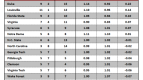
Ok, so thanks to an insightful UCLA fan, we realized that our exuberant reliance on NCSA data to justify our Athlademic Rankings posted last week was giving them way too much credit for properly vetting their data.  So to make sure we get it right this time, we spent the better part of today going through the 2007-08 US News rankings and the 2006-07 Sears Cup rankings ourselves.  Here’s the revised list, in Table A

Table A.  Athlademic Ratings – Division I (revised)

NCSA Revised Rankings

New Arrivals.  In addition to UCLA and USC, we also see the inclusion of Georgia, Texas A&M, Georgia Tech, Minnesota, Tennessee, Rutgers and Auburn onto our list – all driven by strong athletic programs.  High academic schools with relatively weak athletic programs, such as Army, William & Mary and Dartmouth, fell out of the top 50 due to the addition of the above programs. 

Ivy League logo

The Ivies strike a Nice Balance in Athlademics 

Ivy League Balance.   Speaking of Dartmouth, Keggy the Keg and friends are the only Ivy League school that didn’t make our Top 50.  The other seven did, with Princeton (no surprise there) leading the way at #16 overall.  Granted, the high academics of the schools drives their inclusion here, but we shouldn’t discount that these schools rate above many larger BCS schools in terms of the success of its athletic programs.  Cornell has the 55th most successful athletic program, but there are 73 BCS schools, which means Cornell, Princeton (#63) and Harvard’s (#64) athletic programs  are outperforming bigger state schools such as Kansas (#66), Iowa (#68), and Connecticut (#82).

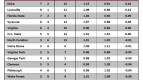
Big 10 – ACC Challenge.    As in, the Big 10 and ACC challenge the rest of the BCS conferences to keep up with it when it comes to athlademics.  We rated all 73 BCS conference schools, keeping those ahead of them in place, and Table B below shows the results. 

Table B.  BCS Conference Athlademic Ratings

 Conf Ratings

Why is the Big East so bad?  There’s a pretty clear top tier of Big 10, ACC and Pac-10, a middle tier of the SEC and Big 12, and a bottom tier, where the Big East lurks like Gollum all by itself.  The Big East really gets killed on both sides of the equation – it has seven (of 16) third-tier academic schools, as rated by US News (more than the other 5 conferences combined); and seven schools that finished outside of the top 100 in the Sears Cup (Mississippi St. and Kansas St. are the only other two in BCS conferences).  This includes the dubious case of Seton Hall, who was the only BCS conference school of the 73 to not score a single point in the Sears Cup competition for 2006-07.  How is that possible?? 

Seton Hall

Days Long Since Gone at The Hall

Haves and Have-Nots.  The Pac-10 is the greatest example of bifurcation within a conference.  It has five of the top twenty athlademic programs in America (Stanford, UCLA, USC, Cal, Washington), but it also only has five of the top fifty programs - its next highest ranked school is Arizona at #51.  Compare this with the Big 10, who has nine of its eleven members ranked in the top forty, with only Indiana (#53) and Iowa (#58) weighing it down.  Conversely, the Big 12 only has two of its twelve schools ranked in the top forty – Texas (#11) and Texas A&M (#23). 

Non-BCS Stars.  We already mentioned the Ivies, whose eight schools average a 29.9 rating on our list.  But who else steps up to challenge the BCS big boys as an athlademic school?  The Naval Academy (#28) and a couple of the smaller UCs (Irvine (#35) & Santa Barbara (#39)) lead the way.  One surprise inclusion is our Mormon friends at BYU, who used a strong athletic showing to come in at 39th on our list. 

You can do Better.  Not to harp on anyone in particular, but it makes no sense to us that football (read: revenue) schools like Cincinnati (#196 in the Sears Cup), South Florida (#133), Mississippi St. (#120), Kansas St. (#111) and Syracuse (#110) can’t do any better with their overall athletic programs.  Let’s throw in Villanova (#132) and Marquette (#127) for good measure – both schools are wealthy private Catholic institutions, which means they have the resources to spread around the non-revenue sports.  So what’s their excuse? 


NCAA Tourney Conference Overachievers and Underachievers (1985-2007)

July 11th, 2007

Today we’re ready to unleash the last installment of our analysis of NCAA Tournament stats of the 65 (64) team era… that is, unless we decide to analyze the coaches too… well, it is over three months until Midnight Madness, so ok, hold that thought.  Anyway, as you hopefully recall, during the weekend we took a look at the raw numbers of the era by conference, and essentially concluded that the ACC has been the most successful conference of the last 23 years, the Pac-10 SWAC/NEC the worst, and that the mid-major conferences may not have been as consistently good as we had hoped over the years.

Now let’s take a look at the conferences who have overachieved and underachieved over the 65 (64) team era. In our analysis of this measure by school, you may remember that we looked at two different models – a Standard Model of expected wins by seed (e.g., a #1 seed should win 4 games per appearance), and a Historical Model of expected wins by seed (e.g., a #1 seed has actually won 3.36 games per appearance from 1985-2007). We concluded then that the true value lies in considering the Historical Model foremost because the Standard Model places too unrealistic of an expectation on high seeds and not high enough of one on low seeds, which ultimately skews its results in favor of lower-seeded schools and conferences. Given that condition, we now show the Overachiever and Underachiever conferences of the 65 (64) Team Era using the Historical Model. See Table A below.

Table A. Historical Model applied to 65 (64) Team Era

Notes: the table is sorted by “+/- per App,” which represents the number of games won above or below the expected number of wins for that seed per NCAA appearance (1985-2007). The conferences whose names are in bold are BCS conferences. The conferences whose names are in red are conferences that no longer exist.

NCAA Tourney by Conf v.3

Not Just George Mason. The first thought everyone will have (because we had it too) is that George Mason’s miraculous run in 2006 accounts for the Colonial Conference’s rather aristocratic pedigree at the top of our list. But looking a little further inside the numbers somewhat mitigates this idea. Sure, the Masonites (as a #12 seed) won 3.52 games beyond its expected value of 0.48 wins per appearance in 2006, but that only accounts for half of the Colonial’s wins beyond expectation during this era. So where are the rest of the wins coming from? Thank David Robinson’s Navy squads of the mid-80s and Dick Tarrant’s Richmond Spiders in the immediate aftermath for the CAA’s perch as the biggest overachiever on our lofty list.

David Robinson

George Mason isn’t the only CAA School to Overachieve

BCStriation. Unlike our previous posting that used standard objective measures (wins, F4s, titles, etc.) to show that the six BCS conferences were without question the top six leagues of the era, today’s posting paints a substantially different picture. A league can be very successful objectively and still considerably underachieve, as in the strange case of the Pac-10 (and to a much lesser extent, the Big 10). Although the Pac-10 was clearly the weakest of the BCS conferences by the raw numbers, we certainly didn’t expect that it would be the second-worst underachiever of the 65 (64) team era – but it unquestionably is. The Pac-10 has won sixteen fewer games than it should have during this period, which dwarfs the negative output of any other conference – next in line for public shaming are Conference USA (7.6 wins fewer) and the Big 10 (6.5). Looking back at our list of chronic underachieving schools, we note that Stanford, Arizona and Cal all fall into the frequent NCAA underachievers list, which should have tipped us off that this was coming.

High Achievers. On the other side of things, the ACC and the Big East fall in line behind the CAA as the biggest overachievers of the era, which proves that you can get great seeds, have tremendous objective success in terms of wins and titles, and still overachieve as a conference. The ACC has won a whopping 22 games and the Big East 18 games beyond expectation; and the SEC isn’t far behind with 13. We also want to nod a tip of the hat to the Mid-Continent (+4.5 wins), MAC (+4 wins) and Horizon (+4 wins) conferences, each of which shows that leagues with consistently low seeds can do some damage on a regular basis in the NCAA Tournament.

Bradley

Missouri Valley Teams Need to Do More of This

What About…? If anything, these last two posts have opened our eyes to just how traditionally overrated the Missouri Valley Conference has been. For a so-called mid-major who gets multiple teams invited every year, its performance leaves a lot to be desired (4 wins below expectations). We realize that things change – conferences get better and worse over the years – but the MVC is going to have to really start producing in the next 5-10 years to lose our proffered overrated tag. As a comparison, the Horizon and West Coast conferences have performed nearly as well (19 wins each) as the MVC (22 wins) despite earning far fewer NCAA bids and having a slightly worse average seed.

Ivy League Paradox. We suppose that if you asked a hundred college basketball fans whether they believed the Ivy League traditionally overachieves in the NCAA Tournament, 99 of them would likely agree. This is probably due to a memorable upset or two over the years in addition to a common perception that the Ivies are a “tough out” every year. But looking above, we see quite starkly that the Ivy League has been one of the biggest underachievers of this era, earning only three wins versus an expected total of seven. This is largely because the Ivy champs (usually Penn or Princeton) have consistently earned seeds ranging from #11-#13 over the last decade, but haven’t been able to earn a single win during that period. The lesson here, we suppose, is to never take an Ivy team in your brackets (we’ve heard that taking an Ivy team against the spread in the first round is a good bet, however).