Friday, March 19 (all CBS)
12:25pm - Minnesota vs. Xavier
12:30pm - Cornell vs. Temple
2:30pm - Siena vs. Purdue
2:35pm - Missouri vs. Clemson
4:45pm - Utah St vs. Texas A&M
7:10pm - FSU vs. Gonzaga
7:15pm - Ga Tech vs. Okla St
7:20pm - NMSU vs. Michigan St
9:30pm - Syracuse vs. Vermont
9:40pm - Houston vs. Maryland
9:45pm - Louisville vs. California
 

ATB: Mid-Major Tourney Sunday

March 8th, 2010

Conference Tourneys.  Given the propensity of conference tournaments this weekend, we’ve divided up the ATB this weekend so that this post will cover only the eleven mid-major tourneys that were in action today, while our other ATB post will discuss the end of the regular season for the major conferences.

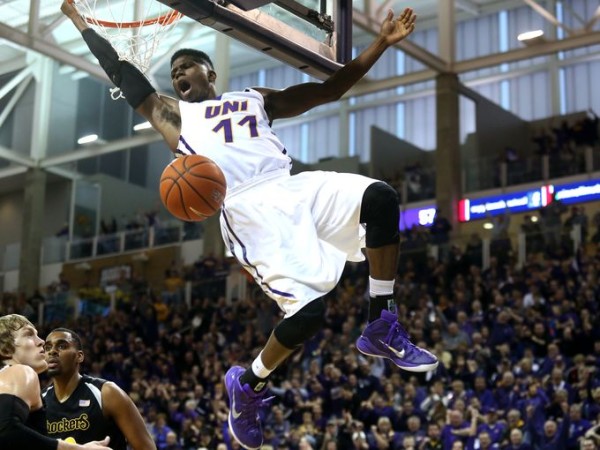
Missouri Valley Championship – Northern Iowa 67, Wichita State 52.  When Northern Iowa held Drake without a field goal for 28 minutes during their quarterfinal matchup on Friday, many people on press row who were unfamiliar with their stingy defense dismissed it as a statistical anomaly made possible by an inferior opponent. After holding #2 seed and NCAA Tournament Bubble Watch team Wichita State scoreless for 12 minutes during a 23-3 second half run today, those same people became believers. The Panthers had the second best defense in the country this year, and over three days in St. Louis, they showcased that defense in winning their second consecutive Arch Madness title.  In a 67-52 victory over the Shockers, UNI got big contributions from their bench: 25 points and a contagious energy level that gave their starters a chance to breathe easier in their third game in as many days. “Our bench stepped up huge for us tonight just like they did the night before,” commented Ali Farokhmenesh. “I think our bench was the biggest difference in that (23-3 run) and then probably in the entire game overall. They made huge plays for us and they wore down the starters for Wichita.” Jack Koch was the chief contributor off the UNI bench, hitting three clutch treys and finishing with 13 points.  Kwadzo Ahelegbe, who was named the tournament’s Most Outstanding Player, led the way with 24 points, which included 12-14 from the free throw line. He also hit two big three-pointers for the Panthers, whose other starters struggled for most of the day. “I have an easy job,” Ahelegbe told reporters after the game. “When you can get to the basket and nobody’s there because you have two great shooters, it’s easy, easy money.” Along with Ahelegbe, teammate Jordan Eglseder was also named to the All-Tournament team. Eglseder had remarkably consistent lines all weekend, scoring 10 points in each game, and grabbing 4, 5 and 5 rebounds in the three games while blocking five shots in the final.  Northern Iowa earns the automatic bid to the NCAA Tournament, where they haven’t won a game since a 1989 upset of Missouri in an era before they joined the MVC. They’ll almost certainly be favored to win their game this year, however, as the 28-4 Panthers should be a “protected” seed when the brackets come out. Can the Panthers stay motivated over the 12-day layoff between now and their first round game, though? “The players get to decide as a team what their goals are, and there are a couple still on there that we have not gotten,” noted coach Ben Jacobson after the win. “So there is a lot of motivation still. I really like how we played here. I knew today was going to be a close game, so that momentum helps as we go into practices getting ready for this. That’s an important part and we’ve got momentum and confidence.”  As for Wichita State, they’re a bubble team that likely finds itself on the outside looking in come Selection Sunday. Coach Gregg Marshall tried to make a case for them after the game to reporters. “We’ve got 25 wins, a couple of top 25 victories, we were undefeated at home. We’re a very talented team…we’ve got size, we’ve got 7-footers, we’ve got long, rangy athletes. We’re going to defend.” He then defended the league itself. “This is a pretty good basketball league. We had to play a team with 20 wins in the quarterfinals that was getting top 25 votes for December as a 2 seed. So that goes to show you the depth of the conference.”  In the end, what Northern Iowa showed against a good Wichita State team is that their defense is for real, and that they’re one of the better teams in the country. As Marshall noted afterwards, “Northern Iowa’s a great team. They’re well coached, they’re seasoned and they’re experienced. They’ll win games in the NCAA Tournament. Period.”

Back to Back Championships for UNI (WCF-Courier/M. Putney)

Colonial.  The CAA semis resulted in two excellent games, and RTC Live was there for both this afternoon in Richmond.  Top seed Old Dominion survived a tough-minded attack by VCU, whose campus is merely a few blocks down the road from the Richmond Arena.  Gerald Lee was awesome, scoring 26 points on 10-13 FGs, but it was his teammated Ben Feeney (11/6) who saved the day down the stretch as the Monarchs came from behind in regulation to tie VCU and send the game to overtime.  In the other semifinal, #3 William & Mary held on to outlast #2 Northeastern in a game that also came down to the last shot of regulation.  The Tribe’s David Schneider hit a three with 35 seconds remaining in the game — his only field goal — giving W&M the lead on a clutch shot for the second consecutive night.  Northeastern had seven chances on the final possession to tie or win, but none of them dropped for the Huskies.  ODU and W&M played twice previously this season, with the Monarchs winning both, and as you probably have heard, the Tribe will play for their first-ever NCAA Tournament bid tomorrow night.

Read the rest of this entry »


Breaking Down the Bracketbusters…

February 2nd, 2010

Special to RushTheCourt.  Ryan Restivo of the MAAC-based SienaSaintsBlog is the RTC correspondent for the Colonial Athletic Association. SienaSaintsBlog now features exclusive video!

The BracketBuster matchups are out, and as promised, RTC is here with some analysis of some of the top games!  Five Colonial Athletic Association teams lead the pack into these February weekend matchups. The Western Athletic Conference drew four bids and the Missouri Valley drew three.  One problem with the BracketBusters? Five of the television games will be on ESPNU, which of course means they’re not available on ESPN360.  However I’d say there are five games where you must, to quote another piece here, “quit your job and divorce your wife if that’s what it takes to watch this game live.”

Friday 2/19  (RPI)

Old Dominion (#46) @ Northern Iowa (#17)  – 7 pm on ESPN2/ESPN360

Get to Know Gerald Lee

The Monarchs will travel to Cedar Rapids to play where the Panthers have won every home game by an average of 14 points per game entering this week. 6’8 UNI senior Adam Koch is a tough-to-contain inside presence, scoring a team high 12.7 points per game. 6’10 ODU senior Gerald Lee will likely be assigned to the task of guarding Koch, an he has been a beast this year for the Monarchs, shooting 53% from the field and leading the team with 14.3 points per game. The matchup to watch in this game will be to see if Old Dominion can defend Koch on the inside while keeping their shooters, junior Kwadzo Ahelegbe (11.1 ppg) and Senior Ali Farokhmanesh (team high 42 3-pointers made), at bay. Both teams are first in their respective conferences in FG percentage defense at eerily similar numbers: Old Dominion’s 39.5% FG-defense is 21st while Northern Iowa’s 39.9% ranks 37th nationally. The Monarchs have had some defensive trouble lately, trying zones at Northeastern on Saturday when facing a team with similar size and offensive weapons as the Panthers, to give up a season high 59.5% field goal percentage. 

Saturday 2/20 (RPI)

Siena (#44) @ Butler (#19) – 11 am on ESPN2/ESPN360

The owner of the nation’s longest winning streak, Siena at thirteen straight, will go into an extremely tough environment at Butler in Saturday’s first Bracketbuster game. The Saints are led by 6’5 senior Edwin Ubiles and his 15.8 points per game as he makes his case for MAAC Player of the Year despite some lingering shoulder issues. Alex Franklin plays bigger than his 6’5 frame to lead the Saints down low with 16.1 points per game. On the other side, Butler’s Gordon Hayward has been a beast for the Bulldogs this year, scoring 16.1 points per game and tying a season-high 25 in Sunday’s comeback win over UW-Milwaukee. Hayward, a sophomore, is already attracting the attention of NBA scouts. Fellow sophomore Shelvin Mack has scored 15 points per game and Matt Howard, when not in foul trouble, scores 11 points per game. Howard has been tough to defend inside, going off for 23 points in Butler’s nine-point loss to Minnesota, but has had issues with foul trouble, getting disqualified in three of the Bulldogs’ four losses. It will be interesting to see how Siena defends Hayward and Howard and how this veteran Saints team led by seniors Ubiles, Franklin and Ronald Moore can contain this explosive offense on the road.

Read the rest of this entry »


RTC Top 25: Week 13

February 1st, 2010

A good discussion on twitter today about how to rank the top four (all one-loss) teams.  Here’s our version, with analysis after the jump:

Read the rest of this entry »


RTC Interview: Seth Davis On College Basketball, His New Show, & Fannovation

January 29th, 2010

Last week, RTC spoke with Seth Davis of Sports Illustrated and CBS to talk about a variety of topics on college basketball and a new promotion for Coke Zero. This is not the first time we have spoken with Seth as we interviewed him last March for the launch of his book “When March Went Mad” about the 1979 championship game between Magic Johnson and Larry Bird. Before the interview officially began, Seth expressed his displeasure about not getting linked every day in the Morning Five. We would give you the transcript of that discussion, but Chinese government regulations prohibit us from doing so.

Ed. Note: This interview took place last week, but due to some transcribing issues we are just putting it up now.

Seth Davis: Man of Intrigue

RTC: I guess we will start with your alma mater. Duke is looking strong again this year, but is different than they usually look as they are not relying on the outside shooting as much as a complete game. A lot of people have been talking up Duke. Do you think this is the year they can make it back to the Final Four?

SD: I do. I think they are legit. It’s kind of funny. Here they are ranked 5th or 6th in the country, putting together a great record, and there is not a lot of buzz about Duke right now. It’s funny to say that because they are so ubiquitous on television, but I think that we have all seen them get off to these great starts the past few years before they fall in the tournament. This team does things that those teams did not primarily defend and rebound. Those things are very important assets to carry into the tournament because at some point you are going to have an “off” shooting night and I think back for example to when they lost in the 2nd round to West Virginia. I think West Virginia was like +16 on the boards. At some point the shots aren’t going to fall. This team has the ability to overcome that so I don’t know from strictly a talent standpoint if I would put them on the Texas, Kentucky, and Kansas level, but do I think of them on a short list of contenders to get to the Final Four? Absolutely. I think by the way they will have a great chance of getting a #1 seed if they win the ACC regular season and then win the [ACC] tournament. I would be surprised if they aren’t a #1 seed.


RTC: Sticking with a US News & World Report College Rankings theme. Another team that has really made a lot of news this year is Cornell with a lot of close losses to very good teams, but that doesn’t impact their RPI and NCAA seeding as much as some people would think. How good is this team? How high do you think they could be seeded and how far could they go in the NCAA tournament?
Read the rest of this entry »

Early Week Conference Check-Ins…

January 6th, 2010

Colonial - Ryan Restivo of SienaSaintsBlog  (READ MORE)

William & Mary is on a Roll. The Tribe have won ten straight, a new school record, and won 48-47 at Hofstra on a Kendrix Brown three point play to continue their historic season.  William & Mary is 2-0 in the CAA for the first time since 1997-98.  The Tribe have not started this well since 1948-49 when they started 14-2.  More impressively, the Tribe never gave up the lead at Maryland after the 4:44 mark in the first half in a convincing 83-77 win in College Park.  After dropping their first two games to Connecticut by nine and Harvard in triple-overtime, the Tribe have racked up impressive statement wins over Richmond, Wake Forest and Maryland.  According to Kenpom.com, their Offensive efficiency is tops in the nation (124.2).

Missouri Valley – Patrick Marshall of White & Blue Review  (READ MORE)

Northern Iowa mowing down the Valley — Those that don’t consider Northern Iowa the class of the Valley need to have their head examined (including myself, before now).  The Panthers are on an 11-game winning streak after following a tough road win against Creighton in Omaha with victories against Evansville and Missouri State to race out to a 3-0 conference record in the first week.

SEC – Paul Jordan of Wildcat Blue Blog  (READ MORE)

The big story in the SEC this week was the arrest and indefinite suspension of four Tennessee basketball players — Tyler Smith, Melvin Goins, Cameron Tatum and Brian Williams.  The group was arrested on a myriad of drug and weapon charges.  Some of the charges were felonies, and given the recent problems with UT’s football program, it is hard to imagine any scenario in which the players may step back on the court this season.
ACC - Steve Moore  (READ MORE)

After splitting the top spot last week with rival UNC, the Blue Devils sit atop this week’s rankings all by themselves. No, it wasn’t the win over Long Beach State or the 59-point demolition of Penn. Duke pretty much dismantled highly regarded Clemson Sunday night, posting a 21-point win that was never even remotely that close.  Jon Scheyer is scoring more than enough for Duke, and Kyle Singler and the Devils’ frontcourt proved it could handle a seasoned big man like Trevor Booker. An impressive win, to say the very least.

Big Ten – Jason Prziborowski  (READ MORE)

Big 10 Madness has begun – Conference play started this past week in the Big Ten, and they didn’t disappoint. Indiana loses Maurice Creek, their top scorer and player, and then they upset Michigan at home. Michigan, not to be outdone, gets revenge for what their football team couldn’t do against OSU. Wisconsin, not wanting to miss out, blows out both OSU and PSU. Surprisingly, only Michigan and Minnesota have at least a win and a loss. Everyone else either hasn’t lost, or hasn’t won.


Where 2009-10 Happens: Reason #17 Why We Love College Basketball

October 20th, 2009

seasonpreview

Shamelessly cribbing from the very clever NBA catch phrase, we here at RTC will present to you the Thirty Reasons We Love College Basketball as we gear up toward the start of the season about three weeks from now.  We’ll be bringing you players to watch for this season and moments to remember from last season, courtesy of the series of dump trucks, wires and effluvia known as YouTube.

#17- Where Conference Tournament Finals Happen


2009-10 Conference Primers: #26 – Southern Conference

October 12th, 2009

seasonpreview

Justin Glover is the RTC correspondent for the Southern Conference. Click here for all of our 2009-10 Season Preview materials.

Predicted Order of Finish:

North Division- Two Divisions in the SoCon
1.  Western Carolina (14-6 SoCon) 22-11 Overall
2.  Samford (12-8 SoCon) 16-15 Overall
3.  Applachian State (10-10 SoCon) 17-14 Overall
4. Chattanooga (9-11 SoCon) 15-17 Overall
5. Elon (8-12 SoCon) 16-16 Overall
6. UNC Greensboro (3-17 SoCon)  4-26 Overall
South Division- Two Divisions in the SoCon
1.  College of Charleston  (16-4 SoCon)  24-9 Overall
2.  Davidson (12-8 SoCon) 19-14 Overall
3.  Citadel (11-9 SoCon) 17-15 Overall
4.  Wofford (9-11 SoCon) 16-17 Overall
5. Georgia Southern (7-13 SoCon) 11-20 Overall
6. Furman (6-14 SoCon) 10-21 Overall

North Division

  1. Western Carolina (13-5 SoCon) 22-11 overall
  2. Samford (11-7 SoCon) 16-15 overall
  3. Applachian State (9-9 SoCon) 17-14 overall
  4. Chattanooga (8-10 SoCon) 15-17 overall
  5. Elon (7-11 SoCon) 16-16 overall
  6. UNC-Greensboro (2-16 SoCon)  4-26 overall

South Division

  1. College of Charleston (15-3 SoCon)  24-9 overall
  2. Davidson (11-7 SoCon) 19-14 overall
  3. Citadel (10-8 SoCon) 17-15 overall
  4. Wofford (8-10 SoCon) 16-17 overall
  5. Georgia Southern (6-12 SoCon) 11-20 overall
  6. Furman (5-13 SoCon) 10-21 overall

All-Conference Team:

  • Andrew Goudelock (G)College of Charleston (Jr.) – 16.7 ppg
  • Cameron Wells (G) The Citadel (Jr.) – 15.6 ppg
  • Harouna Mutombo (F)Western Carolina (So.) – 14.4 ppg
  • Bryan Friday (F)Samford (Sr.) – 12.5 ppg
  • Noah Dahlman (C)Wofford (Jr.) – 17.8 ppg

6th Man. Jake RobinsonWestern Carolina (Sr) – Led the team in three pointers made (60) and attempted (167), coming off the bench in 19 games.

Impact Newcomer. Rashad WrightCollege of Charleston – Intimidating presence inside with his 6’9″ frame, averaged 10.8 points, 8.2 rebounds and four blocks a game at South Kent High School last season will look to contribute to a team that is lacking in size.

What You Need to Know. Although this conference lacks the star power of a certain recently departed, diminutive guard from Davidson, the conference is not devoid of talent as witnessed by the fact that the aforementioned guard didn’t even make the NCAA tournament last year. While the Wildcats will certainly fall off this year, don’t be surprised to see the second most famous basketball personality in the league last year (Bobby Cremins) getting plenty of airtime in March.

Predicted Champion: College of Charleston (NCAA Seed: #15) – Made it to the SoCon Championship game last season after a Cinderella type run knocking off the favorite in Davidson on their way to the finals. They have always been an athletic team that uses stellar guard play to offset lack of size inside. With the starting back court of Tony White Jr., who scored 31 points in the SoCon finals game against Chattanooga, and junior all-conference candidate Andrew Goudelock who led the team in points per game and three pointers. CofC should be the team to beat in the Southern Conference this season with close to 75% of its scoring coming back from a team that made the finals in the conference tournament.

Read the rest of this entry »


5 Down, 60 To Go…

March 8th, 2009

Just one more ticket punched today, but rest assured no high major team will want to see Missouri Valley champion Northern Iowa in their first game. Here’s your brief introduction as now five invitees have accepted the NCAA’s bids.

danceticket-1951

#5 – Northern Iowa (23-10, 14-4 MVC). UNI won the regular season championship and took care of business this weekend at Arch Madness, winning tight ones over Indiana St. and Illinois St. (in OT) to get the automatic bid.  In today’s game, we kept expecting Illinois St. to put UNI away behind the shooting of Osiris Eldridge and Champ Oguchi; but UNI stayed poised and made the correct plays down the stretch to secure the third win over ISU this season.

Projected Seed: #12

Something to Remember: UNI likes to slow the pace down to a crawl.  They don’t turn the ball over, they hit their FTs (75%) and they don’t make many mistakes.  Look for a possible upset if they play an undisciplined team that gets frustrated with ball-control teams.

Stay tuned – four more tickets will be punched tomorrow – CAA, MAAC, SoCon, WCC.  RTC Live will be reporting live from the WCC Finals.


ATB: Happy in Happy Valley

March 6th, 2009

afterbuzzer1

Game of the Night. Penn St. 64, Illinois 63. It was nice to see a team turn the tables on Illinois after they had pulled off a furious comeback win in the last five minutes against Northwestern.  PSU was down ten pts with five minutes remaining, but the Lions stormed back and when Talor Battle’s feathery soft leaner dropped through with 0.3 remaining on the clock, the “white house” of fans went wild and quickly RTC’d the court.  Now, THAT is how you RTC, friends!  Quick, no hesitation, straight to the middle of the floor.  Immediate bedlam.  We have two clips here – the first will show the tv version of the winning shot by Battle (scroll ahead to the 6:00 mark); the second is a user-generated clip of the RTC.  Enjoy.  (btw, PSU is IN if they win at Iowa this weekend)

The Rest of Tonight’s Key Games.

  • UCLA 79, Oregon St. 54. The Bruins kept their Pac-10 title hopes alive with a blowout win over Oregon St. tonight.  If they beat Oregon this weekend and Washington loses to Wazzu, then they’ll both be tied at 12-6, where the Bruins would presumably win the tiebreaker.  What’s up with Josh Shipp’s line tonight?  27 pts, 0 rebounds, 0 assists, 0 blocks, 0 steals, 0 turnovers, 0 fouls, 1 block.  He really didn’t do anything other than shoot tonight, did he?
  • Villanova 97, Providence 80. Villanova picked up its second strong win of the week as it continues to make its case for the coveted double-bye in the Big East Tournament.  Scottie Reynolds had 23/4/4 stls as Nova finished off a perfect home slate.  Providence has a #69 RPI but finished at 10-8 in the Big East – what to do with the Friars?
  • USC 80, Oregon 66.  USC shot 59% behind Demar DeRozan’s 19 pts and Taj Gibson’s 18 pts as the long nightmare continues for Ernie Kent’s Oregon team.  USC is a classic bubble team, sporting a mid-40s RPI and what will likely be a 9-9 Pac-10 record come Saturday night.
  • California 83, Arizona 77.  Arizona really didn’t need to lose another home game, but they’ve fallen apart the last two weeks.  Tonight’s loss to Cal was their fourth in a row, and they absolutely need to get the game against Stanford this weekend to turn this around.  Cal’s Jerome Randle had eight threes on his way to 31 pts.
  • Temple 68, St. Joseph’s 59.  This Big Five matchup had A10 ramifications as Temple moved into a two-way tie for the #3 seed in the conference (tied with Dayton), as well as kept their bubble chances alive.
  • Tennessee 86, South Carolina 70. Tough home loss for SC, while Tennessee captured the top seed in the East Divison of the SEC behind Tyler Smith’s 22/6/7 assts.  The Vols are coming on lately, having won at Florida and SC in their last two games.
  • Stanford 74, Arizona St. 64. ASU is slumping lately, having lost their last three games.  James Harden had 22, but was only 2-10 from three, and it doesn’t appear if either of the Arizona teams have much interest in playing deep into March at this point.

QnD Conf Tourney Update.  Tomorrow the America East, CAA, MAAC, SoCon and WCC begin.  Here’s what happened tonight.

A-Sun. The two higher seeds, #3 Belmont and #4 Lipscomb advanced, meaning the top four seeds will be in the semis starting tomorrow.

Big South. VMI will play Radford (the top two seeds) on Saturday for possibly the first NCAA automatic bid this year.

MVC. Indiana St. and Wichita St. advanced to the quarters.

NEC. The top three seeds (Robt. Morris, Mt. St. Mary’s, Sacred Heart) + Quinnipiac advanced to the semis on Sunday.


Missouri Valley Conference Wrapup & Tourney Preview

March 4th, 2009

Patrick Marshall of Bluejay Basketball is the RTC correspondent for the MVC and Big 12 Conferences.  He will be reporting from the MVC Tournament this weekend in St. Louis, Missouri.

mvc-final-standings-comparison

The Missouri Valley Conference finished regular season play this last week with Northern Iowa and Creighton sharing the MVC regular season crown.  Due to the complicated tie-breaker formula, Northern Iowa received the 1-seed for the MVC Tournament and Creighton the 2nd.   My preseason predictions weren’t exactly what happened, but like the whole bizarre Valley season usually is, the middle was all muddled up.   No one expected Northern Iowa to be as good as they were in conference play and at the same time, it wasn’t expected to see Southern Illinois take such a nosedive so fast in the past two seasons.

The MVC released their postseason awards on Tuesday with Booker Woodfox from Creighton getting the Larry Bird MVC Player of the Year honors.  Woodfox leads the nation in 3-point shooting at 50.9% and averaged almost 16 points a game.  Champ Oguchi from Illinois St. received the Newcomer of the Year award.  I’m a little surprised that Bryan Mullins won the Defensive Player of the Year honors when he missed almost the whole last half of the conference season.  Maybe it is a lifetime award or something.

This Thursday night starts what is affectionately known as Arch Madness.  I will be down in St. Louis covering things for Rush The Court with a planned RTC Live for at least one game each day starting Friday and other daily updates.  I will also have all-access to the postgame news conferences and other media information.  If you have things you want me to check out or have questions for the coaches or players – but I won’t be the guy that got kicked out of the Creighton game last weekend—then be sure to ask.

Let’s take a look at the matchups starting on Thursday:
Read the rest of this entry »


Championship Week is Actually Two Weeks, Starting Tomorrow

March 2nd, 2009

We all know that the calendar turned to March a little over 36 hrs ago, but did you know that we’re already on the verge of conference tournament season?  ESPN’s ballyhooed Championship Week doesn’t start for another seven days, but some of the smaller conferences are ready to tip it off and crown a champion.  Immediately, as in…  Tomorrow. 

Yes, the Big South, OVC and Horizon are all playing elimination games within the next 24 hours, and we’re quite sure that you weren’t aware of that.  The Patriot League begins Wednesday, and there will be ten other conferences that will start their tournament extravaganzas this week, with five of those finishing before Saturday is through.  In order to keep up with it all, we produced this schedule for our own internal use that might as well be made public for you guys also. 

2009-conf-tourney-schedule-v3

Also keep in mind that RTC Live will be attending the festivities this week in St. Louis, Richmond and Las Vegas for the MVC, CAA and WCC Tournaments, respectively.  Should be a blast at all three of those high mids.


ATB: Orange Crushed

January 14th, 2009

afterbuzzer

Some mid-week news and notes

  • One of the nation’s top prospects, 6′9 Derrick Favors, decided on his hometown school Georgia Tech today.  He’ll join a long line of 1-and-dones at Ga Tech under Paul Hewitt.  Speaking of recruits, Gary Parrish spoke with Sonny Vaccaro about the Brandon Jennings Experiment, and it appears more players are interested in testing the waters in Europe next season.  What’s left unsaid in this article is how BJ’s year in Europe (where he’s not playing all that well) will impact his draft status.
  • Kansas guard Mario Little will play out the remainder of the season rather than apply for a medical hardship due to his stress fracture (leg) and hand injuries.
  • The MVC and Mountain West will start an ACC/Big 10-style Challenge next season.   Great idea.  Kyle Whelliston should be happy about this.
  • Vegas Watch breaks down his Futures Watch with eight teams in Part 1 and another seven in Part 2.
  • Seth Davis breaks down the non-conference strength of schedule RPIs to see who is in good shape and who is in trouble come Selection Sunday.

Tonight’s Big East Blockbuster (there’s seemingly one every night)Georgetown 88, Syracuse 74. Looks like nvr1983 may have been onto something earlier today in his SYT piece previewing this game when he ripped Syracuse’s schedule thus far.  The bottom line about this game is this.  When Georgetown shoots the ball from deep as well as they were today (12-21 from three), the Hoyas are nearly impossible to beat due to their system.  The discipline they show on the offensive end limits their turnovers and their players are drilled to always move the ball to find the open man.  The reason Georgetown isn’t the top national title contender, though, is because they don’t usually shoot it that well.  They’re currently ranked #205 in 3fg% at 33%, which is below the national average of 34%.  Tonight was a bit of an anomaly, but Syracuse looked significantly off its game tonight – the Orange shot the ball ok (48%) and outrebounded the Hoyas by seven (who doesn’t?), but their defense seemed a couple steps slow on their rotations and losing Andy Rautins to injury early in the game seemed to remove most of the wind from their sails (word is that Rautins will be ok).  The thing about this conference that Syracuse must remember is that any one game is simply that – one game.  Georgetown just finished a five-game stretch where they played four Top 10 teams and came out of it 3-2 – they’ll take that in spades.  Cuse, on the other hand, played four bottom-dwellers (starting 4-0), and is about to play Notre Dame, Pitt and Louisville in succession – they’ll be lucky to get a split in this four-game stretch.  Everyone in the Big East is going to lose games.  The strongest teams in March will have learned from these wars and made the necessary adjustments – that’s what Syracuse needs to take away from tonight’s loss.  Oh one final note – that Dajuan Summers and-one was unreal.

Peter Lockley/Washington Times)

(Photo Credit: Peter Lockley/Washington Times)

Upset of the Night. Colorado St. 71, UNLV 69. Ouch.  CSU came into this game 5-11 overall.  UNLV had better be careful, as they’ve now lost two in row in the Mountain West to teams they shouldn’t be losing to (TCU was the other).  The Rebs had built a solid non-conference resume with wins over Arizona and Louisville, but all of that good will has disappeared with these last two losses.

Other Games Inducing General Malaise.

  • Michigan St. 78, Penn St. 73. PSU used a furious second-half comeback to shave 16 pts off of a 17-pt lead and give MSU a huge scare, but the Spartans held on for their tenth in a row.  Penn St. is becoming a place nobody in the Big Ten wants to play.
  • Duke 70, Georgia Tech 56. Duke only hit 39% from the field but was able to completely shut down Tech’s scorers, holding Gani Lawal, Lewis Clinch and Alade Aminu well below their averages.  Kyle Singler and Gerald Henderson had 19 each.
  • Pittsburgh 75, South Florida 62. The nation’s #1 team started slowly, but they pulled away in the second half – perhaps they were looking ahead to their battle with Louisville on Saturday night.  DeJuan Blair singlehandedly outrebounded USF on the offensive end (9-8).
  • Davidson 83, Elon 68. Stephen Curry dropped 6 threes en route to a 39-pt night.  He must have seen that Jodie Meeks added 2 pts/game to his average in one night and needed to secure his national lead in scoring.
  • Florida 68, Auburn 65. We caught a little of this one, and as usual, UF failed to impress.
  • LSU 85, South Carolina 68.  LSU is now 13-0 at home, 0-3 on the road.  Tasmin Mitchell blew up for 30/14 tonight.
  • Mississippi 74, Arkansas 65. Speaking of which, Arkansas has beaten Oklahoma and Texas at home, but is 1-2 on the road.
  • Creighton 73, S. Illinois 72 (OT). P’Allen Stinnett dropped 29 pts in the late comeback win for Creighton at home, which SIU apparently was trying to give away (and they did).
  • Illinois 66, Michigan 51. The Illini held Michigan to 32% shooting, including an ugly 3-14 night from DeShawn Sims.
  • Wake Forest 83, Boston College 73. Wake improves to 15-0 behind Jeff Teague’s 29 pts, setting up a huge matchup of unbeatens at Clemson on Saturday.  Check RTC’s liveblog of this game here.
  • Miami (FL) 62, Maryland 60. Another gutpunch loss for the Terps, who led 52-35 with 12+ minutes to go in the game.  Miami, behind five late threes from Jack McClinton and James Dews, roared back to take their first lead with 24 seconds remaining.
  • Texas A&M 84, Baylor 73. A&M is quietly putting together an NCAA resume, and by watching the Aggies tonight, they have sufficient talent to get there this year and do some damage.  All five starters for Texas A&M reached double figures, and they showed an array of ways to score.  Baylor has to improve on the road in the Big 12 to ever make the leap to serious contender (4 wins in the last 33 trips).

Watch Out, SEC. The Mountain West is Breathing Down Your Neck.

December 11th, 2008

You may recall last week that we looked at how the power conferences (ACC, Big 10, Big 12, Big East, Pac-10, SEC) were doing halfway through the non-conference schedule this year.  We generally concluded that the ACC and Big East are currently at the top of the heap, and the SEC in particular should be booted out of the group.

What Mid-Majors Play For

What Mid-Majors Play For

But what about the mid-majors?  As important as the non-conference slate is for the BCS schools in terms of seeding and whether five or six teams are invited to the Big Dance, it’s even more important to the mid-majors who are fighting for simply a second or third bid and assuredly will see their conference RPIs drop once conference season begins.  So today we take a look at evaluating the mid-majors’ performance thus far, keeping in mind the dual criteria for success that we established last week – considerable success against your peers and domination of your subordinates.  We’ll add a third criterion for these mid-majors, which is a reasonable showing against your superiors (the power conference schools) as well.  So let’s take a look at the W/L numbers thus far (through 12.11.08):

mid-majors-h2h-121108

It seems clear to us right off the bat that the Mountain West (ranked #7 by both Sagarin and Pomeroy) has the best overall profile thus far.  While it has struggled with its BCS record (.214), its measure in that category is only significantly worse than two conferences – the A10 (.355) and the WCC (.411) – in that regard.  But the MWC has absolutely dominated its peer conferences (.704) and its underlings (.900) as if it were a power onference-lite (watch yourselves, SEC).  It’s overall non-conference record is also outstanding for a mid-major, at 49-22 (.690), bettering its peers by a considerable margin (#2 - Missouri Valley - .583).

For the next best mid-major conference, we’re split between the Missouri Valley, Atlantic 10 and Conference  USA.  The A10 has a solid 11-20 (.355) record against the big boys, whereas the MVC (.176) and CUSA (.263) do not, but the MVC has performed significantly better against its peers (.583 vs. .357/.500, respectively).  All three conferences have pretty well owned their subordinates this year.  So how to distinguish the three?  Let’s go with the top-heavy theory.  According to Sagarin, the A10 has six teams in the top 100, the MVC has five, and CUSA has four.  Good enough for us.

mid-major-licious-2

There’s a pretty clear delineation between these top four mid-majors and the others – WCC, Horizon, MAC, WAC, Colonial, but we’re not going to try to distinguish from among this group because it’s largely too close to call based on the above data.  As it currently stands, it will be a struggle for any of these five conferences to put a second team into the NCAA Tournament this year (St. Mary’s needs to keep that in mind).  Nevertheless, we do want to point out a few interesting observations that we had along the way.

  • The MAC is 0-16 against power conference schools.  You’re not going to be a mid-major very long playing like that.  The Colonial is barely any better.
  • The WCC is a respectable 7-10 against the power conferences, but lays an egg against the low-majors (9-12).  We have to believe this shows just how top-heavy this conference is (w/ Gonzaga and St. Mary’s).
  • The Horizon needs to play more games against D1 opponents – we can’t believe they’ve only played 12 games against the low majors (6-6).

We’ll check back in on this when we get to the end of the non-conference schedule, because at that point with few exceptions, conference positions are relatively static.


RTC Back to School: 2008-2009 Preview

November 10th, 2008

rtc-08-09-preview

For those of your who haven’t been spending as much time on Rush the Court the past few months as you should (looking at myself in the mirror), we thought we would offer you a quick guide to what we have been working on over the past few months.

General Overview: Some top quality writing/prognosticating to get you in the spirit for the run from today until the early morning hours of April 7th, 2009.
- Finally, It’s Here: New RTC feature columnist John Stevens offers his thoughts about the upcoming season.
- A Little Preseason Bracketology: RTC co-editor (Do we even have titles?) rtmsf does his best Joe Lunardi impression and makes a surprising pick for his national champion. I’m smelling an attempt to make the RTC preseason bracketology championship the new Madden cover.
- Vegas Odds – Preseason Check-In: For the degenerate gamblers out there, RTC co-founder rtmsf offers an analysis of the Las Vegas odds for the 2009 NCAA champions for pure academic purposes. . .
- Preseason Polls Released: The surprisingly employed (I’m running out of titles here) rtmsf analyzes the AP and Coaches polls going into the season with a deeper look at unanimous #1 UNC’s early schedule.
- ESPN Full Court: 562 Games of Gooey, Delicious Goodness*: Once again, rtmsf comes through with the entire ESPN Full Court schedule with a Steve Nash-style assist from Patrick Marshall of Bluejay Basketball.

Big Early Season News: While there are several big stories going into this season, there were 2 major stories that have come out recently that you should know about before you start watching games.
- Tyler Hansbrough Out Indefinitely: Who? Oh yeah, that guy. Everybody’s favorite for national POY and NBA Draft Day snub (get ready for the annual Dick Vitale rant) Psycho T will be out for a while, but we think the Tar Heels will be ok by March.
- Jai Lucas Leaving Florida: In a story that isn’t getting nearly the attention that the Psycho T story has (for good reason), Billy Donovan has lost last season’s starting point guard on the eve of the new season. While it appears that Lucas was probably heading towards a role as a backup point guard on the Gators, the timing of this announcement is surprising. It will be interesting to see what the Gators will do if freshman guard Erving Walker struggles in adjusting to SEC basketball.
Conference Primers: As part of our attempt to make a new-and-improved RTC, we hired the finest journalists in America to make our site more all-inclusive of the little people in the college basketball landscape. To that end we put together 31 conference previews (31 automatic bids to the Big Dance means 31 previews from RTC) with the help of the aforementioned correspondents.
- ACC
- America East
- Atlantic 10
- Atlantic Sun
- Big 12
- Big East
- Big Sky
- Big South
- Big Ten
- Big West
- Colonial
- Conference USA
- Horizon
- Ivy League
- MAAC
- MAC
- MEAC
- Missouri Valley
- Mountain West
- Northeast
- Ohio Valley Conference
- Pac-10
- Patriot League
- SEC
- Southern
- Southland
- Summit
- Sun Belt
- SWAC
- WAC
- West Coast Conference

As the season progresses, we will have more features and content including updates from all 31 conferences. We hope all of you are looking forward to the new season as much as we are and even if your team looks like it will struggle to make it to the NIT, remember the words of Kevin Garnett, who incidentally didn’t play a minute of college basketball (that’s another post), “Anything is possible!”


Blogpoll – Week 3

November 29th, 2007

What a week. So we’re a little late on this week’s blogpoll, among several other things, but we’re slowly getting caught up and feel that this week’s poll is the first one that accurately captures how teams are playing several weeks into the season. We’ve had a chance to watch most of the teams in the poll ourselves, and our illustrious blogging brethren have ostensibly done likewise. So here’s Week 3 (blogger ballots located here)…

Blogpoll - Week 3

Note: blogpoll does not include 11/27-28 games.

Justifying Our Ballot. We still rank UCLA #1 and UNC #2 ahead of overall #1 Memphis simply based on the fact that we believe UCLA and UNC have beaten better teams than Memphis thus far. Memphis looked solid in CvC wins versus Oklahoma and UConn, but those teams are probably mid-conference finishers this year. UCLA has a marquee win (w/o Darren Collison) against #13 Michigan St., a team that is better than we thought; and UNC has solid wins over likely NCAA teams Davidson, Old Dominion and #20 BYU (w/o Ty Lawson). Memphis will have an opportunity this weekend to improve its standing in our eyes with a win vs. #25 USC. Like everyone else, we raised #9 Texas A&M and #6 Duke on the strength of their wins in the PNIT and Maui, respectively, and #8 Texas got a nod into the top ten by virtue of its destruction of #12 Tennessee. In the lower reaches of the top 25, we still refuse to vote for #18 Clemson despite their win at Mississippi St. We’ve been down this road before with them, and if the Tigers are 14-0 going into the game vs. UNC on January 6, then we’ll consider it. We also left BYU, Miami (FL), and USC off of our ballot, figuring that Stanford, Ohio St., Wisconsin and Baylor had put together better resumes to this point. After the ACC/Big 10 meetings the last two nights, we’re really questioning our sanity on those two midwestern teams above.

Uncertainty. We’re still seeing blogger indecisiveness when it comes to Indiana and Michigan St., but some new additions at the low range of the top 25 populate our list this week. Here are the top five most uncertain teams (remember, a high std dev means greater variation in blogger rankings of that team):

  • Indiana (std dev = 6.43; range = 10 to nr)
  • Pittsburgh (6.39; 8 to nr)
  • Clemson (5.74; 11 to nr)
  • BYU (5.44; 13 to nr)
  • Michigan St. (4.83; 8 to 21)

The top seven teams in the blogpoll are also the top seven lowest standard deviation this week.

Conference Call.

  • Big East – 5
  • ACC & Pac-10 - 4
  • Big 12 - 3
  • Big 10 – 2
  • Atlantic 10 , CUSA, Horizon, MVC, Mtn West, SEC, WCC – 1

Wow, the SEC is really struggling right now, with only one team ranked (Tennessee) and that squad getting its doors blown off by Texas last week. The ACC only has four ranked teams, but leads all conferences with 6 of the 31 remaining unbeaten teams in D1. Impressive that half of that league is still flawless. Other BCS unbeatens: (Big East & Big 12 – 4 each; Pac-10 – 3; SEC – 1; Big 10 – 0).


Breaking Down the Preseason Mags… pt. 2

September 14th, 2007

So Wednesday we established that the Athlon Sports preseason magazine is one that you probably shouldn’t take home with you. Unless you’re the type of person who goes gaga over seeing your favorite team/player on the cover and must own them all in a Sisyphian quest to document every newsworthy event involving it throughout history. Consider this excitable Carolina fan’s tale we stumbled across today (re: the Athlon issue)…

Yep, arrived in Atlanta area stores last week, and every darn store I checked had the Georgia edition (one UGA player and one Ga Tech player on the cover). Same as last year. And the year before. Ad nauseum.

So I will do what I do every year – wait until all the mags are out, then drive up to visit my brother in NC and buy every mag with a Heel on the cover. That is always one of my most happy trips of the year.

Hey, we don’t judge. So here’s the second installment of our continuing series of reviews of the preseason magazines.

Next Up: Lindy’s.

Lindy’s


I. Covers (5 pts) - are they cool? inclusive?

  • 21 regional covers is a nice number, but the Rocky Mtn states aren’t represented in the least – Does Lindy’s realize that the Mountain West and WAC have fans too?
  • Coolest Cover – none – they’re pretty much all the same format, with multiple players photographically stacked on top of each other.
  • Say What? The Tennessee issue highlights UT, Memphis, Vandy and the Lady Vols?? The NE issue features UConn, BC and something called the “Lady Huskers,” which we assume is supposed to be “Huskies.” Either way, we have no tolerance for this.
  • Total Points = 2

II. Ease of Use (5 pts) – how hard is it to find confs/teams?

  • Somewhat difficult upon first glance. Eleven major conferences are arranged alphabetically, then by predicted order of finish of its teams. The rest of the conferences are shoved into the back of the mag with the teams arranged alphabetically within. Confusing.
  • Standard format otherwise – roundup, features & predictions; analysis of teams; recruiting, in that order.
  • Total Points = 2.5

III. Roundup (10 pts) – every mag has one – tell us something new!

  • Scoping the Nation dives into the one-and-done phenomenon, and pretty much makes the same assessment we made here back in May – that coaches at the elite programs recognize the necessity in assuming the risk of taking potential one-and-dones. The potential reward, as in the cases of Greg Oden and Mike Conley for Thad Matta at Ohio St., is simply too much to pass up. They also take a look at the ten most likely one-and-dones for this season and next.
  • The Nov/Dec Action to Check Out section is a bit of a copout by Lindy’s in the sense that its early publication resulted in not being able to review full schedules. Still, they make an attempt by reviewing the big pre-conference game possibilities in the holiday tournaments.
  • Lots of Lists – that’s ok, we like lists.
    • Top 10 “under the radar” players
    • Top 10 transfer players
    • Top 10 juco transfers
    • Top 10 jump shooters
    • Top 5 defenders
  • Lindy’s also provides a complete Top 25 (+15 fringe teams), a listing of the NCAA field of 65 by conference, as well as predictions of the Sweet 16 and Final Four.
  • There is also a complete list of coaching changes and the conferences are rated first (Pac-10) to worst (SWAC).
  • We also appreciated seeing deserving blurbs on Rick Majerus’s return to college coaching at St. Louis, and Skip Prosser’s passing at Wake.
  • They also rate the Top 25 players at each position…
    • PG – Drew Neitzel (Michigan St.)
    • SG – Chris Lofton (Tennessee)
    • SF – Brandon Rush (Kansas)
    • PF – Tyler Hansbrough (UNC)
    • C – Roy Hibbert (Georgetown)
  • …and the top frontcourt (UCLA) and backcourt (UNC).
  • Cool Stat Award. Utah St. guard Jaycee Carroll’s shooting numbers – .527 from the field, .432 on threes, and .888 from the foul line!
  • Total Points = 9

IV. Features (15 pts) – give us some insightful and unique storylines.

  • Kentucky-centric. Three of their feature articles relate to the UK head coaching position – Tubby’s leaving of the job (He’s Gone), Billy D’s courting of the job along with his about-face with Orlando (He Couldn’t Leave), and Gillispie’s acceptance of the job (Billy & the Believers).
  • What’s Good for the Zags… is a good article about the pressures that other mid-major programs (even the successful ones) now face in light of the Gonzaga Effect.
  • Embracing Kelvin is an insightful piece about the “my way or the highway” coaching style of Kelvin Sampson, and validates why we expect big things from IU this season.
  • Early and Often is a somewhat weaker article describing how coaches are faced with recruiting players earlier and earlier in high school (and sometimes back into junior high).
  • Total Points = 11

V. Predictions (20 pts) – how safe are their picks? do they take any chances? are they biased toward the big boys?

  • Lindy’s uses both the 65-team prediction model and the Top 25, as discussed above. Like Athlon, they too have UCLA defeating UNC in the final game, but we give them a little bit of credit for projecting first-timer Tennessee into the F4. They don’t predict an Elite Eight, but only half of their Sweet 16 made it there in 2007, which is realistic.
  • Big Conference Bias. Still, 14 of that Sweet 16 are from BCS conferences – Gonzaga and Memphis are the only exceptions. NCAA Bids – ACC (5), Big Ten (4), Big 12 (5), Big East (8), Pac-10 (7), SEC (7).
  • Mid-Major Watch. Mid-Major bids – 3 A10 (Xavier, St. Joe’s, St. Louis), 2 CAA (George Mason, VCU), 2 CUSA (Memphis, UAB), 1 Mountain West (BYU), 1 WAC (New Mexico St.), 1 MVC (S. Illinois).
  • Surprising Omissions. Florida loses everyone, but are there really seven better teams in the SEC this year? Billy D. has the #1 recruiting class coming into Gainesville. We also think Lorenzo Romar’s Washington squad is primed for a return to the NCAAs this year. Also, we gotta believe that the always-underrated MVC will manage to get another team in there, while seven (Georgia and Vandy??) from the SEC is a little ridiculous this year.
  • Boldest Prediction. Again, Lindy’s doesn’t go too far out on a limb with any of their picks, but Alabama winning the SEC West completely depends on Ronald Steele’s knees, and Cornell winning the Ivy League is also dubious.
  • Total Points = 14

VI. Conference Pages (5 pts) – as a primer for the conference, how much can we learn here?

  • The major and mid-major conferences get a predicted order of finish with brief analysis, a substantial recruiting roundup, three teams of all-conference selections, returning leaders in key categories, team stats and a fair superlatives section. While we appreciate a focus on acquainting readers with the newcomers, we would have liked to have seen less space used on this in favor of the returners.
  • The small conferences get a predicted order of finish, two teams of all-conference selections and a superlatives section.
  • Total Points = 3.5

VII. Team Pages (20 pts) – how in-depth is the analysis? where does it come from? is it timely and insightful given this year’s squad or is it just a rundown of last year’s achievements?

  • Lindy’s Top 40 teams get a full page of analysis, including player evaluations and team statistical rankings.
  • All other BCS and mid-major teams get a brief half-page of analysis with the same evaluations/rankings. Low major teams (even if predicted to make the NCAA Tourney) get a paragraph and a few key stats. Minimal info.
  • Again, similar to Athlon, analysis is lacking. Much of it is based on recapping last season’s accomplishments plus the obligatory coach’s quotes. For teams outside the Top 40, they barely get a mention.
  • Total Points = 12

VIII. Recruiting (5 pts) – we want to know who the top players are coming into college bball, where they’re going and who to watch for next year.

  • As mentioned above, each major conference page has a substantial section on newcomers and what their strengths and weaknesses are.
  • Six pages of recruiting information, featuring the top 25 recruiting classes with a brief description of each.
  • The top 50 of 2007 is provided by Rivals.com, but Lindy’s focuses on the future classes more than present, listing the top 100 for both 2008 and 2009, plus the top 10 for 2010.
  • They also provide some much-needed context and analysis from Justin Young at Rivals.
  • Total Points = 5

IX. Title IX Guilt (aka Chick Ball) (5 pts) – the less the better…

  • We already established that they’re putting some women’s players on the cover.
  • They also give it four pages in the front features section, with a detailed top 25 and fifteen All-Americans. Unacceptable.
  • Total Points = 1

X. Intangibles (15 pts) – what’s good and bad about the magazine as a whole?

  • Errors. We’re not sure if the cause is shoddy editing or what, but who and what are Reyshawn Green Terry (formerly of UNC) (p.9), David Lightly Lighty (Ohio St.) (p.18) and Gongzaga Gonzaga (p.28)? – these errors were found in the first few pages and seemed pervasive throughout, mitigating the mag’s credibility from the start.
  • Whereas Lindy’s provides far more interesting detail in almost every other area over Athlon, its writing (and clearly its editing) is weaker on the whole.
  • Again, no schedules due to the early publication date.
  • It takes some risks with its predictions (which we like), but its analysis really doesn’t explain why, e.g., Georgia is an NCAA Tournament team and Florida isn’t.
  • Total Points = 9

RTC Grade for Lindy’s = 69 pts

Basis: Lindy’s is a better magazine on the whole than Athlon, but it has serious weaknesses with respect to its team analyses. Where it excels is in the areas of roundup and recruiting information, but it needs better writing, editing and much more consideration of the smaller conferences. A little more attention to detail would make this magazine a legit value in future iterations.

Grading Scale:

  • 90-100 pts - exceptional quality in all areas – must buy and keep on-hand all season!
  • 80-89 pts - very good quality mag – worthy of purchasing and reading cover-to-cover
  • 70-79 pts - average, run of the mill magazine – some value in certain areas but weak in others – tough call as to whether to purchase it
  • 60-69 pts - magazine on the weaker side, but may still have some positive attributes – probably not worth the money, though
  • 0-59 pts - such a low quality magazine that it’s not worth any more than the five minutes you thumbed through it at the store

Breaking Down the Preseason Mags…

September 12th, 2007

We’re heading into the middle of September already, literally thirty days until Midnight Madness, and the first batch of preseason mags are already proliferating on B&N shelves like West Virginians on crystal meth at a swap meet (no offense intended to the West Virginians not on crystal meth, of course). We know many of our readers are asking, “what’s a magazine?” To which we reply, “it’s what old people read while they’re on the toilet.” For our few readers here over 30 (present company excluded), we offer the first installment of our continuing series of reviews of the preseason magazines.

First in line: Athlon Sports.

Athlon Preseason Cover 07

I. Covers (5 pts) - are they cool? inclusive?

  • 34 regional covers seems like overkill, but we suppose having a Minnesota/Iowa/Iowa St. cover matters to someone.
  • Coolest Cover – for some reason, we particularly like the elated yet menacing look Patrick Beverly gives the camera on the Arkansas edition.
  • Say What? Athlon’s UCLA/USC cover (above) features Kevin Love and OJ Mayo in their Burger Boy unis – was it really too much trouble to shoot them with their correct jerseys on?
  • Total Points = 4

II. Ease of Use (5 pts) – how hard is it to find confs/teams?

  • Conferences and teams are arranged alphabetically, allowing for quick navigation assuming you know your conference.
  • Standard format otherwise – features & predictions; analysis of teams; recruiting, in that order.
  • Total Points = 4

III. Roundup (10 pts) – every mag has one – tell us something new!

  • 10 Things to Watch is ok, but we didn’t learn anything new (i.e., the Pac-10 is great, keep an eye on Love/Mayo/Gordon, etc.).
  • Hoops Madness is a little better, mostly because of its lists of emerging stars (hot sophs to watch), top transfers and coaches on the hot seat. Also enjoyed learning that Dayton’s band has become the band by proxy for the Niagara Purple Aces (since NU doesn’t have one).
  • Cool Stat Award. Memo to Adam Lonon (VMI) – shoot more! (31 starts, 26 FGs)
  • Total Points = 5

IV. Features (15 pts) – give us some insightful and unique storylines.

  • Next Generation is a decent article about the young brigade of coaches who have been successful so far (Donovan, Matta, JT3, Howland, etc.). It wasn’t unique, as we expect to see a lot of this in the rags this year.
  • The Fix relates the story of the Tulane pointshaving scandal two decades ago. Although the article briefly mentions the Tim Donaghy story, it focuses primarily (and misguidedly) on the people involved in the scandal. What we needed to see here was an article about the existence of gambling among college athletes and efforts to prevent it. Big swing & miss here.
  • The Scoop is three one-page interviews with Ronald Steele (Alabama), Bill Walker (Kansas St.) and Drew Neitzel (Michigan St.), none of which are very interesting.
  • Total Points = 5

V. Predictions (20 pts) – how safe are their picks? do they take any chances? are they biased toward the big boys?

  • Athlon uses the 65-team prediction model, eschewing the traditional Top 25 (they get pts for that). But Athlon goes waaaaaaaaay safe by predicting six of the elite eight the same as 2007 (Georgetown, Kansas, Memphis, UNC, Oregon, UCLA with Louisville and Tennessee added for good measure). UCLA defeats Carolina in the championship.
  • Big Conference Bias. 15 of its Sweet 16 are from BCS conferences – highly doubtful and incredibly LAME! NCAA Bids – ACC (5), Big Ten (5), Big 12 (5), Big East (9), Pac-10 (7), SEC (6).
  • Mid-Major Watch. Only Memphis from a mid-major conference (CUSA) into the Sweet 16. Mid-Major bids – 2 CAA (George Mason, VCU), 2 MVC (Bradley, S. Illinois), 1 A10 (Xavier), 1 Mountain West (BYU), 1 WAC (Nevada). We’ll bet anything Athlon’s editors choose that those six conferences will get more than eight bids next March.
  • All-Americans. Athlon really likes Drew Neitzel for some reason. He joins Psycho T, Chris Lofton, Roy Hibbert and Darren Collison (?) on their first team. They took a big flier on putting oft-injured Ronald Steele on the third team.
  • Boldest Prediction. It’s sad that we had to dig this deep to find it, but it’s probably their pick for Cornell to win the Ivy League over Penn & Princeton. The last time a team other than those two won the Ivy Championship was in 1988 with (guess who?) Cornell.
  • Total Points = 10

VI. Conference Pages (5 pts) – as a primer for the conference, how much can we learn here?

  • The major conferences get a predicted order of finish, a brief recruiting roundup, and three teams of all-conference selections plus a “superlatives” section, which is fairly weak compared to others we’ve seen (POY, DPOY, most underrated, newcomer).
  • The mid-major and small conferences only get a predicted order of finish, one team of all-conference selections and an all-time NCAA Tourney stat for the conference (which is interesting).
  • Total Points = 2.5

VII. Team Pages (20 pts) – how in-depth is the analysis? where does it come from? is it timely and insightful given this year’s squad or is it just a rundown of last year’s achievements?

  • All major conference and projected mid-major NCAA Tournament teams get a full page of analysis, including evaluations of the frontcourt and backcourt as well as a team roster (w/ stats) and a team-oriented stat.
  • Non-NCAA Tournament mid-majors and low majors get at most a half-page analysis and roster, but most only get a paragraph with a very brief synopsis.
  • Clearly much of the analysis is based on what coach’s interviews, which results in analyses from “glass half full” perspective. We would have liked to have seen more contrarian viewpoints.
  • The depth of analysis is solid if not spectacular for the major conference teams, but largely lacking for the others.
  • Total Points = 14

VIII. Recruiting (5 pts) – we want to know who the top players are coming into college bball, where they’re going and who to watch for next year.

  • Four pages of recruiting information, including the top 100 (Scout.com) of 2007, the next 200 players, and the top 20 by position. Solid raw data.
  • It also includes the top 25 classes, but only as a list, with no additional details.
  • The top 100 in the class of 2008, top 25 in 2009 and top 10 in 2010 are also listed.
  • Total Points = 3

IX. Title IX Guilt (aka Chick Ball) (5 pts) – the less the better…

  • Only two pages worth, and at the very back of the magazine.
  • Total Points = 5

X. Intangibles (15 pts) – what’s good and bad about the magazine as a whole?

  • In the past, Athlon’s mag hasn’t always looked as professional as some of the others. This is no longer the case. Its layout looks great, the photos and graphics are solid, and the writing has improved.
  • Because it comes out so early, the advantage it gains in being one of the first published is mitigated by other temporal factors. Most notably, there are no schedules within the magazine – for that reason alone, Athlon cannot be your “go-to” preview issue during the season.
  • Additionally, its early publish date means that it misses late summer news involving injuries, transfers and coaching changes. While they did get the Skip Prosser news in there, they did not, for example, consider how Andy Rautins’ knee injury will impact Syracuse.
  • As a nontraditional magazine (i.e., not Street & Smith or TSN), Athlon should have taken more risks with their predictions – going all chalk won’t separate it from the pack.
  • Total Points = 8

RTC Grade for Athlon = 60.5 pts

Basis: Athlon is on the lower side of quality with the preseason magazines, but they have gotten better, and there is some value in their analysis. Its best use (given its early arrival on the newstand) is simply to refamiliarize yourself with the names and faces of the upcoming season. We wouldn’t recognize purchasing it unless you simply cannot wait for the better ones to come out.

Grading Scale:

  • 90-100 pts - exceptional quality in all areas – must buy and keep on-hand all season!
  • 80-89 pts - very good quality mag – worthy of purchasing and reading cover-to-cover
  • 70-79 pts - average, run of the mill magazine – some value in certain areas but weak in others – tough call as to whether to purchase it
  • 60-69 pts - magazine on the weaker side, but may still have some positive attributes – probably not worth the money, though
  • 0-59 pts - such a low quality magazine that it’s not worth any more than the five minutes you thumbed through it at the store

NCAA Tourney Conference Overachievers and Underachievers (1985-2007)

July 11th, 2007

Today we’re ready to unleash the last installment of our analysis of NCAA Tournament stats of the 65 (64) team era… that is, unless we decide to analyze the coaches too… well, it is over three months until Midnight Madness, so ok, hold that thought.  Anyway, as you hopefully recall, during the weekend we took a look at the raw numbers of the era by conference, and essentially concluded that the ACC has been the most successful conference of the last 23 years, the Pac-10 SWAC/NEC the worst, and that the mid-major conferences may not have been as consistently good as we had hoped over the years.

Now let’s take a look at the conferences who have overachieved and underachieved over the 65 (64) team era. In our analysis of this measure by school, you may remember that we looked at two different models – a Standard Model of expected wins by seed (e.g., a #1 seed should win 4 games per appearance), and a Historical Model of expected wins by seed (e.g., a #1 seed has actually won 3.36 games per appearance from 1985-2007). We concluded then that the true value lies in considering the Historical Model foremost because the Standard Model places too unrealistic of an expectation on high seeds and not high enough of one on low seeds, which ultimately skews its results in favor of lower-seeded schools and conferences. Given that condition, we now show the Overachiever and Underachiever conferences of the 65 (64) Team Era using the Historical Model. See Table A below.

Table A. Historical Model applied to 65 (64) Team Era

Notes: the table is sorted by “+/- per App,” which represents the number of games won above or below the expected number of wins for that seed per NCAA appearance (1985-2007). The conferences whose names are in bold are BCS conferences. The conferences whose names are in red are conferences that no longer exist.

NCAA Tourney by Conf v.3

Not Just George Mason. The first thought everyone will have (because we had it too) is that George Mason’s miraculous run in 2006 accounts for the Colonial Conference’s rather aristocratic pedigree at the top of our list. But looking a little further inside the numbers somewhat mitigates this idea. Sure, the Masonites (as a #12 seed) won 3.52 games beyond its expected value of 0.48 wins per appearance in 2006, but that only accounts for half of the Colonial’s wins beyond expectation during this era. So where are the rest of the wins coming from? Thank David Robinson’s Navy squads of the mid-80s and Dick Tarrant’s Richmond Spiders in the immediate aftermath for the CAA’s perch as the biggest overachiever on our lofty list.

David Robinson

George Mason isn’t the only CAA School to Overachieve

BCStriation. Unlike our previous posting that used standard objective measures (wins, F4s, titles, etc.) to show that the six BCS conferences were without question the top six leagues of the era, today’s posting paints a substantially different picture. A league can be very successful objectively and still considerably underachieve, as in the strange case of the Pac-10 (and to a much lesser extent, the Big 10). Although the Pac-10 was clearly the weakest of the BCS conferences by the raw numbers, we certainly didn’t expect that it would be the second-worst underachiever of the 65 (64) team era – but it unquestionably is. The Pac-10 has won sixteen fewer games than it should have during this period, which dwarfs the negative output of any other conference – next in line for public shaming are Conference USA (7.6 wins fewer) and the Big 10 (6.5). Looking back at our list of chronic underachieving schools, we note that Stanford, Arizona and Cal all fall into the frequent NCAA underachievers list, which should have tipped us off that this was coming.

High Achievers. On the other side of things, the ACC and the Big East fall in line behind the CAA as the biggest overachievers of the era, which proves that you can get great seeds, have tremendous objective success in terms of wins and titles, and still overachieve as a conference. The ACC has won a whopping 22 games and the Big East 18 games beyond expectation; and the SEC isn’t far behind with 13. We also want to nod a tip of the hat to the Mid-Continent (+4.5 wins), MAC (+4 wins) and Horizon (+4 wins) conferences, each of which shows that leagues with consistently low seeds can do some damage on a regular basis in the NCAA Tournament.

Bradley

Missouri Valley Teams Need to Do More of This

What About…? If anything, these last two posts have opened our eyes to just how traditionally overrated the Missouri Valley Conference has been. For a so-called mid-major who gets multiple teams invited every year, its performance leaves a lot to be desired (4 wins below expectations). We realize that things change – conferences get better and worse over the years – but the MVC is going to have to really start producing in the next 5-10 years to lose our proffered overrated tag. As a comparison, the Horizon and West Coast conferences have performed nearly as well (19 wins each) as the MVC (22 wins) despite earning far fewer NCAA bids and having a slightly worse average seed.

Ivy League Paradox. We suppose that if you asked a hundred college basketball fans whether they believed the Ivy League traditionally overachieves in the NCAA Tournament, 99 of them would likely agree. This is probably due to a memorable upset or two over the years in addition to a common perception that the Ivies are a “tough out” every year. But looking above, we see quite starkly that the Ivy League has been one of the biggest underachievers of this era, earning only three wins versus an expected total of seven. This is largely because the Ivy champs (usually Penn or Princeton) have consistently earned seeds ranging from #11-#13 over the last decade, but haven’t been able to earn a single win during that period. The lesson here, we suppose, is to never take an Ivy team in your brackets (we’ve heard that taking an Ivy team against the spread in the first round is a good bet, however).


NCAA Tournament Success in the 65 (64) Team Era by Conference

July 7th, 2007

Hope everyone had a great 4th of July holiday… although we gotta say this midweek holiday thing kinda sucks. Give us the three-day (or four!) day weekend instead.

Anyway, we’re now ready to unveil the conference follow-up to our June analysis of the Top NCAA Performers of the 65 (64) Team Era. Once again, we’re going to take several different views of the world here. Today we’ll just look at the raw statistics and make some obvious insightful observations. In the next post, we’ll take a look at how conferences have performed versus its seeds during this era, and whether we can draw any broad conclusions from the data about overachieving and underachieving conferences.

Conference

What Kind of Conference is This?

A couple of notes before rolling out the data. First, with only one notable exception, we counted a team’s performance in a given year toward the totals of its conference at the time. For example, Louisville’s 1986 national title counts toward the Metro Conference totals (the Metro disbanded in 1995), not the Big East totals. The notable exception is that all Big 8 totals were subsumed into the new Big 12 conference, since every member of the Big 8 ultimately became Big 12 members. See Table A below.

Table A. NCAA Tournament Success by Conference (1985-2007)

Notes: this table is sorted by winning percentage. The conferences whose names are in red are conferences that no longer exist.

NCAA Tournament Conferences v.5

BCS Conferences. This won’t surprise anyone, but we wanted to show the numbers in context. The following represents the percentage of each category achieved by the six BCS conferences from 1985-2007.

  • 46.4% of all NCAA Appearances
  • 60.9% Winning Percentage
  • 72.5% of all Wins
  • 76.6% of all Sweet 16s
  • 87.0% of all Final 4s
  • 90.2% of all #1 Seeds
  • 91.3% of all Titles

If you’re writing a paper on the correlation between resources, exposure, talent and success in NCAA basketball, the above numbers should be included in your first paragraph. It matters.

Best in Show

Best in Show?

Best in Show. Over this 23-year period, there can be no question that the ACC has been the strongest performer in the NCAA Tournament. This conference leads in every objective category except for appearances, which actually makes their hard numbers with respect to S16s, F4s and Titles look even more impressive. The most shocking finding for us regarding the ACC’s success was that more than half (52.5%) of its participants during this era won at least two games (i.e., made the Sweet 16). This is phenomenal, especially considering that the next-best major conference is the Big East at 42.6%. Of course, when you’re winning greater than two-thirds of your games as a conference, then it shouldn’t be that surprising.

Next Best. From our view, the next tier of conferences include the Big East, SEC and Big Ten – you can pretty much throw them all in a pot and pick any of the three as second behind the ACC. The Big East leads in S16s and winning percentage; the SEC leads in titles and mostly has middle-of-the-pack numbers otherwise; and the Big Ten leads in appearances and F4s. We rate the Big 12 slightly below this group because there seems to be a drop in most categories from the above three, most notably in winning percentage and titles (ouch – only one). But the Pac-10 clearly performs worst over this era, earning the fewest bids, having the worst winning percentage and owning by far the least wins, S16s and F4s.

Mid-Majors. From the numbers, we only recognize four true mid-major conferences during this period – the Metro/Great Midwest/CUSA and WAC/Mountain West hybrids, the Atlantic 10 and the Missouri Valley. What’s interesting is that only the Metro/GM/CUSA teams have a winning record during this period, while of course all of the BCS conferences easily have winning records. This shows once again just how large of a disparity there is between the three levels of college basketball. Remember when during the mid-90s, the A10 was supposedly overtaking the Big East in talent and performance? – the lesson here is to not believe the hype. Within that group, Metro/GM/CUSA has had the most success, led by Louisville, Cincinnati and Memphis. Now that two of those three are in the Big East, we don’t expect CUSA’s success to continue. We were also a little surprised at how low both The Valley and the Mountain West performed here – they have poor winning percentages and the Mountain West in particular has only put two teams (of 18 bids) into the Sweet Sixteen since its inception in 2000 – pathetic for an annual multi-bid league.

Tarkanian

Tark Has This Effect on Everyone

UNLV and Gonzaga Effect. The Big West and West Coast Conference exhibit how one very successful school can make a league look better than it actually is. By the numbers, the Big West looks like a mid-major league, but when broken down further, you quickly realize that the Rebels account for 21 of the conference’s 28 wins over this period. Excluding UNLV, the Big West is only 7-23 (.233) in the NCAA Tournament, which would put it on par with the Sun Belt and the Mid-Continent. The same is true with the WCC – when Gonzaga is excluded, the league is 7-21 (.250) during this period.

NEC

Stay Away from the NEC if you Want to Win in the NCAA Tournament

Low Majors. Picking a best conference among the low majors is a little like picking the prettiest ugly girl in the bar (not that we know anything about that, mind you), but if we have to choose, we’ll take the Southland Conference (note: we consider the conferences on the list above between the Great Midwest and the Sun Belt mid-majors, although the Sun Belt’s one S16 appearance with 32 bids is strong evidence that we might be giving that league too much credit). We choose the Southland because it’s one of only two of these conferences to put a team into the Sweet 16 (Karl Malone’s Louisiana Tech in 1985), and it has a better winning percentage than the others. We realize, of course, that all of these low majors are virtually equal in their NCAA ineptitude – only the Ohio Valley and the MAAC have ever received at-large bids (1987 – Middle Tennessee St.; 1995 – Manhattan) – but that’s our pick here. Our vote for the worst conference in D1 is a tie – the SWAC and the Northeast Conference. Each has the unenviable distinction of only winning one game in the NCAA Tournament during this period. Of course, maybe we’re looking at this the wrong way, and instead we should be celebrating the fact that every single conference has managed to win a game in the Dance during this period.

Final Thoughts. Can anyone catch the ACC? The Big East has a chance to tally significant gains if it continues to put eight teams into the NCAAs, as it did in 2006. But numbers alone probably isn’t enough – after all, the Big 10 has put the most teams in the Tournament since 1985. Rather, the ACC gives the obvious recipe for success by having two dominant programs that over the long haul consistently go deep into the NCAA Tournament (Duke and Carolina). Looking ahead, the Big East has an aging Calhoun at UConn and Boeheim at Syracuse so we’re not sure about its prospects. The Big 10 has Thad Matta the Recruiting Machine at OSU, but Michigan St. has regressed in recent years, and who else can rise up (Weber at Illinois? Beilein at Michigan? Tubby at Minnesota?). We’ll keep looking. The Pac-10 has an obvious supernova developing in Westwood at UCLA, but where else? Arizona will be in what kind of shape after Lute retires? Our choice for the conference to challenge the ACC in the next decade is the SEC. Billy Donovan at Florida has already proved his mettle; and with Billy Gillispie at Kentucky and Bruce Pearl at Tennessee challenging anyone to outwork them, it almost makes up for the coaching lightweights over in the SEC West (you know who we’re talking about). The youthful exuberance of these coaches at several programs willing to put forth the resources for success may give the SEC the best shot at catching the ACC, but the truth will ultimately lie in what happens to Duke after Coach K retires. If Duke manages to keep its dominance intact with their next coach, then it won’t much matter what happens with the other conferences – they’re not going to catch the ACC.

Coming Next: a look at how conferences overachieve and/or underachieve relative to their seeds over the years. Should be interesting stuff. Check back early next week.