Improving ESPN’s Prestige Rankings: Public Comment

Posted by rtmsf on August 6th, 2008

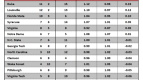
On Monday RTC’s East Coast field office submitted a piece that has driven considerable discussion, both internally and externally, as to the legitimacy of ESPN’s Prestige Rankings of college basketball programs in the 64-team era (since 1985).  While we have the utmost respect for ESPN interns researchers Harold Shelton,  Nick Loucks and Chris Fallica for plowing through mounds of college hoops data in the interest of the greater good,  Nvr1983 noted in his post that there were several areas where he (and by proxy, we) take issue with how they attributed their points (their NCAA appearance = NIT appearance is just killing us) and ultimately, the rankings.  Don’t get us wrong – overall, we think ESPN did a solid job with their effort.  We just think it could be better. 


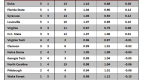
Graphic Credit (The Hype)

With that in mind, and with the full realization that we don’t have all the answers ourselves, we took a stab at creating a new attribution of points that more accurately reflects what college basketball fans really care about.  The key difference between us and them is that we want to hear from you, the readers, what should be added, eliminated, changed, revised, re-scored, or whatever else.  Feel free to leave a comment below or simply fire us an email at rushthecourtATyahooDOTcom.  It’s not guaranteed that we’ll take every suggestion to heart in our final analysis, but in the spirit of web 2.x, we want to hear your thoughts. 

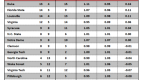
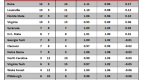
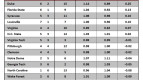
In Table A below, we show ESPN’s attribution of points, our suggested revision, and any justification as such where we felt it was necessary.  Criteria that we changed or added are represented in blue font.  Items that we removed are in gray shading.  The list is also stored on a separate Google Docs page, so you can copy/paste if you like and we can publicly update it as we move forward. 

We now submit this revised scoring attribution list to you, the readers, for public comment. 


Breaking Down ESPN’s Prestige Rankings

Posted by nvr1983 on August 4th, 2008

Ed. Note:  Don’t like ESPN’s Prestige Rankings?  Provide your comment on how to improve them here.  We’re going to take this information and create a new set of rankings based on additional factors (and getting rid of the moronic NIT appearance = NCAA appearance (1 point) criterion). 

A couple of weeks ago I noticed that ESPN was trying to fill the dead space between the NBA Finals and the Olympics with yet another list. Normally I wouldn’t have even bothered to look at it because ESPN’s lists have been getting progressively more ludicrous (hitting its peak–or nadir–when John Hollinger put Dwayne Wade’s 2006 “Fall down 7 times, shoot 14 free throws” performance above every single one of Michael Jordan’s masterpieces). However, when I noticed that ESPN was trying to rank the most prestigious programs for college basketball in the 64-/65-team era, I was intrigued and figured it was worth some analysis.
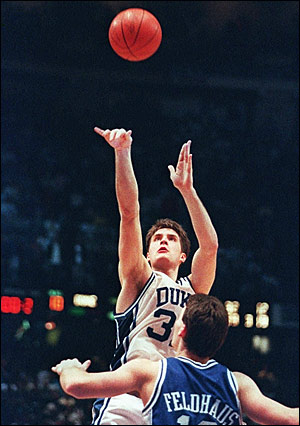
Your #1 team of the era

The first thing I always do when looking at any list is to see the scoring system used and ESPN sure picked an interesting system. I’ll break it into segments with some analysis:

• National title … 25
• Title game loss … 20
• National semifinal loss … 15
• Elite Eight loss … 10

– All four of these things seems pretty reasonable. I think that most fans would value the post-season performances in a way that is pretty close to the points awarded although it seems like a Final 4 berth is considered a great accomplishment for any program (even for the Duke’s and North Carolina’s of the college basketball world). I probably would have bumped up the national title, title game loss, and national semifinal loss by 5 points to give a 10 point spread between an Elite 8 loss and a national semifinal loss.

• Best W-L record in conference’s regular season … 5
• 30-plus wins in a season … 5
• Sweet 16 loss … 5

– This is where the scoring starts to get questionable. I’m assuming the “Best W-L record in conference’s regular season” is lawyerspeak for regular season conference champion. I’m glad that ESPN has decided that the America East regular season champion deserves more points for their in-conference performance than the regular season runner-ups in the ACC, Big East, and SEC. The 5 points for the 30-plus win season may seem like a lot, but in fact they are very rare (Duke leads with 9 such seasons and I could only count/remember 16 programs with any 30-win seasons since the start of the 1984-85 season) so that seems reasonable (as does the 5 points for a Sweet 16 loss although 16 programs achieve are awarded this each season while approximately the same number have achieved it for a 30-win season during the entire era). My main question with the 5-point awards is if they really consider all regular season conference titles the same as it is easier to win certain titles than others. One interesting note about this methodology is that Princeton with 10 regular season Ivy League titles is awarded 50 points with this methodology while Duke with 9 30-plus win seasons is only awarded 45 points for that feat (ignoring the fact that Duke probably won the regular season conference title most of those years).

• Conference tournament title … 3
• AP first-team All-American … 3
• Losing in NCAA second round … 3

– I’m assuming that the Ivy League regular season champ automatically gets the 3 points for winning the conference tournament title since they don’t have a post-season tournament. This only further skews the points Princeton and UPenn get in this system as they receive 80 points and 96 points respectively for their Ivy League titles not to mention the 20-win seasons they racked up beating up on Cornell, Columbia, Harvard, and Brown. I’m perfectly fine with the AP 1st-team AA points as at most 5 teams a year will have a player earn that distinction. Perhaps they should have thrown in a National POY bonus as that player is the one who usually defines the season (Ralph Sampson, Christian Laettner, etc.). Likewise, I’m in agreement with the 3 points for the 2nd round NCAA tournament loss.

• Player in top 10 of NBA draft … 2
• NCAA first-round win as a 12-16 seed … 2
• NIT title … 2
• AP second-team All-American … 2

– This is where it starts to get really weird. Let’s get the reasonable things out of the way first. Top 10 pick worth 2 points? Ok. That seems fine even if the draft was dominated by high schoolers and Euros for a few years. In the future, the one-and-done rule might make this benefit the schools that are willing to take the one-and-done guys even if it does hurt their APR. That is unless those guys start going to Europe. Cinderella getting 2 points for a 1st-round upset? Fine with this too even if we will all remember the Hampton upset of Iowa State more than we will remember the annual 5-12 upsets. AP second-team AA worth 2 points? Ok with this one too even if I think once you start getting to the 2nd team the players selected start getting more dependent on the voters. I’m too lazy to check this out (perhaps rtmsf can do it), but I’d be willing to venture there is a lot more variation in the guys selected to the 2nd team by various publications/groups than there is with the 1st team. Now for the crazy one. . .Awarding 2 points for a NIT title? Maybe in the 1950s, but today winning the NIT only makes you the butt-end of every more successful team in your conference. How many message board threads have trolls made mocking the 65th (now 66th) best team in country? I’ll admit that the NIT champs would probably beat the 13-16 seeds most of the time, but is there really any pride in being the small fish (mediocre team) in the big ponds (power conference) that can beat up on the plankton (13-16 seeds)? I’d give the NIT champ 1 point overall, which leads into the next big problem. . .

• 20-29 wins in a season … 1
• NCAA tournament berth … 1
• Postseason NIT berth … 1
• AP third-team All-American … 1

– Let’s get the easy ones out of the way. No problems here with the 20-29 wins or AP 3rd team AA getting 1 point. I would probably differentiate between 20-24 wins, which is usually a solid season, and 25-29 wins, which usually will put you into consideration for a top 4 seed if you’re from a power conference. Like I said before the further down the AA list you go, the more variation you will have by publication/group, but it’s not really worth arguing about for 1 point. The thing worth arguing about is giving the same number of points for a NCAA tournament berth and a postseason NIT berth. To borrow an over-used phrase from John McEnroe, “You cannot be serious!” While I recognize that in this system the NIT team can only receive 2 points from the tournament (if they win), it is ridiculous to even consider invitations to the 2 tournament similar when the entire selection special is based on camera crews camping out in rooms with bubble teams to see if they got into the NCAA tournament. Maybe the ESPN stat whizzes have access to different camera feeds than I do, but it seems like the players, coaches, and families are happier when they get into the NCAA tournament than when they find out they are going to the NIT (even if Madison Square Garden is a slight upgrade from Boise, Idaho–unless we’re talking NBA). That’s just one man’s interpretation of the reactions I see although I could probably point out that a few years ago Georgetown declined an invitation to the NIT because they wanted to give their players more time to study for exams. . .in March. I wonder why Georgetown didn’t turn down its #2 seed this year. Do John Thompson III and the Georgetown AD not care about those same exams any more?

• NCAA first-round loss to a 12-16 seed … -2
• Losing season … -3
• Ban from NCAA tournament … -3

– No problem with the first two although I wonder if a losing season is counted against you if you have it expunged from your record and throw your long-time assistant coach under the bus? Also, I’d consider a 15-16 season a disappointment while I would consider 8-20 a complete embarrassment, so I’d probably make the less than 10-win season a significantly bigger penalty. I think the NCAA tournament ban should be a much larger penalty in this scoring system as the public (and press) reaction tends to be pretty bad (see below).

This is only a 3 point deduction per year?

>> Minimum 15 seasons in Division I
** Ties are broken by overall winning percentage since the 1984-85 season

– After all the issues with the scoring system, I’m not going to complain about these minor qualifiers and tiebreakers. Both of them seem reasonable and none of the top 50 teams were tied.

Now that we’ve looked the methodology it’s time to pick apart the rankings to see what ESPN got right and what they screwed up. Duke is the run-away winner as even the most ardent Duke-hater (feel free to chime in here rtmsf) would agree that Coach K’s Blue Devils have been the most dominant program of the era even if their results have been underwhelming the past few years. The Blue Devils are followed by the Jayhawks in 2nd and the Tar Heels in 3rd. I’m not going to argue much with this although I would have UNC in 2nd just because I consider Kansas a team that historically underperforms in the tournament (Mario Chalmers’ shot and Danny and the Miracles not withstanding). Now onto the rankings I am utterly confused by.

Overated:
UNLV: 8th?!? I loved Jerry Tarkanian’s Runnin’ Rebs, who may have been one of the best college teams ever even if they lost/threw the 1991 national semifinal against Duke, but there is no way this has been the 8th most prestigious program in the country over the past 20+ years just like Memphis isn’t in that category. ESPN provides a pretty clear summary of why UNLV shouldn’t be in the top 10: “2 NCAA sanctions; 10 coaches since 1984-85; 0 NCAA tourney wins between 1992 and 2007”. I’d keep UNLV in the top 20, but they definitely don’t belong in the top 10 with that track record.
Xavier: The Muskeeters (at #17) have a nice Atlantic-10 program, but the fact that they have never made a Final 4 should automatically keep them out of the top 25. The Musketeers are buoyed by 21 combined conference titles, but have not really been a threat in the NCAA tournament having only racked up 15 NCAA tournament wins. Interestingly, Xavier came in 2 spots ahead of Cincinnati even though Xavier is widely considered the red-headed stepchild in the city.
Temple: I don’t mean to sound like Billy Packer ripping on the mid-majors (sorry, if you’re not a BCS conference, you’re a mid-major in my eyes), but the Owls never made the Final 4 despite five trips there under John Chaney. I think they’re a very good program, but like Xavier, Temple shouldn’t be in the Top 25 without a Final 4 appearance.
Murray State: Now this is the point where I rip the little guy. I was absolutely stunned when I saw this one. The Racers always seem to be one of those teams you see at the bottom of the bracket and maybe every once in a while you decide to take a chance on them to pull off the huge upset. Unfortunately, if you’re one of those people, you’ve only been rewarded once (1988 against 3rd-seeded NC State). The Racers piled up the points by dominating the Ohio Valley Conference racking up 22 (or 24 depending on your addition skills) conference titles and twelve 20+ win seasons (thanks to an easy conference schedule). Somehow this manages to put them above Villanova, Oklahoma State, Georgia Tech, and Wake Forest.

Underrated:
Maryland: The Terps (28th) are killed by the fact that they play in the ACC and have lost out on a ton of points thanks to playing in the same conference as Duke and UNC. Although Gary Williams hasn’t had good teams the past few years, the Terps run especially in the Juan Dixon era should have been enough to propel them into the top 20. How does this program only rank 2 spots ahead of Murray State?
Utah: I don’t think the Utes would be able to move up much higher, but it would be interesting to see how high they would be on this list if they didn’t have the misfortune of playing Kentucky so many times in the 1990s. While the Utes benefited playing in a softer conference than some of their peers on the list (SEC and ACC), the Mountain West has been a fairly strong conference in recent years.
Florida: I’m not sure how much higher the Gators could move up because of their relative lack of success (not counting Lon Kruger’s 1994 Final 4 run) before Joakim Noah and company ran off back-to-back titles, but it seems like that alone should be enough to crack the top 20 especially when programs like Xavier and Temple are ranked ahead of them despite not making a single Final 4 appearance. The Gators probably belong in the top 15 although that may be more of a recency effect, but it just seems that there recent run puts them at a level that isn’t that much different than UNLV with its run with Larry Johnson.

Other points of interest:
– Coach K’s current program (Duke) ranks #1. The program he left (Army) comes in tied for 298th, or as it is more commonly referred to “DFL”. Hopefully the Duke athletic department program has a better succession plan in place than Army did when Coach K decides to leave the sidelines.
– I found this rather amusing from personal experience. Boston University comes in at 108th ahead of programs such as Clemson, Providence (with a Final 4 appearance), Washington, and USC.
– In the current SportsNation voting, Kentucky is in the lead (good work out of the Sea of Blue crowd) with Duke in 4th even though they have the most #1 votes (something tells me they were left off a lot of ballots or voted 25th). The three teams I singled out as being overrated in the top 25 were moved down quite a bit. Note: I thought they were overrated even before I saw the online voting.

No bonus points for Dream Teamers?

Syracusean Thoughts

Posted by rtmsf on August 4th, 2008

A post today from the most entertaining Syracuse sports blog Troy Nunes is an Absolute Magician got us thinking about a couple of seemingly disparate things today. 

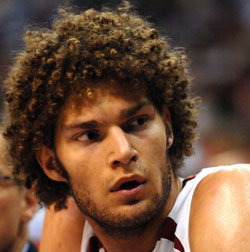
First, is there any more difficult impossible charge for a college athlete to shed than that of some kind of sexual assault?  Similarly, is there any more difficult impossible charge for an institution and the police to prove than that of some kind of sexual assault (eliminating the outright rapes involving DNA, of course)?  Usually all that anyone can seem to agree upon is that something happened involving a player and an unnamed woman.  How far that something went and whether it was consensual or a simple misunderstanding often involves convolution that would make Robin Lopez’s lafro look stick-straight in comparison.

How Twisted and Convoluted?

We can think of a couple of recent examples where the he-said/she-said repartee ultimately resulted in a slightly uncomfortable exoneration of a player’s name, where everyone sorta shrugs their shoulders, looks around and wonders exactly what the hell happened while simultaneously hoping that it doesn’t impact next year’s team.  Kentucky’s Chuck Hayes is but one example.  Kansas’ Sherron Collins another.  Need we even mention Kobe Bean’s douche d’amour  in Eagle, CO?  And now we encounter the trio of Syracuse’s Jonny Flynn, Scoop Jardine and Rick Jackson, each of whom was accused of playing a role in a sexual assault on the Syracuse campus last fall.  Flynn is arguably Cuse’s top returning player, and Jardine/Jackson are both contributors whose roles should increase next season.


Come On Ladies, It Was Only a Kiss…

Reading through the grand jury account (filtered through the Syracuse Post-Standard’s news report) is a lot like watching hockey on tv – you know the puck is down there somewhere, but you can’t really follow it until it hits something.   Depending on who you ask, the accuser is a) not seeking criminal prosecution; b) seeking criminal prosecution; c) is no longer claiming she was a victim of sexual assault; d) is claiming that she was a victim of sexual assault; e) being treated as a pawn amongst her mother and the university.  In other words, about as clear as Mudd.

Ultimately there was a grand jury proceeding, and the accuser testified at the hearing. She must have apparently been laughed out of the room due to the fact that, according to the old legal adage that a grand jury will indict a ham sandwich, the accuser’s story did not rise to ham sandwich level.  According to Troy Nunes, Syracuse University will continue with its own internal disciplinary proceedings in this matter (on what evidence, we’d love to hear).

Juli Needs to Put the Screws to Jim Again

The other thing that this post got us thinking about was Jim Boeheim’s program in general.  We’ve a notion that Boeheim should be called Mail It In-heim for the way he’s been handling the Orange in the years since his only Carmelo-led championship.  With his hot MILF wife and his secure ring finger, does Jimmy B. have the drive to push beyond mediocrity anymore (we were going to compare him to Gary Williams at Maryland, but realized quickly that GW deserves his own category of underachievement)? 

Consider: 

  • Three of Boeheim’s eleven 10+ loss seasons in 32 years as a head coach have come in the last three years (12, 11, and 14 losses, respectively).   Last year’s 14 losses were the most for a Jim Boeheim-coached team EVER. 
  • Before last year, the 1980-81 and 1981-82 seasons were the last period where Syracuse had not gone to the NCAAs in consecutive years.  (granted, Cuse got screwed royally in 2006-07, but they were still a bubble team)  It could have been three in a row if not for G-Mac’s miraculous Big East Tourney title run in 2006. 
  • In fact, Syracuse hasn’t won an NCAA Tournament game since 2004, its longest streak of such misery since prior to Boeheim’s arrival in 1976.      
  • Boeheim’s winning percentage from 1976-2003 is .743.  His percentage from 2004-present is .694, and that includes four bogus NIT wins played in the friendly confines of the Carrier Dome. 
  • Honestly, the only highlights of the last five seasons since the national championship were the 2005 and 2006 Big East Tournament titles.  That’s great and all, but it’s not how Syracuse basketball built its name (both of those were Cinderella runs). 

Perhaps this is old news for Syracuse faithful, but it really surprised us when we took a look at the numbers.  With an eligible Jonny Flynn and Paul Harris in addition to a healthy Eric Devendorf, there is potential for Syracuse to break its stranglehold on an NIT bid this season; but we’re not sure that Boeheim is getting as much from his players as he once did.  We’ll definitely be keeping a closer eye on upstate New York this year. 

Fast Breaks 07.31.08

Posted by rtmsf on July 31st, 2008

As July leads into August, here are some tasty bits of knowledge for the summer heat…

  • Richmond’s top player Dan Geriot is expected to miss the 08-09 season with a knee injury.  Auburn’s best player, Josh Dollard, was simply kicked off the team for not getting his sh!t together.
  • Guess we know how Texas A&M-Corpus Christi made the Tourney two years ago. 
  • Thuggins, summertime, scofflaws.  Any questions?
  • It appears as if Illinois’ Jamar Smith violated the terms of his probation by drinking alcohol; he’ll learn his fate at a Sept. 17 hearing.  In other news, a 21-year old ball player recently had sex with a woman. 
  • Memphis could be in some hot water over an improper phone call made by the FedEx CEO to one of his employees (who also happens to be the mother of the #2 rated PG in the class of 2009, Abdul Gaddy). 
  • Baylor????  No, really, Baylor????
  • Gregg Doyel says he’ll bury the hatchet with Coach K if he brings home the gold medal next month.  The most interesting part of this piece is the story about Coach K torpedoing Doyel’s book deal in 1999.   
  • Yes, UK Fans are insane.  We mean that in a good way, of course.
  • Andy Katz takes a look at the Wake Forest program one year after the untimely death of head coach Skip Prosser.
  • We thought this article by Dana O’Neil about coaches working themselves too hard in light of Prosser’s heart attack was going to suck, but we really enjoyed it.  Coaches whine and complain about the summer circuit, but they really love it (poor headline, ESPN). 
  • Jeff Goodman breaks down his top ten prospects from the summer camps in Vegas.
  • Gary Parrish gives an interesting insight into how programs game the summer recruiting circuit by not hiring assistant coaches until after they’ve developed good relationships with top prospects (sidenote: why did Arizona fire Miles Simon – that guy won them a championship!).  He follow that up with another article on how coaches get creative but ethically suspect in getting recruits onto campus in a legal manner.

Vegas Odds Check-In – Summer Edition

Posted by rtmsf on July 29th, 2008

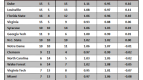
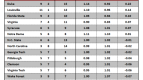
We’re quite sure Vegas Watch can analyze this much better than we can, but we stumbled across the idea on his site last week and decided to throw up this post showing what the current Vegas odds are for winning next April’s national championship.  Analysis to follow table…

Source:  TheGreek.com

Thoughts. 

  • It’s a LOCK!!  Given the unpredictable nature of the NCAA Tournament (much less the regular season), getting +350 on a team like North Carolina is as close to a lock as it gets.  We wish we had access to the summer 2001 Duke and summer 2006 Florida numbers to see if they were higher than UNC’s.  Regardless, we still think this bet is a little high; if it were in the +400 to +500 range, we’d like it a lot better. 
  • Overvalued.   Unless Coach K has figured out how to bring Dwight Howard with him from Beijing to Durham next season, we don’t see how Duke can be +800.  Same with Florida at +1000 – is there any skilled size whatsoever on these two teams?  Kentucky at +1500????  Patrick Patterson and whose army?    
  • Undervalued.  Because only UNC, Duke and Florida are currently higher than the Field (+1200), we see quite a few undervalued teams out there right now.   Let’s start with UConn and Louisville at +1200 each.  These two teams are probably the most well-suited to challenge the Carolina juggernaut next year with their size, strength and athleticism.   How about Tennessee and good grief have we learned nothing yet about Ben Howland – UCLA!!! – at +1500?  There is a ton of talent remaining on those two squads.  Mid-majors Davidson at +2500 and Gonzaga at +4000 also seem like decent values – both teams should be stacked next year… and if Carolina falters somewhere along the way, who knows?
  • Indiana.  Wow, for only $1, you can win $500 if Tom Crean, Kyle Taber and company manage to pull off the most miraculous sporting turnaround in the history of organized sports.  Pass. 
  • Your Team Isn’t Good Enough to Post Odds.  55 of the listed 59 teams are from BCS conferences.  Other luminaries such as Colorado, Virginia, Iowa St., Rutgers, Depaul, Cincinnati, Minnesota, Penn St., Auburn, South Carolina and Oregon St. were missing from the list.  Actually, we would have loved to have seen what odds Oregon St. would have gotten (0-18 in the Pac-10 last year).  Ok, so we’re joking about the above schools being included, but no Xavier? – they’re usually solid.   

NBA Draft Picks by School (1949-2008)

Posted by rtmsf on July 29th, 2008

Since we’re in the deadest of dead times when it comes to college basketball, we figured now was as good a time as any to update some of our databases with 2008 figures.  We like to do this for a couple of reasons: a) we’re incredibly stat nerdy, and if we don’t update our charts with new data in a reasonable amount of time after it becomes available, we begin suffering cold-sweat night terrors involving 39395 errors; and, b) like everyone else, we find it difficult to access this kind of historical data on the interwebs, and so this year we’ll be adding links to Google Docs to harbor all of our raw data.

Yes, Redheads Appreciate Robust Data

Our first task is to update our NBA Draft Picks by School information.  You may recall that we put together several posts last summer detailing the historical statistics of the first two rounds of the NBA Draft from its inception as a round-robin spectacle in 1949.  (See Draft Picks 1949-2006 by School, by Round and by Decade)  Since not a lot of the data has changed in the interim, we’re going to take a different tack this time around.  Rather than overwhelming you as we did last year with enormous data-filled tables, we’re going to break it down into smaller bite-size morsels first before giving you the full Monty.  However, if you’re the type of person who can’t wait to dive headfirst into reams of data, be our guest.  All of the raw data from the 1949-2008 NBA Drafts is here.

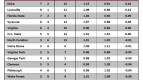
So here’s Table A, where we list the 11 programs with the most NBA Draft picks in history (1949-2008).  For the full list of programs with ten or more historical draft picks, see our Google Doc on the subject.

It doesn’t take much brainpower to see that UCLA‘s Ben Howland and UNC‘s Roy Williams are likely to spend the next decade further dominating this list.  Louisville and Kansas also stand to rise into the top five quickly with the players Rick Pitino and Bill Self are recruiting these days.  Indiana, Duke, Kentucky – all have been trending downward, but how will the newish coaches at IU and UK change that, and will Coach K start recruiting studs again now that making the Sweet 16 is the norm at Duke?  St. John’s and Maryland? Both are living on lost glory with no recent signs of improvement.  And keep an eye on the sleeping giant Thad Matta is building at Ohio St. (currently at 25 total picks) – he could overtake the Terps with two more of his Thad Five-type classes. 

Total draft picks are nice, but championships are won with first-round talent, and first-round talent tends to become first-round picks (just sayin’).  So let’s slice the data a little further to see what schools produce the most first rounders (Table B). 

The top six programs in history are also the top six producers of first round talent.  Correlation, much? (ok, for that comment, forget Notre Dame and their zero F4s)  We’re still aghast that Minnesota continues to appear in the top ten of this list.  Something tells us that Tubby won’t exactly set the Twin Cities on fire with first rounders up there on the tundra.   

How about elite players?  It’s true that a good argument can be made that the NBA’s recent propensity in drafting potential over production has mitigated some of the value of analyzing these draft numbers at the college level, but there’s likely still a strong correlation between elite NBA draftees and collegiate team success.  See Table C for the list of the schools with the most Top 10, Top 5 and #1 Overall Picks.   

LSU is the real anomaly of this group – they’ve had a modicum of team success over the years (three F4s), but they seem to excel in producing top-tier individual talent, with eight Top 5 picks in history.  Considering that LSU trails only UNC, UCLA and Duke in that category, it is phenomenal that the Tigers haven’t had more national success over the years (until we remember again… Dale Brown, John Brady).  Did anyone else realize that Duquesne has had two #1 picks in its history, and that they were in consecutive years?!?  Those Dick Ricketts (1955) and Sihugo Green (1956) teams of the mid-50s must have had P-town roiling, eh?  (well, actually, the Dukes were NIT Champs in 1955).

Now we’re to Table D, which shows the breakdown of picks by decade.  Keep in mind that the table is sorted by the 2000s column on the left – yes, we’re guilty of a serious case of presentism. 

We threw this table up mostly to show that with one NBA Draft remaining this decade, several schools have a chance to take the lead for most picks in the 2000s.  UCLA, Duke, Connecticut, Florida and Arizona could all have a couple more picks in the books by this time next year.  UNC is the real wildcard, though.  The Heels could have as many as five draftees in next year’s class, which would give them an outside shot at leading the decade, and is amazingly something that UNC has never done in its regal NBA Draft history.

Again, here is the link to the Google Docs listing the programs with 10+ draft picks in history, and here is the link to the comprehensive raw data where you can look up and manipulate the table to locate any pick from the last sixty years. 

We have some further ideas for this data, but that’ll have to wait for another post. 

07.25.08 Fast Breaks

Posted by rtmsf on July 25th, 2008

Some things we’ve missed while lounging in a pool of indignant contempt (and mineral hot springs)with Lute Olson, Kevin O’Neill and friends the past few weeks…

  • It’s Extension Season! – Davidson’s Bob McKillop (3 more yrs until 2015-16), UCLA’s Ben Howland (7 yrs at approximately $2M per until 2014-15), Tennessee’s Bruce Pearl (1 more yr until 2013-14, but with a raise that will average out to $2.3M per over that span), Notre Dame’s Mike Brey (2 more yrs until 2014-15), Temple’s Fran Dunphy (2 more yrs through 2013-14), and Oregon’s Ernie Kent (3 more yrs until 2012-13) all got their wives a new car last week.
  • UCLA’s AD Dan Guerrero is the new NCAA Tournament Committee chairman for 2009-10.   Expect UCLA to play in Pauley and the Staples Center during its first four rounds that year.
  • Tim Floyd breathed a sigh of relief when he learned last week that Demar DeRozan passed the ACT and will be eligible next season for his Trojans.  DeRozan is a likely 1-and-done, which means Lute Olson has vowed to not recruit players like him for the rest of his career (still feeling the burn of Jennings and Bayless, Lute?)
  • Gonzaga forward and RTC fav Austin Daye both tore and didn’t tear his ACL at the Lebron Skills Camp recently.  He should be ok for the upcoming season. 
  • Welcome to the Kyle Taber Hoosiers.  Speaking of which, ex-Hoosier Jordan Crawford is transferring to Xavier. 
  • Memphis guard Doneal Mack has decided to return to Calipari’s squad after all – he had previously stated that he was transferring to the University of FEMA New Orleans. 
  • This is interesting.  Georgia Tech center Ra’Sean Dickey has decided to forgo his senior season so that he can begin his professional career in Ukraine?  Wow, thie Euro thing is starting to heat up, eh?
  • The fall of former Florida gambler guard and gunner Teddy Dupay is now complete.  He was recently charged with rape, aggravated sexual assault and aggravated kidnapping of a Utah woman, according to court documents. 
  • It’s sayonara to the Top of the World Classic in Alaska.
  • The extremely poorly situated Kentucky Basketball Museum closed its doors in the face of large financial losses. 
  • We wanted to get a take in on the Brandon Jennings Experiment, as articulately described by N-Bug upon BJ’s announcement that he’ll spend his “1-and-done” year playing in Europe.  Generally, we think this will be a disaster and wouldn’t be surprised if Jennings absolutely submerges his draft stock during the season (that is, until he returns next spring and excels in the 1-on-1 workouts given by teams).  Gottlieb nailed it when he pointed out that EuroLeague ball is of a much-higher quality than what Jennings probably thinks it is (and certainly well above college hoops).  Lots of risk of exposure here for Jennings.  Bad decision. 
  • Gary Parrish makes a compelling point about the inherent conflict of interest in referees working for schools calling games on international trips and scrimmages, then turning around and calling games for those same teams during the season.  As you may recall, we wrote exactly a year ago that the Donaghy situation happens way more than anyone thinks, and this is just another loophole that encourages it. 
  • Maybe we’re cynical, but there has to be a Shawn Kemp is Broke story somewhere in this tender piece by Luke Winn.
  • Davidson’s Stephen Curry has noticed that his life has changed after his spectacular March run.
  • Where does Super Mario’s shot rank in the all-time great NCAA shots pantheon?  His former teammate Sherron Collins won’t have to worry about watching the highlight from the pokey, as prosecutors stated there was not enough evidence to substantiate allegations against him stemming from an alleged incident in an elevator with a woman on the KU campus. 

The Brandon Jennings Experiment

Posted by nvr1983 on July 17th, 2008

In what will undoubtably be one of the most scrutinized decision in prep sports history, 5-star point guard and Arizona signee Brandon Jennings has decided to forgo his college eligibility to turn pro. . .in Europe. While most people have been speculating that the decision is based on his trouble achieving a high enough SAT score–met the requirement on his 2nd try, but the NCAA flagged it for being a suspiciously high increase from his 1st try and he is awaiting the results of his 3rd attempt–his family asserts they have been considering going to Europe for a while because of the NBA rule that American high school players cannot be drafted until 1 year after their high school class has graduated. Lute Olson appears to be less than thrilled with the decision and has stated he will not recruit anybody who would be a one-and-done player.

While Jennings probably isn’t the 1st American-born player to go straight from high school to an overseas professional league, he certainly is the first with legitimate NBA potential. It will be interesting to see how Jennings does as it will give us a better insight into high-level college basketball versus European pro ball.

On Thursday, Jennings signed with Pallacanestro Virtus Roma of the Italian league. The deal was negotiated by Sonny Vaccaro (surprise!) and is described as a “three-year, multimillion-dollar” contract with an option for a buyout if Jennings wishes to enter the NBA Draft. Vaccaro declined to go into detail about the financials, but I’m assuming Vaccaro is shrewd enough to make sure that the buyout isn’t significant enough to affect his client’s draft stock.

I’m not that familiar with European basketball outside of a few of the major powers, which Pallacanestro Virtus Roma definitely is not (last European League title came in 1984). However, it seems like Vaccaro has ensured that Jennings is in a position to succeed by placing him with an English-speaking coach and arranging for many other things including taking care of his family.

In order to study what could become a major turning point in college basketball (players skipping it to go overseas before the NBA), we will try to provide updates and analysis of Jennings and his performance along with an attempt to translate it into how it will affect his draft stock. In the meantime, if any of you are familiar with Italian league basketball share your knowledge with your fellow fans in the comment section.

Adios, Billy Packer!

Posted by nvr1983 on July 14th, 2008

In a move that we are certain will generate a ton of praise around the college basketball world (and the blogosphere), CBS has decided to not renew everyone’s least favorite curmudgeon Billy Packer (h/t to The Big Lead for pointing this out). After 27 years at CBS and having called the national championship game every year since 1977, CBS has “decided to move into another direction” (a phrase I’m sure many of our readers have heard before).

Like most college basketball fans, I’m excited to see Packer and his bitterness leave the airwaves (although I’m sure that rtmsf is sad to see a Wake Forest alum lose his job). While Packer has certainly become an institution (of hatred) in college basketball, it seems like in recent years, Packer has been more controversial than normal although that may just be a recency effect.

Among Packer’s “memorable” moments:
1996: During a Georgetown-Villanova game, he calls Allen Iverson a “tough monkey”. He apologizes and John Thompson (the original, not JT3) says it’s a non-issue because he says Packer is not a racist.
2000: When two Duke female (yeah, I know an oxymoron) students ask to see his press pass, Packer reportedly responds “Since when do we let women control who gets into a men’s basketball game? Why don’t you go find a women’s game to let people into?” Once again Packer apologizes.
2004: Criticizes the NCAA selection committee for giving 1-loss Saint Joseph’s a #1 seed in the East Regional. This leads to a small disagreement between Packer and the CBS guest–St. Joseph’s coach Phil Martelli. The Hawks go onto reach the Elite 8 (beating Packer’s alma mater Wake Forest in the Sweet 16) before losing to Oklahoma State in a tight game.
2006: Packer rips into the selection committee for taking mid-majors over BCSconference schools. The mid-majors responded by having Bradley and Wichita State make it to the Sweet 16 and George Mason make it to the Final 4.
2008: With 27:30 left in the national semifinal, Packer tells viewers that the game is over. Surprisingly it isn’t. I’m sure the CBS bigwigs weren’t too thrilled that Packer essentially told viewers they could stop watching with 27:30 left in the game.

I’m sure there are others dating back to the beginning of his time on TV, but frankly I’m too young to remember the more distant controversies.

In an attempt to remain “fair & balanced”, we should note that Packer is most likely the 2nd person casual college basketball fans think of when they think of announcers–a distant 2nd to Dick Vitale. We’ll leave you with this YouTube clip from last year with Packer and Jim Nantz discussing his potential legacy (disclosure: I haven’t listened to this because I’m at work and I forgot my headphones–it’s a Monday):

“…inherited a tremendous amount of dysfunction”

Posted by rtmsf on July 3rd, 2008

The above quote is attributable to new Indiana coach Tom Crean, whose program was rocked again yesterday with the news that IU will give up two scholarships in anticipation of a poor APR score in 2008-09.  You may recall that the Hoosiers with a score of 899 already ranked in the bottom eight BCS schools in the most recent APR scoring.  Seeking to counteract an anticipated horrendous score based on the 2007-08 debacle (can you get a zero in the APR?), Indiana has decided to get proactive and attempt to take their medicine all in one lump next season.  Keeping in mind that IU lost seven players this offseason (not to mention a coach and an AD), Assistant AD Frank Cuervo had this to say:

It’s not necessarily about one issue.  It’s obviously related to the APR score. In terms of reasons, it’s not necessarily due to just players leaving.

Um, yeah, it’s not about players leaving per se; rather, it’s about players leaving an academic clusterf*ck in their wake.  Considering what we know about how Kelvin Sanctions with respect to his organizational management skills (almost as good as Tubby Smith’s missing fax), it’s not a leap to believe that most of his players at IU were barely skirting by in the classroom.  Several of them may have stopped attending classes altogether. 

Crean Needs Some Good News For Once

The NCAA has a lot of decisions to make in the coming month with respect to the IU program.  The NCAA Infractions Report is due near the end of July, and Indiana appears to have put its best foot forward throughout this process to retroactively police itself.  But we fear that the ‘clean house’ approach may not satisfy the NCAA, who may use this situation to steer conscientious programs away from questionable-character coaching hires in the future.   Regardless of the penalties levied, with only eight scholarship players suiting up in 2008-09 Hoosier basketball is probably facing its worst season  since Lou Watson’s 7-17 debacle back in 1969-70.  And without snagging a few Eric Gordons all at once, it’s unlikely Indiana basketball will “get back” until early in the next decade.