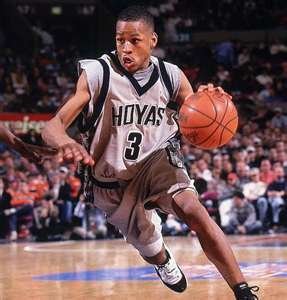
We’re old enough to remember the mid-80s, when Hoya Paranoia ruled the national college basketball scene. Back then, the word Georgetown was synonymous with high-flying, athletic but brutish players who liked to get in an opponent’s face and let him smell what he had for breakfast. The Hoyas under John Thompson were intimidating. They were brash. They were physical and they let you know it. In some hushed circles, the Hoyas were even called “thugs.”
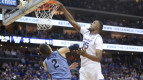
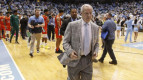
Seriously, Nobody Had the Shaved Head Look in 84 (photo credit: SI)
Image was part of it. Maybe it was the unique grey t-shirts under their uniforms or the way-before-its-time shaven head of hired gun Michael Graham. Maybe it was the bombastic style of their oversized coach with his towel and militaristic type of discipline. More likely, it was the superior size, skill and power of players like Patrick Ewing, Charles Smith and Reggie Williams. We remember watching teams simply wilt when faced with another patented Georgetown blitzkrieg. A few woofs, a couple of wailing chin-ups on the rim, and you could literally see the fear develop in the eyes of the opponent. John Thompson, of course, enabled and facilitated this mentality – it was gasoline to fuel his “us against them” paradigm, and it worked. The Hoyas went to three title games from 1982-85, and won the whole shebang in 1984.
So it was interesting to hear last week that JT the Elder had admonished his son’s team on his radio show over Georgetown’s current rebounding woes by stating that the Hoyas need more “thugs” on its team. From the AP report:
One of the pitfalls of having a Hall of Fame father with a radio show is that the father-son advice gets dispensed for everyone to hear. Those listening to the John Thompson Show on local station WTEM (DC) this week heard the longtime Georgetown coach suggest that the current team was in need of some “thugs.” Not criminals or classroom bullies. But guys who can go get some rebounds. Thompson gave more or less the same advice when he visited practice this week, imploring the players to adopt the kind of get-the-ball attitude that could solve the rebounding woes that have beset the program under John Thompson III.
Of course, we all know what Thompson meant – that Georgetown needs to get tougher – but it was an interesting use of a loaded word by the CEO of Hoya Paranoia, someone who would have defiantly taken umbrage with that characterization of his team (and used it to his full advantage) a generation ago.
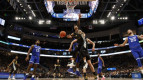
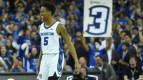
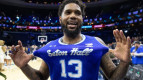
Thuggalicious (photo credit: AP/Laura Rauch)
Nevertheless, there is truth to JT2’s complaint. Georgetown currently ranks a paltry 289th nationally in rebound percentage (47.9%), they have been outrebounded in eight of their fourteen contests, and only Greg Monroe (6.3) averages more than five per game. Even the son JT3 admits that it is a problem. To the Hoyas’ credit, in their last two games, they’ve been +5 (Notre Dame) and +11 (Providence) in the rebounding department, so maybe in taking a page from his motivational playbook, father knows best after all.
In a move that we are certain will generate a ton of praise around the college basketball world (and the blogosphere), CBS has decided to not renew everyone’s least favorite curmudgeon Billy Packer (h/t to The Big Lead for pointing this out). After 27 years at CBS and having called the national championship game every year since 1977, CBS has “decided to move into another direction” (a phrase I’m sure many of our readers have heard before).
Like most college basketball fans, I’m excited to see Packer and his bitterness leave the airwaves (although I’m sure that rtmsf is sad to see a Wake Forest alum lose his job). While Packer has certainly become an institution (of hatred) in college basketball, it seems like in recent years, Packer has been more controversial than normal although that may just be a recency effect.
Among Packer’s “memorable” moments:
-1996: During a Georgetown-Villanova game, he calls Allen Iverson a “tough monkey”. He apologizes and John Thompson (the original, not JT3) says it’s a non-issue because he says Packer is not a racist.
-2000: When two Duke female (yeah, I know an oxymoron) students ask to see his press pass, Packer reportedly responds “Since when do we let women control who gets into a men’s basketball game? Why don’t you go find a women’s game to let people into?” Once again Packer apologizes.
-2004: Criticizes the NCAA selection committee for giving 1-loss Saint Joseph’s a #1 seed in the East Regional. This leads to a small disagreement between Packer and the CBS guest–St. Joseph’s coach Phil Martelli. The Hawks go onto reach the Elite 8 (beating Packer’s alma mater Wake Forest in the Sweet 16) before losing to Oklahoma State in a tight game.
-2006: Packer rips into the selection committee for taking mid-majors over BCSconference schools. The mid-majors responded by having Bradley and Wichita State make it to the Sweet 16 and George Mason make it to the Final 4.
-2008: With 27:30 left in the national semifinal, Packer tells viewers that the game is over. Surprisingly it isn’t. I’m sure the CBS bigwigs weren’t too thrilled that Packer essentially told viewers they could stop watching with 27:30 left in the game.
I’m sure there are others dating back to the beginning of his time on TV, but frankly I’m too young to remember the more distant controversies.
In an attempt to remain “fair & balanced”, we should note that Packer is most likely the 2nd person casual college basketball fans think of when they think of announcers–a distant 2nd to Dick Vitale. We’ll leave you with this YouTube clip from last year with Packer and Jim Nantz discussing his potential legacy (disclosure: I haven’t listened to this because I’m at work and I forgot my headphones–it’s a Monday):
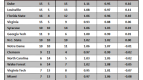
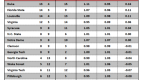
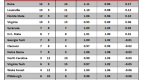
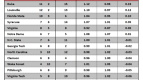
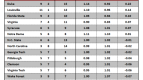
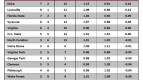
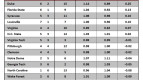
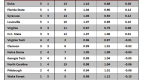
Today is the final installment of the three-part series where we wanted to take a look at the NBA Draft broken down by school over the history of the modern NBA Draft (1949-2006). In Part I, we examined the raw numbers and made a rudimentary attempt at tying NBA talent to NCAA Tournament success. In Part II, we broke out the raw numbers by round selected, and then further sliced that data into an examination of “Top 10″ and “Top 5″ selections. Today we finish off the series by looking at draft selections by decade, hoping to see how things have trended over the entire era of the NBA Draft. See Table C below.

Table C. NBA Draft Picks by School & Decade (1949-2006)
Notes: this table is sorted by the Total Draftees column, and is limited to schools with a minimum of ten or more draft picks since 1949. The yellow shading refers to the highest number in that column.
Observations:
Consistency. The first thing that struck us as interesting were the schools that were fairly consistent in providing draft picks throughout the NBA Draft era. UNC, Louisville, Kentucky and St. John’s do not lead any particular decade, but each school has provided at least two picks per decade throughout. UCLA and Indiana have been similarly consistent over the entire period, but each also led a decade in picks (UCLA during the 70s; Indiana during the 80s).
Less Volume, but Still Consistent. Look at Big 10 stalwarts Illinois and Minnesota, along with Villanova and Utah. We’ve been clowning the Gophers all week, but surprisingly, they’ve consistently produced between 2 to 7 picks per decade – guess it’s easy to forget about Willie Burton and Joel Przybilla. The same is true for the Illini (between 2 to 7 per decade), Villanova (2 to 5) and Utah (2 to 5). Maryland, Syracuse, Ohio St., Marquette, Wake Forest, Temple, USC, Stanford, Memphis, Tennessee, Oregon, BYU, Mississippi St., LaSalle and Bradley are some of the other schools with at least one draft pick per decade.
The USF Dons Represent a Bygone Era
Whatever happened to…? The University of San Francisco, led by KC Jones and Bill Russell, produced fourteen draft picks from 1949-79, and only two since. Eight of Kansas St.’s fourteen total draft picks were produced from 1949-69, but there’s only been one since 1989 (Steve Henson in 1990) – it even led the 1940s/50s with seven picks. And despite its recent renaissance under John Beilein and the proliferation of draft picks to come under Bob Huggins, West Virginia has only had one draft pick since 1968 (seven overall)! Another early producer Holy Cross (six overall) hasn’t had any picks since 1969; and Grambling (nine overall) hasn’t had any since 1978.
These Two Schools Have Come On Strong
Late Bloomers. The biggest examples of late bloomers have to be Arizona and Connecticut. Arizona’s first draft pick was in 1974, and it has produced thirty-three more since, good enough for sixth (tied with UK) all-time. Connecticut is even more shocking – the Huskies’ first pick was Cliff Robinson in 1989 (!!!), but it has produced twenty picks since (1.11 picks per year). Duke also has to be mentioned here. The Devils had good success in the early years (seven picks through the 70s), but have had thirty-two draft picks since 1980, twenty-six of those since 1990 (1.44 picks per year). They were second in the 90s with fifteen picks, and are currently tied with UConn leading the 2000s with eleven picks. No wonder they’ve been so good. Other late bloomers include Georgia Tech (22 of its 24 picks since 1982), Michigan St. (24 of its 26 picks since 1979), Georgetown (17 of 18 since 1980), Alabama (19 of 23 since 1982), Texas (15 of 17 since 1982), and Georgia (13 of 14 since 1982). After tonight’s draft, Florida could have as many as 14 of its 15 picks since 1984, but we already knew the Gators were a late bloomer. As a bit of an anomaly among the traditional powers, Kansas didn’t really begin consistent production of draft picks until the 70s (24 of 27 picks since 1972).
Coaches. The one trend we see with many of these late bloomers is how important coaches are to the talent level of a program. UNC, Louisville, UCLA, Kansas, Kentucky and Indiana have had great coaches throughout most of their histories. It makes sense that these schools have also been the most consistent at putting talent into the NBA Draft. But look at some of the other schools, particularly the late bloomers. Jim Calhoun has been responsible for every single one of UConn’s draft picks; Lute Olson has been responsible for all but five of Arizona’s draft picks (85%), and Coach K for 74% of Duke’s all-time picks. Bobby Cremins at Georgia Tech (79%), John Thompson at Georgetown (83%), and the Jud Heathcote/Tom Izzo reign at Michigan St. (92%) show just how important a single coach can be to a program.
Final Thoughts. This has been a fun experiment, and in only a few hours, we get to update all of our data with draft data from 2007. Something tells us that Florida and Ohio State’s numbers are going to be rising. Thanks to everyone for your thoughts and commentary. We now return to our regularly scheduled programming…