11.24.08 Fast Breaks

Posted by rtmsf on November 24th, 2008

Feasting on a feastly week of hoops… here’s the news…

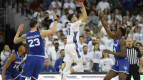
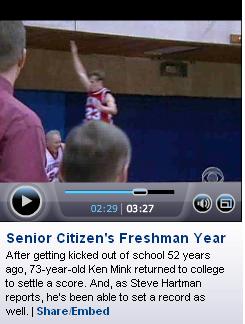
  • Remember 73-yr old Ken Mink’s first game where he scored two points?  We wondered who and how he could possibly get fouled?!?  Believe it or not, watch the video here of this CBS News report where Mink pump-fakes on the wing and gets hammered by some 19-year old defender (#23) who never learned to properly close out on shooters.

ken-mink-fouled

  • Loyola Marymount head coach Bill Bayno is taking a leave of absence from his position, effective immediately, due to an undisclosed medical condition. 
  • UCLA’s Alfred Aboya didn’t break his hand in Friday’s game against SIU, but SIU’s Nick Evans did (out 4-6 weeks). 
  • Another blow for St. John’s basketball – their best player Anthony Mason, Jr is out for the year with a torn tendon is his foot (ouch).
  • The 2009 Maui began today, but the 2010 field is already set with: UConn, Kentucky, Washington, Wichita St., Michigan St., Oklahoma, Virginia and Chaminade. 
  • More changes at Arizona – they’re bailing on their home-and-home with UNC starting next year.
  • Oh, and this.  Erin Andrews at the UNC game (h/t Deadspin).  Dude must have had RTC up on his cell phone to explain his lack of interest in what was in front of him.

erin-andrews-unc-game

Share this story

Preseason NIT Breakdown

Posted by rtmsf on November 17th, 2008

(ed. note: if you’re looking for the 2009 NIT Bracket, click here.)

The Preseason NIT, the Granddaddy of all the Preseason Tourneys, begins tonight, with all sixteen teams in action at four regional pods (Chestnut Hill, MA; W. Lafayette, IN; Norman, OK; Tucson, AZ).  Unlike many of the D2 and whatever-else teams thrown into the pods of the CvC last week, the PNIT at least uses all D1 teams for its sacrificial lambs.  A new feature is that each of the sixteen teams was seeded, although we’re not sure how BC and Arizona ended up with protected seeds over Davidson (also, why isn’t #1 Purdue playing #16 Miss. Valley St., and #2 v. #15, etc.?).  We suppose BC fans would buy more tickets in Manhattan next week?  Whichever.   Below is the regional bracket, and our thoughts and picks follow.

Best first-round game. #8 St. John’s v. #9 Cornell.  You don’t think that Big Red is looking forward to sticking it to their Big East brethren to the south?  Click here if you don’t believe us.  These two NY teams have never played, but we’re thinking that Cornell will ride its three-point shooting to the upset win in Chestnut Hill tonight.

Other Upset Possibilities. Keep an eye on these two games in the Tucson regional:

  • #3 Arizona v. #15 Florida Atlantic.  Nobody has a clue how Arizona is going to respond to all of its turmoil from the offseason, or whether half of its players will even be available tonight (apparently so), but if there’s one thing we’ve learned about college basketball and despite trite cliches to the contrary – adversity generally does NOT end well.  New FAU head coach Mike Jarvis knows how to coach up a team for one game, and this could be a rude awakening for Russ Pennell as a D1 coach.
  • #7 UAB v. #11 Santa Clara. The recipe for an upset here is clear.  WCC talent is generally underrated.  This is a west-coast team playing an east-coast team in the Pacific time zone.  John Bryant inside the paint.  Robert Vaden may still be feeling the effects from his recent arrest hanging over his head (4 pts last game on 2-13 FGs).  UAB head coach Mike Davis has been known to lay an egg or two in his career.  UAB will have no answer for Santa Clara big man

Will MVSU Break 30? #2 Oklahoma v. #16 Mississippi Valley St. Knowing what we know about Oklahoma’s defense, and knowing also what we know about MVSU’s inability to score the basketball, we foresee something along the lines of 75-35 in this game.

They Should Roll. BC at home v. Loyola (MD).  Purdue at home vs. Eastern Michigan.  And Davidson in Norman vs. James Madison.  No way any of these three loses tonight.

Two Evenly Matched Bad Teams. #6 Georgia v. #10 Loyola (IL). Wow, the PNIT should commend itself for getting two Loyola into this tournament.  Was Loyola Marymount not available?  No further comment on this game, other than to say either team could win, and Purdue will blast said winner tomorrow night.

Regional Picks. We’ve got BC, Purdue, Davidson and Santa Clara (taking advantage of the FAU upset).  We really didn’t want to pick against Oklahoma at home, but then again, how do you justify picking against Stephen Curry?  If the Wildcats can contain Blake Griffin inside, they can win that game and head to MSG.

Enough with ESPNU!!!! Three of the four televised games tonight in this tournament are on the U.  Look, we understand why the games are on there.  But why not also put them on the ESPN Full Court package so that those of us held completely hostage by our cable companies can actually take advantage of those games as well?  We already pay for the FC service, so what possible harm could it do to expose more paying customers to your product?  Make us pay $10 if you like, but just give us access to it!

Share this story

2008-09 Conference Primers: #1 – Big East

Posted by rtmsf on November 10th, 2008

Rob Dauster of Ballin is a Habit is the RTC correspondent for the Big East Conference. 

Predicted Order of Finish (from the coach’s pre-season poll, released at Big East media day):

  1. Connecticut (9)
  2. Louisville (3)
  3. Pitt (3)
  4. Notre Dame (1)
  5. Villanova
  6. Marquette
  7. Georgetown
  8. Syracuse
  9. West Virginia
  10. Providence
  11. Cincinnati
  12. Rutgers
  13. Seton Hall
  14. St john’s
  15. DePaul
  16. South Florida

big-east-logo

WYN2K. You hear that? You know what that is? That’s the sound of RTC stealing my thunder.  I’m not much of a statistician myself, but just by looking at that pre-season poll I can tell you this – the Big East is loaded.  If you live outside of Big East country, then you are probably sick of hearing about how good the conference is, year in and year out. But facts are facts. Four teams are legitimate Final Four threats. Another six teams are, depending on who you ask, expected to be a part of the 65 team field. Three more teams have an outside shot at punching a ticket to the dance if they can catch a few breaks (transfers getting cleared, freshman getting eligible, etc.).  So in this day and age of college basketball, where “early entry,” “parity,” and “mid-major” have become household terms, how did one conference manage to stockpile so many good teams? Well, as you can see, the Big East is HUGE. There are sixteen teams spanning from Rhode Island to Wisconsin to Florida and everywhere in between. When you have that many teams in one conference, there are bound to be years where there are a lot of good teams, especially when so many of the schools have a rich basketball tradition.  This just happens to be one of those years where the Big East got lucky. Last season, 32 players were named to an All-Big East team (1st, 2nd, honorable mention, all-rookie), and only two of those players (WVU’s Joe Alexander and Syracuse’s Donte Greene) declared for the draft with eligibility remaining. Would Pittsburgh be as good as expected if Sam Young left? What about UConn without Hasheem Thabeet? Those two, and a number of other players, probably would be on NBA rosters right now if they left, but for whatever reason (a loaded draft class last year, smarts enough to know they weren’t ready, boosters offered them more than what they would get paid on a rookie’s salary) they decided to head back to campus.

So without further ado, here is your conference breakdown:

Cellar Dwellars.  DePaul, St. John’s, South Florida, Rutgers

  • There are some talented players on these teams. Sophomore Dar Tucker of DePaul is a poster waiting to happen. South Florida’s Dominique Jones scored 17.1 ppg as a freshman. St. John’s has senior Anthony Mason Jr. and sophomore Justin Burrell to carry the load. But with the depth of the Big East this year combined with the loss of some talented seniors, none of these three teams really look like they have a shot at doing much. Rutgers might have the best shot of the group to make some noise, as Fred Hill has landed back-to-back talented freshman classes. Don’t be surprised if you hear the names Gregory Echenique and Mike Rosario (RU’s first Mickey D’s all-american) quite often during the season.

We Should Have Bribed The NCAA.  Cincinnati (NIT), Seton Hall (NIT)

  • Both the Pirates and the Bearcats are awaiting the NCAA’s word on whether or not they will have some key players in their rotation. After struggling with the remnants of the Cincy program in the wake of Bob Huggins, Mick Cronin finally has the program heading in the right direction. He brings back Deonta Vaughn, who is one of the most explosive scorers in the country, and gets former Texas forward Mike Williams back from an Achilles injury. Adding two talented freshman in Yancy Gates and Cashmere Wright only helped matters. But Wright tore up his knee in the first week of practice, meaning that Vaughn is, once again, their only real backcourt threat and that they must rely heavily on their front line, which could be bolstered by the addition of 7’2” center John Riek. The Sudanese refugee, who was considered one of the best prospects in the country two years ago but has battled knee problems, is dealing with eligibility issues but could be in uniform by December. 
  • Seton Hall’s situation is a little different. The Pirates lose leading scorer Brian Laing (18.6 ppg) but return a solid nucleus of Eugene Harvey, Jeremy Hazell and John Garcia. Bobby Gonzalez had also hoped to add transfers Herb Pope (New Mexico St.) and Keon Lawrence (Missouri) without having to wait the mandatory one year for a transfer by having each kid apply for the NCAA’s hardship waiver. Pope’s been denied, Lawrence’s application will wait until after the first semester, and freshman Melvyn Oliver is still waiting to be cleared academically, meaning the Pirates currently have only eight scholarship players.

Pretenders or Contenders?  Providence (NIT), West Virginia (NCAA #7)

  • I know what you’re thinking. Providence? Really, Rob? They haven’t been good since the days of Ryan Gomes and Donnie MacGrath (and even then, good might have been pushing it). But the Friars have the horses to sneak up on some people this year. They were as balanced as any team in the Big East last year, with six guys (five returners) that averaged at least 8.7 ppg.  PG Sharaud Curry, arguably their best player, is back from a stress fracture in his foot and they have added Keno Davis, last year’s national COY at Drake, as the head coach. Davis should have some success in his first year with the Friars if they follow the same spread floor style that was so successful at Drake. One key reason for that is big man Geoff McDermott, who is adept at playing on the perimeter and is a stat stuffer (10 ppg, 8 rpg, 5 apg, 1 spg, and 1.5 bpg). Remember, this Providence team, who battled the injury bug all year, swept UConn and beat Temple and Arkansas last seaso. The talent’s there, but consistency and healthy players will be the key to their season.
  • The Mountaineers are a different story. They really came on towards the end of the season, thanks in (very) large part to the emergence of Joe Alexander, who was probably the best player in the conference (maybe the country) for the last month-plus of the season and is now a forward with the Bucks. Left are a bunch of very good role players that fit into Huggy Bear’s system and play hard. Guys like Joe Mazzula, Alex Ruoff and Da’Sean Butler. There are two major questions for the Mountaineers – who is going to play in the post and who is going to fill to void of “go-to guy” with Alexander gone. Freshman Devin Ebanks may be able to fill Alexander’s shoes with time, but the rest of the Mountaineers front line will be small (especially for the Big East) and inexperienced.

Worst of the Rest.  Syracuse (NCAA #7), Georgetown (NCAA #7), Marquette (NCAA #6), Villanova (NCAA #5)

  • I’ll be completely honest with you. I’m a UConn fan. I hate Syracuse. Despise them. I even hate the color orange. I didn’t even rank them in my top 25. Call it being biased, call it homerism, call it what you like. But I’ve had an epiphany – this team is really talented. Jonny Flynn is one of the best point guards in the country. Eric Devendorf is a very talented combo guard. Andy Rautins can flat out stroke the three. Paul Harris is a linebacker playing basketball. Arinze Onuake is a beast on the block. And this year, they actually have a deep bench filled with role players and hustle guys. They’re not quite in the top four, but Boeheim has himself his most talented team since Melo.
  • Georgetown lost a lot of very important players to graduation (Roy Hibbert, Jonathan Wallace, Patrick Ewing Jr) and transfers (Jeremiah Rivers, Vernon Macklin). They are left with just four guys who were in their rotation last year – guards Chris Wright, Jessie Sapp, Austin Freeman and forward DaJuan Summers. They do add a great recruiting class, headlined by big men Greg Monroe and Henry Sims, but it will still be somewhat of a rebuilding year for the Hoyas. Part of the reason is that John Thompson III may have to change up his style of play from the Princeton Offense. Hibbert, Wallace, and Ewing were perfectly suited to a slowed down game, where as Sapp and Wright are quick guards that can make plays in the open floor.
  • Marquette has a new coach, but they will be the same team. By now, you must know about their three great guards – Dominic James, Jerel McNeal and Wesley Matthews – who, when combined with Maurice Acker and David Cubillan, make up one of the deepest, most explosive backcourts in the country. But, much like Villanova and West Virginia, Marquette needs someone to step up inside. It’s great when you have a bunch of guards that can score and make plays, but will Dominic James 40” vert help him against the likes of Luke Harangody or DeJuan Blair? Dwight Burke is going to have to make some big strides as a senior, or else the Golden Eagles will have to rely on a freshman and two JuCo transfers inside.
  • Remember that Villanova team from a few years back? The one with Kyle Lowry, Randy Foye, Allan Ray and Mike Nardi? Well this ‘Nova team is going to be similar to that squad. Led by scoring machine Scottie Reynolds, ‘Nova has one of the best backcourts in the conference. But the key to their success this year will be the front court. Dante Cunningham, an athletic, 6’9 PF, has proven himself as a capable frontcourt player in the Big East, but the rest of the Wildcats frontline will need to step up if Jay Wright’s club wants to crack the top four.

Crème de la Crème.  Notre Dame (NCAA #5), Pittsburgh (NCAA #3), Louisville (NCAA #2), UConn (NCAA #1)

  • Notre Dame returns basically the entire team that finished tied for second in the Big East, including reigning Big East player of the year Luke Harangody. While I can’t help but comment on his resemblance to a pot-bellied pig, you can’t argue with his production last year (23 ppg and 11 rpg in conference). While he is built like one of Charlie Weis’ lineman, he is actually incredibly nimble and has great feet and balance, which is one of the reasons he is able to scorer against bigger, more athletic defenders. Surrounding him will be shooters Ryan Ayers and Kyle McAlarney (who was a 1st team all-conference performer), as well as Tory Jackson, who is one of the more underrated PGs in the league. Notre Dame is going to be a fun team to watch if you like games with a lot of scoring and a lot of threes.
  • Pitt is going to be a typical Pitt team, with a lot of big, strong, tough kids that are going to play rugged, in your face defense. Sam Young, who developed a deadly jumper out to around the three point line, and DeJuan Blair, a 6’7 270-lb mammoth inside, provide one of the toughest frontcourts to match up with in the country. The biggest questions for Pitt surround their backcourt. When will Levance Fields return from foot surgery, and will he be healthy? Can anyone on this team replace the three point shooting of Ronald Ramon and Keith Benjamin?
  • Louisville, along with Pitt, is probably going to be the toughest defensive team in the conference. It starts with their backcourt, where they have five guys (Edgar Sosa, Andre McGee, Jerry Smith, Preston Knowles, Reginald Delk) that will really get after you on the perimeter. Earl Clark and Terrence Williams (who is coming off a torn meniscus and should be out another month or so) are both athletic, versatile players. T-Wills is more of a perimeter player and is the Cardinals best creator offensively, averaging more than 4.5 apg last year. Clark is more of a combo forward that will get his points off of fast breaks and cutting to the basket. Louisville loses their entire front line from last year, but they bring in a solid recruiting class, the star of which is Samardo Samuels, probably the best post recruit in America this year.
  • Last, but certainly not least, is UConn. The Huskies probably won’t be at full strength until December, as AJ Price is coming off of a torn ACL and freshman Ater Majok and junior Stanley Robinson (who was last seen on a poster) are both going to be made eligible (hopefully) after the first semester ends. Regardless, UConn is loaded with talent. 7’3” junior and shot blocking machine Hasheem Thabeet returns, as does Jeff Adrien, the Huskies leading scorer and rebounder. Price will be joined in the backcourt by talented but troubled junior Jerome Dyson and Mickey D’s all-american Kemba Walker. UConn’s biggest question mark right now – can they win a big game? They were 8-8 on the road or on a neutral court last year, and are 0-3 in the Big East and NCAA tournaments the last two years.

RPI Boosters.  The Big East RPI is going to be high enough, but here are some of the must-see non-conference match-ups (ignoring the possible match-ups in pre-season tournaments):

  • Wisconsin @ Marquette  (12.06.08)
  • Villanova vs. Texas and Davidson vs. West Virginia in NYC at Jimmy V  (12.09.08)
  • Cincinnati vs. Xavier  (12.13.08)
  • Memphis @ Georgetown  (12.13.08)
  • Marquette @ Tennessee  (12.16.08)
  • Gonzaga vs. UConn in Seattle  (12.20.08)
  • Syracuse @ Memphis  (12.20.08)
  • Kentucky @ Louisville  (01.04.09)
  • Georgetown @ Duke  (01.17.09)
  • Notre Dame @ UCLA  (02.07.09)

65 Team Era.  The Big East earned its chops as a basketball conference in the 80s, and that tradition persists to this very day despite the expansion of the league to it’s current sixteen-team iteration.  Last year the league earned eight bids to the NCAAs, and it’s difficult to envision a future scenario where the conference would ever get less than six bids again.  This obviously will skew their future numbers on a whole scale, but their stats to date are nothing to sneeze at (206-126, .620, 11 F4s, 4 titles).  With the power at the top of this year’s league, we could potentially see another 1985 F4 on the horizon (3/4 of the F4 were Big East teams – Villanova, Georgetown, St. John’s). 

Final Thought.  The Big East is wide open this year. Every night is going to be a dog fight. One thing you can be sure of, however, is that any team from this league that makes it to the postseason is going to be battle-tested.

Share this story

08.20.08 Fast Breaks

Posted by rtmsf on August 20th, 2008

Is anyone else a little Michael Phelpsed out?  Apparently Amanda Beard is…  on to the hoops news…

  • Remember the Toledo kid (Sammy Villegas) who the FBI busted for pointshaving?  In a shocking (!!!) turn of events, the FBI is now saying that it was related to the football pointshaving scandal from last season!  (heavy sarcasm alert for you analog types)   So…  how deep does this mire go at Toledo?
  • Former Johnnie and Dookie Roshown McLeod, last seen fumbling a ball out of bounds in the 98 regional finals in St. Pete, is back on the radar as a new assistant for Tom Crean at Indiana (yes, we’re aware he got a little run in the NiBbA).  Too bad he can’t suit up for the new $24M man
  • Former UNC big man Alex Stepheson will transfer to USC and will attempt to get a waiver from the NCAA (similar to what Tyler Smith did last year at Tennessee) so that he can play this season for the Trojans.  His father is suffering from an undisclosed illness. 
  • Get ready to see a LOT of Stephen Curry this year (not a bad thing).  The Preseason NIT will feature Curry’s Davidson squad in addition to other NCAA teams Purdue, Oklahoma, Cornell, Georgia, Mississippi Valley St., and Arizona.   We like the Boilers vs. Curry in the finals.
  • So Ty Lawson ends up with 26 hours of community service (working on his crossover?) and the city of Chapel Hill still has its celebrated point guard in light of his “drinking while driving” arrest back in the spring.  Something doesn’t seem too right about that. 
  • The NCAA denied Pitt forward Mike Cook’s request for an extra year of eligibility.  He played in eleven games last season before suffering a knee injury, and according to the NCAA rules, a player is only eligible for a redshirt season if he played in less than 30% of his team’s games.  Pittsburgh played 37 games last year – Cook played in 11.  That’s 29.7%, so what’s the problem?  The problem is that the NCAA qualifies ALL postseason games as ONE game, which means, by their fuzziest of math, Cook played in 11 of 32 games, or 34.3%.  Ridiculous.  Did you guys know that Kansas won its title in only one game last March/April?
Share this story

NBA Draft Picks by School (1949-2008)

Posted by rtmsf on July 29th, 2008

Since we’re in the deadest of dead times when it comes to college basketball, we figured now was as good a time as any to update some of our databases with 2008 figures.  We like to do this for a couple of reasons: a) we’re incredibly stat nerdy, and if we don’t update our charts with new data in a reasonable amount of time after it becomes available, we begin suffering cold-sweat night terrors involving 39395 errors; and, b) like everyone else, we find it difficult to access this kind of historical data on the interwebs, and so this year we’ll be adding links to Google Docs to harbor all of our raw data.

Yes, Redheads Appreciate Robust Data

Our first task is to update our NBA Draft Picks by School information.  You may recall that we put together several posts last summer detailing the historical statistics of the first two rounds of the NBA Draft from its inception as a round-robin spectacle in 1949.  (See Draft Picks 1949-2006 by School, by Round and by Decade)  Since not a lot of the data has changed in the interim, we’re going to take a different tack this time around.  Rather than overwhelming you as we did last year with enormous data-filled tables, we’re going to break it down into smaller bite-size morsels first before giving you the full Monty.  However, if you’re the type of person who can’t wait to dive headfirst into reams of data, be our guest.  All of the raw data from the 1949-2008 NBA Drafts is here.

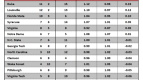
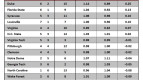
So here’s Table A, where we list the 11 programs with the most NBA Draft picks in history (1949-2008).  For the full list of programs with ten or more historical draft picks, see our Google Doc on the subject.

It doesn’t take much brainpower to see that UCLA‘s Ben Howland and UNC‘s Roy Williams are likely to spend the next decade further dominating this list.  Louisville and Kansas also stand to rise into the top five quickly with the players Rick Pitino and Bill Self are recruiting these days.  Indiana, Duke, Kentucky – all have been trending downward, but how will the newish coaches at IU and UK change that, and will Coach K start recruiting studs again now that making the Sweet 16 is the norm at Duke?  St. John’s and Maryland? Both are living on lost glory with no recent signs of improvement.  And keep an eye on the sleeping giant Thad Matta is building at Ohio St. (currently at 25 total picks) – he could overtake the Terps with two more of his Thad Five-type classes. 

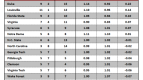
Total draft picks are nice, but championships are won with first-round talent, and first-round talent tends to become first-round picks (just sayin’).  So let’s slice the data a little further to see what schools produce the most first rounders (Table B). 

The top six programs in history are also the top six producers of first round talent.  Correlation, much? (ok, for that comment, forget Notre Dame and their zero F4s)  We’re still aghast that Minnesota continues to appear in the top ten of this list.  Something tells us that Tubby won’t exactly set the Twin Cities on fire with first rounders up there on the tundra.   

How about elite players?  It’s true that a good argument can be made that the NBA’s recent propensity in drafting potential over production has mitigated some of the value of analyzing these draft numbers at the college level, but there’s likely still a strong correlation between elite NBA draftees and collegiate team success.  See Table C for the list of the schools with the most Top 10, Top 5 and #1 Overall Picks.   

LSU is the real anomaly of this group – they’ve had a modicum of team success over the years (three F4s), but they seem to excel in producing top-tier individual talent, with eight Top 5 picks in history.  Considering that LSU trails only UNC, UCLA and Duke in that category, it is phenomenal that the Tigers haven’t had more national success over the years (until we remember again… Dale Brown, John Brady).  Did anyone else realize that Duquesne has had two #1 picks in its history, and that they were in consecutive years?!?  Those Dick Ricketts (1955) and Sihugo Green (1956) teams of the mid-50s must have had P-town roiling, eh?  (well, actually, the Dukes were NIT Champs in 1955).

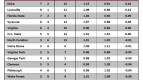
Now we’re to Table D, which shows the breakdown of picks by decade.  Keep in mind that the table is sorted by the 2000s column on the left – yes, we’re guilty of a serious case of presentism. 

We threw this table up mostly to show that with one NBA Draft remaining this decade, several schools have a chance to take the lead for most picks in the 2000s.  UCLA, Duke, Connecticut, Florida and Arizona could all have a couple more picks in the books by this time next year.  UNC is the real wildcard, though.  The Heels could have as many as five draftees in next year’s class, which would give them an outside shot at leading the decade, and is amazingly something that UNC has never done in its regal NBA Draft history.

Again, here is the link to the Google Docs listing the programs with 10+ draft picks in history, and here is the link to the comprehensive raw data where you can look up and manipulate the table to locate any pick from the last sixty years. 

We have some further ideas for this data, but that’ll have to wait for another post. 

Share this story

ATB: Please Never Make Us Watch Columbia Again

Posted by rtmsf on November 14th, 2007

ATB v.4

11.12.07

Story of the Night. Boring. There was really only one good game tonight – Syracuse 72, St. Joseph’s 69. We had this one on our upset alert radar last night, and it took a three from Jonny Flynn at the top of the key to put the Hawks away at the Carrier Dome tonight (see vid below). Amazingly, that was Flynn’s only hoop of the game, coming after his record 28 pts last night. His backcourt mate Paul Harris picked up the slack tonight, going for 18/14/6 assts/2 stls in the win. How a 6’5 guard tallies 29 rebounds in two games confounds us. Syracuse has shown that it has the guards to play with anyone, but will the Orange have anything on the interior this year? We shall see, but until then, Cuse blog Axeman Cometh tells us to get the popcorn ready.

[vodpod id=ExternalVideo.440016&w=425&h=350&fv=]

Things We Saw. Not much else tonight. Ohio St.-Columbia was the other ESPN game tonight, and although the Ivy League Lions gave a good effort, there was never a realistic chance for the upset. Once again, OSU didn’t really impress us, but we thought back to last year, and when did they ever impress us then either? They won 35 freakin’ games last year and we can only remember a handful where we thought ‘this is a pretty good team’ – the Big 10 championship game v. Wisconsin, the Tennessee second half comeback, and the Georgetown F4 game. So that’s how they do. We’re not going to count them out this year based on first impressions. Koufos (19/7/3 blks), Butler (18/7/3 assts) and Lighty (13/4/4 assts) led the way (Ohio St. 68, Columbia 54).

[vodpod id=ExternalVideo.440017&w=425&h=350&fv=]

SEC Goes on the Road. Two interesting games for SEC teams involved Vanderbilt going on the road to Toledo and Alabama going to upstart Mercer tonight. These were games that neither could afford to lose if they expect to be seriously considered for at-large bids next March. Vandy burst out to an 18-0 lead before Toledo bothered to score a single point, and although the game got close, Vandy continues to show with a balanced attack from Shan Foster and AJ Ogilvy why it will be heard from in the SEC East this year (Vanderbilt 77, Toledo 70). Bama went into a sold-out arena at Mercer and survived A-Sun Mayhem thanks to Richard Hendrix’s 28/14, but we’re patiently waiting the bottom to fall out on this team without a true point guard (Alabama 90, Mercer 83). Ole Miss also got a solid mid-major win at home over South Alabama tonight (Ole Miss 81, South Alabama 78).

Big Halftime Leads. #8 Michigan St. up 19 on Chicago St., Missouri up 30 on Fordham, #2 UCLA up 35-11 on Cal St.-San Bernardino, Washington up 21 on NJIT… (all blowout wins).

Ranked Teams.
#9 Washington St. 86, Boise St. 74. Wazzu struggled before blowing it open with a 60-pt second half.
#16 Gonzaga 80, Idaho 43. Another huge second half (44-13) led by Austin Daye (18/4/3 assts/6 blks).
#19 Texas A&M 67, Oral Roberts 53. This surprised us that it wasn’t very close.
#20 Arizona 76, N. Arizona 69. Lute is due back soon. Budinger with 25/6/4.

Upset Alert. Like we said, it was a boring night.

On Tap Tonight (all times EST). 50 more games tonight, including numerous ho-hums on FC .

  • Florida (NL) v. NC Central (ESPN FC) 7pm – yes, this is the same team Duke beat by 1000 pts.
  • UNC (-11) v. Davidson (ESPN) 7pm – Stephen Curry, neutral court??? Naaaah…..
  • St. John’s (NL) v. St. Francis (NY) (ESPN FC) 7:30pm – these are the games we wish we could give back to ESPN FC.
  • LSU (NL) v. McNeese St. (ESPN FC) 8pm – tune in just 5 mins to see Anthony Randolph.
  • North Texas (NL) v. Oklahoma St. (ESPN FC) 8pm – see above re: St. John’s.
  • Sam Houston St. (NL) v. Texas Tech (ESPN FC) 8pm – upset alert! SHSU is legit, and Knight isn’t what he used to be.
  • Bradley (NL) v. Iowa St. (ESPN FC) 8pm – Bradley should win this game for the Valley.
  • Texas A&M (NL) v. UTEP 9pm – Turgeon’s crew impressed tonight.
  • California (-8) v. Southern Mississippi 10:30pm – if Ben Braun weren’t still coaching there, Cal could surprise this year.
Share this story

ESPNUSUCK.

Posted by rtmsf on November 5th, 2007

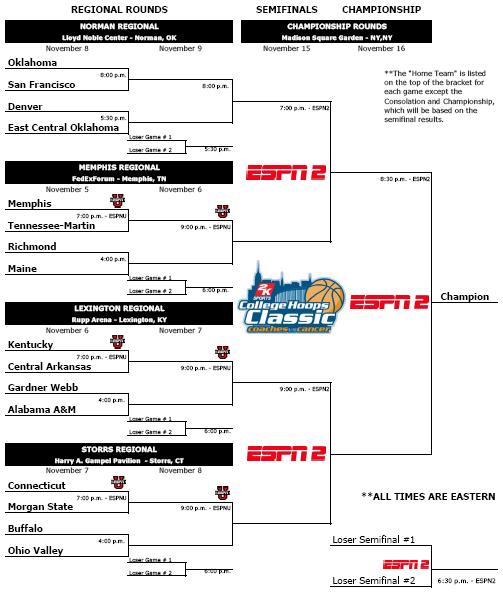
The official start of the 2007-08 regular season isn’t until Friday, but the NCAA exempted the annual Coaches vs. Cancer Tournament, which is starting tonight in Memphis and will run throughout the week at several other sites (Storrs, Lexington, Norman) before holding the championship rounds at MSG next week. ESPN and Comcast have ensured that we won’t be able to see any of this week’s games in our local viewing area – thanks, guys! But jeez, this seems really early – we just changed our clocks for chrissakes. Mike DeCourcy has the best take on the matter:

Once again, instead of the triumphant introduction to the season we have in such sports as NFL football and Major League Baseball, college basketball just sort of stumbles in and grabs a seat in the corner.

With college football and the NFL in full swing, it’ll take until Thanksgiving for anyone to notice that we’re already playing games, but that’s ok. It gives us a chance to bone up on early hits and misses (ahem, Michigan St.) while nobody’s watching.

Here’s the CvC bracket:

Coaches v. Cancer Bracket 07 v.1

A few comments:

  • Quick Rant. Why the hell aren’t ESPNU games part of the Full Court Package? That makes completely no sense to us as it seems a natural fit. And yes we’re extremely annoyed that Comcast will not offer ESPNU in our area.
  • Predictions. Memphis will roll through its regional, keeping the nation’s longest homecourt winning streak (32) alive. Kentucky will bomb Central Arkansas but struggle with Alabama A&M and shotblocker extraordinaire Mickell Gladness in the second round. UConn will get a game from Todd Bozeman’s Morgan St. squad before faltering, then destroy Buffalo in round two. Our possible upset alert is USF over Oklahoma. The Dons probably don’t have enough to pull it off, but we expect a close game there. Still, we expect Jeff Capel’s OU team to represent the Norman region at MSG next week.
  • Quick Fact. Kentucky is 0-2 in this event, with both losses coming in 2000 (UCLA, St. John’s) when it was a four-team tourney. Grab the ball, Tayshaun! That record will change this time around.
Share this story

NBA Draft Picks by School Part III

Posted by rtmsf on June 28th, 2007

Today is the final installment of the three-part series where we wanted to take a look at the NBA Draft broken down by school over the history of the modern NBA Draft (1949-2006). In Part I, we examined the raw numbers and made a rudimentary attempt at tying NBA talent to NCAA Tournament success. In Part II, we broke out the raw numbers by round selected, and then further sliced that data into an examination of “Top 10” and “Top 5” selections. Today we finish off the series by looking at draft selections by decade, hoping to see how things have trended over the entire era of the NBA Draft. See Table C below.

Table C. NBA Draft Picks by School & Decade (1949-2006)

Notes: this table is sorted by the Total Draftees column, and is limited to schools with a minimum of ten or more draft picks since 1949. The yellow shading refers to the highest number in that column.

NBA Draft Picks by Decade v.1

Observations:

Consistency. The first thing that struck us as interesting were the schools that were fairly consistent in providing draft picks throughout the NBA Draft era. UNC, Louisville, Kentucky and St. John’s do not lead any particular decade, but each school has provided at least two picks per decade throughout. UCLA and Indiana have been similarly consistent over the entire period, but each also led a decade in picks (UCLA during the 70s; Indiana during the 80s).

Less Volume, but Still Consistent. Look at Big 10 stalwarts Illinois and Minnesota, along with Villanova and Utah. We’ve been clowning the Gophers all week, but surprisingly, they’ve consistently produced between 2 to 7 picks per decade – guess it’s easy to forget about Willie Burton and Joel Przybilla. The same is true for the Illini (between 2 to 7 per decade), Villanova (2 to 5) and Utah (2 to 5). Maryland, Syracuse, Ohio St., Marquette, Wake Forest, Temple, USC, Stanford, Memphis, Tennessee, Oregon, BYU, Mississippi St., LaSalle and Bradley are some of the other schools with at least one draft pick per decade.

USF Dons

The USF Dons Represent a Bygone Era

Whatever happened to…? The University of San Francisco, led by KC Jones and Bill Russell, produced fourteen draft picks from 1949-79, and only two since. Eight of Kansas St.‘s fourteen total draft picks were produced from 1949-69, but there’s only been one since 1989 (Steve Henson in 1990) – it even led the 1940s/50s with seven picks. And despite its recent renaissance under John Beilein and the proliferation of draft picks to come under Bob Huggins, West Virginia has only had one draft pick since 1968 (seven overall)! Another early producer Holy Cross (six overall) hasn’t had any picks since 1969; and Grambling (nine overall) hasn’t had any since 1978.

Arizona & UConn

These Two Schools Have Come On Strong

Late Bloomers. The biggest examples of late bloomers have to be Arizona and Connecticut. Arizona’s first draft pick was in 1974, and it has produced thirty-three more since, good enough for sixth (tied with UK) all-time. Connecticut is even more shocking – the Huskies’ first pick was Cliff Robinson in 1989 (!!!), but it has produced twenty picks since (1.11 picks per year). Duke also has to be mentioned here. The Devils had good success in the early years (seven picks through the 70s), but have had thirty-two draft picks since 1980, twenty-six of those since 1990 (1.44 picks per year). They were second in the 90s with fifteen picks, and are currently tied with UConn leading the 2000s with eleven picks. No wonder they’ve been so good. Other late bloomers include Georgia Tech (22 of its 24 picks since 1982), Michigan St. (24 of its 26 picks since 1979), Georgetown (17 of 18 since 1980), Alabama (19 of 23 since 1982), Texas (15 of 17 since 1982), and Georgia (13 of 14 since 1982). After tonight’s draft, Florida could have as many as 14 of its 15 picks since 1984, but we already knew the Gators were a late bloomer. As a bit of an anomaly among the traditional powers, Kansas didn’t really begin consistent production of draft picks until the 70s (24 of 27 picks since 1972).

Coaches. The one trend we see with many of these late bloomers is how important coaches are to the talent level of a program. UNC, Louisville, UCLA, Kansas, Kentucky and Indiana have had great coaches throughout most of their histories. It makes sense that these schools have also been the most consistent at putting talent into the NBA Draft. But look at some of the other schools, particularly the late bloomers. Jim Calhoun has been responsible for every single one of UConn’s draft picks; Lute Olson has been responsible for all but five of Arizona’s draft picks (85%), and Coach K for 74% of Duke’s all-time picks. Bobby Cremins at Georgia Tech (79%), John Thompson at Georgetown (83%), and the Jud Heathcote/Tom Izzo reign at Michigan St. (92%) show just how important a single coach can be to a program.

Final Thoughts. This has been a fun experiment, and in only a few hours, we get to update all of our data with draft data from 2007. Something tells us that Florida and Ohio State’s numbers are going to be rising. Thanks to everyone for your thoughts and commentary. We now return to our regularly scheduled programming…

Share this story

NBA Draft Picks by School (1949-2006)

Posted by rtmsf on June 26th, 2007

We always believed that it would be cool if someone would take the time to break down the NBA Draft by schools since its inception, figuring there must be a loose correlation between the collegiate powers of the past sixty years and the players that the NBA finds draft-worthy. We’re not saying that a player is talented simply because he’s drafted by the NBA or that he sucks if he isn’t – rather, a player being drafted is solely an imperfect indicator that, at the time, a player’s collegiate career inspired professional scouts to believe that he could ultimately contribute to their team. But it’s also the only consistent indicator we have. To that end, we tried to determine if there was a rational way to determine how much “bang for your buck” having these talented soon-to-be NBA players on a college team’s roster matters over time.

Bang for Buck

We realize there are many ways to do this analysis and a number of these are meritorious, but for us, it always comes back to NCAA Tournament success – Appearances, Final Fours, Championships. These three measures show that you’re good enough to be invited, you’re good enough to go deep, and you’re good enough to win the title. So in looking at Table A below, you’ll see that the table is sorted by the schools with the most NBA Draft Picks in the first two rounds since 1949 (the first year of the “modern” NBA Draft), and each school also lists those three measures of success next to it (also since 1949). We considered here only the first two rounds of each draft for consistency and the likelihood of a player actually making the parent team.

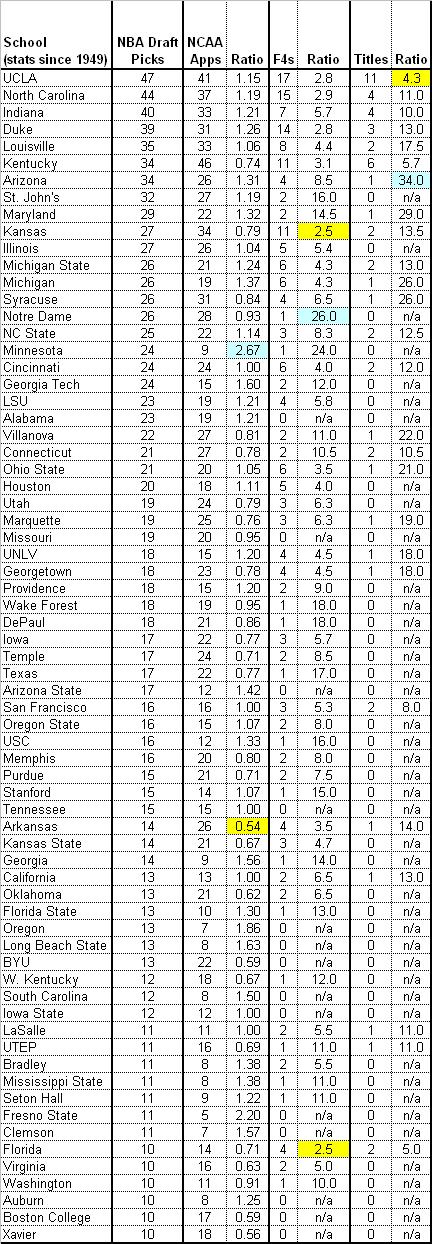
Table A. NBA Draft Picks (first two rounds) From 1949-2006

Notes: this table is sorted by the NBA Draft Picks column and is limited to schools with a minimum of ten NBA Draft Picks since 1949. The yellow shading refers to the lowest ratio in that column; the light blue shading refers to the highest ratio in that column.

NBA Draft Picks by School - Ratios v.2

Observations.

Talent = Success. Out of the traditional Super Six schools – UCLA, UNC, Indiana, Duke, Kentucky and Kansas – each is among the top ten schools with the most NBA Draft picks. Collectively, these six schools have accounted for over 10% (231 of 2214) of the all-time NBA draft picks, which is fairly amazing if you consider that we’re discussing nearly sixty years worth of college basketball players and hundreds of programs.

Surprises. St. John’s, Maryland and Notre Dame are in the top fourteen of NBA draft picks with 32, 29 and 26, respectively, but their historic success as programs (two F4s each for SJU and Maryland, 1 F4 for ND) is definitely a bit lower than their talent over the years might suggest. They have had numerous good players, but it hasn’t translated into NCAA Tournament success at the same level as their contemporaries on this list. At the other end of the list, Florida‘s recent ascent into the elite company is not (yet) well-represented by its number of draft picks (only 10). However, we’d expect that to change very quickly, hitting as much as 15 after this year’s draft (Horford, Brewer, Noah, perhaps Green & Richard).

Golden gOh-fers. The biggest shocker of all deserves its own paragraph. Somehow the Minnesota Golden Gophers have managed to put 24 players into the NBA Draft over the years – only fifteen other programs have put more – yet nobody would mistake Minnesota for an elite program during any era, considering its paltry nine NCAA appearances and one F4. This disconnect is exhibited by the fact that Minnesota has the highest draft pick/NCAA appearance ratio among the schools listed. Fresno St. (thanks Tark) is the only other school with a ratio greater than 2.0. We think Long Beach St. also deserves a mention, not simply due to its high ratio (1.63), but also because it has produced more draft picks than many major conference teams despite never being much of a power, even within its own conference. On the flip side of things, it was also somewhat amazing to us that Arkansas had only produced fourteen NBA picks despite a substantial amount of NCAA success (26 appearances; 4 F4s; 1 title).

Goldy Gopher

Apparently These Three Gophers Were Drafted by the NBA

Team vs. Individuals. We’re going to be careful to avoid drawing too significant of a conclusion here, but we also found it interesting that among the top ten schools, only Kentucky and Kansas had draft pick/appearance ratios under 1.0, while the other eight schools were above that marker. We wonder out loud if this shows evidence of schools that have traditionally emphasized the team concept to make up for a lack of individual talent over the years; or if UK and KU are simply an anomaly among the most talented teams. There are probably too many variables at play here to make any supportable conclusion.

F4 & Title Ratios. Reviewing the draft pick/F4 ratios, only Indiana is the outlier here, as expected schools such as Kansas, UCLA, UNC, Duke and Kentucky (along with Florida) comprise the six lowest ratios. Considering only the schools with multiple F4 appearances, St. John’s and Maryland have the highest ratios of draft picks/F4s, showing again that they’re producing a lot of good players without as much success to show for it as the others near the top of the list. Along the same lines, considering only multiple titlists, Louisville, Kansas and Duke appear to be getting the least bang for the buck from its talent, as these three schools have the highest draft pick/title ratios among multiple titlists.

Coming Next: now that we’ve looked at the overall numbers, we’ll take a snapshot look at those numbers by decade and by round to see if anything else looks interesting. View Part II (by round) and Part III (by decade) here.

Share this story

NCAA Tourney Overachievers and Underachievers of the 65 (64) Team Era

Posted by rtmsf on June 15th, 2007

We’ve received a resounding response on the post Tuesday evaluating school performance during the 65 (64) team era, so let’s waste no time in presenting Part II of our statistical profile of the NCAA Tournament during that period. As we alluded to in that post, looking at raw data in a vacuum has its limitations. From that data we got a reasonable sense of which programs have had the most success during the period, but it didn’t really give any insight as to which programs have overachieved, underachieved, or simply performed about as expected.

Ziggy

Which Schools Reach Their Potential?

Today’s post will address that issue. You might want to bookmark this page for next year’s bracket-filling, because we feel that what we’re showing today has significant value in determining those schools that tend to embrace expectations and those that tend to wither in the face of the red-hot lights of March. Stat geeks like ourselves should enjoy this post – hopefully it won’t bore the rest of you.

The first consideration in trying to determine which programs have overachieved and underachieved is how to answer that question. Traditionally, you often hear commentators and writers talk about “playing to your seed,” which essentially presumes that a #1 seed should make it to the Final Four, a #2 seed to the Elite Eight, and so on (see Table A below). Using this model, a team that wins any games beyond the expected wins of its seed would fairly be said to have overachieved as to the expectations of the seed (and vice versa).

Table A. Standard Model
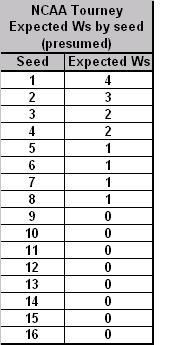
NCAA EV by Seed (Presumed)

So let’s try to first answer that question using the Standard Model outlined in Table A. But don’t give up on the post after you review the Standard Model results, as we have another model below it that may bring up new and interesting considerations. The Standard Model as applied to the 65 (64) Team Era is Table B below.

Table B. Standard Model Applied to 65 (64) Team Era

Notes: the table is sorted by “+/- per App,” which represents the number of games won above or below the expected number of wins for that seed per NCAA appearance (1985-2007). The rows colored in green highlight schools that are in the top twelve spots of both Tables B and D. The rows colored in yellow highlight schools that are in the bottom twelve spots of both Tables B and D.
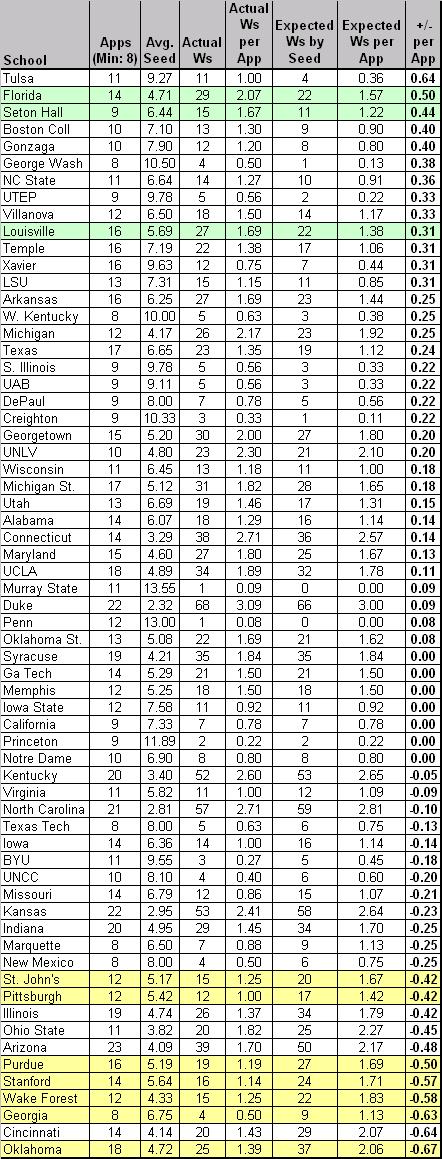
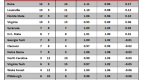
NCAA EV by Seed - Detailed v.3

Inside the Numbers (Table B):

Overachievers. What first jumps out at us using this method is just how (except Florida) there are no big names near the top of the list. Tulsa, Seton Hall, GW, UTEP, Temple? Without taking away from their performance – after all, every one of those teams should be commended for overperforming versus its seed – this immediately suggests to us that the Standard Model often used by the pundits actually favors lower-seeded teams who manage to win a game or two every couple of years in the NCAA Tournament. Using the schools above +0.30 as a natural break point, only Florida, Louisville and Temple have won more than twenty games in the NCAAs during this period, and the average seed of these thirteen schools was 7.0. Are these teams chronically underseeded or are they overachieving as a general rule? Whatever the case, we’re going to think a little harder about picking Tulsa the next time they make the bracket.
Tulsa Logo

Are the Golden Hurricanes the Biggest NCAA Tourney Overachievers?

Underachievers. A brief look at the names at the bottom of the list – Oklahoma, Cincinnati, Wake Forest, Stanford, Purdue, etc. – tells us that we’re on to something here. As our good buddy MK says, “Wake and Purdue can effin’ bite me. They kill my bracket every year.” Or something like that. Using -0.42 as a natural break, the eleven teams at the bottom averaged a seed of 4.8 during this period, which is a marginally better seed than the overachievers on this list. Oklahoma, Arizona and Illinois – what do you have to say for yourselves? Each of you has had at least 18 appearances during this era, averaged a solid if not spectacular seed between #4 and #5, and consistently played below that seed to the tune of -0.42 wins per appearance or worse. This matches Tuesday’s analysis with Oklahoma as a disappointment; but under this model, Arizona and Illinois (second tier elite performers on Tuesday) have some explaining to do.

Oklahoma celebration

You May Want to Avoid These Guys in your Brackets

You’ll See Them Again on the Long Road Back to the Middle. The Big Four from Tuesday – Duke, UNC, Kentucky and Kansas – find themselves in the middle of the pack. It’s notable that Duke averaged a seed of 2.32 during this era and still overachieved by +0.09 wins per appearance relative to seed. UNC and Kentucky are verrrry slightly underachieving, whereas KU’s recent vintage teams (2005 & 2006) probably contribute to its slightly lesser position at -0.23 wins per appearance. UConn should be lauded for overachieving at a clip of +0.14 wins per appearance, which somewhat mitigates their overall lack of F4s – they do win a lot of NCAA Tournament games. Syracuse, Georgia Tech, Memphis, Iowa St., California, Princeton and Notre Dame – all of these programs have played exactly to seed in the last 23 years. Be sure to remember that fact next year when filling out your brackets.

Criticism of the Standard Model. The primary problem with evaluating NCAA Tournament success based on “playing to the seed” is that it puts an unrealistic burden on highly-seeded teams because over time they never play to their seed. In the knockout crucible that makes the NCAA Tournament so exciting, a corollary result of using this criteria is that higher seeds (#1-#4) are largely set up to fail, and lower seeds (#9-#16) are significantly overachieving simply by winning one game. Additionally, we feel that using the Standard Model assumes too much at the squishy margins – that a #4 seed should win two games, a #5 seed should win only one game, and that a #8 seed should always beat a #9 seed – when both teams are probably very similar in ability. For this reason, we now offer an alternative model, one that considers actual historical performance of the seeds.

To that end, see Table C below for a historical snapshot of how well each seed actually performed in the 65 (64) team era.

Table C. Historical Model
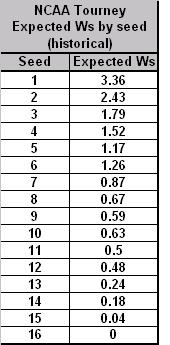
NCAA EV by Seed - Historical

Considering Table C, we wanted to point out for a moment that we have a couple of thoughts. First, we found it interesting that #6 seeds have traditionally performed better than #5 seeds. This at first seems anathema to conventional wisdom, as a #6 likely has to get past a #3 in the second round, whereas a #5 must only defeat a #4. That is, until you remember that a #5 has the dreaded 5-12 match-up that knocks out so many higher-seeded teams (excepting 2007, of course). Also, it’s interesting that a #10 seed has a better historical expected number of wins than a #9 seed. This shows again that a better draw is to avoid the 8-9 match-up, even if you end up as a lower (but more likely to succeed) #10 seed.

Using the 1985-2007 Historical Model as a baseline expected value for each seed, our list of 64 schools is now featured in Table D below.

Table D. Historical Model Applied to 65 (64) Team Era

Notes: the table is sorted by “+/- per App,” which represents the number of games won above or below the expected number of wins for that seed per NCAA appearance (1985-2007). The rows colored in green highlight schools that are in the top twelve spots of both Tables B and D. The rows colored in yellow highlight schools that are in the bottom twelve spots of both Tables B and D.
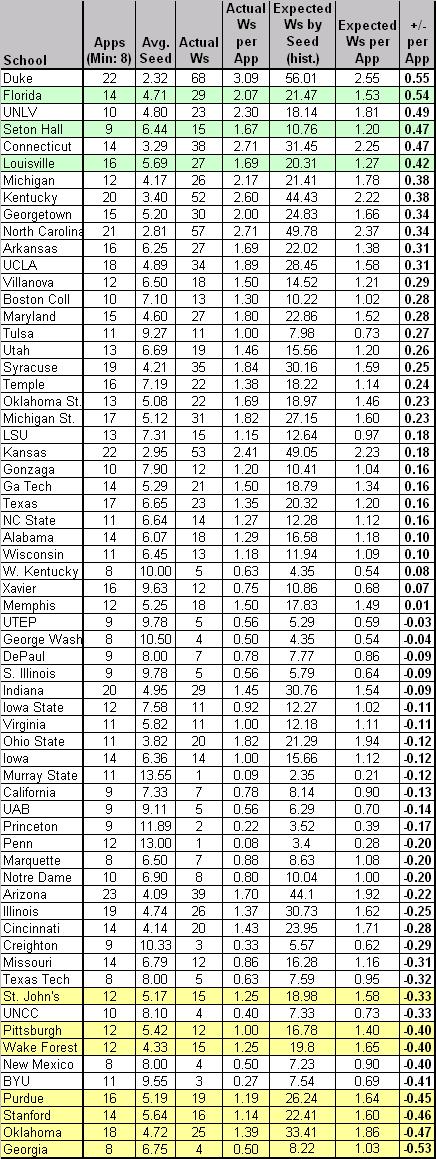
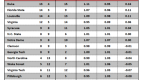
NCAA EV by Seed - Hist Detailed 3

Notable Differences. Using the Historical Model, the first thing that strikes us as interesting is that many of the heavy hitters of the era have jumped considerably, including some all the way to the top of the list. In fact, the following schools – Kentucky, UNC, Duke, Kansas, UConn, UNLV, UCLA, Syracuse, Ohio St. – all rose at least fifteen places from where they were situated in Table B. Each of these schools (excluding Kansas and Ohio St.) have overachieved at least +0.25 wins per appearance above the historical performance of their seeds. Since these schools represent a total of thirteen championships and thirty-eight F4s during this era, the Historical Model viewpoint makes more sense than what the Standard Model shows.

Who Dropped? Creighton, George Washington, UAB and UTEP all went from nice-looking overachievers in Table B to slight underachievers using this model. NC State, Xavier and Gonzaga looked fantastic using the Standard Model, but look rather pedestrian using this one. The explanation for this is simple – these teams collectively averaged a #9 seed throughout this era – if we use the Basic Model, they should never win a game, so when they do, it looks as if they’re significantly overachieving. However, using the Historical Model, we see that they actually win NCAA Tournament games roughly commensurate with how a #9 seed typically performs. This again illustrates why we feel this model shows a truer snapshot of performance.

More Importantly, Who Stayed the Same? Now this is where it gets really interesting. The rows shaded in green in Tables B and D represent schools that were in the top twelve in playing beyond its seed using both models. You could accurately say that, no matter how you slice it, Florida, Seton Hall and Louisville are the truest overachievers of the 65 (64) team era. (Incidentally, Florida and Seton Hall are in the top four of both tables, with each school averaging an extra win beyond its seed for every two appearances in the NCAA Tournament.)  These three schools consistently play beyond the actual and historical expected value of the seed that the NCAA Selection Committee gives them.  

The rows shaded in yellow at the bottom of Tables B and D represent the true underachievers. These schools were in the bottom twelve in playing below its seed using both models. What’s peculiar about this statistic is that there appears to be a much greater correlation between the tables with respect to the underachievers than with the overachievers. Whereas the overachievers only had three common schools between the tables, regular NCAA disasters such as Georgia, Oklahoma, Stanford, Purdue, Wake Forest, Pittsburgh and St. John’s find themselves in both at the bottom looking up. If you are at all like us and believe that the weight of history contributes as a predictor of the future, then anyone reading this post should be extremely hesitant picking these schools to play beyond its seed to its seed in the Dance in the years going forward.
Chicken or the Egg

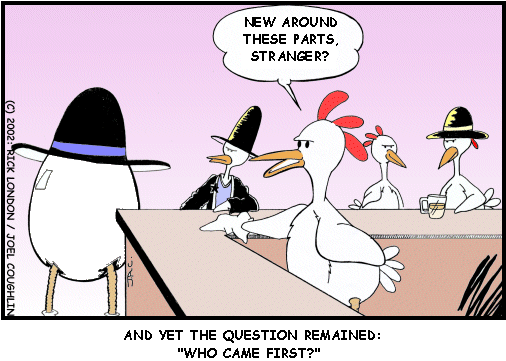
And Now, the Chicken/Egg Argument. Whether you buy into the Standard Model or the Historical Model or neither, we can say without a doubt that some schools appear to consistently overachieve relative to its seed, while others consistently underachieve relative to its seed. The question we want to posit to the readers is what causes this – is this simply a statistical anomaly? Are the overachievers regularly seeded too low by the NCAA committee; or, are the underachievers regularly seeded too high? Is there a self-fulfilling prophecy at work here, where schools that are known as chronic underachievers (ahem, Oklahoma) place so much pressure on themselves that they tighten up in the clutch? Conversely, do the overachievers find their wits amidst chaos to consistently come through under pressure because they are expected to do so? These are questions that we cannot answer, but we figure that there are elements of each at play here. We’d certainly like to hear your thoughts on this and any other topic. Oh, and apologies for the long post today.

Coming Next: We’ll take a look at the raw numbers again, but this time we’ll examine it by conference, which isn’t as easy as it sounds. Do you realize how many conference re-alignments and mergers and dissolutions there have been in the last 23 years of NCAA basketball?



Share this story