Andrew Murawa is the RTC correspondent for the Pac-10 and West Coast Conference.
A Look Back
With non-conference play all but wrapped up and the first week of the conference season in the books, we’re getting a clearer and clearer picture of who the legitimate contenders are and who is going to be bumping along in the lower half of the standings as the season progresses. But, it wouldn’t be the Pac-10 if it didn’t have plenty of surprises in store for us. And with the first nine games of the season complete, we’ve already got the mind-boggling first week surprise of an Oregon State sweep of the Arizona schools, Stanford bouncing back from struggles in their early games to smack Bay Area rival Cal around and Washington going on what is likely their toughest road trip of the season and pulling out just their third-ever sweep of the road trip to Los Angeles to establish themselves as the clear-cut favorite for the crown.
Team of the Week
Oregon State – It is awful hard not to peg the Huskies as the team of the week, given that they’ve just passed with flying colors what is likely their biggest test of the conference slate. But, this Beaver team just wrapped up a completely fascinating weekend. This is an OSU team that I have previously this year described in this column as “bad,” “amazingly underwhelming,” “very ordinary,” “pitiful,” “terrible,” and “just awful.” In the weekly power ratings, they have never been ranked higher than tenth and I even once wished that there were already 12 teams in the conference just so I could put the Beavers lower than that. There are losses to Texas Southern, Seattle and Utah Valley State in the record books and this team just had the look of a team that would fight and scrap and claw to get to 0-18 in the Pac-10, even if it killed them. But then, just before Christmas, much-heralded and waited-for recruit Roberto Nelson became eligible, the team looked improved in a sneaky-good 20-point win over Illinois-Chicago, and there were whispers that this team had turned the corner. Then this past weekend, they killed Arizona State by 22 before coming back on Sunday night and upsetting Arizona, in a game where the Beavers didn’t even play all that well. And now all of a sudden, you look up and down that roster and see talented freshmen and sophomores (like Nelson, Ahmad Starks, Joe Burton and the star of the Arizona win, Jared Cunningham) paired with a couple of serious veterans in Calvin Haynes and Omari Johnson and you see a pretty stout lineup. I’m not for a second suggesting that out of the blue this OSU team woke up one day as a consistent finished product, but on the right night when things click together for this team, they can beat just about everybody in this conference. And I’m still a little bit scared that I just wrote that sentence.
Player of the Week
Matthew Bryan-Amaning, Senior, Washington – In the Huskies’ New Year’s weekend sweep of the Los Angeles schools, the 6’9 senior from London led the way for Lorenzo Romar’s club, leading the team in both points and rebounds in their two games while posting averages of 19.5 points and nine rebounds per contest. After losing his starting spot for four games earlier this season, Bryan-Amaning has bounced back in a big way, knocking down a high percentage of shots in an efficient manner, being a monster on the boards on both ends, taking care of the ball and defending well. With Washington firmly entrenched as the favorite in the Pac-10, Bryan-Amaning will need to continue being a steady frontcourt presence for the relatively undersized Huskies.
Newcomer of the Week
Dwight Powell, Freshman, Stanford – From the minute Powell stepped on the court this season, it was clear that he had an abundant supply of athletic gifts. But, all too often, Powell has struggled to reign in those talents and play under control and within the structure of the Cardinal offense while still being able to make an impact. This week, however, in his first Pac-10 contest against the hated Cal Bears, Powell pulled it all together in breaking out a career-high 20 points, adding seven rebounds and hitting seven of his 11 attempts from the field. The next test for the talented 6’9 forward is to recreate performances like that on a regular basis. If he can do that, a Stanford squad that struggled in non-conference play could make an impact in the Pac-10 race.
Game of the Week
Washington 73, USC 67 (OT) – If the first game of the year is any indication, we’re in for a wild Pac-10 season. Despite struggling through foul difficulties and injuries, the Huskies battled the homestanding Trojans for 40-minutes to a draw, then saddled back up and went at it for five more intense minutes before coming away with a hard-fought victory. The game was played at the pace and in the style that the Trojans wanted, with the score in the mid-50s at the end of regulation and with the Huskies having to switch to primarily zone defense after they got in deep foul trouble early in the first half (three U-Dub players fouled out, two more wound up with four personals). But Lorenzo Romar got big performances from senior Matthew Bryan-Amaning and freshman Terrence Ross, who each had a team-high 18 points – a career high for Ross. It was seniors Venoy Overton and Justin Holiday who came up biggest in overtime, with Holiday hitting the first five points of OT (including a fall-away three) and Overton scoring eight of his 11 points in the extra frame. All things considered, it was a great example of the Huskies getting positive contributions from a variety of sources in order to get their weekend, and their conference run, off to a scintillating start.
Game of the Upcoming Week
UCLA at USC, 1/9, 7:30 PM PST, FSN – Both LA-area schools started out conference play with a split, each knocking off Washington State in close games, but with both teams entertaining hopes of making a run at NCAA Tournament consideration, this becomes a very important game, apart from the inherent dislike between the two programs. Entertaining matchups abound in this game, with both squads featuring big and imposing frontlines ready to battle it out on the boards. In the backcourt, UCLA junior Malcolm Lee will likely be lined up against the Trojans’ Jio Fontan, and USC’s defensive stopper Marcus Simmons should set his sights on the Bruins’ versatile Tyler Honeycutt. One key in this game could be UCLA’s offensive rebounding. Ben Howland’s team loves to get after the offensive glass, but Kevin O’Neill preaches some heavy duty work on the defensive glass and his duo of Nikola Vucevic and Alex Stepheson are willing acolytes. If they can keep UCLA’s Josh Smith and Reeves Nelson from getting easy buckets on the boards, the tight USC defense could make life difficult for the Bruin offense.
Power Rankings
1. Washington (10-3, 2-0): With the help of last week’s sweep of the Los Angeles schools, the Huskies have erased whatever doubts there may have been about their legitimacy as the favorite in the Pac-10. After earning the hard-fought win over USC detailed above, they came back a couple days later to run away from UCLA in the second half. However, just when it seemed there was nothing but good news surrounding the Husky program, news broke on Wednesday that sophomore point guard Abdul Gaddy had torn his ACL in practice and would miss the rest of the season. One glance at the stat sheet and Gaddy’s 8.3 PPG may make one believe that, though a tough loss for the Huskies, this is one that they can overcome. And while it is certainly true that the combination of Isaiah Thomas, Venoy Overton, C.J. Wilcox and Scott Suggs still form a strong backcourt, Washington will definitely miss Gaddy’s confidence and leadership. He had developed into a true floor general and an efficient player on both ends of the court after a rough freshman season. In his absence, however, Overton and Thomas will both get more minutes at the point, with Suggs and Wilcox due for a bump in playing time at the two (although Wilcox played just four minutes on the SoCal trip due to a staph infection). While the Gaddy injury is a huge bummer for Husky fans (and college basketball fans in general), it is by no means a deal breaker for Washington, especially considering they now have a chance to adjust to his loss over the remainder of the regular season.
Looking ahead: The conference home-opener at the Hec-Ed is on Thursday, with northwest rival Oregon coming to two, then a suddenly interesting contest with Oregon State on Saturday afternoon.
2. USC (9-6, 1-1): With Washington the clear-cut favorite in the Pac-10, the question now becomes, who’s number 2? And the answer remains, albeit after only one week of play: who knows? For now, I’ll go with the Trojans, who gave the Huskies everything they could handle in the opener. A couple of days later, they looked excellent against Washington State for about 37 minutes before slowing up short of the finish line and winding up with a fortunate two-point win. But all things considered, this is a USC team with a reputation as a great defensive team, strong on the boards and with plenty of upside on the offensive end. The Trojans are still adjusting to life with Jio Fontan as their lead guard, and given that he is their most talented offensive player, once everybody is comfortable in their roles USC should improve upon their average offensive efficiency numbers to date. The biggest weakness for Kevin O’Neill is the complete lack of depth on this squad, so if the grind of conference play slows any of the Trojans’ key contributors, things could get tight, but with a little luck, USC could ride a strong conference run to an NCAA Tournament invitation.
Looking ahead: The Trojans host UCLA at the Galen Center on Sunday before getting out on the road in conference play for the first time with a trip to the Oregon schools.
3. UCLA (9-5, 1-1): The Bruins’ homestand against the Washington schools was an eventful one. In the opener against Wazzu, they needed a big second half to defend their turf and get conference play started on the right foot. Sophomore Reeves Nelson had 13 second-half points and classmate Tyler Honeycutt added 12 as UCLA used a 20-6 second half run to come back from an eight-point halftime deficit to post a nine-point win. In the follow-up game, however, it was a 27-10 Washington run that doomed the Bruins to a split. One big factor for the Bruins in the early season has been freshman Joshua Smith and his issues with foul trouble. When Smith can keep clean, few teams around the country have players than can defend him well, but all too often he gets in early foul trouble and then either has to sit or play more carefully for fear of fouling out. In the Washington game, he picked up two quick fouls trying to hedge on ball-screens at the top of the key – a strategy Ben Howland has used successfully with big men during his time in Westwood. Howland admitted he has reconsidered and will no longer regularly ask Smith to hedge ball-screens, rather asking him to sit back and plug the lane.
Looking ahead: The cross-town battle with USC on Sunday should be a must-watch game, with a trip to the Oregon schools to follow.
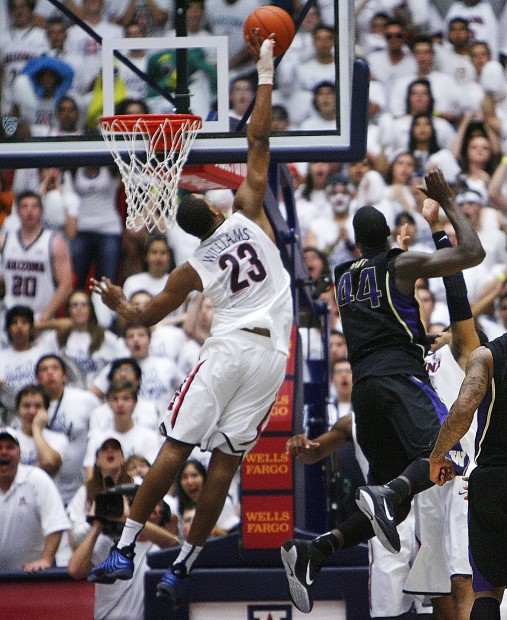
4. Arizona (12-3, 1-1): The Wildcats’ loss to Oregon State on Sunday was maybe the biggest story around the Pac-10, and it is worth another look from the Arizona perspective. I don’t know about anyone else, but the first thing I look at when I check out an Arizona box score is Derrick Williams, and just looking at his line is a pretty good microcosm of what went wrong in Corvallis. First and foremost, there is little dispute that Williams is the Wildcats’ best player and the guy who Sean Miller wants to be most involved in the offense. He is an insanely efficient offensive player who has been absolutely on fire early in the season. Why then did he only attempt six field goals, especially considering he made every one? Yes, he was limited somewhat by foul trouble, but he still played 29 minutes and yet Arizona could only get him a field goal attempt once every five minutes, in their game with the highest number of possessions this year? Worse yet, that’s not even much of an aberration, as he has only once taken double-digit attempts from the field (ten attempts against CS Fullerton on 12/8) since Thanksgiving weekend. Aside from the six field goal attempts, Williams did get to the line ten times, but he made just three of them, a stunning number given his 81.7% rate coming into the game. And last, but certainly not least damning, Williams had exactly two rebounds in 29 minutes. Two. Really. Two. There were 75 rebounds available for grabbing in that game, approximately 54 rebounds available to him in the time he played, and he grabbed less than 4% of them. That’s unforgivable for a player as talented as he. There is a lot of talk about Arizona as an underrated team and a potential challenger for the Pac-10 crown, but unless Williams, clearly the most talented player on a relatively under-talented Arizona team, can get more aggressive on the boards and more involved in the offense, this is little more than a middle-of-the-Pac team.
Looking ahead: The Wildcats get a chance to bounce back from the Beaver debacle with visits from the young Bay Area teams to the McKale Center.
5. Washington State (10-4, 0-2): After a second half fade against UCLA, the Cougars came out cold against USC, struggled to get good shots and then failed to convert when they did get open looks. And yet, after an 11-0 run in crunch time to get to within 58-56, Klay Thompson drove and spotted an open Abe Lodwick at the three-point line in the corner. However, the pass from Thompson was just a bit off target and Lodwick couldn’t handle it, and a clean look at a possible game-winning three fell harmlessly out of bounds. At this point, you wouldn’t blame Cougar fans if they were a little bit skittish about their team, even after a pretty strong non-conference schedule. Sure, the 0-2 start to conference play is easily explained away with the fact that it was a pair of road games against arguably the toughest pair of travel partners the Washington schools will face all season. And sure, those first two games of the conference schedule came at the tail end of a nearly two-week span away from home. But on the heels of last year’s freefall from a 12-3 start to a 16-14 finish (including a 6-12 conference record good for last place, this WSU team has a lot to prove.
Looking ahead: The Cougs have a chance to get back to .500 in conference by defending their home court against the Oregon teams, two teams expected to finish in the bottom half of the Pac-10. However, with Oregon State’s sudden resurgence, Ken Bone and company had better bring their A-game on Thursday, just to be safe.
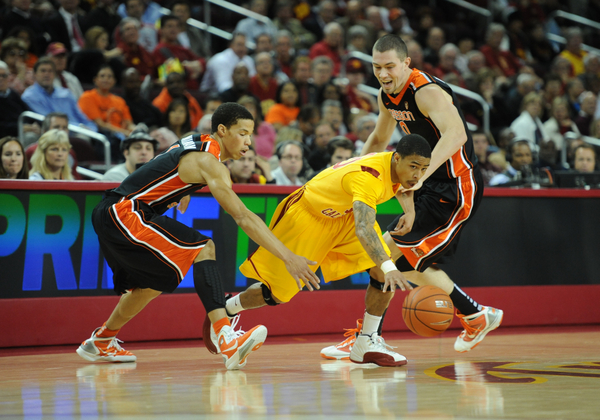
6. Oregon State (7-6, 2-0): Am I really going to jump the Beavers from #10 to #6? I don’t know what choice I have. As I mentioned above, I think this is a talented roster. Couple that with their most recent three games and put on a pair of decent blinders, and this ranking seems perfectly reasonable. Sophomore guard Jared Cunningham has proven to be one of the most dangerous thieves in the country, picking opposing teams’ pockets on six percent of all possessions, and he’s also shown to be an athletic talent in the open floor. He threw down one of the better dunks of the year over Arizona, although he still missed at least three point-blank bunnies in that game. Sophomore center Joe Burton burst out over the weekend as well, averaging 16.5 points and seven rebounds in the game and displaying quick feet, nice hands, a soft touch and a good feel for the game, especially for 6’7, 280-pound guy. Throw in 6’9 athletic senior forward Omari Johnson defending the top of the 1-3-1 zone and second-team All-Pac-10 selection in 2009-10 Calvin Haynes to go with a handful of other young and talented athletes and this Beaver team has gone from an afterthought to must-see TV in the span of about two weeks.
Looking ahead: The Beavers travel to the Washington schools this week, with Pullman the first stop. If they were going to win one of these games, the Wazzu game would be the more likely one. Despite their reputation in previous seasons under Craig Robinson as a team that wants to play a slow pace, this Beaver team is young, athletic and raring to go, qualities which are endearing but which could get them in trouble against the more talented Huskies.
7. Stanford (8-4, 1-0): While not as extreme of a surprise as Oregon State’s start to conference play, Stanford’s 14-point win over Cal goes down as an unexpected result as well. It’s not so much that the Cardinal won that was surprising, but the manner in which it happened. For most of the start of the Stanford season, it had been primarily the Jeremy Green/Josh Owens show, with Green providing the bulk of the offense from the perimeter and Owens doing the dirty work inside. But on Sunday, aside from Green’s 21 points, our Newcomer of the Week, Dwight Powell, busted out for 20 points and fellow freshman Anthony Brown and Aaron Bright also went for double digits, outplaying the Cal freshman and providing the difference in the game. Just one game is too small of a sample size to think the Stanford freshmen have turned the corner, but if Jeremy Green can continue to get help from the youngsters around him, Johnny Dawkins’ bunch can spring an upset or two this season.
Looking ahead: The Cardinal head to the desert for matchups with Arizona State and Arizona, giving their freshman class their first taste of life on the road in the Pac-10.
8. Arizona State (8-5, 1-1): Sun Devil leading scorer Trent Lockett missed the first two games of the Pac-10 season with a toe injury, and he was definitely missed. In the opener, the Sun Devils looked awful against Oregon State. They were outrebounded badly, grabbing just 51% of the available defensive rebounds while getting outshot badly on the way to an embarrassing 22-point loss. They bounced back to beat Oregon on Saturday, but didn’t look particularly good in doing so. Junior college transfer Carrick Felix got his second and third starts of his career and his most run (averaging 28.5 minutes per game), and responded with a particularly good game against Oregon, posting a line of 19 points, six rebounds and four assists, and it will be interesting to see Felix’s role upon Lockett expected return this week.
Looking ahead: The Sun Devils host Stanford and Cal, two winnable home games.
9. (Cal 7-6, 0-1): The sole game of the week was the Bears’ disappointing road trip to Stanford, but the big story broke Wednesday in Berkeley, when it was announced that freshman guard Gary Franklin was no longer in school and would be transferring out. Franklin had struggled mightily with his shot in the early season, hitting just 29% from the field, 29% of his threes and only 44% from the line – all this for a guy whose strength was considered to be his shooting. Franklin started the first 11 games of the season, but removed from the starting lineup in the Bears final non-conference game against Hartford, where he only played ten minutes and didn’t score. However, Franklin returned to prominence in the Stanford game, still coming off the bench, but this time getting 30 minutes, knocking down four of his seven three-point attempts and scoring 15 points in his best game of the season. Three days later, the decision was made, and he’ll be playing somewhere else beginning next December. The whole story is confusing, but the scuttlebutt is that Franklin was unhappy with coming off the bench, despite the fact that he still averaged over 25 minutes a game. Odds are, he’ll reappear in another west coast team, maybe San Diego State or UNLV or something like that, but this observer from outside can’t help but see this as a bad decision by a kid who has been treated more than fairly by Mike Montgomery, allowed to work through his struggles with his shot while still being trotted out there every night. In the meantime, Cal’s backcourt become a little thinner, and their fans’ dreams of a Franklin/Allen Crabbe backcourt bringing them back to glory in the not-too-distant future fade far earlier than expected.
Looking ahead: The Golden Bears head to the desert as well, starting with Arizona on Thursday, then heading to Arizona State on Saturday.
10. Oregon (7-7, 0-2): A sad week in Oregon basketball. Yes, they lost their first two games of the Pac-10 season, but really, Duck fans know there are more losses where those came from. The saddest part of the week was the final scheduled men’s basketball games at McArthur Court, the second oldest on-campus arena in Division I (behind Fordham’s Rose Hill Gym). So the old brokedown palace, site of not only many a classic Pac-10 game, but also one of the best Grateful Dead shows ever, gets put out to pasture, while the bright shiny new Matthew Knight Arena gets unveiled in a couple weeks. I’m sure that place is beautiful, and it will probably wind up giving Duck fans a better, more comfortable experience at games. And sure, the Knight Arena and its attendant facilities give Oregon some great new perks to offer potential recruits. I get it. But I’m still sad to see the old place go. I would love it if Oregon could find a way to sneak a game back over across the way to the old barn, but I’m sure that’s little more than a pipe dream. Fare you well, Mac Court, fare you well.
Looking ahead: The Washington swing is up next for the Ducks, and by this time next week, in all likelihood your Oregon Ducks will be sitting at 0-4 in the conference. Their time will come to sneak up on somebody in the Pac-10, but I doubt it is this week.