Orlando Pre-Draft Camp Day 2

Posted by rtmsf on May 29th, 2008

So Wednesday was Day 2 of the Orlando Pre-Draft Camp (Day 1’s notes are here), and once again we’ll try to synthesize some of the reports coming from various sources who are actually attending the camp. Hopefully we’ll start to get a sense as to who is improving or shatting all over decreasing their stock. Our sources today are DraftExpress, NBADraft.net, Jeff Goodman and Doug Gottlieb.

Players Doing Well So Far:
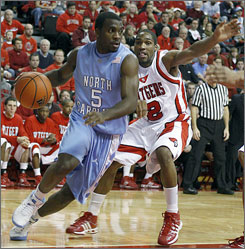
Lawson Really Must Not Want to Return to UNC (photo credit: USA Today)

  • Ty Lawson, UNC
    • DraftExpressTy Lawson was a cut above everyone else on the floor here, showing incredible quickness taking an outlet pass and getting his team out in transition, and fantastic court vision finding open teammates on the move. He made the game very simple for all of his teammates, as all they had to do was run with him and make sure their hands were ready for the pass.
    • GottliebBest point guard here so far – UNC’s Ty Lawson, trailed closely by Sean Singletary. While Singletary is more refined than Lawson and seems to be using his experience from being here last year to his benefit, Lawson has an extra step that you just cannot teach.
    • NBADraft.net – (10pts, 5ast, 3stl) From the moment he came on the floor he changed the tempo of the game. Pushing the ball in transition, he made some nice decisions finding open teammates or getting to the hoop and finishing. The highlight for him may have been the fact that he completely outplayed Lester Hudson, the man he was matched up with. Not only did he get by Hudson at will of the dribble, but he held him scoreless for the longer part of the game.
    • Gary Parrish also wrote an article yesterday explaining how shocked Ty Lawson has been by UNC fans’ reactions to his attempts to enter the NBA Draft. Many of the same people who congratulated him as a Tar Heel are now trashing him through this process. Maybe that’s why he’s playing so well?
  • Joe Crawford, Kentucky
    • DraftExpressJoe Crawford had a very strong game with 19 points on 6-11 shooting, thanks to an extremely hot and aggressive start that kept his team in the game. He took the ball to the rack extremely well, showing smoothing body control, solid ball-handling skills and impressive overall scoring instincts, and also knocked down a number of shots from outside.
    • GottliebKentucky’s Joe Crawford and UAB’s Robert Vaden both looked very much at ease with the added 3-point range needed for this level of basketball. Crawford looks smaller that the 6-5 he has always been listed at, but he was explosive in terms of scoring in the first half of his first game.
    • NBADraft.netJoe Crawford was one of the big surprises of Day One. His 19 points were the high point total on the day. Crawford was able to use his quick first step to get by his man and to the rim. He also knocked down 2-3 from 3 showing the ability to pull up off the dribble from distance. Crawford appears on his way to claiming a spot in the second round if he can keep up his quality play.
  • Pat Calathes, St. Joseph’s
    • DraftExpress – Pat Calathes only got to play 15 minutes (sitting an extensive amount of time between stints), but really made the most of his time out on the floor, scoring 10 points and dishing off 5 assists (compared to just one turnover), many of the spectacular variety. His ball-handling skills, vision and all-around creativity were on full display throughout, looking aggressive and intelligent while not forcing the issue in the least bit. He would have had even more assists playing with some more skilled big man. He seems like a lock to get drafted at this point, and may be able to work himself considerably up the board if he continues to play like this in the next two days.
    • NBADraft.net (10pts, 5ast) Showed some nice moves off the dribble and in transition, he was able to use his quickness to get by the defense. He seems to have put on some weight since Portsmouth, but still looks extremely skinny. He can knock down the mid-range shot, but with his unorthodox release he seems to lack range out to the NBA 3.
  • JR Giddens, New Mexico
    • Gottlieb – Giddens looked like, well, J.R. Giddens of old. He can still shoot the deep 3, runs like a deer, had a nice two dribble pull-up jumpers and generally looked good in trying to score. He did pout and not run back on defense a couple of times, he struggles to handle the ball on pick-and-roll situations, and he is not a pure guard by any stretch of the imagination. The consensus is Round 2.
    • DraftExpress(not the most skilled with the ball, but capable as a spot-up shooter and constantly making plays offensively and especially defensively thanks to his trademark length and explosiveness)

Players Hurting Themselves:

Can Shan Foster Do Anything Other Than Shoot? (photo credit: vanderbilt.edu)

  • Davon Jefferson, USC
    • GottliebDavon Jefferson will be taken in this draft. He moves well offensively off screens and looks like he will become a solid pro shooter. But he has no left hand and seems lost defensively. Jefferson will knock heads will Walker both in workouts and maybe the D-League.
    • NBADraft.net(7pts, 6rebs, 3ast) In the early going it seemed as if Jefferson may have made a mistake showing up this week, as he was almost non-existent. Although his performance was still not spectacular, he was able to salvage the day as he put up a decent 10 minutes together to finish the game off. His offensive skill is still in need of much work, but one cannot deny his terrific frame, and explosiveness.
    • DraftExpressWho hurt himself the worst? Most likely Davon Jefferson. He came here out of shape, and has barely been hustling at all for the past two days. Although he was able to use his freakish athleticism to make some plays on the glass and in transition, NBA types can’t be crazy about what they are seeing here. He needs to realize the urgency of the situation quickly if he wants to avoid destroying what otherwise might be a very promising future. At this point it looks very obvious that the 21-year old freshman is not ready to be in this draft, and definitely made a hasty decision hiring an agent
  • Wayne Ellington, UNC
    • DraftExpressThe most intriguing story might have been the incredibly poor play of North Carolina shooting guard Wayne Ellington—projected by some as a first round pick, but looking like anything but one from what we’ve seen in the first two days so far. Ellington was 1 of 8 from the field until the game was pretty much over with two minutes left and he managed to make his boxscore look somewhat respectable with two garbage-time baskets. He forced a number of shots badly, dribbled the ball off his foot on his way to 6 painful turnovers, played poor defense and did not grab even a single rebound in 27 minutes. He finished the game with 8 points, and is looking like he’ll be on the first plane back to Chapel Hill to kick off his junior season once this camp is over unless he can turn things around in a major way.
    • NBADraft.netWayne Ellington was one of the day’s big disappointments. He scored a couple buckets late to salvage his stats to a degree but in reality he was thoroughly outplayed by Gary Forbes who appears to have strength, size and experience over Ellington.
    • GottliebIf UNC gets Wayne Ellington back, which they should, Roy Williams should thank Deron Washington. Washington played picture-perfect defense on the UNC sophomore the entire first half of their matchup. Ellington got just two contested looks and struggled to separate himself from Washington’s long arms and great lateral quickness.
  • Shan Foster, Vanderbilt
    • DraftExpressShan Foster was a big disappointment once again, continuing the same trend we saw in the morning and the day before. He looks completely out of his element mentally, forcing bad shots and even air-balling one 3-pointer by about five feet, which is completely uncharacteristic of the player widely considered the top shooter in this draft class. He got chased off the 3-point line way too easily, getting caught into the trap of being forced to use his ball-handling skills, which he is much less effective at than just spotting up from behind the arc. He looks like he’s putting way too much pressure on himself, and will need to settle down a bit and remember what got him here.
    • NBADraft.netShan Foster struggled to get on track with just 7 points on 2-7 shooting. His lack of a great handle and ability to get by opponents appears to be getting exposed some. He’s a great shooter, but still must show a more diverse offensive game.
  • Danny Green, UNC
    • DraftExpressAlso on the negative side of the spectrum we found Danny Green (forcing the issue way too much, especially from behind the arc [0-4], and looking clearly hobbled by his sprained left ankle).
    • GottliebGreen is dribbling too much and seems stuck between wanting to be a 2 guard and playing more like his natural 3 position. He has plenty of upside since he is only 20, but family concerns may keep him in this draft.
    • GoodmanHe said he felt somewhere between 75 and 90 percent. Green also sounded upset that Roy Williams didn’t initially include him among the Big Three (Tyler Hanbsrough, Ty Lawson, Wayne Ellington), when he was getting early reports from NBA executives on where his players were projected

More takes on some of the other players at the Pre-Draft Camp:

  • GottliebRichard Hendrix looks leaner (he said he has lost 15 pounds and wants to lose more), and he was much more agile because of it. Hendrix, Maryland’s James Gist and Memphis’ Joey Dorsey are three very different, yet very draftable big men who give teams in the late first round and the early second round interesting options. Hendrix, who looks like the only one who could go in Round 1, is a skilled wide body who can face up and beat you with a catch and shoot off the pick-and-pop, and he is a good rebounder/outlet passer. Gist is the lean athlete who can block shots, has streamlined his jumper to 18 feet and runs the floor very well. Dorsey is a beast. He caught two alley-oops that counted, he is a pretty solid passer both on the outlets and in the offense, and his long arms make up for his lack of great height.
  • NBADraft.net – LR Mbah Moute (9pts, 5rebs) He seemed to have tweaked his ankle in the early going, but showed some character fighting through and still put up a decent performance. With his length and athleticism, he is always able to alter plays defensively, and convert on hustle baskets offensively. Devon Hardin had three thunderous dunks but struggled to display any touch or post skills. As impressive a physical specimen as he is, he appears to be a big tease, a player who gives the impression that he can become a force, but lacking the focus and direction to get there. Patrick Ewing (14pts, 5-7fg) With Ewing Sr. in attendance, the younger Ewing put in a decent game. He was able to convert on a number of open jumpers and showed some nice athleticism, but his overall skill set has glaring holes and he does not have a natural position on the floor. James Gist displayed his tremendous athleticism with a reverse jam in which he was fouled and missed, followed by a nearly identical reverse dunk in which he was able to covert. He also showed a mid range game knocking down a number of 12-15 foot jumpers. And while he still needs to add consistency to his shot, there’s some reason for optimism about his offensive game.
  • DraftExpress Richard Hendrix had a solid outing with 12 points and 5 rebounds in 20 minutes. He was extremely unselfish and did a great job crashing the glass, showing a good feel for the game but also struggling a bit defensively on the perimeter and not being very effective finishing around the rim in traffic. Malik Hairston’s stat-line might not have been that impressive on paper (8 points, 4 assists, 3-4 FG), but he did a very nice job finding teammates within the flow of the offense and playing with and off of Pat Calathes, who he seems to have nice chemistry with. His athleticism looked better than advertised getting off the floor and elevating for dunks. DeMarcus Nelson was intense and aggressive, but looked a bit out of control at times too with some of his drives. Trent Plaisted had some flashes with his ridiculous athleticism, but was a bit too quiet in stretches, not making his presence felt enough.

Update: See our summary of Days 3 & 4 of the Orlando Pre-Draft Camp here.
Share this story

Conference Tourney Mini-Previews: Pac-10

Posted by rtmsf on March 12th, 2008

Next Up:  Pac-10 Tournament.  The best conference in America this year should provide us with more entertainment this weekend, as there are arguably nine teams who have enough talent to make a run and win this thing.  One question – why is it in the Staples Center every year?  Memo to the Pac-10 commisioners: there are other NBA arenas in Phoenix, Oakland, Portland and Seattle that would also make great venues for this event. 

Where:  Staples Center, Los Angeles, CA
When:
  Wednesday-Saturday

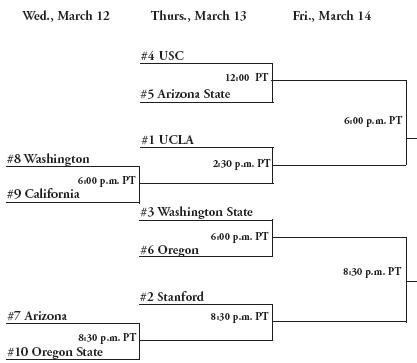
Pac-10 Tourney Bracket

The Favorite(s).  Vegas Watch doesn’t have the Pac-10 odds up yet, but UCLA is sitting on a 94% chance at a #1 seed in the NCAAs, and they’re playing about ten miles from campus, so we’re going to go ahead and anoint them the easy favorite here.  There is some evidence that Ben Howland teams don’t take this tournament seriously, though, with three first-game losses in his four years at UCLA (although the Bruins did win the Pac-10 Tourney in 2006). 

The Darkhorse.  Take your pick.  The #9 seed, Cal, just played within a blown call and a circus shot of beating UCLA at Pauley last week.  The #7 seed, Arizona, took Kansas to overtime at Lawrence.  The #4 seed, USC, starts two potential lottery picks.  We could go on, but you get the point.  The Pac-10 is loaded, and anybody but the hapless Oregon St. Beavers could make a run at this title. 

Bubble Buster Game.  Arizona v. Stanford in round two.  Arizona has a tremendous computer profile with the #2 strength of schedule in the nation and a #29 RPI according to KenPom, but that 17-13 (8-10) record leaves a lot to be desired.  They’ll beat OSU tonight, but they really need to beat Stanford tomorrow to get to .500 in conference and add one more quality win to their resume.   If the Cardinal mails it in like they did last weekend at USC, Arizona should have a very good chance to win that game.  Oregon (#54 RPI) could also stand to beat Wazzu, but they’re terrible away from home this year, so we don’t expect that to happen.

Cinderella.  USC.  The Trojans have been playing a lot better lately, and if UCLA dumps the first game again, they should have a relatively easy path to the finals on Saturday.  Even if UCLA doesn’t dump that game, they’ve already defeated the Bruins once and played them very tough in another game.  Also, playing in familiar environs doesn’t hurt. 

Games We Want to See.   Basically, all of them.  No other league has as much individual talent or intriguing contrasts in style of play as the Pac-10, so this should be a great tournament.  If it comes down to it, though, we’re hoping for a third matchup between the two LA schools, followed by Stanford getting another shot against the Bruins on Saturday. 

Champion.  We’re not sure Stanford will ever recover from their collapse and screwing in Westwood last week, nor do we have enough faith that the Bruins will put their best foot forward in this event.  Wazzu and ASU are good choices to fill the void, but we really like the way USC has been playing in recent weeks, and we think maybe they’ll put it all together this weekend to make a nice run (only to get overconfident and drop their first round game next week, of course).  So our champion is USC.    

Share this story

ATB: Jet-Zagged

Posted by rtmsf on December 2nd, 2007

ATB v.4

12.01.07

The clock struck December today, which meant that the last day of the college football regular season coincided nicely with the first big Saturday of college hoops. Although today’s menu looked better than the actual meal tasted, there were still quite a few interesting results today.

Game of the Day. #18 Gonzaga 85, Connecticut 82. We got to see this one, and it was a very fun game to watch. Neither team had much of a lead throughout the second half, but you have to hand it to the Zags for playing two very tough road games against quality teams 3000 miles away and coming away with two wins in the process. We really feel that once Gonzaga gets Josh Heytvelt back healthy this could be their best team in the Mark Few era. The key difference is that Jeremy Pargo (23/4/5 assts) gives them a degree of athleticism and skill at the guard position that they simply haven’t had in past years – usually they had players with one or the other, but rarely both (we’re giving him a pass for that stupid-ass foul on a three that nearly cost them the game). Then you throw in the versatile games that Heytvelt, Matt Bouldin, Austin Daye and David Pendergraft gives them, and you have a tough team to stop. Traditionally, the Zags’ problem has been on the defensive end, but at least so far this season, they’re getting the job done in that area (#13 in defensive efficiency nationally and held UConn to 38% shooting). As for today’s game, Gonzaga made just enough plays down the stretch to get the victory, but we were struck for the first time in two years with UConn’s fight. AJ Price had a nice game (22/3/6 assts), but does anyone else feel that Hasheem Thabeet (6/5/3 blks in 23 foul-plagued minutes) is the most overhyped player in America?

[vodpod id=ExternalVideo.443104&w=425&h=350&fv=]

Other Good Games. #6 Duke 79, Davidson 73. ESPNU game, so we didn’t get to see it, but it looked like it went just as expected. Close game until Stephen Curry (20/5) got called for a questionable charging foul in each half, at which point Duke rebuilt its cushion to double digits each time. Davidson once again showed that it can hang with the nation’s elite, but simply has not been able to break through and win one of these things. We expect they’ll get the upcoming game against NC State. Still, give Duke their due – a balanced attack led by Gerald Henderson’s 21/8/4 assts resulted in another quality neutral court win. #3 UNC 86, Kentucky 77. Sticking in the ACC, remember when UNC-Kentucky was a big early-season game? There were several years in a row where CBS began its college hoops coverage for the year with this game – now it’s being shown on ESPN2 of all places. We watched this game too, but it was mostly boring because you knew that UK never really had a chance to win the game, even at home. Carolina didn’t shoot particularly well (43%) or look particularly good, but we could quickly tell that UK didn’t have enough good players to win this game. Two things we noticed – Danny Green (20/6 on 8-11 shooting) is really coming on for the Heels, and Patrick Patterson (19/9) is the real deal for UK. Oh, and we’re already sick of watching Psycho T’s incredibly awkward post game. Providence 98, Boston College 89 (OT). With 14:40 remaining in the second half, Providence was leading BC 62-38. Over the next thirteen minutes, BC outscored Providence 37-8 (incl. a 17-0 run) to take a five-pt lead with just over a minute remaining. Unbelievably, PC’s Weyinmi Efejuku (21/9/4 assts) (yeah, you try saying it) hit two key threes in the last minute to send the game they’d totally blown into overtime. In the extra session, the Friars went on a 13-2 run to finally put the wild game away. Our whipping boy Tyrese Rice had 25/3/6 assts/4 stls for BC, but he did miss the game-winning shot with 5 seconds remaining in regulation.

[vodpod id=ExternalVideo.443105&w=425&h=350&fv=]

Big 12/Pac-10 Hardwood Series. California 86, Missouri 72. This was a very solid home win for Cal to remain unbeaten, as these were the types of games they typically lost in past years. Down for much of the game, the Bears fought back to finally take a lead with eight minutes remaining in the game on the strength of guards Patrick Christopher (18/4) and Ryan Anderson (15/11) as well as big man Devon Hardin (16/12). Cal is definitely a team with NBA talent to keep an eye on this year. Oklahoma St. 96, Washington 71. Speaking of keeping an eye on someone, we just cannot figure out Washington. A relatively tight game broke open to a 20-pt deficit for UW late in the first half, and they never challenged after that. Jon Brockman (22/13) appears to be the only Husky who showed up, but where’s the defense (UW gave up 58% shooting to OSU). For the Pokes, freshman James Anderson continued his under-the-radar early season stellar play with 22 pts. The Pac-10 now leads the HS 4-2 by our count.

Upset of the Day. Harvard 62, Michigan 51. Poetic justice, anyone? God knows there’s no Tommy Amaker fans around here, but we had to laugh at the fortuitous scheduling that allowed Harvard to play a home game against Amaker’s old employer in the year immediately following his dismissal. Michigan isn’t very good, obviously, but they should never be getting whipped by Harvard down the stretch like they did tonight (Harvard scored the last 11 pts of the game). Good for Amaker – that’s a great signature win for his first year in Cambridge. Good to see the Harvard kids RTC there.

[vodpod id=ExternalVideo.443106&w=425&h=350&fv=]
More Upsets.

  • Centenary 70, Texas Tech 66. Ugh. Sam Houston St. and Centenary already, and it’s only Dec. 1. Shouldn’t Knight hang ’em up soon?
  • IUPUI 89, Massachusetts 77. Two short days after dropping 107 on Cuse in the Dome, UMass gets blitzed 57-32 in the second half v. IUPUI and loses all their mojo. IUPUI’s George Hill poured in 30.

Other Ranked Teams.

  • #5 Georgetown 61, Fairfield 49. Another ho-hum win for Georgetown.
  • #10 Louisville 47, Miami (OH) 44. Louisville really isn’t looking very good anymore (Tim Pollitz 22/11 for MU).
  • #11 Butler 65, Ohio St. 46. OSU was outscored 45-16 in the second half – these droughts are killing the Buckeyes. Not that anyone in C-bus noticed today (thanks WVU and Mizzou).
  • #13 Michigan St. 80, Jacksonville 51. Raymar Morgan with a career-high 24/7.
  • #15 Indiana 64, #23 S. Illinois 51. E-Giddy with 22 and DJ White with 10/12 in a tremendous road win for IU.
  • #17 Pittsburgh 78, Toledo 52. Sam Young with 17/12 in another easy win for the Panthers.
  • #18 Clemson 85, South Carolina 74. KC Rivers with 24/8 with one more nail in Davey O’s coffin.
  • #20 BYU 78, Portland 54. Trent Plaisted with 16/8 in another efficient win for the Cougs.
  • #21 Xavier 90, Belmont 49. Wow, the margin here amazes us. Belmont shot only 27% for the game.
  • #24 Villanova 84, Pennsylvania 61. Scottie Reynolds with 21 in another blowout win for a ranked team.

Other Notable Scores.

  • Vanderbilt 92, Georgia Tech 79. Vandy is the second-best team in the SEC right now (7-0).
  • West Virginia 70, Winthrop 53. Huggins’ guys are already #1 in defensive efficiency – they held Winthrop to 30% shooting today.
  • Mississippi St. 78, Murray St. 61. Charles Rhodes with 22/5 in only 25 mins tonight.
  • Arkansas 62, Oral Roberts 51. Gary Ervin with 16 off the bench for the Hawgs.
  • St. Mary’s 85, Seton Hall 70. SMC is very very tough at home.
  • Pacific 70, Nevada 66. Nevada (2-4) is on its way to not making the NCAAs this year at this rate.

On Tap Today(all times EST). More Big 12/Pac-10 action and little else.

  • Kansas (-2.5) v. USC (FSN) 2pm – we kinda figure KU will destroy USC in this game, but it’s worth watching to find out.
  • Nebraska (-2.5) v. Arizona St. (ESPNU) 2pm. a clunker in the Hardwood Series.
  • Stanford (-7.5) v. Colorado (ESPNU) 4pm – this is only interesting to see how Stanford handles another road game.
  • Texas A&M v. Arizona (-2) (FSN) 6pm – this could be a tremendous matchup if Zona decides to protect its home court.
  • Maryland (-3.5) v. VCU 7:30pm – the battle of disappointments.
  • UCLA (-11) v. Texas (FSN) 8pm – Vegas giving Texas no respect here. We’re very excited about this matchup regardless.
Share this story

Gary Williams Hates Graduation

Posted by rtmsf on October 4th, 2007

Yesterday the NCAA released its latest graduation rate figures for all D1 athletes who entered school in the classes of 1997-2000. Unlike the federally-mandated graduation rate, the GSR (Graduate Success Rate) is more realistic for athletes – it gives each player six years to complete his degree and it does not count transfer students against a school (reflecting the reality of athlete puddle-jumping for playing time in D1).

Here are the NCAA’s key findings:

The latest GSR figures show that 77 percent of student-athletes who began college from 1997-2000 graduated within six years. That four-year graduation rate is unchanged from last year’s data and up from 76 percent two years ago.

The Graduation Success Rate for men’s basketball rose from 55.8 percent in 1995 to 63.6 percent in 2000, a 7.8 percent increase. Football increased from 63.1 percent to 66.6 percent for teams competing in the Bowl Subdivision and from 62 percent to 64.7 percent for teams competing in the Championship Subdivision. Baseball increased from 65.3 percent to 67.3 percent.

Gary Williams chicken wing

Gary is Too Busy to Worry About Graduation Rates

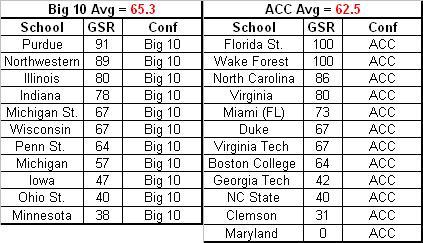
Since the NCAA doesn’t provide a sortable database of team information (or at least we can’t find it), we decided to quickly throw together some tables showing how the BCS schools performed in this cohort. Gary Williams should be especially proud of himself. Seriously, Gary, the best you can do with those Juan Dixon/Lonny Baxter teams is zero?!? Not even ONE player???

Big 10 + ACC GSRs 07

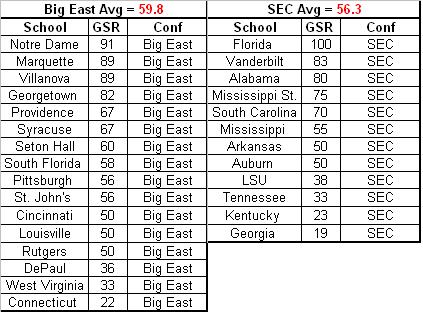
Big East + SEC GSRs 07

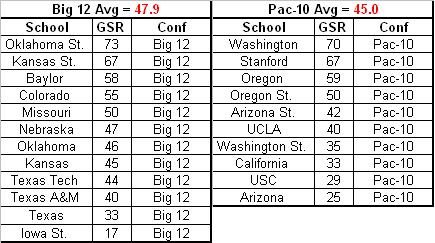
Big 12 + Pac-10 GSRs 07

Thoughts.

  • At the high end, Florida St. at 100% makes us wonder if any of these stats are credible. Then again, Florida is also at 100%, and these numbers are around 2000, so maybe there was a hanging chad issue or something. We’re also amazed that Eddie Sutton’s band of merry criminals men led the Big 12.
  • At the low end, Jim Calhoun at UConn, Lute Olson at Arizona, Tim Floyd/Larry Eustachy at Iowa St., Ron Jirsa/Jim Harrick at Georgia, and the seediest of all, Clem Haskins at Minnesota, join Gary Williams in the dregs of their respective conferences. What a list of slimy characters there.
  • The Pac-10 is surprisingly low, given that Stanford, Cal, UCLA and USC are all great schools. Especially Stanford – how can Mike Montgomery justify graduating only 2/3 of his players? Guess he doesn’t have to at this point – or does he? And the SEC is surprisingly high, with Alabama, the Mississippi schools and South Carolina doing well.

We may have more thoughts on this later, but we’re heading for the airport at the moment, so it’ll have to wait.

Share this story

2007 Athlademic Ratings – Revised

Posted by rtmsf on September 5th, 2007

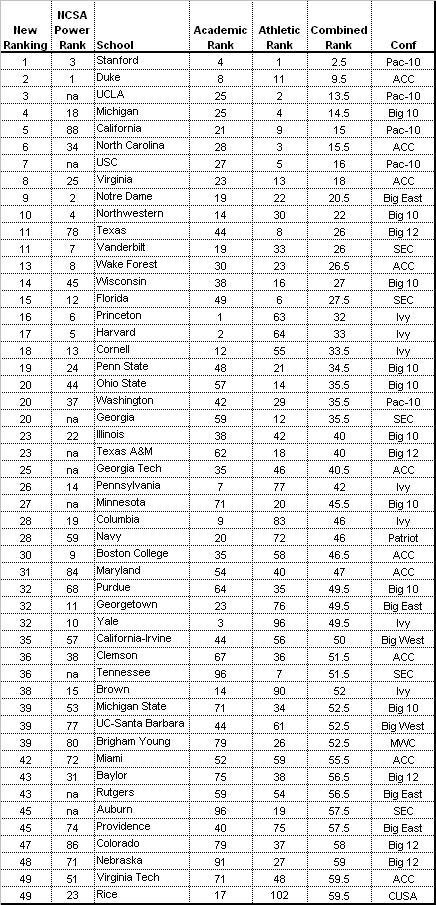
Ok, so thanks to an insightful UCLA fan, we realized that our exuberant reliance on NCSA data to justify our Athlademic Rankings posted last week was giving them way too much credit for properly vetting their data.  So to make sure we get it right this time, we spent the better part of today going through the 2007-08 US News rankings and the 2006-07 Sears Cup rankings ourselves.  Here’s the revised list, in Table A

Table A.  Athlademic Ratings – Division I (revised)

NCSA Revised Rankings

New Arrivals.  In addition to UCLA and USC, we also see the inclusion of Georgia, Texas A&M, Georgia Tech, Minnesota, Tennessee, Rutgers and Auburn onto our list – all driven by strong athletic programs.  High academic schools with relatively weak athletic programs, such as Army, William & Mary and Dartmouth, fell out of the top 50 due to the addition of the above programs. 

Ivy League logo

The Ivies strike a Nice Balance in Athlademics 

Ivy League Balance.   Speaking of Dartmouth, Keggy the Keg and friends are the only Ivy League school that didn’t make our Top 50.  The other seven did, with Princeton (no surprise there) leading the way at #16 overall.  Granted, the high academics of the schools drives their inclusion here, but we shouldn’t discount that these schools rate above many larger BCS schools in terms of the success of its athletic programs.  Cornell has the 55th most successful athletic program, but there are 73 BCS schools, which means Cornell, Princeton (#63) and Harvard‘s (#64) athletic programs  are outperforming bigger state schools such as Kansas (#66), Iowa (#68), and Connecticut (#82).

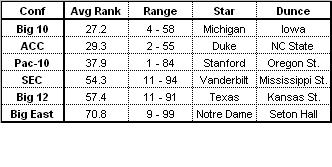
Big 10 – ACC Challenge.    As in, the Big 10 and ACC challenge the rest of the BCS conferences to keep up with it when it comes to athlademics.  We rated all 73 BCS conference schools, keeping those ahead of them in place, and Table B below shows the results. 

Table B.  BCS Conference Athlademic Ratings

 Conf Ratings

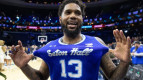
Why is the Big East so bad?  There’s a pretty clear top tier of Big 10, ACC and Pac-10, a middle tier of the SEC and Big 12, and a bottom tier, where the Big East lurks like Gollum all by itself.  The Big East really gets killed on both sides of the equation – it has seven (of 16) third-tier academic schools, as rated by US News (more than the other 5 conferences combined); and seven schools that finished outside of the top 100 in the Sears Cup (Mississippi St. and Kansas St. are the only other two in BCS conferences).  This includes the dubious case of Seton Hall, who was the only BCS conference school of the 73 to not score a single point in the Sears Cup competition for 2006-07.  How is that possible?? 

Seton Hall

Days Long Since Gone at The Hall

Haves and Have-Nots.  The Pac-10 is the greatest example of bifurcation within a conference.  It has five of the top twenty athlademic programs in America (Stanford, UCLA, USC, Cal, Washington), but it also only has five of the top fifty programs – its next highest ranked school is Arizona at #51.  Compare this with the Big 10, who has nine of its eleven members ranked in the top forty, with only Indiana (#53) and Iowa (#58) weighing it down.  Conversely, the Big 12 only has two of its twelve schools ranked in the top forty – Texas (#11) and Texas A&M (#23). 

Non-BCS Stars.  We already mentioned the Ivies, whose eight schools average a 29.9 rating on our list.  But who else steps up to challenge the BCS big boys as an athlademic school?  The Naval Academy (#28) and a couple of the smaller UCs (Irvine (#35) & Santa Barbara (#39)) lead the way.  One surprise inclusion is our Mormon friends at BYU, who used a strong athletic showing to come in at 39th on our list. 

You can do Better.  Not to harp on anyone in particular, but it makes no sense to us that football (read: revenue) schools like Cincinnati (#196 in the Sears Cup), South Florida (#133), Mississippi St. (#120), Kansas St. (#111) and Syracuse (#110) can’t do any better with their overall athletic programs.  Let’s throw in Villanova (#132) and Marquette (#127) for good measure – both schools are wealthy private Catholic institutions, which means they have the resources to spread around the non-revenue sports.  So what’s their excuse? 

Share this story

Fast Breaks 07.16.07

Posted by rtmsf on July 16th, 2007

For some reason, we don’t recall summers growing up as this boring…

  • Mizzou players Kalen Grimes (accused of assault with a shotgun in, of all places, a Jack in the Box) and DeMarre Carroll (shot in the ankle outside a nightclub) were involved in separate incidents within five days of each other. Mike Anderson’s honeymoon is apparently over in Columbia.
  • Bad Luck in Durham: Duke’s Brian Zoubek broke his foot in a pickup game; and Demarcus Nelson broke his wrist at the Pan Am trials within the last week. No word on whether Greg Paulus’s mishap with autoerotic asphyxiation will affect his play next year.
  • The Big East moves to an 18-game conference schedule for 2007-08, so each team will play at least once next year. We like this trend.
  • SEC Commish Mike Slive will head the NCAA Selection Committee in 2009 – Ole Miss and Vandy are already making hotel reservations to reward their 18-10 records.
  • New Ohio St. President Gordon Gee says that he will not tolerate bad behavior on his watch within the Buckeye program… we’re still waiting on the punchline here.
  • The 2007 HOF Challenge on December 1 is set with two solid matchups: UConn vs. Gonzaga and BC vs. Providence.
  • Cal assistant Joe Pasternack takes the head coaching job at the University of New Orleans. Bears fans lament that Ben Braun didn’t take the job.
  • The Fanhouse put together its admittedly premature top 20 for the summer. Georgetown is too low on their list and Indiana is too high.
  • UCLA’s incoming frosh Kevin Love is the Gatorade POY. Still not sure how we feel about him – is he another Psycho T or Aaron Gray?
  • Wake got 2008 verbals from the #3 and #18 players last week (to go along with already committed #10), but is the Class of 2008 any good? Speaking of Wake, TrueHoop unearthed a fantastic introspective piece into the mind of the greatest Deac of all, Tim Duncan.
  • Seth Davis gives his takes from the road on the summer circuit.
  • Apparently Steve Lavin knows how to throw a party.
Share this story

NCAA Tourney Conference Overachievers and Underachievers (1985-2007)

Posted by rtmsf on July 11th, 2007

Today we’re ready to unleash the last installment of our analysis of NCAA Tournament stats of the 65 (64) team era… that is, unless we decide to analyze the coaches too… well, it is over three months until Midnight Madness, so ok, hold that thought.  Anyway, as you hopefully recall, during the weekend we took a look at the raw numbers of the era by conference, and essentially concluded that the ACC has been the most successful conference of the last 23 years, the Pac-10 SWAC/NEC the worst, and that the mid-major conferences may not have been as consistently good as we had hoped over the years.

Now let’s take a look at the conferences who have overachieved and underachieved over the 65 (64) team era. In our analysis of this measure by school, you may remember that we looked at two different models – a Standard Model of expected wins by seed (e.g., a #1 seed should win 4 games per appearance), and a Historical Model of expected wins by seed (e.g., a #1 seed has actually won 3.36 games per appearance from 1985-2007). We concluded then that the true value lies in considering the Historical Model foremost because the Standard Model places too unrealistic of an expectation on high seeds and not high enough of one on low seeds, which ultimately skews its results in favor of lower-seeded schools and conferences. Given that condition, we now show the Overachiever and Underachiever conferences of the 65 (64) Team Era using the Historical Model. See Table A below.

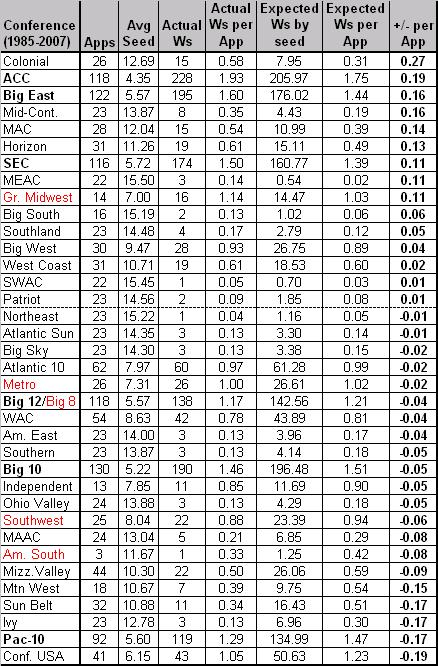
Table A. Historical Model applied to 65 (64) Team Era

Notes: the table is sorted by “+/- per App,” which represents the number of games won above or below the expected number of wins for that seed per NCAA appearance (1985-2007). The conferences whose names are in bold are BCS conferences. The conferences whose names are in red are conferences that no longer exist.

NCAA Tourney by Conf v.3

Not Just George Mason. The first thought everyone will have (because we had it too) is that George Mason‘s miraculous run in 2006 accounts for the Colonial Conference’s rather aristocratic pedigree at the top of our list. But looking a little further inside the numbers somewhat mitigates this idea. Sure, the Masonites (as a #12 seed) won 3.52 games beyond its expected value of 0.48 wins per appearance in 2006, but that only accounts for half of the Colonial’s wins beyond expectation during this era. So where are the rest of the wins coming from? Thank David Robinson’s Navy squads of the mid-80s and Dick Tarrant’s Richmond Spiders in the immediate aftermath for the CAA’s perch as the biggest overachiever on our lofty list.

David Robinson

George Mason isn’t the only CAA School to Overachieve

BCStriation. Unlike our previous posting that used standard objective measures (wins, F4s, titles, etc.) to show that the six BCS conferences were without question the top six leagues of the era, today’s posting paints a substantially different picture. A league can be very successful objectively and still considerably underachieve, as in the strange case of the Pac-10 (and to a much lesser extent, the Big 10). Although the Pac-10 was clearly the weakest of the BCS conferences by the raw numbers, we certainly didn’t expect that it would be the second-worst underachiever of the 65 (64) team era – but it unquestionably is. The Pac-10 has won sixteen fewer games than it should have during this period, which dwarfs the negative output of any other conference – next in line for public shaming are Conference USA (7.6 wins fewer) and the Big 10 (6.5). Looking back at our list of chronic underachieving schools, we note that Stanford, Arizona and Cal all fall into the frequent NCAA underachievers list, which should have tipped us off that this was coming.

High Achievers. On the other side of things, the ACC and the Big East fall in line behind the CAA as the biggest overachievers of the era, which proves that you can get great seeds, have tremendous objective success in terms of wins and titles, and still overachieve as a conference. The ACC has won a whopping 22 games and the Big East 18 games beyond expectation; and the SEC isn’t far behind with 13. We also want to nod a tip of the hat to the Mid-Continent (+4.5 wins), MAC (+4 wins) and Horizon (+4 wins) conferences, each of which shows that leagues with consistently low seeds can do some damage on a regular basis in the NCAA Tournament.

Bradley

Missouri Valley Teams Need to Do More of This

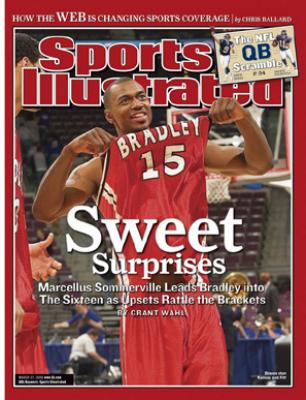
What About…? If anything, these last two posts have opened our eyes to just how traditionally overrated the Missouri Valley Conference has been. For a so-called mid-major who gets multiple teams invited every year, its performance leaves a lot to be desired (4 wins below expectations). We realize that things change – conferences get better and worse over the years – but the MVC is going to have to really start producing in the next 5-10 years to lose our proffered overrated tag. As a comparison, the Horizon and West Coast conferences have performed nearly as well (19 wins each) as the MVC (22 wins) despite earning far fewer NCAA bids and having a slightly worse average seed.

Ivy League Paradox. We suppose that if you asked a hundred college basketball fans whether they believed the Ivy League traditionally overachieves in the NCAA Tournament, 99 of them would likely agree. This is probably due to a memorable upset or two over the years in addition to a common perception that the Ivies are a “tough out” every year. But looking above, we see quite starkly that the Ivy League has been one of the biggest underachievers of this era, earning only three wins versus an expected total of seven. This is largely because the Ivy champs (usually Penn or Princeton) have consistently earned seeds ranging from #11-#13 over the last decade, but haven’t been able to earn a single win during that period. The lesson here, we suppose, is to never take an Ivy team in your brackets (we’ve heard that taking an Ivy team against the spread in the first round is a good bet, however).

Share this story

NCAA Tourney Overachievers and Underachievers of the 65 (64) Team Era

Posted by rtmsf on June 15th, 2007

We’ve received a resounding response on the post Tuesday evaluating school performance during the 65 (64) team era, so let’s waste no time in presenting Part II of our statistical profile of the NCAA Tournament during that period. As we alluded to in that post, looking at raw data in a vacuum has its limitations. From that data we got a reasonable sense of which programs have had the most success during the period, but it didn’t really give any insight as to which programs have overachieved, underachieved, or simply performed about as expected.

Ziggy

Which Schools Reach Their Potential?

Today’s post will address that issue. You might want to bookmark this page for next year’s bracket-filling, because we feel that what we’re showing today has significant value in determining those schools that tend to embrace expectations and those that tend to wither in the face of the red-hot lights of March. Stat geeks like ourselves should enjoy this post – hopefully it won’t bore the rest of you.

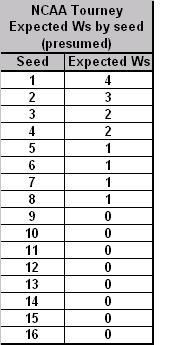
The first consideration in trying to determine which programs have overachieved and underachieved is how to answer that question. Traditionally, you often hear commentators and writers talk about “playing to your seed,” which essentially presumes that a #1 seed should make it to the Final Four, a #2 seed to the Elite Eight, and so on (see Table A below). Using this model, a team that wins any games beyond the expected wins of its seed would fairly be said to have overachieved as to the expectations of the seed (and vice versa).

Table A. Standard Model

NCAA EV by Seed (Presumed)

So let’s try to first answer that question using the Standard Model outlined in Table A. But don’t give up on the post after you review the Standard Model results, as we have another model below it that may bring up new and interesting considerations. The Standard Model as applied to the 65 (64) Team Era is Table B below.

Table B. Standard Model Applied to 65 (64) Team Era

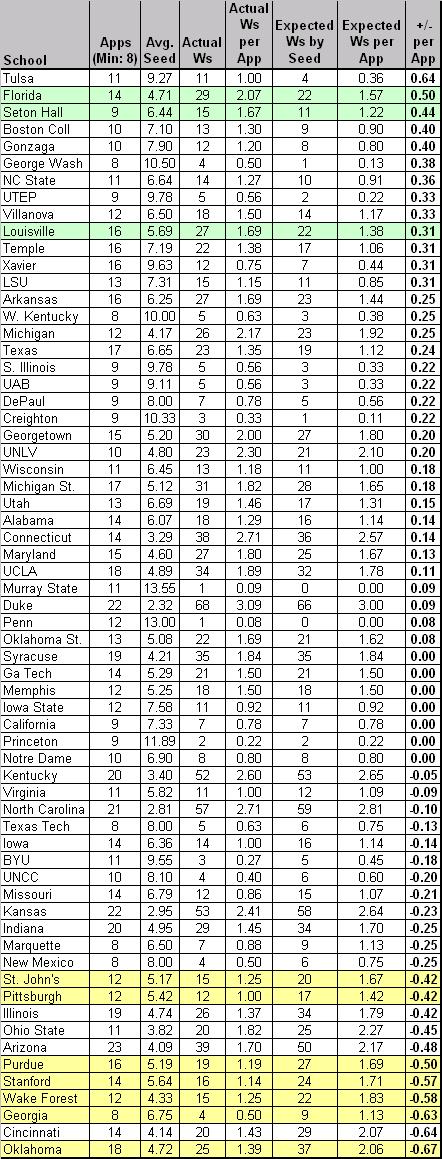
Notes: the table is sorted by “+/- per App,” which represents the number of games won above or below the expected number of wins for that seed per NCAA appearance (1985-2007). The rows colored in green highlight schools that are in the top twelve spots of both Tables B and D. The rows colored in yellow highlight schools that are in the bottom twelve spots of both Tables B and D.

NCAA EV by Seed - Detailed v.3

Inside the Numbers (Table B):

Overachievers. What first jumps out at us using this method is just how (except Florida) there are no big names near the top of the list. Tulsa, Seton Hall, GW, UTEP, Temple? Without taking away from their performance – after all, every one of those teams should be commended for overperforming versus its seed – this immediately suggests to us that the Standard Model often used by the pundits actually favors lower-seeded teams who manage to win a game or two every couple of years in the NCAA Tournament. Using the schools above +0.30 as a natural break point, only Florida, Louisville and Temple have won more than twenty games in the NCAAs during this period, and the average seed of these thirteen schools was 7.0. Are these teams chronically underseeded or are they overachieving as a general rule? Whatever the case, we’re going to think a little harder about picking Tulsa the next time they make the bracket.

Tulsa Logo

Are the Golden Hurricanes the Biggest NCAA Tourney Overachievers?

Underachievers. A brief look at the names at the bottom of the list – Oklahoma, Cincinnati, Wake Forest, Stanford, Purdue, etc. – tells us that we’re on to something here. As our good buddy MK says, “Wake and Purdue can effin’ bite me. They kill my bracket every year.” Or something like that. Using -0.42 as a natural break, the eleven teams at the bottom averaged a seed of 4.8 during this period, which is a marginally better seed than the overachievers on this list. Oklahoma, Arizona and Illinois – what do you have to say for yourselves? Each of you has had at least 18 appearances during this era, averaged a solid if not spectacular seed between #4 and #5, and consistently played below that seed to the tune of -0.42 wins per appearance or worse. This matches Tuesday’s analysis with Oklahoma as a disappointment; but under this model, Arizona and Illinois (second tier elite performers on Tuesday) have some explaining to do.

Oklahoma celebration

You May Want to Avoid These Guys in your Brackets

You’ll See Them Again on the Long Road Back to the Middle. The Big Four from Tuesday – Duke, UNC, Kentucky and Kansas – find themselves in the middle of the pack. It’s notable that Duke averaged a seed of 2.32 during this era and still overachieved by +0.09 wins per appearance relative to seed. UNC and Kentucky are verrrry slightly underachieving, whereas KU’s recent vintage teams (2005 & 2006) probably contribute to its slightly lesser position at -0.23 wins per appearance. UConn should be lauded for overachieving at a clip of +0.14 wins per appearance, which somewhat mitigates their overall lack of F4s – they do win a lot of NCAA Tournament games. Syracuse, Georgia Tech, Memphis, Iowa St., California, Princeton and Notre Dame – all of these programs have played exactly to seed in the last 23 years. Be sure to remember that fact next year when filling out your brackets.

Criticism of the Standard Model. The primary problem with evaluating NCAA Tournament success based on “playing to the seed” is that it puts an unrealistic burden on highly-seeded teams because over time they never play to their seed. In the knockout crucible that makes the NCAA Tournament so exciting, a corollary result of using this criteria is that higher seeds (#1-#4) are largely set up to fail, and lower seeds (#9-#16) are significantly overachieving simply by winning one game. Additionally, we feel that using the Standard Model assumes too much at the squishy margins – that a #4 seed should win two games, a #5 seed should win only one game, and that a #8 seed should always beat a #9 seed – when both teams are probably very similar in ability. For this reason, we now offer an alternative model, one that considers actual historical performance of the seeds.

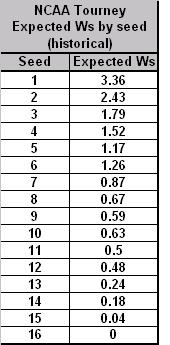
To that end, see Table C below for a historical snapshot of how well each seed actually performed in the 65 (64) team era.

Table C. Historical Model

NCAA EV by Seed - Historical

Considering Table C, we wanted to point out for a moment that we have a couple of thoughts. First, we found it interesting that #6 seeds have traditionally performed better than #5 seeds. This at first seems anathema to conventional wisdom, as a #6 likely has to get past a #3 in the second round, whereas a #5 must only defeat a #4. That is, until you remember that a #5 has the dreaded 5-12 match-up that knocks out so many higher-seeded teams (excepting 2007, of course). Also, it’s interesting that a #10 seed has a better historical expected number of wins than a #9 seed. This shows again that a better draw is to avoid the 8-9 match-up, even if you end up as a lower (but more likely to succeed) #10 seed.

Using the 1985-2007 Historical Model as a baseline expected value for each seed, our list of 64 schools is now featured in Table D below.

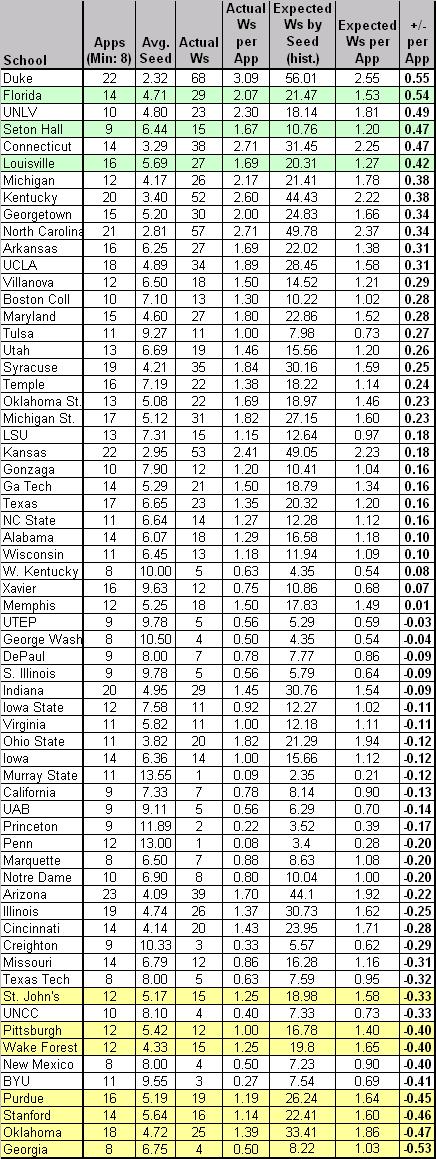
Table D. Historical Model Applied to 65 (64) Team Era

Notes: the table is sorted by “+/- per App,” which represents the number of games won above or below the expected number of wins for that seed per NCAA appearance (1985-2007). The rows colored in green highlight schools that are in the top twelve spots of both Tables B and D. The rows colored in yellow highlight schools that are in the bottom twelve spots of both Tables B and D.

NCAA EV by Seed - Hist Detailed 3

Notable Differences. Using the Historical Model, the first thing that strikes us as interesting is that many of the heavy hitters of the era have jumped considerably, including some all the way to the top of the list. In fact, the following schools – Kentucky, UNC, Duke, Kansas, UConn, UNLV, UCLA, Syracuse, Ohio St. – all rose at least fifteen places from where they were situated in Table B. Each of these schools (excluding Kansas and Ohio St.) have overachieved at least +0.25 wins per appearance above the historical performance of their seeds. Since these schools represent a total of thirteen championships and thirty-eight F4s during this era, the Historical Model viewpoint makes more sense than what the Standard Model shows.

Who Dropped? Creighton, George Washington, UAB and UTEP all went from nice-looking overachievers in Table B to slight underachievers using this model. NC State, Xavier and Gonzaga looked fantastic using the Standard Model, but look rather pedestrian using this one. The explanation for this is simple – these teams collectively averaged a #9 seed throughout this era – if we use the Basic Model, they should never win a game, so when they do, it looks as if they’re significantly overachieving. However, using the Historical Model, we see that they actually win NCAA Tournament games roughly commensurate with how a #9 seed typically performs. This again illustrates why we feel this model shows a truer snapshot of performance.

More Importantly, Who Stayed the Same? Now this is where it gets really interesting. The rows shaded in green in Tables B and D represent schools that were in the top twelve in playing beyond its seed using both models. You could accurately say that, no matter how you slice it, Florida, Seton Hall and Louisville are the truest overachievers of the 65 (64) team era. (Incidentally, Florida and Seton Hall are in the top four of both tables, with each school averaging an extra win beyond its seed for every two appearances in the NCAA Tournament.)  These three schools consistently play beyond the actual and historical expected value of the seed that the NCAA Selection Committee gives them.  

The rows shaded in yellow at the bottom of Tables B and D represent the true underachievers. These schools were in the bottom twelve in playing below its seed using both models. What’s peculiar about this statistic is that there appears to be a much greater correlation between the tables with respect to the underachievers than with the overachievers. Whereas the overachievers only had three common schools between the tables, regular NCAA disasters such as Georgia, Oklahoma, Stanford, Purdue, Wake Forest, Pittsburgh and St. John’s find themselves in both at the bottom looking up. If you are at all like us and believe that the weight of history contributes as a predictor of the future, then anyone reading this post should be extremely hesitant picking these schools to play beyond its seed to its seed in the Dance in the years going forward.

Chicken or the Egg

And Now, the Chicken/Egg Argument. Whether you buy into the Standard Model or the Historical Model or neither, we can say without a doubt that some schools appear to consistently overachieve relative to its seed, while others consistently underachieve relative to its seed. The question we want to posit to the readers is what causes this – is this simply a statistical anomaly? Are the overachievers regularly seeded too low by the NCAA committee; or, are the underachievers regularly seeded too high? Is there a self-fulfilling prophecy at work here, where schools that are known as chronic underachievers (ahem, Oklahoma) place so much pressure on themselves that they tighten up in the clutch? Conversely, do the overachievers find their wits amidst chaos to consistently come through under pressure because they are expected to do so? These are questions that we cannot answer, but we figure that there are elements of each at play here. We’d certainly like to hear your thoughts on this and any other topic. Oh, and apologies for the long post today.

Coming Next: We’ll take a look at the raw numbers again, but this time we’ll examine it by conference, which isn’t as easy as it sounds. Do you realize how many conference re-alignments and mergers and dissolutions there have been in the last 23 years of NCAA basketball?


Share this story