

Monday, March 22 (all NIT)
6pm - Nevada @ URI (ESPNU)
7pm - UConn @ Va Tech (ESPN)
8pm - Kent St @ Illinois (ESPNU)
9pm - Dayton @ Cincy (ESPN)
 

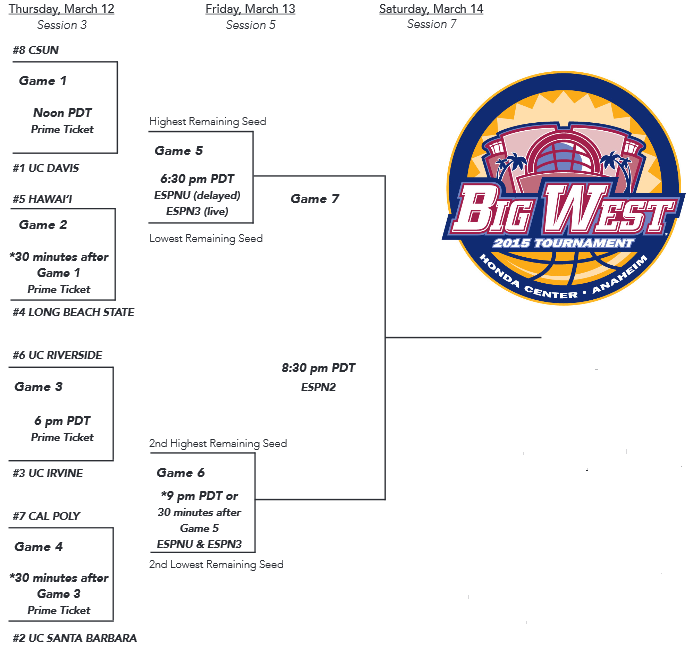
Big West Tournament Preview

March 10th, 2010

Steve Coulter of the Clarion is the RTC correspondent for the Big West Conference.

Regular Season Recap

A year after making the NCAA Tournament, Cal State Northridge is the final team to make the Big West Conference tournament. However, it hasn’t been a year of complete surprise, rather just a season of emergence.  Depending on who plays in Big West Tournament final game on Saturday afternoon, the Big West could have their conference champion as high as a No. 12 seed come the NCAA tournament. Both Santa Barbara and Pacific have had great seasons and they could be rewarded greatly by if the selection committee if they win the conference crown.

Overall the conference’s bottom four teams—Cal Poly, UC Irvine, CS Northridge and CS Riverside–have had ugly seasons with sub-.500 conference records. Despite this they have produced some of the conference’s best players. The Highlanders’ Kyle Austin would be conference player of the year, and still has a shot, if it weren’t for his team’s last place finish. His back-to-back 35+ point effort against Fullerton and Cal Poly is one of the bigger achievements of the year. Like Austin, senior forward Kenny Daniels has an argument for being player of the year despite the Matadors’ tough season. He scored in double figures in all of his last eight games and finished averaging 15.3 points a game.

Although neither are going to win conference player of the year, the Anteaters’ Eric Wise and Michael Hunter proved to be one of the conference’s more lethal tandems. Hunter, a senior, was a scoring threat for the Anteaters, but his biggest contributions were on the court leadership and defense. He finished the year with 1.4 steals per game. The middle teams—CS Fullerton, Long Beach State and UC Davis–all had back and forth seasons that included both winning streaks and losing streaks. Overall Fullerton had a pretty consistent season, finishing over .500 both at home and on the road. After a three-game losing streak in January, the Titans turned things around in February and almost earned a first round bye. The 49ers had the roughest schedule of any team in the Big West, playing five top 25 teams during the season. Despite their 15-15 overall record, they played through the tough schedule to earn a first round bye. The 49ers biggest conference win came on January 14 when they beat the No. 1 seeded Gauchos by 20 points. The Aggies also had success against the top of the conference, beating Pacific on February 10. Despite Dominic Calegari’s departure after this season, the Aggies return their two top guards in Payne and Harden, which will put them in a position to be conference favorite next season.

The real difference between the league’s elite teams, Santa Barbara and Pacific, and the rest of the conference, is depth.  Although the Gauchos have relied on only a few guys for scoring, the teams bench has given valuable minutes. In conference play they have at least four bench players averaging over ten minutes of action a night. As for the Tigers, they are a team that spreads the scoring effort around and does not rely on a single person to lead them each night. The similarities between Pacific and Santa Barbara are clear though, in that they are both teams that like to use their bench and use it effectively. That is why they are atop the conference going into the postseason.

Big West POY and COY Predictions

Read the rest of this entry »


Full Breakdown Of The Top November Tournaments

November 8th, 2009

seasonpreview

What’s the best part of the college basketball season kicking off? The early-season tournaments, of course! Coaches vs. Cancer, Preseason NIT, Maui Invitational, Anaheim Classic…these are our first opportunities to see the top teams in the nation, gauge exactly how much of a force they could pose this season, evaluate the progression of upperclassmen and estimate the talent level of the much-ballyhooed freshmen. The preseason tournament fields this season are not quite as loaded as in year’s past (you’ll recall last season Maui featured three top-ten teams, although two — Texas and Notre Dame — didn’t pan out), but there’s plenty of potential for memorable early-season classics. Let’s delve into the cream of the crop in November:

2K Sports Classic Benefiting Coaches vs. Cancer (Regionals: November 9-11, NYC: November 19-20)

* RTC Live will be at the California subregional and the NYC semis and finals.

The Field: The powers-that-be decided to avoid any clunker matchups at MSG in mid-November, so they’ve given the four hosts — North Carolina, California, Ohio State and Syracuse – an automatic pass to the semifinals in NYC, so don’t expect any Gardner-Webb Cinderella stories invading the Big Apple. The tournament kicks off Monday and Wednesday at all four sites with Syracuse battling Albany and Robert Morris, California taking on Murray State and Detroit, North Carolina facing Florida International and North Carolina Central and Ohio State matched up against Alcorn State and James Madison. The semifinal games are set for November 19 with Syracuse vs. California as the under-card and North Carolina vs. Ohio State in the nightcap.

The Sleeper: The bigger news, in my opinion, that came out of the Carrier Dome last Wednesday when Syracuse stunningly fell to Le Moyne was not the final score, but Wesley Johnson scoring 34 points after a clunker in the exhibition opener. Big-time programs have been stunned in exhibitions before — you’ll recall Michigan State fell to Grand Valley State a few years back and still reached the Sweet 16 — and Syracuse was primarily experimenting with a man-to-man defense that Jim Boeheim could very well scrap for the season. Johnson exploding for 34 points shows he could be the go-to scorer Syracuse needs with Jonny Flynn and Eric Devendorf no longer manning the orange.

The Pick: I’ve been on their bandwagon all off-season so why not? My pick is Ohio State. Dallas Lauderdale keeps saying he should be ready to play. They return all-around performer Evan Turner who has a triple-double in his plans this season. William Buford and Jon Diebler can shoot the lights out and should really extend the Carolina defense. Receive steady point guard play from P.J. Hill and Jerime Simmons and that’s a possible top-ten team. I’ll take the Buckeyes to knock off UNC and California.

CBE Classic (Regionals: November 15-19, Kansas City: November 23-24)

*RTC Live will be at the semis and finals.

The Field: Much like the 2K Sports Classic, the semifinals are already set for Kansas City pitting Texas against Iowa and Pittsburgh against Wichita State. The four regional games are as follows: Texas facing UC Irvine and Western Carolina, Binghamton and Eastern Kentucky visiting Pittsburgh, Fairleigh Dickinson and Arkansas-Monticello taking on Wichita State and Iowa getting Duquesne and UTSA. The one possible upset here (not that it matters) is a high-scoring Duquesne team upsetting Big Ten bottom-feeder Iowa.

The Sleeper: It’s really hard to see Texas not annihilating this field, but could Wichita State knock off Pittsburgh? The Panthers won’t have Gilbert Brown (suspension) and possibly Jermaine Dixon (foot injury) for this one while already attempting to overcome the loss of DeJuan Blair, Levance Fields and Sam Young. Gregg Marshall returns seven of his top ten scorers for a squad that could linger near the top of the MVC led by senior guard Clevin Hannah and junior forward J.T. Turley, who is poised to become a star. If the Shockers can contain freshman forward Dante Taylor, they could live up to their name and pull a shocker in Kansas City.

The Pick: I have Texas ranked #2 in my preseason top-25 and they don’t have much sterling competition in this field. Pittsburgh was depleted by losses and may not even be an NCAA tournament team this season, Wichita State is a few rungs behind Creighton and Northern Iowa in the MVC and Texas’ first round opponent, Iowa, won’t be able to stay on the floor with the supremely talented Longhorns. Rick Barnes’ team is extremely deep at every position and could be a national title contender if Florida transfer Jai Lucas or newly-eligible J’Covan Brown provides stability at point guard. Damion James and Dexter Pittman are constant double-double threats inside.

Read the rest of this entry »


RTC 2009-10 Impact Players – Southwest Region

October 30th, 2009

impactplayers

Ed. Note: the previous posts in this series (Northeast, Mid-Atlantic, Atlantic South, Deep South, Mid-South, Lower Midwest, Upper Midwest and Mountains) are located here.

It’s time for the ninth installment of our RTC 2009-10 Impact Players series, the group of hot, dry, desert-y states known as the Southwest Region.   Each week we’ll pick a geographic area of the country and break down the five players who we feel will have the most impact on their teams (and by the transitive property, college basketball) this season.  Our criteria is once again subjective – there are so many good players in every region of the country that it’s difficult to narrow them down to only five  in each – but we feel at the end of this exercise that we’ll have discussed nearly every player of major impact in the nation.  Just to be fair and to make this not too high-major-centric, we’re also going to pick a mid-major impact player in each region as our sixth man.  We welcome you guys, our faithful and very knowledgeable readers, to critique us in the comments where we left players off.  The only request is that you provide an argument – why will your choice be more influential this season than those we chose?

Southwest Region (NM, AZ, NV, HI, southern CA)

sw_impact_players_v.2

  • Rihards Kuksiks – F, Jr – Arizona State. Advice to Pac-10 coaches writing up their scouting reports for when they go up against Arizona State this season: when Rihards Kuksiks enters the building, get a man on him. Don’t bother waiting until the game actually starts. You don’t want him getting comfortable, because he’s the kind of shooter who can change a game just that quickly. The guy can touch the ball a few times and the next thing you know you’re down nine before the first TV timeout. Or you get a little comfortable with your late-game lead and after Kuksiks gets a couple of touches the lead is gone and you’re wondering how time can tick so slowly. You want numbers? Fine. Kuksiks is third in terms of returning individual leaders in 3-point field goal percentage (44.3%) in the country among players who hit at least two threes a game and finished 8th in that category last year. A recent article on FoxSports.com by Jeff Goodman reveals some other incredible stats: in games decided by 2 points or less, Kuksiks shot 47% from behind the 3-point line; against ranked opponents he shot 46% from beyond the arc, and in the loss to Syracuse in the NCAA Tournament’s second round last year, he put up his career high in points with 20, with 18 of those coming from long range. In other words, the man steps up during big games. If the numbers don’t interest you, then consider the fact that many of these threes are not from a hair behind the line. They are often from distance. And they are often clutch (ask Arizona about a couple of late ones he nailed in that February game last year). Most importantly, watch the form. It should be an instructional video. He gets good height on his jumper but doesn’t overdo it, and you can see how he gets his legs into the shot. He releases the ball out in front just a little bit, but then the follow-through is a perfect example of that “reach into the cookie jar” that basketball coaches start teaching kids from the moment they can lift a basketball. By the way, he’s 6′6 and more than happy to mix it up in the paint, if needed. My favorite bit about Kuksiks comes from an interview he did for a site called EuropeanProspects.com in which he was asked what kind of player he was. The first words out of his mouth? “I am a sharpshooter.”  This is confidence, not cockiness, from the big man from Riga, Latvia. But I think it’s just fine if there actually is a little cockiness there. Long-range shooters are like neurosurgeons. They’re often asked to do the most difficult things in their field…and if I get to the point where I need to depend on one, I want them a little bit cocky.

Read the rest of this entry »


2009-10 Conference Primers: #16 – Big West

October 21st, 2009

seasonpreview

Ryan ZumMallen of LBPostSports.com is the RTC correspondent for the Pac-10 and Big West Conferences.

Predicted Order of Finish:

  1. Long Beach State (13-3)
  2. UC Santa Barbara (12-4)
  3. UC Riverside (12-4)
  4. UC Davis (9-7)
  5. UC Irvine (9-7)
  6. Cal State Fullerton (7-9)
  7. Pacific (5-11)
  8. Cal Poly (3-13)
  9. Cal State Northridge (2-14)

All-Conference Team:

  • Mark Payne (G), UCD
  • Larry Anderson (G), LBSU
  • Joe Harden (F), UCD
  • Kyle Austin (F), UCR
  • Eric Wise (C), UCI

6th Man. Joe Ford (G), Pacific

Impact Newcomer. Michael Wilder (G), UCI

big west logo

eWhat You Need to Know.  The Big West consistently sends one representative to the NCAA Tournament, which is then soundly bounced from competition in the first round; but that shouldn’t take away from the fierce battle that’s being done within conference confines. The conference is riding a wave of improvement, witnessed by a recent flood of top-notch recruits and Cal State Northridge taking #2 Memphis to the wire in the first round of last season’s Tourney.  This season, there are shining stars waiting to break out, and most teams have scheduled challenging preseason opponents in a seemingly league-wide strategy to boost the conference’s profile. Long Beach State sophomore Larry Anderson and UC Riverside senior Kyle Austin have the combination of size and pro-level talent that give their teams the chance to beat anyone on any night. Tough schedules and big, athletic guards – does that make the Big West a conference with upset capabilities? No doubt.

Predicted ChampionLong Beach State (NCAA Seed:  #12).  The 49ers will be the popular pick to win the Big West regular season as well as conference tournament, due to an elevated talent level and difficult preseason schedule that will make the rest of the conference season seem like JV.  Because of that difficult preseason schedule – and therefore a favorable RPI – Long Beach State will likely be a trendy upset pick in the NCAA Tournament, especially if they can pull off an upset against Texas, Kentucky or Duke; on a national scale, however, they probably lack the firepower needed to advance to the second round. Only four seniors graduated from last year’s team that earned second place in the conference. The 49ers’ quartet of sophomores will lead the charge – with athletic sixth man Eugene Phelps, darting point guard Casper Ware, crafty forward T.J. Robinson and 2008-09 first-teamer Larry Anderson.

Read the rest of this entry »


2008-09 Conference Primers: #21 – Big West

October 21st, 2008

Ryan ZumMallen, LBPOSTSports columnist, is the RTC correspondent for the Big West conference. 

Predicted Order of Finish:

  1. Cal St. Northridge
  2. UC Santa Barbara
  3. Long Beach State
  4. Pacific
  5. UC Irvine
  6. UC Davis
  7. Cal St. Fullerton
  8. Cal Poly
  9. UC Riverside

What You Need To Know (WYN2K).  I know what you’re thinking: no good teams ever come out of the Big West.  Oh yeah?  What about 2006-07’s Long Beach State 49ers who ran roughshod over their schedule to a 24-8 record and an NCAA berth… losing to Tennessee by 35.  Or last year’s three-way tie for first?  UC Santa Barbara, Cal State Northridge and Cal State Fullerton each won 12 conference games and two earned postseason berths… one bowing out in the NCAA opener and one in the NIT.

Ok, there hasn’t been much success outside of the conference lately – and last year produced some colossal stinkers – but that doesn’t mean that intense basketball isn’t being played within the Big West’s confines.  After a conference flooded with seniors last season, nearly every team is starting anew, making for one of the most wide-open conferences in the country.  All you need is one stud to will your team to victory, and if 2007 Fullerton product and recent Sacramento Kings signee Bobby Brown is any indication, it is definitely possible for raw talent to be developed in the Big West.  Don’t expect the top teams to feast on the bottom-feeders again – all it takes is one hot hand for any team to have a shot on any night.  So let’s get into it!

Bottom Feeders.  UC Riverside, Cal Poly SLO and Cal State Fullerton.  I mention them now because I shan’t be mentioning them again.  All three lost a vast majority of their scoring to graduation, and senior leadership is vital in the Big West.  Expect painful rebuilding from these three, although Fullerton’s Josh Akognon (video footage below) will win a few games for the Titans all by himself.  The 5’11 guard averaged 20 ppg last year and won Big West Tournament MVP honors, but with only 2 returners and Akognon the only returning starter, it’ll be a long year in the cellar for CSF.

Middle of the Pack.

  • One team that you can (surprisingly) expect to emerge from that very cellar this year is UC Davis.  Yes, the UC Davis that went 2-14 in the Big West last season.  Stop laughing.  Last year’s Aggies fielded zero seniors and this year’s edition has five.  They return a trio of senior starters that scored 28.4% of the team’s points, boast two key transfers in Joe Harden and Todd Lowenthal and look to Big West Freshman of the Year Mark Payne to step us as a sophomore.  With all of that, I’ve still got them pegged in 6th because, c’mon, it’s UC Davis.
  • UC Irvine gets the nod for 5th in the Big West, even after losing their top two scorers who brought in a combined 29.5ppg.  They do return their other three starters, though, and while the team is not particularly heavy on seniors or explosive guardplay, last year’s squad won 9 of 12 down the stretch so these guys know how to win.  Adding three recruits sized 6’8” or taller does not hurt, either.  But the Anteaters could well fall prey to the experience of UC Davis, and certainly neither is worthy of a Top 4 spot. 
  • The Pacific Tigers come in 4th, based yet again almost entirely on the genius of the Big West Conference’s greatest basketball mind, head coach Bob Thomason.  Thomason consistently squeezes more productivity out of less talent than any other BW coach, and I’ve learned the hard way not to bet against the Tigers.  They don’t have the talent to dominate this year, but the high-flying Anthony Brown enters his senior season, and I am intrigued to see what magic Thomason has worked with the 6’9” forward who wowed us with his potential and now will have to show us what’s been done with it.  What wins games in the Big West? Guards.  Anyone who gives senior sharpshooter Chad Troyer more than an inch of room deserves to be cut and sent to UC Riverside.

Top Tier. 

  • As we saw last season, the cream of the Big West crop can be extremely competitive.  So these next three teams could end up in any of the top spots, or even in a three-way tie for first like the Trio of ’08.  They’re clearly the most talent-laden squads and have the best shot at the hardware.  At the rear of the triumvirate is – pains me to say it – Long Beach StateDisclosure: I’m a graduate, and last season’s 6-25 campaign was one of my life’s more painful experiences.  But we relied heavily on first-year coach Dan Monson’s genius and junior guard Donovan Morris’ magic.  This year, we’ll again need plenty of both, but have added more ammunition than a Howitzer tank to back them up.  The 6’3” Morris is the only returning All-Big West honoree in the conference, led the Big West in scoring and is the likely preseason Player of the Year.  But the 49ers also add three transfers and a four-member freshman class that is oozing with raw talent in one-guard Casper Ware and freakish swingman Larry Anderson.  The experience and talent are there after recording barren levels of both last year.  My pick is 3rd place and possibly higher – it’s just tough to get past the oddness of picking a 6-win team to win the conference, even if it’s my own.
  • Here then, we arrive at #2.  This team could definitely end the season in a lower position than this, and probably doesn’t have much chance at the top spot due to a lack of real scoring power or explosive guards.  But a notoriously stingy defense and hard-nosed hustle, coupled with eight returners (including three starters) earns the UC Santa Barbara Gauchos the second spot.  Well-rounded forward Chris Devine begins collecting Social Security this year enters his sixth season with UCSB after being granted another year of eligibility due to injuries.  His leadership will be invaluable as the Gauchos look to recapture the magic after being one of the three teams tied for the conference title in ’08.  They’ll rely heavily on a suffocating half-court defense that allows few second chances, and will look for junior James Powell on the perimeter after shooting 46.7% from three-point land and averaging 12.3 ppg last season.  Experience and guard-play win out, and the Gauchos legendary grit put them in a class above (most of) the rest.
  • Experience experience experience.  The Cal State Northridge Matadors (#16 NCAA) field five seniors and eight juniors on their roster, including last year’s conference leaders in rebounds, assists and blocked shots.  They too shared the Big West title and have a great shot to repeat with Tremaine Townsend returning to terrorize Big West post players for yet another season.  Townsend led the conference in rebounds with 9.8 rpg, and blocked shots with 1.3 bpg.  The Matadors led the conference in team rebounding, and senior guard Josh Jenkins will look to improve upon his conference leading 6.4apg as well.  CSUN head coach Bobby Braswell has never won an outright Big West title in 13 years at the helm, but this is his best chance ever to break the streak.

RPI Boosters. 

  • California @ Pacific  (11/15/08)
  • Long Beach St. @ Wisconsin  (11/16/08)
  • Cal St Northridge @ Stanford  (11/18/08)
  • UNC @ UCSB  (11/21/08)
  • Wake Forest v. Cal St Fullerton  (11/27/08)
  • Cal St Northridge @ UCLA  (12/7/08)
  • Long Beach St. @ Syracuse  (12/13/08)

65 Team Era.   Due to UNLV’s former association with the conference in the late 80s and early 90s, the Big West has a solid overall record for the era (28-30, .483).  But if you take out the Rebels, you’re left with a true mid-major level performance (7-24, .226) with only three wins in the last sixteen years.  Pacific’s nice run in the 2003-05 seasons accounts for two of those; the other belongs to another former member of the conference, Utah St. in 2001.

Final Thought.  Just for fun, let’s throw in the final seconds of Cal St Fullerton’s Big West championship game…


2007 Athlademic Ratings – Revised

September 5th, 2007

Ok, so thanks to an insightful UCLA fan, we realized that our exuberant reliance on NCSA data to justify our Athlademic Rankings posted last week was giving them way too much credit for properly vetting their data.  So to make sure we get it right this time, we spent the better part of today going through the 2007-08 US News rankings and the 2006-07 Sears Cup rankings ourselves.  Here’s the revised list, in Table A

Table A.  Athlademic Ratings – Division I (revised)

NCSA Revised Rankings

New Arrivals.  In addition to UCLA and USC, we also see the inclusion of Georgia, Texas A&M, Georgia Tech, Minnesota, Tennessee, Rutgers and Auburn onto our list – all driven by strong athletic programs.  High academic schools with relatively weak athletic programs, such as Army, William & Mary and Dartmouth, fell out of the top 50 due to the addition of the above programs. 

Ivy League logo

The Ivies strike a Nice Balance in Athlademics 

Ivy League Balance.   Speaking of Dartmouth, Keggy the Keg and friends are the only Ivy League school that didn’t make our Top 50.  The other seven did, with Princeton (no surprise there) leading the way at #16 overall.  Granted, the high academics of the schools drives their inclusion here, but we shouldn’t discount that these schools rate above many larger BCS schools in terms of the success of its athletic programs.  Cornell has the 55th most successful athletic program, but there are 73 BCS schools, which means Cornell, Princeton (#63) and Harvard’s (#64) athletic programs  are outperforming bigger state schools such as Kansas (#66), Iowa (#68), and Connecticut (#82).

Big 10 – ACC Challenge.    As in, the Big 10 and ACC challenge the rest of the BCS conferences to keep up with it when it comes to athlademics.  We rated all 73 BCS conference schools, keeping those ahead of them in place, and Table B below shows the results. 

Table B.  BCS Conference Athlademic Ratings

 Conf Ratings

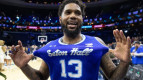
Why is the Big East so bad?  There’s a pretty clear top tier of Big 10, ACC and Pac-10, a middle tier of the SEC and Big 12, and a bottom tier, where the Big East lurks like Gollum all by itself.  The Big East really gets killed on both sides of the equation – it has seven (of 16) third-tier academic schools, as rated by US News (more than the other 5 conferences combined); and seven schools that finished outside of the top 100 in the Sears Cup (Mississippi St. and Kansas St. are the only other two in BCS conferences).  This includes the dubious case of Seton Hall, who was the only BCS conference school of the 73 to not score a single point in the Sears Cup competition for 2006-07.  How is that possible?? 

Seton Hall

Days Long Since Gone at The Hall

Haves and Have-Nots.  The Pac-10 is the greatest example of bifurcation within a conference.  It has five of the top twenty athlademic programs in America (Stanford, UCLA, USC, Cal, Washington), but it also only has five of the top fifty programs - its next highest ranked school is Arizona at #51.  Compare this with the Big 10, who has nine of its eleven members ranked in the top forty, with only Indiana (#53) and Iowa (#58) weighing it down.  Conversely, the Big 12 only has two of its twelve schools ranked in the top forty – Texas (#11) and Texas A&M (#23). 

Non-BCS Stars.  We already mentioned the Ivies, whose eight schools average a 29.9 rating on our list.  But who else steps up to challenge the BCS big boys as an athlademic school?  The Naval Academy (#28) and a couple of the smaller UCs (Irvine (#35) & Santa Barbara (#39)) lead the way.  One surprise inclusion is our Mormon friends at BYU, who used a strong athletic showing to come in at 39th on our list. 

You can do Better.  Not to harp on anyone in particular, but it makes no sense to us that football (read: revenue) schools like Cincinnati (#196 in the Sears Cup), South Florida (#133), Mississippi St. (#120), Kansas St. (#111) and Syracuse (#110) can’t do any better with their overall athletic programs.  Let’s throw in Villanova (#132) and Marquette (#127) for good measure – both schools are wealthy private Catholic institutions, which means they have the resources to spread around the non-revenue sports.  So what’s their excuse?