Analyzing the Wooden Candidates

Posted by rtmsf on October 24th, 2007

 University of Texas' Kevin Durant, left, and University of Tennessee's Candace Parker pose after winning the 2007 John R. Wooden Award, Saturday April 7, 2007 in Los Angeles. (AP Photo/Damian Dovarganes)

Who will be this year’s Wooden Award Winner?

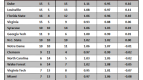
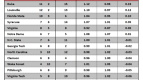
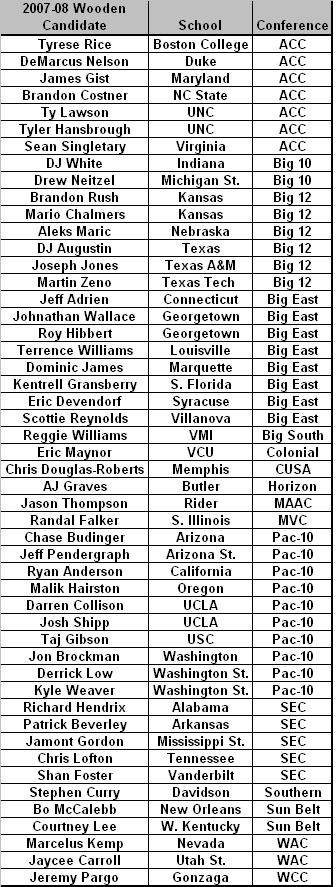
This afternoon the 2007-08 Wooden Award candidates were released to the public. The top 50 vote-getters (who gets to vote for this anyway – is the Wizard of Westwood sitting in his apt filling out ballots?) are listed below (organized by conference, then by team):

2007-08 Wooden Candidates v.2

Quick ruminations:

  • Conference Rundown: Pac-10 (10), Big East (8), ACC (7), Big 12 (6), SEC (5), Big 10 (2), Mid-Majors + Low Majors (12).
  • We like the love thrown to the non-BCS leagues – nearly a quarter of the selections are from eleven other leagues.
  • It’s no surprise the Pac-10 is held in such high esteem this coming season, while the Big 10 isn’t – look at the difference in good players returning.
  • For some reason, the Wooden doesn’t consider freshmen in its preseason picks, even though it does at the end of the year (Kevin Durant was the recipient last year). If it did, you’d figure the Pac-10 would look even better, with OJ Mayo and Kevin Love added to the mix.
  • Other than freshmen, who are some notable omissions around the country? First thought was Josh Heytvelt (Gonzaga), but maybe that has something to do with his propensity to ingest hallucinogens – can’t see the WoW signing off on that selection. We might have chosen Darrell Arthur over Mario Chalmers at Kansas, but maybe the Jayhawk fans would disagree with us. Raymar Morgan (Michigan St.), anyone? Edgar Sosa (Louisville)? What about Alex Harris down at UCSB?
  • Some guys we’d take off the list – Tyrese Rice at BC has shown he can shoot a lot and turn the ball over a lot – what else? Choosing DeMarcus Nelson smacks of making sure someone from Duke is on the list. We’re also not sure about the selection of Texas Tech’s Martin Zeno to the list. None of this really matters, though, as the list will eventually whittle itself down based on actual performance.
  • Anybody else have any thoughts?
Share this story

Breaking Down the Preseason Mags… pt. 3

Posted by rtmsf on October 21st, 2007

A month ago we gave you our reviews of the Athlon and Lindy’s preseason mags.

We’ve been busy plugging away at the conference previews, but in the interim, a few more mags have hit the shelves. So here’s the third installment of our continuing series of reviews of the preseason magazines.

Next Up: Sporting News/Street & Smith’s.

Note: Yes, TSN and S&S, two of the oldest and most respected preview issues, have joined forces this year on their college basketball preview. It remains to be seen whether this is a good idea.

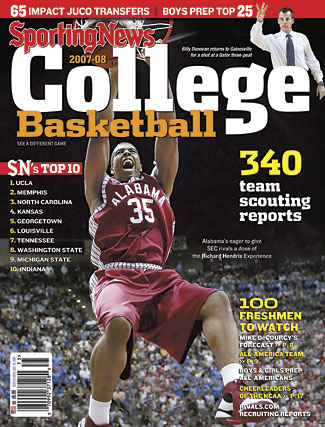
TSN / S&S Cover 08

I. Covers (5 pts) – are they cool? inclusive?

  • 12 regional covers hitting only the BCS conferences. Definitely a major conference bias here.
  • Coolest Cover – see above – one thing we really like is that most of the covers are full-color action shots. The Roy Hibbert (getting serviced by Vandy’s Ross Neltner?) and Mario Chalmers shots are our favs after Richard Hendrix above. Great cover.
  • Oops. The Athlon, Lindy’s and TSN issues all use the exact same action shot for Brook Lopez of Stanford on their Pac-10 cover. Unfortunately for Cardinal fans, Lopez is not reaching for a textbook.
  • Total Points = 4

II. Ease of Use (5 pts) – how hard is it to find confs/teams?

  • Not a fan of their setup here. They divide the conferences into high, mid, and low-major categories, then list them alphabetically within each section. Quick – is the Big West a mid-major or low-major league? The MAC? How about the Southern Conference? TSN considers the MAC a high major (???) and the others as mid-majors, which means we were flipping all over the place to find these leagues. Difficult navigation.
  • Within the league, they then list each team by predicted order of finish. Typical fare here.
  • Standard format otherwise – roundup, features, analysis of teams, recruiting, stats and schedules in that order.
  • Total Points = 2.5

III. Roundup (10 pts) – every mag has one – tell us something new!

  • The Late, Late Show is a short article explaining the basis behind TSN’s pick of UCLA as the #1 team in America.
  • Decourcy’s Directives are short narratives on the following topics: Coach Calipari’s calculations; Don’t Cry for Duke; One-and-Outs to Watch; and, Recipe for a Championship. The only interesting information here is in the Recipe section, which explains that most national champions for the last 20 yrs have had at least one NBA-caliber big man and guard on their roster (exceptions: MSU-2000; Arkansas-1994; Syracuse-2003).
  • TSN also provides three teams of All-Americans, led by seven sophomores and two freshmen among the fifteen. We like that they took some chances, going with Eric Gordon (Indiana) and Chase Budinger (Arizona) on the first team over some of the better-known names.
  • There is also a Top 25 with a couple of sentences describing each team’s strengths, but it is notable that TSN doesn’t bother with predicting the NCAA field anywhere within the magazine.
  • There is one page devoted to listing the Top 100 freshmen, but rather than listing them #1-#100, they made a confounding decision to order them geographically (all-east, all-south, etc.) and then alphabetically. There’s no way to intelligently distinguish OJ Mayo (all-east) from Edwin Rios (all-south).
  • Another page lists transfers eligible this season and next, but again they’re not ranked in any discernible manner. This page also lists all the coaching changes from the offseason.
  • Overall, this section is incredibly weak compared to the other previewed magazines, and especially considering that TSN and S&S were once considered the bibles of this genre. We literally learned nothing new in this section.
  • Total Points = 3

IV. Features (15 pts) – give us some insightful and unique storylines.

  • Features – what features? There is only one feature article, which if we said was shocking would be severely understating our sentiment. So surely that one article has something to do with this season, right? Nah. Try Whatever Happened To… Teddy Dupay, JR Van Hoose and Dane Fife, three (white) players who were HS stars ten years ago but didn’t ultimately make it to the League. Don’t get us wrong, we actually appreciate the concept of an article like this. The problem is that it’s the only feature article TSN felt necessary to give us in the entire magazine. That’s beyond unacceptable, especially when you consider the cache of writers that TSN has at its disposal.
  • Cheerleaders. Ok, we enjoy a photo collage of college cheerleaders as much as the next guy, but the only other “feature” that TSN insults us with offers us is a five-page spread of various gals in tricky positions. Again, this just seem so beneath TSN and S&S to pull out the cheerleader photo section to try to increase sales. But it’s becoming increasingly apparent that they just don’t care anymore. Good grief – they even put the Duke cheerleaders in the spread (Doherty was right)!!
  • FWIW, the Texas gal on p. 21 is absolutely scorching hot, with nods to Miss UCLA and Miss Florida on p.19. Surprisingly, we found Miss Kentucky (p.20) to be one of the fugliest of the group, along with Miss Hawaii (p.19). And Miss Wichita St. (p.18) can bend in ways that aren’t quite believable.
  • Total Points = 3

V. Predictions (20 pts) – how safe are their picks? do they take any chances? are they biased toward the big boys?

  • TSN’s Top 25 is pretty standard issue big conference fodder. They do put Memphis at #2, Gonzaga at #12 and Xavier at #25, but every other team is a BCS school. Since there are no NCAA predictions, we can only assume their top 4 is their predicted F4, which would mean UCLA, Memphis, UNC and Kansas are their choices.
  • Big Conference Bias. Assuming top 16 = Sweet 16, then Gonzaga and Memphis are the only exceptions. As for the Top 25, here’s the conference breakdown – Pac-10 (5), Big 12 (4), Big East (4), ACC (3), SEC (3), Big 10 (3), CUSA (1), WCC (1), A10 (1).
  • Surprises. Some teams that are getting some preseason pub that TSN doesn’t think much of include: Syracuse (10th in the Big East, which presumably would mean not an NCAA team); UConn (7th); USC (7th in Pac-10) & Vanderbilt (5th in SEC East). On the flip side, teams that TSN values more than others include: Georgia (3d in SEC East); Penn St. (4th in Big 10) & NC State (3d in ACC).
  • Boldest Prediction. Not much in the way of excessively bold predictions, but we believe that a lot of these prognosticators are going to regret giving a 5-11 ACC team (NC State) so much preseason hype this year.
  • We’re really annoyed that TSN doesn’t give us a field of 65, at minimum.
  • Total Points = 12

VI. Conference Pages (5 pts) – as a primer for the conference, how much can we learn here?

  • High Majors. The twelve conferences TSN designates as high majors each gets a full page primer, and there’s a lot to like here. The predicted order of finish uses a cool feature with arrows that shows how the team is trending this year – up, down, or steady. There’s a five man all-conference team, a short narrative breakdown of the league, and the most inclusive list of superlatives we’ve yet seen (15-20 different superlatives). There is also a third of the page devoted to ranking the recruiting classes within the conference and short analyses of each incoming player.
  • Mid Majors. TSN anoints only six leagues as mid-major leagues, and each of these leagues gets a half-page of analysis, including the predicted order of finish, a short narrative, an all-conference team, recruiting rankings and three superlatives.
  • Low Majors. The remaining conferences receive one page each, nearly the same as the mid-majors with the exception that the narrative is really just a paragraph wrapup.
  • Total Points = 5

VII. Team Pages (20 pts) – how in-depth is the analysis? where does it come from? is it timely and insightful given this year’s squad or is it just a rundown of last year’s achievements?

  • Roughly the top 2/3 of the high major teams get a full page of analysis from TSN; the remainder get a half page. Again, there’s a lot to like here – the writing is solid, giving decent insight into the strengths and weaknesses of each team without merely another rundown of each player and his stats. There is also a section on power ratings by five categories, a five-year wins trend, an impact rookie blurb and a brief but useful team statistics table.
  • The mid-major conference projected champions get the same treatment as the lower third teams of the high majors – a half-page with much of the same information above. The remainder of mid-major teams simply get the one-paragraph rundown treatment.
  • The low-majors all get a single paragraph, whether they’re the projected champion or not.
  • For the top twelve conferences, the analysis is the best we’ve seen this year thus far. The writers clearly know these teams and do a good job at breaking down what to watch for this season. The remaining leagues get short shrift, but those fans are not the target audience.
  • Total Points = 16

VIII. Recruiting (5 pts) – we want to know who the top players are coming into college bball, where they’re going and who to watch for next year.

  • As mentioned above, each major conference page has a substantial section on recruits for each school and rankings within each league.
  • See above for our issue with their list of the top 100 incoming players.
  • There is no listing of the best incoming recruiting classes nationally anywhere in the magazine, which is incomprehensible to us.
  • Once upon a time, S&S was the best place to get recruiting information, but that time again seems to have passed. They have four pages of names of players without ranking any of them outside of their Boys All-America Team (top 20). It’s nice they give a paragraph describing the skill set of each of those twenty players, but there’s just no way to compare players outside of that grouping.
  • With that said, we continue to enjoy the All-Metro Teams of twenty or so HS basketball hotbeds around the country. It gives us something to look for in our local area.
  • We also enjoy that TSN lists the top 25 HS teams for 2007-08.
  • This magazine has more information on high school prospects than any other we’ve seen, and yet they muff it by not presenting the information in a way most people would want to see it. Lists are fine, but they have to be useful for comparison.
  • Total Points = 4

IX. Title IX Guilt (aka Chick Ball) (5 pts) – the less the better…

  • The women’s preview is a Top 25 with four pages of analysis, but thankfully they stuck it in the back of the magazine.
  • Where they really go wrong is by wasting five more pages in the back on girls’ HS All-Americans and a HS top 20. We cannot believe that anyone would buy this magazine to get this information.
  • Total Points = 2

X. Intangibles (15 pts) – what’s good and bad about the magazine as a whole?

  • This magazine is trying to be everything to everyone. You can easily tell which parts were the expertise of TSN and which were the responsibility of S&S, and as such, the magazine seems random and incomplete in parts. For example, in addition to the prep information in the back, the magazine also gives us a full page on D2, D3 and NAIA basketball (with top 10s and All-Americans). And if that’s not enough, it also has a juco section, complete with a Top 10 and an article explaining why juco talent is getting deeper.
  • There is also a full page of individual and team stats for D1, D2, D3 and NAIA, plus two pages of women’s stats. Wouldn’t it have made a lot more sense to give us six pages of D1 stats instead? Are a substantial number of NAIA fans really buying this magazine?
  • Schedules. By virtue of its release date, TSN has most every team’s schedules in complete form at the very back of the magazine. The back page also has a nice roundup of all the in-season tourneys and conference tournament information.
  • The writing of this magazine is better than Lindy’s and Athlon, but the only writing actually performed is in the conference and team previews. It was very disappointing there weren’t more features at the front.
  • Total Points = 10

RTC Grade for Sporting News/Street & Smith’s = 61.5 pts

Basis: We have to say that we were really disappointed with this magazine, largely because when we were growing up, the TSN and S&S previews were must-reads in our house. Wow, how the mighty have fallen. How can you not have feature articles or build an NCAA field? How can you not rank-order recruits? How can you add a cheerleader section and spend page after page giving us NAIA stats? At this point, and we never thought we’d say this, the TSN magazine is definitely worse than Lindy’s and no better than Athlon. This would have been unheard of a few short years ago. The only value of this magazine is in the quality of the writing of the analyses for the high major conferences and teams – that is the one (and only) area where TSN trumps the other two. What a disappointment.


Grading Scale:

  • 90-100 pts – exceptional quality in all areas – must buy and keep on-hand all season!
  • 80-89 pts – very good quality mag – worthy of purchasing and reading cover-to-cover
  • 70-79 pts – average, run of the mill magazine – some value in certain areas but weak in others – tough call as to whether to purchase it
  • 60-69 pts – magazine on the weaker side, but may still have some positive attributes – probably not worth the money, though
  • 0-59 pts – such a low quality magazine that it’s not worth any more than the five minutes you thumbed through it at the store
Share this story

10.16.07 Fast Breaks

Posted by rtmsf on October 16th, 2007

An absolute ton of newsworthy stuff to catch up on from the weekend…

  • 2008 #1 player Greg Monroe committed to Georgetown after his visit there this weekend.  It couldn’t have had anything to do with that now-ubiquitous Jerry Rice dance, could it?  “Hoops” Weiss has the definitive take on how Monroe will impact the Hoyas.  Above the Rim writes that Duke (who was hot-n-heavy for Monroe) isn’t used to losing out on these guys. 
  • Making the Dance reports that after Georgetown (who obviously had the best MM weekend), Illinois (Bruce Weber can recruit after all?!?!), Indiana, Louisville and several others had good weekends. 
  • Lots of Midnight Madness and practice coverage from the weekend…
    • Huggins taking over the reins at his alma mater.  (there’s an amusing wmv file floating around where Huggins is giving a speech to some WVU booster club – it’s longwinded and rambling, but the DerMarr Johnson payoff is funny) 
    • A general roundup of MM from Lexington to Lawrence.
    • Catching up with Tubby in Minnesota. 
    • Pat Forde takes in the scene at UK with Billy Gillispie.  Apparently Goodman did the same.   
    • Andy Katz checks in on the hype surrounding Memphis. 
    • Goodman also took a road trip to Saluki country to report on the best mid-major not named Gonzaga, while en route to seeing Pitino in Louisville
    • Wake’s first practice without Skip Prosser
    • Dave Odom tries to save his job with transfers at South Carolina.
    • Pitt has XXXL expectations for DeJuan Blair
    • The defending champs (2x) start the rebuilding process.
  • Sad news that former Georgia star and current surgeon Alec Kessler died of a heart attack last weekend. 
  • Injuries, suspensions and dismissals:
    • Gonzaga’s Josh Heytvelt was reinstated on Friday but will miss the first week of practice due to shroom farming foot pain.
    • Louisville’s Juan Palacios injured his ankle and may have to redshirt his senior season. 
    • Brandon Rush reports that he’s on target for his Dec. 1 return to Kansas.
    • Georgia suspended three players for not attending classes, including top two scorers Takais Brown (9 games) and Mike Mercer (15 games).  Seriously, fellas?  SEC Hoops:TGTBTD has the take on how this will affect the Bulldogs.
    • Northwestern’s best player Kevin Coble is taking a leave of absence to be with his sick mother. 
    • Ball St. coach Billy Taylor booted two more players off the team, making a total of six since he was hired in August. 
  • More Preseason goodies:
    • Gary Parrish and Ben Howland converse about whether the Pac-10 will have the most first round picks ever this year.
    • Pitino bitches about the difficulty of the unbalanced league schedule Louisville is being forced to play. 
    • MMAS continues its comprehensive review with its non-BCS top 25
    • Seth Davis asks us 20 questions, then he answers them. 
    • Gary Parrish lists his start-of-practice top 26.  Memphis, eh?
    • The Fanhouse wonders if Memphis is even the best team in its own state.
    • Jeff Goodman takes a realistic look at Duke’s expectations for this season.
    • ESPN plans on showing a grand total of TWO Pac-10 games this year!  Up from zero last year. 
    • The Big 12 handed out its preseason awards – DJ Augustin is the projected POY. 
    • Shawn Siegel lists his top 25 Big 12 players and top 25 Big 10 players for 07-08. 
Share this story

Gary Williams Hates Graduation

Posted by rtmsf on October 4th, 2007

Yesterday the NCAA released its latest graduation rate figures for all D1 athletes who entered school in the classes of 1997-2000. Unlike the federally-mandated graduation rate, the GSR (Graduate Success Rate) is more realistic for athletes – it gives each player six years to complete his degree and it does not count transfer students against a school (reflecting the reality of athlete puddle-jumping for playing time in D1).

Here are the NCAA’s key findings:

The latest GSR figures show that 77 percent of student-athletes who began college from 1997-2000 graduated within six years. That four-year graduation rate is unchanged from last year’s data and up from 76 percent two years ago.

The Graduation Success Rate for men’s basketball rose from 55.8 percent in 1995 to 63.6 percent in 2000, a 7.8 percent increase. Football increased from 63.1 percent to 66.6 percent for teams competing in the Bowl Subdivision and from 62 percent to 64.7 percent for teams competing in the Championship Subdivision. Baseball increased from 65.3 percent to 67.3 percent.

Gary Williams chicken wing

Gary is Too Busy to Worry About Graduation Rates

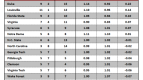
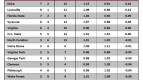
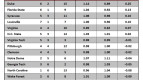
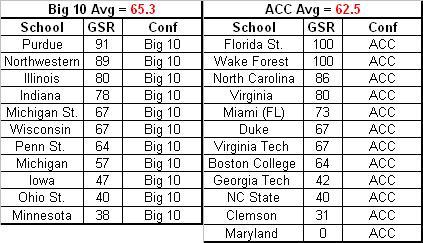
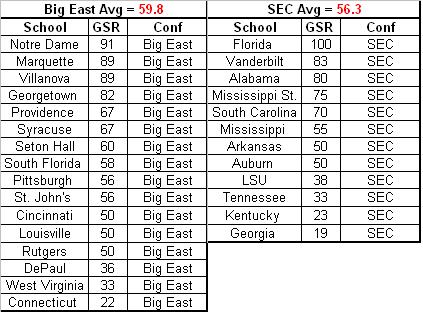
Since the NCAA doesn’t provide a sortable database of team information (or at least we can’t find it), we decided to quickly throw together some tables showing how the BCS schools performed in this cohort. Gary Williams should be especially proud of himself. Seriously, Gary, the best you can do with those Juan Dixon/Lonny Baxter teams is zero?!? Not even ONE player???

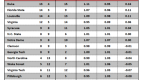
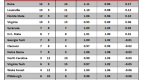
Big 10 + ACC GSRs 07

Big East + SEC GSRs 07

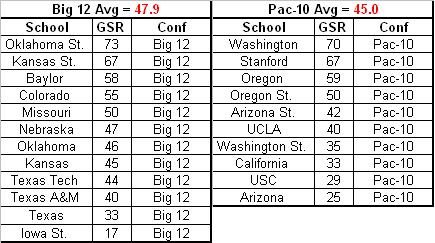
Big 12 + Pac-10 GSRs 07

Thoughts.

  • At the high end, Florida St. at 100% makes us wonder if any of these stats are credible. Then again, Florida is also at 100%, and these numbers are around 2000, so maybe there was a hanging chad issue or something. We’re also amazed that Eddie Sutton’s band of merry criminals men led the Big 12.
  • At the low end, Jim Calhoun at UConn, Lute Olson at Arizona, Tim Floyd/Larry Eustachy at Iowa St., Ron Jirsa/Jim Harrick at Georgia, and the seediest of all, Clem Haskins at Minnesota, join Gary Williams in the dregs of their respective conferences. What a list of slimy characters there.
  • The Pac-10 is surprisingly low, given that Stanford, Cal, UCLA and USC are all great schools. Especially Stanford – how can Mike Montgomery justify graduating only 2/3 of his players? Guess he doesn’t have to at this point – or does he? And the SEC is surprisingly high, with Alabama, the Mississippi schools and South Carolina doing well.

We may have more thoughts on this later, but we’re heading for the airport at the moment, so it’ll have to wait.

Share this story

Conference Challenges, Invitationals & Hardwood Series

Posted by rtmsf on September 27th, 2007

Now that schedules are out, we thought it was worth a quick look at the new so-called conference challenges that are set to begin this year. We already know about the ACC’s annual emasculation and disembowelment of the Big very small 10 Conference, but we will recap that one too while we’re on the topic.

Big East / SEC Invitational
Big East / SEC Invitational

The Big East, having played in this sort of made-for-tv event once before (the ACC/Big East Challenge from 1989-91 resulted in an evenly split 12-12 record), has decided that it wants to show its wares against the SEC these days. This is a noble pursuit inasmuch as the two leagues have equalized in power over the last 15 years, with the Big East falling and the SEC rising. The confounding problem with this event is that it only involves four games annually and ESPN determines the matchups. While at first blush we thought this might be a good thing – visions of UConn-Florida, Kentucky-Syracuse, Tennessee-Georgetown and LSU-Seton Hall were dancing through our heads (ok not so much on the last one) – but upon actual review of this year’s schedule, we have to wonder if this will be worth our time at all.

December 5 (Birmingham Jefferson Civic Center; Birmingham, Ala.)
7:00 p.m. West Virginia vs. Auburn – ESPN2
9:30 p.m. Georgetown vs. Alabama – ESPN

December 6 (The Wachovia Center; Philadelphia, Pa.)
7:00 p.m. South Carolina vs. Providence – ESPN2
9:30 p.m. LSU vs. Villanova – ESPN

Out of this group, we see what, maybe one or two NCAA Tournament teams (Georgetown and who? Villanova or WVU?). Sure, Bama losing Ronald Steele couldn’t be anticipated, but what’s up with choosing last year’s SEC bottom dwellers Auburn, LSU and South Carolina? Is the SEC willfully trying to lose these games?

Big 12 / Pac-10 Hardwood Series

So that brings us to the other new conference challenge, which is slated to pit the Big 12 and Pac-10 against each other. This challenge mimics the ACC-Big 10 version in that every team will participate, and some even twice (Arizona & Stanford this year). Also, teams will play at home arenas rather than neutral sites, which ultimately makes early-season games more exciting.

Thurs., Nov. 29, 2007
8:00 p.m. Oregon at Kansas State – ESPN2
10:00 p.m. Oklahoma at USC – FSN

Fri., Nov. 30, 2007
8:00 p.m. Washington State at Baylor – ESPNU
10:00 p.m. Iowa State at Oregon State – FSN

Sat., Dec. 1, 2007
4:30 p.m. Washington at Oklahoma State – ESPN
10:00 p.m. Missouri at California – FSN

Sun., Dec. 2, 2007
2:00 p.m. Arizona State at Nebraska – ESPNU
2:00 p.m. Stanford at Colorado – ESPN2
5:00 p.m. Texas A&M at Arizona – FSN

7:00 p.m. Texas at UCLA – FSN

Outside the 10-game series window:
7:oo p.m. Arizona at Kansas (Sun., Nov. 25) – ESPN
3:30 p.m. Stanford vs. Texas Tech (Sat., Dec. 22) – ESPN2

Now that’s more like it. There are seven legitimately good games in this group, and a couple of them are potential blockbusters (Texas-UCLA and Arizona-Kansas). Furthermore, this could go a long way toward improving the schedule strength of these two conferences, both of which have traditionally been lower among the BCS conferences.

ACC / Big 10 Challenge
ACC / Big Ten Challenge 2

And now for the annual event where the ACC has not only won but dominated the Big 10 for eight years running. 48 wins, 27 losses. This year should be no different. Even though the ACC is a little down from last season, the Big 10 is a lot down, and we see no more than four wins from our midwestern friends this year.

Monday, Nov. 26
7:00 p.m. Wake Forest at Iowa – ESPN2

Tuesday, Nov. 27
7:00 p.m. Georgia Tech at Indiana – ESPN
7:30 p.m. Minnesota at Florida State – ESPN2
7:00 p.m. Northwestern at Virginia – ESPNU

9:00 p.m. Wisconsin at Duke – ESPN
9:30 p.m. Purdue at Clemson – ESPN2

Wednesday, Nov. 28
7:00 p.m. N.C. State at Michigan State – ESPN
7:30 p.m. Illinois at Maryland – ESPN2
7:00 p.m. Boston College at Michigan – ESPNU
9:00 p.m. North Carolina at Ohio State – ESPN
9:30 p.m. Virginia Tech at Penn State – ESPN2

A couple of final thoughts on these conference challenges. We’d like to see more conferences get involved with this, even if only the top few teams in the mid-major conferences were playing other top teams. A Missouri Valley/WCC or CAA/A10 challenge would be really instructional for considering mid-majors in March – a little like BracketBusters but more comprehensive.

Additionally, it should be a really fun ten days after the Thanksgiving weekend settling in each night for these games. The Big East and SEC have got to give us some better matchups, though.

Share this story

Breaking Down the Preseason Mags… pt. 2

Posted by rtmsf on September 14th, 2007

So Wednesday we established that the Athlon Sports preseason magazine is one that you probably shouldn’t take home with you. Unless you’re the type of person who goes gaga over seeing your favorite team/player on the cover and must own them all in a Sisyphian quest to document every newsworthy event involving it throughout history. Consider this excitable Carolina fan’s tale we stumbled across today (re: the Athlon issue)…

Yep, arrived in Atlanta area stores last week, and every darn store I checked had the Georgia edition (one UGA player and one Ga Tech player on the cover). Same as last year. And the year before. Ad nauseum.

So I will do what I do every year – wait until all the mags are out, then drive up to visit my brother in NC and buy every mag with a Heel on the cover. That is always one of my most happy trips of the year.

Hey, we don’t judge. So here’s the second installment of our continuing series of reviews of the preseason magazines.

Next Up: Lindy’s.

Lindy’s


I. Covers (5 pts) – are they cool? inclusive?

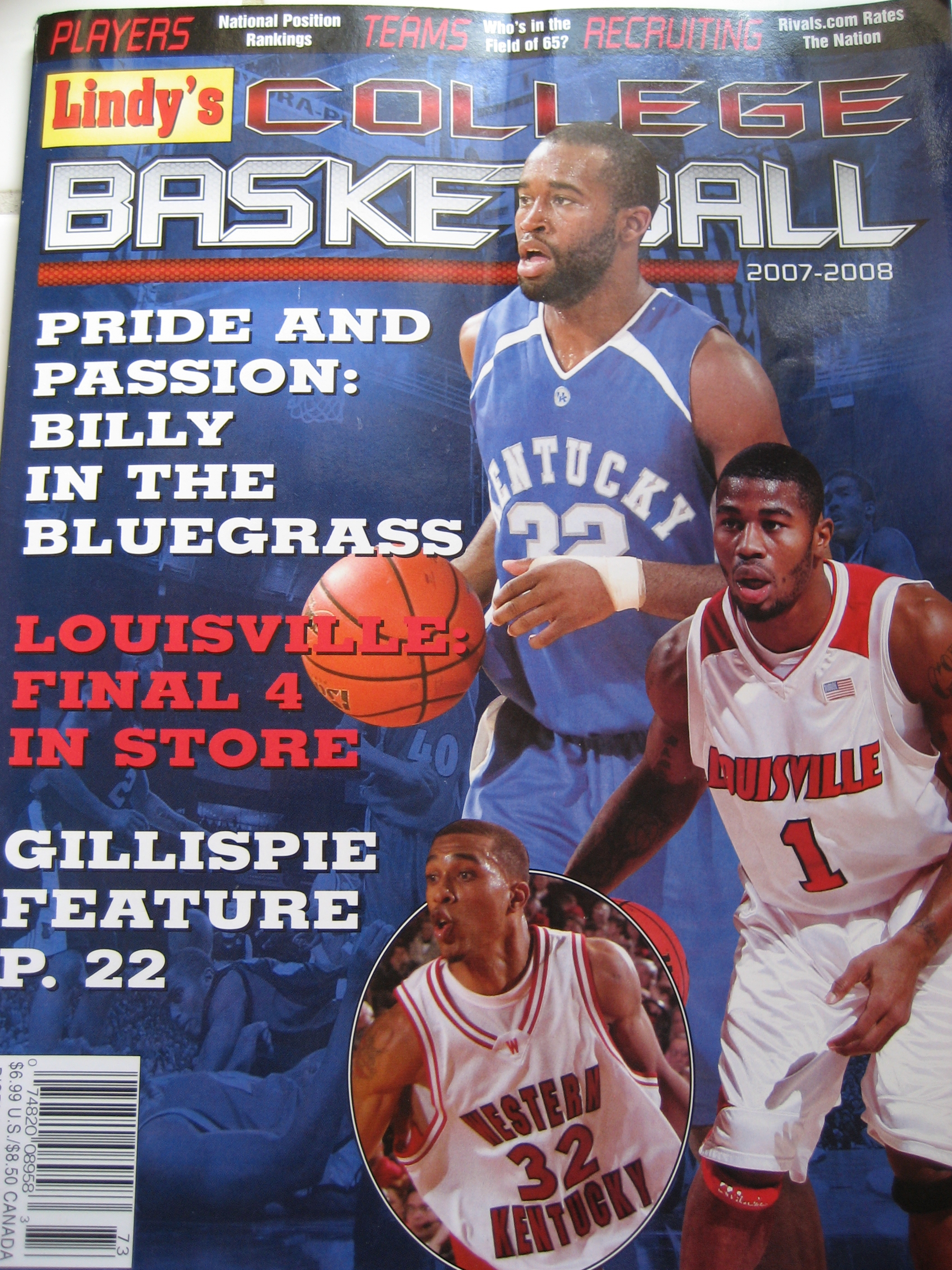
  • 21 regional covers is a nice number, but the Rocky Mtn states aren’t represented in the least – Does Lindy’s realize that the Mountain West and WAC have fans too?
  • Coolest Cover – none – they’re pretty much all the same format, with multiple players photographically stacked on top of each other.
  • Say What? The Tennessee issue highlights UT, Memphis, Vandy and the Lady Vols?? The NE issue features UConn, BC and something called the “Lady Huskers,” which we assume is supposed to be “Huskies.” Either way, we have no tolerance for this.
  • Total Points = 2

II. Ease of Use (5 pts) – how hard is it to find confs/teams?

  • Somewhat difficult upon first glance. Eleven major conferences are arranged alphabetically, then by predicted order of finish of its teams. The rest of the conferences are shoved into the back of the mag with the teams arranged alphabetically within. Confusing.
  • Standard format otherwise – roundup, features & predictions; analysis of teams; recruiting, in that order.
  • Total Points = 2.5

III. Roundup (10 pts) – every mag has one – tell us something new!

  • Scoping the Nation dives into the one-and-done phenomenon, and pretty much makes the same assessment we made here back in May – that coaches at the elite programs recognize the necessity in assuming the risk of taking potential one-and-dones. The potential reward, as in the cases of Greg Oden and Mike Conley for Thad Matta at Ohio St., is simply too much to pass up. They also take a look at the ten most likely one-and-dones for this season and next.
  • The Nov/Dec Action to Check Out section is a bit of a copout by Lindy’s in the sense that its early publication resulted in not being able to review full schedules. Still, they make an attempt by reviewing the big pre-conference game possibilities in the holiday tournaments.
  • Lots of Lists – that’s ok, we like lists.
    • Top 10 “under the radar” players
    • Top 10 transfer players
    • Top 10 juco transfers
    • Top 10 jump shooters
    • Top 5 defenders
  • Lindy’s also provides a complete Top 25 (+15 fringe teams), a listing of the NCAA field of 65 by conference, as well as predictions of the Sweet 16 and Final Four.
  • There is also a complete list of coaching changes and the conferences are rated first (Pac-10) to worst (SWAC).
  • We also appreciated seeing deserving blurbs on Rick Majerus‘s return to college coaching at St. Louis, and Skip Prosser‘s passing at Wake.
  • They also rate the Top 25 players at each position…
    • PG – Drew Neitzel (Michigan St.)
    • SG – Chris Lofton (Tennessee)
    • SF – Brandon Rush (Kansas)
    • PF – Tyler Hansbrough (UNC)
    • C – Roy Hibbert (Georgetown)
  • …and the top frontcourt (UCLA) and backcourt (UNC).
  • Cool Stat Award. Utah St. guard Jaycee Carroll’s shooting numbers – .527 from the field, .432 on threes, and .888 from the foul line!
  • Total Points = 9

IV. Features (15 pts) – give us some insightful and unique storylines.

  • Kentucky-centric. Three of their feature articles relate to the UK head coaching position – Tubby’s leaving of the job (He’s Gone), Billy D’s courting of the job along with his about-face with Orlando (He Couldn’t Leave), and Gillispie’s acceptance of the job (Billy & the Believers).
  • What’s Good for the Zags… is a good article about the pressures that other mid-major programs (even the successful ones) now face in light of the Gonzaga Effect.
  • Embracing Kelvin is an insightful piece about the “my way or the highway” coaching style of Kelvin Sampson, and validates why we expect big things from IU this season.
  • Early and Often is a somewhat weaker article describing how coaches are faced with recruiting players earlier and earlier in high school (and sometimes back into junior high).
  • Total Points = 11

V. Predictions (20 pts) – how safe are their picks? do they take any chances? are they biased toward the big boys?

  • Lindy’s uses both the 65-team prediction model and the Top 25, as discussed above. Like Athlon, they too have UCLA defeating UNC in the final game, but we give them a little bit of credit for projecting first-timer Tennessee into the F4. They don’t predict an Elite Eight, but only half of their Sweet 16 made it there in 2007, which is realistic.
  • Big Conference Bias. Still, 14 of that Sweet 16 are from BCS conferences – Gonzaga and Memphis are the only exceptions. NCAA Bids – ACC (5), Big Ten (4), Big 12 (5), Big East (8), Pac-10 (7), SEC (7).
  • Mid-Major Watch. Mid-Major bids – 3 A10 (Xavier, St. Joe’s, St. Louis), 2 CAA (George Mason, VCU), 2 CUSA (Memphis, UAB), 1 Mountain West (BYU), 1 WAC (New Mexico St.), 1 MVC (S. Illinois).
  • Surprising Omissions. Florida loses everyone, but are there really seven better teams in the SEC this year? Billy D. has the #1 recruiting class coming into Gainesville. We also think Lorenzo Romar’s Washington squad is primed for a return to the NCAAs this year. Also, we gotta believe that the always-underrated MVC will manage to get another team in there, while seven (Georgia and Vandy??) from the SEC is a little ridiculous this year.
  • Boldest Prediction. Again, Lindy’s doesn’t go too far out on a limb with any of their picks, but Alabama winning the SEC West completely depends on Ronald Steele’s knees, and Cornell winning the Ivy League is also dubious.
  • Total Points = 14

VI. Conference Pages (5 pts) – as a primer for the conference, how much can we learn here?

  • The major and mid-major conferences get a predicted order of finish with brief analysis, a substantial recruiting roundup, three teams of all-conference selections, returning leaders in key categories, team stats and a fair superlatives section. While we appreciate a focus on acquainting readers with the newcomers, we would have liked to have seen less space used on this in favor of the returners.
  • The small conferences get a predicted order of finish, two teams of all-conference selections and a superlatives section.
  • Total Points = 3.5

VII. Team Pages (20 pts) – how in-depth is the analysis? where does it come from? is it timely and insightful given this year’s squad or is it just a rundown of last year’s achievements?

  • Lindy’s Top 40 teams get a full page of analysis, including player evaluations and team statistical rankings.
  • All other BCS and mid-major teams get a brief half-page of analysis with the same evaluations/rankings. Low major teams (even if predicted to make the NCAA Tourney) get a paragraph and a few key stats. Minimal info.
  • Again, similar to Athlon, analysis is lacking. Much of it is based on recapping last season’s accomplishments plus the obligatory coach’s quotes. For teams outside the Top 40, they barely get a mention.
  • Total Points = 12

VIII. Recruiting (5 pts) – we want to know who the top players are coming into college bball, where they’re going and who to watch for next year.

  • As mentioned above, each major conference page has a substantial section on newcomers and what their strengths and weaknesses are.
  • Six pages of recruiting information, featuring the top 25 recruiting classes with a brief description of each.
  • The top 50 of 2007 is provided by Rivals.com, but Lindy’s focuses on the future classes more than present, listing the top 100 for both 2008 and 2009, plus the top 10 for 2010.
  • They also provide some much-needed context and analysis from Justin Young at Rivals.
  • Total Points = 5

IX. Title IX Guilt (aka Chick Ball) (5 pts) – the less the better…

  • We already established that they’re putting some women’s players on the cover.
  • They also give it four pages in the front features section, with a detailed top 25 and fifteen All-Americans. Unacceptable.
  • Total Points = 1

X. Intangibles (15 pts) – what’s good and bad about the magazine as a whole?

  • Errors. We’re not sure if the cause is shoddy editing or what, but who and what are Reyshawn Green Terry (formerly of UNC) (p.9), David Lightly Lighty (Ohio St.) (p.18) and Gongzaga Gonzaga (p.28)? – these errors were found in the first few pages and seemed pervasive throughout, mitigating the mag’s credibility from the start.
  • Whereas Lindy’s provides far more interesting detail in almost every other area over Athlon, its writing (and clearly its editing) is weaker on the whole.
  • Again, no schedules due to the early publication date.
  • It takes some risks with its predictions (which we like), but its analysis really doesn’t explain why, e.g., Georgia is an NCAA Tournament team and Florida isn’t.
  • Total Points = 9

RTC Grade for Lindy’s = 69 pts

Basis: Lindy’s is a better magazine on the whole than Athlon, but it has serious weaknesses with respect to its team analyses. Where it excels is in the areas of roundup and recruiting information, but it needs better writing, editing and much more consideration of the smaller conferences. A little more attention to detail would make this magazine a legit value in future iterations.

Grading Scale:

  • 90-100 pts – exceptional quality in all areas – must buy and keep on-hand all season!
  • 80-89 pts – very good quality mag – worthy of purchasing and reading cover-to-cover
  • 70-79 pts – average, run of the mill magazine – some value in certain areas but weak in others – tough call as to whether to purchase it
  • 60-69 pts – magazine on the weaker side, but may still have some positive attributes – probably not worth the money, though
  • 0-59 pts – such a low quality magazine that it’s not worth any more than the five minutes you thumbed through it at the store
Share this story

09.13.07 Fast Breaks

Posted by rtmsf on September 12th, 2007

News from around the basketblogosphere…

  • A couple of late summer transfers to report today. It appears Kenny Cooper is leaving Oklahoma St. to be closer to home (Louisiana) and Anthony Gurley (Massachusetts) is leaving Wake Forest for the same reason.
  • Our new friends over at Plissken at the Buzzer put together a well-thought out and detailed analysis of the Pac-10’s non-conference schedules in an effort to determine how it will ultimately affect their postseason chances.
  • Lion in Oil reports that the Final Four will embrace the BasketBowl approach to squeeze more fans into “distant view” seats on the final weekend beginning in 2009.
  • Gonzaga’s Josh Heytvelt of psychedelic mushroom fame is set to return to the team after paying off his debt to society (no, it did not involve organic farming).
  • NC State’s promising freshman Jonny Thomas is out for the season with a knee injury.
  • Goodman reports Greg Monroe is down to his final eight schools (Duke, Georgetown, LSU, USC, Baylor, UConn, Texas, Kansas), and that KU’s Darrell Arthur is fully recovered from his stress fracture.
  • Fluff Pieces. Parrish writes about Capel’s rebuilding project at Oklahoma, DeCourcy writes about Willie Kemp’s expected role at Memphis alongside Derrick Rose, and Goodman writes about Donnie Jones returning home to coach at Marshall.
  • Shawn Siegel‘s teams that won’t make the NCAA Tournament (#144 – #72) are up, with some interesting comparisons to the preseason rankings from 2006.
  • Finally, we have to mention that we’re excited to see what the combo of Ken Pomeroy and Baseball Prospectus can come up with in their new blog called Basketball Prospectus, which will focus exclusively on college hoops from a statistical bent beginning this fall.
Share this story

Breaking Down the Preseason Mags…

Posted by rtmsf on September 12th, 2007

We’re heading into the middle of September already, literally thirty days until Midnight Madness, and the first batch of preseason mags are already proliferating on B&N shelves like West Virginians on crystal meth at a swap meet (no offense intended to the West Virginians not on crystal meth, of course). We know many of our readers are asking, “what’s a magazine?” To which we reply, “it’s what old people read while they’re on the toilet.” For our few readers here over 30 (present company excluded), we offer the first installment of our continuing series of reviews of the preseason magazines.

First in line: Athlon Sports.

Athlon Preseason Cover 07

I. Covers (5 pts) – are they cool? inclusive?

  • 34 regional covers seems like overkill, but we suppose having a Minnesota/Iowa/Iowa St. cover matters to someone.
  • Coolest Cover – for some reason, we particularly like the elated yet menacing look Patrick Beverly gives the camera on the Arkansas edition.
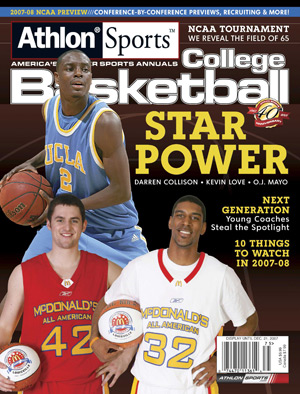
  • Say What? Athlon’s UCLA/USC cover (above) features Kevin Love and OJ Mayo in their Burger Boy unis – was it really too much trouble to shoot them with their correct jerseys on?
  • Total Points = 4

II. Ease of Use (5 pts) – how hard is it to find confs/teams?

  • Conferences and teams are arranged alphabetically, allowing for quick navigation assuming you know your conference.
  • Standard format otherwise – features & predictions; analysis of teams; recruiting, in that order.
  • Total Points = 4

III. Roundup (10 pts) – every mag has one – tell us something new!

  • 10 Things to Watch is ok, but we didn’t learn anything new (i.e., the Pac-10 is great, keep an eye on Love/Mayo/Gordon, etc.).
  • Hoops Madness is a little better, mostly because of its lists of emerging stars (hot sophs to watch), top transfers and coaches on the hot seat. Also enjoyed learning that Dayton’s band has become the band by proxy for the Niagara Purple Aces (since NU doesn’t have one).
  • Cool Stat Award. Memo to Adam Lonon (VMI) – shoot more! (31 starts, 26 FGs)
  • Total Points = 5

IV. Features (15 pts) – give us some insightful and unique storylines.

  • Next Generation is a decent article about the young brigade of coaches who have been successful so far (Donovan, Matta, JT3, Howland, etc.). It wasn’t unique, as we expect to see a lot of this in the rags this year.
  • The Fix relates the story of the Tulane pointshaving scandal two decades ago. Although the article briefly mentions the Tim Donaghy story, it focuses primarily (and misguidedly) on the people involved in the scandal. What we needed to see here was an article about the existence of gambling among college athletes and efforts to prevent it. Big swing & miss here.
  • The Scoop is three one-page interviews with Ronald Steele (Alabama), Bill Walker (Kansas St.) and Drew Neitzel (Michigan St.), none of which are very interesting.
  • Total Points = 5

V. Predictions (20 pts) – how safe are their picks? do they take any chances? are they biased toward the big boys?

  • Athlon uses the 65-team prediction model, eschewing the traditional Top 25 (they get pts for that). But Athlon goes waaaaaaaaay safe by predicting six of the elite eight the same as 2007 (Georgetown, Kansas, Memphis, UNC, Oregon, UCLA with Louisville and Tennessee added for good measure). UCLA defeats Carolina in the championship.
  • Big Conference Bias. 15 of its Sweet 16 are from BCS conferences – highly doubtful and incredibly LAME! NCAA Bids – ACC (5), Big Ten (5), Big 12 (5), Big East (9), Pac-10 (7), SEC (6).
  • Mid-Major Watch. Only Memphis from a mid-major conference (CUSA) into the Sweet 16. Mid-Major bids – 2 CAA (George Mason, VCU), 2 MVC (Bradley, S. Illinois), 1 A10 (Xavier), 1 Mountain West (BYU), 1 WAC (Nevada). We’ll bet anything Athlon’s editors choose that those six conferences will get more than eight bids next March.
  • All-Americans. Athlon really likes Drew Neitzel for some reason. He joins Psycho T, Chris Lofton, Roy Hibbert and Darren Collison (?) on their first team. They took a big flier on putting oft-injured Ronald Steele on the third team.
  • Boldest Prediction. It’s sad that we had to dig this deep to find it, but it’s probably their pick for Cornell to win the Ivy League over Penn & Princeton. The last time a team other than those two won the Ivy Championship was in 1988 with (guess who?) Cornell.
  • Total Points = 10

VI. Conference Pages (5 pts) – as a primer for the conference, how much can we learn here?

  • The major conferences get a predicted order of finish, a brief recruiting roundup, and three teams of all-conference selections plus a “superlatives” section, which is fairly weak compared to others we’ve seen (POY, DPOY, most underrated, newcomer).
  • The mid-major and small conferences only get a predicted order of finish, one team of all-conference selections and an all-time NCAA Tourney stat for the conference (which is interesting).
  • Total Points = 2.5

VII. Team Pages (20 pts) – how in-depth is the analysis? where does it come from? is it timely and insightful given this year’s squad or is it just a rundown of last year’s achievements?

  • All major conference and projected mid-major NCAA Tournament teams get a full page of analysis, including evaluations of the frontcourt and backcourt as well as a team roster (w/ stats) and a team-oriented stat.
  • Non-NCAA Tournament mid-majors and low majors get at most a half-page analysis and roster, but most only get a paragraph with a very brief synopsis.
  • Clearly much of the analysis is based on what coach’s interviews, which results in analyses from “glass half full” perspective. We would have liked to have seen more contrarian viewpoints.
  • The depth of analysis is solid if not spectacular for the major conference teams, but largely lacking for the others.
  • Total Points = 14

VIII. Recruiting (5 pts) – we want to know who the top players are coming into college bball, where they’re going and who to watch for next year.

  • Four pages of recruiting information, including the top 100 (Scout.com) of 2007, the next 200 players, and the top 20 by position. Solid raw data.
  • It also includes the top 25 classes, but only as a list, with no additional details.
  • The top 100 in the class of 2008, top 25 in 2009 and top 10 in 2010 are also listed.
  • Total Points = 3

IX. Title IX Guilt (aka Chick Ball) (5 pts) – the less the better…

  • Only two pages worth, and at the very back of the magazine.
  • Total Points = 5

X. Intangibles (15 pts) – what’s good and bad about the magazine as a whole?

  • In the past, Athlon’s mag hasn’t always looked as professional as some of the others. This is no longer the case. Its layout looks great, the photos and graphics are solid, and the writing has improved.
  • Because it comes out so early, the advantage it gains in being one of the first published is mitigated by other temporal factors. Most notably, there are no schedules within the magazine – for that reason alone, Athlon cannot be your “go-to” preview issue during the season.
  • Additionally, its early publish date means that it misses late summer news involving injuries, transfers and coaching changes. While they did get the Skip Prosser news in there, they did not, for example, consider how Andy Rautins’ knee injury will impact Syracuse.
  • As a nontraditional magazine (i.e., not Street & Smith or TSN), Athlon should have taken more risks with their predictions – going all chalk won’t separate it from the pack.
  • Total Points = 8

RTC Grade for Athlon = 60.5 pts

Basis: Athlon is on the lower side of quality with the preseason magazines, but they have gotten better, and there is some value in their analysis. Its best use (given its early arrival on the newstand) is simply to refamiliarize yourself with the names and faces of the upcoming season. We wouldn’t recognize purchasing it unless you simply cannot wait for the better ones to come out.

Grading Scale:

  • 90-100 pts – exceptional quality in all areas – must buy and keep on-hand all season!
  • 80-89 pts – very good quality mag – worthy of purchasing and reading cover-to-cover
  • 70-79 pts – average, run of the mill magazine – some value in certain areas but weak in others – tough call as to whether to purchase it
  • 60-69 pts – magazine on the weaker side, but may still have some positive attributes – probably not worth the money, though
  • 0-59 pts – such a low quality magazine that it’s not worth any more than the five minutes you thumbed through it at the store
Share this story

2007 Athlademic Ratings – Revised

Posted by rtmsf on September 5th, 2007

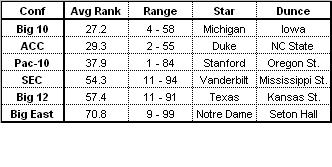
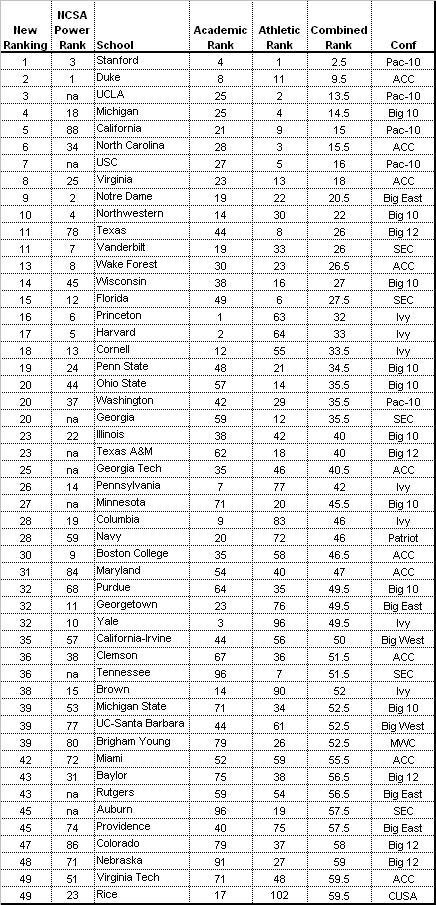
Ok, so thanks to an insightful UCLA fan, we realized that our exuberant reliance on NCSA data to justify our Athlademic Rankings posted last week was giving them way too much credit for properly vetting their data.  So to make sure we get it right this time, we spent the better part of today going through the 2007-08 US News rankings and the 2006-07 Sears Cup rankings ourselves.  Here’s the revised list, in Table A

Table A.  Athlademic Ratings – Division I (revised)

NCSA Revised Rankings

New Arrivals.  In addition to UCLA and USC, we also see the inclusion of Georgia, Texas A&M, Georgia Tech, Minnesota, Tennessee, Rutgers and Auburn onto our list – all driven by strong athletic programs.  High academic schools with relatively weak athletic programs, such as Army, William & Mary and Dartmouth, fell out of the top 50 due to the addition of the above programs. 

Ivy League logo

The Ivies strike a Nice Balance in Athlademics 

Ivy League Balance.   Speaking of Dartmouth, Keggy the Keg and friends are the only Ivy League school that didn’t make our Top 50.  The other seven did, with Princeton (no surprise there) leading the way at #16 overall.  Granted, the high academics of the schools drives their inclusion here, but we shouldn’t discount that these schools rate above many larger BCS schools in terms of the success of its athletic programs.  Cornell has the 55th most successful athletic program, but there are 73 BCS schools, which means Cornell, Princeton (#63) and Harvard‘s (#64) athletic programs  are outperforming bigger state schools such as Kansas (#66), Iowa (#68), and Connecticut (#82).

Big 10 – ACC Challenge.    As in, the Big 10 and ACC challenge the rest of the BCS conferences to keep up with it when it comes to athlademics.  We rated all 73 BCS conference schools, keeping those ahead of them in place, and Table B below shows the results. 

Table B.  BCS Conference Athlademic Ratings

 Conf Ratings

Why is the Big East so bad?  There’s a pretty clear top tier of Big 10, ACC and Pac-10, a middle tier of the SEC and Big 12, and a bottom tier, where the Big East lurks like Gollum all by itself.  The Big East really gets killed on both sides of the equation – it has seven (of 16) third-tier academic schools, as rated by US News (more than the other 5 conferences combined); and seven schools that finished outside of the top 100 in the Sears Cup (Mississippi St. and Kansas St. are the only other two in BCS conferences).  This includes the dubious case of Seton Hall, who was the only BCS conference school of the 73 to not score a single point in the Sears Cup competition for 2006-07.  How is that possible?? 

Seton Hall

Days Long Since Gone at The Hall

Haves and Have-Nots.  The Pac-10 is the greatest example of bifurcation within a conference.  It has five of the top twenty athlademic programs in America (Stanford, UCLA, USC, Cal, Washington), but it also only has five of the top fifty programs – its next highest ranked school is Arizona at #51.  Compare this with the Big 10, who has nine of its eleven members ranked in the top forty, with only Indiana (#53) and Iowa (#58) weighing it down.  Conversely, the Big 12 only has two of its twelve schools ranked in the top forty – Texas (#11) and Texas A&M (#23). 

Non-BCS Stars.  We already mentioned the Ivies, whose eight schools average a 29.9 rating on our list.  But who else steps up to challenge the BCS big boys as an athlademic school?  The Naval Academy (#28) and a couple of the smaller UCs (Irvine (#35) & Santa Barbara (#39)) lead the way.  One surprise inclusion is our Mormon friends at BYU, who used a strong athletic showing to come in at 39th on our list. 

You can do Better.  Not to harp on anyone in particular, but it makes no sense to us that football (read: revenue) schools like Cincinnati (#196 in the Sears Cup), South Florida (#133), Mississippi St. (#120), Kansas St. (#111) and Syracuse (#110) can’t do any better with their overall athletic programs.  Let’s throw in Villanova (#132) and Marquette (#127) for good measure – both schools are wealthy private Catholic institutions, which means they have the resources to spread around the non-revenue sports.  So what’s their excuse? 

Share this story

Who Doesn’t See This Coming?

Posted by rtmsf on August 28th, 2007

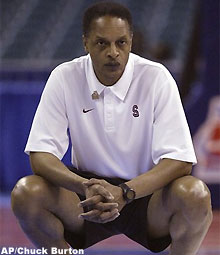
Word out of the Bay Area today is that Mike Montgomery, coach emeritus of Stanford University, will be returning to The Farm in an administrative capacity with the athletic department.  According to the San Jose Mercury News:

He is expected to help with fundraising and the mentoring of coaches, a job that should allow him to continue working as a regional television analyst during the college basketball season. […]  “We’ve talked at some length about having him come back with some role at Stanford,” [Stanford AD Bob] Bowlsby said last month. “I think we’ve got a plan in mind.”

 Trent Johnson

Trent Johnson Needs to be Careful in 07-08

What could that plan be?  The pressure is on for current head man Trent Johnson as Stanford, led by the Lopez wondertwins (“activate…  form of… a complete player“), is expected to field its best team in his four years at the helm.  His previous three years have been underwhelming, resulting in a 52-40 overall record with two Mark Madsen-ugly first-round NCAA beatdowns.  Compare that with Monty’s 74-21 mark during his last three years in Palo Alto.   

From this angle, this looks an awful lot like the Pat Riley / Stan van Gundy situation with the Miami Heat last year.  We can easily envision a mid-season takeover should the Cardinal get off to another bad start (the last two seasons have begun with ridiculous Stanford home losses – 79-45 vs. Air Force in 2005-06, and 79-63 to UC-Irvine in 2004-05), and especially if the promise of this team isn’t fully realized come next March.  With the Pac-10 arguably having the most talent in the nation in 2007-08, Johnson is going to have to get the most of his players this year to make the NCAAs and  keep his job.  Being a high-profile college coach is hard enough without your esteemed and more accomplished predecessor hovering over your shoulder at every move.  The easy prediction: Monty will be back as head coach at Stanford by next spring.     

Share this story