10.19.07 Fast Breaks

Posted by rtmsf on October 19th, 2007

More news and notes from a busy first week of practice.

  • Everyone is piling on Kelvin Sampson for his phone indiscretions.  AOL Fanhouse looks into the poor cell phone service excuse, while DeCourcy takes shots at IU’s compliance office.  One blogger wrote an open letter to Kelvin Sampson asking him to just go away.  Yesterday Sampson resisted talking about the issue at his press conference.
  • Speaking of Indiana coaches causing trouble, the NCAA instituted a point of emphasis this year on abusive behavior by coaches on the sideline.   M2M has the definitive take on this.
  • More IU-related content:  Bob Knight felt the need to talk about the MLB playoffs during his presser this week.
  • Basketball Prospectus is up and running (woohoo!) – the first post that captured our attention was this one on what makes an assist an assist?
  • MJ expects to watch his son sit the bench play at least once this year in Champaign.
  • On Monday it was official that Mike Hopkins would succeed Jim Boeheim at Syracuse upon his retirement; by Tuesday, it wasn’t official anymore.
  • So what really went down in practice between OJ Mayo and Daniel Hackett?  Was it an errant ‘bow or a flat-out haymaker to the schnozz?
  • One of the underrated coaches at an underrated program, Randy Bennett at St. Mary’s got a two-year extension (through 2013). 
  • Katz dissects the budding UCLA-USC rivalry, comparing it to UNC-Duke.  What he fails to mention is that SoCallers don’t care about college hoops nearly as much as the NCers.  That’s a Laker area, through and through.
  • Injuries, Suspensions, etc.
    • Is Brook Lopez planning on playing this year?  He’s already out for the first nine games – now he’s indefinitely suspended for breaking team rules, which means he can’t even practice. 
    • Wisconsin starter Michael Flowers is going on a leave of absence for the cryptic reason of “medical problems.” 
    • Notre Dame super-soph Luke Harongody will miss 3-6 weeks with damage to his thumb ligaments. 
    • Mizzou senior forward Darryl Butterfield was arrested for domestic assault and suspended indefinitely by the team.
    • Remember our pal Frank Tolbert?  The good state of Alabama did not agree with local prosecutors that Tolbert was drunk while stealing driving his SUV away from the towing lot.  He is not expected to miss any games.
    • A bunch of UK players are injured in various ways.  Oh, and Alex Legion isn’t hurt, but his mom is some kind of prophet.     
  • And more preseason chatter from various sources.
    • MSNBC has its preseason top 25 out (UNC #1).
    • Luke Winn spent the week slurping up whatever they’re selling in the RTP these days. 
    • Meanwhile, Jeff Goodman did a Tennessee three-step – Memphis, Vandy & UT
    • SEC:TGTBTD has it’s all-SEC teams ready – 3d Team, 2d Team, 1st Team (Chris Lofton, Jamont Gordon, Patrick Beverly, Richard Hendrix, Shan Foster).
    • Gary Parrish has his all-american teams + 10 ready (we like his balls to put Derrick Rose on the first team).   
    • Big 12 talk – apparently K-State is loading up on players, while KU is striking out on recruiting.  Yahoo asks if the Big 12 will ever win a title again, and oh yeah, Tom Osborne is the new AD at Nebraska.
    • Will Florida even make the NCAA Tourney this year?  Billy D. isn’t sure. 
    • Can UConn’s AJ Price stay away from the computer lab this year?  Jim Calhoun thinks he can. 
Share this story

10.16.07 Fast Breaks

Posted by rtmsf on October 16th, 2007

An absolute ton of newsworthy stuff to catch up on from the weekend…

  • 2008 #1 player Greg Monroe committed to Georgetown after his visit there this weekend.  It couldn’t have had anything to do with that now-ubiquitous Jerry Rice dance, could it?  “Hoops” Weiss has the definitive take on how Monroe will impact the Hoyas.  Above the Rim writes that Duke (who was hot-n-heavy for Monroe) isn’t used to losing out on these guys. 
  • Making the Dance reports that after Georgetown (who obviously had the best MM weekend), Illinois (Bruce Weber can recruit after all?!?!), Indiana, Louisville and several others had good weekends. 
  • Lots of Midnight Madness and practice coverage from the weekend…
    • Huggins taking over the reins at his alma mater.  (there’s an amusing wmv file floating around where Huggins is giving a speech to some WVU booster club – it’s longwinded and rambling, but the DerMarr Johnson payoff is funny) 
    • A general roundup of MM from Lexington to Lawrence.
    • Catching up with Tubby in Minnesota. 
    • Pat Forde takes in the scene at UK with Billy Gillispie.  Apparently Goodman did the same.   
    • Andy Katz checks in on the hype surrounding Memphis. 
    • Goodman also took a road trip to Saluki country to report on the best mid-major not named Gonzaga, while en route to seeing Pitino in Louisville
    • Wake’s first practice without Skip Prosser
    • Dave Odom tries to save his job with transfers at South Carolina.
    • Pitt has XXXL expectations for DeJuan Blair
    • The defending champs (2x) start the rebuilding process.
  • Sad news that former Georgia star and current surgeon Alec Kessler died of a heart attack last weekend. 
  • Injuries, suspensions and dismissals:
    • Gonzaga’s Josh Heytvelt was reinstated on Friday but will miss the first week of practice due to shroom farming foot pain.
    • Louisville’s Juan Palacios injured his ankle and may have to redshirt his senior season. 
    • Brandon Rush reports that he’s on target for his Dec. 1 return to Kansas.
    • Georgia suspended three players for not attending classes, including top two scorers Takais Brown (9 games) and Mike Mercer (15 games).  Seriously, fellas?  SEC Hoops:TGTBTD has the take on how this will affect the Bulldogs.
    • Northwestern’s best player Kevin Coble is taking a leave of absence to be with his sick mother. 
    • Ball St. coach Billy Taylor booted two more players off the team, making a total of six since he was hired in August. 
  • More Preseason goodies:
    • Gary Parrish and Ben Howland converse about whether the Pac-10 will have the most first round picks ever this year.
    • Pitino bitches about the difficulty of the unbalanced league schedule Louisville is being forced to play. 
    • MMAS continues its comprehensive review with its non-BCS top 25
    • Seth Davis asks us 20 questions, then he answers them. 
    • Gary Parrish lists his start-of-practice top 26.  Memphis, eh?
    • The Fanhouse wonders if Memphis is even the best team in its own state.
    • Jeff Goodman takes a realistic look at Duke’s expectations for this season.
    • ESPN plans on showing a grand total of TWO Pac-10 games this year!  Up from zero last year. 
    • The Big 12 handed out its preseason awards – DJ Augustin is the projected POY. 
    • Shawn Siegel lists his top 25 Big 12 players and top 25 Big 10 players for 07-08. 
Share this story

Gary Williams Hates Graduation

Posted by rtmsf on October 4th, 2007

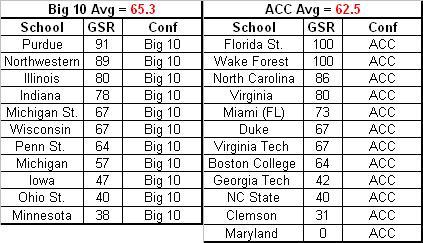
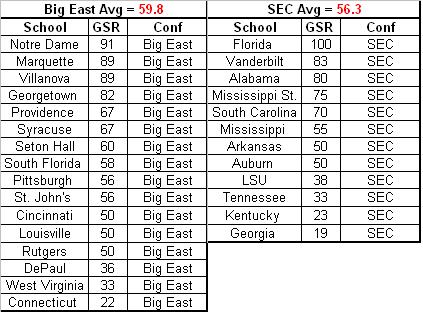
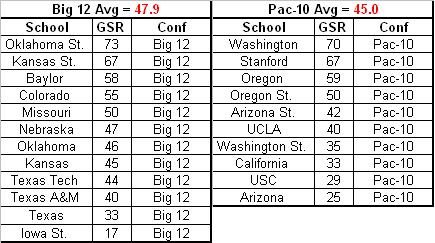
Yesterday the NCAA released its latest graduation rate figures for all D1 athletes who entered school in the classes of 1997-2000. Unlike the federally-mandated graduation rate, the GSR (Graduate Success Rate) is more realistic for athletes – it gives each player six years to complete his degree and it does not count transfer students against a school (reflecting the reality of athlete puddle-jumping for playing time in D1).

Here are the NCAA’s key findings:

The latest GSR figures show that 77 percent of student-athletes who began college from 1997-2000 graduated within six years. That four-year graduation rate is unchanged from last year’s data and up from 76 percent two years ago.

The Graduation Success Rate for men’s basketball rose from 55.8 percent in 1995 to 63.6 percent in 2000, a 7.8 percent increase. Football increased from 63.1 percent to 66.6 percent for teams competing in the Bowl Subdivision and from 62 percent to 64.7 percent for teams competing in the Championship Subdivision. Baseball increased from 65.3 percent to 67.3 percent.

Gary Williams chicken wing

Gary is Too Busy to Worry About Graduation Rates

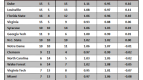
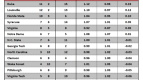
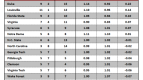
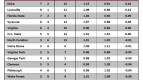
Since the NCAA doesn’t provide a sortable database of team information (or at least we can’t find it), we decided to quickly throw together some tables showing how the BCS schools performed in this cohort. Gary Williams should be especially proud of himself. Seriously, Gary, the best you can do with those Juan Dixon/Lonny Baxter teams is zero?!? Not even ONE player???

Big 10 + ACC GSRs 07

Big East + SEC GSRs 07

Big 12 + Pac-10 GSRs 07

Thoughts.

  • At the high end, Florida St. at 100% makes us wonder if any of these stats are credible. Then again, Florida is also at 100%, and these numbers are around 2000, so maybe there was a hanging chad issue or something. We’re also amazed that Eddie Sutton’s band of merry criminals men led the Big 12.
  • At the low end, Jim Calhoun at UConn, Lute Olson at Arizona, Tim Floyd/Larry Eustachy at Iowa St., Ron Jirsa/Jim Harrick at Georgia, and the seediest of all, Clem Haskins at Minnesota, join Gary Williams in the dregs of their respective conferences. What a list of slimy characters there.
  • The Pac-10 is surprisingly low, given that Stanford, Cal, UCLA and USC are all great schools. Especially Stanford – how can Mike Montgomery justify graduating only 2/3 of his players? Guess he doesn’t have to at this point – or does he? And the SEC is surprisingly high, with Alabama, the Mississippi schools and South Carolina doing well.

We may have more thoughts on this later, but we’re heading for the airport at the moment, so it’ll have to wait.

Share this story

Conference Challenges, Invitationals & Hardwood Series

Posted by rtmsf on September 27th, 2007

Now that schedules are out, we thought it was worth a quick look at the new so-called conference challenges that are set to begin this year. We already know about the ACC’s annual emasculation and disembowelment of the Big very small 10 Conference, but we will recap that one too while we’re on the topic.

Big East / SEC Invitational

Big East / SEC Invitational

The Big East, having played in this sort of made-for-tv event once before (the ACC/Big East Challenge from 1989-91 resulted in an evenly split 12-12 record), has decided that it wants to show its wares against the SEC these days. This is a noble pursuit inasmuch as the two leagues have equalized in power over the last 15 years, with the Big East falling and the SEC rising. The confounding problem with this event is that it only involves four games annually and ESPN determines the matchups. While at first blush we thought this might be a good thing – visions of UConn-Florida, Kentucky-Syracuse, Tennessee-Georgetown and LSU-Seton Hall were dancing through our heads (ok not so much on the last one) – but upon actual review of this year’s schedule, we have to wonder if this will be worth our time at all.

December 5 (Birmingham Jefferson Civic Center; Birmingham, Ala.)
7:00 p.m. West Virginia vs. Auburn – ESPN2
9:30 p.m. Georgetown vs. Alabama – ESPN

December 6 (The Wachovia Center; Philadelphia, Pa.)
7:00 p.m. South Carolina vs. Providence – ESPN2
9:30 p.m. LSU vs. Villanova – ESPN

Out of this group, we see what, maybe one or two NCAA Tournament teams (Georgetown and who? Villanova or WVU?). Sure, Bama losing Ronald Steele couldn’t be anticipated, but what’s up with choosing last year’s SEC bottom dwellers Auburn, LSU and South Carolina? Is the SEC willfully trying to lose these games?

Big 12 / Pac-10 Hardwood Series

So that brings us to the other new conference challenge, which is slated to pit the Big 12 and Pac-10 against each other. This challenge mimics the ACC-Big 10 version in that every team will participate, and some even twice (Arizona & Stanford this year). Also, teams will play at home arenas rather than neutral sites, which ultimately makes early-season games more exciting.

Thurs., Nov. 29, 2007
8:00 p.m. Oregon at Kansas State – ESPN2
10:00 p.m. Oklahoma at USC – FSN

Fri., Nov. 30, 2007
8:00 p.m. Washington State at Baylor – ESPNU
10:00 p.m. Iowa State at Oregon State – FSN

Sat., Dec. 1, 2007
4:30 p.m. Washington at Oklahoma State – ESPN
10:00 p.m. Missouri at California – FSN

Sun., Dec. 2, 2007
2:00 p.m. Arizona State at Nebraska – ESPNU
2:00 p.m. Stanford at Colorado – ESPN2
5:00 p.m. Texas A&M at Arizona – FSN

7:00 p.m. Texas at UCLA – FSN

Outside the 10-game series window:
7:oo p.m. Arizona at Kansas (Sun., Nov. 25) – ESPN
3:30 p.m. Stanford vs. Texas Tech (Sat., Dec. 22) – ESPN2

Now that’s more like it. There are seven legitimately good games in this group, and a couple of them are potential blockbusters (Texas-UCLA and Arizona-Kansas). Furthermore, this could go a long way toward improving the schedule strength of these two conferences, both of which have traditionally been lower among the BCS conferences.

ACC / Big 10 Challenge

ACC / Big Ten Challenge 2

And now for the annual event where the ACC has not only won but dominated the Big 10 for eight years running. 48 wins, 27 losses. This year should be no different. Even though the ACC is a little down from last season, the Big 10 is a lot down, and we see no more than four wins from our midwestern friends this year.

Monday, Nov. 26
7:00 p.m. Wake Forest at Iowa – ESPN2

Tuesday, Nov. 27
7:00 p.m. Georgia Tech at Indiana – ESPN
7:30 p.m. Minnesota at Florida State – ESPN2
7:00 p.m. Northwestern at Virginia – ESPNU

9:00 p.m. Wisconsin at Duke – ESPN
9:30 p.m. Purdue at Clemson – ESPN2

Wednesday, Nov. 28
7:00 p.m. N.C. State at Michigan State – ESPN
7:30 p.m. Illinois at Maryland – ESPN2
7:00 p.m. Boston College at Michigan – ESPNU
9:00 p.m. North Carolina at Ohio State – ESPN
9:30 p.m. Virginia Tech at Penn State – ESPN2

A couple of final thoughts on these conference challenges. We’d like to see more conferences get involved with this, even if only the top few teams in the mid-major conferences were playing other top teams. A Missouri Valley/WCC or CAA/A10 challenge would be really instructional for considering mid-majors in March – a little like BracketBusters but more comprehensive.

Additionally, it should be a really fun ten days after the Thanksgiving weekend settling in each night for these games. The Big East and SEC have got to give us some better matchups, though.

Share this story

Breaking Down the Preseason Mags…

Posted by rtmsf on September 12th, 2007

We’re heading into the middle of September already, literally thirty days until Midnight Madness, and the first batch of preseason mags are already proliferating on B&N shelves like West Virginians on crystal meth at a swap meet (no offense intended to the West Virginians not on crystal meth, of course). We know many of our readers are asking, “what’s a magazine?” To which we reply, “it’s what old people read while they’re on the toilet.” For our few readers here over 30 (present company excluded), we offer the first installment of our continuing series of reviews of the preseason magazines.

First in line: Athlon Sports.

Athlon Preseason Cover 07

I. Covers (5 pts) – are they cool? inclusive?

  • 34 regional covers seems like overkill, but we suppose having a Minnesota/Iowa/Iowa St. cover matters to someone.
  • Coolest Cover – for some reason, we particularly like the elated yet menacing look Patrick Beverly gives the camera on the Arkansas edition.
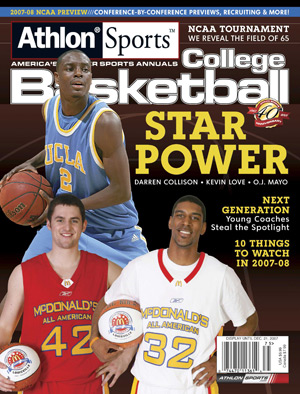
  • Say What? Athlon’s UCLA/USC cover (above) features Kevin Love and OJ Mayo in their Burger Boy unis – was it really too much trouble to shoot them with their correct jerseys on?
  • Total Points = 4

II. Ease of Use (5 pts) – how hard is it to find confs/teams?

  • Conferences and teams are arranged alphabetically, allowing for quick navigation assuming you know your conference.
  • Standard format otherwise – features & predictions; analysis of teams; recruiting, in that order.
  • Total Points = 4

III. Roundup (10 pts) – every mag has one – tell us something new!

  • 10 Things to Watch is ok, but we didn’t learn anything new (i.e., the Pac-10 is great, keep an eye on Love/Mayo/Gordon, etc.).
  • Hoops Madness is a little better, mostly because of its lists of emerging stars (hot sophs to watch), top transfers and coaches on the hot seat. Also enjoyed learning that Dayton’s band has become the band by proxy for the Niagara Purple Aces (since NU doesn’t have one).
  • Cool Stat Award. Memo to Adam Lonon (VMI) – shoot more! (31 starts, 26 FGs)
  • Total Points = 5

IV. Features (15 pts) – give us some insightful and unique storylines.

  • Next Generation is a decent article about the young brigade of coaches who have been successful so far (Donovan, Matta, JT3, Howland, etc.). It wasn’t unique, as we expect to see a lot of this in the rags this year.
  • The Fix relates the story of the Tulane pointshaving scandal two decades ago. Although the article briefly mentions the Tim Donaghy story, it focuses primarily (and misguidedly) on the people involved in the scandal. What we needed to see here was an article about the existence of gambling among college athletes and efforts to prevent it. Big swing & miss here.
  • The Scoop is three one-page interviews with Ronald Steele (Alabama), Bill Walker (Kansas St.) and Drew Neitzel (Michigan St.), none of which are very interesting.
  • Total Points = 5

V. Predictions (20 pts) – how safe are their picks? do they take any chances? are they biased toward the big boys?

  • Athlon uses the 65-team prediction model, eschewing the traditional Top 25 (they get pts for that). But Athlon goes waaaaaaaaay safe by predicting six of the elite eight the same as 2007 (Georgetown, Kansas, Memphis, UNC, Oregon, UCLA with Louisville and Tennessee added for good measure). UCLA defeats Carolina in the championship.
  • Big Conference Bias. 15 of its Sweet 16 are from BCS conferences – highly doubtful and incredibly LAME! NCAA Bids – ACC (5), Big Ten (5), Big 12 (5), Big East (9), Pac-10 (7), SEC (6).
  • Mid-Major Watch. Only Memphis from a mid-major conference (CUSA) into the Sweet 16. Mid-Major bids – 2 CAA (George Mason, VCU), 2 MVC (Bradley, S. Illinois), 1 A10 (Xavier), 1 Mountain West (BYU), 1 WAC (Nevada). We’ll bet anything Athlon’s editors choose that those six conferences will get more than eight bids next March.
  • All-Americans. Athlon really likes Drew Neitzel for some reason. He joins Psycho T, Chris Lofton, Roy Hibbert and Darren Collison (?) on their first team. They took a big flier on putting oft-injured Ronald Steele on the third team.
  • Boldest Prediction. It’s sad that we had to dig this deep to find it, but it’s probably their pick for Cornell to win the Ivy League over Penn & Princeton. The last time a team other than those two won the Ivy Championship was in 1988 with (guess who?) Cornell.
  • Total Points = 10

VI. Conference Pages (5 pts) – as a primer for the conference, how much can we learn here?

  • The major conferences get a predicted order of finish, a brief recruiting roundup, and three teams of all-conference selections plus a “superlatives” section, which is fairly weak compared to others we’ve seen (POY, DPOY, most underrated, newcomer).
  • The mid-major and small conferences only get a predicted order of finish, one team of all-conference selections and an all-time NCAA Tourney stat for the conference (which is interesting).
  • Total Points = 2.5

VII. Team Pages (20 pts) – how in-depth is the analysis? where does it come from? is it timely and insightful given this year’s squad or is it just a rundown of last year’s achievements?

  • All major conference and projected mid-major NCAA Tournament teams get a full page of analysis, including evaluations of the frontcourt and backcourt as well as a team roster (w/ stats) and a team-oriented stat.
  • Non-NCAA Tournament mid-majors and low majors get at most a half-page analysis and roster, but most only get a paragraph with a very brief synopsis.
  • Clearly much of the analysis is based on what coach’s interviews, which results in analyses from “glass half full” perspective. We would have liked to have seen more contrarian viewpoints.
  • The depth of analysis is solid if not spectacular for the major conference teams, but largely lacking for the others.
  • Total Points = 14

VIII. Recruiting (5 pts) – we want to know who the top players are coming into college bball, where they’re going and who to watch for next year.

  • Four pages of recruiting information, including the top 100 (Scout.com) of 2007, the next 200 players, and the top 20 by position. Solid raw data.
  • It also includes the top 25 classes, but only as a list, with no additional details.
  • The top 100 in the class of 2008, top 25 in 2009 and top 10 in 2010 are also listed.
  • Total Points = 3

IX. Title IX Guilt (aka Chick Ball) (5 pts) – the less the better…

  • Only two pages worth, and at the very back of the magazine.
  • Total Points = 5

X. Intangibles (15 pts) – what’s good and bad about the magazine as a whole?

  • In the past, Athlon’s mag hasn’t always looked as professional as some of the others. This is no longer the case. Its layout looks great, the photos and graphics are solid, and the writing has improved.
  • Because it comes out so early, the advantage it gains in being one of the first published is mitigated by other temporal factors. Most notably, there are no schedules within the magazine – for that reason alone, Athlon cannot be your “go-to” preview issue during the season.
  • Additionally, its early publish date means that it misses late summer news involving injuries, transfers and coaching changes. While they did get the Skip Prosser news in there, they did not, for example, consider how Andy Rautins’ knee injury will impact Syracuse.
  • As a nontraditional magazine (i.e., not Street & Smith or TSN), Athlon should have taken more risks with their predictions – going all chalk won’t separate it from the pack.
  • Total Points = 8

RTC Grade for Athlon = 60.5 pts

Basis: Athlon is on the lower side of quality with the preseason magazines, but they have gotten better, and there is some value in their analysis. Its best use (given its early arrival on the newstand) is simply to refamiliarize yourself with the names and faces of the upcoming season. We wouldn’t recognize purchasing it unless you simply cannot wait for the better ones to come out.

Grading Scale:

  • 90-100 pts – exceptional quality in all areas – must buy and keep on-hand all season!
  • 80-89 pts – very good quality mag – worthy of purchasing and reading cover-to-cover
  • 70-79 pts – average, run of the mill magazine – some value in certain areas but weak in others – tough call as to whether to purchase it
  • 60-69 pts – magazine on the weaker side, but may still have some positive attributes – probably not worth the money, though
  • 0-59 pts – such a low quality magazine that it’s not worth any more than the five minutes you thumbed through it at the store
Share this story

2007 Athlademic Ratings – Revised

Posted by rtmsf on September 5th, 2007

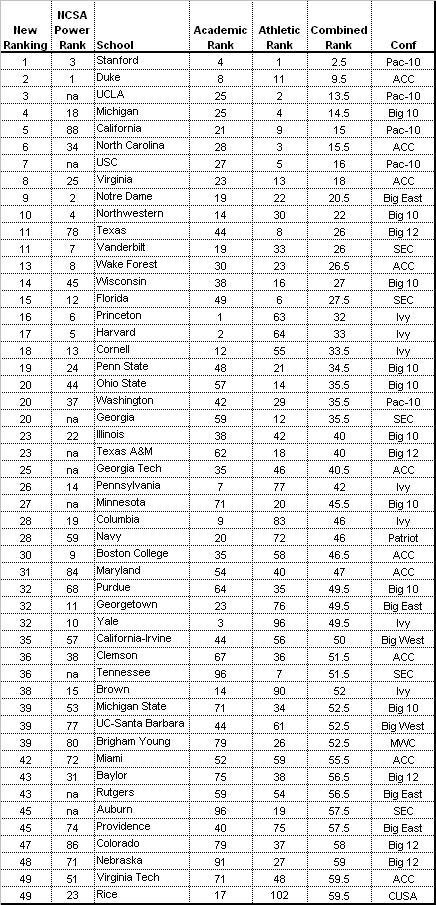
Ok, so thanks to an insightful UCLA fan, we realized that our exuberant reliance on NCSA data to justify our Athlademic Rankings posted last week was giving them way too much credit for properly vetting their data.  So to make sure we get it right this time, we spent the better part of today going through the 2007-08 US News rankings and the 2006-07 Sears Cup rankings ourselves.  Here’s the revised list, in Table A

Table A.  Athlademic Ratings – Division I (revised)

NCSA Revised Rankings

New Arrivals.  In addition to UCLA and USC, we also see the inclusion of Georgia, Texas A&M, Georgia Tech, Minnesota, Tennessee, Rutgers and Auburn onto our list – all driven by strong athletic programs.  High academic schools with relatively weak athletic programs, such as Army, William & Mary and Dartmouth, fell out of the top 50 due to the addition of the above programs. 

Ivy League logo

The Ivies strike a Nice Balance in Athlademics 

Ivy League Balance.   Speaking of Dartmouth, Keggy the Keg and friends are the only Ivy League school that didn’t make our Top 50.  The other seven did, with Princeton (no surprise there) leading the way at #16 overall.  Granted, the high academics of the schools drives their inclusion here, but we shouldn’t discount that these schools rate above many larger BCS schools in terms of the success of its athletic programs.  Cornell has the 55th most successful athletic program, but there are 73 BCS schools, which means Cornell, Princeton (#63) and Harvard‘s (#64) athletic programs  are outperforming bigger state schools such as Kansas (#66), Iowa (#68), and Connecticut (#82).

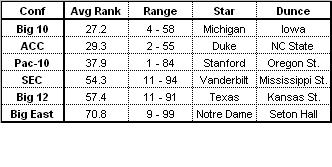
Big 10 – ACC Challenge.    As in, the Big 10 and ACC challenge the rest of the BCS conferences to keep up with it when it comes to athlademics.  We rated all 73 BCS conference schools, keeping those ahead of them in place, and Table B below shows the results. 

Table B.  BCS Conference Athlademic Ratings

 Conf Ratings

Why is the Big East so bad?  There’s a pretty clear top tier of Big 10, ACC and Pac-10, a middle tier of the SEC and Big 12, and a bottom tier, where the Big East lurks like Gollum all by itself.  The Big East really gets killed on both sides of the equation – it has seven (of 16) third-tier academic schools, as rated by US News (more than the other 5 conferences combined); and seven schools that finished outside of the top 100 in the Sears Cup (Mississippi St. and Kansas St. are the only other two in BCS conferences).  This includes the dubious case of Seton Hall, who was the only BCS conference school of the 73 to not score a single point in the Sears Cup competition for 2006-07.  How is that possible?? 

Seton Hall

Days Long Since Gone at The Hall

Haves and Have-Nots.  The Pac-10 is the greatest example of bifurcation within a conference.  It has five of the top twenty athlademic programs in America (Stanford, UCLA, USC, Cal, Washington), but it also only has five of the top fifty programs – its next highest ranked school is Arizona at #51.  Compare this with the Big 10, who has nine of its eleven members ranked in the top forty, with only Indiana (#53) and Iowa (#58) weighing it down.  Conversely, the Big 12 only has two of its twelve schools ranked in the top forty – Texas (#11) and Texas A&M (#23). 

Non-BCS Stars.  We already mentioned the Ivies, whose eight schools average a 29.9 rating on our list.  But who else steps up to challenge the BCS big boys as an athlademic school?  The Naval Academy (#28) and a couple of the smaller UCs (Irvine (#35) & Santa Barbara (#39)) lead the way.  One surprise inclusion is our Mormon friends at BYU, who used a strong athletic showing to come in at 39th on our list. 

You can do Better.  Not to harp on anyone in particular, but it makes no sense to us that football (read: revenue) schools like Cincinnati (#196 in the Sears Cup), South Florida (#133), Mississippi St. (#120), Kansas St. (#111) and Syracuse (#110) can’t do any better with their overall athletic programs.  Let’s throw in Villanova (#132) and Marquette (#127) for good measure – both schools are wealthy private Catholic institutions, which means they have the resources to spread around the non-revenue sports.  So what’s their excuse? 

Share this story

NCAA Tournament Success in the 65 (64) Team Era by Conference

Posted by rtmsf on July 7th, 2007

Hope everyone had a great 4th of July holiday… although we gotta say this midweek holiday thing kinda sucks. Give us the three-day (or four!) day weekend instead.

Anyway, we’re now ready to unveil the conference follow-up to our June analysis of the Top NCAA Performers of the 65 (64) Team Era. Once again, we’re going to take several different views of the world here. Today we’ll just look at the raw statistics and make some obvious insightful observations. In the next post, we’ll take a look at how conferences have performed versus its seeds during this era, and whether we can draw any broad conclusions from the data about overachieving and underachieving conferences.

Conference

What Kind of Conference is This?

A couple of notes before rolling out the data. First, with only one notable exception, we counted a team’s performance in a given year toward the totals of its conference at the time. For example, Louisville’s 1986 national title counts toward the Metro Conference totals (the Metro disbanded in 1995), not the Big East totals. The notable exception is that all Big 8 totals were subsumed into the new Big 12 conference, since every member of the Big 8 ultimately became Big 12 members. See Table A below.

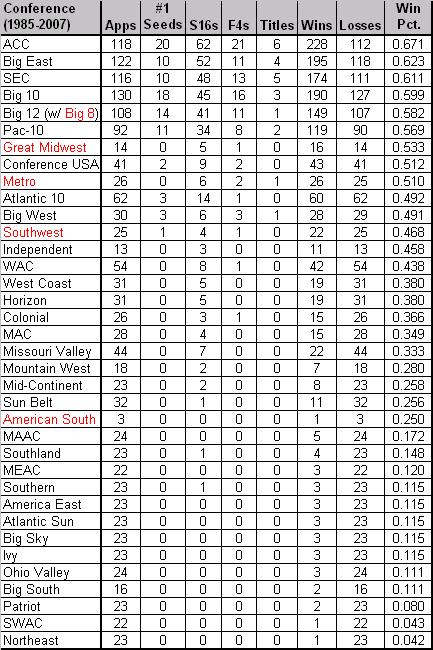
Table A. NCAA Tournament Success by Conference (1985-2007)

Notes: this table is sorted by winning percentage. The conferences whose names are in red are conferences that no longer exist.
NCAA Tournament Conferences v.5

BCS Conferences. This won’t surprise anyone, but we wanted to show the numbers in context. The following represents the percentage of each category achieved by the six BCS conferences from 1985-2007.

  • 46.4% of all NCAA Appearances
  • 60.9% Winning Percentage
  • 72.5% of all Wins
  • 76.6% of all Sweet 16s
  • 87.0% of all Final 4s
  • 90.2% of all #1 Seeds
  • 91.3% of all Titles

If you’re writing a paper on the correlation between resources, exposure, talent and success in NCAA basketball, the above numbers should be included in your first paragraph. It matters.

Best in Show

Best in Show?

Best in Show. Over this 23-year period, there can be no question that the ACC has been the strongest performer in the NCAA Tournament. This conference leads in every objective category except for appearances, which actually makes their hard numbers with respect to S16s, F4s and Titles look even more impressive. The most shocking finding for us regarding the ACC’s success was that more than half (52.5%) of its participants during this era won at least two games (i.e., made the Sweet 16). This is phenomenal, especially considering that the next-best major conference is the Big East at 42.6%. Of course, when you’re winning greater than two-thirds of your games as a conference, then it shouldn’t be that surprising.

Next Best. From our view, the next tier of conferences include the Big East, SEC and Big Ten – you can pretty much throw them all in a pot and pick any of the three as second behind the ACC. The Big East leads in S16s and winning percentage; the SEC leads in titles and mostly has middle-of-the-pack numbers otherwise; and the Big Ten leads in appearances and F4s. We rate the Big 12 slightly below this group because there seems to be a drop in most categories from the above three, most notably in winning percentage and titles (ouch – only one). But the Pac-10 clearly performs worst over this era, earning the fewest bids, having the worst winning percentage and owning by far the least wins, S16s and F4s.

Mid-Majors. From the numbers, we only recognize four true mid-major conferences during this period – the Metro/Great Midwest/CUSA and WAC/Mountain West hybrids, the Atlantic 10 and the Missouri Valley. What’s interesting is that only the Metro/GM/CUSA teams have a winning record during this period, while of course all of the BCS conferences easily have winning records. This shows once again just how large of a disparity there is between the three levels of college basketball. Remember when during the mid-90s, the A10 was supposedly overtaking the Big East in talent and performance? – the lesson here is to not believe the hype. Within that group, Metro/GM/CUSA has had the most success, led by Louisville, Cincinnati and Memphis. Now that two of those three are in the Big East, we don’t expect CUSA’s success to continue. We were also a little surprised at how low both The Valley and the Mountain West performed here – they have poor winning percentages and the Mountain West in particular has only put two teams (of 18 bids) into the Sweet Sixteen since its inception in 2000 – pathetic for an annual multi-bid league.
Tarkanian

Tark Has This Effect on Everyone

UNLV and Gonzaga Effect. The Big West and West Coast Conference exhibit how one very successful school can make a league look better than it actually is. By the numbers, the Big West looks like a mid-major league, but when broken down further, you quickly realize that the Rebels account for 21 of the conference’s 28 wins over this period. Excluding UNLV, the Big West is only 7-23 (.233) in the NCAA Tournament, which would put it on par with the Sun Belt and the Mid-Continent. The same is true with the WCC – when Gonzaga is excluded, the league is 7-21 (.250) during this period.
NEC

Stay Away from the NEC if you Want to Win in the NCAA Tournament

Low Majors. Picking a best conference among the low majors is a little like picking the prettiest ugly girl in the bar (not that we know anything about that, mind you), but if we have to choose, we’ll take the Southland Conference (note: we consider the conferences on the list above between the Great Midwest and the Sun Belt mid-majors, although the Sun Belt’s one S16 appearance with 32 bids is strong evidence that we might be giving that league too much credit). We choose the Southland because it’s one of only two of these conferences to put a team into the Sweet 16 (Karl Malone’s Louisiana Tech in 1985), and it has a better winning percentage than the others. We realize, of course, that all of these low majors are virtually equal in their NCAA ineptitude – only the Ohio Valley and the MAAC have ever received at-large bids (1987 – Middle Tennessee St.; 1995 – Manhattan) – but that’s our pick here. Our vote for the worst conference in D1 is a tie – the SWAC and the Northeast Conference. Each has the unenviable distinction of only winning one game in the NCAA Tournament during this period. Of course, maybe we’re looking at this the wrong way, and instead we should be celebrating the fact that every single conference has managed to win a game in the Dance during this period.

Final Thoughts. Can anyone catch the ACC? The Big East has a chance to tally significant gains if it continues to put eight teams into the NCAAs, as it did in 2006. But numbers alone probably isn’t enough – after all, the Big 10 has put the most teams in the Tournament since 1985. Rather, the ACC gives the obvious recipe for success by having two dominant programs that over the long haul consistently go deep into the NCAA Tournament (Duke and Carolina). Looking ahead, the Big East has an aging Calhoun at UConn and Boeheim at Syracuse so we’re not sure about its prospects. The Big 10 has Thad Matta the Recruiting Machine at OSU, but Michigan St. has regressed in recent years, and who else can rise up (Weber at Illinois? Beilein at Michigan? Tubby at Minnesota?). We’ll keep looking. The Pac-10 has an obvious supernova developing in Westwood at UCLA, but where else? Arizona will be in what kind of shape after Lute retires? Our choice for the conference to challenge the ACC in the next decade is the SEC. Billy Donovan at Florida has already proved his mettle; and with Billy Gillispie at Kentucky and Bruce Pearl at Tennessee challenging anyone to outwork them, it almost makes up for the coaching lightweights over in the SEC West (you know who we’re talking about). The youthful exuberance of these coaches at several programs willing to put forth the resources for success may give the SEC the best shot at catching the ACC, but the truth will ultimately lie in what happens to Duke after Coach K retires. If Duke manages to keep its dominance intact with their next coach, then it won’t much matter what happens with the other conferences – they’re not going to catch the ACC.

Coming Next: a look at how conferences overachieve and/or underachieve relative to their seeds over the years. Should be interesting stuff. Check back early next week.

Share this story

2007 NBA Draft Musings

Posted by rtmsf on June 29th, 2007

Note:  If you’re looking for the 2008 NBA Draft Musings, look here. 
Some post-apocalyptic draft thoughts for your Friday, as we settle into a long summer of waiting for something to happen…

Oden

Championship or Bust in Portland?

  • One and Dones. These players acquitted themselves quite well in this year’s draft, which means they were getting good information from their schools and representatives. Greg Oden, Kevin Durant, Mike Conley, Jr., Brandan Wright, Spencer Hawes and Thaddeus Young were six of the top twelve players taken. Not coincidentally, five of those were among the top seven seniors of the Class of 2006, according to Rivals (Chase Budinger of Arizona was the lone holdout returning to school, and Conley was rated #18). Javaris Crittenton and Daequan Cook were also selected in the first round, meaning that every college freshman who declared was taken this year. Although it’s arguable whether the one-and-done system worked for college basketball (Ohio State – yes; Washington – no), we assert from a player perspective that it helped them exponentially in terms of marketability and readiness to perform at the next level. Every sports fan in America now knows who Greg Oden and Kevin Durant are – that wouldn’t have been the case prior the one-and-done rule.
  • Gator Rule. As we alluded to yesterday, the Florida Gators were set to greatly increase its all-time count of draft picks last night, and they did so with a flourish (see Joakim Noah‘s getup below), increasing its total from 10 to 15 overnight. Florida’s five entries into the NBA last night – Al Horford, Corey Brewer (who looked like the happiest man alive), Noah, Chris Richard (we figured he’d get a look), and Taurean Green – ties UConn for the most draft picks in one year. What, no Lee Humphrey?!?! The Huskies also entered five in 2006. One question, though. Where was Billy Donovan during this celebration of Pax Floridana? Maybe Christine hasn’t let him out of the house yet.

Joakim Noah Suit

Love the Seersucker, Jo

  • Conference Breakdown. The BCS conferences accounted for 39 of the 60 picks last night. The ACC (9 total; 6 first rounders) led the way, with the SEC close behind (8/3); the Big 10 (6/4), Pac-10 (6/4) and Big East (6/2) each showed moderate success, while the Big 12 fell behind the others (4/3). Considering that there were thirteen international players selected, that left only eight picks for the mid-majors. The highest mid-major player selected was Rodney Stuckey from Eastern Washington at #15; although Nevada also placed two players in the second round (Nick Fazekas and Ramon Sessions).
  • Dumb Declarations. By our count, only four players from D1 schools who stayed in the draft as an early entry candidate were not selected this year (most notably, Shagari Alleyne, formerly of Kentucky). This shows again that players are improving at determining their real value (vs. perceived inflated value) before making the decision to jump.

“Why Didn’t I Go Pro Last Year????”

  • A Year Late, A Dollar Short. Three players from big-name schools were probably kicking themselves for not leaving school early last year, when their weaknesses weren’t as exposed to the scouts. Duke’s Josh McRoberts (offensive skills), LSU’s Glen “Big Baby” Davis (weight issues) and Arizona’s Marcus Williams (headcase) all would have been much higher picks last year. Now each must battle for scraps as second-round selections this time around.
  • Parlez vous français? We always hate to see guys who put in their four years at college and were pretty good players, only to get passed over in the draft for Pau Gasol’s little brother. So a special shout-out goes to Zabian Dowdell (Virginia Tech), JR Reynolds (Virginia), Curtis Sumpter (Villanova), Mario Boggan (Oklahoma St.), Ekene Ibekwe (Maryland) , Brandon Heath (San Diego St.), Ron Lewis (Ohio St.) and Kyle Visser (Wake Forest) for providing wholesome collegiate entertainment over the last half-decade. We were tempted to also include Mustafa Shakur (Arizona) here, but he seemed to disappoint more than inspire during his tenure in Tucson.

SLAM Oden & Durant

Oden Wins Championships; Durant Wins Scoring Titles.

  • Final Thought. Oden vs. Durant was endlessly debated all season long. While we have to agree that we enjoy watching Durant play far more than Oden, that belies our bias against watching post men in favor of perimeter players in general. Still, Oden is the kind of player that championship teams are built around, and the Durants of history are comparitively light in the hardware department. We saw this played out in this year’s NCAA Tournament, where Oden’s team went to the national finals, and Durant’s squad was out (embarrassingly) in the second round. Either way, we wish the best of luck to both of them, as they made college basketball a more interesting game for the year they spent with us.
Share this story

The West Side is the Best Side…

Posted by rtmsf on June 9th, 2007

2Pac

2Pac was right after all

Quite a bit was made last season of a renaissance in the quality of basketball in the Pac-10 conference, as it ended the season as a top three conference in both the RPI and Sagarin ratings in addition to earning a record six NCAA bids for the conference and enjoying the prestige as the only conference with multiple teams in the Elite Eight (Oregon and UCLA). There has always been a surplus of talent on the west coast, especially in the Seattle and SoCal areas, but it was largely characterized by players opting to play for an eastern school just as often as staying home to play for State U. This has been changing over the last five years, however, as new coaches such as Lorenzo Romar at Washington, Tim Floyd at USC, Tony Bennett at Wazzu and Ben Howland at UCLA have endeavored and succeeded in keeping as many of those talents as possible close to home. This is no more evident than in some of the recruiting wars over the last couple of years that resulted in top ten players such as Spencer Hawes (Washington), twins Brook & Robin Lopez (Stanford), Kevin Love (UCLA) and Brandon Jennings (Arizona) signing to play in the Pac-10 (notable exception: Lake Oswego’s (OR) Kyle Singler to Duke).

Steve Lavin

Lavin’s former conference is on the rise

Still, we were a little surprised when Rivals released its top ten players at each position for the 2007-08 season, and the Pac-10 claimed by far the most players, with thirteen of the top fifty. This is especially remarkable given that the league is losing all-conference performers Arron Afflalo (UCLA), Aaron Brooks (Oregon), Marcus Williams (Arizona) and Nick Young (USC) to the NBA next season, while it welcomes likely top fifty players Kevin Love and OJ Mayo (USC) to the league. With talent like this staying on the west coast, we should expect another great season from the Pac-10 conference next year. Somewhere Steve Lavin’s hair gel is celebrating.

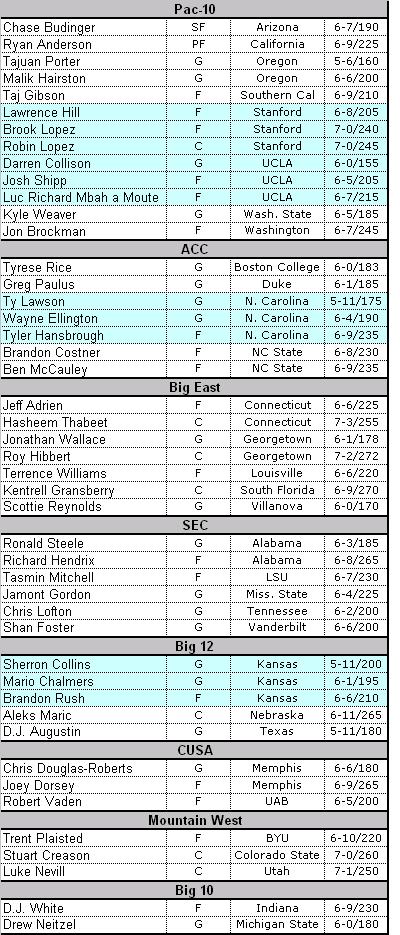
The ACC and Big East have seven players each on the list; the SEC has six, and the the Big 12 has five of the top fifty players. The Mountain West and Conference USA both have three of the top fifty, outperforming the Big 10 (again), who only has two. The Colonial (Eric Maynor – VCU), Horizon (AJ Graves – Butler), Missouri Valley (Randal Falker – S. Illinois) and Southern (Stephen Curry – Davidson) conferences each have one top fifty player returning. Below is the list including multiple-player conferences:

Rivals 2007-08 Top 50 Players

You probably noticed that we shaded the teams with three top fifty players returning next season – Stanford, UCLA, UNC, Kansas. It’s certainly no coincidence that three of those will begin next year in the top five of the polls, and the fourth, Stanford, will probably be knocking on the door of the top ten.

Thoughts –

  • Where is all the Big Ten talent? Having less players on this list than CUSA and the Mountain West is cause for alarm, and helps to explain why only one Big Ten team played into the second weekend of the NCAA Tournament last season. Where are the usual stables of talent at Michigan State and Illinois? Aside from the yeoman’s work that Matta is putting into recruting at OSU, the rest of the Big Ten has signed only two top thirty prospects during the last three recruiting cycles – Joe Krabbenhoft of Wisconsin in 2005, and Eric Gordon of Indiana in 2007. An influx of coaching talent has entered the league (Tubby Smith at Minnesota and Kelvin Sampson at Indiana), but without the players to accompany those moves, the Big Ten is going nowhere fast.
  • Nitpicks. We probably would have found a place for the following players: Derrick Low (Washington St.), Edgar Sosa (Louisville), Jerel McNeal (Marquette), and Patrick Beverley (Arkansas). Expect each of these players to be all-conference performers in their respective leagues next season. We also have a sneaky feeling that guys like DaJuan Summers (Georgetown), Deon Thompson (UNC), Derrick Caracter (Louisville) and JaJuan Smith (Tennessee) will make a solid case to be on this list next season.
  • Surprises. NC State’s future looks bright with two young big men, Brandon Costner and Ben McCauley, returning for Sidney Lowe’s team. Alabama should be much improved next year as well, assuming Ronald Steele gets healthy (he was on many preseason all-american teams last year but struggled with tendinitis and ankle injuries that largely derailed Bama’s season). Apologies to the Mountain West, but who are Stuart Creason and Luke Nevill? Their inclusion on this list shows that the depth of talent at the center position in the college game is ridiculously thin.
  • Instant Impact Players in 2007-08. This list next season will be populated by the likes of OJ Mayo, Eric Gordon, Kevin Love, Michael Beasley (Kansas St.), Derrick Rose (Memphis) and Anthony Randolph (LSU).
Share this story

Early Entries: Who has been hit hardest?

Posted by rtmsf on April 29th, 2007

NBA Draft

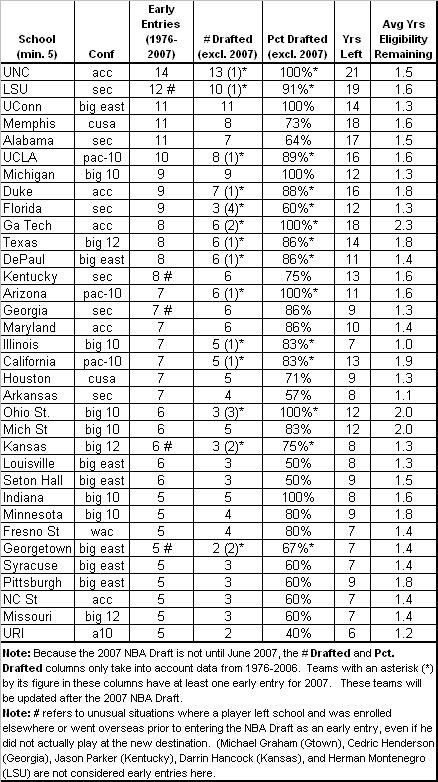
With the early entry deadline now behind us, we got to thinking about what schools and conferences have been hit the hardest over the years in terms of losing guys early to the NBA draft. We already know, for example, that Florida is set to lose four underclassmen one year early (Noah, Horford, Green and Brewer), and that North Carolina may be preseason #1 next year thanks to its good fortune in keeping Lawson, Ellington and Hansbrough around for another year. We reviewed the early entry lists from 1976, the first year after the NBA eliminated its “hardship” application process, to 2007, and here is what we found:

Note: conference stats include all teams currently within that conference (e.g., Texas & Kansas includes stats from both the Big 12 and Big 8 eras).

Early Entries by Univ 1976-2007

Who has been hit the hardest? From our view the ACC and SEC have taken the brunt of early entry punishment over the past thirty years. Six SEC schools – LSU, Alabama, Kentucky, Florida, Georgia, and Arkansas – have lost a combined 54 players to the NBA over the years – nearly ten per team. North Carolina, Duke, Maryland and Georgia Tech have been similarly afflicted, having lost 38 players early to the NBA over the same period. Read the rest of this entry »

Share this story