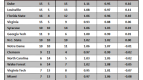
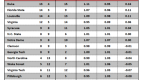
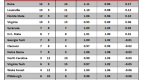
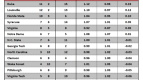
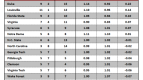
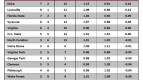
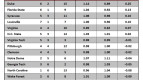
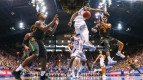
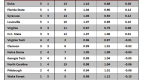
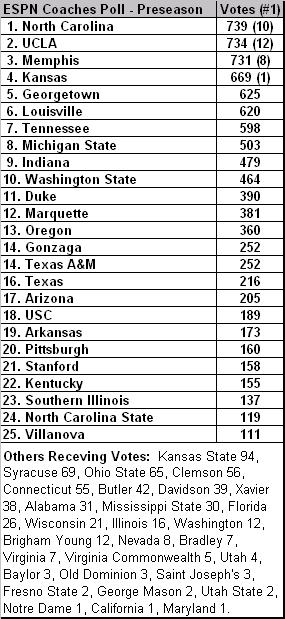
UNC is #1, yet UCLA garnered more first-place votes (12-10).
9 of the top 10 match the online Blogpoll – the one difference is that coaches like Indiana more than Marquette. Fwiw, so do we. (come on blogpollers! We should represent the non-MSM contrarian voice!)
Did the coaches go with the “name” programs over Calipari’s squad at #1? Interesting that the bloggers voted Memphis a solid #1 while UNC/UCLA were left behind.
Only one coach agreed with us that Kansas is preseason #1 (Bill Self?), although we aren’t predicting KU to win it all.
Buy:Oregon (mighty mite Tajuan Porter!), Gonzaga (magic mushroomania), Texas (hey mr. DJ put that record on…), S. Illinois (you sexy mother Falker!), Davidson (spicy Curry), VCU (Eric Maynor alone is worth more than five votes).
Sell:Duke (anxiously awaiting the Brian Zoubek experiment), USC (Young+Pruitt > Mayo+Jefferson), NC State (folks, they were 5-11 in the ACC last year!!), Alabama (no Steele = no chance).
Conference breakdown (top 25, all 54 teams receiving votes): Pac-10 (6, 8), Big East (5, 8), ACC (3, 6), Big 12 (3, 5), SEC (3, 6), Big 10 (2, 5), MVC (1, 2), CUSA (1, 1), WCC (1, 1), Colonial (0, 3), WAC (0, 3), A10 (0, 2), Mountain West (0, 2), Horizon (0, 1), Southern (0, 1).
Word to the Colonial and WAC with three teams each receiving votes even though none are in the Top 25.
Is there any value in this meaningless poll whatsoever? Some. Last year the top 6 (and 8 of the top 10) in the preseason coaches poll finished in the top 11 of the final poll (before the NCAA Tournament), and every team in the final top 11 had been ranked somewhere in the top 25 before the season started. Additionally, all four F4 teams were ranked in last year’s preseason top 8 (#1 Florida, #4 Ohio St., #5 UCLA, #8 Georgetown).
Only six of the preseason top 25 last year didn’t make the NCAA Tournament (#7 LSU, #12 Alabama, #16 Washington, #18 Connecticut, #20 Syracuse, #23 Creighton), so that’s fair evidence that the coaches (at least last year) have a bit of a clue. Note we said only a bit.
WYN2K. The Sun Belt is a league that has seen better days in the eyes of the basketball world. In the 80s and early 90s, the conference was a top ten league that regularly sent multiple teams to the NCAA Tournament (10 times from 1980-95), peaking at four bids in 1986. Since 1995, however, the league has been exclusively a one-bid conference, as its corresponding seed average has dropped from a #10.9 (1985 to present), to a #12.6 (1995 to present), to a #13.8 seed in the last five years. In other words, the Sun Belt is trending downward (and league officials know it). What was once a proud mid-major league is now clearly a low-major (albeit near the top of that heap), despite its relatively robust 167-208 (.445) record against OOC opponents in the last three years. Some of this may be attributable to a loss of league identity, as the conference expanded away from its mid-South roots and has swelled to thirteen schools that span three time zones in locations that often have very little in common with each other (i.e., Boca Raton, FL, Bowling Green, KY, and Denver, CO).
Predicted Champion.Western Kentucky (#13 seed NCAA). Darrin Horn’s Hilltoppers have been a bit of a hard luck team over the past few seasons, averaging 20.5 wins over his four year tenure and winning one regular season championship, but having no NCAA appearances to show for it. Guards Courtney Lee, Tyrone Brazelton and TyRogers comprise a returning perimeter corps that is among the most experienced and talented in the league, and three other significant contributors return from a 22-11 (12-6) team. If WKU is to slip up, it will probably be because of its sometimes porous defense that has a tendency to give up easy baskets (allowing an eFG% of 52.6% – #272 nationally) and foul a lot (43.2 FTAs given up per game – #284 nationally). We believe this is the year that the Toppers get it done. Check the nasty follow dunk from C-Lee below.
Others Considered. Should WKU falter, the next best teams we see are Louisiana-Monroe and Florida Atlantic. Monroe returns all five starters from an 11-7 team that lost in overtime in the conference finals against North Texas last year. They were nearly unbeatable at home (14-0) and seemed to win all the close games (5-0 in games decided by <6 pts in conference) last year. Because of this, they were considered one of the “luckiest” teams in America last year (#10 via Pomeroy), earning 2.7 wins more than expected by their overall profile. Notwithstanding their luck, we’re just not comfortable picking a team that has nobody taller than 6’8 on their roster. Florida Atlantic is another team that returns substantial experience including the league’s best big man Carlos Monroe, a burly 6’8, 245 lb. beast who shot nearly 60% from the field and pulled down over a quarter (25.8%, #18 nationally) of his team’s defensive boards last year. The Owls also finished strong, winning six of their last seven games and pestering WKU in a tough quarterfinal matchup in the conference tourney before bowing out. New Orleans is also intriguing simply because the Privateers have a new coach in former Cal assistant and Bob Knight disciple Joe Pasternack, but they also have the league’s best player in Bo McCalebb, a Wooden Award candidate who averaged mind-numbing numbers last year (25 ppg, 6.8 rpg, 3.3 apg, 2.0 spg). Did we mention that he was the team’s leading rebounder as a 6’0 guard? There are three other starters returning from a 9-9 team that was #4 nationally in 3fg% (41.4%), #5 nationally in stl% (7.1%) and #11 nationally in to% (17.0%). The Privateers shoot well, take care of the ball, and have a fantastic player – if any team was going to make a huge improvement with a new coach, it would be this team. Quick note: last year’s regular season and tourney champs simply lost too much to be considered as a contender this year – South Alabama lost three starters and its head coach, John Pelphrey, while North Texas lost its top two scorers.
Games to Watch. The top of this league should be exciting to watch this year, as there are several excellent players (Courtney Lee, Bo McCalebb, Carlos Monroe) who could singlehandedly influence the conference race. With the unbalanced schedule in this league, New Orleans appears to be the most likely beneficiary (only three games against the other three, two at home).
RPI Booster Games. Given its location (spanning 2000+ miles from Denver to Miami), the Sun Belt takes on a full complement of SEC and Big 12 teams every year. Last year the league was 2-30 (.063) against BCS teams (WKU 70, Georgia 67; Ark-Little Rock 67, Minnesota 66), and there are a similar amount of games scheduled this year. Here are some highlights.
Louisiana-Monroe @ Kansas (11.09.07)
Florida Atlantic @ Boston College (11.12.07)
South Alabama @ Mississippi (11.13.07)
New Orleans @ NC State (11.18.07)
WKU @ Gonzaga (11.22.07)
Nebraska @ WKU (12.05.07)
Middle Tennessee St. @ Memphis (12.05.07)
Mississippi St. @ South Alabama (12.15.07)
WKU @ Southern Illinois (12.22.07)
Louisiana-Monroe @ Arkansas (12.29.07)
Odds of Multiple NCAA Bids. We’re a long way removed from the Sun Belt’s glory years, so none this year.
Neat-o Stat. Joe Scott is returning to Colorado to take over as head coach at Denver, just a few clicks down the road from where he revitalized the Air Force program in the early 2000s. What should we make of this guy? Using the Princeton offense that he learned under Pete Carril in the 80s as a player and 90s as an assistant, he successfully built the Air Force Academy into a Mountain West champion and NCAA Tournament team in 2004. So how do we explain how he went back to Princeton in 2005 and orchestrated two (out of three) terrible seasons and an overall record of 18-24 in the Ivy League (2-12 in 2007) during his time there? He has yeoman’s work ahead of him, as Denver ranked in the bottom five teams nationally in defensive efficiency (#330) and four other defensive statistics, as well as in the bottom dozen two-point fg% (42.8%) teams in America. Work on layup drills, perhaps?
64/65-Team Era. The Sun Belt is 11-32 (.256) in the NCAA Tourney during this era, but due to the severe drop in league cachet over the last ten to fifteen years, those numbers are somewhat skewed for present consideration, especially when you consider that the league’s last NCAA victory was in 1995 (#8 WKU defeated #9 Michigan 82-76). Despite ten trips to the second round (most trips: WKU with 4), only one team has broken through to the Sweet 16, Ralph Willard’s #7 Western Kentucky squad in 1993. In fact, that Hilltopper team was an overtime loss away (Florida St. 81, WKU 78) from meeting Rick Pitino’s Kentucky team in the elite eight.
Final Thought. We’d love to be able to say that the Sun Belt contains solid mid-major material at the top, but recent history belies that position as only once in the last four years has a Sun Belt team so much as tested its first round NCAA opponent (2005: Louisville 68, Louisiana-Lafayette 62). The other three years the Sun Belt team got blitzed by an average of 16.7 pts, and we’re not sure we see a way for this league to turn things around. It’s uncertain if there’s been any talk to this effect, but perhaps going the WAC/Mountain West route and drafting a few more teams, only to split into two leagues, is the way to re-focus itself.
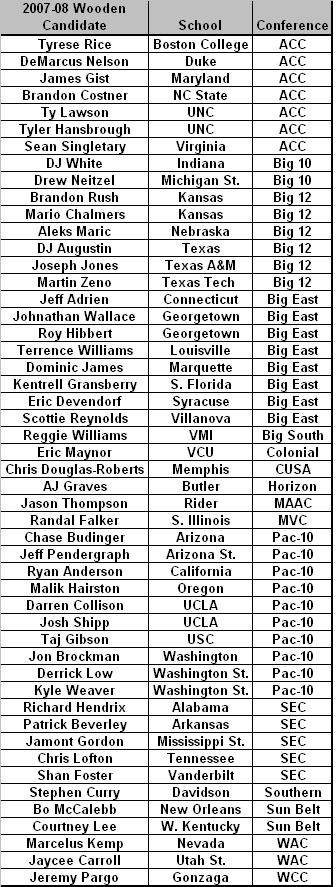
This afternoon the 2007-08 Wooden Award candidates were released to the public. The top 50 vote-getters (who gets to vote for this anyway – is the Wizard of Westwood sitting in his apt filling out ballots?) are listed below (organized by conference, then by team):
Quick ruminations:
Conference Rundown: Pac-10 (10), Big East (8), ACC (7), Big 12 (6), SEC (5), Big 10 (2), Mid-Majors + Low Majors (12).
We like the love thrown to the non-BCS leagues – nearly a quarter of the selections are from eleven other leagues.
It’s no surprise the Pac-10 is held in such high esteem this coming season, while the Big 10 isn’t – look at the difference in good players returning.
For some reason, the Wooden doesn’t consider freshmen in its preseason picks, even though it does at the end of the year (Kevin Durant was the recipient last year). If it did, you’d figure the Pac-10 would look even better, with OJ Mayo and Kevin Love added to the mix.
Other than freshmen, who are some notable omissions around the country? First thought was Josh Heytvelt (Gonzaga), but maybe that has something to do with his propensity to ingest hallucinogens – can’t see the WoW signing off on that selection. We might have chosen Darrell Arthur over Mario Chalmers at Kansas, but maybe the Jayhawk fans would disagree with us. Raymar Morgan (Michigan St.), anyone? Edgar Sosa (Louisville)? What about Alex Harris down at UCSB?
Some guys we’d take off the list – Tyrese Rice at BC has shown he can shoot a lot and turn the ball over a lot – what else? Choosing DeMarcus Nelson smacks of making sure someone from Duke is on the list. We’re also not sure about the selection of Texas Tech’s Martin Zeno to the list. None of this really matters, though, as the list will eventually whittle itself down based on actual performance.
WYN2K. The story of the Patriot League this season, like many other low-major leagues, is that the big dogs are suddenly vulnerable. Holy Cross and Bucknell have combined for six of the last seven Patriot League championships, but with a mass of graduations and injuries between the two, the gap between themselves and the rest of the league is closing. The question is whether the gap in talent returning has closed enough to where we can make a good faith argument that another team will win the Patriot this year. Sadly, we can’t.
Predicted Champion.Holy Cross (#14 seed NCAA). Ralph Willard’s team lost its entire starting backcourt of conference POY Keith Simmons and DPOY Torey Thomas, but guards at the low major level are easier to replace than bigs, and former 2005 ROY Pat Doherty should smoothly take over the reins of the Crusaders (if he can stay healthy). Six other players return from a 13-1 team, but the most intriguing is 6’11 center Tim Clifford. Schools at this level simply do not have the luxury of skilled size, yet Clifford (#42 block% nationally) has shown that he can anchor the post for one of the nation’s most efficient defenses (#5 in defEff and #1 in stl% nationally). The Crusaders have gone 44-1 over the last three seasons in the Patriot League against ABB (anyone but Bucknell), so there is also a psychological advantage here that shouldn’t be understated.
Others Considered. As much as we really enjoy watching Bucknell play in the NCAAs, we fear that their personnel losses are simply too much to justify picking the Bison to win the league this year. Bucknell was already losing three main cogs from its 2005/2006 NCAA squads (Chris McNaughton, Donald Brown & Abe Badmus) before it got news that incumbent forward Darren Mastropaolo tore his ACL over the summer and will likely miss this season as well (all three inside players from the nations #1 offReb% team are now gone). That leaves guard John Griffin as the team’s sole returning starter with a group of talented reserves ready to step up. While we expect Bucknell to take a bit of a step back this year, we really don’t see another team in the Patriot ready to vault into the Bison’s position as a member of the Big Two. If we have to choose one, Lehigh is probably the most viable candidate. The Mountain Hawks return several starters from a 7-7 squad, but their coach Billy Taylor jumped to Ball St. in the wake of the Ronny Thompson fiasco. One knock against this team is that, in a league filled with three-point shooters, Lehigh defends against the three like a sieve (in other words, teams shot 39.2% from three against them last year – #318 nationally). Another team we considered is Colgate, who returns most of its minutes except for leading scorer Jon Simon, but they have a tendency to underachieve (20 wins in two years) and we don’t expect that to change substantially this season.
Games to Watch. Bucknell and Holy Cross are must-watches for this league. They will probably meet three times again this season.
RPI Booster Games. This is the first league we’ve analyzed this year that pulled a complete oh-fer against BCS opponents last season (0-23). Bucknell came closest to pulling out wins, losing in OT to both Wake Forest and Penn St. (the Bison did beat Xavier 68-67). Nevertheless, this is probably a simple anomaly because this league is good enough to get a few wins against BCS teams most years. Out of only fifteen scheduled this year, here are the best opportunities.
Army @ Minnesota (11.10.07)
Bucknell @ Villanova (11.18.07)
Seton Hall @ Navy (11.23.07)
Bucknell @ Wake Forest (12.16.07)
Colgate @ Syracuse (12.18.07)
Lehigh @ Penn St. (12.31.07)
Holy Cross @ Maryland (01.08.08)
Odds of Multiple NCAA Bids. None this year, but if Bucknell and Holy Cross continue to grow their programs, there could be a foreseeable future where both of these teams would have good enough overall resumes to get an NCAA bid.
Neat-o Stat. Just how dominant have Bucknell and Holy Cross been in this league over the past three years? Try 80-4 on for size, with a perfect 28-0 record in 2007 against the other six conference members. Is it any wonder that the other six coaches are cautiously optimistic about their chances this season? Of course, in order to have a chance to win this league, the bottomfeeder group of Army, Colgate, Navy and Lafayette are going to have to do better than finishing in the bottom fifty teams nationally in offensive efficiency (cf. with Bucknell – 140th; Holy Cross – 189th).
64/65-Team Era. The Patriot actually has one of the worst conference histories of this era (2-16, .111), ranking only ahead of the SWAC (.043) and the Northeast (.042) conferences in terms of NCAA Tourney success (and tied with the OVC and Big South). Part of this is due to its seeding, which has averaged #14.9 over the years. Still, in the last five years with the ascendance of Bucknell and Holy Cross, the league has earned an average seed of #13.2, which, not coincidentally, is the period of the most success of the league. The two wins were both orchestrated by Bucknell in magnificent upsets, the 2005 victory over #3 Kansas 64-63 still resonating in the nation’s heartland (in the form offirebillself.com… joking… joking… these are simple jokes we tell…). Enjoy.
Final Thought. As we’ve gone through the low majors we’ve been a little surprised by just how many dominant programs have risen to the top of these leagues. It’s gotten to the point in several conferences where if you don’t see a particular name such as Belmont (Atlantic Sun), Penn/Princeton (Ivy), Winthrop (Big South), Davidson (Southern), or Holy Cross/Bucknell, etc., then something went seriously wrong. By pure coincidence, Holy Cross and Bucknell are the two Patriot League schools that spent the most money on its hoops programs in 2006 (h/t to Mid-Majority).
Tough week at Pepperdine. First, their top returning player Kingsley Costain was dismissed from the school; now they don’t have anywhere to practice due to the insane fires in Malibu.
Now that Maryland has instituted a new alcohol awareness program, what’s the over/under on some Terp like James Gist getting a DWI? Or maybe it’ll be our favorite tool, Gus Gilchrist? He committed to the Terps over the weekend and will play next season.
Maybe Purdue’s Gordon Watt should transfer to Maryland now – he was kicked out of Purdue for a DWI last week.
In a nice gesture, the ACC renamed its Scholar-Athlete award in honor of Skip Prosser.
BYU extended head coach Dave Rose‘s contract through 2011.
Beginning next year, the Preseason NIT will guarantee each participant four games at on-campus sites, even for those teams that lose in the first two rounds.
We hadn’t seen this yet, but ESPN announced its College Gameday sites a week or two ago. We cannot wait until Jan. 26 – Creighton at S. Illinois.
Thankfully, Myles Brand says there will be no expansion of the NCAA Tournament anytime soon.
Raymond Felton didn’t help Roy after all – Iman Shumpert chose Georgia Tech over UNC and Marquette.
Andy Katz has a really interesting article about Kevin Love asking the Wizard of Westwood (who turned 97 Sunday) for advice. We like this kid already.
Thad Matta is hobbling around after back surgery this summer.
More Preseason Chatter –
ACC Media Days – the Research Triangle schools came in 1 (UNC), 2 (Duke), 3 (NC State) in the preseason conference poll.
Katz explains why Calipari opted to stay in Memphis over taking the NC State job two years ago.
DeCourcy gives USC some love for tough scheduling (even though they’re going to lose all those games), while he rates crosstown rival UCLA #1 in his poll.
STF gets us up to speed on what the mid-major conferences are bringing to the table this year.
SEC Hoops:TGTBTD chooses Jamont Gordon over Chris Lofton for SEC POY. Interesting…
Final thought – believe it or not, the Colorado Lady Buffaloes actually have a Brittany Spears and a Whitney Houston on their squad this season. Coke dealers in Boulder are already calculating their profits.
WYN2K. For possibly the first time in two decades, the Ivy League basketball championship is wide open. The twin towers of power – Penn and Princeton – have held the Ivy title on one of their campuses each of the last twenty seasons. This year, however, Princeton will be recovering from the Joe Scott disaster (18-24 in three seasons culminating in an atrocious 2-12 debacle last year), while Penn will have to deal with the loss of the core group that won three straight Ivy championships. Penn has enough returning to make another run at the title, but don’t expect another 13-1 blitzkrieg through the league, as several other contenders will make their own push toward an NCAA bid.
Predicted Champion.Penn (#14 seed NCAA). Ok, ok, so we’re too chicken to pick anybody else here. We know that on paper there are other Ivy schools with more returning talent (ahem, Yale), but consider the weight of history that Penn has behind it – 5 of the last 6 titles… 7 of the last 9… 10 of the last 15. Every other champion during that time was Princeton. With the Tigers almost completely out of the picture, how can we not make our pick for Penn? Despite losing two-time Ivy POY Ibrahim Jabber and Mark Zoller, the Quakers still have the most depth of any team in the league to go along with the best home court advantage at the Palestra. This year’s squad will be led by Brian Grandieri and Justin Reilly, the latter of whom showed some decent post skills during the NCAA Tourney loss to Texas A&M last year. Sorry, Ivy faithful, but we just can’t pick against Penn until someone outside of Princeton knocks them off their perch.
Others Considered. Should Penn crash and burn this year, Princeton assuredly will not be the beneficiary, which means that a team not used to winning this title will be doing so for the first time in a generation. We like Yale as next in line. The Bulldogs return four starters plus their top two reserves, including prohibitive POY favorite Eric Flato, a do-it-all guard who nailed 71 treys last season. The only reason to lend a skeptic’s glance toward Yale is their maddening tendency to lose “shoulda” games, such as when they dropped a home game vs. Columbia immediately prior to a big showdown at Penn last year, effectively ending their conference title hopes. Cornell is another team that appears ready to make the leap on paper, but simply hasn’t been able to get past the monolith in Philly. Coach Steve Donahue is a tidy 0-14 in his career vs. the Quakers, which doesn’t exactly inspire confidence in winning a conference race that depends solely on regular season performance. Still, the Big Red, who was the last non-P&P team to make the NCAA Tourney back in 1988, has a nice set of guards returning (Ryan Wittman and Louis Dale) along with the 2006 ROY Adam Gore (redshirted last year) and USC transfer Collin Robinson.
Games to Watch. Since the Ivy League decides its champion via round-robin and not a conference tournament, there are a few key home-and-homes to watch this season.
Penn @ Cornell (02.09.08) & Cornell @ Penn (03.07.08)
RPI Booster Games. Last year the Ivy League went 2-17 against BCS schools, but surprisingly, middle-of-the-packers Cornell (defeated Northwestern 64-61) and Brown (defeated Providence 51-41) were the two winners. Penn, on the other hand, was 0-5 – go figure. There are 23 games on the slate this year, and here are a few highlights.
Yale @ Stanford (11.20.07)
Virginia @ Penn (11.23.07)
Brown @ Northwestern (11.24.07)
Michigan @ Harvard (12.01.07)
Cornell @ Syracuse (12.20.07)
Penn @ Miami (FL) (01.02.08)
Odds of Multiple NCAA Bids. Zippo.
Neat-o Stat. With the hiring of Tommy Amaker at Harvard and Sydney Johnson at Princeton, six of the eight head coaches in the Ivy League are now black. Unthinkable a generation ago, this means that the Ivy has a higher percentage of black head honchos (75%) than all but the two historically black D1 conferences, the SWAC and MEAC. We’re not sure if that will necessarily translate to more wins at those two schools, but it can’t be a bad thing in terms of inspring qualified minority hiring practices at other schools (ed. note – we guess that assumes Amaker is qualified. Apologies).
64/65-Team Era. The Ivy League has gone 3-23 (.115) over the era, with all three wins concentrated in the mid- to late-90s. The Ivy tends to receive a favorable seed from the NCAA committee, averaging a #12.8 over this period, which equates to an expected value of around seven wins. This shows that the league has really underperformed compared with its seed over the years. Of the three wins, two belong to Princeton (1996 – #13 Princeton 43, #4 UCLA 41; 1998 – #5 Princeton 69, #12 UNLV 57) and one to Penn (1994 – #11 Penn 90, #6 Nebraska 80). With that said, the league’s NCAA representative (well, Penn, really) has in recent years consistently played its first round opponent tough before ultimately succumbing to superior talent.
2003 – #11 Penn down four to #6 Oklahoma St. with 2:25 remaining
2006 – #15 Penn down one to #2 Texas with 6 mins left
2007 – #14 Penn tied with #3 Texas A&M with 11 minutes to go
Nothing says thrilling like Gus Johnson, so we’ll leave you his call of 1996 Princeton-UCLA.
Final Thought. We actually look at this year’s Ivy a little bit like we look at the Big South. You have one program (Penn and Winthrop, respectively) that has clearly been the class of the league for the better part of a decade going through some serious changes, and you have a smattering of challengers ready to stake their claims on the league crown. The problem in both cases is more psychological than physical – can the likes of Yale and Cornell overcome the mental hurdles that Penn has constructed for them over the years by winning a key game in late February on the road when it really counts? It should make for an interesting winter in our nation’s smartest league, that’s for sure.
A month ago we gave you our reviews of the Athlon and Lindy’s preseason mags.
We’ve been busy plugging away at the conference previews, but in the interim, a few more mags have hit the shelves. So here’s the third installment of our continuing series of reviews of the preseason magazines.
Next Up: Sporting News/Street & Smith’s.
Note: Yes, TSN and S&S, two of the oldest and most respected preview issues, have joined forces this year on their college basketball preview. It remains to be seen whether this is a good idea.
I. Covers (5 pts) –are they cool? inclusive?
12 regional covers hitting only the BCS conferences. Definitely a major conference bias here.
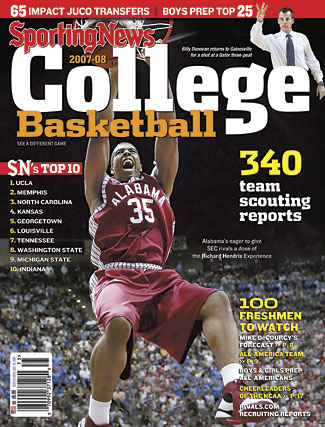
Coolest Cover – see above – one thing we really like is that most of the covers are full-color action shots. The Roy Hibbert (getting serviced by Vandy’s Ross Neltner?) and Mario Chalmers shots are our favs after Richard Hendrix above. Great cover.
Oops. The Athlon, Lindy’s and TSN issues all use the exact same action shot for Brook Lopez of Stanford on their Pac-10 cover. Unfortunately for Cardinal fans, Lopez is not reaching for a textbook.
Total Points = 4
II. Ease of Use (5 pts) – how hard is it to find confs/teams?
Not a fan of their setup here. They divide the conferences into high, mid, and low-major categories, then list them alphabetically within each section. Quick – is the Big West a mid-major or low-major league? The MAC? How about the Southern Conference? TSN considers the MAC a high major (???) and the others as mid-majors, which means we were flipping all over the place to find these leagues. Difficult navigation.
Within the league, they then list each team by predicted order of finish. Typical fare here.
Standard format otherwise – roundup, features, analysis of teams, recruiting, stats and schedules in that order.
Total Points = 2.5
III. Roundup (10 pts) – every mag has one – tell us something new!
The Late, Late Show is a short article explaining the basis behind TSN’s pick of UCLA as the #1 team in America.
Decourcy’s Directives are short narratives on the following topics: Coach Calipari’s calculations; Don’t Cry for Duke; One-and-Outs to Watch; and, Recipe for a Championship. The only interesting information here is in the Recipe section, which explains that most national champions for the last 20 yrs have had at least one NBA-caliber big man and guard on their roster (exceptions: MSU-2000; Arkansas-1994; Syracuse-2003).
TSN also provides three teams of All-Americans, led by seven sophomores and two freshmen among the fifteen. We like that they took some chances, going with Eric Gordon (Indiana) and Chase Budinger (Arizona) on the first team over some of the better-known names.
There is also a Top 25 with a couple of sentences describing each team’s strengths, but it is notable that TSN doesn’t bother with predicting the NCAA field anywhere within the magazine.
There is one page devoted to listing the Top 100 freshmen, but rather than listing them #1-#100, they made a confounding decision to order them geographically (all-east, all-south, etc.) and then alphabetically. There’s no way to intelligently distinguish OJ Mayo (all-east) from Edwin Rios (all-south).
Another page lists transfers eligible this season and next, but again they’re not ranked in any discernible manner. This page also lists all the coaching changes from the offseason.
Overall, this section is incredibly weak compared to the other previewed magazines, and especially considering that TSN and S&S were once considered the bibles of this genre. We literally learned nothing new in this section.
Total Points = 3
IV. Features (15 pts) – give us some insightful and unique storylines.
Features – what features? There is only one feature article, which if we said was shocking would be severely understating our sentiment. So surely that one article has something to do with this season, right? Nah. Try Whatever Happened To… Teddy Dupay, JR Van Hoose and Dane Fife, three (white) players who were HS stars ten years ago but didn’t ultimately make it to the League. Don’t get us wrong, we actually appreciate the concept of an article like this. The problem is that it’s the only feature article TSN felt necessary to give us in the entire magazine. That’s beyond unacceptable, especially when you consider the cache of writers that TSN has at its disposal.
Cheerleaders. Ok, we enjoy a photo collage of college cheerleaders as much as the next guy, but the only other “feature” that TSN insults us with offers us is a five-page spread of various gals in tricky positions. Again, this just seem so beneath TSN and S&S to pull out the cheerleader photo section to try to increase sales. But it’s becoming increasingly apparent that they just don’t care anymore. Good grief – they even put the Duke cheerleaders in the spread (Doherty was right)!!
FWIW, the Texas gal on p. 21 is absolutely scorching hot, with nods to Miss UCLA and Miss Florida on p.19. Surprisingly, we found Miss Kentucky (p.20) to be one of the fugliest of the group, along with Miss Hawaii (p.19). And Miss Wichita St. (p.18) can bend in ways that aren’t quite believable.
Total Points = 3
V. Predictions (20 pts) – how safe are their picks? do they take any chances? are they biased toward the big boys?
TSN’s Top 25 is pretty standard issue big conference fodder. They do put Memphis at #2, Gonzaga at #12 and Xavier at #25, but every other team is a BCS school. Since there are no NCAA predictions, we can only assume their top 4 is their predicted F4, which would mean UCLA, Memphis, UNC and Kansas are their choices.
Big Conference Bias. Assuming top 16 = Sweet 16, then Gonzaga and Memphisare the only exceptions. As for the Top 25, here’s the conference breakdown – Pac-10 (5), Big 12 (4), Big East (4), ACC (3), SEC (3), Big 10 (3), CUSA (1), WCC (1), A10 (1).
Surprises. Some teams that are getting some preseason pub that TSN doesn’t think much of include: Syracuse (10th in the Big East, which presumably would mean not an NCAA team); UConn (7th); USC (7th in Pac-10) & Vanderbilt (5th in SEC East). On the flip side, teams that TSN values more than others include: Georgia (3d in SEC East); Penn St. (4th in Big 10) & NC State (3d in ACC).
Boldest Prediction. Not much in the way of excessively bold predictions, but we believe that a lot of these prognosticators are going to regret giving a 5-11 ACC team (NC State) so much preseason hype this year.
We’re really annoyed that TSN doesn’t give us a field of 65, at minimum.
Total Points = 12
VI. Conference Pages (5 pts) – as a primer for the conference, how much can we learn here?
High Majors. The twelve conferences TSN designates as high majors each gets a full page primer, and there’s a lot to like here. The predicted order of finish uses a cool feature with arrows that shows how the team is trending this year – up, down, or steady. There’s a five man all-conference team, a short narrative breakdown of the league, and the most inclusive list of superlatives we’ve yet seen (15-20 different superlatives). There is also a third of the page devoted to ranking the recruiting classes within the conference and short analyses of each incoming player.
Mid Majors. TSN anoints only six leagues as mid-major leagues, and each of these leagues gets a half-page of analysis, including the predicted order of finish, a short narrative, an all-conference team, recruiting rankings and three superlatives.
Low Majors. The remaining conferences receive one page each, nearly the same as the mid-majors with the exception that the narrative is really just a paragraph wrapup.
Total Points = 5
VII. Team Pages (20 pts) – how in-depth is the analysis? where does it come from? is it timely and insightful given this year’s squad or is it just a rundown of last year’s achievements?
Roughly the top 2/3 of the high major teams get a full page of analysis from TSN; the remainder get a half page. Again, there’s a lot to like here – the writing is solid, giving decent insight into the strengths and weaknesses of each team without merely another rundown of each player and his stats. There is also a section on power ratings by five categories, a five-year wins trend, an impact rookie blurb and a brief but useful team statistics table.
The mid-major conference projected champions get the same treatment as the lower third teams of the high majors – a half-page with much of the same information above. The remainder of mid-major teams simply get the one-paragraph rundown treatment.
The low-majors all get a single paragraph, whether they’re the projected champion or not.
For the top twelve conferences, the analysis is the best we’ve seen this year thus far. The writers clearly know these teams and do a good job at breaking down what to watch for this season. The remaining leagues get short shrift, but those fans are not the target audience.
Total Points = 16
VIII. Recruiting (5 pts) – we want to know who the top players are coming into college bball, where they’re going and who to watch for next year.
As mentioned above, each major conference page has a substantial section on recruits for each school and rankings within each league.
See above for our issue with their list of the top 100 incoming players.
There is no listing of the best incoming recruiting classes nationally anywhere in the magazine, which is incomprehensible to us.
Once upon a time, S&S was the best place to get recruiting information, but that time again seems to have passed. They have four pages of names of players without ranking any of them outside of their Boys All-America Team (top 20). It’s nice they give a paragraph describing the skill set of each of those twenty players, but there’s just no way to compare players outside of that grouping.
With that said, we continue to enjoy the All-Metro Teams of twenty or so HS basketball hotbeds around the country. It gives us something to look for in our local area.
We also enjoy that TSN lists the top 25 HS teams for 2007-08.
This magazine has more information on high school prospects than any other we’ve seen, and yet they muff it by not presenting the information in a way most people would want to see it. Lists are fine, but they have to be useful for comparison.
Total Points = 4
IX. Title IX Guilt (aka Chick Ball) (5 pts) – the less the better…
The women’s preview is a Top 25 with four pages of analysis, but thankfully they stuck it in the back of the magazine.
Where they really go wrong is by wasting five more pages in the back on girls’ HS All-Americans and a HS top 20. We cannot believe that anyone would buy this magazine to get this information.
Total Points = 2
X. Intangibles (15 pts) – what’s good and bad about the magazine as a whole?
This magazine is trying to be everything to everyone. You can easily tell which parts were the expertise of TSN and which were the responsibility of S&S, and as such, the magazine seems random and incomplete in parts. For example, in addition to the prep information in the back, the magazine also gives us a full page on D2, D3 and NAIA basketball (with top 10s and All-Americans). And if that’s not enough, it also has a juco section, complete with a Top 10 and an article explaining why juco talent is getting deeper.
There is also a full page of individual and team stats for D1, D2, D3 and NAIA, plus two pages of women’s stats. Wouldn’t it have made a lot more sense to give us six pages of D1 stats instead? Are a substantial number of NAIA fans really buying this magazine?
Schedules. By virtue of its release date, TSN has most every team’s schedules in complete form at the very back of the magazine. The back page also has a nice roundup of all the in-season tourneys and conference tournament information.
The writing of this magazine is better than Lindy’s and Athlon, but the only writing actually performed is in the conference and team previews. It was very disappointing there weren’t more features at the front.
Total Points = 10
RTC Grade for Sporting News/Street & Smith’s = 61.5 pts
Basis: We have to say that we were really disappointed with this magazine, largely because when we were growing up, the TSN and S&S previews were must-reads in our house. Wow, how the mighty have fallen. How can you not have feature articles or build an NCAA field? How can you not rank-order recruits? How can you add a cheerleader section and spend page after page giving us NAIA stats? At this point, and we never thought we’d say this, the TSN magazine is definitely worse than Lindy’s and no better than Athlon. This would have been unheard of a few short years ago. The only value of this magazine is in the quality of the writing of the analyses for the high major conferences and teams – that is the one (and only) area where TSN trumps the other two. What a disappointment.
Grading Scale:
90-100 pts – exceptional quality in all areas – must buy and keep on-hand all season!
80-89 pts – very good quality mag – worthy of purchasing and reading cover-to-cover
70-79 pts – average, run of the mill magazine – some value in certain areas but weak in others – tough call as to whether to purchase it
60-69 pts – magazine on the weaker side, but may still have some positive attributes – probably not worth the money, though
0-59 pts – such a low quality magazine that it’s not worth any more than the five minutes you thumbed through it at the store
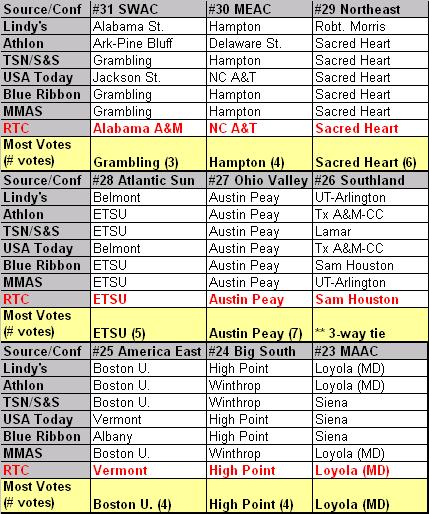
Every year, all the preview magazines, bloggers, media pundits and the like make myriad predictions about conferences, all-americans, bracketology, etc., but come March, very few of them ever own up to those prognoses. Usually that’s because they were wrong about nearly everything. So we’re going to try to provide a modicum of accountability here. The idea is that we’ll post the predictions of the varoius media outlets now with the intent to revisit them next spring.
And if you never hear about this again, you’ll know that our predictions were waaaaaay off. :-)
So for starters, we’re going to post consensus conference predictions for the leagues we rated #31 through #24. We’ll show you every media outlet’s pick for conference winner in addition to the school that got the most picks (if there is one). If we’re missing anyone, please notify us so we can add them as well. Our picks are below in red.
As you can see, we agree with the consensus pick in five of the nine leagues we’ve reviewed so far – NEC, A-Sun, OVC (wow, Austin Peay has a lot to live up to –unanimous!), Big South and the MAAC. We don’t understand the Grambling pick (we have them 3d) nor the Hampton pick (4th). The BU pick in the America East makes sense to us (2d in our prediction) and the Southland is a three-way tie, with understandable choices of UT-Arlington and Texas A&M-CC.
We’ll update this accordingly as we complete another group of leagues for the season preview.
WYN2K. The Metro Atlantic, or the MAAC in local parlance, is a league that usually has a handful of good teams that can consistently compete with the mid-majors and beat the low-majors, but just doesn’t have the horses to run with the high majors. As a case in point, the league went 1-19 against BCS teams last year (Marist 63, Minnesota 56), but still managed to have one of the best low-major records against nonconference opponents over the last three years (122-174, .412). This is also exhibited by the league’s average seeding (#13.8) in the NCAA Tournament over the last decade – only two times has the MAAC received a #16 seed (2001 – Siena; 2007 – Niagara), and both times it won the PiG as a result. As such, the league is typically competitive at the top, and this year is no different as we can foresee as many as five teams making a run at the title.
Predicted Champion.Loyola (MD) (#15 seed NCAA). We’re a bit of a sucker for a great turnaround story, and none this year could possibly be better than Loyola. In 2004 the Greyhounds endured a 1-27 season, tied for the fewest victories in D1. Enter Jim Patsos, a smooth-talking optimist who guided Loyola to 6 wins, then 15 wins, then 18 wins last season as he has re-energized the program. Now in his fourth year, the Greyhounds are poised to win the MAAC and earn an NCAA bid, led by former transfers such as Gerald Brown (22.2 ppg – #8 nationally) from Providence, Hassan Fofana (a 6’10 bruiser) from Maryland and Joe Miles (an instant-offense guy) from Marshall. With four returning starters from a 12-6 conference record last year, we think that Loyola is the team to beat in the MAAC this year.
Others Considered. Siena is another school that returns a slew of talent from a 12-6 team, including Kenny Hasbrouck, the 2006 MAAC ROY and an all-league selection last year. The Saints won nine of their last ten games last year before losing to Niagara in the MAAC title game, but we feel that the loss of big man Michael Haddix gives Loyola the edge here. It will be a close race in any case. Last year’s regular season champ Marist returns a good amount of experience and adds some key transfers (including former Syracuse guard Louis McCroskey), but the loss of second-round NBA draft pick point guard Jared Jordan, who led the nation in assists for two years in a row, will be tough to replace. We also expect Manhattan to make some noise this year, as the Jaspers return seven sophomores from a team that surprised the MAAC by going 10-8 last season. Niagara also should be mentioned even though it lost four starters from its NCAA team; after all, the Purple Eagles have won two of the last three NCAA bids, and the one starter returning is all-MAAC forward Charron Fisher, who will be assisted by the MAAC conference tourney MVP Tyrone Lewis. We’d also be remiss if we didn’t mention Rider, if for no other reason than they have an NBA prospect named Jason Thompson on the team, the only returning 20/10 player in all of D1 this season.
Games to Watch. We’re still in the low-majors, so only one game matters.
MAAC Championship Game (03.10.08). ESPN2.
RPI Booster Games. The MAAC doesn’t play many BCS games in a typical season, and this year is no different with 21 on the slate. As always, there are a few opportunities to grab a handful of wins against some BCS bottom-feeders in addition to improving the overall profile of the league simply by showing up and taking your medicine.
Siena @ Syracuse (11.12.07)
Marist @ Miami (FL) (11.15.07)
Stanford @ Siena (11.17.07)
Loyola (MD) @ Seton Hall (11.20.07)
NC State @ Rider (11.22.07)
Fairfield @ Georgetown (12.01.07)
Niagara @ St. John’s (12.15.07)
Loyola (MD) @ Illinois (12.28.07)
Odds of Multiple NCAA Bids. Once again, for the record, zero.
Neat-o Stat. Former Pitino assistant Kevin Willard takes over for Jeff Ruland at Iona after the Gaels’ horrendous 2-28 performance last season. How do you lose that many games? Well, first, you turn the ball over on more than a quarter (26.1%, 329th nationally) of your possessions; and second, when you manage to hang onto the ball long enough to get to the foul line, you convert at only a 57.7% rate (334th nationally). Iona lost six conference games by <5 points or in overtime – you think extra possessions and making foul shots might have helped?
64/65-Team Era. The MAAC is 5-24 (.172) over this era, which actually accounts for the second-best record among the traditional low-majors (only the Mid-Continent is better), but this is a little misleading because two of those wins were from PiGs. As we stated above, the league tends to receive a favorable seed (among low-majors), averaging a #13.0 over the entire period. Still, only three teams have managed to win a true first round game, and one of those was as a surprising #4 seed (1990 – LaSalle and Lionel “L-Train” Simmons over #13 Southern Miss 79-63 – believe it or not, we found a clip of the L-Train in action in 1988 below). The other two upset victories for the MAAC were in 1995 (#13 Manhattan over #4 Oklahoma 77-67) and 2004 (#12 Manhattan over #5 Florida 75-60). Seems as if only the Jaspers can pull off the upset from this conference.
Note: video cannot be embedded, so double-click on the YouTube logo above to get it to play.
Final Thought. The MAAC as a whole has seen better days, but really it’s the bottom half of the league that’s keeping it down. It’s an exaggeration, but it seems as if every year the worst team in America (as judged solely by records and media coverage) comes from the MAAC. Several years ago it was Loyola, and last year it was Iona. Part of this probably derives from increased media attention due to its location of schools centered in and around New York. Nevertheless, the perception of this league is worse than its actual performance. Still, it has been slipping a smidge over the past couple of years and it needs to put together a strong season this year to earn back some of that respect.