Sunday, March 21 (all CBS)
12:10pm - Syracuse vs. Gonzaga
2:20pm - Ohio State vs Georgia Tech
2:30pm - Maryland vs Michigan State
2:40pm - West Virginia vs Missouri
2:50pm - Wisconsin vs Cornell
4:50pm - Pittsburgh vs Xavier
5:00pm - Purdue vs Texas A&M
5:15pm - Duke vs California
 

Ten Tuesday Scribbles…

January 5th, 2010

RTC contributor and bracketologist Zach Hayes will deliver ten permeating thoughts every Tuesday as the season progresses.

1. More than the countless Big East tournament runs at the Garden, or the contention for conference regular season titles on a yearly basis, or reaching upper-echelon status in college basketball playing with no flashy All-American recruits, Jamie Dixon is proving his worth as a coach this year more than ever. Few teams lost as much talent, leadership, and production as senior point guard Levance Fields, dominating big man DeJuan Blair and outside threat Sam Young. The departure of these three mainstays plus two projected starters for 2009-10, Jermaine Dixon and Gilbert Brown, beginning the year MIA prompted many preseason prognosticators (including myself) to deem Pittsburgh a non-contender in the rugged Big East. My mistake, Jamie. The Panthers just finished one of their most difficult Big East road stretches of the year with two statement victories at previously undefeated Syracuse and at fringe-ranked Cincinnati. Sophomore Ashton Gibbs is taking his experience from playing under Dixon at the U19 Games to good use, running the Pitt offense with superb efficiency, shooting the ball lights out from deep and breaking the all-time Pitt record for consecutive free throws made in the process. Brown has his academics in order and used his athleticism to make a few back-breaking baskets against Cincy last night. Dixon provides stellar defense and outside shooting. It remains to be seen whether Pitt can stay at the top of the Big East with less talent than the other squads, but we do know that Dixon’s team will play smarter and tougher than any opponent. And that always gives them a fighting chance.

2. The most significant win this New Year’s week had to be Purdue running away from West Virginia to remain unblemished and surpass the Mountaineers as a projected #1 seed at this stage of the season. Purdue and coach Matt Painter have constructed their program unlike many of their other counterparts atop the rankings on a weekly basis. There’s no Xavier Henry, Avery Bradley, Devin Ebanks or John Wall walking through the doors of Mackey Arena to play for the Boilers for one or two years; instead, their 2009-10 highly ranked squad features a group of players that have been together for three straight seasons, such a rarity in the age of one-and-done players and the glorification of NBA riches. This specific group of players- Robbie Hummel, Chris Kramer, JaJuan Johnson, E’Twaun Moore, Keaton Grant- have practiced and played together for three straight years now, stepping up the ladder slowly but surely in the college hoops landscape. They took the Big Ten by surprise in 2007-08 before falling in the second round to Xavier and climbed up another step by reaching the Sweet 16 a season ago. This year they hope to reach the top and cut down the nets in nearby Indianapolis with a group of kids that have been through the ups and downs of a college basketball season together more than once- a group of lightly-recruited but tough-minded individuals that will utilize defensive intensity and offensive efficiency to reach the ultimate goal Hummel, Johnson, Moore and others been striving for since arriving in West Lafayette.

3. Think about this for a second: Despite losing three four-year starters that all played 30+ MPG and notched 10+ PPG, Marquette coach Buzz Williams would probably tell you that his Golden Eagles should be staring at a 12-2 (2-0) record with wins over top-ten Villanova and West Virginia and another top-25 team in Florida State. Typical of young, inexperienced squads, Marquette has simply been unable to close games this season against stellar competition. If Darius Johnson-Odom and Jimmy Butler don’t miss two front ends of 1-and-1 opportunities, Da’Sean Butler’s game-winning shot never happens and Marquette has the second most impressive road win in the country this season (just behind Pitt stunning Syracuse). Up two Saturday against Villanova, Johnson-Odom again stepped to the line up two points and 2:35 left on the clock. Both of those attempts bricked, and, couple that with a bunny missed by Butler at the buzzer, the Golden Eagles again fell just short. Rewind back to November in the Old Spice Classic where Marquette held a 30-18 lead at half against FSU and a 10-point cushion midway through the second half, but squandered the lead. I haven’t even included the NC State game where Marquette lead by 11 at the intermission. Closing out games has been a devastating problem for Buzz Williams’ squad this season, and these close losses could very well cost Marquette a spot in the field come March if they’re sitting on the bubble.

Read the rest of this entry »


Ten Tuesday Scribbles…

December 29th, 2009

RTC contributor and bracketologist Zach Hayes will deliver ten permeating thoughts every Tuesday as the season progresses.

1. The most competitive conference in the land this season should spark the most competitive Player of the Year race come March. Top-seeded Kansas boasts three potential candidates once center Cole Aldrich starts to play with a more aggressive mentality on the offensive end. Senior point guard Sherron Collins has the skill set to explode come conference play and should provide the Jayhawks with more than one clutch play the season wears on. Freshman Xavier Henry has surpassed everyone’s expectations early in Lawrence as the Jayhawks early scoring leader. Nipping at the heels of #1 Kansas is #2 Texas and their all-time rebounder Damion James. James has exploded onto the scene the last week-plus with two masterful performances against North Carolina (25/15/4 stl on 8-22 FG) and Michigan State (23/13 on 10-18 FG). You’d be hard-pressed to find someone that argues James isn’t the current frontrunner for Big 12 POY and deserves definite consideration for first team All-America honors. Kansas State has been one of the bigger surprises in college basketball through the first month and a half behind sharp-shooting guard Jacob Pullen. The junior went on a tear recently scoring 28 in a big road win at UNLV then topping himself with 30 points at Alabama. In his last three games, Pullen has nailed an incredible 16 of his last 25 threes. Lurking in the shadows is Oklahoma State’s James Anderson (21.8 PPG, 6.0 RPG) and Iowa State forward Craig Brackins (17.5 PPG, 8.1 RPG) with Baylor’s Ekpe Ugoh and Oklahoma’s Willie Warren also making large impacts on their respective squads.

2. It’s fairly clear the top two teams in a weaker Pac-10 conference will be Washington behind Isaiah Thomas and Quincy Pondexter and California behind their big three of Jerome Randle, Theo Robertson and Patrick Christopher. While both teams have encountered their early season struggles, Washington knocking off an emotionally scarred Texas A&M squad at home Tuesday and California hanging in with Kansas in Allen Fieldhouse should convince most critics that those two will compete for the Pac-10 title. Prior to the season, many believed UCLA would be that third team in the Pac-10 to cause some damage and sneak into the NCAA field. But with a week that included wins over Tennessee, St. Mary’s and UNLV, it’s becoming quite evident that USC might very well be that team. Even with early season home defeats at the hands of Loyola Marymount and Nebraska and blowout losses at Texas and Georgia Tech, the Trojans are coming together behind newly-entrenched point guard Mike Gerrity and coach Kevin O’Neill. The two-time transfer Gerrity is already the Trojans leading scorer and far and away their best assist man. He won’t blow anyone away with flash and speed, but he knows how to run an offense and play the position with efficiency. A starting five of Gerrity, Nikola Vucevic, Alex Stepheson, Dwight Lewis and Marcus Johnson all of a sudden doesn’t look too shabby, does it?

Read the rest of this entry »


ATB: Holiday Hoops (what little there was)

December 28th, 2009

A Weekend So Quiet, Not Even a Mouse...  Yeah, it was a holiday weekend filled with high-calorie food, insane family members and yet another sweater that we don’t need, but college hoops was on the back burner with only a smattering of games throughout.  There were, however, a few games that we need to get you caught up on, so here goes…

Game of the Weekend/RTC Live#6 West Virginia 90, Seton Hall 84 (OT). A modern arena packed with hometown fans so hungry for a win you could hear it in their cheers and see as they stood and cheered for their heroes. The host Seton Hall Pirates, a team of stitched-together scrappers made of overlooked local high school ballers, transfers and JUCOs nipped at the heels of the West Virginia Mountaineers all game long, but never quite able, despite the high-energy encouragement from the partisan crowd to close the gap. Down by ten with 57 seconds left and the fans slowly trickling towards the exits, Seton Hall put on a 12-2 run that put the fans back into their seats (or better put, in front of their seats) cheering like banshees,  knotted the score at 77 apiece and sent the official Big East opener into overtime. This was a script CBS could only have prayed for (see the amazing comeback in the second half of this video).

Too bad Coach Gonzalez’s band of Pirates could not close out the shaken but still confident Mountaineers. Playing off of each other’s enthusiasm, the West Virginia squad mounted an 8-0 run to open the overtime. No more miracle threes left, the Pirates worked the ball into the paint for Herb Pope to put away on a layup. Too little too late however, as Coach Huggins’ squad responded with a pair of free throws from Devin Ebanks to push it back out to eight for the remainder. Jeremy Hazell’s last field goal was a two, and brought his point total on the afternoon to 41 on 14-33 (10-14 FT, 4-19 3FG) and 9-12 FG shooting. West Virginia’s Devin Ebanks logged a double-double with 22 points and 17 rebounds. “He was 3 turnovers away from a triple-double” joked Coach Huggins in the post game press conference.

What to Make of USC? USC 67, #20 UNLV 56. It can’t just be the addition of Mike Gerrity, right?  After a 40-minute, 13/3 asst performance, the MVP of the Diamond Head Classic could be the most important unheralded player of the season.  But what has changed since he’s taken over the reins of the Trojan team?  Many will point to his team-leading 15 PPG and 4 APG as the primary reason, and no doubt that helps on a team struggling with offense, but where he’s really been beneficial is making an already-good defensive team even better.  In the four games where Gerrity has played, USC’s defensive points per possession has been a stellar .795, which would rank in the top ten in America for the entire season (as it stands their .851 defensive PPP is still a staunch #18).  In this game against UNLV, the USC defense held the Rebels to their season-low in FG% (34%) and points (56), while getting their typical production from their seven-man lineup.  Marcus Johnson led the way with 19/9, while Dwight Lewis added 14, and Oscar Bellfield with 17 points was the only UNLV player to reach double figures.  This four-game winning streak over two ranked clubs (UNLV and Tennessee), in addition to a solid team outside the rankings (St. Mary’s) makes us wonder if USC isn’t the second-best team (behind Washington) in the weakened Pac-10 this year.  Stay tuned…

Other Games of National Interest.

  • #11 Connecticut 93, Iona 74. UConn got 29/5 from Stanley Robinson while his two young daughters watched him play, and the Huskies will enter conference play leading the nation in blocks/game (nearly ten per contest) after nine again tonight.
  • #19 Washington 86, San Francisco 71. Quincy Pondexter continues to make his case for all-american honors with 22/5/3 blks on 10-12 shooting, and why not?  Even though many people haven’t seen QP play much this year, he’s currently the fifth most efficient player in America, dropping 22/9 on 56% shooting for his team, currently 9-2 and trending positive.  UW managed to put this one away even without a good game from its other star Isaiah Thomas, who had four points on 1-9 FG tonight.

Boom Goes the Dynamite: 12.19.09

December 19th, 2009

Welcome back!  Another weekend means another edition of everyone’s favorite college basketball live blog.  Assuming they all actually happen (there was, like, a huge snowstorm, you see), there are actually some pretty darn good games happening today (Michigan at Kansas, anyone?  Maybe a little Xavier at Butler?), and since we know you’ll be watching, and we know we’ll be watching…why not watch with us?  We’ll be commenting all day, but we want to know what your thoughts are on the games as they’re being played.  So keep checking this space and hitting that refresh button, and let’s have your comments as well.  It’ll start at noon and go all day long, so I suggest you grab some hot chocolate (or your beverage of choice), turn on your favorite game, and join us.  Keep checking back every few minutes!

12:03 pm: So here we go.  Starting off with Michigan at Kansas on ESPN as our principle (and as of right now, only noteworthy) game.  This is a good but perplexing Michigan team.  Their four losses are Marquette, Alabama, Boston College, and at Utah.  Michigan was a tournament team last year and returned those two stars in Manny Harris and DeShawn Sims, which would make me think they should have at least won a couple of those.  BC is tough, but Michigan has to defend the home floor against a team like that if they want to be taken seriously.  Quite a tall order they’ve got today.  As I type this, Michigan’s last three shots have been threes, none of which went down.  Meanwhile, Kansas has been getting the ball inside every trip down.

Read the rest of this entry »


RTC 2009-10 Impact Players – Wrap-Up

November 8th, 2009

impactplayersOver the course of the last ten weeks we’ve broken down sixty players from around the country whom we expect will have the biggest impact on college basketball this season.  We performed this exercise geographically, choosing five high-major and one mid-major player from each of the somewhat arbitrary ten regions of the country.  If you’d like to read through the individual regions (and we highly encourage that), you can check all ten here.
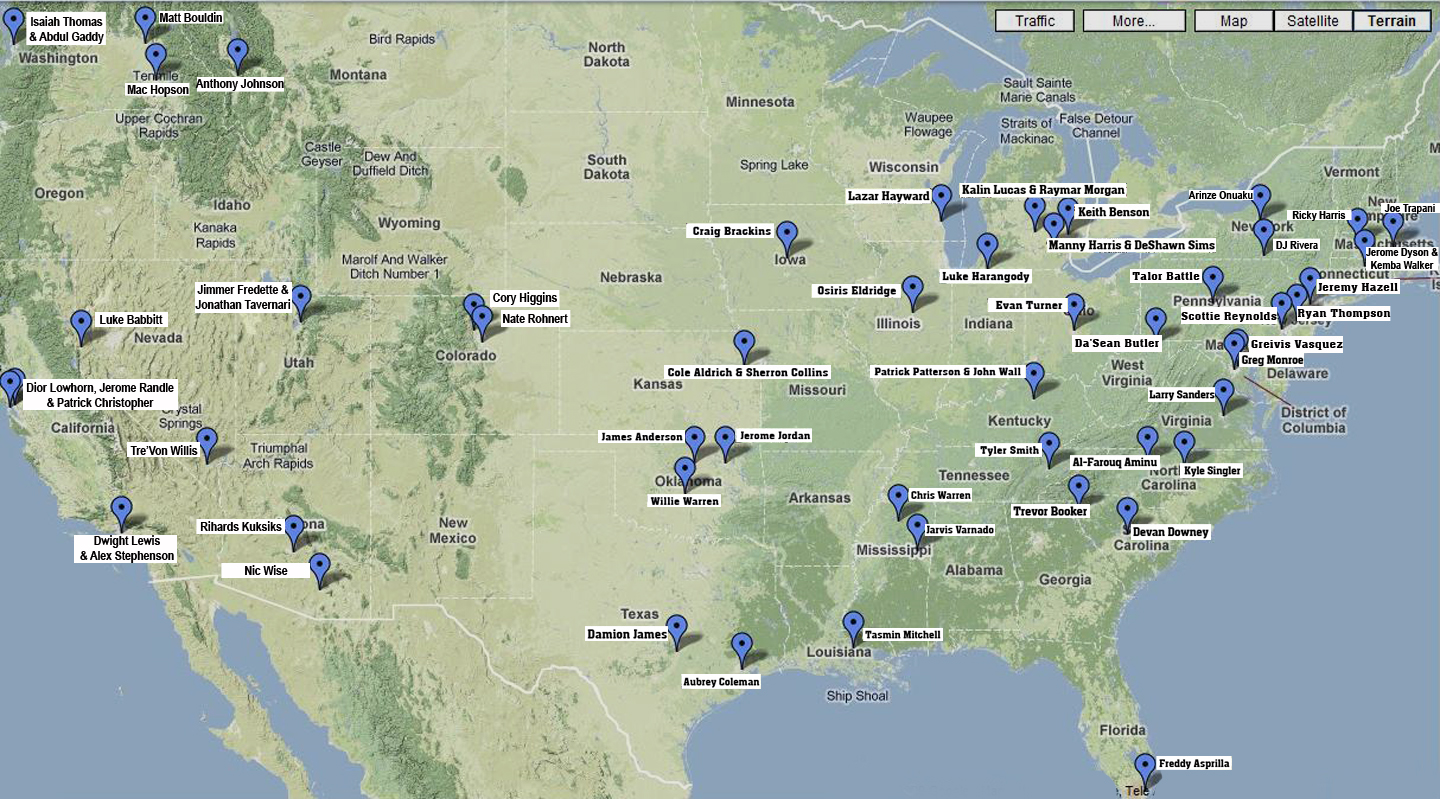
impactcountry(2)

If you don’t have the time or inclination to read through all of the previous posts, we’ll summarize here for you by rating the strongest to the weakest regions.

(ed. note: we started this so long ago that Binghamton still had a promising basketball program, and DJ Rivera still had a place to play)

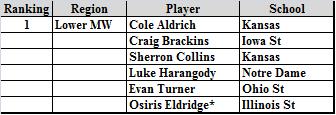
1.  Lower Midwest Region (OH, IN, IL, IA, NE, KS)
lower mw summary

Overview. This seemed pretty clear just at a first glance.  Aldrich, Collins and Harangody are three of the 1st team AAs on the RTC preseason list, and Brackins and Turner are on the 2d team.  This group has unbelievable scoring ability, size and experience.  The only weak link is the mid-major inclusion of Eldridge, who is a fine player, but not in the class of the rest of these superstars.  The nation’s heartland is the epicenter of college basketball talent this year.

Best Players Left Out. Where to start?  The depth in this region is incredible.  Gordon Hayward and Matt Howard at Butler, Robbie Hummell and E’Twaun Moore at Purdue, even Lance Stephenson at Cincinnati.  The #6-10 players in this region would probably be better than all but a few of the other regions.

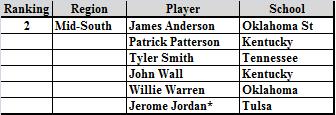
2.  Mid-South Region (KY, TN, MO, AR, OK)
mid-south summary

Overview.  It was a very close call between this region and the South Atlantic, but we felt that the guard play of Warren and Wall with Anderson on the wing would compensate for what this team gives up in size.  And it doesn’t give up much, considering Patterson, Smith and Jordan are all exceptional inside.  Tough call, but Wall is the likely #1 pick, so he’s the x-factor.

Best Players Left Out.  Plenty of raw size here, including Samardo Samuels at Louisville, Michael Washington at Arkansas and DeMarcus Cousins at Kentucky.  Throw in the skilled size of AJ Ogilvy at Vanderbilt and Wayne Chism at Tennessee and this area will punish you on the interior.

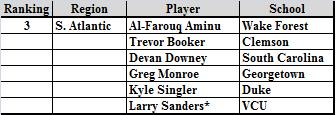
3.  South Atlantic Region (DC, VA, NC, SC, GA)
s.atlantic summary

Overview.  This is the third region that’s chock full of NBA talent – each of the rest below have smatterings of it, but not nearly as much.  Aminu, Booker and Singler all define skilled versatility, while Monroe could end up the best big in the entire country if he wants it enough.  Sanders is a little undersized but relentless as well.

Best Players Left OutEd Davis at UNC was a lighting rod topic, as some felt that he’d be an all-american this year with his length and skill set.  Derrick Favors and Gani Lawal are two others.  A good argument could be made that this region had the best players left out, but it sorta depends on how this year plays out due to their relative youth and inexperience.

Read the rest of this entry »


RTC 2009-10 Impact Players – Southwest Region

October 30th, 2009

impactplayers

Ed. Note: the previous posts in this series (Northeast, Mid-Atlantic, Atlantic South, Deep South, Mid-South, Lower Midwest, Upper Midwest and Mountains) are located here.

It’s time for the ninth installment of our RTC 2009-10 Impact Players series, the group of hot, dry, desert-y states known as the Southwest Region.   Each week we’ll pick a geographic area of the country and break down the five players who we feel will have the most impact on their teams (and by the transitive property, college basketball) this season.  Our criteria is once again subjective – there are so many good players in every region of the country that it’s difficult to narrow them down to only five  in each – but we feel at the end of this exercise that we’ll have discussed nearly every player of major impact in the nation.  Just to be fair and to make this not too high-major-centric, we’re also going to pick a mid-major impact player in each region as our sixth man.  We welcome you guys, our faithful and very knowledgeable readers, to critique us in the comments where we left players off.  The only request is that you provide an argument – why will your choice be more influential this season than those we chose?

Southwest Region (NM, AZ, NV, HI, southern CA)

sw_impact_players_v.2

  • Rihards Kuksiks – F, Jr – Arizona State. Advice to Pac-10 coaches writing up their scouting reports for when they go up against Arizona State this season: when Rihards Kuksiks enters the building, get a man on him. Don’t bother waiting until the game actually starts. You don’t want him getting comfortable, because he’s the kind of shooter who can change a game just that quickly. The guy can touch the ball a few times and the next thing you know you’re down nine before the first TV timeout. Or you get a little comfortable with your late-game lead and after Kuksiks gets a couple of touches the lead is gone and you’re wondering how time can tick so slowly. You want numbers? Fine. Kuksiks is third in terms of returning individual leaders in 3-point field goal percentage (44.3%) in the country among players who hit at least two threes a game and finished 8th in that category last year. A recent article on FoxSports.com by Jeff Goodman reveals some other incredible stats: in games decided by 2 points or less, Kuksiks shot 47% from behind the 3-point line; against ranked opponents he shot 46% from beyond the arc, and in the loss to Syracuse in the NCAA Tournament’s second round last year, he put up his career high in points with 20, with 18 of those coming from long range. In other words, the man steps up during big games. If the numbers don’t interest you, then consider the fact that many of these threes are not from a hair behind the line. They are often from distance. And they are often clutch (ask Arizona about a couple of late ones he nailed in that February game last year). Most importantly, watch the form. It should be an instructional video. He gets good height on his jumper but doesn’t overdo it, and you can see how he gets his legs into the shot. He releases the ball out in front just a little bit, but then the follow-through is a perfect example of that “reach into the cookie jar” that basketball coaches start teaching kids from the moment they can lift a basketball. By the way, he’s 6′6 and more than happy to mix it up in the paint, if needed. My favorite bit about Kuksiks comes from an interview he did for a site called EuropeanProspects.com in which he was asked what kind of player he was. The first words out of his mouth? “I am a sharpshooter.”  This is confidence, not cockiness, from the big man from Riga, Latvia. But I think it’s just fine if there actually is a little cockiness there. Long-range shooters are like neurosurgeons. They’re often asked to do the most difficult things in their field…and if I get to the point where I need to depend on one, I want them a little bit cocky.

Read the rest of this entry »


Tim Floyd’s Rollercoaster Ride at USC

April 12th, 2009

It’s gearing up as another interesting offseason for Tim Floyd at USC.  For the second consecutive year, with the news that Demar DeRozan, Daniel Hackett and Taj Gibson are going pro, he’ll be losing a significant portion of his team to NBA early entry after another relatively disappointing campaign.  (note: we’re sorry, but if you lose potentially five draft picks in two seasons and win only one NCAA Tournament game in that period, that’s really disappointing).  And guess what, probable one-and-doner Renardo Sidney is set to arrive on campus in 2009-10, further contributing to the problem that Floyd annually faces: it’s great to have NBA-level talent every season, but he doesn’t have enough ‘program guys’ who stick around for 3-4 years and provide consistency within the USC program.

007081118427_new_mexico_st_at_usc

An interesting analogy is John Calipari at Memphis.  When Calipari returned to college coaching at Memphis in 2000, there was a common presumption that he would do very well immediately.  The truth, however, is that it took Calipari five years at Memphis before he really got rolling – his first half-decade with the Tigers resulted in 2 NCAA appearances and only one NCAA win.  Remember the Dajuan Wagner, Antonio Burks and early Rodney Carney teams?  Yeah, we don’t really either.  It was only after he had built up enough depth of talent to sustain annual high draft pick losses and still win 30 games the next season did Memphis become a brand name again.

Floyd has struggled in his four seasons at USC to put together a team that looks largely like its predecessor, which is really the only way to consistently perform at an elite level.  The last three champions (UNC, Kansas, Florida) were essentially the same teams as the year prior, and that’s basically true of many of the F4 teams as well (with a piece here or there added).  Floyd’s problem is exacerbated by his tendency to utilize a short bench, as he typically plays only 7-8 guys throughout the season, so when he ends up losing a couple or three key players he’s left with depending on star freshmen to lead his team the next year (e.g., Sidney and star wing Noel Johnson in 2009-10).

Floyd would do well to continue recruiting elite players who are likely one-and-dones, but he should also try to get a few more of the three- and four-year players that will provide a backbone of consistency for his program.  Otherwise, the annual postseason rollercoaster of incoming/outgoing talent that USC basketball currently finds itself on won’t end anytime soon.  Of course, this all may be for naught if the NCAA continues snooping around


NCAA Basketball 2009: The BCS Version

March 16th, 2009

bcs-fail

With the release of the brackets on Sunday evening there has been quite a bit of controversy (Arizona over St. Mary’s being the predominant gripe) and there have been some interesting moments with Jay Bilas and Digger Phelps ganging up on Dick Vitale and almost bringing him to tears. However, it was nothing compared to the furor that we saw when the BCS released its final poll that determined the BCS bowl games and more importantly the national championship. We thought it would be a fun exercise to try to make a mock BCS basketball system. I used the AP and ESPN/USA Today polls as the human polls and ESPN.com’s InsiderRPI, KenPom.com, and Sagarin’s ratings as the computer polls. There are a couple polls I excluded for other reasons: Kenneth Massey’s (wasn’t updated yet) and Jerry Palm’s (not free). I did not throw out the high and low computer polls for two reasons: (1) we only had 3 available and (2) they were fairly similar with a few exceptions (Gonzaga in the RPI, but they weren’t going to be a factor anyways because of Memphis). ESPN.com’s InsiderRPI didn’t include the games from Sunday, but after looking at the final results they would not have had any impact on the rankings  based on the teams involved. Here are the results:

bcs-2009

If you want to try and follow along, here are the BCS criteria.

Now onto the match-ups. . .

Read the rest of this entry »


ATB: Blake Griffin Wasn’t Using Those Anyway*

December 5th, 2008

afterbuzzer1

*

Big 12/Pac-10 Hardwood Challenge. We’d hoped to have gotten a preview up on these games this afternoon, but we were epically busy today, so it didn’t happen.  Nevertheless, we probably would have chosen UCLA, USC and Oklahoma St.  But we have to say that the two marquee games tonight were considerably more interesting than the premier games of the ACC/Big 10 Challenge the last two nights (Duke v. Purdue and UNC v. Michigan St.).  We had the good fortune to watch both of these game in their entirety.

  • Oklahoma 73, USC 72. As soon as you’re prepared to completely right off Tim Floyd and his Trojans, they have a game like this where it makes you reconsider every lackadaisical stereotype that you held about his team.  Of course, the stereotype for punkish behavior – yep, still got that one.  We’re sure you’ve already seen it, but in case you haven’t, USC freshman goon forward Leonard Washington introduced himself to all-world Blake Griffin with a rogue elbow to the family jewels as they ran upcourt in the second half (see below).  He was ejected for the manuever, but Griffin was forced to leave the game for a while, whereupon USC immediately started cutting into the 6-8 pt lead.  The game remained tight until the very end, when OU made just enough FTs to hang on.  USC competed well in the hostile environment, though, shooting 50% from the field and 8-11 from three; Dwight Lewis had 25 and Taj Gibson chipped in a double-double (12/10).  Most importantly, even though Griffin still had 25 pts, OU kept him off the boards to the tune of 6 total (13 below his average) and  only 1 offensive, so limiting those second-chances helped keep the Trojans in the game.

  • Texas 68, UCLA 64. When these two teams get together, you can count on physical defense, high-flying athletes, and (usually) a bricklayer’s convention.  That was pretty much the case tonight, as the two teams combined for 50-122 (40.9%) from the field and 16-29 (55.2%) from the line.  Still, the duel between all-american guards Darren Collison and AJ Abrams was well worth the price of admission.  Early in the game it appeared that Collison was going to shoot 70% for the remainder of the season, as everything he threw up was hitting the bottom of the net.  But it was Abrans who had the last laugh again this year, as his huge three with just under three minutes remaining gave Texas a more comfortable six-point lead and forced UCLA to begin rushing possessions.  Damion James added 13/13 for Texas, but UCLA is going to have to get more help for its upperclassmen from their uber-hyped freshmen (1-12) tonight.  Their rookie quintet will ultimately determine the success of their season.
  • Washington 83, Oklahoma St. 65. UW is difficult to figure this year.  They’ve looked downright awful at times, and like a tournament team others.  Tonight was the latter, as Jon Brockman dropped 16/11 in the home win.  What has happened to OSU’s James Anderson?  Big things were expected for this sophomore guard, but in his last four games he’s put up only 11ppg on 14-44 shooting.

Read the rest of this entry »


2008-09 Conference Primers: #4 – Pac-10

November 8th, 2008

Predicted Order of Finish:

  1. UCLA (25-4, 15-3)
  2. Arizona St. (20-8, 11-7)
  3. USC (17-11, 10-8)
  4. Washington St. (17-12, 10-8)
  5. Washington (18-12, 9-9)
  6. California (14-15, 8-10)
  7. Arizona (13-16, 8-10)
  8. Oregon (11-17, 7-11)
  9. Stanford (12-17, 6-12)
  10. Oregon St. (7-22, 3-15)

pac10logo1

WYN2K.  This is not the same Pac-10 conference as last year, plain and simple.  Gone are lottery picks OJ Mayo (USC), Russell Westbrook (UCLA), Kevin Love (UCLA), Brook Lopez (Stanford) and Jerryd Bayless (Arizona).  Gone are Robin Lopez (Stanford) and Ryan Anderson (Cal), also first-rounders.  Gone are Luc Richard Mbah a Moute (UCLA) and Davon Jefferson (USC), who went in the second round and not at all, respectively.  This year’s Pac-10 transition isn’t just limited to players.  There are new coaches at Oregon St. (Craig Robinson), Stanford (Johnny Dawkins), Cal (Mike Montgomery) and Arizona (Russ Pennell).  It’s safe to say that no other major conference will look as significantly different from last year as the Pac-10 in 2008-09. 

Predicted Champion.   UCLA (NCAA #1)Perhaps the only consistency in the Pac-10 this year will be he continued dominance of Ben Howland’s UCLA Bruins over the rest of this conference.  After three straight Final Fours and another superb recruiting class matriculating in Westwood, Howland has built his program to the enviable point where he can lose two lottery picks and another starter as early entries to the NBA Draft and not expect his program to suffer major slippage.  While we don’t believe that this version of UCLA will be as good of a team as the 2007-08 edition, the Bruins’ position relative to the rest of the conference may actually be stronger this time around.  He returns an all-american PG, Darren Collison, who has played in three F4s and led the nation in 3FG% last year (.525, min. 80 attempts).  More importantly, Collison has a chip on his shoulder after a miserable national semifinal performance against Memphis last year (2 pts, 5 tos, 5 fouls) - when he’s directing his team effectively, there are few teams in America that can overcome their bruising defense and efficient offense.  The national #1 recruiting class is headlined by all-world guard Jrue Holiday, who is expected to start from day one.  His talent, along with a cadre of perimeter (Malcolm Lee, Jerime Anderson) and inside players (J’Mison Morgan, Drew Gordon), will give Howland numerous lineup options to throw at opponents.  Furthermore, UCLA returns a finally-healthy Josh Shipp and Alfred Aboya to provide experience and a steady hand at crunch time.  As we said before, we don’t believe this UCLA team will be as good as last year’s squad, but it probably doesn’t have to be.  The Pac-10 has dropped in talent significantly, and UCLA should be able to roll through to another fantastic record and possible high RPI rating to garner another #1 seed out west.  Here’s a pretty good indication of why Darren Collison is so important for this team.

NCAA Teams.  We’re not sure that we see more than four NCAA teams in the Pac-10 this year, which sent six to the Big Dance last season and arguably deserved seven (Arizona St.).  In the best-case scenario, things come together for certain teams and the league hopes for five on Selection Sunday, but there’s a more realistic chance that there will only be three NCAA selections made on that day. 

  • Arizona St. (NCAA #4)Herb Sendek’s coaching resume shows that once he gets a program to the 20-win plateau for the first time, it typically stays there.  In other words, there’s absolutely no reason to believe that ASU, who is returning its top eight players from a 21-13 NIT quarterfinalist, will regress this season.   The key player, of course, is James Harden, a coulda-been-one-and-done, who lit up the conference for 18/5/3 assts, including 41% from behind the arc (and 53% overall).  Harden is a future lottery pick in a league where the only other potential such picks are freshmen (DeRozan, Holiday).  Pac-10 teams are not going to enjoy their trips to Tempe this year.
  • USC (NCAA #8) – We struggled in making this selection, but the thing that pushes USC into the top three of the Pac-10 is simply, talent.  Other than UCLA, no other program has as much pure talent that it can put on the floor.  Undisciplined, maddening talent – sure – but that’s Tim Floyd for ya.  Demar DeRozan wll be a highlight reel for his one year in LA, but he has considerable help next to him, assuming they can all learn to share the ball and play together.  Daniel Hackett, Taj Gibson and Dwight Lewis are all talented players, and if UNC transfer Alex Stepheson is deemed eligible to play for the Trojans this year, USC has enough talent to make a run at the Pac-10 title.  We don’t expect that to happen because Ben Howland is Ben Howland and Tim Floyd is Tim Floyd, but the talent differential excuse doesn’t hold water anymore. 
  • Washington St. (NCAA #10) – We’re taking a bit of a risk with Wazzu at fourth and a bubble team for the NCAAs, but we truly believe that Tony Bennett is a system coach.  Like Bo Ryan at Wisconsin, the names on the backs of the jerseys are largely irrelevant to the success of the program.  They’re going to run their slower-than-Xmas stuff no matter which faces are running around out there, and in so doing, dare the rest of the Pac-10 to figure it out.  Now we’re not saying that the losses of Derrick Low, Kyle Weaver and Robbie Cowgill won’t hurt – after all, that trio was the most decorated group of players in Washington St. history; but with center Aron Baynes returning along with guard Taylor Rochestie and small forward Daven Harmerling, Bennett has more than enough experience to continue confounding skeptics up in Pullman. 

NIT Teams.

  • Washington (NIT) – This program has seemed to be in a funk ever since Brandon Roy left the dreary environs of Seattle.  If the Huskies are going to take advantage of a weaker Pac-10 to make a run at the NCAA Tournament (or the NIT), they’re going to have to get another superb season from PF Jon Brockman (18/12 on 54% FG).  But that won’t be enough without improved performances from Quincy Pondexter and Justin Dentmon on the perimeter.  Freshman Isaiah Thomas is getting some hype from Husky fans – perhaps he can push them over the top. 

Others.

  • California – The story here is obviously Mike Montgomery’s return to college coaching at his former employer’s bitterest rival.  Had Cal held onto star player Ryan Anderson, we would have considered the Bears as a bubble NCAA team.  We do think Monty will get there eventually, as he did at Long Beach St. and Stanford (not exactly powerhouses when he arrived), but he’s not a quick-fix guy and it will take time to undo the culture of mediocrity left by Ben Braun. 
  • Arizona – On talent alone, with Chase Budinger, Nic Wise and Jordan Hill, the Wildcats should be a top three Pac-10 team.  However, with the fiasco that unfolded last month and the eyebrow-raising hire of the fomer Arizona State radio announcer Russ Pennell as the head coach, we’re not sure anyone will actually want to play for UA this season.  Putting them seventh was a gift. 
  • Oregon – We still can’t figure out how Ernie Kent got a big contract extension, but we suppose it doesn’t take much to satisfy people in Eugene.  At least until Mark Few takes an interest in coaching in the Pac-10.  With only one significant player returning, the 5′6 Tajuan Porter, and nine new faces, we just don’t see the Ducks making a return trip to the NCAAs this season.
  • Stanford – We think Johnny Dawkins is in for a surprise in Palo Alto this season.  Nobody has any clue as to how good of a coach he will be, but we can say with a degree of certainty that the only thing keeping the Cardinal afloat last year was the interior presence of the comical Lopez twins.  The guardplay was relatively abysmal (39.5% shooting), and oh, well, now the Lopezes are gone.  Good luck with that, JD. 
  • Oregon St. – Hey, did you guys hear that new head coach Craig Robinson is Barack Obama’s bro-in-lawWe hadn’t either.  Screw Corvallis, with Robinson’s financial resume, he should be in DC helping Barry fix the economy.  Seriously though, last year, OSU might have been the worst major conference team we’d ever seen (Indiana has a shot at bettering that this year).  Ferguson had success at Brown, though, which is a herculean task in its own right, so maybe he can get a few Ws in Corvallis this season.  Three or four would be miraculous. 

RPI Boosters.

  • Washington v. Kansas  (11.24.08)
  • UCLA @ Texas  (12.04.08)
  • USC @ Oklahoma  (12.04.08)
  • Arizona @ Texas A&M  (12.05.08)
  • Gonzaga @ Washington St.  (12.10.08)
  • Arizona v. Gonzaga  (12.14.08)
  • Kansas @ Arizona  (12.23.08)
  • Notre Dame @ UCLA  (02.07.09)

Important Games.

  • UCLA @ USC  (01.11.09)
  • Arizona St. @ UCLA  (01.17.09)
  • USC @ Washington St.  (01.24.09)
  • USC @ UCLA  (02.04.09)
  • USC @ Arizona St.  (02.15.09)
  • Washington @ UCLA  (02.19.09)
  • Arizonan @ Arizona St.  (02.22.09)

Neat-O Stat.  The Pac-10, with only ten conference members, is the only BCS league that plays a true round-robin schedule of home/away games with every other team.  We like this because it gives a true measure of the strength of each team relative to one another in the conference.  There are no plans on the horizon to expand the Pac-10 to twelve members (for football reasons, the NCAA requires twelve teams to have a postseason championship game). 

65 Team Era.  The Pac-10 has traditionally been the weakest of the six major conferences in its NCAA Tournament performance, going 127-96 (.570) over the era.  The league simply doesn’t put as many teams into the Tournament as its peers, earning 4.1 bids per year – the next lowest is the Big 12 with 4.8 per year, and the “Super Six” average is 5 bids per year.  As might be expected as a correlation to that fact, the Pac-10 is also last among the six conferences in #1 seeds (12), S16s (36) and F4s (9).  UCLA can’t do it all, folks!

Final Thoughts.  UCLA has led the re-emergence of the Pac-10 conference as a basketball powerhouse the last several seasons, but turmoil among several previously consistent programs (Arizona, Stanford) has put the possibility of UCLA and the Nine Dwarves back into the conversation.  One thing that we can be certain of is that Ben Howland will win and win big as long as he’s residing in Westwood.  He hasn’t won a national title yet, but it seems a foregone conclusion that one of these years he’ll break through and win the brass ring.  The rest of the Pac-10 is going to have to figure out a way to recruit on par with UCLA as well as perform in March before this league will be considered a national power again.  We know that Pac-10 schools can attract star talent across the spectrum, but can they be coached up to taste national success?