Michael Chin is the RTC correspondent for the West Coast Conference.
So to update the conference, the fact is nothing has really changed:
Saint Mary’s took care of business with a win against San Diego State (SDSU). SDSU is a good team in a mediocre mid-major conference. Saint Mary’s front court played very well, but Patty Mills turned in another subpar performance, going 6-18. He needs to become a true point guard and let the game come to him. Their game against Oregon is now a must-win after San Diego edged by the Ducks this weekend.
San Diego is really an anomaly this year. They lose to New Mexico and San Jose State and the pull off a win against Oregon. This really speaks to the coaching of Bill Grier. Looking at the big picture, if Oregon doesn’t offer Mark Few the job, Bill Grier may also be on their short list.
You may recall last week that we looked at how the power conferences (ACC, Big 10, Big 12, Big East, Pac-10, SEC) were doing halfway through the non-conference schedule this year. We generally concluded that the ACC and Big East are currently at the top of the heap, and the SEC in particular should be booted out of the group.
What Mid-Majors Play For
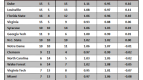
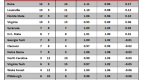
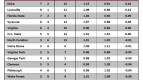
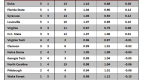
But what about the mid-majors? As important as the non-conference slate is for the BCS schools in terms of seeding and whether five or six teams are invited to the Big Dance, it’s even more important to the mid-majors who are fighting for simply a second or third bid and assuredly will see their conference RPIs drop once conference season begins. So today we take a look at evaluating the mid-majors’ performance thus far, keeping in mind the dual criteria for success that we established last week – considerable success against your peers and domination of your subordinates. We’ll add a third criterion for these mid-majors, which is a reasonable showing against your superiors (the power conference schools) as well. So let’s take a look at the W/L numbers thus far (through 12.11.08):
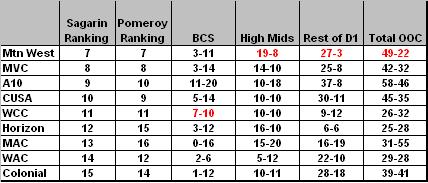
It seems clear to us right off the bat that the Mountain West (ranked #7 by both Sagarin and Pomeroy) has the best overall profile thus far. While it has struggled with its BCS record (.214), its measure in that category is only significantly worse than two conferences – the A10 (.355) and the WCC (.411) – in that regard. But the MWC has absolutely dominated its peer conferences (.704) and its underlings (.900) as if it were a power onference-lite (watch yourselves, SEC). It’s overall non-conference record is also outstanding for a mid-major, at 49-22 (.690), bettering its peers by a considerable margin (#2 – Missouri Valley – .583).
For the next best mid-major conference, we’re split between the Missouri Valley, Atlantic 10 and Conference USA. The A10 has a solid 11-20 (.355) record against the big boys, whereas the MVC (.176) and CUSA (.263) do not, but the MVC has performed significantly better against its peers (.583 vs. .357/.500, respectively). All three conferences have pretty well owned their subordinates this year. So how to distinguish the three? Let’s go with the top-heavy theory. According to Sagarin, the A10 has six teams in the top 100, the MVC has five, and CUSA has four. Good enough for us.
There’s a pretty clear delineation between these top four mid-majors and the others – WCC, Horizon, MAC, WAC, Colonial, but we’re not going to try to distinguish from among this group because it’s largely too close to call based on the above data. As it currently stands, it will be a struggle for any of these five conferences to put a second team into the NCAA Tournament this year (St. Mary’s needs to keep that in mind). Nevertheless, we do want to point out a few interesting observations that we had along the way.
We’ll check back in on this when we get to the end of the non-conference schedule, because at that point with few exceptions, conference positions are relatively static.
We delayed the start of the Blogpoll this year so we could get a better sense as to the first few weeks of the season, so here it is. The blogpoll is represented through Monday night’s games (although records are current).

Michael Chin is the RTC correspondent for the West Coast Conference.
So first, five things I noticed from WCC basketball this week:

Michael Chin is the RTC correspondent for the West Coast Conference (WCC).
Predicted Order of Finish:
Sleeper. San Francisco
WYN2K. For the last ten years the WCC national storyline has read “Gonzaga and the seven dwarfs.” However, as many have learned, Grumpy and Sleepy are finally growing up. Saint Mary’s and San Diego, both of which made the Big Dance last season, return 88% of their scoring and are primed for return trips to March Madness. Saint Mary’s is lead by lightning quick Aussie Patrick Mills and All Conference Defensive Player of the Year Diamon Simpson. Down south, the Toreros return forward Gyno Pomare and guard Brandon Johnson, both of whom made the All-Conference team a season ago. Don’t be fooled however, Gonzaga still has the bullets to defend their conference crown as they return WCC player of the year Jeremy Pargo and potential lottery pick Austin Daye. Aside from the “three wise men,” the remaining teams in the conference are rebuilding. Loyola Marymount, Pepperdine and USF all have new coaches, while Santa Clara’s Kerry Keating is only in his second year as the head man of the Broncos. Portland looks to build on a young cast which includes Nik Raivio (brother of former GU All-American Derek) and Luke Sikma (son of Sonic great Jack Sikma).
Predicted Champion. Gonzaga (NCAA #3). The Bulldogs’ strength this year will be in its backcourt where they figure to go with three guard sets quite often. This team will go as far as Conference POY Jeremy Pargo will take them. After flirting with the NBA this summer, the Chicago native decided to return for a final year to hone his outside shooting skills. His backcourt mate Steven Gray is the sharpshooter of the bunch. The third guard for the Bulldogs is Matt Bouldin. After a stellar freshman campaign two seasons ago, Bouldin had an up-and-down year as a sophomore. Demetrius Goodson, a super athletic freshman point guard and Micah Downs, a former Kansas Jayhawk capable of playing the 2, 3, and 4 positions add significant depth to the GU backcourt. The frontline, though stellar on offense, lacks proven depth and a real defensive force. Austin Daye, the silky forward from Irvine, can shoot it from anywhere on the court and provides GU with a real mismatch when he plays at the 3 spot. The only true experienced big man on the GU roster is senior Josh Heytvelt. Injuries and personal problems have nagged at his career, however, but if he can bounce back from a constant foot problem and returns to his sophomore form, GU should have a solid post threat to go alongside their outstanding perimeter shooting. The depth for Gonzaga has potential, but right now it is unproven. The best of the bunch is 7-footer Robert Sacre, but last year Few used him in limited action on tips-offs. Another 7-footer, Will Foster, may provide some defensive minutes, but to date has not shown any offensive prowess. Coaches like Ira Brown’s toughness, but against a Diamon Simpson or Gyno Pomare, he will have a tough time. Freshman Andrew Poling and Iowa POY Grant Gibbs may end up redshirting this season.
Others Considered.
Fighting for Fourth.
Bottom Feeders.
All Conference Team.
Prediction. Until another team proves otherwise, the Gonzaga Bulldogs remain at the top. However GU is not a unbeatable as some think (Sporting News ranks them #4 nationally). The Bulldogs can shoot the lights out with the best of them, but their frontcourt remains a huge question mark. On the other hand, Saint Mary’s can bang with anybody, but until someone can prove to be their go-to deep shooter, the Gaels will have a difficult time matching up against upper echelon athletic teams, especially those with great shooting guards. San Diego is the darkhorse, but to this analyst they look like a poor man’s Gonzaga. In order for all three to make a return appearance to the NCAAs they will have to perform well in brutal preseason schedules and manage the expectations. This shouldn’t be a problem for Gonzaga, as they are used to the pressure which comes from being the top dog, but as for Saint Mary’s and San Diego, it will be interesting to see what how they will respond as the hunted.
65 Team Era. The WCC is 20-34 (.370), but let’s not kid ourselves, the majority of those wins (12) are from Gonzaga during the last decade (4 others are from the run-n-gun LMU teams in the late 80s/early 90s). Still, in five of the last nine seasons, the WCC has been a multiple-bid league, including the best-ever showing of three bids in 2008. How interesting is it that the lowest seed, #13 San Diego, was the only team to win a game in the Tourney, while higher seeded #7 Gonzaga and #10 St. Mary’s were sent packing in their first game. With the collective strength of the top half of this conference this year and potentially into the future, there should be numerous opportunities for the WCC to have multiple teams advancing very soon.
Prediction: by the end of the first week of December, UNC will no longer be #1 in the major media polls.
No way, there’s too much pressure and they have too many good teams to handle before we even get our advent calendars. Oh, and did you hear, a small piece of their offense will be out for a while with a stress reaction? Even if this substantial piece never misses a game, which is extremely unlikely, he’s going to miss practice and be out of ‘game shape’ for a while. And no, we’re not talking about Marcus Ginyard, but his loss hurts too.
Here’s Carolina’s early schedule – you tell us how they’re going to come out of this unscathed…
There are at least three opportunities for the major upset here, and if Hansbrough and/or Ginyard are out for any of those games, go ahead and mark it down. UNC will not enter the second week of December #1 and unbeaten.
Now, on to the polls, where UNC was a unanimous #1 in the AP Poll for the first time EVER (nope, not even 1991 UNLV, 1992 Duke or 2007 Florida), and also unanimous in the Coach’s Poll. No pressure or anything… FYI – UNC has been preseason #1 six times in its history (incl. this year) – the results of those seasons are: 1982 (Natl. Champs), 1984 (S16), 1987 (E8), 1994 (R32), 2008 (F4) – all that’s missing is a first-round loss or a title game loss.
Here are the polls.

We plan on doing some broader-based analytics of preseason polls in a general sense next week, but for now, here are a few things that we noticed right away.
Are the leaves changing colors in your town? We’re less than three weeks until Midnight Madness…

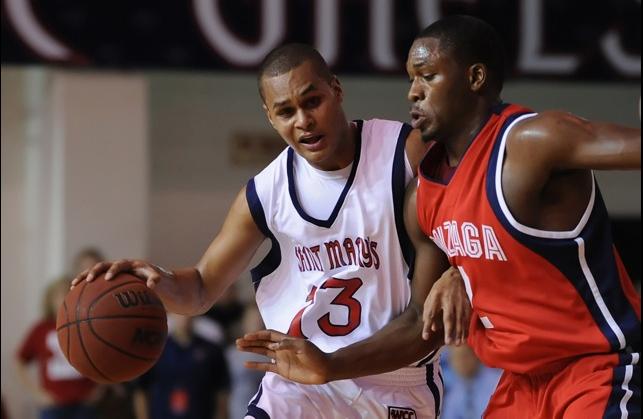
Mills and Pargo Played Each Other Tough
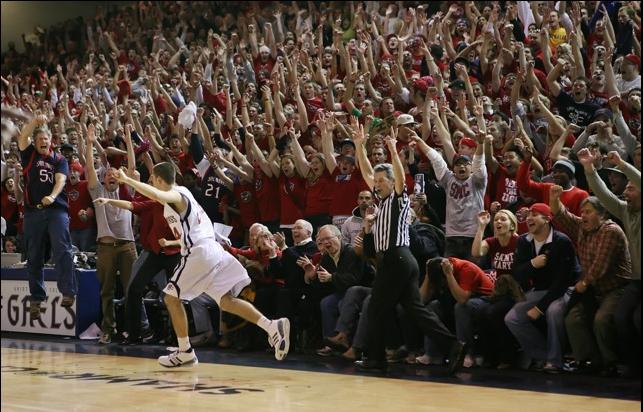
#24 Hits the Big 3 in Overtime
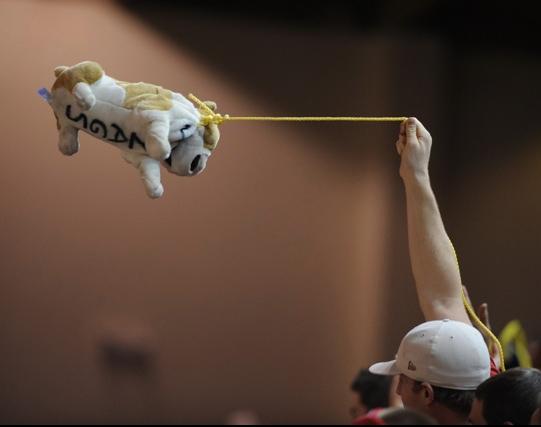
In our dreams, when we envision writing the great american travelogue about college basketball, last night’s game was exactly the type of environment we’d hope to capture. There was a bandbox arena with poor lighting, a rabid crowd so fired up for the contest that it sang the last stanza of the national anthem in unison, multiple eye-popping plays on both ends of the court, a sprinkle of controversy, and an overtime classic that went to David. Oh, and a 2:1 ratio. :-)
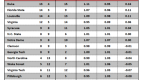
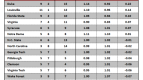
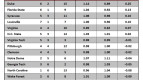
What a week. So we’re a little late on this week’s blogpoll, among several other things, but we’re slowly getting caught up and feel that this week’s poll is the first one that accurately captures how teams are playing several weeks into the season. We’ve had a chance to watch most of the teams in the poll ourselves, and our illustrious blogging brethren have ostensibly done likewise. So here’s Week 3 (blogger ballots located here)…
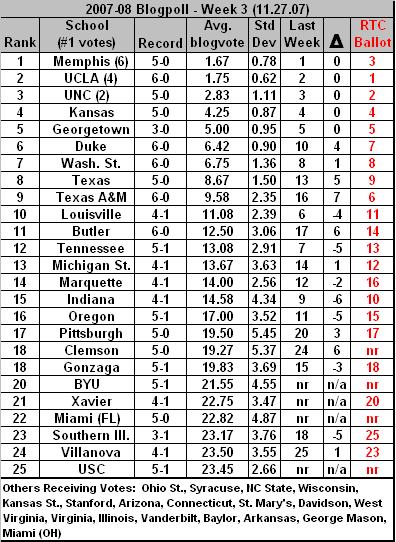
Note: blogpoll does not include 11/27-28 games.
Justifying Our Ballot. We still rank UCLA #1 and UNC #2 ahead of overall #1 Memphis simply based on the fact that we believe UCLA and UNC have beaten better teams than Memphis thus far. Memphis looked solid in CvC wins versus Oklahoma and UConn, but those teams are probably mid-conference finishers this year. UCLA has a marquee win (w/o Darren Collison) against #13 Michigan St., a team that is better than we thought; and UNC has solid wins over likely NCAA teams Davidson, Old Dominion and #20 BYU (w/o Ty Lawson). Memphis will have an opportunity this weekend to improve its standing in our eyes with a win vs. #25 USC. Like everyone else, we raised #9 Texas A&M and #6 Duke on the strength of their wins in the PNIT and Maui, respectively, and #8 Texas got a nod into the top ten by virtue of its destruction of #12 Tennessee. In the lower reaches of the top 25, we still refuse to vote for #18 Clemson despite their win at Mississippi St. We’ve been down this road before with them, and if the Tigers are 14-0 going into the game vs. UNC on January 6, then we’ll consider it. We also left BYU, Miami (FL), and USC off of our ballot, figuring that Stanford, Ohio St., Wisconsin and Baylor had put together better resumes to this point. After the ACC/Big 10 meetings the last two nights, we’re really questioning our sanity on those two midwestern teams above.
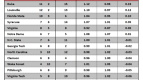
Uncertainty. We’re still seeing blogger indecisiveness when it comes to Indiana and Michigan St., but some new additions at the low range of the top 25 populate our list this week. Here are the top five most uncertain teams (remember, a high std dev means greater variation in blogger rankings of that team):
The top seven teams in the blogpoll are also the top seven lowest standard deviation this week.
Conference Call.
Wow, the SEC is really struggling right now, with only one team ranked (Tennessee) and that squad getting its doors blown off by Texas last week. The ACC only has four ranked teams, but leads all conferences with 6 of the 31 remaining unbeaten teams in D1. Impressive that half of that league is still flawless. Other BCS unbeatens: (Big East & Big 12 – 4 each; Pac-10 – 3; SEC – 1; Big 10 – 0).




 Overnight 5: February 16, 2023
 2021-22 Rush The Court Preseason All-America TeamsRTC 16: 2021-2022 Pre-Season Rankings
 Preseason Stock Report: Buy Now
 Preseason Stock Report: Bear Market
 2020-21 Rush the Court All-America Teams and Yearly AwardsEight Questions for the Final FourEight Key Questions for the Sweet Sixteen16 Questions For First Round Saturday of the NCAA Tournament16 Questions for First Round Friday of the NCAA Tournament