Breaking Down the Preseason Mags… pt. 3

Posted by rtmsf on October 21st, 2007

A month ago we gave you our reviews of the Athlon and Lindy’s preseason mags.

We’ve been busy plugging away at the conference previews, but in the interim, a few more mags have hit the shelves. So here’s the third installment of our continuing series of reviews of the preseason magazines.

Next Up: Sporting News/Street & Smith’s.

Note: Yes, TSN and S&S, two of the oldest and most respected preview issues, have joined forces this year on their college basketball preview. It remains to be seen whether this is a good idea.
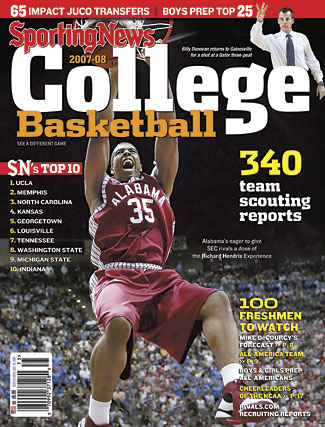
TSN / S&S Cover 08

I. Covers (5 pts) – are they cool? inclusive?

  • 12 regional covers hitting only the BCS conferences. Definitely a major conference bias here.
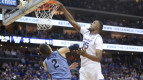
  • Coolest Cover – see above – one thing we really like is that most of the covers are full-color action shots. The Roy Hibbert (getting serviced by Vandy’s Ross Neltner?) and Mario Chalmers shots are our favs after Richard Hendrix above. Great cover.
  • Oops. The Athlon, Lindy’s and TSN issues all use the exact same action shot for Brook Lopez of Stanford on their Pac-10 cover. Unfortunately for Cardinal fans, Lopez is not reaching for a textbook.
  • Total Points = 4

II. Ease of Use (5 pts) – how hard is it to find confs/teams?

  • Not a fan of their setup here. They divide the conferences into high, mid, and low-major categories, then list them alphabetically within each section. Quick – is the Big West a mid-major or low-major league? The MAC? How about the Southern Conference? TSN considers the MAC a high major (???) and the others as mid-majors, which means we were flipping all over the place to find these leagues. Difficult navigation.
  • Within the league, they then list each team by predicted order of finish. Typical fare here.
  • Standard format otherwise – roundup, features, analysis of teams, recruiting, stats and schedules in that order.
  • Total Points = 2.5

III. Roundup (10 pts) – every mag has one – tell us something new!

  • The Late, Late Show is a short article explaining the basis behind TSN’s pick of UCLA as the #1 team in America.
  • Decourcy’s Directives are short narratives on the following topics: Coach Calipari’s calculations; Don’t Cry for Duke; One-and-Outs to Watch; and, Recipe for a Championship. The only interesting information here is in the Recipe section, which explains that most national champions for the last 20 yrs have had at least one NBA-caliber big man and guard on their roster (exceptions: MSU-2000; Arkansas-1994; Syracuse-2003).
  • TSN also provides three teams of All-Americans, led by seven sophomores and two freshmen among the fifteen. We like that they took some chances, going with Eric Gordon (Indiana) and Chase Budinger (Arizona) on the first team over some of the better-known names.
  • There is also a Top 25 with a couple of sentences describing each team’s strengths, but it is notable that TSN doesn’t bother with predicting the NCAA field anywhere within the magazine.
  • There is one page devoted to listing the Top 100 freshmen, but rather than listing them #1-#100, they made a confounding decision to order them geographically (all-east, all-south, etc.) and then alphabetically. There’s no way to intelligently distinguish OJ Mayo (all-east) from Edwin Rios (all-south).
  • Another page lists transfers eligible this season and next, but again they’re not ranked in any discernible manner. This page also lists all the coaching changes from the offseason.
  • Overall, this section is incredibly weak compared to the other previewed magazines, and especially considering that TSN and S&S were once considered the bibles of this genre. We literally learned nothing new in this section.
  • Total Points = 3

IV. Features (15 pts) – give us some insightful and unique storylines.

  • Features – what features? There is only one feature article, which if we said was shocking would be severely understating our sentiment. So surely that one article has something to do with this season, right? Nah. Try Whatever Happened To… Teddy Dupay, JR Van Hoose and Dane Fife, three (white) players who were HS stars ten years ago but didn’t ultimately make it to the League. Don’t get us wrong, we actually appreciate the concept of an article like this. The problem is that it’s the only feature article TSN felt necessary to give us in the entire magazine. That’s beyond unacceptable, especially when you consider the cache of writers that TSN has at its disposal.
  • Cheerleaders. Ok, we enjoy a photo collage of college cheerleaders as much as the next guy, but the only other “feature” that TSN insults us with offers us is a five-page spread of various gals in tricky positions. Again, this just seem so beneath TSN and S&S to pull out the cheerleader photo section to try to increase sales. But it’s becoming increasingly apparent that they just don’t care anymore. Good grief – they even put the Duke cheerleaders in the spread (Doherty was right)!!
  • FWIW, the Texas gal on p. 21 is absolutely scorching hot, with nods to Miss UCLA and Miss Florida on p.19. Surprisingly, we found Miss Kentucky (p.20) to be one of the fugliest of the group, along with Miss Hawaii (p.19). And Miss Wichita St. (p.18) can bend in ways that aren’t quite believable.
  • Total Points = 3

V. Predictions (20 pts) – how safe are their picks? do they take any chances? are they biased toward the big boys?

  • TSN’s Top 25 is pretty standard issue big conference fodder. They do put Memphis at #2, Gonzaga at #12 and Xavier at #25, but every other team is a BCS school. Since there are no NCAA predictions, we can only assume their top 4 is their predicted F4, which would mean UCLA, Memphis, UNC and Kansas are their choices.
  • Big Conference Bias. Assuming top 16 = Sweet 16, then Gonzaga and Memphis are the only exceptions. As for the Top 25, here’s the conference breakdown – Pac-10 (5), Big 12 (4), Big East (4), ACC (3), SEC (3), Big 10 (3), CUSA (1), WCC (1), A10 (1).
  • Surprises. Some teams that are getting some preseason pub that TSN doesn’t think much of include: Syracuse (10th in the Big East, which presumably would mean not an NCAA team); UConn (7th); USC (7th in Pac-10) & Vanderbilt (5th in SEC East). On the flip side, teams that TSN values more than others include: Georgia (3d in SEC East); Penn St. (4th in Big 10) & NC State (3d in ACC).
  • Boldest Prediction. Not much in the way of excessively bold predictions, but we believe that a lot of these prognosticators are going to regret giving a 5-11 ACC team (NC State) so much preseason hype this year.
  • We’re really annoyed that TSN doesn’t give us a field of 65, at minimum.
  • Total Points = 12

VI. Conference Pages (5 pts) – as a primer for the conference, how much can we learn here?

  • High Majors. The twelve conferences TSN designates as high majors each gets a full page primer, and there’s a lot to like here. The predicted order of finish uses a cool feature with arrows that shows how the team is trending this year – up, down, or steady. There’s a five man all-conference team, a short narrative breakdown of the league, and the most inclusive list of superlatives we’ve yet seen (15-20 different superlatives). There is also a third of the page devoted to ranking the recruiting classes within the conference and short analyses of each incoming player.
  • Mid Majors. TSN anoints only six leagues as mid-major leagues, and each of these leagues gets a half-page of analysis, including the predicted order of finish, a short narrative, an all-conference team, recruiting rankings and three superlatives.
  • Low Majors. The remaining conferences receive one page each, nearly the same as the mid-majors with the exception that the narrative is really just a paragraph wrapup.
  • Total Points = 5

VII. Team Pages (20 pts) – how in-depth is the analysis? where does it come from? is it timely and insightful given this year’s squad or is it just a rundown of last year’s achievements?

  • Roughly the top 2/3 of the high major teams get a full page of analysis from TSN; the remainder get a half page. Again, there’s a lot to like here – the writing is solid, giving decent insight into the strengths and weaknesses of each team without merely another rundown of each player and his stats. There is also a section on power ratings by five categories, a five-year wins trend, an impact rookie blurb and a brief but useful team statistics table.
  • The mid-major conference projected champions get the same treatment as the lower third teams of the high majors – a half-page with much of the same information above. The remainder of mid-major teams simply get the one-paragraph rundown treatment.
  • The low-majors all get a single paragraph, whether they’re the projected champion or not.
  • For the top twelve conferences, the analysis is the best we’ve seen this year thus far. The writers clearly know these teams and do a good job at breaking down what to watch for this season. The remaining leagues get short shrift, but those fans are not the target audience.
  • Total Points = 16

VIII. Recruiting (5 pts) – we want to know who the top players are coming into college bball, where they’re going and who to watch for next year.

  • As mentioned above, each major conference page has a substantial section on recruits for each school and rankings within each league.
  • See above for our issue with their list of the top 100 incoming players.
  • There is no listing of the best incoming recruiting classes nationally anywhere in the magazine, which is incomprehensible to us.
  • Once upon a time, S&S was the best place to get recruiting information, but that time again seems to have passed. They have four pages of names of players without ranking any of them outside of their Boys All-America Team (top 20). It’s nice they give a paragraph describing the skill set of each of those twenty players, but there’s just no way to compare players outside of that grouping.
  • With that said, we continue to enjoy the All-Metro Teams of twenty or so HS basketball hotbeds around the country. It gives us something to look for in our local area.
  • We also enjoy that TSN lists the top 25 HS teams for 2007-08.
  • This magazine has more information on high school prospects than any other we’ve seen, and yet they muff it by not presenting the information in a way most people would want to see it. Lists are fine, but they have to be useful for comparison.
  • Total Points = 4

IX. Title IX Guilt (aka Chick Ball) (5 pts) – the less the better…

  • The women’s preview is a Top 25 with four pages of analysis, but thankfully they stuck it in the back of the magazine.
  • Where they really go wrong is by wasting five more pages in the back on girls’ HS All-Americans and a HS top 20. We cannot believe that anyone would buy this magazine to get this information.
  • Total Points = 2

X. Intangibles (15 pts) – what’s good and bad about the magazine as a whole?

  • This magazine is trying to be everything to everyone. You can easily tell which parts were the expertise of TSN and which were the responsibility of S&S, and as such, the magazine seems random and incomplete in parts. For example, in addition to the prep information in the back, the magazine also gives us a full page on D2, D3 and NAIA basketball (with top 10s and All-Americans). And if that’s not enough, it also has a juco section, complete with a Top 10 and an article explaining why juco talent is getting deeper.
  • There is also a full page of individual and team stats for D1, D2, D3 and NAIA, plus two pages of women’s stats. Wouldn’t it have made a lot more sense to give us six pages of D1 stats instead? Are a substantial number of NAIA fans really buying this magazine?
  • Schedules. By virtue of its release date, TSN has most every team’s schedules in complete form at the very back of the magazine. The back page also has a nice roundup of all the in-season tourneys and conference tournament information.
  • The writing of this magazine is better than Lindy’s and Athlon, but the only writing actually performed is in the conference and team previews. It was very disappointing there weren’t more features at the front.
  • Total Points = 10

RTC Grade for Sporting News/Street & Smith’s = 61.5 pts

Basis: We have to say that we were really disappointed with this magazine, largely because when we were growing up, the TSN and S&S previews were must-reads in our house. Wow, how the mighty have fallen. How can you not have feature articles or build an NCAA field? How can you not rank-order recruits? How can you add a cheerleader section and spend page after page giving us NAIA stats? At this point, and we never thought we’d say this, the TSN magazine is definitely worse than Lindy’s and no better than Athlon. This would have been unheard of a few short years ago. The only value of this magazine is in the quality of the writing of the analyses for the high major conferences and teams – that is the one (and only) area where TSN trumps the other two. What a disappointment.


Grading Scale:

  • 90-100 pts – exceptional quality in all areas – must buy and keep on-hand all season!
  • 80-89 pts – very good quality mag – worthy of purchasing and reading cover-to-cover
  • 70-79 pts – average, run of the mill magazine – some value in certain areas but weak in others – tough call as to whether to purchase it
  • 60-69 pts – magazine on the weaker side, but may still have some positive attributes – probably not worth the money, though
  • 0-59 pts – such a low quality magazine that it’s not worth any more than the five minutes you thumbed through it at the store
Share this story

10.10.07 Fast Breaks

Posted by rtmsf on October 10th, 2007

Lots of MSM content coming out this week…

  • But first, have you heard that Stanford’s Brook Lopez can’t pass calculus?  He’ll be out until he figures out derivatives (presumably Dec. 19, after nine games).
  • Along the same lines, the NCAA cleared Marquette big man frosh Trevor Mbakwe to play this season.
  • New Mexico swingman and all-Mtn West selection Tony Danridge had surgery on his broken left leg, and is expected to be back by January 2008.   Arkansas forward Sonny Weems is due back from his hand injury within the next couple of weeks.    
  • A hoops pollster explains why college football polling is misguided
  • Shawn Siegel lists the top 25 players in the ACC. 
  • CSTV claims Louisville and UConn have the top 2008 Big East recruiting classes so far. 
  • We already know why George Mason will get an at-large bid next spring – one name: Tom O’Connor
  • DeCourcy goes with Chris Lofton as his preseason POY, but there’s no way we think he’ll win it. 
  • Catching up with coaches…  Parrish looks at how Dan Monson is adjusting to life at Long Beach St.  Katz examines how Jim Calhoun is recovering from his worst season ever.  And the AP reports on John Beilein not knowing what to expect at Michigan.
  • Luke Winn also has an interesting Q&A with Jerel McNeal, defensive dynamo at Marquette. 
  • Finally, the offense that’s taking over the nation – Memphis’s AASAA
Share this story

09.26.07 Fast Breaks

Posted by rtmsf on September 26th, 2007

Some news flotsam and jetsam we’ve accumulated this week…

  • It was an expensive week for Ohio State paying its head coaches, as Thad Matta got a $500k raise (to $2.5M per annum) and contract extension through 2016.
  • Tennessee forward Duke Crews has been suspended indefinitely for violating team rules. How long is “indefintely?”
  • We mentioned it briefly above, but it deserves its own note. Former Hawg PG Corey Beck was shot Sunday morning during a robbery attempt – he is listed in good condition.
  • Free Shoes University is embroiled in another cheating scandal – the question is which sports are involved?
  • Porsches, Polo & Ponies. SMU basketball avoids NCAA sanctions – wait, SMU still has a basketball program? Oh, right. Matt Doherty. So the answer is no.
  • Plissken at the Buzzer gives a thorough and interesting breakdown of Memphis’ schedule (following up on Andy Katz’s top 10 last week) and how that will affect the Tigers’ NCAA seed next March.
  • Melo is giving back to Syracuse, as Jim Juli Boeheim convinced him to fork over $3M toward a new practice facility for the Orange.
  • Injury Report – Louisville freshman Clarence Holloway will miss the entire season after open heart surgery (!!), and NC State’s PG Javier Gonzalez will miss the next twelve weeks with a shooting thumb injury.
  • BC’s success in the ACC on the gridiron and hardwood have increased its applications from traditionally ACC country.
  • Construda still loves Luke Recker, oh these many years later…
  • We guess Shawn Stockton isn’t as good as his uncle John.
  • According to Jeff Goodman, 2008 #1 player Greg Monroe has narrowed his list to LSU, Kansas, Duke and Georgetown. Although Gary Parrish disputes this in a meandering article about Monroe’s eight finalists.
  • Speaking of Parrish and Goodman, the former riffs on Bama’s point guard situation after losing Ronald Steele, and the latter notes that Bruce Pearl is in search of outside shooters and Arizona is looking at possible successors for Lute Olson.
  • It’s NEVER too early for a projected field of 65.
  • MascotLove: College Hoops Heaven takes a look at the top 15 mascots.
Share this story

Welcome Back, Big Nasty!

Posted by rtmsf on September 26th, 2007

When we saw the news today that the “Big Nasty” is retiring from the NBA and returning to the college ranks to become an assistant coach for Arkansas Baptist College, our easily distracted brains floated back to reflect on what we believe was one of the top half-dozen or so college careers of the 90s. 

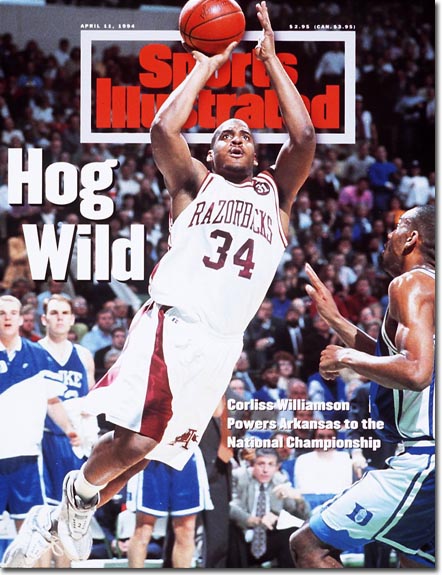
Nolan Richardson’s “40 Minutes of Hell” Arkansas teams of Corliss Williamson, Scotty Thurman, Corey Beck (who in completely unrelated news, was shot on Sunday!) and others represented more than a gimmicky name, they represented an ethos.  An ethos mandating that they would run and substitute and run some more with the express purpose of ramming the ball down your throat until you got so tired from the harassing and pressing and constant stream of 6’5 defenders hawking you all over the court, that you simply succumbed to their collective will and gave it up.  They could make excellent teams look downright silly when the 40MoH avalanche gained momentum – ask Richard Williams (Feb. 20, 1993 – Arkansas 115, Mississippi St. 58) or Norm Stewart (Dec. 2, 1993 – Arkansas 120, Missouri 68) about that.  In those days, Arkansas basketball was absolutely must-watch tv for fans because if you watched Frasier instead, you might miss a display of Al Dillard 35-foot bombs and Big Nasty’s pirouettes into a timeout after a patented 11-0 run by the Hawgs.  These were also Nolan’s last great teams before he deteriorated into a paranoid and raving lunatic retired.   

Corliss Williamson 

This take-no-prisoners attitude derived as much from the Big Nasty as it did from the coach.  One look at his shaved dome and lips curled into a snarl as he sought to molest another rebound or eviscerate another defender in the post (using every inch of his 6’7 frame) was all you needed to see that this guy meant business.  When a bucket was needed (he was a career 58% shooter), the ball would enter into his surehanded mitts, who, for those short on memory, had the touch and agility of Glen “Big Baby” Davis with a far greater passion and understanding of the game (this is one case where given nicknames seem appropriate).  We’ll never forget how he utterly abused the much-taller, longer and athletic Rasheed Wallace in the second half (19 of his game-high 21 pts) of the 1995 national semifinals, leading the Hawgs from seven down at halftime to a seven-point victory.  It was the kind of performance that separates champions from pretenders at that level, and Big Nasty backed down to nobody. 

In three seasons at Arkansas, Corliss and friends won the national championship in 1994 and lost to the eventual national champions the other two years (1993 – lost to UNC in OT; 1995 – lost to UCLA in the title game).    They went 85-19 including a sparkling 13-2 NCAA record during this period.  Big Nasty was the team leader and best player, averaging 19 ppg and 7 rpg in just under 30 minutes.  He was drafted in the first round of the 1995 NBA Draft, and re-focused his game on the perimeter to utilize his stature and quickness over the next several years.  He ultimately played twelve seasons in the L, garnering a reputation as a great locker-room presence, and earning Sixth Man of the Year in 2002 plus an NBA title with the Pistons in 2004.  We’re not completely sure, but we think he is one of only three players so far who won NCAA titles in the 1990s and later won an NBA title (Rip Hamilton – UConn (99), Pistons (04) and Nazr Mohammed – UK (96, 98), Spurs (05)).

Welcome back to the college game, Big Nasty.  We wish you well.   

Update:  Always a nice guy off the court, we found this clip of Big Nasty playing along with the interviewer (and rockin’ the fly Jesus shirt) at a charity bowling tournament.   One question – who is the white guy and who is the black guy here?

Share this story

09.11.07 Fast Breaks

Posted by rtmsf on September 11th, 2007

We’re so far behind in news that this is a must-post…

  • Huckleberry Hound Roy Williams and the entire 1966 Texas Western squad were the collegiate candidates inducted into the Basketball HOF on Friday.  No beef with the Glory Road fellas (although UK and Rupp’s ex post facto vilification is a story that still needs correcting), but has RW accomplished enough yet (five F4s, one title) to warrant inclusion?  Seems as if the committee jumped a little early on that one.
  • Come see the new inclusions in your town this fall, as the HOF is making a 30-city tour around the country over the next year.  The spokesperson of the tour is the Human Highlight Film himself. 
  • Stability in the Northeast – BC’s Al Skinner and Holy Cross’s Ralph Willard both had their contracts extended through 2013. 
  • Calipari mobilizes the entire city of Memphis to watch his players, who apparently cannot be trusted out on their own without inciting a freakin’ riot.  We knew before it even came out that The Mouth of the South, Joey Dorsey, would somehow be involved in this.  Make it rain, Joey.     
  • Not to be outdone, Mike Davis’s transfers at UAB decided to party without him, and all five were arrested on various charges.  The most disturbing in our eyes?  Walter Sharpe’s outstanding warrant for his arrest on a prior marijuana charge.  Not only did he already have a prior, but he didn’t even show up for the hearing?  And Davis didn’t know about this??  Now we know why IU fans wanted him gone.
  • Oh, and former Terp star and NCAA Champion Lonny Baxter has an unhealthy interest in firearms likes guns. 
  • From a while back, ESPN believes that nearly a third of D1 teams are eligible to become Bracket Busters.  (h/t to Awful Announcing)
  • Louisville’s new arena (due in 2010) is already bidding for future NCAA Tournament games.  Possible beneficiaries:  Kentucky, Indiana, Cincinnati, Xavier.   
  • Rivals weighs in with Alabama, Villanova, Illinois and others’ Labor Day weekend trips.  (takeaways:  Bama will struggle w/o Steele and Scottie Reynolds was on fire
  • Andy Katz also contributes with reports (here and here) of his trip to Mexico with OJ Mayo and USC.  (takeaway: OJ is the real deal)  
  • Goodman also has some summer excursion thoughts on Oklahoma, Duquesne, USC and Arkansas here; and Villanova, Marquette and James Madison here
  • Apparently Ohio St.’s Kosta Koufos was offered but did not take a Christian Drejer deal in Greece last week. 
  • Blue Ribbon’s preseason All-Americans are out – Drew Neitzel, Chris Lofton, Roy Hibbert, Tyler Hansbrough and Dominic James.  We’re lukewarm on Neitzel as a first-teamer. 
Share this story

International Incidents

Posted by rtmsf on July 17th, 2007

The real dog days of summer are here, and that can only mean one thing to hoopheads – international basketball.  Yes, we know that you’ve all missed the trapezoidal lane and goofy emblazoned unitards preferred by our international friends.  Harkening back to the days of our youth when we trotted amateurs out there and still actually won these events, we should take solace in the knowledge that, even though the world has indeed caught us in team basketball, we still own the patent on And1-style showmanship.  If only there was an international competition that allows four steps after picking up your dribble followed by random acts of dancing with the crowd.

Skip to my Lou

A Team USA Led by S2ML Could Win This Competition

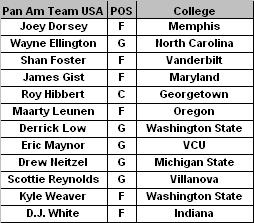
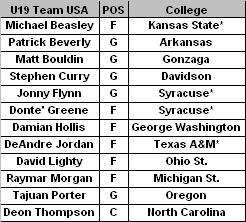
The Senior Men’s National Team will get most of the hype this summer (will Kobe play?  will Team USA qualify for the Beijing Olympics?), but there are two other international teams filled with collegians that we’re keeping an eye on – the Pan Am team and the Under-19 World Championships team (see rosters below).   

Pan Am Team USA Roster

 Pam Am Team USA

The Pan Am team (coached by Villanova’s Jay Wright) begins play in Rio de Janeiro on July 25, and at least half of the roster is filled with players who will be NCAA All-Americans next season.  What’s most interesting about this roster is the names of some of the players who were left off the squad.  Preseason first-teamer Chris Lofton apparently counterbalanced global warming all by himself as he froze up the gym with his shooting stroke during the trials and was left home, as were Kansas guards Sherron Collins and Mario Chalmers and Duke sharpshooter Jon Scheyer.  It was also peculiar that Wisky’s Brian Butch was left off the team, as it leaves Roy Hibbert as the only true center available – let’s hope he stays out of foul trouble.  Jay Wright realizes that the four-guard offense that he employed at Villanova was out of necessity, yes?  Nobody asked us, but this team seems heavy on shooters and wings and extremely light in the middle.  That’s probably not a strong recipe to win in international competition against stronger, older and more experienced players.  We’ll see…

Seth Davis gave his insights after watching the trials here.      

Under-19 World Championships Roster

U19 Team USA Roster

The Under-19 Worlds team, coached by the Undertaker, has already won its first five games in pool play heading into a showdown with 4-1 France tomorrow.  K-State’s incoming freshman Michael Beasley (14 ppg; 6 rpg; 70% fg in only 17 mpg) and Davidson guard Stephen Curry (11 ppg; 3 apg; 61% fg) have led a balanced attack for the high-scoring (99 ppg) American squad.  Arkansas guard Patrick Beverly is the only Team USA member earning more than 25 mpg thus far, while Donte’ Green and Damian Hollis appear to be the only two Americans not getting substantial minutes.  From what we’ve seen so far, it appears that Beverly, David Lighty and Deon Thompson are poised for breakout years at their respective schools, while Big 12 fans should just hang on for the one-year ride watching Beasley and DeAndre Jordan perform.  The eight-team medal round begins on Friday in lovely (especially as compared to Rio) Novi Sad, Serbia.

Beasley Team USA

Michael BEASTley

We’ll be checking back in periodically with these teams to see how they finish in their respective competitions and, more importantly, whether any particular player(s) shows what to expect next season. 

Share this story

NBA Draft Picks by School (1949-2006)

Posted by rtmsf on June 26th, 2007

We always believed that it would be cool if someone would take the time to break down the NBA Draft by schools since its inception, figuring there must be a loose correlation between the collegiate powers of the past sixty years and the players that the NBA finds draft-worthy. We’re not saying that a player is talented simply because he’s drafted by the NBA or that he sucks if he isn’t – rather, a player being drafted is solely an imperfect indicator that, at the time, a player’s collegiate career inspired professional scouts to believe that he could ultimately contribute to their team. But it’s also the only consistent indicator we have. To that end, we tried to determine if there was a rational way to determine how much “bang for your buck” having these talented soon-to-be NBA players on a college team’s roster matters over time.

Bang for Buck

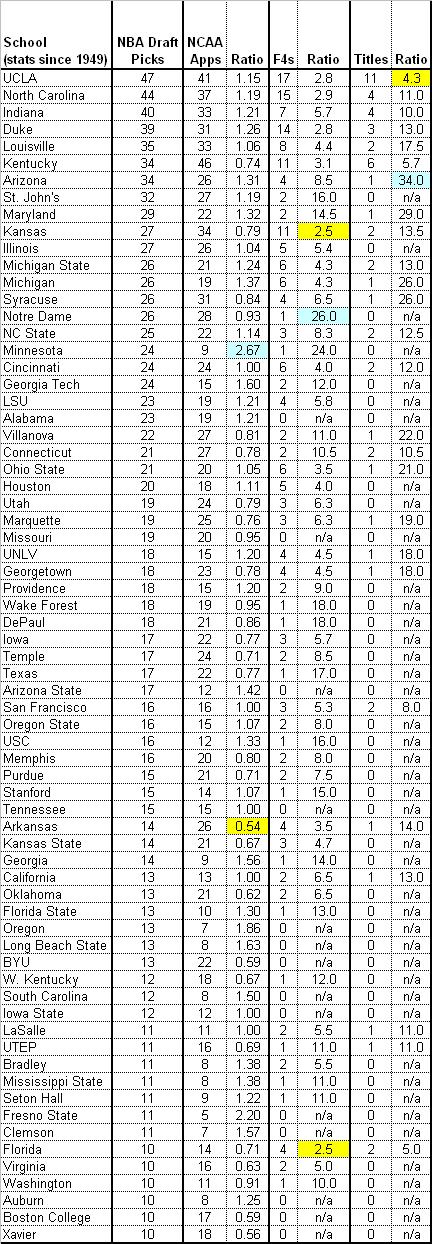
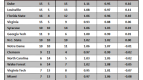
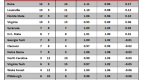
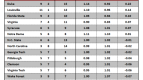
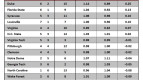
We realize there are many ways to do this analysis and a number of these are meritorious, but for us, it always comes back to NCAA Tournament success – Appearances, Final Fours, Championships. These three measures show that you’re good enough to be invited, you’re good enough to go deep, and you’re good enough to win the title. So in looking at Table A below, you’ll see that the table is sorted by the schools with the most NBA Draft Picks in the first two rounds since 1949 (the first year of the “modern” NBA Draft), and each school also lists those three measures of success next to it (also since 1949). We considered here only the first two rounds of each draft for consistency and the likelihood of a player actually making the parent team.

Table A. NBA Draft Picks (first two rounds) From 1949-2006

Notes: this table is sorted by the NBA Draft Picks column and is limited to schools with a minimum of ten NBA Draft Picks since 1949. The yellow shading refers to the lowest ratio in that column; the light blue shading refers to the highest ratio in that column.

NBA Draft Picks by School - Ratios v.2

Observations.

Talent = Success. Out of the traditional Super Six schools – UCLA, UNC, Indiana, Duke, Kentucky and Kansas – each is among the top ten schools with the most NBA Draft picks. Collectively, these six schools have accounted for over 10% (231 of 2214) of the all-time NBA draft picks, which is fairly amazing if you consider that we’re discussing nearly sixty years worth of college basketball players and hundreds of programs.

Surprises. St. John’s, Maryland and Notre Dame are in the top fourteen of NBA draft picks with 32, 29 and 26, respectively, but their historic success as programs (two F4s each for SJU and Maryland, 1 F4 for ND) is definitely a bit lower than their talent over the years might suggest. They have had numerous good players, but it hasn’t translated into NCAA Tournament success at the same level as their contemporaries on this list. At the other end of the list, Florida‘s recent ascent into the elite company is not (yet) well-represented by its number of draft picks (only 10). However, we’d expect that to change very quickly, hitting as much as 15 after this year’s draft (Horford, Brewer, Noah, perhaps Green & Richard).

Golden gOh-fers. The biggest shocker of all deserves its own paragraph. Somehow the Minnesota Golden Gophers have managed to put 24 players into the NBA Draft over the years – only fifteen other programs have put more – yet nobody would mistake Minnesota for an elite program during any era, considering its paltry nine NCAA appearances and one F4. This disconnect is exhibited by the fact that Minnesota has the highest draft pick/NCAA appearance ratio among the schools listed. Fresno St. (thanks Tark) is the only other school with a ratio greater than 2.0. We think Long Beach St. also deserves a mention, not simply due to its high ratio (1.63), but also because it has produced more draft picks than many major conference teams despite never being much of a power, even within its own conference. On the flip side of things, it was also somewhat amazing to us that Arkansas had only produced fourteen NBA picks despite a substantial amount of NCAA success (26 appearances; 4 F4s; 1 title).

Goldy Gopher

Apparently These Three Gophers Were Drafted by the NBA

Team vs. Individuals. We’re going to be careful to avoid drawing too significant of a conclusion here, but we also found it interesting that among the top ten schools, only Kentucky and Kansas had draft pick/appearance ratios under 1.0, while the other eight schools were above that marker. We wonder out loud if this shows evidence of schools that have traditionally emphasized the team concept to make up for a lack of individual talent over the years; or if UK and KU are simply an anomaly among the most talented teams. There are probably too many variables at play here to make any supportable conclusion.

F4 & Title Ratios. Reviewing the draft pick/F4 ratios, only Indiana is the outlier here, as expected schools such as Kansas, UCLA, UNC, Duke and Kentucky (along with Florida) comprise the six lowest ratios. Considering only the schools with multiple F4 appearances, St. John’s and Maryland have the highest ratios of draft picks/F4s, showing again that they’re producing a lot of good players without as much success to show for it as the others near the top of the list. Along the same lines, considering only multiple titlists, Louisville, Kansas and Duke appear to be getting the least bang for the buck from its talent, as these three schools have the highest draft pick/title ratios among multiple titlists.

Coming Next: now that we’ve looked at the overall numbers, we’ll take a snapshot look at those numbers by decade and by round to see if anything else looks interesting. View Part II (by round) and Part III (by decade) here.

Share this story

Top NCAA Performers of the 65 (née 64) Team Era

Posted by rtmsf on June 12th, 2007

GMU Cartoon

Since there’s absolutely nothing going on this week, this is a good a time as any to start rolling out some of the data that we’ve been hoarding. First, a respectful tip of the hat goes to Florida Gator fan Louis Frank, who allowed us unbridled access to the detailed work in his NCAA Tournament database. Over the next week or so, we’re going to be presenting some descriptive statistics on the 64/65 team era of the NCAA Tournament sliced and diced in various ways.

Our first focus will be on individual team performance, viewed through the raw numbers and then with some analytical twists; then we’ll turn our attention to conference performance using the same parameters. The basic question we seek to answer is which teams and conferences tend to over- and underachieve in the NCAA Tournament since it expanded to 64 teams in the 1985 season? The reason we start with that somewhat arbitrary season is because from that point until now every championship team has had to win six games against seeded teams, with no exceptions. It also provides a tidy way of reviewing the data with a substantial sample of seasons – twenty-three – which also happens to coincide perfectly with the rise in popularity of NCAA basketball and the ESPN era.

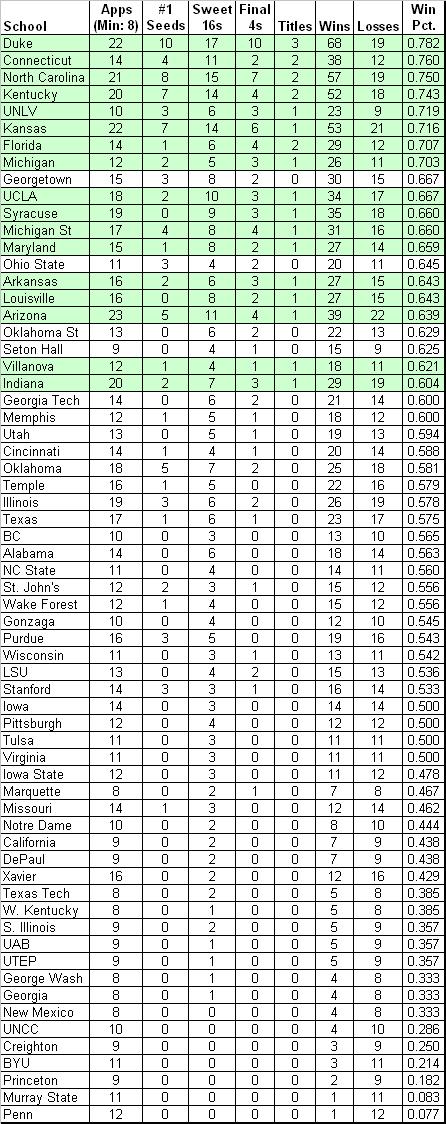
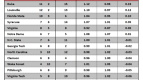
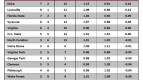
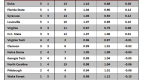
NCAA Tournament Success (1985-2007)

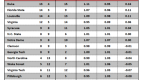
Notes: the chart is sorted by winning percentage (minimum: 8 appearances) from 1985-2007. The green shaded rows represent schools that have won a national title during this period.

NCAA Tournament 1985-2007 v.3

Inside the Numbers:

Elite Eight. Of the 267 schools that have been invited to the NCAA Tournament during the last 23 years, the 64 listed above are the chronic repeat performers, each having made the Dance on at least eight occasions. Thirty-nine of those sixty-four have winning (> .500) records, but only a handful, eight, are elite (> .700 winning pct.). Suffice it to say that those eight elite programs account for 14 of the 23 (61%) national championships and 39 of the 92 (42%) Final Four teams during this era (programs with a national title are denoted above in green shading). These eight programs are: Duke, Connecticut, UNC, Kentucky, UNLV, Kansas, Florida and Michigan. Incidentally, Georgetown is the only school of the top 13 who did not have a title from 85-07, but dumb luck led to its 1984 title team being omitted from this list – apologies to the Hoyas.

Coach K b/w

You Have to Give the Devil His Due

The Krzyzewski Era. This era also neatly coincides with the rise of Duke as a basketball powerhouse – Coach K’s first Final Four was in 1986, and his string of success particularly from 1988-92 exceeds by itself almost every other school’s performance on this list. Duke has the most #1 seeds, the most Sweet 16 appearances, the most Final Four appearances, the most wins, the best winning percentage and the most national titles during this period. In several of those categories it leads by comfortable margins. We’ve made note that the current era of Duke basketball might be slipping a tad, but with numbers like the above to sustain, that may be an impossible task even for Krzyzewski. By these numbers, you’d have to go with North Carolina in second place and Kentucky a close third. Each has very similar statistics (appearances, #1 seeds, sweet 16s, titles, wins, winning pct.) in all but one category, Final Fours. Given the importance that the college basketball community places on reaching the final weekend, Carolina’s seven F4s to Kentucky’s four must trump, all else being relatively equal.

Traditional Powers. With Duke, UNC and Kentucky taking the top three spots by the raw numbers, how do the other three traditional powers of UCLA, Kansas and Indiana fare? Kansas is closest to the top group. The Jayhawks mirror UNC in many categories (including F4s), but its winning percentage is a little lower and it lacks that second national title that would vault it into the top three. UCLA experienced a couple of down periods during this era, but now appears to be on the rise again with two F4s in the past two seasons. Still, its top ten winning percentage (.667) and its national title in 1995 keep it in the second tier of performers over this era. Indiana has largely struggled since Bob Knight was forced out of Bloomington, but their consistency in making the tournament and winning a game or two (.604 winning pct.) – plus that national title in 1987 – probably keeps it in the second tier as well. There should be no question, though – if any of the traditional six powers were slipping in favor of one or more of the nouveaux riche, Indiana would be the choice here.

Bob Knight IU

IU is Showing post-Knight Slippage

Nouveaux Riche. Of the elites, Connecticut and Florida are clearly the party-crashers. Prior to 1985, UConn had four wins and Florida zero wins in the NCAA Tournament. Each now has two national titles and a winning percentage of greater than .700. The question is whether these programs will be sustainable whenever Calhoun and Donovan decide to move on (Calhoun, to retirement; Donovan, as Christine’s full-time house-b*tch). The 64/65 team era is already littered with similar riches-to-rags stories such as UNLV, which fell hard when Tarkanian was indicted retired; and, Michigan, who also dropped out of the college basketball landscape once the gravy train of athlete peddler Ed Martin ended. Arkansas is yet another example – all three programs have a national title and multiple F4s to its credit, but long periods of poor teams and inconsistency places them in the second tier of the era.

Others in Second Tier. Several programs were consistenty excellent over this era, but their numbers weren’t as eye-popping as some of the above schools. Syracuse, Michigan State, Maryland and Louisville all claim a title to go with multiple F4s. Who knew other than Orange fans that Jim Boeheim’s squad never claimed a #1 seed during this era – that seems hard to believe. True, though – Syracuse’s best seeds were five #2s – during the glory days of Pearl Washington, DC, Billy Owens and company – 1986, 1987, 1989, 1990, and 1991. It looked like Michigan State was ready to become a top tier program 6-8 years ago, and they still are an excellent one, but its winning percentage needs to improve a little more to reach that level.

Lute Olson

The Silver Fox has had his Ups and Downs

Whither Arizona? Arizona is the only school that was invited to the NCAA Tournament each year of this era. Yet Arizona’s success in the postseason leaves something to be desired for a program of its stature – multiple F4s and a title, but near the bottom of the championship-level schools in winning percentage. The Wildcats are a team to keep a watchful eye on when we present our over- and under-acheivers list later this week.

Rising Stars. Several programs to observe closely as we go deeper into this era are rising stars Georgetown, Ohio St., Memphis, Texas and Gonzaga. None yet has a title during this era, but each except Gonzaga has been to a F4, and all five are knocking on the door. These programs have the facilities and coaching in place to continue to rise up this list in the coming years.

Disappointments. Again, basing these observations on nothing more than raw numbers, you’d have to say that Oklahoma, Illinois, Purdue and Stanford have been the biggest disappointments. Collectively, these schools have had fourteen #1 seeds with only five F4s to show for it (obviously, zero titles as well). Although most of these programs have been consistently invited to the NCAA Tournament during this era, none has a winning percentage topping .600.

Quin Snyder Norm Stewart

What did these two do to Missouri?

Embarrassments. We’ll leave the mid-majors like Xavier alone here, but we wanted to save special mention for some of the BCS schools who have managed to get invited multiple times, but really didn’t do much when they got there. Georgia‘s one sweet sixteen in eight appearances and its .333 winning percentage doesn’t say much for a program that always seems to be rebuilding; Bob Knight’s Texas Tech doesn’t fare much better (two sweet sixteens). But the real winner of the most pathetic NCAA-caliber program award, in our estimation, has to belong to Missouri. The Tigers have been to the tournament fourteen different times during this era, even once as a #1 seed, and have only managed three sweet sixteen appearances, two elite eights and an overall losing record (.462). Serious congrats are in order for Norm Stewart and Quin Snyder. Mike Anderson has his work cut out for him. The saddest part is that Mizzou traditionally likens itself as a basketball school!

Ivy Sadness. The last word goes to Ivy stalwarts Penn and Princeton, two schools who show up every year (21 of the last 23 NCAA Tournaments) at the right time and venue, battle hard for about thirty minutes against a superior athletic opponent, then go back home and lick their wounds for another year after inevitably wearing down to the size and strength of its opponent. They may be a collective 3-21 (.125) in the Dance, but who will forget when they pull the big upsets, like Princeton 43, UCLA 41 (1996), or Penn 90, Nebraska 80 (1994). Ok, maybe beating Nebraska isn’t a big upset after all, but we still love the UCLA upset.

Coming Next: now that we’ve analyzed the raw numbers of the 64/65 team era of the NCAA Tournament, we’ll next be taking a look at the over- and under-achievers during the same period. After seeing the above, can you project who the best and worst will be? You might be surprised at some of the results.  View Overachievers and Underachievers here.

Share this story

The Christine Donovan Effect

Posted by rtmsf on June 4th, 2007

CD Angry

Mrs. Donovan appears thrilled at the press conference naming her husband the new coach of the Orlando Magic.

Memo to Billy Donovan:

Listen to your wife before you sign the contract next time. As a married man of over a decade, you should have known better. Sure, her lips may have been mouthing “do whatever you want, honey” but the eyes… look at those eyes!!! were saying something completely different.

Because of this egregious infraction in marital comprehension, you now look like a circus clown (isn’t Barnum & Bailey’s college around there too?) and more than a little flakey in front of the basketball universe. Sure, others have been down this road – most recently, Dana Altman (Creighton to Arkansas and back) and Gregg Marshall (Winthrop to College of Charleston and back) – but neither of them were foolish enough to sign a contract prior to backing away. The last person we can remember who actually signed the contract while still employed was Bobby Cremins (Georgia Tech to South Carolina and back), and has he been heard from since? Not really. (Note: Majerus was unemployed/retired/at the trough when he backed out on USC in 2004; and Cremins is now the head coach at College of Charleston in an ironic twist.)

bd-magic.jpg

So let’s be honest, Billy. Despite complete radio silence coming out of Gainesville, and Orlando officials stating publicly that you are still in a “dialogue” with the Magic, we all know that this is simply legal saber-rattling for the sake of saving face. The buyout/settlement that you will pay Orlando will surely be substantial. Wouldn’t that money have been better spent on a new convertible Benz for your wife – which, incidentally, you’re going to have to buy her anyway (look at the eyes). A Benz might actually be getting off easy – imagine all the painstaking interrogations and whispering that is already going on behind her back at the PTA meetings and at the pool’s social committee. Her ears are burning and her eyes are furious.

Actually, Billy, here’s another thought. After you get off the phone with Orlando management, maybe you should call Tiffany’s as well. We heard that diamond earrings look just divine while driving an SL 55 Roadster.

Update: Andy Katz wrote that Donovan started having second thoughts on Friday afternoon at the Florida farewell press conference, and upon waking Saturday morning, he was sure he had made the wrong decision. This dovetails very nicely with the Christine Donovan effect. Who hasn’t gone home thinking a decision is final only to learn that your opinion is far less valuable than you believed when it results on you sleeping on the couch that night?


Share this story

Billy D… isney World?

Posted by rtmsf on May 31st, 2007

Billy Donovan 

Breaking news on all the major sites today is that Billy Donovan has been offered $42M over seven years to leave the University of Florida to become the new head coach of the Orlando Magic.  According to team officials, as reported by the Orlando Sentinel, the wunderkind is expected to take the job.  This comes on the heels of a week-plus of speculation as to why Donovan had not yet signed an extension worth reported $3.5M annually with the Gators.

We’ve been down this road before with Billy D. – a mere six weeks ago, in fact.  But somehow with the ridiculous dollars being mentioned and the “nowhere to go but down” aspect looming at Florida, we think this might be the situation where he makes the jump.  The Magic certainly isn’t in terrible shape, with a young beast Dwight Howard and, lest we forget, JJ Redick, to build around. 

From our perspective, this would also change the balance of power in the SEC in a hurry.  Florida has the #1 ranked recruiting class coming into Gainesville, but it’s apparent that the new blood at Tennessee and Kentucky are hot on its tail.  The big question for us – who would take over for Billy D.?  Would the Gators gamble Stan Heath-style with one-year wonder Anthony Grant from VCU?  Or speaking of Heath, would the Gators make a play for former recruiter extraordinaire and current Arkansas coach John Pelphrey?  Or would they go outside the family and find someone like Gregg Marshall from Winthrop?  Stay tuned… 

Update:  Yahoo.com is now reporting Donovan will be introduced as the Orlando Magic head coach tomorrow morning at 9am.  Terms are $28.5M over five years. 

Share this story