Why Tourney Expansion to 96 Teams is a Terrible Idea…

Posted by rtmsf on December 8th, 2009

Sunday you were probably there with every other college sports fan glued to your television at 8 pm as the bowl pairings were announced, right?  Orrrr… not, as it came in dead last in its time slot on Fox.  So why weren’t you there with your pencil and brackets bowl matchup worksheets in hand?  Because you knew that there is only one more college football game that matters this season, and you already knew who was playing for it (i.e., traditional powers Alabama and Texas).  Other than to the fans of the individual schools who can take a holiday-season vacation to (hopefully) a warmer clime, the other 477 bowls are utterly meaningless to the crowning of a national champion, a jury-rigged travesty that continues to barf on itself seemingly every year as teams who win every single one of their games are considered unworthy for a shot at the ultimate prize (particular hilarity reserved for when a non-trad BCS team such as Cincinnati is left out).
Why Mess With Perfection?

Why Mess With Perfection?

We Can Actually Learn Something From NCAA Football… Well, Sorta

The best argument that the BCS apologists make every year is that their system values the regular season, and this is true to a certain extent.  The problem is that it overvalues the regular season at the expense of the postseason.  It values the regular season so much that it excludes worthy teams from its national championship picture based on ambiguous metrics that include computer rankings and vaguely-tuned in coaches and sportswriters who have been shown to not put equitable and informed efforts into their ballots.  Consider that last year’s basketball computer rankings — both Sagarin and KenPom — could have placed Memphis against UNC in the “BCS title game” at the end of the regular season.  Given their personnel losses, did anyone actually believe Memphis was a Final Four team last year, much less a title contender?  Of course not.  Thank goodness for small favors… and the NCAA Tournament.

This is why, when those of us who favor a college football playoff argue in favor of it, we push for an 8-team or 16-team playoff.  Like the current format of the NCAA Tournament, such an entity would allow for every realistic potential NCAA football champion to have a shot at glory.  Cincy, Boise and TCU this year – check.  Utah last year – check.  Boise again in 2006 – check.  And so on back through the running comedy that has been the BCS over the last twelve years.  The reason that we support this system (over a 32-team playoff, for example) is that it allows for college football to crown a tested and worthy champion while also respecting the integrity of a national championship by only including deserving and excellent teams.

70% of BCS Teams Do Not Belong in the NCAA Tournament

When we read today that the NCAA is considering expansion of March Madness to 96 teams from its current 65, effectively folding the NIT into the Big Dance and adding another week to the Tournament, we really cannot get on board with this idea.  Why not?  Because put simply, the additional teams that will be invited are not worthy.  Every year there are certainly a few bubble teams that have a great case for inclusion in the field of 65; but there aren’t 32 of them, and if we add another layer of middling BCS teams, we only serve to cheapen what is right now the greatest spectacle for excitement in all of sports while simultaneously further minimizing the importance of the regular season.  Seriously, why even have a 16-game ACC schedule if you’ll get a bid by winning six or seven games?

Only a Handful of Bubble Teams Deserve Entry

Only a Handful of Bubble Teams Deserve Entry

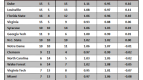
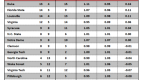
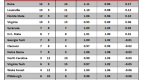
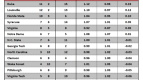
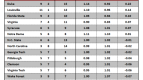
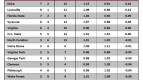
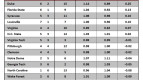
Let’s look at this from a numbers perspective.  Consider last year’s NIT field (presumably the #66-#97-ranked teams, discounting for the regular season champion clause).  We’ll focus exclusively on BCS teams here because they are the most likely beneficiaries of the new setup.  By our calculation, if the 2009 NCAA Tournament had included the NIT field, almost half (15) of the additional teams would have come from the BCS conferences, which would mean that FIFTY-ONE of the SEVENTY-THREE (70%) BCS conference teams would have been invited to the NCAA Tournament.  So what’s the profile threshold that would have gotten you a bid last year using this format?

  • Bubble Team (19-12, 9-10) – the typical team in this group lost to nearly everyone they were supposed to, beat very few elite teams, and mostly built up the majority of their wins in a soft nonconference schedule.  They finished anywhere between 7th-10th in their conference and, on average, won one game in the conference tournament.  There was nothing particularly interesting or compelling about any of these teams, and the odds of any of them making a run to the Round of 32, much less the Sweet Sixteen, would have been minimal.  See below breakdown for a detailed look at the fifteen BCS teams that would have been invited last season.

So why add them?  The answer that the coaches want to expand the NCAA Tournament is not satisfactory (of course they do!).  The answer that media executives also want to expand it also falls on deaf ears (they are selling a product and can’t be relied upon to act in the best interests of the game).  Whoever is seriously listening to this idea really needs to be removed from his or her post.  Why would you mess with something that already works so damn well?  As Mike DeCourcy so succinctly put it in today’s article, this is a “horrible idea” and would end up being a “disaster.”  Couldn’t agree more, Mike.

2009 NIT BCS Team Breakdown

*note – all records and stats are prior to the 2009 NIT (conf reg season finish)

ACC – 7 NCAA teams, 2 NIT teams

  • Virginia Tech (18-14, 8-10) – lost 7 of their last 9 games (t-7).
  • Miami (FL)  (18-12, 7-10) – lost 8 of their last 12 games (t-7).

Big East – 7 NCAA teams, 3 NIT teams

  • Georgetown (16-14, 7-12) – is this a joke?  Georgetown couldn’t beat anyone in the Big East; finished 4-11 in their last fifteen games. (t-11)
  • Notre Dame (18-14, 9-11) – ND at one point lost seven Big East games in a row; five of their final six wins were against teams rated #80 or below. (t-9)
  • Providence (19-13, 11-9) – at least PC had a winning Big East record, right? (t-7)

Big Ten – 7 NCAA teams, 2 NIT teams

  • Penn State (22-11, 11-9) – PSU had a reasonable argument for inclusion last year with their resume, and they showed it by winning the NIT. (t-4)
  • Northwestern (17-13, 8-11) – NW did not and their resume was in no way supportive of an NCAA berth last year. (9)

Big 12 – 6 NCAA teams, 3 NIT teams

  • Kansas State (21-11, 9-8) – K-State is another bubble team that could have arguably received a bid to the Big Dance last year (t-4).
  • Baylor (20-14, 8-12) – Baylor, on the other hand, went 2-10 in their last twelve regular season games prior to making a Big 12 Tourney run (10).
  • Nebraska (18-12, 8-9) – lost five of their last eight and was sorely lacking in quality wins over the course of the season (9).

Pac-10 – 6 NCAA teams, 1 NIT team

  • Washington State (17-15, 9-11) – a mediocre Pac-10 team who lost to nearly every good team it played last season. (7)

SEC – 3 NCAA teams, 4 NIT teams

  • South Carolina (21-9, 10-7) – best wins of the year were against who?  Kentucky and Florida? (t-1 East)
  • Auburn (22-11, 11-7) – at least the Tigers finished strong, winning 9 of their last 11 games. (2 West)
  • Florida (23-10, 10-8) – again, the Gators beat and lost to a bunch of other mediocre SEC teams – how is that NCAA-worthy? (3 East)
  • Kentucky (20-13, 9-9) – losing 8 of their final 11 regular season games does not an NCAA team make. (t-4 East)

Out of the above group, there are maybe 3-4 teams that had a reasonable argument to be included in the field of 65 teams.  Other than that, do we really want teams like the 2009 versions of Georgetown, Kentucky, Northwestern, Notre Dame, Miami (FL), and Baylor getting bids to the Big Dance?  Let those teams stay in the NIT where they belong.  Please.

Share this story

Morning Five: 12.08.09 Edition

Posted by rtmsf on December 8th, 2009

morning5

  1. GROAN…  our post on this will be forthcoming immediately following this M5, but if your attention span is much shorter than our longwindedness requires, suffice it to say that the possibility of the NCAA Tournament expanding to 96 teams is a complete, unmitigated abomination.  If you can find anyone in support of this  idea other than coaches at mediocre programs and network executive types who are greedily trying to destroy the best event in all of sports, please send them our way for drawing, quartering and compulsory re-education.
  2. This great piece by Luke Winn comparing offensive production as freshmen with recruiting rankings confirms what we’ve been saying for a long time — that the relative dropoff in talent between top 10 recruits and top 50 recruits is much larger than the drop between top 50 and top 100 recruits.  The next step is to crosstabulate that data with team success to see just how impactful those numbers are with respect to wins and losses.  Great stuff.
  3. William & Mary, the nation’s surprise middie this year?  According to Basketball Prospectus, TSN and Andy Katz… possibly.
  4. Jeff Goodman takes a look back at the last week with his Weekly WrapMike DeCourcy takes a look at the week aheadSeth Davis gives us his weekly Hoop Thoughts.
  5. Former UCLA forward Drew Gordon did an interview with Fanhouse, and although much of this interview is whimsical, he did mention that “pigs will fly” before UCLA would keep the star player over the coach (Ben Howland) – an absurd question in its own right.  Still, Gordon did confirm that he and Howland had serious differences which led him to leaving the program, and he didn’t let on where he might be headed next.
Share this story

Morning Five: Black Friday Edition

Posted by rtmsf on November 27th, 2009

morning5

  1. So instead of fighting the mobs of penny-pinchers today angling for that last 1080p LCD on the shelves, we recommend a relaxing day watching more live hoops than you can possibly handle.  During the commercials, fire up the Youtubes for each and every one of the games listed here (and yes, we’re extremely bitter we didn’t think of this…).  With respect to the #1 game, we’d recommend throwing in two other games from the best E8 weekend of all time: 2005 Michigan State vs. Kentucky and West Virginia vs. Louisville.  Each game was seemingly better than the last that weekend (UNC-Wisconsin was the only stinker).
  2. In case you were busy filling your face with non-avian bird flesh yesterday, you might have missed that West Virginia’s Devin Ebanks suited up but did not play for Bob Huggins’ team in their blowout win over Long Beach State.  Gary Parrish came right out and said what this actually is — not a problem of “personal issues,” but a suspension for some undisclosed reason.  So depending on how close today’s game against Texas A&M is, we may or may not see the preseason all-american in the lineup.
  3. How bad was the ballroom setup at the Cancun Challenge?  According to John Calipari, pretty terrible.  Gaps in the floor big enough to lodge a foot in, warped areas of the hardwood, chandeliers hanging a mere 29 feet above the floor…  just wait until the year some star player blows out an ankle or a knee because this venue can’t or won’t upgrade its facilities.
  4. Misleading Headline Theater.  This article by Scout.com explains that Memphis head coach Josh Pastner has done something that not even John Calipari could do, which is ink the #1 class in their recruiting rankings at Memphis.  Well, sure.  Technically.  But if Calipari had stayed at Memphis, he would have had John Wall, DeMarcus Cousins and Xavier Henry — assuredly the #1 class in America.  The only reason he didn’t get one at Memphis was because he left there; not that he couldn’t do it.  The other thing that bothered us about this article was a quote by Josh Pastner: “You look at the last four years, and it’s the greatest run in the history of college basketball and may never be done again.” Josh, Coach Wooden and his seven national titles in a row is on line three for you…  Greatest run in the history of CUSA?  Yes.  College basketball?  UCLA, Duke, Kentucky, and many, many others say hello.  Spare us with the hyperbole already.
  5. Finally, since we were all giving thanks yesterday, Jeff Goodman gave us the ten things that he’s thankful for this year.  Right there with ya on #1, Jeff.  Right there with ya…
Share this story

Who Says the South Only Cares About Football?

Posted by rtmsf on September 21st, 2009

The NCAA is starting to scare us a little bit with the news today that the Final Four will be held in warm-weather venues from 2011-13.  Surely they don’t expect us to stay in our rooms during the interminable wait from F4 Saturday night to Monday night’s championship.  Don’t they know that basketball is a cold-weather sport?  That you should see your breath as you huddle outside the arena waiting to get inside, where the scents of metallic air ducts mix with wet clothing and hot dogs in an olfactory orgy of late winter sensations?    Where’s my Minneapolis, my Detroit, my St. Louis?  No, now we’ll actually be forced to enjoy some early April outdoor air in three fun cities where 70s and 80s (before the oppresssive summer humidity hits) are common that time of year.  This means that you, the readers of this site, will pay for our folly.  We’re not happy with you, NCAA. 

The 2010 Final Four is in Indianapolis, IN.  Here’s the list for the next four years…  make your travel plans now.

Which Venue Will You Attend?  (photo credit: NCAA.org)
Which Venue Will You Attend? (photo credit: NCAA.org)

2010 NCAA Tournament

  • F4 – Indianapolis, IN
  • Regionals – Syracuse, NY (East); Houston, TX (South); St. Louis, MO (Midwest); Salt Lake City, UT (West).
  • Sub-Regionals – Providence, RI; Buffalo, NY; Jacksonville, FL; New Orleans, LA; Oklahoma City, OK; Milwaukee, WI; San Jose, CA; Spokane, WA.

2011 NCAA Tournament

  • F4 – Houston, TX
  • Regionals – Newark, NJ (East); New Orleans, LA (South); San Antonio, TX (Southwest); Anaheim, CA (West).
  • Sub-Regionals – Tulsa, OK; Charlotte, NC; Chicago, IL; Cleveland, OH; Denver, CO; Tampa, FL; Tucson, AZ; Washington, DC.

2012 NCAA Tournament

  • F4 – New Orleans, LA
  • Regionals – Boston, MA (East); Atlanta, GA (South); St. Louis, MO (Midwest); Phoenix, AZ (West).
  • Sub-Regionals – Albuquerque, NM; Columbus, OH; Greensboro, NC; Louisville, KY; Nashville, TN; Omaha, NE; Pittsburgh, PA; Portland, OR.

2013 NCAA Tournament

  • F4 – Atlanta, GA
  • Regionals – TBD (East); Arlington, TX (South); Indianapolis, IN (Midwest); Los Angeles, CA (West).
  • Sub-Regionals – Dayton, OH; Auburn Hills, MI; Lexington, KY; Salt Lake City, UT; San Jose, CA; Austin, TX; Kansas City, MO; Philadelphia, PA.

A few quick reflections on the next four years of March Madness venues:

  • ACC fans who bellow from the mountaintops that Duke and UNC always “get to play at home” in the first two rounds (we’re also guilty of this) and/or the regionals won’t have much to complain about the next four Tourneys.  There are two subregional sites (Charlotte in 2011; Greensboro in 2012) within the friendly confines of North Carolina, but a grand total of zero regionals and certainly not a F4. 
  • On the flip side, the West Regional looks EXTREMELY friendly to a certain blue/gold team from SoCal, with locations in Anaheim in 2011 (34 miles), Phoenix in 2012 (368 miles) and downtown LA in 2013 (11 miles).  Egads. 
  • We can’t recall the last time an NCAA Tournament game was in Louisville, and we always wondered why Freedom Hall stopped doing it.  Good to see the River City back on the list with its planned new 22k-seat arena. 
  • What’s with the NCAA renaming a region the “Southwest” Regional for one year only (San Antonio: 2011)?  Regardless of that, you can’t tell us that Rick Barnes hasn’t already circled the Tulsa/San Antonio/Houston pathway in his Iphone calendar as something to shoot for. 
  • Newark (2011 East Regional), really?  Looks like Cory Booker’s doing better than we thought there. 
  • Other than that, mostly the usual suspects.  We all know that it doesn’t really matter where the games are played – they’ll be exciting regardless.
Share this story

Team of the 2000s: Wrap-Up and Honorable Mention

Posted by rtmsf on August 23rd, 2009

teamof2000(2)

Direct Links to the Top Ten.

1.  UNC
2.  Kansas
3.  Florida
4.  Duke
5.  Michigan St.
6.  UConn
7.  UCLA
8.  Memphis
9.  Syracuse
10.  Maryland

Intro.  Welcome back.  We wanted to use this post to wrap up the loose ends with an endeavor such as this one.  Let’s talk about our methodology, the teams who were easiest/most difficult to place, the Memphis quandary, and the teams who were on the outside of the top ten looking in.   As always, feel free to disagree in the comments.

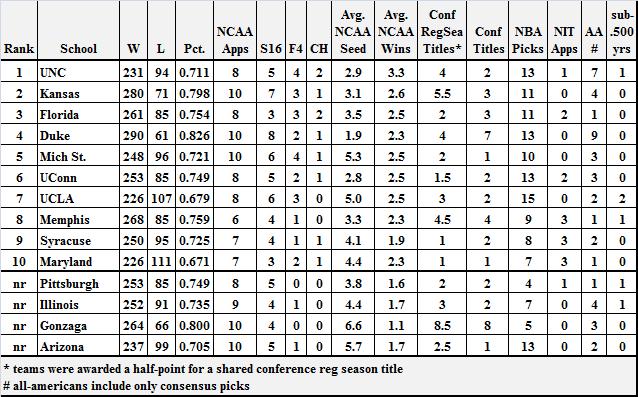
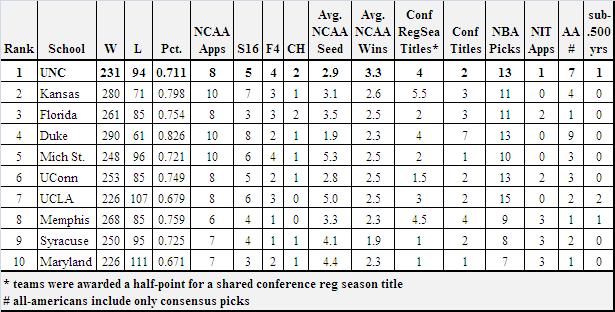
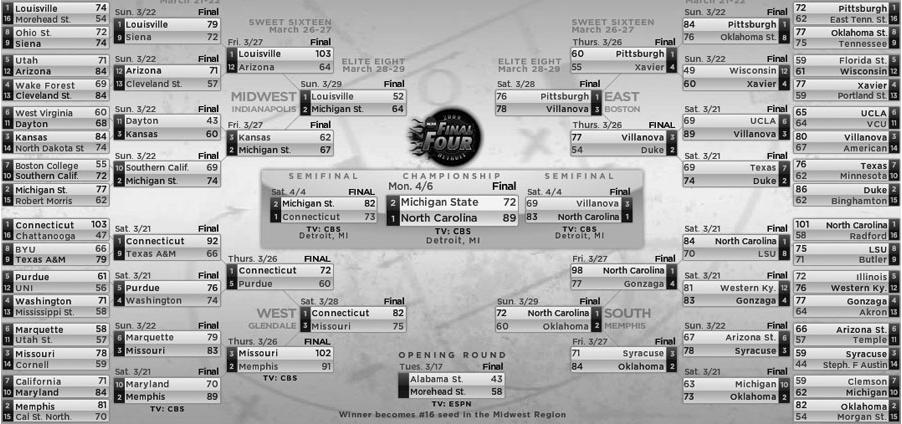
Defending Our Methodology.  One of the more interesting things about releasing these rankings has been the reaction from various fan bases. Some have been very measured in their response and criticism (such as the people in Lawrence, Kansas) while others have been a little more vitriolic (fans of another program in the center of the country). Most of the criticism has been directed at our methodology. There seemed to be quite a bit of confusion on this, so let’s clear it up immediately.  Some people have misinterpreted our table (below) as if the listed criteria were all considered totally and equally in how we ranked teams. Nothing could be further from the truth – rather, the table  was intended to be used as a tool showing the universe of relevant statistics that our panel might find useful when making their decisions.  There was no formula that a panelist was obliged to follow – instead, each panelist had complete discretion to consider or ignore any statistic he deemed important (or irrelevant).  Once each panelist submitted his list, we then took a holistic view of the world when determining where to rank certain teams.  Obviously we all considered winning percentage, NCAA Tournament success, conference achievements, etc., but in varying degrees.  That’s what makes these debates work – while one panelist may think that the NCAA Tournament is all that really matters and wants to weight teams almost exclusively on that metric, another panelist may want to give more substantial weight to the regular season.  Here’s the thing, though – reasonable minds always differ, and both conclusions are completely ok.  We believe that this sort of subjective analysis – review the available stats, pre-rank a list, reconvene to discuss, finalize the rankings – gives such a ranking system more credibility than simply weighting and re-weighting a formula until everything “feels” right.  For those of you who wanted a completely “objective” ranking system… well, here’s an example we did last spring that shows how the BCS formula would have applied to the NCAA Tournament.   Hint: F4 participants Villanova and UConn wouldn’t have even been invited to the Ball. In sum, we think that our methodology resulted in a solid, defensible list of the top ten programs of the 2000s.  Not everyone can be happy, but we’re comfortable with the results.

team2000s final list

Hardest Teams to Peg.  There were three teams that the panel had the hardest time nailing down – #4 Duke, #5 Michigan St., and #8 Memphis.  Both Duke and MSU received a #1 vote in our initial analyses, although to be fair, those were outliers among the panel.  Memphis was equally contentious, with half of the panel initially placing the Tigers in the top seven, while the other half didn’t even have them ranked at all.  It probably makes sense that we’ve received the most criticism based on these difficult-to-peg teams.

Easiest Teams to Peg.  On the other hand, the top three teams – #1 UNC, #2 Kansas, #3 Florida – were unanimous in order (although not in ranking).  Every panelist rated those three in the same order relative to one another, and the lowest any of the four teams were rated was fourth.  Interestingly, criticism died down on the placement of these teams.  Perhaps our panel was representative of what Average College Basketball Fan would choose as well?

What About Memphis? After the news that the NCAA vacated Memphis’ 38 wins and title appearance from the 2008 season, there was some buzz about what we should do with our list.  By our estimation, Memphis was rated as the #8 program of the 2000s, but if we removed that year, they most undoubtedly would have dropped out of the top ten.    After some internal discussion, we’re unwilling to go there.  There are a couple of reasons for this.  First and foremost, we don’t want to.  We watched Memphis play its way into the national finals, we saw Derrick Rose clang his first FT with nine seconds left, and we remember the shocked look on Calipari’s face in the interview room afterwards.  We also remember Michael Redd’s shooting in 99, Marcus Camby blocking everything in sight in 96, C-Webb calling timeout in 93, and several other vacated performances over the years.  Those games and moments happened.  They’re seared into our memory.  The NCAA can vacate whatever it wants, but we’re not going to join forces with them in their legal fiction.  Which brings us to our second point on this topic.  The NCAA’s application of these penalties is so wantonly inconsistent that if we gave credence to this one while ignoring such wholesale violations known to the general public – Sam Gilbert at UCLA and Reggie Bush at USC should immediately come to mind – that we’d be doing our readers a disservice.  We recognize that cheating at some level happens nearly everywhere, but our stance is that if the NCAA doesn’t catch it and punish the school prior to the games affected, then we’re not going to join them in their after-the-fact erasures.  Sorry.  Memphis stays at #8.

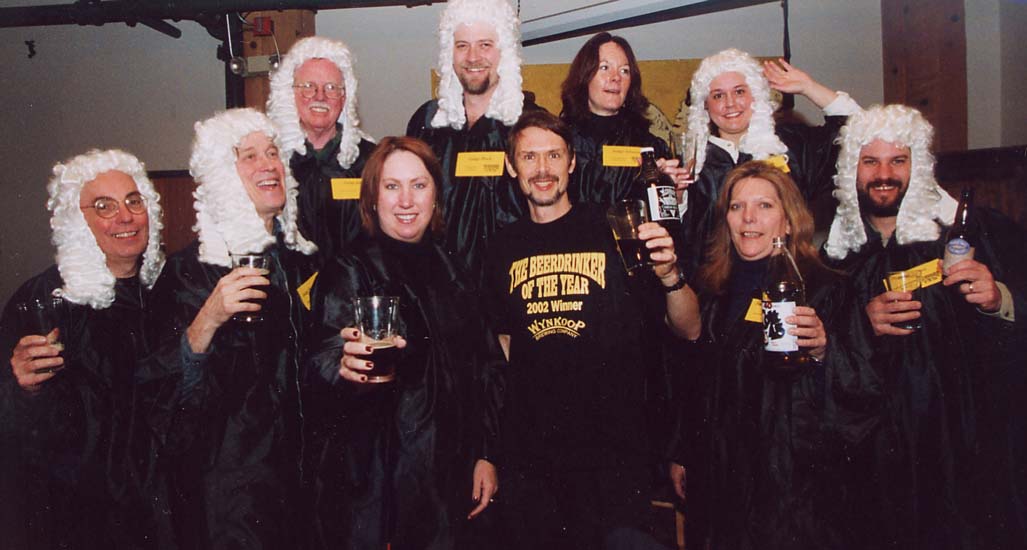
The Celebrated RTC Panel

Honorable Mention (in no particular order).

  • Pittsburgh.  Pitt was an oddity when it came to evaluating them for our countdown.  There was considerable variance among the voters as to where the Pitt program landed, and because of that they were one of the first teams to whom we awarded this “honorable mention” status.  Still, after the votes had been submitted, in the ensuing discussion it wasn’t that hard to move Pittsburgh out of the Top 10.  Make no mistake, it’s been an excellent ten years for the Pitt program, but in order to make a decade’s-end Top 10 list there are certain things you simply HAVE to get done.  Of their eight trips to the NCAA tournament, six of those saw Pittsburgh with at least a 4-seed (five of them were #3 or better).  The result?  Zero trips to the Final Four and only one Elite Eight.  It’s not like the Panthers didn’t have their chances.  True, it’s not easy to lose a coach like Ben Howland (who took Pitt to the Dance in 2002 and 2003) and the program deserves credit for a hire like Jamie Dixon, who didn’t miss a beat. And it’s not easy to lose to a Howland-coached UCLA team in 2007 in a #2-vs-#3 seed Sweet 16 game when you’re playing them in San Jose.  But if you want to be considered among the elite, you HAVE to beat 10th-seeded Kent State in the Sweet 16 when you’re a #3 (2002).  You HAVE to beat Pacific in the first round of 2005, even if you are on the low side of an #8-vs-#9 game.  You CANNOT LOSE to 13th-seeded Bradley in the second round when you’re a 5-seed (2006).  And perhaps the most painful — when you’ve earned a 1-seed after an incredible 28-4 season playing in the Big East, when you’re playing in your first Elite Eight in 35 years, you MUST beat the 3-seed, even if it is an in-state rival in the form of a very tough-nosed Villanova squad.  Dixon faces a bit of a rebuilding task in the upcoming season, but they ended the 2000s strong.  It’s because of that strong finish, that trend of improvement, that people – especially Pittsburgh fans – may be surprised to not see the Panthers in the Top 10 for the last decade.  As we start the new decade with the upcoming season, Dixon has the Pittsburgh program poised to move into that elite category.  As far as the last decade, though, they came up just short.
  • Illinois. On three of our personal Team of the 2000s rankings, Illinois barely missed the cut, meaning if the Bruce Weber-led 2005 squad managed to topple North Carolina for a national championship, they’d likely be included in the top ten. Illinois has also flamed out a bit at the tail end of the decade, finishing with a losing record in 2007-08 (16-19) before rebounding to a 24-10 mark in 2008-09 and eventually falling victim to a 12-5 upset by Western Kentucky. Bill Self and Bruce Weber have built a phenomenal program throughout the decade, though. The 2004-05 team featuring Deron Williams, Luther Head, Dee Brown and James Augustine was one of the top teams of the 2000s, flirting with an undefeated mark until Ohio State knocked them off in Columbus, then pulling off one of the most sensational comebacks in NCAA Tournament history in the Elite 8 against Arizona. Illinois has tied or won the Big Ten three times in the 2000s and finished as high as second three more times. What holds Illinois back from garnering a spot on the list? They haven’t reached the second weekend of the NCAA Tournament or won a conference title since that special 2004-05 campaign. Borderline teams have experienced more success in March, both in the Big Dance and in conference tournament play, than Illinois. For example, Maryland has two Final Fours, a national title and never finished with a losing record in the decade. Illinois hasn’t won the Big Ten Tournament since 2004-05. With packed recruiting classes ahead and a top-notch leader in Weber, Illinois will look to turn around a program that hasn’t been nearly as feared since watching Carolina cut down the nets on that fateful April night four years ago.
  • Gonzaga. The Zags undoubtedly were the most successful mid-major of the decade (moreso than Xavier and Butler), but their overall profile simply didn’t have enough juice to vault Gonzaga into the top ten. They dominated the WCC, winning the league eight times en route to an average of 26+ wins per year, an outstanding 80% winning percentage, and ten straight NCAA appearances.  But when it came to the NCAAs, Mark Few’s squads were only able to make it to the Sweet Sixteen four times.  And how many times in the decade were they able to advance past the third round?  Um, try zero.    Nevertheless, we believe that Gonzaga rates a tick higher than other such notable programs as Louisville, Wisconsin, Arizona and Oklahoma (all of whom made one F4) because they were so consistently good despite their scheduling limitations.  The worst Zag team (2006-07) still had 23 wins, and as a result of the weaker schedule of the WCC, their average NCAA seed was easily one of the lowest on our list.  Yet, as we all know, Gonzaga has tried to load up on high-impact RPI games during the nonconference slate, and we give them credit for that.  Fans of the other programs may quibble with this selection, but we can live with including at least one mid-major for consideration as the Team of the 2000s, and Gonzaga is our choice.
  • Arizona.  The obvious question here for Wildcat fans is how can a team that made the NCAA tournament every year for the past decade (and 25 straight if you don’t take away their vacated 1999 appearance) not be considered one of the top ten programs of the 2000s behind four teams that failed to make the tournament twice, two teams that failed to make the tournament three times, and another team that failed to make the tournament four times?  While the answer probably won’t satisfy Wildcat fans, it comes down to a few key things for us:
  1. Barely having a winning percentage at 70% despite playing in the Pac-10. Save the whining, West Coast people. The Pac-10 has only been one of the best conferences in the nation once in the past decade (2008 comes immediately to mind).
  2. Averaging 1.7 wins per NCAA Tournament appearance, which is lower than any other team in the top 10. The only team that they are close to is Syracuse and the Orange have a national title (wouldn’t be in the top 10 without it).
  3. Mediocre performance in the Pac-10. The Wildcats had 2.5 regular season conference titles (one being a split title) and 1 postseason conference title (since it was started in 2002). Like we said before, the Pac-10 might have the most attractive co-eds in the nation (although the SEC has a strong case), but the Pac-10 pales in comparison to the ACC, Big East, Big 12, SEC, and the Big 10 over the past decade in terms of the quality of their basketball teams.
  4. You could argue that the Wildcats got lucky with many of those NCAA tournament bids, most notably two years ago when they got in ahead of an Arizona State team that had a very strong case for being in above their rival.
Share this story

Team of the 2000s: #1 – North Carolina

Posted by rtmsf on August 21st, 2009

teamof2000(2)

Ed. Note: check the category team of the 2000s for our other entries in this feature.

And so we reach the pinnacle.  Ladies and gentlemen, prep yourselves, as this will come as a complete shocker… but your #1 program of the last decade is the North Carolina Tar Heels.  We know that you were probably thinking it was Gonzaga or Pittsburgh, but alas, the fine programs from Washington and Pennsylvania will have to wait another decade for the RTC Good Hoopskeeping seal of approval.

Be sure to check back Monday as we’ll do some clean-up on the series, including a look at some of the programs who just missed the top ten.

#1 – North Carolina

team2000sunc2

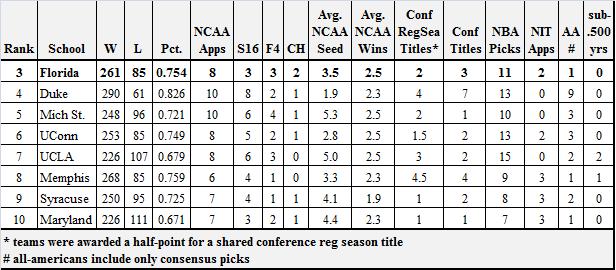
Overview.  Maybe we should just call it the Decade of Roy Williams.  After all, most of Carolina’s success in the 2000s is directly attributable to Ol’ Roy.  If you consider his 111 more wins at Kansas, three more trips to the NCAA’s second weekend and two additional F4s in the decade, you’re looking at a coaching juggernaut.  But Roy isn’t North Carolina and UNC isn’t Roy – it only feels that way.  This is about UNC, and despite a one-season blip in 2001-02 that time has forgotten, mostly accounting for their relatively poor overall winning percentage, the Heels have the goods in almost every other way.  Were they as consistent as Duke or Michigan State?  Nope.  Were they as much of a conference titan as KU or their hated rival in Durham?  Nope again.  But their numbers stack up very well in all categories across the board, and they’ve utterly dominated the second half of the 2000s in much the same way that Duke/Kentucky lorded over their respective halves of the 90s.  From 2005-09, the Heels have won two national championships with completely different casts, went to another F4, lost in OT in an Elite Eight and lost in the second round against the biggest Cinderella of the last quarter-century.  Not.  Too.  Shab.  The Heels didn’t have as much success during the first half of the decade, but they still managed to tack on another F4 as an absurd #8 seed in 2000, as well as two other second round appearances and an NIT appearance.  All the while continuing to produce a slew of  all-americans and NBA draft picks.  What separates Carolina in our eyes is the second championship that Roy hung next to the others in 2009.  Florida’s 06/07 back-to-back was extremely impressive, because everyone knows just how difficult it is to repeat in college basketball.  But in our view, it’s even more impressive to endure massive defections of NBA talent the likes of which UNC had from 2005-07 and still be able to climb the mountaintop a mere four years later.  A reasonable argument could be made that UNC was the best team in the country in four of the last five seasons (2005, 2007, 2008, 2009), and it wouldn’t necessarily render you a nutjob to contemplate it.  So North Carolina is our choice for the top program of the 2000s, and with the second championship currently shimmering in the Chapel Hill sunlight, we’re not convinced that any other school should be higher.

unc title 2005

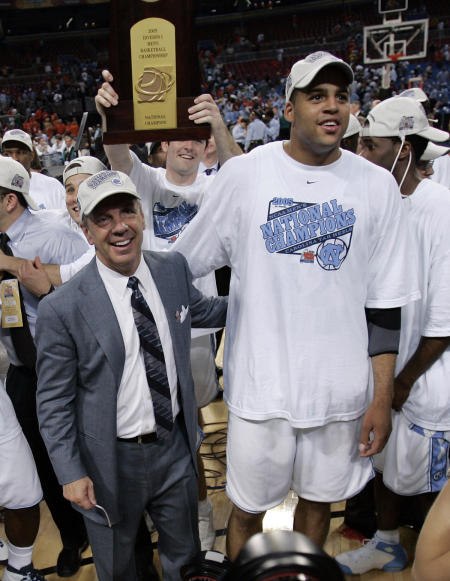
Pinnacle.  The 2005 national championship.  Just three short years removed from the worst Carolina season in modernity (more on this later), UNC was once again the king of the college basketball world.  What seemed a million and one miles away under Matt Doherty’s tenure felt like a natural outcome under the coolest of cats, Roy Williams.  One of the very proudest fanbases in America could once again claim basketball supremacy, and after what they had been through, it must have felt like raining gold coins from heaven.   Carolina’s fourth national championship team was led by Sean May, Rashad McCants and Ray Felton, but it was a long, lean freshman by the name of Marvin Williams who saved the Heels from a trademarked (at the time) Roy collapse when he rebounded a wild reverse layup from the sometimes-erratic McCants and punched it back in for a 72-70 lead.  A Felton steal later and several desperation three attempts by the Illini, and the monkey was most definitely off of Roy’s back.  His back is so light right now that he turned around and did it again in 2009 and looks primed to have several more shots at it before he retires a Carolina hero.

Tailspin.   Without question, the 2001-02 UNC team represents the worst season for a traditional powerhouse school in two decades.  But just as Duke was Team of the 1990s despite the Pete Gaudet Incident; UNC made up for its one bad year with plenty of success the rest of the decade.  In ACC circles, UNC’s record of 8-20 is still brought up as a euphemism for terrible.  And that team was terrible – eight of their twenty losses were of the 20+ point variety as teams who had long been pushed around by UNC wasted no time in returning the favor, if only for a year.  It began with three straight opening losses to the likes of Hampton, Davidson and Indiana, continued with a series of whippings by Kentucky, Maryland, Wake Forest, Duke and Ohio (at home), but the most embarrassing part of the entire season had to be the Heels’ last game of the year in the ACC Tournament.  Deciding that UNC simply couldn’t stack up talent-wise with the defending national champion Blue Devils (who had defeated them by a total of 54 pts in their regular season meetings), Matt Doherty decided to slow the game down to a veritable crawl, holding the ball until under-ten on the shot clock before running a play.  The typically entertaining and high-scoring Duke-Carolina showdown was bastardized into a 28-22 at the half Big Ten game.  Doherty got one more year to turn the ship around, but a near-mutiny at the end of the 2002-03 season led to the Roy Williams era.

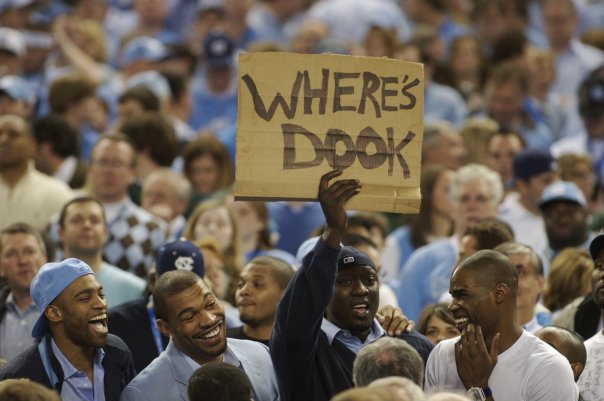
wheresdook

Outlook for 2010s:  Grade: A+.   Roy Williams is 59 years old and is showing no signs of slowing down.  Unlike other coaches his age, he seems to embrace recruiting and it pays off year after year with NBA caliber talent coming through his program.  By our count, Williams has recruited an absurd THIRTY McDonald’s All-Americans in his twenty-one years of coaching (average: 1.4 per year) at Kansas and UNC, and there are no signs of this receding (14 at Carolina already, including four incoming freshman for 2009-10).  Duke is the only other program with thirty or more.  Furthermore, there’s absolutely no chance of Williams taking any other job, NBA or college – he’ll be at UNC until retirement.  We fully expect UNC to continue to make F4s and compete for championships throughout the next decade, and the Heels may be right here on top of this list again ten years from now.

Share this story

Team of the 2000s: #3 – Florida

Posted by jstevrtc on August 18th, 2009

teamof2000(2)

Ed. Note: Check the category team of the 2000s for our other entries in this feature.

As we move into the top three teams of the 2000s, we reach rarefied air.  The team we review today at the third spot was one of the absolute toughest to place, for reasons that will be described below.

#3 — Florida

team2000sflorida

Overview.  When Billy Donovan arrived at Florida in 1996 he brought with him all of two years of head coaching experience, a mere 35-20 record as the head bull at Marshall.  In its previous 81 seasons, the Florida program had gone through 18 different head coaches and known the joys of only a single Final Four, coming in 1994 under Lon Kruger.  Nevertheless, much was expected of Donovan.  Because of his leadership skills displayed as a point guard at Providence and an assistant at Kentucky (serving head coach Rick Pitino in both capacities), Donovan was quickly anointed as the Next Big Thing in terms of young, up-and-coming college coaches.  He delivered quickly, getting the Gators to the championship game in 2000 (falling to Tom Izzo and the Flintstones) and establishing himself as an unbelievable recruiter.  But, despite the Blue Devil-like stable of stars, Florida in the early 2000s couldn’t manage past the second round at best in the NCAA Tournament; true, they had made themselves into a formidable power in the SEC, culminating in their first-ever (?!?) SEC Tournament title in 2005 – the first of three straight – but because of their troubles in the Big Dance people began to wonder if Donovan really had what it took to “win the big one.”  The best evidence to this was the fact that in each of their appearances from 2001 to 2005, Florida lost to a lower-ranked opponent, and usually quite handily.  The only non-double-digit loss during that span was a double-overtime defeat to Creighton in a 12-vs-5 game in the first round in 2002.  Those Florida teams may have had top-flight recruits but seemed to lack a physical toughness (with the possible exception of David Lee) required of a true NCAA title contender, and this resulted in the Gators frequently getting pushed around in early tournament games.

74728926_UCLA_v_Florida
Just as soon as people began to truly doubt Donovan, though, the coaching “potential” and the talent on the floor seemed to meld perfectly in the 2005-2006 season.  While fellows like Al Horford, Joakim Noah, Taurean Green, and Corey Brewer were all prized recruits during their high school careers, they weren’t quite as highly regarded as some of the players Donovan had on his comparatively disappointing squads mentioned above.  What those fellows did indeed possess was the physical toughness, killer instinct, and coachability that Donovan’s system requires, and this perfect fit resulted in Florida’s first national basketball championship in 2006.  Donovan and his Florida program still had their detractors who claimed that they merely lucked into an easy draw — four of their six victories in that tournament came against teams seeded 7th or worse — and that their 2006 title was just a fluke.  Surprisingly, the “Oh-Fours” (the collective nickname that Brewer, Horford, Noah, and Green had given themselves for obvious reasons) all decided to return to campus the following year despite the certain looming promise of NBA riches.  Flipping a gigantic middle finger to the aforementioned detractors, they proved that the previous season’s title was certainly no fluke by becoming the first repeat champions in 15 years.  When considering the two straight titles, Billy Donovan’s recruiting prowess, and his intact image as a young coach with an increasingly bright future, everyone from ESPN anchors to sports-talk radio hosts began tossing around that dangerous word — “dynasty.”

Then, just like Keyser Soze, poof — they were gone.  Proving that Florida is a program so bipolar that it should be on Lithium, after repeating as champs, the Gators missed the last two tournaments of the 00s.  So, let’s recap the decade in order:  a final, five early exits to lower-ranked teams, two national championships, two missed tournaments.  Florida basketball…your prescription is ready.

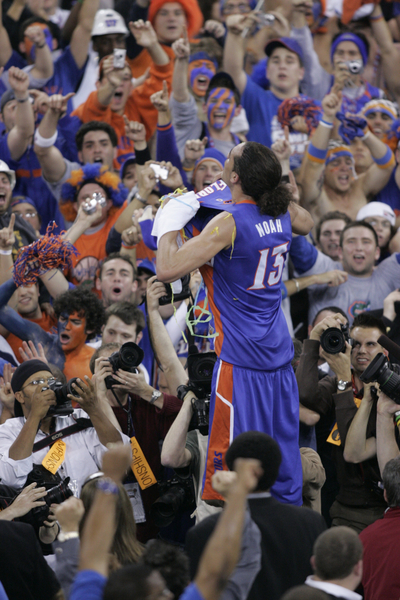
Pinnacle.  This has to be the night of the repeat championship in 2007.  The second title officially took care of any idiots who felt the 2005-06 championship was a fluke.  Also, we know how hard it is to repeat in this sport.  A case could be made that the true pinnacle was that pep rally after the first championship when the Oh-Fours all announced that they were coming back to college the next year, and of course after the second title everyone pretty much knew that those guys were gone.  But in this era of college basketball I don’t see how there can be any higher pinnacle than the very moments right after repeating as national champions — a peak brought into even greater relief by the decline that followed.

Tailspin.  It started on Selection Sunday in 2008.  Yes, Florida lost a lot of talent after the second championship, to say the least; they were left with a 2007-08 team consisting of two juniors, three sophomores, and seven incoming freshmen.  But with Walter Hodge, Marreese Speights and arguably the nation’s best recruiting class headed to Gainesville for the 2007-08 season, you’d think they could at least have made it back to the NCAA Tournament (to their credit, they did post a 24-12 record, 8-8 SEC).  The 2008-09 squad was also a young one, with 11 of the 14 players in either their freshman or sophomore years, but there was enough talent there to make the Dance.  To be honest, Florida basketball is still in its tailspin.

Will Billy the Kid Find Another Group Like the Oh-Fours?

Will Billy the Kid Find Another Group Like the Oh-Fours?

Outlook for 2010s: Grade: A-.  I wouldn’t go shedding any tears for Donovan or his Gator program.  Donovan will always get big-time talent, and, above all, it’s big-time talent that wins championships.  Most likely, Florida fans can rely on this continued steady diet of…unsteadiness, meaning a cycle of deep tournament runs followed by NIT births.  But if Donovan can find a way to keep the player defections (for whatever reason) to a minimum and get to the point where he can develop teams with some upperclassman leadership, you’ll see a longer string of consecutive years where Florida doesn’t just have great incoming freshman classes but a solid foundation of a few juniors and seniors — and it’s in this manner that legendary runs are built for a program.  It could very well begin with the upcoming season as Kenny Boynton and Erik Murphy come to town to lend their assistance, comprising a smaller yet still highly skilled recruiting class.  Most likely they’ll all have people forgetting how to pronounce “Calathes” by Christmas.

Share this story

Team of the 2000s: #5- Michigan State

Posted by zhayes9 on August 15th, 2009

teamof2000(2)
Ed. Note: Check the category
team of the 2000s for our other entries in this feature.

With the first five teams of our Team of the 2000s countdown here at Rush the Court out of the way, we can truly delve into the class of the decade. These are teams that didn’t just experience a couple years of peak success, but sustained prominence and positive standing throughout the ten seasons that are being considered. These are programs that first pop into the head of basketball fans when considering the cream of the crop not only in recent years, but throughout the annals of the sport’s illustrious history. The midpoint takes us to the Midwest. In fact, they’re the lone team from their conference on the list- the Michigan State Spartans.

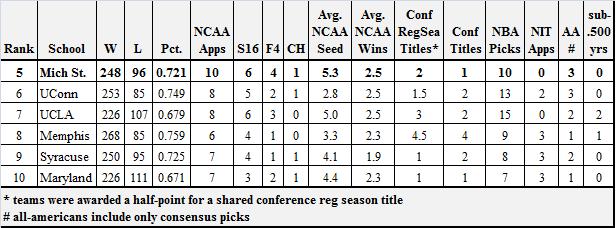
#5 – Michigan State

team2000smsu

Overview. While the Spartans did experience certain success during the Jud Heathcote era extending nearly 20 years in East Lansing, Michigan State battled through nine seasons of .500 or worse basketball in conference play during his tenure. Enter longtime assistant Tom Izzo, a passionate and in-your-face personality that immediately made marked improvement for the program, sending the Spartans to the NCAA second round in 1996 and 1997, followed by a Sweet 16 in 1998, a Final Four in 1999 and culminating in the program’s second national championship to kick off the decade of the 2000s. From there, Izzo has continued to deliver, sending the Spartans to the Final Four yet again in 2001 and winning 20 games every season in the decade with the exception of 19 and 18 wins in 2001-02 and 2003-04, respectively. Unlike some teams preceding the Spartans that have faded out of contention, Izzo has sent Michigan State to the tournament every single season in the 2000s (they didn’t have one losing season, either) and only two programs – Kansas and North Carolina – have averaged more NCAA wins than Michigan State (2.5 per tournament).

4390903142048_Ohio_St_v_Michigan_St[1]

Pinnacle. Only two programs have sent their basketball teams to the Final Four on four separate occasions in the decade – North Carolina and Michigan State. The 2001 run is slightly tainted because the Spartans had to defeat a 16, 9, 12 and 11 seed to reach Minneapolis only to get throttled by Arizona, but give that team credit for collecting a #1 seed. The 2005 run is famous for the thrilling double-OT win over Kentucky involving Patrick Sparksfoot-on-the-line game-tying three. That Spartans team led at halftime against eventual champion UNC in the national semis before faltering. The 2009 run was also memorable with a gut-check win over Kansas and the dismantling of #1 seeds Louisville and Connecticut (gives me an excuse to show this). But the pinnacle is fairly easy to determine – the 2000 national title run behind Mateen Cleaves, Jason Richardson, Morris Peterson and Charlie Bell takes the cake. That juggernaut won every single NCAA Tournament game by double digits. Hey, even if it took place three months into the decade, it still counts.

Tailspin. Michigan State has been so consistent as a program over the course of the decade, it’s hard to pinpoint a specific tailspin similar to, say, Syracuse missing the tournament two years in a row. The one knock on Izzo has been his inability to win Big 10 conference regular season and tournament titles. This might stun you, but the Spartans did not win a single regular season title for six consecutive seasons in the middle of the decade and hasn’t won a Big 10 conference tournament since the 2000 national title season. My vote goes to 2005-06 and 2006-07: 16-16 in Big 10 play including a first round loss to George Mason in 2006 (that team faded away right after said upset).

Outlook for 2010s: Grade: A. Seriously, the Spartans are in TREMENDOUS shape as long as Tom Izzo is leading the charge, and he shows no signs of slowing down. Unlike Gary Williams’ struggles to recruit within the D.C./Baltimore region, Izzo perennially raids Michigan of its elite talent. Five and four star recruits Durrell Summers, Kalin Lucas, Draymond Green and incoming center Derrick Nix are all from Michigan and Izzo has extended his boundaries throughout the Midwest. Izzo not only collects lauded recruits, but they immediately buy into his hard-nosed system that has proven so effective. Izzo has run a notoriously clean program that graduates players at a high rate. The Breslin Center is one of the loudest arenas in college basketball. What’s not to like here? With another potential top-five team gracing the hardwood again this season, the future for Michigan State in the next decade is very bright.

Share this story

Team of the 2000s: #7 – UCLA

Posted by rtmsf on August 12th, 2009

teamof2000(2)

Ed. Note: check the category team of the 2000s for our other entries in this feature.

As we were going through the list of candidates for the top programs of the 2000s, we found that teams tended to fall into similar statistical cohorts.  Among the top twelve programs, we found three such delineations where teams within each group were largely indistinguishable, and our discussions over rankings got more intense as a result.  The group involving #8-#12 was one such cohort, and as we’ve noted in the comments, the rankings within that group came down to slicing hairs.  The next group where teams were very similar begins today with our seventh choice, and continues through to the fifth selection early next week.

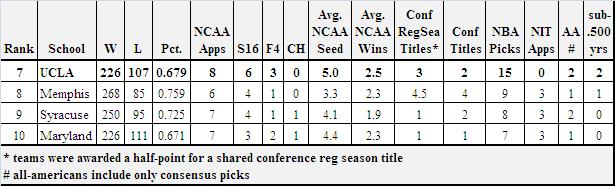
#7 – UCLA

team2000sucla

Overview.  The nation’s program with the most all-time championships failed to win one during the 2000s, but under the wise direction of Ben Howland, integrity and pride was restored in Westwood during this period.  Whereas Maryland, for example, started off the decade with a bang and ended on a whimper, UCLA took the opposite track.  The decade for the Bruins began better than you probably remember under Steve Lavin, with disappointing regular seasons followed by runs to the Sweet Sixteen (as a #8 and #6 seed in two of those years), but then the bottom fell out – the Jason Kapono-led team of 2002-03 wilted during a nine-game midseason losing stretch to end up with the first sub-.500 season in Westwood in over fifty years.  Out with much-maligned Lavin and in with the studious Ben Howland from Pittsburgh.  After one year gaining traction (11-17) under the new regime, things have been on the uptick ever since, as UCLA has been to five straight NCAAs with three consecutive trips to the final weekend sandwiched in the middle.  In two of those years, the Bruins ran into the buzzsaw Florida teams that went back-to-back: we often wonder whether UCLA would have cut down the nets had they avoided the Gators in either of those years.  In terms of UCLA’s placement on our Team of the 2000s list, it’s clear that the dominance they showed in the NCAA Tournament from 2006-08 has had an effect on people to the extent that the two losing seasons were largely forgiven.  Six trips to the second weekend and three trips to the final one, while doing so with a generally weaker seed than its contemporaries on the list, is enough for us.  UCLA was the seventh best program of the 2000s.

Pinnacle.  Since UCLA has yet to win the brass ring under Howland, we’re going to go with a well-known incident in the 2006 NCAA Tournament that announced to everyone in college basketball that UCLA was “back” and would have to be dealt with.  You’ll remember it well.  UCLA was down nine points with 3:26 to go against America’s mid-major darling, Gonzaga, and their NPOY candidate Adam Morrison.  Gonzaga had been the dominant team for the entire game, but UCLA’s pressure defense was just getting started.  When it was all said and done, UCLA had finished the game on an 11-0 run, Morrison was left crying on the floor of the Oakland Coliseum and pangs of long-dormant hatred were welling up across America for the celebrating team in white and gold.  UCLA would go on to the NCAA finals where Florida cleaned their clock (Act 1), but Ben Howland had established UCLA as a national powerhouse once again and recruits started lining up at the gates.  Let’s reminisce with Gus Johnson’s call, shall we?

Tailspin.   A UCLA fan would reply with “the Steve Lavin era,” but that’s a little unfair from an objective viewpoint.  In Lavin’s seven years at the helm, he took UCLA to four Sweet Sixteens and one Elite Eight in six NCAA appearances.  Yet there was always a sense that his teams underachieved given the NBA talent they had on the floor (the fact that Lavin suffered ten losses of 25+ points supports this view).  Still, the writing was on the wall during the 2002-03 season when UCLA started out 4-14 before rallying late to win eleven games (including a Pac-10 Tourney victory over #1 seed Arizona) – UCLA was on the ropes.  Frankly, given the number of coaches that the Bruin program has gone through since the Wizard retired in 1975 (seven prior to Howland), it was no guarantee that their next hire would be a good one.  Dan Guerrero made a shrewd choice in going with the rough-and-tumble style of Ben Howland – the rest of the Pac-10 wasn’t ready for Big East basketball on the west coast.

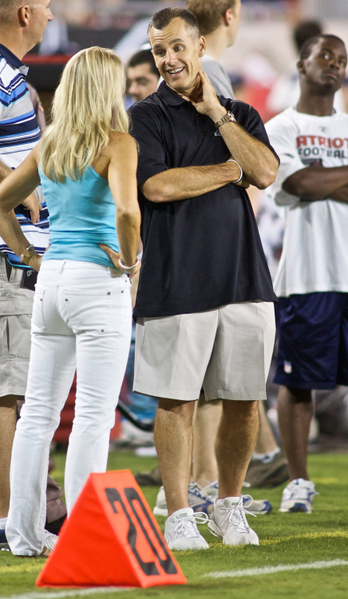
howland with wooden

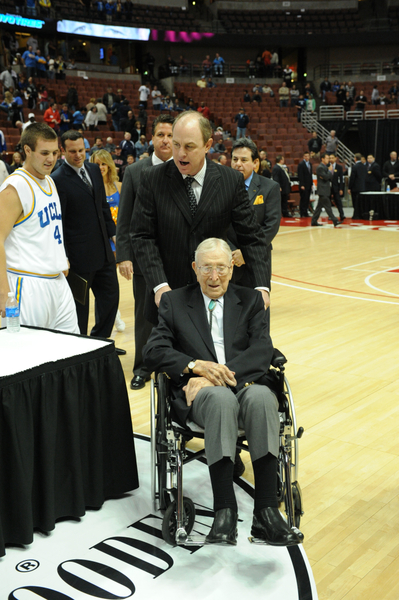
Outlook for 2010s:  Grade: A+.   It’s simply a matter of time before Howland hangs #12 up in Westwood.  There’s an unbelievable amount of talent in Southern California, and now with USC and Arizona out of the way (for a while, at least), the Bruins should even further dominate the market.  According to Scout’s team rankings, Ben Howland has brought in a top 25 class in each of his last five years at the school, and the last three years were all in the top twelve.  And with six first-round NBA draft picks in the last four seasons, Howland has established a clear prep-to-pro pipeline that keeps young players interested in playing near the beach.  Furthermore, Howland, at age 52, has no designs on another position.   He’s stated numerous times that he’s currently coaching at his dream job, and unlike other coaches who shall remain nameless, we actually believe this guy.  His next ten years should be the apex of his career, and UCLA should feel especially lucky to have gotten him.

Share this story

Team of the 2000s: #9 – Syracuse

Posted by rtmsf on August 10th, 2009

teamof2000(2)

Ed. Note: check the category team of the 2000s for our other entries in this feature.

And we’re back with the second installment of our Team of the 2000s feature.  Just to refresh the schedule we anticipate, we’ll be putting up #10-#6 this week, and #5-#1 next week.  Yesterday we picked Maryland as our tenth selection (over Gonzaga, Pitt, and several others) and we’re declaring today that the ninth best program of the 2000s is none other than the Syracuse Orange…  let the flames begin.

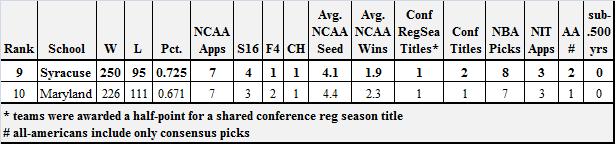
#9 – Syracuse

team2000cuse2

Overview.  This selection will be one of our more controversial top 10 selections. How can a team miss the NCAA tournament 3 of the 10 years of the decade and still manage to sneak into the top 10 when perennial Sweet 16 teams get left on the outside looking in?  Simple. Win a national title. Ok. It’s a little more complex than that, but in my eyes to be an elite program you have to win a national title (or at least come agonizingly close as a subsequent team on this list has done). Are we overvaluing that “One Shining Moment?” Perhaps, but to even the most hardcore college basketball fans like ourselves the eras are defined by the champions not the near-misses (with potential exceptions like the Jameer Nelson St. Joseph’s team). In this case, the Carmelo Anthony/Hakim Warrick/Gerry McNamara team outweighs the 3 NIT bids – two of those years were controversial snubs and the other was a late-season nosedive the year before Carmelo showed up in upstate New York. Beyond that the Orangemen have made two Sweet 16 appearances to go along with two Big East Conference tournament titles (in years they flamed out in the 1st round of the NCAA tournament). Despite missing the NCAA tournament two of the last three years, the Orangemen have shown signs of a resurgence with last year’s Sweet 16 appearance that followed their epic 6-OT win against UConn in the Big East Tournament and the addition of what appears to be a strong recruiting class.

8360118  Syracuse v Memphis

Pinnacle.  As I noted before, the 2003 national title is the clear-cut choice here. Before Kevin Durant and Kevin Beasley, there was Carmelo Anthony. While Anthony may not have put up as spectacular numbers as the other two in his freshman season (and consequently didn’t win any national POYs from any major media sources – RTC didn’t exist at the time or he would have at least one award), he does have the one thing that neither of those two freshman picked up in their layovers in college: a national title. The 2003 Orangemen team will never be mentioned among the all-time great teams, but they rebounded from an opening-game loss to Memphis to finish a very respectable 30-5. Jim Boeheim started the same 5 for all 35 games: two freshmen (Anthony and McNamara), two sophomores (Warrick and Craig Forth), and one senior (Kueth Duany). Despite how history will remember this as “Melo’s team”, the Orangemen did feature three other double-digit scorers. In the NCAA tournament, Syracuse was only seriously challenged twice: once against a Marquis Daniels-led Auburn team staging a furious comeback in the Sweet 16 (a game I attended) and the championship game where Warrick blocked a potential game-tying 3 by Michael Lee in the waning seconds to give Boeheim his first and only national title to date.

Tailspin.  2008. After following up the 2003 title with a Sweet 16 trip (minus Melo), the Orangemen were upset in the 1st round in back-to-back years  (2004 and 2005) including infamously to the Taylor Coppenrath-led Vermont Catamounts. Things couldn’t possibly get any worse for the Orangemen, right? Wrong. Try back-to-back Selection Sundays in 2007 and 2008 where Jim Boeheim’s crew was the proverbial “last team left out”. Following that 2008 season, there were several vocal critics in the upstate New York area who were calling for Boeheim’s head.

Outlook for 2010s:  Grade: B+. It’s amazing how quickly things have turned around for Boeheim. While the Orangemen lose a lot in the backcourt (Jonny Flynn and Eric Devendorf) along with Paul Harris and Kristof Ongenaut, they are absolutely loaded on the inside where they boast returnees Arinze Onuaku and Rick Jackson along with 4-star recruit DaShonte Riley and Iowa State transfer (and Big 12 All-Rookie selection) Wesley Johnson. That alone should be enough for the Orangemen to compete in a relative down year in the Big East with DeJuan Blair and Hasheem Thabeet no longer roaming the paint. Syracuse won’t contend for a national title next year, but their fans aren’t thinking about the 2010 Final Four. They are thinking about cutting down the nets in 2011 when they will be bringing a loaded freshman class to the NCAA tournament with Fab Melo, Dion Waiters, and C.J. Fair. While this class can’t match the one that John Calipari stole brought with him to Kentucky, it’s an impressive haul for Boeheim. The question is whether Boeheim can continue this kind of recruiting success after they start reading the weather forecast for Syracuse in the middle of winter (actually, that’s never hurt him before, his players can’t read… we kid, we kid)…

Share this story