
Recruiting Rumor Mill: 08.02.10 Edition

Posted by nvr1983 on August 2nd, 2010

It was a relatively quiet week for recruiting after the crazy week last week in Las Vegas, but we should start to get more news over the next few weeks as recruits start narrowing down their list or even committing to schools.

  • Austin Rivers got the headlines in Orlando this week, but we hope that everyone paid attention to a solid performance from Trevor Lacey, who had 22 points to Rivers’ 24 points, as they combined to lead their team to victory. The game was supposed to be a showdown between Rivers and Michael Gilchrist that was scrapped when Gilchrist’s mom shut him down for the summer, but there was still plenty of star power as Rivers and Lacey knocked off Ben McLemore and Bradley Beal.
  • Speaking of Rivers…by now you have probably already read it, but for those of you who haven’t, FanHouse has a pretty lengthy profile on Rivers, his dad’s influence on his game, and the schools he is looking at.
  • It seems like a weekly thing now, but we have another update for Anthony Davis. The talented power forward has apparently expanded his list to include DePaul. Even though that is his hometown team I’m sure the Illinois faithful are wondering why Bruce Weber can’t elicit any interest from an in-state recruit like Davis.
  • Maurice Harkless is starting to turn some heads especially after his solid performance at the Fab 48 and after beating out a number of big names for MVP honors at the Desert Duel. Harkless, who had previously committed to UConn, will be releasing his list later this month and if the names of the coaches watching him this summer are any indication the list should be full of big names.
  • Dayton received a commitment from Percy Gibson, a 6’8 big man from Detroit who the Flyers reportedly had as their #1 big man target. [Ed. Note: Does a school ever pick up a player who wasn’t their #1 target?]
  • Meanwhile, Rutgers added its own big man in Derrick Randall, who has stated that he will try to bring his AAU point guard (and St. Anthony’s recruit) Myles Mack with him.
  • With so few highly rated big men in this year’s class, every solid interior player is drawing a lot of interest and Johnny O’Bryant is no exception, as he is drawing interest from big names like Kansas, Kentucky, and Louisville.
  • Nick Kerr, son of former NBA sharpshooter Steve Kerr, won’t be following in his father’s footsteps at Arizona, opting to stay in California (where the family resides now) and committing to play at San Diego. Like his father, Nick possesses a sweet jump shot (41% from 3-point range and 85% from the free throw line as a junior) and has not been heavily recruited out of high school.
  • Although this isn’t what you normally think about when you consider recruiting, Andy Glockner brings us an analysis of incoming transfers who are basically new recruits. Teams are unlikely to get game-changers like a star freshman, but some of these transfers could give their teams just the little bit extra they need to get over the hump whether it is into the NCAA Tournament, into the Sweet 16, or cutting down the nets in San Antonio in April.
  • Read the rest of this entry »

Share this story

Recruiting Rumor Mill: 07.26.10 Edition

Posted by nvr1983 on July 26th, 2010

This week’s action was mostly centered around Las Vegas (and we will certainly talk about Vegas), but there as always there was news from across the rest of the nation. Based on the way that these AAU tournaments run most of our “news” comes from tweets from courtside observers, but we do have a few articles sprinkled in here. If you have a hot recruiting tip or news that you want to share with us, e-mail us at rushthecourt@gmail.com.

Read the rest of this entry »

Share this story

The Meteoric Rise Of Anthony Davis

Posted by nvr1983 on July 20th, 2010

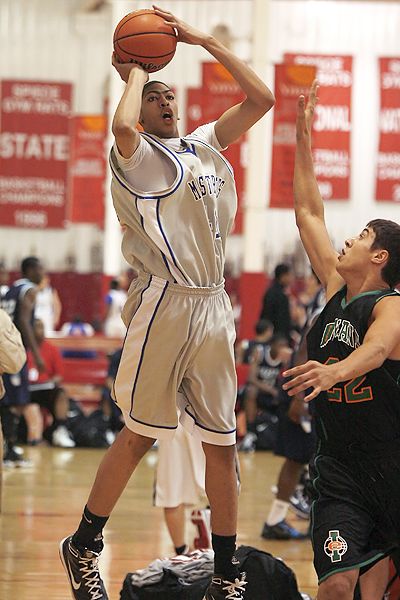
For most of his high school career, Michael Gilchrist (a recent Kentucky verbal commit), has been the top-rated player in his class. Now it looks like the talented small foward might be losing his place atop those rankings through no fault of his own. Instead, the reason for his drop is the spectacular play of Anthony Davis over the past few weeks, which has prompted many analysts to anoint the 6’10” power forward out of the “Mean Streets” of Chicago (that’s actually his AAU team’s name) as the new #1 player in the rising senior class. Davis has been rising up the charts so rapidly that even in-state schools like Illinois have only began to pay particular attention to him in the past few months. An ESPN Chicago writer took a look at the rise of Davis back in May while he was rocketing up the class rankings, but was still not receiving “#1 in the class” praise. Currently, the only listed “schools of interest” are SyracuseOhio State, and Kentucky although there are reports that UNC is reportedly interested in Davis (and which school wouldn’t be?). However it appears that the Tar Heels sit in 4th position at the moment while the Davis family analyzes UNC’s current situation.

Credit: David Dixon/Natural Talent Scouting

Where will Davis land?

All of this begs the question as to how someone as talented as Davis could go relatively unnoticed in the over-saturated recruiting landscape. The only comparison player we could think of who rocketed up this quickly this late was Tracy McGrady who went from a relative unknown coming into the summer before his senior year to the top recruit in his class by the time he graduated a little over a decade ago, but that was pre-YouTube and even pre-Google (yes, there was a world before Google). Part of the reason that Davis has shot up the rankings is because of a ridiculous growth spurt during his sophomore and junior years (6-7 inches in 18 months according to Evan Daniels). Still some Illinois recruiting gurus [Ed. Note: We are imagining a Hoop Dreams-like TV segment here.] only had him as the #9 player in the state of Illinois after the high school season ended just a few months ago. There has been some speculation amongst Illinois high school basketball fans that Davis may have been ranked so low coming into the summer because he played in a weak Chicago Public League division that most of the recruiting gurus paid little attention to and until this summer he had skipped the AAU summer circuit. All of this seems perfectly reasonable although somewhat surprising so we are left to wonder just how good Davis actually is. For that we turned to Jeff Goodman of Fox Sports and Adam Zagoria of ZagsBlog, who have seen Davis in person and spoken with Davis and people close to him.

Read the rest of this entry »

Share this story

Morning Five: 07.06.10 Edition

Posted by jstevrtc on July 6th, 2010

  1. Let’s just get this out of the way early: Damon Evans has officially resigned as Georgia’s AD.  He’s got enough on his mind, so we see no need to pile on any further.
  2. Stan Heath guided South Florida to a tidy 20-13 record last year and 9-9 in the Big East, a 125% improvement in the Bulls’ best-ever Big East tally.  He was rewarded with a four year extension to his current contract, so he’s locked down until 2015.
  3. Ouch.  Former Kentucky big fella Daniel Orton’s line in his first summer league game for the Magic:  three points (on 1-8 shooting), five fouls, four turnovers, and an ejection.  But that’s one of the purposes of the summer league, right?  We’re sure Orton will get the kinks worked out, and kudos to him for staying positive.  But some of the takes on his rocky debut have been pretty funny.
  4. Rivals.com lists ten hot-seat coaches for next season.  We don’t know about Bruce Weber, but it’s hard to argue with the other nine.
  5. The gentlemen at Scout.com have released their spankin’ new top 100 list of high school recruits for the class of 2011.  It’s always fun to look at the “Schools of Interest” column on these lists; of the top six, John Calipari’s already nabbed two of them and is in the running for three others, but, examining the whole list, one can tell that the boys at Ohio State and North Carolina aren’t exactly sleeping on the job.
Share this story

Opening Round Questions Still Unanswered

Posted by jstevrtc on July 2nd, 2010

Andrew Murawa is the RTC correspondent for the Pac-10 and Mountain West conferences and an occasional contributor.

The NCAA Men’s Division I Basketball Committee met this week in Chicago, and the biggest item on their agenda was to decide on the format of the new 68-team tournament. In deciding to expand from the 65-team tournament, which has been the rule for the last ten years, to 68 teams in time for the 2011 tournament, the NCAA has committed itself to four opening round games.  The questions of who will play in those games, however, and where those games will take place, among other logistical issues, are still to be decided. While it doesn’t look like a decision will be announced this week, outgoing committee chairperson and UCLA athletic director Dan Guerrero has spelled out three possible options for who will compete in the opening round games:

  1. The teams that would be the 16th and 17th seeds in a bracket, or those teams seeded at spots 61 through 68 in the overall field — likely teams from the historically one-bid conferences,
  2. The last eight non-automatic qualifiers or the teams generally referred to as bubble teams — generally teams from a mixture of BCS leagues and mid-major conferences, or
  3. Some combination of the first two options, with the most talked-about scenario being the last four bubble teams playing in a couple of games and the lowest seeded automatic qualifiers (seeds 65-68) playing in the other two.

While it is still within the realm of reason that additional options could arise (maybe the lowest seeded automatic qualifiers each match up against one of the bubble teams), the answer will likely be one of the three options above. And, frankly, option three is a bit of a copout, so the decision between options one and two comes down to something of a battle between the big power conferences and the less influential conferences that nonetheless make up the bulk of Division I. And neither side wants to play in those games.

Should a conference champ be sent to an opening-rounder and have a better chance to make more money, or should their performance be rewarded with a spot in the main draw?

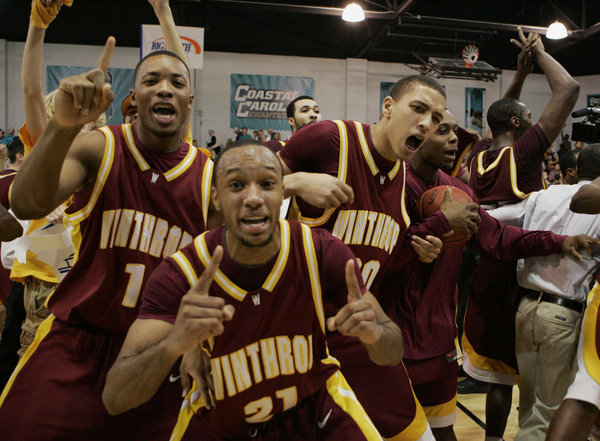
“I think that if you are an automatic qualifier, you should not be in a play-in game,” said Winthrop head coach Randy Peele when we talked with him earlier this week, and he’s had experience with the opening round game as the coach at a school that has now appeared in two opening round tournament games, including last season’s loss to Arkansas-Pine Bluff.  Peele’s sentiment was echoed by Michael White, the Associate Athletic Director for Communications at East Tennessee State University. “For teams like ours that come out of a league with one tournament bid, and to have to earn it by winning our conference tournament, we don’t want to have to be sent to a play-in game.”

Even the term “play-in game,” used in reference to the single opening round game played in Dayton for the last ten years, is a divisive one. The NCAA has gone to great lengths to make sure that game was referred to as the “opening round game,” despite it commonly being referred to by fans and media as the play-in game. “The way the NCAA markets the first day is critical,” said ETSU’s head coach Murry Bartow. “They shouldn’t be marketed as play-in games, where you’re not even in the tournament until you win that game.”

Read the rest of this entry »

Share this story

Morning Five: 05.25.10 Edition

Posted by rtmsf on May 25th, 2010

  1. Some transfer news from the weekend…  Two of the bigger names in college basketball from a celebrity perspective are leaving their respective schools.  Guard Jeff Jordan (MJ’s son, in case you hadn’t heard) is leaving Illinois for his senior season a mere year after he quit the team and returned the first time.  We’re not sure what exactly the deal is with the somewhat indecisive Jordan, but the word is that he’s looking for more PT than the fourteen minutes per game he received last year for the Illini.  The other big transfer name belongs to Percy Miller, aka Lil Romeo, the hip-hop star who presumably sold a lot more albums than he scored points (5) in his two-year USC Trojan career.  The subject of one of RTC’s first-ever posts (#3 actually), it’s not clear whether he will try to continue playing college basketball elsewhere or give it up completely.
  2. Moving to players that actually matter at this level, former Washington guard Elston Turner will re-surface at Texas A&M beginning in 2011-12 and LSU star guard Bo Spencer will be ineligible for the fall semester next season as a result of academic problems.  Turner will have two years of eligibility in College Station, while Spencer will have an opportunity to return to his team next winter if he can get his books in order.
  3. The final notable piece of news with players leaving is that Florida’s Nimrod Tishman is leaving the Gator program after only one year in Gainesville.  He is returning to Israel to play professionally, causing mass lamentations throughout the SEC fanbases from Fayetteville to Columbia.
  4. Is the one-year renewable scholarship a bigger problem than we, or anyone, knows?  If you buy USA Today’s report that over 20% of athletes on the 65 NCAA teams leave the program in a given year, it just might be.  We’d never really given it much thought other than when a new coach comes into town and runs everyone off (see: Calipari, John), but maybe we should start paying attention to this a little more.
  5. We always thought something didn’t smell quite right with the universally-liked and respected Tyler Smith being caught with a firearm in a rental car on New Year’s Day.  Smith finally came out and said that he purchased the gun based on death threats that he was receiving about his three-year old son.  He didn’t go into details as to whom was making the threats or why they would be making them, but he’s now back in Tennessee after playing professionally in Turkey for a few months and waiting to see if his name is called next month in the NBA Draft.
Share this story

Breaking Down The ACC/Big Ten Challenge Matchups

Posted by zhayes9 on May 13th, 2010

Zach Hayes is a regular RTC writer and resident bracketologist.

The ACC/Big Ten Challenge is surely one of the highlights of the non-conference season. These two power conferences are perennially the most competitive and successful in college basketball, and the powers-that-be who determine the games routinely do a fantastic job of pitting the best teams from each respective conference against each other. The Challenge next winter is ratcheted up even another notch with Duke, Michigan State and Purdue likely rounding out the top three in the polls. Let’s delve into each game with a breakdown and prediction:

November 29- Virginia at Minnesota

The ugly Sylven Landesberg breakup was crushing for Virginia’s hopes of contending in the ACC this season. Trusting Tony Bennett and his system, most prognosticators would likely have pegged the Cavailers as a NCAA team with Landesberg around. Virginia still has returning talent in spite of his departure, but it won’t feature enough firepower to win at the Barn in Minneapolis. Replacing Lawrence Westbrook and Damian Johnson won’t be easy, but Tubby Smith still has a 47% three-point shooter in Blake Hoffarber, breakout candidate Devoe Joseph and the return of star guard Al Nolen at his disposal. Winner: Minnesota (Big Ten leads 1-0).

November 30- North Carolina at Illinois

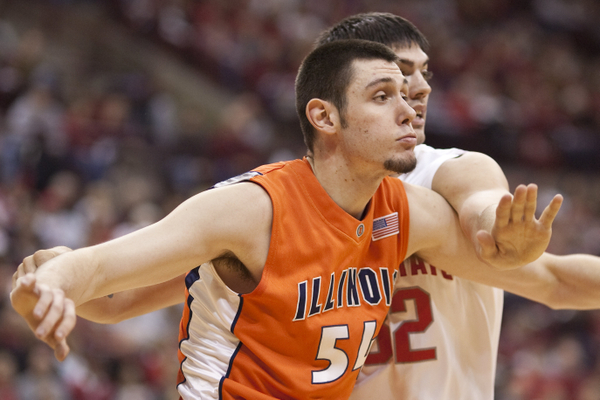
One of the headlining matchups, this game should peg two top-25 teams that boast loads of young talent. Depending on how much of an impact freshmen Harrison Barnes, Kendall Marshall and Reggie Bullock can make immediately, and how much John Henson, Tyler Zeller and Larry Drew improve in the offseason, Carolina could make the leap from NIT participant to top-15 team. Illinois has their own heralded recruiting class entering Champaign to play alongside reigning assist kid Demetri McCamey and the twin towers of Mike Davis and Mike Tisdale. It’s a bit overzealous to expect a young UNC team to win such a difficult road game this early in the season. Winner: Illinois (Big Ten leads 2-0).

Mike Tisdale leads a talented Illinois squad against Carolina

November 30- Ohio State at Florida State

These two teams faced off in last year’s Challenge and the Buckeyes were able to emerge victorious in Columbus. Now they travel to Tallahassee to take on a Seminole squad that may have lost Solomon Alabi, but they do return all-ACC candidate Chris Singleton and sophomore Michael Snaer, a much-ballyhooed recruit two years ago that could make an impact. The Buckeyes still out-man the ‘Noles at nearly every position, though. If Aaron Craft is able to run the point as a freshman, the sky’s the limit for Thad Matta’s team. Jared Sullinger is the most college-ready player of this year’s class. He teams with three-point marksman Jon Diebler, the super-talented William Buford, defensive stalwart David Lighty and shot-blocker extraordinaire Dallas Lauderdale. Buckeyes squeak one out on the road. Winner: Ohio State (Big Ten leads 3-0).

November 30- Michigan at Clemson

Clemson will be looking for redemption after last season’s Challenge collapse against Illinois. A new coach, Brad Brownell, leads the Tigers charge without Trevor Booker. They still have enough to knock out a rebuilding Michigan team on their home floor. Demontez Stitt, Andre Young and Tanner Smith lead a talented Clemson backcourt, while Jerai Grant can certainly contribute in the post. Without Manny Harris and DeShawn Sims, it’s going to be a long season for John Beilein. Look for incoming freshmen Tim Hardaway Jr. and Evan Smotrycz to get an opportunity right away. Winner: Clemson (Big Ten leads 3-1).

Read the rest of this entry »

Share this story

Post-Deadline 2010-11 Top 25

Posted by zhayes9 on May 10th, 2010

Zach Hayes is a regular RTC writer and resident bracketologist. You can follow his sports-related thoughts at Twitter.

This past weekend, the NBA Draft early entry deadline came and went. With most of the incoming freshman having decided their destination next fall (looking at you Terrence Jones) and underclassmen making their final announcements about next year’s plans, we finally have a solid sense of how the rosters will shake out for the 2010-11 college basketball season. Sounds like a fantastic time for another top 25 to me. I did my best to project each team’s starting lineup (which of course could change with injuries, suspensions, academic ineligibility, etc. from now until November) and even strapped on some predictions at the end. Enjoy.

1. Duke

Starting Lineup: G Kyrie Irving, G Nolan Smith, F Kyle Singler, F Mason Plumlee, F Miles Plumlee

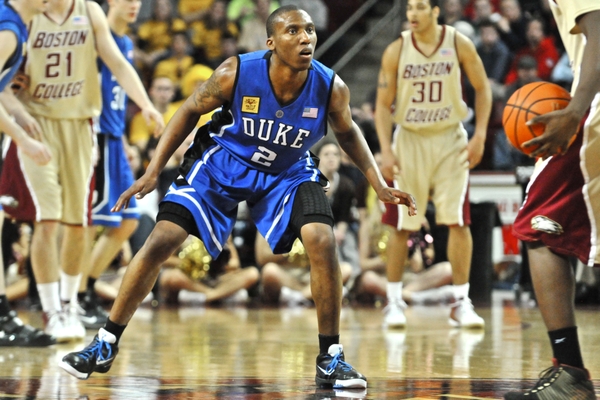
The Blue Devils established themselves as the near-consensus top team as soon as Kyle Singler opted to return to Durham for another campaign. The losses of big bodies Lance Thomas and Brian Zoubek could leave them a bit thin up front and slightly vulnerable against sizable opponents like Kansas State (both will participate in the CBE Classic) or ACC foe Florida State, but Mason Plumlee is a tremendous candidate to break out in his sophomore season. Jon Scheyer is replaced at the point by who scouts are saying might be the best guard to ever come out of New Jersey in Kyrie Irving. Pair him with returnee Nolan Smith and the Blue Devils are a prime candidate to push the tempo this season. Singler and Smith are both definite ACC POY candidates and Irving is the biggest recruit for Coach K since Josh McRoberts. Seth Curry was a 20+ PPG scorer at Liberty in 2008-09 and should be the first guard off the bench, while Andre Dawkins gives Coach K a deadeye shooter for crunch time. This combination of talent plus a championship trophy from April equates to an easy #1 ranking in the preseason.

2. Michigan State

Starting Lineup: G Kalin Lucas, G Durrell Summers, F Draymond Green, F Delvon Roe, C Derrick Nix

The only contributing player missing from last year’s Final Four squad is Raymar Morgan, meaning Tom Izzo is primed for another run deep into March. There are question marks- the readiness of Lucas after his devastating Achilles injury, the focus of Summers for an entire season in a loaded conference and the health of Roe up front. If Lucas returns to form, he’s an All-America candidate, while wings Summers and Chris Allen can spring for six treys on any night. Draymond Green is a bulky point-forward with an improving mid-range jumper that makes him extremely difficult to guard. The bench should also be stellar with Allen, Korie Lucious- who garnered valuable experience in place of Lucas last March- and two highly regarded recruits in Adreian Payne and Keith Appling. As usual, Izzo chose to challenge his Spartans in the preseason. They’ll head to Maui, face Syracuse in the Jimmy V and also have the Big 10/ACC Challenge contest on the docket.

3. Purdue

Starting Lineup: G Lewis Jackson, G Kelsey Barlow, G E’Twaun Moore, F Robbie Hummel, C JaJuan Johnson

The most important announcement of this past weekend was the decision of both E’Twaun Moore and JaJuan Johnson to return for their final season in West Lafayette. Both players made the right call- Johnson isn’t strong or consistent enough for the NBA and Moore may have gone undrafted. Plus, the Boilers have a decent shot at bringing home a national title next April. Robbie Hummel is way ahead of schedule recovering from his knee injury and Lewis Jackson will have a full season to blossom without any foot injury hindrances. Matt Painter will miss the leadership and work of lockdown perimeter defender Chris Kramer, but there’s more than enough production on both ends to contemplate beating out Michigan State and Ohio State for a conference title. Look for Kelsey Barlow to step in at Keaton Grant’s spot in the lineup, but I also wouldn’t count out incoming freshman Terone Johnson earning substantial minutes.

4. Kansas State

Starting Lineup: G Jacob Pullen, G Rodney McGruder, F Dominique Sutton, F Curtis Kelly, F Jamar Samuels

I’m not trying to underestimate the value of Denis Clemente to the Wildcats, but Frank Martin’s team could be even better protecting the Octagon of Doom than last season. Nobody will be out-manning or out-working Kansas State on the boards this season. They feature an assembly line of big bodies that can dominate the backboards and score respectably with UConn transfer Curtis Kelly being the most skilled. Jacob Pullen enters his senior season as the frontrunner for Big 12 Player of the Year and could be a First Team All-American. Pullen has tremendous range on his jumper, but the blow-by-ability (h/t Clark Kellogg) is also sensational. Look for athletic freak Wally Judge to break out in a big way during his sophomore campaign.

5. Villanova

Starting Lineup: G Maalik Wayns, G Corey Fisher, G Corey Stokes, F Antonio Pena, F Mouphtaou Yarou

I started this Top 25 thinking Villanova would be right around the #10-#13 range. After all, they lost clutch extraordinaire and four-year team leader Scottie Reynolds. But they kept moving up my rankings, mostly because I loved what I saw from Maalik Wayns in short spurts last season. He’s the next great Villanova guard and a clone of former Wildcat Kyle Lowry with even better passing ability. Corey Fisher is more than capable of running the Nova offense and could lead the Big East in free throws attempted. No guard duo will get to the line more often than Wayns and Fisher, plus Stokes provides a kick-out dimension for open threes. The frontline should be respectable led by much-improved Antonio Pena and the bench is capable with Dominic Cheek, Taylor King and Isaiah Armwood all bringing different facets to the table. Villanova is the best team in the Big East.

Read the rest of this entry »

Share this story

Morning Five: 05.07.10 Edition

Posted by rtmsf on May 7th, 2010

  1. Finally.  UConn’s Jim Calhoun will receive his long-awaited extension this morning, which will keep him employed in Storrs through the 2013-14 season.  The five-year deal is retroactive to the 2009-10 season and will reportedly pay Calhoun over $13M.  Where’s Ken Krayeske now?
  2. With just a little over 36 hours until the early entry withdrawal deadline passes, a few more players have made their decisions.  UTEP’s Arnett Moultrie will stay in the draft even though he is not considered a first round lock, while Seton Hall’s duo of Jeremy Hazell and Jeff Robinson are returning for another season of Big East basketball.  Mike DeCourcy points out that there are several teams sweating out decisions today and tomorrow as players who probably shouldn’t be in the draft pool are still considering the draft process — most notably, Purdue, Mississippi State and Illinois.  Check back over the weekend for updates on the final decisions of many of these players.
  3. Houston starting point guard Desmond Wade is transferring out of the program, preferably to a school closer to his home base of the New York area.  He started 31 of the Cougars’ 35 games this year in an NCAA season, averaging 6/5 APG in a productive season.  With new coach James Dickey and all but one starter now moving on, UH will have to rebuild quickly to compete again in CUSA next year.
  4. We know that the Wear twins are moving back west after their single season in Chapel Hill, but where will they end up?  Our completely unsubstantiated rumor of the day suggests UCLA’s Ben Howland will be the winner here.
  5. Duke’s inestimable Cameron Indoor Stadium could be getting a significant facelift in the near future.  A two-story building attached to the front of the arena is proposed to act as a hospitality space for alumni and fans to gather before Duke basketball and football games.  Wait, Duke has a football team?
Share this story

What Should the NCAA Do With Its Four Little PiGs?

Posted by rtmsf on May 4th, 2010

This has been discussed repeatedly since the late April announcement that the NCAA Tournament would be moving to a 68-team design beginning in 2011, but we’ve yet to come across a piece that outlines all of the iterations that the new four-PiG format might take.  Hashing it out on the phone with The Kiff (a longstanding member of the Cult of 64) last weekend, we ultimately settled on two major bones of contention — who gets to play in the four play-in games, and how do you structure it so as to maximize interest, revenue and bracketing?  We’ll discuss each of these questions in turn, but first, it’s interesting to read a quote from one prominent member of the NCAA Selection Committee for insights as to what may or may not be on the table here.  Laing Kennedy, the Kent State athletic director who will finish up a five-year term as a member of the NCAA Selection Committee, has this to say about it:

Going from 65 to 68 means four first-round games. Our committee, when we meet in May, will look at some models on how to bracket that. For example, you can have two afternoon and two night games in Dayton, or two games at two different sites.  But the big question to be decided by the committee is which teams should play those play-in games, and how the winners will be seeded into the field.  Speaking individually, I would look at the last eight, and rewarding the AQs [automatic qualifiers].  Those would be highly competitive first games. But those are things we have to look at in May.

Additionally, Greg Shaheen, the NCAA Senior Executive VP who got lit up by the media in the week leading up to the Final Four, said during a radio interview with Doug Gottlieb recently that all options are on the table with respect to logistics but one of the primary considerations of the committee in structuring the new games will be to remove some of the stigma from them.  A noble endeavor, indeed.

How to Avoid the Dreaded Stigma?

With the hope that reasonable minds ultimately will prevail, here are our thoughts on the matter.

Who Plays In It?

This is the part most fans care about, and with good reason — they want to know whether as standard practice they can continue to ignore PiG Tuesday.  As it currently stands, roughly 99.9% of America* fails to so much as recognize that there is a Tuesday night game ostensibly involving NCAA Tournament opponents.  Only the truly anal among us wait until Wednesday to fill out our bracket on the ridiculous off chance that the winner of the PiG is the “right” matchup to give its corresponding #1 team trouble (and you know who you are).  So let’s cut right to it.  For the last ten seasons, there have been only four groups of people who care about this game.

* unscientific sampling of the three guys walking around the office hallway

  1. #16A’s fans, players and families.
  2. #16B’s fans, players and families.
  3. Overly nervous fans of the corresponding #1 seed waiting on an opponent for Friday’s #1/#16 game.
  4. The good citizens of Dayton, Ohio, who keep attending this thing year after year.

Just about six weeks ago, we saw this played out in real time as the “Opening Round” of the NCAA Tournament between Arkansas-Pine Bluff-Winthrop competed directly with the first round of the NIT and several interesting matchups that included UConn-Northeastern, UNC-William & Mary, Texas Tech-Seton Hall and NC State-South Florida.  From that night’s ESPN coverage to the trending Twitter topics and later to the Nielsen ratings, it was painfully clear that on this mid-March evening, the NIT games were the preferred matchups for college hoops fans.  As anyone working at 700 West Washington Street in Indianapolis is surely aware, that should NEVER happen.  Even on its worst night, for an NCAA Tournament game to be overshadowed by another basketball-related sporting event in March should be an impossible achievement, and yet on that particular evening it was not.

This NIT Contest, Not the NCAA Game, Was the Featured Event of the Night

And therein lies the problem.  Most people, even hardcore college hoops fans like us, don’t consider the Tuesday night PiG to be a legitimate part of the NCAA Tournament.  It involves the two worst-rated teams in the field, which means nobody knows anything about them; and it has zero impact on our brackets, which means there’s no corresponding reason to care to learn about them either.  So the question for the NCAA becomes: how do you legitimize it?  How do you remove that stigma that Shaheen mentioned as problematic?  How do you make people care about the (now) four play-in games on Tuesday so that random NIT games involving struggling national powers don’t take priority over NCAA games on the sports page?  Here are the two viable alternatives as we see them.

Status Quo (x4)

Keeping things as they are now where the #16s play the ‘other’ #16s (or possibly #17s in the new scheme) wouldn’t seem to do much to enhance the legitimacy of the PiGs, but there is precedent for this.  From 1978 to 1985, the NCAA Tournament doubled in size from 32 to 64 teams (can you imagine the outcry in today’s environment??).  There were several fits and starts along the way as it expanded a little more almost every year in-between, but suffice it to say that in 1983, the NCAA invited 52 teams to the ball with the final eight automatic qualifiers slotted as #12 seeds into four play-in games (or the “preliminary round” as they called it then).  In 1984, there were five play-in games with an additional #11 seed added to the mix.  In both of these years, all of the play-in games were played on the Tuesday prior to the first round games, and the teams were sent to PiG sites of Philadelphia’s Palestra or Dayton’s UD Arena depending on relative proximity to the school(s) involved.  The winners advanced to play #5 seeds in the true “first round,” with the one exception of the #11 seed (Northeastern) in 1984 who played a #6 seed in that round.

Read the rest of this entry »

Share this story