Sunday, March 21 (all CBS)
12:10pm - Syracuse vs. Gonzaga
2:20pm - Ohio State vs Georgia Tech
2:30pm - Maryland vs Michigan State
2:40pm - West Virginia vs Missouri
2:50pm - Wisconsin vs Cornell
4:50pm - Pittsburgh vs Xavier
5:00pm - Purdue vs Texas A&M
5:15pm - Duke vs California
 

2009-10 Conference Primers: #17 – Summit League

October 20th, 2009

seasonpreview

Eli Linton is the RTC correspondent for the Summit League.

Predicted Order of Finish:

  1. Oakland                          22-9        (16-2)
  2. Oral Roberts                  21-10     (15-3)
  3. South Dakota St.            18-11     (11-7)
  4. IUPUI                               17-14     (9-9)
  5. North Dakota St.           14-14     (8-10)
  6. Southern Utah                13-16     (8-10)
  7. Western Illinois             13-16     (6-12)
  8. IPFW                               11-18     (4-14)
  9. UMKC                             9-20        (4-14)
  10. Centenary                      6-23        (2-16)

All-Conference Team:

  • Johnathan Jones (G), Sr, Oakland
  • Garret Callahan (G), Sr, South Dakota St.
  • Dominique Morrison (F), Soph, Oral Roberts
  • Jon Avery (F), Sr, IUPUI
  • Keith Benson (C), Jr, Oakland

6th Man. Hunter McClintock (G), Fr,  Oral Roberts

Impact NewcomerLarry Wright (G), Jr, Oakland.   The junior transfer from St. John’s University, should have an immediate impact on the Summit League. Two years ago he led the Red Storm in three-point field goal percentage, and he should be the perfect replacement for Erik Kangas, The Oakland great who set the all-time single season mark last year with 145 threes. Wright’s long-range shooting could be the key to Oakland’s success.

summit league logoWhat You Need to Know. The Summit League is like the little engine that could. Every year, it produces a scrappy team that creates some hype in the NCAA Tournament. Last year Ben Woodside and his rag-tag boys from North Dakota State challenged the defending national champs (Kansas), and just came up short 84-74. This year’s Summit League has the potential to produce a similar Cinderella story, with teams like Oakland and Oral Roberts reloading with some really talented players. Watch out for Oral Roberts and their newcomer Damen Bell-Holter (Mr. Alaska 2007, top 50 center prospect on Scout.com) who has the potential to dominate the lesser big men in the conference. Defense is the key to winning the Summit League. Last years champ NDSU held their opponents to 69.1 points per game, and Oral Roberts, in their three straight championships from 2006-08, held their opponents to 62.0, 64.9, and 68.1 points per game.

Predicted ChampionOral Roberts (NCAA Seed: #14).  With all the questions about age and inexperience with the Golden Eagles, it seems that Scott Sutton has the answers with his experience and skill level as a coach. Give him talented players, and his team will always compete. If Oral Roberts clinches another Summit league title, it will be their fourth championship in five years. I think a tough non-conference schedule (at Wake Forest, Missouri, New Mexico, Louisville,and Stanford) will be a trial-by-fire, and help their young freshmen mature quickly. The tough schedule also will help the NCAA Selection Committee give them a more favorable seed, especially if they win a couple of those big games (best bets are at home against New Mexico and Missouri). A #14 seed in the Big Dance will give Oral Roberts the Cinderella tag. A first round win is not out of the question for a Scott Sutton-led ORU squad.

Read the rest of this entry »


RTC 2009-10 Impact Players: Deep South

September 29th, 2009

impactplayers

Ed. Note: the previous posts in this series (Northeast, Mid-Atlantic and Atlantic South) are located here.

It’s time for the fourth installment of our RTC 2009-10 Impact Players series, the group of states bordering the Gulf of Mexico known as the Deep South region.   Each week we’ll pick a geographic area of the country and break down the five players who we feel will have the most impact on their teams (and by the transitive property, college basketball) this season.  Our criteria is once again subjective – there are so many good players in every region of the country that it’s difficult to narrow them down to only five  in each – but we feel at the end of this exercise that we’ll have discussed nearly every player of major impact in the nation.  Just to be fair and to make this not too high-major-centric, we’re also going to pick a mid-major impact player in each region as our sixth man.  We welcome you guys, our faithful and very knowledgeable readers, to critique us in the comments where we left players off.  The only request is that you provide an argument – why will your choice be more influential this season than those we chose?

Deep South Region (FL, AL, MS, LA, TX)

south_impact

Ed. Note: our assumption is that Mississippi State’s Renardo Sidney will not be eligible to play this season.

  • Aubrey Coleman – Sr, G – Houston. Young Mr. Coleman was a controversial pick for our panel, to say the least.  There’s no denying his talent, but the 6′4 rock of a player went national (and viral) last season for his footplant on Chase Budinger’s face during a game at Arizona.  Seriously, that thing made what Christian Laettner did to Aminu Timberlake in 1992 look like playtime in the sandbox.  Coleman served his one-game suspension for the ugly incident, and proceeded to take out any residual anger he might have on the rest of Conference USA to the tune of twelve double-doubles and becoming the only player to finish in the top five in both CUSA scoring and rebounding.  Yeah, rebounding.  At 6′4.  Playing guard.  If that doesn’t give you a clue as to Coleman’s toughness (despite his cowardly act against Budinger), we don’t know what will.  Despite his position, Coleman makes it a common practice to regularly venture into the lane for frequent trips to the foul line on offense and for rebounds on defense (ranks #294 in def reb%).  He also ranked in the top 25 nationally in steals, and we should point out that only three guards in the entire country pulled down more boards per game than Coleman.  About the only part of Coleman’s game that isn’t quite honed is his outside shot (21% on threes), but he doesn’t take many, which shows recognition of his strengths and weaknesses.  With two star players (including Kelvin Lewis) returning for their senior seasons in Houston, it’s safe to say that Tom Penders is sitting on an explosive duo who could lead UH to a successful slate in a wide-open CUSA and its first NCAA Tournament appearance in nearly twenty years.
  • Damion James – Sr, F – Texas. Just three days prior to the declaration deadline for the 2009 NBA Draft, Damion James told Texas head coach Rick Barnes that he’d be returning for a final season in Austin, a decision that drastically alters the expectations of a Longhorns team that underachieved a campaign ago. Texas should be a top-five team in 2009-10 due to an influx of talent from all angles: from returnees like Dexter Pittman, to transfers like Jai Lucas, stud freshmen like Avery Bradley and, most importantly, a senior season from Damion James. James has just about as much pure athletic talent as any forward in the nation featuring an NBA-ready body, constant activity on the glass and an ability to run the floor like few other 6’7 forwards. The issue with James has always been complacency and wavering effort. Often James will hang around the perimeter, settle for outside shots, disappear when his team needs him the most or settle for being a secondary figure when a player with the ability of James should always be The Man. When James is motivated, you’d be hard-pressed to find a player in the Big 12 that can contain him. James finished on the All-Big 12 Second Team his junior season after finishing with 15.4 ppg and 9.2 rpg a year following a sophomore campaign in which James averaged a double-double. James ranked fourth in the Big 12 in rebounding, tenth in the conference in scoring and totaled double-figures on 31 occasions in 2008-09. A player the caliber of James should be right there with Cole Aldrich and Craig Brackins at the top of potential Big 12 POY candidates for the upcoming season. He should be a first round pick and he should average another double-double. One of the reasons I have Texas pegged #2 in the nation preseason is because I trust James to provide that consistent effort for Rick Barnes in search of a very realistic Final Four.

Buzz: Defensive Stalwart Chase Adams Heading to Pitt

August 10th, 2009

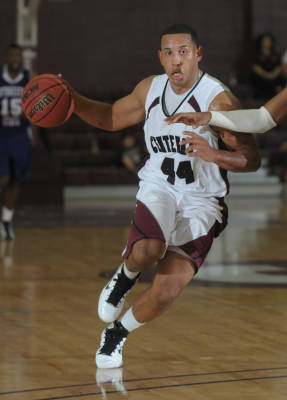
Pitt’s Jamie Dixon picked up some great news today when it was announced that Centenary’s Chase Adams, a 5′10 waterbug point guard originally from Baltimore, is transferring to play for the Panthers and he will be eligible immediately.  With Centenary’s recent decision to move down from D1 to D3, all of its players were given the option to transfer to another school without penalty.  Dixon must be ecstatic because his returning backcourt is relatively inexperienced (Ashton Gibbs was the presumed incumbent), but now he’ll be adding the 2009 Summit League DPOY, a player who was eighth nationally in steals per game (2.7).  This goes along with some nice numbers in scoring (14.6), rebounds (4.2) and assists (4.5) per game.  It sounds as if Adams will fit the Panther ethos of hard work and defense to a T…


07.23.09 Fast Breaks

July 23rd, 2009

It’s actually been a fairly busy week in the world of college hoops despite the mid-summer lull, so let’s take a look at some of the other key stories coming down the pike…

  • Hoop Dreams, 15 Years Later.  This week in his Hoops Thoughts column, Seth Davis pushed us down memory lane to the grungy days of 1994, a year of Cobain, Madonna’s undies and OJ’s white Bronco, but also of a bedraggled jewel of a documentary called “Hoop Dreams.”  We have a fair amount of younger readers on this site, so if you’ve never seen this movie, stop what you’re doing RIGHT NOW, and rent it on Netflix or your local movie shop.  It is without question the best basketball film ever made.  Davis’ summary of the movie is good so we won’t belabor that here, but even fifteen years later, the movie holds its color, bouquet and taste much better than most items from that era.  We slightly quibble with Davis on his contention that HD was the first reality tv (The Real World says hello) or that the two players featured in the film, William Gates and Arthur Agee, were ordinary people (their extraordinary skills at basketball at a young age is what made them not ordinary), but we completely agree with his fundamental assessment that the authenticity behind these two players’ struggles still resonates today.  The early 90s, when Gates and Agee were documented in the film, was an era at the edge of a precipice in two key cultural shifts that are still impacting the game: 1) the worldwide online revolution of 1995, which has impacted scouting and recruiting in an exponential fashion now that players can be commodified based on Youtube clips and independent assessments from anywhere on the globe; and 2) Kevin Garnett’s decision to go to the NBA straight out of HS in 1995 led to a sea change in how high school players were viewed, pushing scouting (and dreams of riches) earlier and earlier into a player’s development.  From a re-viewing of the movie in 2009, it’s easy to see the seeds of World Wide Wes and his ilk as assembly-line talent evaluator-cum-agents strategically dropping their whispers of fame and fortune into player family’s ears at a young age.  What was once limited to the bigger cities and at a much smaller scale is now ubiquitous; where elite players were once counseled by their coach (as in, their HS coach, not their AAU coach), they now listen to runners and quasi-representatives from shoe companies.  All of the dirty elements that are plaguing today’s amateur player development and the college game are there on display, in a rawer, more transparent form, in Hoop Dreams.  The authenticity of how the system uses these players, only to spit them out when they’re no longer useful, is front and center – how have things changed?  Thanks to Seth for re-awakening everyone to this movie – it’s a must-see.     
  • SEC-TV.  Starting this fall, the SEC announced that it will broadcast an all-SEC sports network as part of its new $2.25B deal with ESPN.  The SEC Network (through ESPN Regional) will syndicate its college football and basketball games to 73 (and counting) markets, but what makes this announcement particularly compelling is how the SEC has strategically decided to move outside its traditional nine-state southeastern footprint for this deal.  Local affiliates in the major markets of New York, Los Angeles and Chicago, as well as the three major Texas cities, are included in this deal, which unequivocally shows that the SEC isn’t playing games in terms of its foray to dominate college sports through national recruiting.  Where this could really pay dividends is not with the Kentuckys and Floridas, but with the Mississippi States and the Georgias of the SEC.  If games involving those teams are on tv in major media markets showing recruits a fun, winning style, they might be more inclined to consider going there over local state U.  How will the other leagues react?
  • F the Gazelle Group.  They’re back again this season with another faux-tournament in the form of the Legends Classic.  Remember our piece shredding them on this last year?  If you don’t, here’s a refresher.  The Gazelle Group got upset when little Gardner-Webb upset Kentucky in Rupp two years ago during a preliminary round game, meaning that the legions of UK fans they expected to buy tickets the next week weren’t showing.  So what’d they do the next year – they fixed the tournament!  Yep, all four of the ‘host’ teams get automatic entry to the Championship Rounds (final four teams) despite what happens in the prelims.  Total asinine garbage.  This year’s four faux-champs?  Michigan St., Rutgers, Florida and UMass.  MSU-Florida could be interesting, and definitely keep an eye on summer hotshot Mike Rosario from Joisey (playing in AC). 
  • Quick Hits.  Anthony Mason, Jr.: back in a Johnnies uni for 09-10.  Jim Calhoun: still going full boreJosh Selby/World Wide Wes: that’s just messed upWooden Classic: Georgetown v. Washington; UCLA v. Mississippi St.  Coach K: are Duke fans mad atchaMurray Bartow: 2-year extension at ETSU.  Dickie V: Summer Rolls-RoycersTop 25 Recruits: broken downGary Parrish: on the summer circuitSix OTs: enjoyAntonio Burks: recovering after robbery where he was shot.  Centenary: downgrading to D3WCC Tourney: in Vegas through 2012 (at least).  2010 Vegas Odds: sell Louisville

Summit League Wrapup & Tourney Preview

March 7th, 2009

Ryan Pravato of College Fast Break is the RTC correspondent for the Summit League.

Tourney Preview (Sioux Falls Arena)

2009-summit-tourney-bracket

Saturday Games:

(1) North Dakota St. vs. (8) Centenary

Centenary was outrebounded in their last meeting with NDSU by 22. Although Redus had a strong game, Adams and Stallings combined for just 16 points. Expect the same defensive play from the bigger, better guards of NDSU.

(2) Oral Roberts vs. (7) South Dakota St.

Home state advantage could make this a much tighter game than it is on paper. Jackrabbit forwards Anthony Cardova and Kai Williams, the only players taller than 6′5 to see regular minutes, must come up with huge games on the glass. If Ford and Lewis are not accounted for, it’s over.

Read the rest of this entry »


ESPN Marathon of Hoops Live Blog, Part II

November 18th, 2008

10:02 am – OK, back for more.  A little Drexel-Penn for your Tuesday morning.  Come on, is ESPN serious about this this stuff?  They don’t even have a GameCast going for this one.  Amateurs!  OK, I’ll stop.  Right now I have to give props to the Drexel students, because they have stepped up, here.  They’re in full face/body paint, wigs, etc.  Even for the ones who are just in their “Fear the Fire” t-shirts, they’re there in force.  They’ve filled that arena.  It’s rare that ANY college student is gonna get up at 10am for anything, so to show up like they have for a game at this time of day — even if it is a Big Five game — has got to earn some props.  This looks just like a night game in terms of the crowd behavior.  What this really is, is a total bonanza for any professors at Drexel who might be the attendance-taking type.  They could literally just pause the broadcast periodically and check off truant students on their roll sheets by the dozen.  I hated those professors…

10:26am — Drexel is the better team so far.  They’re outhustling Penn, who actually does look tired.  Drexel is up 8 with 12 minutes to go in the first half and this could get out of hand for the Quakers in short order if they don’t get their heads in it.

10:30am — Drexel extends…up ten at the under-8 timeout.

10:35am — Drexel is doing this with defense and hustle.  They’re winning every loose ball.  This is a Penn squad who only lost to UNC by 15, and they’re already down 14 to the Dragons and we’re coming up on the under-4 timeout.

10:41am — The first hyping of UNC-Kentucky.  I’m reminded of the time in 1995 when CBS was broadcasting an elite eight game involving those two teams (the one where Rasheed Wallace got choked — I don’t mean he CHOKED, I mean he GOT choked by Kentucky’s Andre Riddick during a scuffle early on) and Verne Lundquist and Bill Raftery showed up in tuxedos, given the history of the two programs.  I think whoever’s calling tonight’s game should do the same, especially with the almost constant hype.

10:51am — Halftime…34-27, Drexel.  This could have been worse for Penn who are in full sleepwalking mode.  Drexel decided to chuck (and miss) some threes late in the half; they have the better athletes but a couple of ill-advised shots and a couple of hand-checking fouls let Penn back into this.  If Penn wakes up at halftime, things could get interesting.

Right now, I’m actually a little impressed with Drexel.  Bruiser Flint has got his team mentally ready, except for that hiccup at the end of the half, and I’m gonna repeat my props to the crowd.  Drexel doesn’t look like a team playing their first game of the season, they look like they’re on number five or six.

I’m not complaining (heh heh….) but I’m starting to realize that maybe grabbing a nap before starting this endeavor may have been a good call, instead of working a whole day.  Oh, I’m not goin’ anywhere…but the coffee machine is now operational.

Read the rest of this entry »


What’s Your APR?

May 6th, 2008

No, not Annual Percentage Rate for all you creditworthy folks.  We’re talking about the Academic Progress Report (APR) for men’s basketball (who is regularly the lowest rated sport in D1).  Today the NCAA released the numbers that track athletes’ success (2003-07) in the classroom through retention, eligibility and graduation, and it appears that things are going to get a little dicey for some name-brand programs over the next twelve months. 
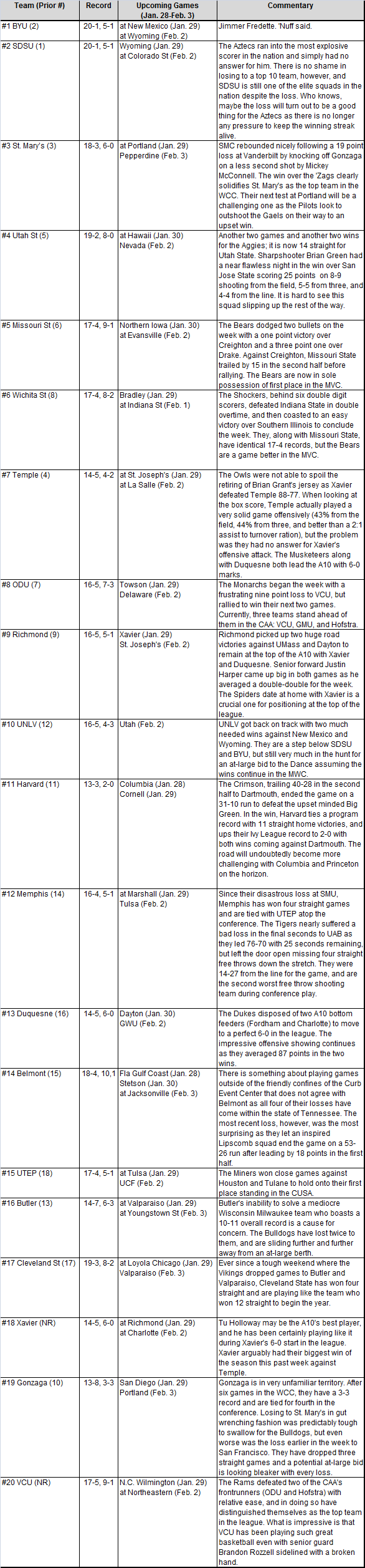

The APR has two classes of penalty – immediate and historic.  Immediate penalties are levied when a program is below the cutoff score of 925 (approximating a 60% graduation rate), and one of their players withdraws from the institution, does not return the following fall term and would not have otherwise been eligible to compete during the regular academic term following his departure.   This year, Kansas St., Purdue, Seton Hall, South Carolina, Tennessee and USC were the BCS programs subject to a one-scholarship loss due to this penalty (see Table A below).  K-State, Purdue, UT and USC are particularly on notice, as each of these programs could lose as many as two scholarships next year should their APRs not improve. 

Historic penalties are levied upon programs that have trouble consistently reaching a threshold of 900 on the APR metric.  The sanctions associated with these penalties are far more severe, and can ultimately result in reduced practice time, banishment from postseason play and restricted membership in Division 1 athletics.  This year among the BCS programs, only Colorado and USC were placed on public notice that their historical profile is lagging.  Should their poor APR scores (<900) continue another year, then the Buffs and Trojans could face a scholarship and/or practice time reduction in the 2009-10 season.  As an example of what not to do, the basketball programs at New Mexico St., Centenary and East Carolina are already one year away from facing a postseason ban based on three consecutive years of failing scores on the APR.  While Colorado doesn’t seem to care much about hoops, USC, with its high-profile coach and the sparking new Galen Center, certainly wants to avoid this fate if it can (note: OJ Mayo and Davon Jefferson’s early exits will not help the Trojans’ APR in 2008-09). 

Table B below shows some of the other notable non-BCS basketball programs and how they fared on this year’s APR.  Memphis, who is already on the cusp of the threshold, could end up getting slammed by this season’s exodus.

We also thought it might be somewhat informative to see how the BCS conferences do individually.  See Table C below.  The ACC is clearly doing the best of the big six conferences, with only Clemson and Maryland under the 925 cutoff (neither are below the 900 threshold).  The SEC, while managing to avoid last place, has seven teams under the 925 mark this year (58.3% of its teams).  The Big East has five, but that only represents 31.3% of its members.  As far as we can tell, there isn’t much of  a correlation with our 2007 Athlademic Ratings from last summer.   

The NCAA appears to be holding fast on its promise to hold schools accountable for keeping its athletes eligible.  AAZone’s Josh Centor, for one, thinks that the APR is working.

For the skeptics who believe the penalties are soft, look at the 26 teams that have entered the historical phase of the structure this year. Those programs have failed to change their behavior and will face restricted scholarships, recruiting and practice time. If the academic performance of those teams doesn’t get better, the penalties will become more severe. Next year, postseason bans will be in the mix and along with the scholarship reductions, those penalties are as strong as the ones doled out for major infractions cases.

It’s going to be interesting to see how these programs that are already on the cusp of sanctions respond to these challenges.   

Update:  Seth Emerson reports that critics of the APR system are wondering if there’s any teeth to it at all, citing the fact that 69.3% of institutions that were eligible to be penalized were given waivers this year.  Our favorite exception – let’s call it the South Carolina St. Rule – allows a waiver if a team’s APR is above that of the general student body.  Yeah, we’d agree that if a team is outperforming the rest of the students, then either the whole school needs to be shuttered; or, the APR is rendered rather meaningless.