In Their Words: Life at the Mid-Major Level

Posted by rtmsf on September 21st, 2010

Andrew Murawa is the RTC correspondent for the Pac-10 and Mountain West Conferences and an occasional contributor.

Part One: RECRUITING

Over the summer, we’ve spent time hearing about some of the next big-name recruits on their way to college basketball: Jared Sullinger and Harrison Barnes, Anthony Davis and Michael Gilchrist. We’ve heard the big-time schools announce their high profile games on their upcoming schedules: Kentucky going to the Maui Invitational and visiting North Carolina, Michigan State hosting Texas and going to Duke. But for the vast majority of Division I programs, they’ve been flying under the radar. There are at present 73 teams that participate in basketball in the six BCS conferences, but there are 347 total programs in Division I. Of those other 274 programs, there are certainly quite a few big-name programs: last year’s national runner-up Butler comes to mind immediately, as does Gonzaga, Memphis and a handful of other schools in conferences like the Atlantic 10 and the Mountain West. But, we were also interested in how the other half (or really, how the other three-quarters) lives, so we spent some time talking to coaches, athletic directors and other people around the country affiliated with some of those other schools — those non-BCS schools, those “mid-majors” — and we asked them about how they recruit, how they create a schedule, how they market their programs, and quite a few other things. Over the next eight weeks, we’ll let them tell you their story, in their own words.

To begin, let me introduce and thank this week’s cast of characters:

  • Murry Bartow, Head Coach, East Tennessee State – Bartow is entering his eighth season as the Buccaneers head coach, after having previously succeeded his father Gene Bartow as the head coach at UAB. Bartow has posted a 118-72 record in his years at ETSU and has racked up 241 total wins and four NCAA appearances in his 13 seasons as a head coach.
  • George Ivory, Head Coach, Arkansas-Pine Bluff – Ivory enters his third season in Pine Bluff, where he has turned the Golden Lions into winners. UAPB turned around an 0-11 start last season by finishing 18-5 over their last 23 games, winning UAPB’s first SWAC tournament title in 43 years and advancing to the NCAA tournament before losing to eventual national-champion Duke.
  • Chris Caputo, Assistant Coach, George Mason – Caputo is entering his sixth season as an assistant coach for the Patriots after spending the previous three seasons as an administrative assistant and video coordinator under head coach Jim Larranaga.
  • Tommy Dempsey, Head Coach, Rider – Dempsey enters his fifth season as the head man at Rider, following two seasons as an assistant. He has compiled an 83-75 record over that time and coached NBA lottery pick Jason Thompson during his time there.
  • Eric Reveno, Head Coach, Portland – Reveno heads into his fifth season at Portland having turned around a program from a team that was 18-45 in his first two seasons to a team on the rise with a 40-24 record over the last two seasons. Reveno spent his previous nine seasons as an assistant at Stanford, his alma mater where he was a Pac-10 Conference All-Academic Team selection as a senior.
  • Eric Brown, Assistant Coach, Long Beach State – Brown enters his fifth year as an assistant on head coach Dan Monson’s staff, after previously having spent time on coaching staffs at Cal-State Northridge, USC and Iowa State.
  • Jason James, Head Coach, Tennessee-Martin – James enters his second season as the head coach at UT-Martin following eight seasons as an assistant coach there. His first season was rough, to the tune of 4-25, after he was appointed head coach in the wake of scandal with the previous head coach. But James, the recruiter who brought Lester Hudson to UT-Martin, has plans to begin to turn things around this season.
  • Dale Layer, Head Coach, Liberty – Layer enters his second season at Liberty after having spent a season as an assistant at the university in 2007-08. In between, he spent a year at Marquette and previously he spent seven seasons as the head coach at Colorado State. He has compiled a 118-122 record in his eight seasons as a Division I head coach.
  • Gregg Bach, Assistant Athletics Director for Communications, Akron – Bach was named to his current position this past summer after having spent the previous eight years on the media relations staff in the Akron athletic department. His new job makes him the spokesperson of the athletic department.

First up: recruiting. This is the biggest, most pressure-packed area in college athletics. No matter how good coaches are at the X’s-and-O’s, they need players to execute their plans. At the mid-major level, the likelihood of a coach winding up with a ready-made pro is minuscule, so coaches have to find diamonds-in-the-rough, and, perhaps more importantly, develop their players over the course of their careers. Not only do schools at this level have to compete with other schools of similar size, if they find themselves competing with  a higher-level school for the same prospect, they may have to make a decision as to whether or not continuing to recruit the player is a worthwhile use of time. And the schools have to make the most of every advantage they can find in order to land the best student-athletes for their institution.
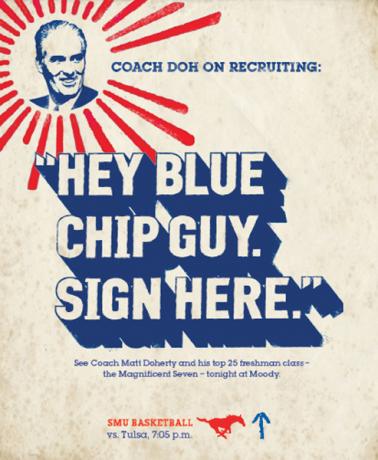
Recruiting Players Takes on Many Forms

Murry Bartow, Head Coach, East Tennessee State: Obviously, if you’re a college basketball coach, the most important part of your job is making sure that you’ve got good players.

George Ivory, Head Coach, Arkansas-Pine Bluff: There are a lot of things that go into recruiting. It comes down to what that kid is really looking for and what that kid wants out of college.

Bartow: There are so many things that go into it. There is no question that the relationship is critical, whether that’s with the head coach or an assistant coach. But that is very pivotal in the decision, building the relationship with not only the prospect, but a mom or a dad or whoever is going to be helping them make that decision. And certainly the product you’re trying to show them is important. Fortunately, I think I’m in a situation where I think we’ve got a good product, but there are a lot of things that are important: the school, the community, the housing, the fan’s support of your program, how many times you’re potentially going to be on TV and what conference you’re in, your history, the success you’ve had and how many times you’ve been to the NCAA tournament recently. So there are a lot of things and certainly different things are important to different players. For instance, we’ve been to the NCAA Tournament the last two years, and for some prospects that is very, very critical and important, and for others that might not be so important. So there are different things for different prospects.

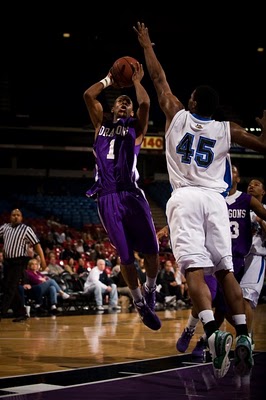
When George Mason broke through to the Final Four in 2006, they were the first big mid-major success story in the NCAA Tournament since, arguably, Larry Bird’s Indiana State team made it there in 1979. Sure, there have been other non-BCS schools to get to the Final Four (Memphis ’08, Louisville ’05 and Marquette ’03 all came out of Conference USA, and Utah ’98 out of the WAC are all examples of non-BCS teams advancing to the Final Four, but none of those teams can really be considered a mid-major given their substantial basketball budgets), but Mason, an 11-seed and one of the last teams into the tournament that season, is clearly the first “modern” mid-major Cinderella story. While their success opened some doors recruiting-wise, new challenges arose as well.

Chris Caputo, Assistant Coach, George Mason: I don’t think anything has gotten easier since the Final Four, but it has been different for sure. I think we’ve gotten some good players, but you’ve got to caution yourself against those with superficial interest, people who will put you on their list because it sounds good, but they’re really not considering you because they are too far from home or whatever. You still want to make sure you’re getting guys that really want to be there and they’re hungry. Sometimes when you have success there are certain kids who are really attracted to the success and maybe not as attracted to working, almost like they’re feeling, “hey, if I get a scholarship over at George Mason, that’s it, I don’t have to work anymore.” But the guys that helped us get there, they signed with George Mason when it wasn’t as fashionable and they were driven to succeed. The one thing that the Final Four appearance has done for us is that it has helped us get involved with guys who maybe we previously couldn’t have gotten involved with. It helps us get into homes in different areas. You know, our school is much more of a household name nationally, and we’ve become a stronger name in our area as well. I think it has been good, but you also have to be careful with it too.

For mid-majors, a lot of the big-name recruits (McDonald’s All-Americans), are out of the question in all but the rarest of circumstances. This season, point guard Ray McCallum, Jr. chose Detroit over BCS schools like Arizona, Florida and UCLA, a decision which would have been startling were it not for the fact that his dad is the head coach there. For most mid-major programs, these players aren’t even in consideration. To make up for that, mid-majors have to find players that fly under the radar of some of the bigger schools and guys who are willing to put in the hard work to improve.

Read the rest of this entry »

Morning Five: 09.21.10 Edition

Posted by rtmsf on September 21st, 2010

  1. In documents obtained as a result of a FOIA request by ESPN.com’s Dana O’Neil, Tennessee self-reported several NCAA violations including over a hundred illegal phone calls to recruits over a period of two years.  Again with the phone calls?  Bruce Pearl stated at a coaching clinic on Sunday that he hopes that the violations do not “rise to the level of termination,” and it’s true that his number of calls are nowhere near the telephonic orgy promulgated by Kelvin Sampson and friends, but that’s not his biggest problem.  His biggest problem will be how the NCAA chooses to handle the outright lie Pearl hurled into their faces when queried as to a photo taken in his home of recruit Aaron Craft and himself.  We’re not sure how this will turn out, although fundamentally we think Pearl will keep his job; but these coaches need to reach for something other than the damn phone when they get a hankering to reach out to one of their prized recruits — sheesh.
  2. It was a very tough freshman year for Duke sophomore Andre Dawkins, but after leaving high school a year early to matriculate at Duke and subsequently losing his sister to a fatal car accident in early December 2009, you can understand why.  The understated 19-year old who averaged 4.4 PPG in spot minutes in the backcourt faces even more competition for minutes this season with Kyrie Irving and Seth Curry both on board, but somehow we figure he’ll work his way into the rotation in much the same way that he did last year when it counted against Baylor (two threes in the first half to help keep Duke in contact with the Bears).  We certainly wish him the best.
  3. We’re not gamers around here at the RTC headquarters, but sometimes we kinda wish we were.  That is, until we learned that there actually isn’t a college basketball game that you can buy these days, a lamentable situation if ever we’ve heard one.  Seriously — you can purchase a game called Nintendogs where you take care of your virtual puppy along with the rest of the humanoids (23.3M sold), but you can’t buy a single college basketball game even though there were once two offered (EA’s NCAA Basketball & 2kSports’ College Hoops).  How is this possible?
  4. Gary Parrish recently wrote a story about UNC’s Tyler Zeller and his injury proneness (or lack thereof), but the part of the article that really caught our eye was this statement: …Zeller would later tell me as we sat in an empty Dean Smith Center, those six national championship banners hanging above us. While technically true (there are six national championship banners hanging in the Smith Center), it’s also quite misleading.  We’ve harped for years that Helms Titles (ex post facto national titles given by the Helms Foundation to schools prior to the origin of the NCAA Tournament in 1939 — they still awarded titles after 1939, but they’re redundant and virtually ignored after that point) are nice additions to the historical tapestry of college basketball at places like UNC (1924), Penn (1920, 1921) and even Montana State (1929), but they’re in no way legitimate and have absolutely no place hanging as banners alongside hard-earned championship teams like those at UNC in 1957, 1982, 1993, 2005 and 2009.  To do so is simply marketing — an effort to persuade journos and others to repeat more impressively, “six national titles,” instead of the actual five — and we’re surprised to have seen the usually-reliable Parrish fall into that well-placed trap here.
  5. Blue Ribbon has released its preseason top 25 for the 2010-11 season.  There is simply no better print edition yearbook in existence out there, and it’s great to see our friends over at CCT pairing up with B/R — two class acts, there.  We love the Ohio State pick at #3, by the way.  A lot of folks will shy away from the Buckeyes this year without Evan Turner, but with the addition of Jared Sullinger and a ton of talent returning, the Bucks could end up better.

Spoonhour Recovering Well After Transplant

Posted by jstevrtc on September 20th, 2010

A while back we mentioned that former Saint Louis, UNLV, and (Southwest) Missouri State head coach Charlie Spoonhour had been diagnosed with a strange and unfortunately progressive lung disease called idiopathic pulmonary fibrosis, the only real cure for which is a lung transplant. Coach Spoonhour had the transplant in mid-August and is said to be doing well, even able to walk up to a mile during the course of a day.

Good spirits, great family support, and a world-class facility. Our money's on The Spoon.

We know this is not something for which they would be outwardly seeking praise, but it’s certainly worth remembering that it was his friends and fellow coaches Bob Huggins and Mike Krzyzewski who helped get Spoonhour into the Duke Medical Center for diagnosis and treatment of this disease. We again applaud their efforts, and we hope Coach Spoonhour’s recovery continues to go well. We hope we can continue to post nothing but positive reports about this.

Recruiting Rumor Mill: 09.20.10 Edition

Posted by nvr1983 on September 20th, 2010

Dear NCAA,
We promise that we have not had any contact with recruits outside the parameters set forth by your upstanding institution.

Sincerely,
Rush the Court

  • Obviously the big news this past week has been the punishment of Bruce Pearl and the effect it would have on Tennessee‘s ability to recruit. It looks like some players including RTC favorite Adonis Thomas are beginning to express some reservations about going to a school that is sure to be closely followed by the NCAA.
  • The big actual recruiting news is that Arizona landed Josiah Turner, the #3 ranked point guard in this year’s class. Now Sean Miller faces an interesting dilemma — how to fit all his scholarship players onto a roster in light of the NCAA sanctions against them stemming from the Lute Olson era. One of the recruits that many expect the Wildcats to be in contention for is LeBryan Nash, but it appears like the talented small forward is leaning towards Oklahoma State over Arizona, Kansas, and Baylor.

    Sean Miller will be counting on Turner to turn the Wildcats around

  • Speaking of point guards. . . Austin Rivers, the de facto #1 point guard in the country and possibly the top player in the country, has narrowed his list down to three schools — Duke, UNC, and Kansas — after eliminating Florida from consideration. Some are speculating that Duke, which many consider to be the leader in the Rivers sweepstakes, could land both Rivers and Quinn Cook. [Ed. Note: Is Coach K cool with his star player and a potential recruit hanging out with Michael Beasley, a player of questionable character?]
  • Ohio State received a commitment from Sam Thompson, one of the top small forwards in this year’s class, with a little help from Evan Turner, who apparently has been texting Thompson to convince him to go to Columbus [Ed. Note: Is this allowed by the NCAA?].
  • With all of these top recruits committing it is interesting and somewhat refreshing to see Norvel Pelle, the #2 center in this year’s senior class, just beginning to take home visits.
  • Read the rest of this entry »

Hey Knight, Wanna Roast?

Posted by rtmsf on September 20th, 2010

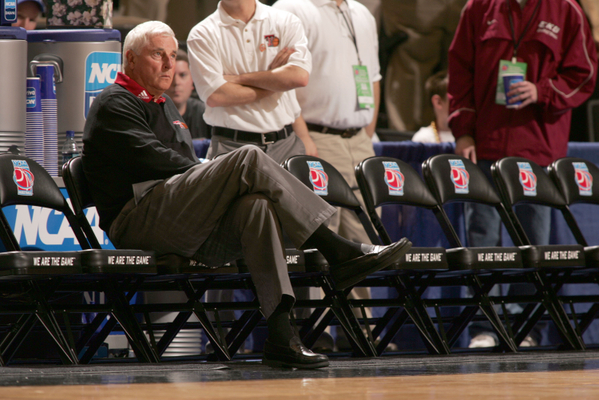
Former Indiana/Texas Tech head coach and current ESPN curmudgeon Bob Knight was back in Indiana over the weekend (Hammond, in the NW corner of the state, to be specific) for a roast in his honor to raise money for Westchester Saint Joseph, the suburban Chicago-area high school that produced such IU notables as Isiah Thomas and Daryl Thomas (not to mention William Gates from Hoop Dreams fame).

"Hey, Knight" Wasn't Part of the Proceedings

These roasts of coaches done of and by other coaches are always a little awkward and very unintentionally funny, and from the videos we’ve seen so far, this roast was no different.  Nevertheless, we’d be doing our readers here a disservice if we didn’t at least mention it and show some clips.  So here are a few from the Bob Knight Roast & Toast on Friday night from the Horseshoe Casino in Hammond, Indiana.  The level of hilarity increases the closer to fifty years old that you are.  (h/t Elliott Harris for the YouTube clips)

Knight tells a biblical parable here… sorta.

Knight commandeers the show from emcee Jay Bilas in his own inimitable way…

Read the rest of this entry »

Morning Five: 09.20.10 Edition

Posted by rtmsf on September 20th, 2010

  1. Christmas in September?  Remember when Kansas forward Tyshawn Taylor was banned from The Facebook mid-season by Bill Self after a series of embarrassing screeds that put himself and the program in a bad light?  Well, he’s back.  Bill Self has allowed the talented but enigmatic guard back on the social networking medium (also on Twitter!), and America flutters in anticipation of what will happen next.  He says he’s grown up after several diarrhea of the mouth incidents last year and now “thinks about it” before putting something online.  Taylor has the skills to become a fantastic player at KU, but his immaturity and inconsistency has to date held him back; it’ll be interesting to track his social networking accounts throughout the next few months to get a sense as to his mood, as he doesn’t seem to be the kind of guy to handle adversity well.
  2. The Pittsburgh Panther team, from top to bottom, believes that they are on the verge of a special 2010-11 season in the Steel City.  And they might be right.  Although it’s true that, historically speaking, NBA-level talent almost unquestionably wins national championships, a team like Pitt can get to the Final Four with a bunch of really good college players.  With Ashton Gibbs, Brad Wanamaker and Gilbert Brown leading the way, Jamie Dixon’s team has plenty of those.
  3. More Bruce Pearl: Gary Parrish suggests that Pearl wasn’t necessarily acting out of turn in lying to the NCAA about hosting recruits at his home, but rather in choosing what would otherwise be a fairly minor issue over which to lie about.  In other words, when you’re going to lie to the NCAA — make it count (academic fraud, paying players, etc.).  Meanwhile, Gregg Doyel believes that the lie should cost Pearl his job at Tennessee, although it seemed that the target of his ire was more focused on UT athletic director Mike Hamilton than Pearl.  We’re of the opinion that Pearl should be heavily sanctioned here, but he shouldn’t lose his job over this.  This, of course, assumes that there isn’t more evidence of significant wrongdoing lurking around the corner.  But nobody asked, least of whom, Mike Hamilton.
  4. This article is a little old, but it represents a home run of a thought: Bob Knight (when not being roasted for charity) should use his loud mouth and irritable persona to get on the pulpit and clamor for changes impacting the betterment of the game of college basketball.  We don’t always agree with some of his tirades, but people will listen to what he has to say, and generally speaking, his heart is in the right place.  The game needs a saber-rattler-in-chief, and right now Knight is as good a candidate as any.
  5. Bobby Hurley may be broke, but he still knows a thing or two about the game of basketball.  He’s now helping his younger brother Danny rebuild Wagner College from the bottom up, as Seth Davis wrote about in a piece on Friday.  And bottom up is no exaggeration — Wagner was 5-26 last year and ranked in the bottom twenty teams in America in both KenPom and RPI.  The Hurley boys have their work cut out for them.

The ESPN-U Midnight Madness Locales

Posted by jstevrtc on September 17th, 2010

Earlier today, ESPN-U let the world in on their plans for the evening of Friday, October 15th, otherwise known as Midnight Madness (see clock, above right). Like last year, ESPN-U will crank out four hours of coverage starting at 9 PM ET, with Lowell Galindo anchoring alongside Andy Katz and Adrian Branch, and of course they’ll have all the live peeks at several schools’ festivities.  This year’s featured schools:

  • Duke
  • Connecticut (women’s team will be featured)
  • Kentucky
  • Gonzaga
  • Kansas State
  • Memphis

Last year we BGtD’d during the broadcast, and we were surprised at how high the talk-to-hoops ratio was, but to be fair it looked like a lot of that was because the analysts and commentators were vamping as they waited for things like volleyball matches, relay races and raffle drawings to finish at the various sites — in other words, as they waited for something interesting to happen that was covering. Still, even though we have no problems with listening to Lowell, Andy, and Adrian talk hoops, even after things like the dunk contests and scrimmages started, there were several instances last year where viewers would be treated to a shot of two or three people talking at a media table or in a locker room while crowds were cheering at what was actually happening on the unseen basketball court. We bet that ratio will change this year.

This debuted during Midnight Madness last year. Wonder what Harrison Barnes and Brandon Knight have in store.

Given the program’s achievements last season, we were hoping to see Butler on the list of coverage sites. Seems to us like some Madness footage from Hinkle Fieldhouse would be a lot of fun, but then we realized — Butler does not do Midnght Madness.

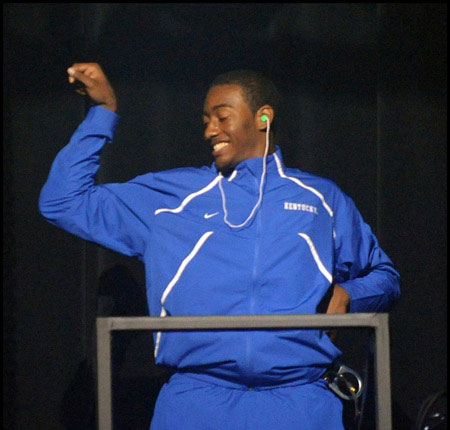
Last year’s Madness coverage brought us the birth of the John Wall Dance and Tom Izzo riding into Michigan State’s party in an Indy car (since the Final Four was to be in Indianapolis). That turned out to be prophetic, so this time around we’ve got our money on Izzo referencing the 2011 Final Four in Houston by descending from the ceiling in some sort of space capsule. Only 27 days, 22 hours, 35 minutes (again, see clock) and change before we find out.

Morning Five: 09.17.10 Edition

Posted by rtmsf on September 17th, 2010

  1. Andy Katz reported that Tennessee has its hands somewhat constricted by the clauses in Bruce Pearl’s contract that protects him from termination short of an NCAA “finding” that he had committed a “significant” violation.  Given that the NCAA is currently in the early stages of its investigation of the UT basketball program, any such finding would not likely come until well into 2011; and even then, there would have to be a finding involving a “significant” violation.  It’s unclear whether hosting recruits at his home and later lying about it rises to that standard of significance, but the key point here is that even if UT wanted to get rid of Pearl, they would have a difficult time doing so presently.  Interesting wrinkle unearthed by Katz, there.
  2. Seth Greenberg’s Virginia Tech Hokies are prepping for what could possibly their best season in his tenure there, but they received bad news yesterday when it was learned that sixth man JT Thompson had torn his ACL and will miss the entire season with that injury.  The senior forward averaged 7/5 last season as the first player off the bench, and he was expected to provide strong front court depth again this year.  With Malcolm Delaney, Dorenzo Hudson and Jeff Allen returning, Tech still has plenty of talent, but Thompson will surely be missed in the wars of the ACC this winter.
  3. Luke Winn checks in with a piece examining the twelve BCS conference coaching changes during the offseason, evaluating which coaches are stepping into the most favorable and least favorable situations.  We couldn’t agree more with his assessment that Oliver Purnell is walking into a nightmarish scene at DePaul (other than the hefty paycheck, of course).  We seriously doubt that will ever work out for anyone involved.
  4. Is John Calipari a good thing for college basketball in general?  Dan Wiederer writes that he’s not, essentially arguing that there’s too much nonsense, if not outright cheating, associated with the man.  And, the response.
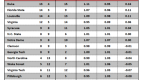
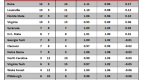
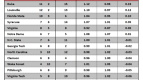
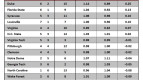
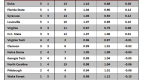
  5. The Big East Conference and ESPN simultaneously announced the Big Monday matchups for the 2010-11 season, which means that we’re that much closer to actually watching some meaningful games again.  Officially, the first three games on the list below are not “Big Monday” games, but they’re Big East matchups on ESPN on Monday nights, so… whatever.  It’s difficult to say which teams will step up in the always-brutal Big East, but the Syracuse-Villanova game on February 21 looks mighty tasty.  Here’s the lineup:

The RTC Big Four State Tournament: Championship Game

Posted by rtmsf on September 16th, 2010

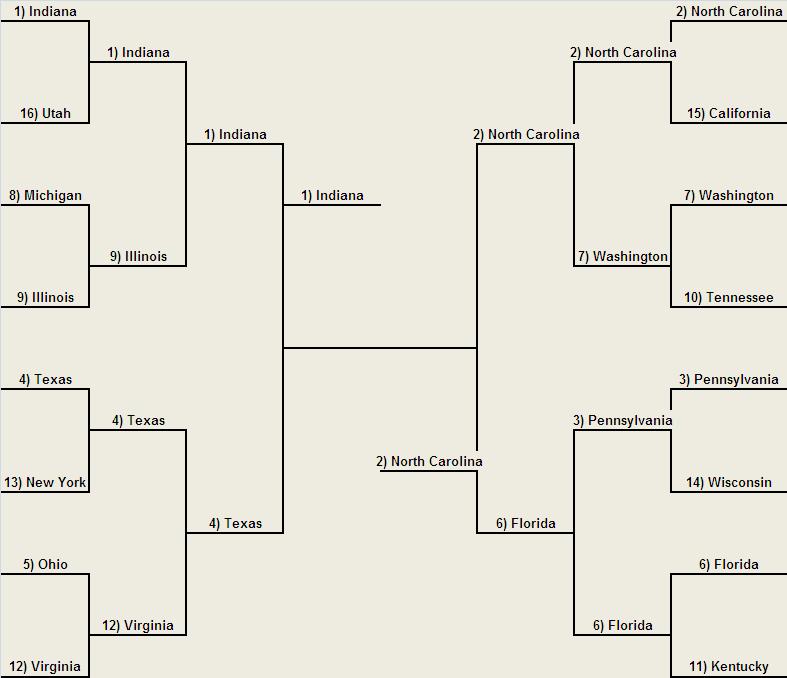
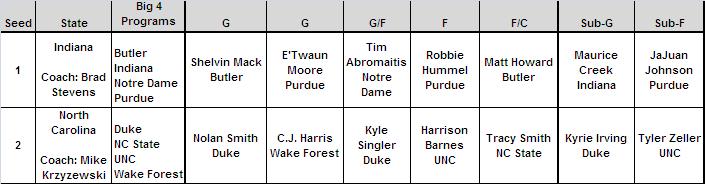
We’re down to the final two of the RTC Big Four State Tournament, and this is pretty much where we all expected to be when the brackets were released, right?  #1 Indiana will take on #2 North Carolina in a classic battle of roundball states chock full of schools who take their hoops very seriously.  There are several interesting storylines here, not least of which is the unusual circumstance that Duke’s Mike Krzyzewski and Butler’s Brad Stevens will once again face off with a national title on the line and several of the same players in tow (Duke’s Nolan Smith and Kyle Singler; Butler’s Shelvin Mack and Matt Howard).  Look at these lineups!  There are potentially five to seven 2010-11 all-america candidates on these rosters — wouldn’t you pay top dollar to see this game?  Our current bracket is below, so let’s tip this one off…

Championship Game (Semifinal fan vote pct. listed)

#1 Indiana (76%) vs. #2 North Carolina (78%)

These two teams come into the final having not really been tested much throughout this tournament.  #2 North Carolina has won its three games by an average of 18.7 points, while #1 Indiana sports a 13.7 point scoring margin, although the Hoosier State had a tough semifinal game against an athletic and scrappy #4 Texas squad.  Nevertheless, no one will argue that these two teams shouldn’t be here — it’s fitting that the two most talented teams have generally bulldozed their way to the championship game.  As for venue, both coaches eschewed the sellout crowd of 75,000 fans in a football stadium they could have filled for this game, instead agreeing to meet in a seedy high school gym on the south side of Chicago with three refs and a couple of television cameras. 

Stevens’ team draws first blood, as Mack and Robbie Hummel work the two-man game to perfection for a couple of early threes, and for the first time in the tournament, future NBA lottery picks Harrison Barnes and Kyrie Irving appear a little rattled by the pressure of the situation.  Coach K, always tuned into his players’ emotions, senses their nervousness and decides to go primarily with his experienced guys for the remainder of the half.  That helps stem the tide somewhat as Smith, CJ Harris and Singler start finding their spots, but Indiana has figured out that the interior defense of Tracy Smith and Tyler Zeller is not fleet-footed enough to deal with several quick catch-and-shoots by Matt Howard and JaJuan Johnson in the post.  The rest of the half falls into a back-and-forth affair where both teams have trouble consistently scoring, but Indiana heads into halftime with an eight-point lead.

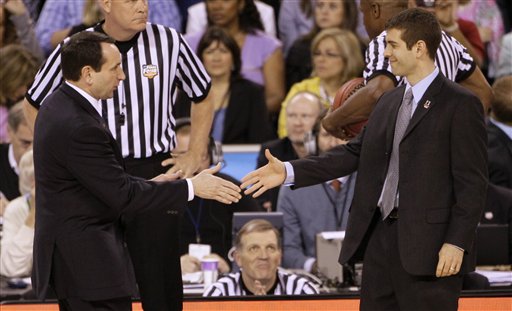
Stevens & K Meet Again, This Time in an Empty Gym (AP/A. Sancetta)

The second half opens in a reversal of the first, with North Carolina’s Barnes and Irving showing that missing confidence and exploding to the rim on drives for several easy buckets off turnovers.  Before you know it, when Tracy Smith corrals an offensive rebound and powers back up through a sea of arms for a basket and-one, NC has tied the game and has all of the momentum.  The problem for Coach K’s team is that his big men simply cannot stop Howard and Johnson in the post.  Every time it appears that North Carolina is putting together a big run, Stevens smartly calls for the ball to go inside to one of his post players and good things continue to happen.  As a result of this strategy, Smith and Zeller find themselves in serious foul trouble with four each heading into the last ten minutes of the game. 

The game tilts back and forth throughout the remainder of the second half until Indiana has the ball in Shelvin Mack’s hands with just under a minute to play, down two.  Working the high-screen and roll with Tim Abromaitis, Mack finds a seam in the lane and floats a runner through the net as the shot clock expires to tie the ballgame.  Coach K has been here a million times, so he calls timeout and sets up his final possession.  He looks at his offensive options and his first inclination is to go with one of his own tried-and-true stars in Singler; but he also remembers his experiences with USA Basketball and, recognizing that Barnes has come on strong in the second half, he gives the ball to rival Roy Williams’ player (and the most talented on his team).  Smith will run the play — the first option will be Barnes on the wing, looking to create, with Singler ready for the kickout and everyone else crashing the boards. 

The plan to kill clock until around six seconds remaining works perfectly, although Stevens surprises K by throwing a matchup zone at North Carolina, perhaps hoping and anticipating an overpenetration mistake by the still-wet-behind-the-ears Barnes.  The UNC freshman receives the ball on the right wing and wastes no time in using his explosive first step to get into the lane.  As the Indiana defense predictably collapses, Barnes elevates and somehow twists his body in the air to avoid slamming into Howard and Hummel, who had created a wall of long arms, pasty skin and hair to stop the soaring Barnes.  He adjusts his shooting arm to recover from the mid-air change of direction, and gently lofts a lefty layup over the outstretched arms of Abromaitis coming over to help.  Bodies hit the floor in unison as the ball falls through the net, and everyone across America watching the game on television waits for the inevitable block/charge call.  But there is no call to be had today — the refs let them play, and North Carolina takes a two-point lead with a mere 1.2 seconds remaining.

Brad Stevens is no dummy.  He knows that 1.2 seconds is an eternity if executed correctly.  After Indiana’s timeout, Hummel throws a strike to his teammate E’Twaun Moore just beyond halfcourt on the right side, who immediately calls timeout again.  With 0.8 seconds remaining, Indiana has a reasonable attempt to put up a good last shot.  Who do they go to?  Stevens draws up a clever play that nobody, not even Coach K, seems to have ever seen used before.  He runs Mack off of a triple-screen to get him open for the final shot, but when the ball is entered into play, he is only the decoy — as everyone for North Carolina rushes to stay with Mack and Hummel as the secondary option on the perimeter, the ball sails over everyone’s head into a camped-out Howard (the original screener who had leaked away in the maelstrom) who has a wide-open twelve-footer from the left baseline.  The shot looks pure in the air, but maybe he was a little shocked to be so open at that juncture, because it ultimately rattles out, giving North Carolina the two-point win and the championship.

What a game, and what a tournament.  How do you see it turning out? 

Ed. Note: thanks to everyone who participated in this feature.  We had a blast putting it together and playing it out.  Maybe we’ll bring it back next year, although we suspect that Indiana and North Carolina will be two of the top several seeds just about every year. 

Morning Five: 09.16.10 Edition

Posted by rtmsf on September 16th, 2010

  1. The son of one of the most dominant scorers we have ever seen play college basketball, Glenn “Trey” Robinson, III, has verbally committed to play at his dad’s  Big Ten rival Michigan.  He’s only beginning his junior prep season, but the 6’6, 195-pound slasher whom Rivals ranks as its #112 player in the Class of 2012, thinks he’s still growing and has the potential to break out during the next two years.  He averaged 16 PPG during his sophomore year in high school for St. John (IN) Lake Central HS, just a tick over half of what his dad dropped on everyone in America (30.3 PPG) during his NPOY season at Purdue in 1994.  He’s also the second former NBA star that UM coach John Beilein has attracted to Ann Arbor — former all-star point guard Tim Hardaway’s son, Tim Hardaway, Jr., (these guys aren’t very original, are they?) is currently a freshman at Michigan.
  2. As we all know, Tennessee head man Bruce Pearl is having a tough week, but his fellow members of the Tribe still have his back.  Pearl has been quite supportive of various Jewish-related charities over the years, so they’re not about to leave him hanging now that he’s run into some trouble with the NCAA, according to this article from the JTA.
  3. Speaking of Pearl, there’s been quite a bit of speculation as to whether his job is ultimately in danger as a result of his admitted NCAA violations, but according to at least one prominent Tennesseean, Knoxville mayor and Republican nominee for Governor, Bill Haslam, accepted Pearl’s apologies and will not ask him to rescind his previous endorsement.  As potentially the most powerful person in the Volunteer State, this could ultimately end up saving Pearl’s job if push came to shove down the road.
  4. Washington took a hit to its frontcourt depth as 6’7, 255-lb forward Tyreese Breshers announced his retirement from basketball as a result of ongoing health issues with his knee and shin.  The former four-star recruit from Los Angeles missed his freshman season in 2008-09 rehabbing from surgery; despite being out of shape and having to play through the pain, Breshers came off the bench in 2009-10 to give Lorenzo Romar 3/3 in about ten minutes per game spotting starter Matthew Bryan-Amaning.  We hate to see what must be a huge disappointment for the young man, but we hope that he’ll take advantage of the other possibilities a full scholarship to UW bestows and he finds peace with the decision.
  5. MaxPreps reports that several mid-major programs — notably, Xavier, Dayton, VCU, Central Florida and Delawareare making noise among the Class of 2011 hotshots.  The real surprise team in this group is Delaware, a school coming off a 7-24 season in the CAA last year.  Yet head coach Monte Ross has already received four commitments from a quartet of well-regarded players in that class.  It probably doesn’t even matter how well he does in 2010-11; he can point ahead to a bright future with more talent coming into the program.