RTC Summer School: Mountain West Conference

Posted by AMurawa on August 14th, 2012

Over the next couple of week’s we’ll be checking in with each of the high mid-major leagues as to their mid-summer offseason status. Up next: the Mountain West.

Drew Murawa is the RTC correspondent for the Mountain West Conference. You can also find his musings on Twitter @amurawa.

Three Summer Storylines

  • Tectonic Movement Continues. For the second straight year, the landscape of the MW shifts. Last year it was BYU and Utah heading off to greener pastures with Boise State landing in their place. This year TCU is on its way out the door with Fresno State and Nevada on their way in. And next year Boise State and San Diego State will depart with San Jose State and Utah State coming in. All in all, this will still be a good basketball conference even after all these moving parts settle, but the loss of a rapidly improving Aztec program will be tough for MW fans to take. TCU and Boise State certainly aren’t major losses on the basketball side, but the strength of their football programs could have provided stability for the conference and the potential for improved programs on the hardwood. Between the four newcomers, each of Fresno State, Nevada and Utah State have had good runs over the course of a handful of years, but they’ll all need to prove their ability to compete with more established programs like UNLV and New Mexico, while SJSU figures to step directly into the basement of the conference.

  • The Mtn. Crumbles. On May 31, The Mtn., the Mountain West’s television network, went dark, ceasing all operations after six years. Now, say what you will about the network, a channel that eschewed HD programming, struggled with distribution and had issues with their on-air talent, but the shuttering of its doors leaves some questions for MW hoops fans. In the era of The Mtn., if you wanted to follow MW hoops, it was easy to do so. Now, it remains to be seen exactly how much exposure teams from this conference will get during the year. Sure, the MW still has deals in place to get games shown on NBC Sports Network and CBS Sports Network, but what about that Air Force/Boise State game on some random February Wednesday? Should you want to watch that game and you’re not in Idaho or Colorado, odds are pretty good you’re going to be out of luck.
  • Continued Success? For all the uncertainty about the membership of the conference, the last three years have been something of the golden age of Mountain West basketball. In the past three seasons, the MW has received 11 NCAA Tournament berths. Two years ago there were dual Sweet Sixteen appearances by BYU and SDSU. We’ve had Jimmer and Kawhi grab national headlines, while other guys like Dairese Gary and Darington Hobson, Billy White and Drew Gordon, D.J. Gay and Hank Thorns, Andy Ogide and Malcolm Thomas have kept us all entertained. But, even with all of those players now gone, there is still plenty to be excited about in the conference. San Diego State and UNLV lead the way again, with both expected to start the season in the preseason Top 25. New Mexico and Colorado State, who joined the Aztecs and Rebels in the Big Dance last year, both should be in the hunt for another tourney bid, while Nevada could be a sleeper in its first season in the conference. And, as always, we could be in for another surprise or two.

Reader’s Take #1
Read the rest of this entry »

Dissecting Joe Lunardi’s First Bracketology: Three Reaches and Three Underrateds

Posted by Chris Johnson on August 14th, 2012

Christopher Johnson is an RTC columnist. He can be reached @ChrisDJohnsonn. 

A three-month chasm stands in the way before another new beginning to another college basketball season. The NCAA Tournament won’t take place for another four months on top of that. But even with that distant timetable, the world’s premier bracketologist, ESPN’s Joe Lunardi, thought it pertinent to release his early projections for the 2013 Field of 68. From this faraway August vantage point, reasonable cases can be made for most every team’s inclusion. After all, no one has actually played any games; thus we have no hard evidence – beyond what our speculative eyes can gather from offseason work, recruiting hauls, summer practices and European tours – that any team actually deserves a Tournament berth. As such, it’s hard to find great fault with Lunardi’s summer projections, if only because we have no factual evidence to debunk their authority. In fewer than three months, teams will officially begin their RPI-building missions, hoping over the winter span to construct a Tournament-worthy resume. It’s a long and enduring process, but come March, Lunardi usually has a pretty decent sense of whose season-long body-of-work belongs and whose doesn’t make the cut.

It’s never too early to begin analyzing March Madness bracket projections

For such a subjective process, Lunardi has over years of trial-and-error deconstructed the Tournament selection procedure into a predictive science. Fans often take his word as fact, or at least to the point where their Selection Show expectations are tempered by Lunardi’s analysis. In that context, it’s not hard to figure out why, even during these late summer months, his brackets drive both positive and negative discussion. The Lunardi bracket craze has reached yours truly, and as a starved college hoops fan, I couldn’t help but pore over its contents. All in all, the entire field seems reasonable, though I did come upon quite a few intriguing placements. To convey my thoughts in coherent form, I’m laying out three teams whose positions seem to be overstating their talent and three others who were undersold by Lunardi’s layout (“Underrateds”). These impressions derive only from the superfluous knowledge we have of each team at this point in the offseason, and how those vague profiles fit within Lunardi’s bracket. When the season begins, my perceptions will no doubt change, as will Lunardi’s March projections, so understand the limited scope from which these interpretations stand. This is merely an avenue to analyze sports’ greatest postseason tournament in a detached and unbiased way, without much in the way of evidence… more than a half-year in advance.

Reaches

UCLA: one-seed (West)

Read the rest of this entry »

Morning Five: 08.14.12 Edition

Posted by rtmsf on August 14th, 2012

  1. After making numerous people mad over the weekend with its ‘top perceived cheater’ query of a sample of the nation’s college basketball coaches, CBSSports.com kept the hits coming on Monday with its follow-up question asking those same coaches whether everyone’s favorite Team USA head honcho, Mike Krzyzewski, has “earned a recruiting advantage” by virtue of his association with the star-studded Olympic squad. Note for the record that the group of writers did not ask if Coach K has a perceived recruiting advantage here — nope, they wanted to know if this is an actual, real-deal, verified by Visa advantage. Accordingly, 71 percent of the respondents affirmed that there is a definite recruiting advantage as a result of Coach K’s association with the Olympic team. On its face, in terms of name recognition and marketing/branding of the Coach K/Duke product with the best basketball players on the planet, the answer should have been 100% — this part is without question. But in terms of actual production on the recruiting trail, Coach K’s last top-rated class (as calculated by RSCI) was in 2002 (Shelden Williams, JJ Redick); prior to that it was in 1999 (Jason Williams, Mike Dunleavy, Carlos Boozer); and before that in 1997 (Shane Battier, Elton Brand, William Avery, Chris Burgess). Since 2006, the first full recruiting year after Krzyewski took over for Team USA, his recruiting classes have been good to great (#3, #3, #11, #8, #9, #2, #10), but none have matched the pinnacle that the Duke head coach was regularly signing a little over a decade ago. So, does Team USA give Krzyzewski an actual recruiting advantage? The intuitive answer is assuredly yes, but the counter-intuitive one — that it makes no difference, or egads, could be a bit of a detriment — certainly has evidence supporting it as well.
  2. The Big East may be on shaky legs as a BCS league these days, but its announcement of its engagement with Bevilacqua Helfant Ventures, a sports media business that most recently negotiated a $3 billion multi-platform deal for the Pac-12, shows that the league doesn’t see it that way. Starting on September 1, the conference will retain an exclusive 60-day negotiating window with ESPN, and after that, it can field offers from other networks. Clearly the league believes that its new and unprecedented bi-coastal setup will be valuable to somebody — they’re already touting the fact that the new conference footprint resides in 13 of the 50 largest television markets holding a population base of 32 million people (reportedly twice that of any other league). Of course, there’s no mention made of penetration into those markets (does anyone in Orlando really care about UCF?), or if anyone will care to watch a San Diego State – Rutgers game, but that’s why the expensive firm was brought in — to deflect those questions. One thing is certain: The bubble of collegiate sports properties is still blowing up, so don’t be surprised if a few months from now we’re all sitting around scratching our heads wondering how the Big East is worth more than the ACC.
  3. The UNC football academic scandal appears to have finally crossed over to the basketball program, at least tangentially. Former two-sport star Julius Peppers‘ academic transcript was (mistakenly?) published on the school’s website Sunday night, where some enterprising NC State fans found it and passed it around like wildfire on the Internet. The transcript is no longer on the site, but assuming it is a legitimate document, it appears that Peppers would not have been eligible to play football or basketball during much of the three academic years when he suited up at UNC. Many of the courses that made him eligible were in the now-infamous African-American Studies major which has been the focus of NCAA investigators. The question that is on everyone’s minds — and frankly it has not yet been satisfactorily answered — is whether the holy grail of Tar Heel basketball was substantially involved in these academic shenanigans (apparently dating back over a decade), and if UNC’s obstinance in thoroughly (and publicly) reviewing this problem represents willful obstruction to protect the program or something much less sinister. Whatever the case, if Peppers turns out to have been an academically ineligible player from 1999-2002, would that mean UNC’s 2000 Final Four (of which Peppers was a key contributor) would be vacated? We’re certain that NC State and Duke fans in the Triangle will stop at nothing to make that happen.
  4. With more schools taking international trips during the summer to build team cohesiveness combined with the ubiquity of worldwide media access and coverage, we should expect to hear increasingly more bizarre stories like the one involving Missouri in The Netherlands over the weekend. According to a school release, during the third quarter of a physical game against the Dutch National Team on Saturday, Frank Haith was ejected for arguing with a referee on what he perceived to be a no-call elbow to the head of freshman Stefan Jankovic. Fearful “for the safety of his players,” and perhaps overreacting a bit, Haith decided to pull his team off the court and call the game over at that point. The Dutch head coach was diplomatic in his response, stating that he “understood” why Haith stopped the game because his technical foul “so suddenly came out of the blue” during game action. As a new league entrant to the SEC next season, we hope that Haith realizes that he’s unlikely to get a single favorable call from January to March 2013 — so he’d probably do well to get used to it.
  5. Jumping to news that will please Missouri fans a little more, Bill Self’s Kansas team just finished its European exhibition tour and to say it went poorly might be putting it a bit too mildly. The Jayhawks finished the trip by losing its last two games to a French professional team, but the second game was interesting in that Self chose to “rest” his upperclassmen for the game’s entirety. This gave his remaining extremely young group of players, led by Perry Ellis’ 16/12, to take center stage, but we also wonder if Self wasn’t using the opportunity to send his veterans — Jeff Withey, Elijah Johnson, and Travis Releford — a clear message that he expects more from them in this, their senior, seasons. As he states in the linked interview, he was willing to live with the second short-handed loss, but he felt that the first loss was “inexcusable” and that his team is “not any good right now.” If we know anything about Self, he’s probably right; but he’s also without a doubt going to have the Jayhawks whipped into shape by January so that they’ll be right at the top of the Big 12 standings once again.

RTC Summer School: Ivy League

Posted by rtmsf on August 13th, 2012

Over the next couple of week’s we’ll be checking in with each of the high mid-major leagues as to their mid-summer offseason status. Up next: the Ivy League.

Michael James is the RTC correspondent for the Ivy League. You can also find his musings on Twitter at @mrjames2006 and @ivybball.

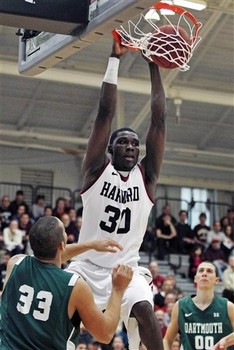
When the final horn sounded, Harvard had finally claimed the Ivy League’s automatic bid to the NCAA Tournament, sending it back to the Big Dance for the first time since 1946. There would be no rushing of the court, no cutting of the nets. In fact, the Crimson team was nowhere to be found. In a situation that can only happen under Ivy League rules, Harvard grabbed its automatic bid by watching one league rival (Princeton) knock off another (Penn). If the result had gone the other way, there would have been a one-game, winner-take-all playoff between the Crimson and Quakers at Quinnipiac University on Conference Championship Saturday. It was the second straight year that the title chase had come down to the final game, as Princeton won at Penn the season prior to earn a playoff against Harvard, from which it emerged victorious, grabbing the Ivy bid.

Harvard Finally Broke Through to the NCAAs Last Season (AP)

With the way the 2012-13 campaign is shaping up, there’s plenty of reason to believe that the Ivy League might just go 3-for-3.

Three Key Storylines

  1. Roster Flux – With nearly half of the 2011-12 All-Ivy spots going to graduating seniors, the league had hoped to weather the storm with the return of several key players that missed most or all of last season with injuries. Brown will see 6’8″ forward Tucker Halpern return to the lineup, while Cornell gets back 6’6″ forward Errick Peck. Penn will finally get to see the much heralded forward Greg Louis, who missed his entire freshman season with hip surgery. That’s the good news. The bad news, though, is pretty bad. Columbia had hoped that 2010-11 All-Ivy First Team guard Noruwa Agho would take a second crack at a senior season, but he has opted not to return. The surprises weren’t limited to injury-related situations either. Brown’s roster release came with a huge surprise, as center Andrew McCarthy was dropped from the roster prior to what would have been his senior season.
  2. Conference Tourney Debate – The Ivy League remains the only Division I basketball conference to hand its NCAA berth to its regular season champion, rather than deciding the bid via a postseason tournament. For a while this offseason, that distinction looked to be in serious jeopardy. The eight Ivy coaches unanimously supported a proposal that would have brought the league an eight-team tournament in exchange for each school dropping one non-conference game from its schedule every season.  The eight athletic directors wasted no time in shooting down the proposal before it could even take the final step to the Ivy presidents. For the Ivy ADs, the trade of a game for a tournament missed the point, as they cited the philosophical belief in the superiority of the true round-robin in deciding a champion as the reason for rejecting what had been the most serious attempt at instituting a conference tournament in quite some time.
  3. What Goes Around, Comes Around – When Penn lost Fran Dunphy to Temple in 2006, its exhaustive search for a new head man led it to another institution within its own league, as the Quakers poached then-Brown coach Glen Miller. This offseason, that move came full circle – sort of. Miller is long gone from Philly, fired just a month into the 2009-10 season, but Mike Martin, a Brown alumnus and one of the assistants Miller brought along with him from his previous stint in Providence, remained on with the Quakers even after his former boss’ departure. So, when Brown jettisoned Jesse Agel following an 8-23 campaign, the Bears made Martin a high priority target. It took Brown until the beginning of June to decide on its choice, but the result was bringing Martin back to his alma mater and handing him the keys to a program that has been on a steady decline since Craig Robinson took the squad to the CBI Tournament in 2008.

Reader’s Take

Read the rest of this entry »

Villanova Assistant Coach Doug Martin Forced to Resign — Why Was He Hired in the First Place?

Posted by Chris Johnson on August 13th, 2012

Christopher Johnson is an RTC columnist. He can be reached @ChrisDJohnsonn .

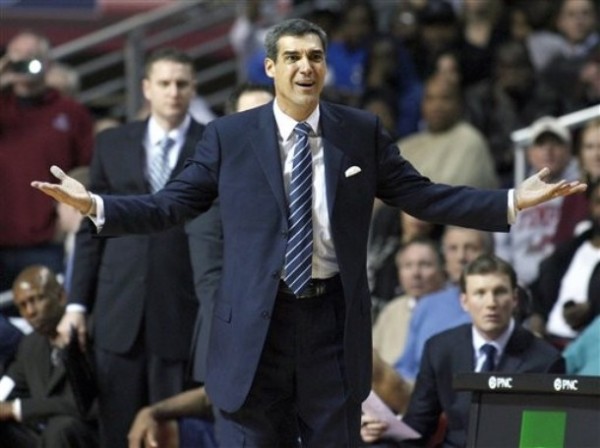
Early last week Villanova announced the hiring of assistant coach Doug Martin, who formerly served similar positions at a private Catholic high school in Virginia as well as the Team Takeover AAU program, a traditional grassroots powerhouse based out of the fertile Washington DC-area recruiting grounds. The hire was questionable on several fronts, and it brought into clearer focus Villanova’s pursuit of Josh Hart, a member of Team Takeover and a prime target on the prospect market who currently holds offers from Memphis, Cincinnati, Arizona, Rutgers and the Wildcats, among others. Yet it wasn’t Martin’s ties to AAU basketball – and his potential role as a recruiting pipeline for Villanova – that cast legitimate doubts over his hiring. It was his resumé, which according to the school’s website said Martin “played collegiate basketball at UW-Green Bay for coach Dick Bennett from 1991-1995.” ESPN.com’s Dana O’Neil unearthed the specifics of Martin’s factual inaccuracies shortly after the Wildcats released word of their newest employee. UWGB has no recollection of him playing there, nor is there any record of Martin on year-by-year statistics or available media guides from the 1990-91 through 1994-95 seasons, Martin’s indicated time frame of participation. His LinkedIn profile claims bachelor degrees from both UWGB and Viterbo University, an NAIA school in Wisconsin. But according to the Viterbo website, Martin played four seasons there rather than at UWGB. Villanova confirmed the inaccuracies over the weekend, and on Saturday announced Martin’s resignation.

The hiring of Martin raises the question of whether AAU-affiliated coaches will have greater access to assistant coaching positions at power-conference schools (Photo credit: H. Rumph Jr/AP Photo).

In today’s social media-crazed world, where any conceivable tidbit of important information is available at the push of a button, lying about your playing history while landing a job as an assistant at a power conference program is simply astonishing. Gone are the days when factual documentation was accepted with little in the way of thorough web-based analysis or speedy, credible cross-checking services. At first glance, Martin’s error doesn’t seem all that egregious. He never played at Wisconsin-Green Bay – as both his high school and Villanova biographical profile suggests – but rather at a different small-sized Wisconsin school. The two schools fall under different sublets of athletic classification (NCAA Division I and NAIA, respectively), which, by all accounts, is no minor error. Yet Martin’s playing past probably holds little, if any bearing on his ability to coach at one of the nation’s top-tier Division I programs some 20 years later. Don’t get me wrong, defrauding the hiring process, particularly at a time when it’s practically impossible to get away with such bait-and-switch maneuvering, is asinine. And Martin’s forced resignation was indeed the best and only way to handle the situation.

Read the rest of this entry »

Morning Five: 08.13.12 Edition

Posted by rtmsf on August 13th, 2012

  1. The buzz throughout the sport over the weekend was directly attributable to the Friday release of the latest in CBSSports.com‘s Critical Coaches series, this time squarely taking aim at the perception of the coaches responsible for the most wrongdoing within the game. In other words, who is perceived as the biggest cheater(s) in college basketball? The results at the top — Kentucky’s John Calipari (36%) and Baylor’s Scott Drew (34%) — are completely unsurprising in that fan perception in this regard probably isn’t markedly different than those of the coaches, but in reality you probably could have simply switched out the question with “Who is the best recruiter in the game today?” and gotten the same result. Proxies notwithstanding, the guys at CBS asked the question they did for a reason, and they’ve spent the intervening three days getting blasted by media and fans alike. A sampling: Mike DeCourcy lays into the coaches for answering the question in the first place (“disgraceful… tacky…”); Kentucky Sports Radio summarizes it succinctly as such, “Haters Gonna Hate”; BaylorFans.com commenter JXL sarcastically notes “if a school was bad and then becomes good, they are by definition cheating“; UCLA’s Bruins Nation calls the poll “ridiculous and insulting” for it’s choice of Ben Howland as the third-worst offender (12%). We could go on with this, but we’ll stop right there. The perception is the perception because once narratives are constructed in the public consciousness, they’re awfully difficult to change; while on the flip side, fans will defend their guy regardless of what comes out against them. Assuming they’re winning, of course — they have to keep winning.
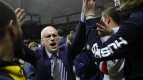
  2. In much more uplifting news over the weekend, Team USA’s men’s basketball team won its second straight gold medal on Sunday by defeating a pesky Spanish team by the final score of 107-100. This team, led by the gleaming supernovas of LeBron James, Kobe Bryant , Carmelo Anthony and Kevin Durant, wasn’t as dominant as their Dream Team forebears two decades ago, but they were equally instrumental in rebuilding the American basketball brand after the colossal disappointment at the Athens Games in 2004. The other name that deserves as much credit as anyone in restoring USA basketball to the top over the last seven years since he came on board is someone who did not even receive a medal: head coach Mike Krzyzewski. Coach K announced prior to the game against Spain that the gold medal match would be his last game as Team USA’s coach, and that proclamation perhaps inspired the 65-year old to jump for joy as the Americans wrapped up the championship in the waning moments yesterday. It’s back to Durham full-time for the Duke head coach as he tries to finish off a superlative career with a fifth national title, but as usual, he performed his job impeccably during his tenure as the man in charge. Thank you for helping to restore American pride in basketball, Coach K.
  3. It’s hard to believe now, but when Krzyzewski took the Team USA job in 2005, more than a few commentators who cover the sport thought that K might be making a mistake with respect to his Blue Devils. The theory then was that his involvement with USA Basketball (particularly during the summers) would take him away from the recruiting trail and allow other programs to make inroads on Duke while he was focused elsewhere. That seems somewhat silly after Duke cut the nets down in 2010 for K’s fourth national title and the top recruits keep rolling in, but is it possible that Krzyzewski could get enjoy even more of a halo effect from the ubiquitous images of him high-fiving and embracing the very best basketball players in the world? Mike Kline at DukeReport.com thinks so, and it’s hard to disagree. Elite recruits care about two things — 1) getting to the NBA, and 2) coolness. Coach K has always had a tremendous amount of the former, but with the association with the winning ways he instituted with Team USA, he also has plenty of the latter.
  4. It’s now only 60 days until Midnight Madness, which means coaches are already carefully examining their schedules to find any possible advantage heading into the 2012-13 season. Like Krzyzewski, Syracuse head coach Jim Boeheim has been busy as an assistant coach for Team USA too, but he already has some ideas about how to prepare his Orange squad for its season opening game — the Battle of the Midway — against San Diego State. The Veterans Day tip-off for both teams will take place on the USS Midway in San Diego Bay (similar to last year’s Carrier Classic on the USS Carl Vinson), and Boeheim is determined to prepare for the possibility of wind and other elements by having his team practice and run some drills outdoors. We’re guessing that whatever weather conditions the Orange players face in October in upstate New York will more than prepare them for anything balmy San Diego has to offer.
  5. We’ll have more on this later today, but over the weekend brand new Villanova assistant coach Doug Martin was forced to resign based upon certain “inaccuracies” on his resume. The primary point of contention is that Martin had claimed that he played college basketball from 1991-95 under legendary coach Dick Bennett at Wisconsin-Green Bay. Dana O’Neil’s cursory fact-checking on the matter quickly revealed that neither UWGB nor Bennett had any record or recollection of Martin at the school, and in fact, he may have actually played limited minutes at a Wisconsin NAIA school called Viterbo instead. It begs the question, though. Surely Martin’s hiring at Villanova was not contingent on having played for Bennett at Green Bay, so why not correct the resume before submitting it — that’s a fairly impressive job to obtain only to lose it over something that seems so inconsequential.

RTC Summer School: West Coast Conference

Posted by rtmsf on August 10th, 2012

Over the next couple of week’s we’ll be checking in with each of the high mid-major leagues as to their mid-summer offseason status. Up next: the WCC.

Michael Vernetti is the RTC correspondent for the West Coast Conference.

Three Key Storylines

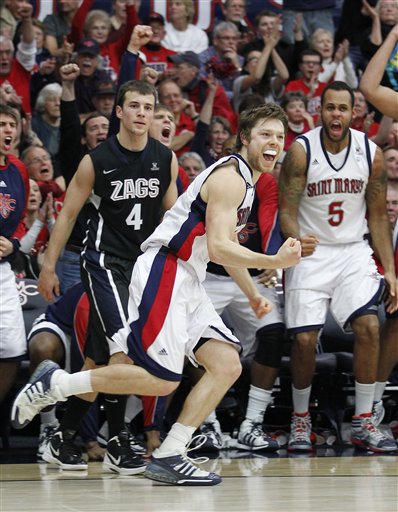
  • Ex-champs Fight Back. Gonzaga’s streak of 11 consecutive seasons with at least a share of the WCC crown came to an end last year as Saint Mary’s won both the regular season title and the WCC Tournament. How will the Zags react as a challenger rather than defending champion? Is Saint Mary’s for real or just a pretender? This is the key storyline for the WCC heading into the 2012-13 season. Gonzaga answers with a strong returning lineup boasting conference leaders Elias Harris at strong forward and dual freshmen sensations Kevin Pangos and Gary Bell, Jr. at the guard spots. Rather than miss the graduated Robert Sacre, Zag partisans insist more playing time for Sam Dower will equal more production in the post. Saint Mary’s answers with a possibly even stronger backcourt of Olympics hero Matt Dellavedova and defensive terror Stephen Holt. The Gaels will have a rebuilt front line anchored by redshirt sophomore Brad Waldow and transfer forward Matt Hodgson, and looks forward to proving last year’s title was no fluke.

These WCC Stars Will Determine the Storyline of the 2012-13 Season

  • Revamp or Disaster? San Francisco coach Rex Walters was consistently cool when asked about the unsettling defection of six players from his roster following last season’s disappointing season (8-8, fifth place in WCC). For the most part he knew they were leaving, Walters said, and he has replaced them with players of equal or better value. Maybe, but any time a team loses its top four scorers (Angelo Caloiaro, Perris Blackwell, Rashad Green and Michael Williams) and returns only two players with significant game experience – Cody Doolin and Cole Dickerson – it puts tremendous pressure on the newcomers. Of the many new faces on the Hilltop, former UCLA recruit De’End Parker, recently cleared to participate in the upcoming season, looks to be the Dons’ best bet for stardom.
  • Broncos Healthy Again. Things could not possibly have gone worse for Santa Clara last year – really, they lost all 16 conference games – so maybe karmic forces are aligned to bring the Broncos salvation. Marc Trasolini, the hard-nosed 6’9″ forward who was looked upon to provide senior leadership, instead tore his ACL in the preseason. Outstanding shooting guard Kevin Foster was arrested on suspicion of driving under the influence following a Bronco home loss to Saint Mary’s, and never returned to action. With Trasolini and Foster back this season, Santa Clara coach Kerry Keating should smile more. Keating will also have improving 7-foot center Robert Garrett and slick point guard Evan Roquemore back in the fold, so the Broncos have a solid foundation for success

Reader’s Take

Read the rest of this entry »

Mark Gottfried Connects With NC State Fans on Twitter With “#FreeRodneyPurvis” Hashtag

Posted by Chris Johnson on August 10th, 2012

Christopher Johnson is an RTC columnist. He can be reached @ChrisDJohnsonn.

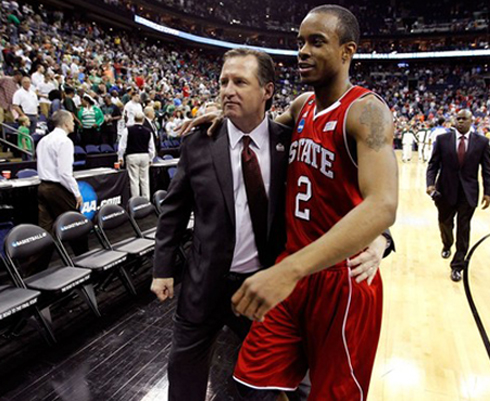
The advent of interactive web-based communication services like Twitter, Facebook and blogs has allowed coaches to connect with fans in a more direct and personal way than ever before. We witnessed an excellent example of this newfound coach-fan correspondence this summer when Kentucky head coach John Calipari, addressing UK fans directly as “Big Blue Nation,” explained in a long-form blog post on his personal website his new “nontraditional” scheduling philosophy as a roundabout way of rationalizing his refusal to continue the program’s decades-long home-and-home series with border rival Indiana. In “Forming a nontraditional schedule for a nontraditional program,” Calipari focuses on three main points: “Preparing our players for the postseason”, “our fans” and “the financial component.” He laid out his thoughts eloquently, a thoroughly-composed argument that shone some light on why he dared put an end to one of the nation’s deepest and most hostile hardwood conflicts.

With Purvis’ eligibility in question, Gottfried is offering comforting words to Wolfpack fans (Photo credit: Rob Carr/Getty Images)

Calipari’s philosophy (and staunch insistence on playing at neutral sites, such as Lucas Oil Arena) didn’t jibe well with Hoosiers coach Tom Crean, who feared the idea of UK staging an annual recruiting fair in his program’s backyard metropolis, Indianapolis. The talks fell through, and college hoops fans nationwide will lament the loss of one of the sport’s most riveting ongoing territorial battles. But Calipari’s direct approach in addressing UK’s legions of fans made sense in more ways than one. Rather than voice his opinion through the traditional media, Calipari proceeded to convey his thoughts via his own personal mouthpiece. It was forthright, frank and an altogether noble gesture from a man who, even to his own fans, seems to exist within his own impenetrable realm of coaching regality.

Read the rest of this entry »

Morning Five: 08.10.12 Edition

Posted by rtmsf on August 10th, 2012

  1. Years ago when things were still going well for Billy Gillispie at Kentucky, we took him and his supporters to task for the ridiculous and utterly embarrassing notion that offering scholarships to 8th graders was a good idea (Michael Avery, anyone?). Thankfully coaches are no longer allowed to sniff around the junior high schoolyards as much as they used to, but that doesn’t mean that young players still can’t make pie-in-the-sky commitments years before they can even drive. As Gary Parrish wrote Thursday, Indianapolis junior Trey Lyles‘ recent de-commitment from Tom Crean’s flagship state school exhibits exactly why it’s probably not a great idea to listen to what 13- or 14-year olds think they’re going to do four years from now. A top 10 player in the Class of 2014, Lyles no doubt wanted to see what other fish are in the sea, and who can blame him? There’s something to be said for the concept of being wanted — and we’ll give credit to Lyles for the realization that few opportunities in life are as good as the one he has in front of him right now.
  2. A little more recruiting talk today, as Michigan‘s Class of 2013 is shaping up as perhaps the best that the school has enjoyed since Ed Martin was sending bags of hundreds to Ann Arbor on his days off. With the quick ascent of 6’6″ wing Zak Irvin on ESPN.com’s latest top 100 list — he rose more than 20 spots to #21 after a great summer — the Wolverines currently have a three-player class that ranks second only to Florida on ESPN’s list. Keeping in mind that only four of the top 20 players in this class have yet committed, this class led by Irvin gives John Beilein a shot at putting one or even two recruits (depending on how Derrick Walton’s senior season goes) into the McDonald’s All-American game next year for the first time since 2002 (Mitch McGary as a fifth-year senior was ineligible last season). Michigan will start next season in the preseason Top 10 — get used to seeing the Wolverines at or near those lofty heights for many years to come.
  3. Marquette announced yesterday that it was investigating a possible NCAA rules violation involving its men’s basketball program. Very few details were released by the school, but the Milwaukee Journal-Sentinel reported that a source disclosed that the violation may be related to recruiting. It is perhaps unrelated, but already this summer the Golden Eagles have lost a junior college transfer named TJ Taylor after only two weeks on campus. Regardless of what the violation turns out to be, it sounds like a relatively minor violation where any punishment the school suffers will be completely irrelevant.
  4. Three months from now we’ll either have a brand-new president or another term from our existing one. If you listen to the talking heads on television, the decision from the American people on this important civic duty may come down to class warfare — the concept that the rich and poor are in conflict with each other in divvying up the pie. ESPN.com’s Myron Medcalf drills down to the bone on a similar issue: the NCAA’s Academic Progress Rate (APR) has inspired an arms race of sorts on the academic side of the athletic shops. The wealthiest schools can afford to provide computer labs with the best equipment, traveling tutors, language labs, and so forth — anything to help keep academically marginal kids at those schools eligible. However, at a number of the poorer schools (such as, in his example, Mississippi Valley State), the idea of spending $2.6 million on academic support services for athletes (as Texas did in 2011-12) is laughable. If there’s one thing we know from several thousand years of world history, it’s that the poor never actually win the battle no matter how much the rich say that they ultimately will. Good piece by Medcalf, well worth the read.
  5. We mentioned in yesterday’s M5 that UNC’s Roy Williams was listed by his peers as the most “overrated” head coach in college basketball. We also scoffed at the idea that someone who has won two national titles in under a decade at the helm in Chapel Hill could ever be truthfully considered “overrated.” It appears we are not alone with this opinion, as Mike DeCourcy rips the results to shreds with a laundry list discussing all of Ol’ Roy’s achievements. If you can get past the bizarro world reference to Kelly Clarkson and Paula Abdul, DeCourcy’s argument is spot on. The easiest criticism in all of sports is to dismiss accomplishments because of “all the talent” available to a coach (nevermind how talent is determined at the time) — but the fallacy in that stance is that it ignores the countless coaches who also recruit great talent yet never actually produce with it. We pose the question again — if Roy Williams is an “overrated” coach, how many national titles should he have reasonably won by now?

Ranking the 2012 ESPN “College Gameday” Match-ups

Posted by Chris Johnson on August 9th, 2012

Christopher Johnson is an RTC columnist. He can be reached @ChrisDJohnsonn.

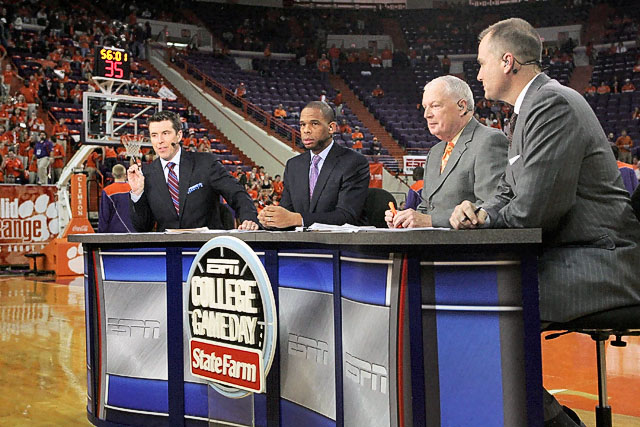
For college hoops fans, winter Saturdays are an overwhelming blur. With so many games spaced out throughout various networks, sitting down and selecting an optimal day-long viewing experience can be somewhat bewildering. When in doubt, the consensus gravitates towards ESPN, where the “College Gameday” crew doles out a constant flow of college hoops action, providing insightful commentary along the way. Starting at 10 AM ET with a studio show staged at that week’s featured game site, a raucous crowd howling in the backdrop, the panel lays out the day’s action, capped with a late-show pick ‘em segment which invariably has the effect of inciting the avid supporters on hand. Then it’s a day’s long succession of enticing fixtures, spanning different leagues, time zones and intrigue levels. The crew — Rece Davis, Digger Phelps, Jay Bilas and for the first time this year Jalen Rose, plus whoever else graces the courtside stage in any given week —  puts a bow on the day’s action with an hour-long recap show, which leads into that week’s marquee matchup. There are few things better than a “Gameday” Saturday: a highly entertaining and energetic crew of college hoops enthusiasts sandwiching a whirlwind of hoop with enlightening breakdowns and analysis about the day’s happenings.

Loved or Hated, Everyone Watches Gameday

In this early-August college hoops lull where the happenings on the gridiron seem to take precedent at most every power conference university, we long dearly for those delightful, couch-side Saturdays. Fortunately, ESPN provided a sneak peak of just how magnificent those Saturdays might be. The network released its “Gameday” schedule Wednesday, and the lineup – at least as far as I can tell from a rather distant August viewpoint – is the best I’ve seen in quite a long time. Maybe ever. The bad news is that January 19, the first Saturday of viewing, seems a pretty long ways away. Not to worry. Before you know it, Midnight Madness will arrive, November and December will slide by and the eight-week selection of action-packed Saturdays will commence. To pique your interest, I’ve put together a ranked list of the eight featured games. There’s no hard and fast criteria here; take this as a simple preferential ordering of which match-ups I feel carry the most appeal. Longstanding rivalries, interesting venues and conference/national title implications will all factor into this 100%-for-fun exercise. On paper, it’s hard to find fault with the selected games. But between now and January, a bad start or two could dampen the hype factor around some of these games. All we can hope is that the scheduled contests maintain their outwardly riveting stature throughout the winter months.

Note: All game times ET.

1. March 9: Syracuse at Georgetown (12 PM), Duke at North Carolina (9 PM)

Read the rest of this entry »