Where 2009-10 Happens: Reason #26 Why We Love College Basketball

Posted by zhayes9 on October 9th, 2009

seasonpreview

Shamelessly cribbing from the very clever NBA catch phrase, we here at RTC will present to you the Thirty Reasons We Love College Basketball as we gear up toward the start of the season a little over a month from now.  We’ll be bringing you players to watch for this season and moments to remember from last season, courtesy of the series of dump trucks, wires and effluvia known as YouTube.

#26- Where Versatility Happens

Share this story

RTC Class Schedule 2009-10: Villanova Wildcats

Posted by zhayes9 on October 1st, 2009

seasonpreview 09-10

There’s not a single program in the entire 16-team Big East in as strong a shape as the Villanova Wildcats.

Even in a league loaded with top-ranked mainstays like Louisville, Connecticut, Georgetown and Pittsburgh, it’s Villanova in the best position to dominate the pre-eminent college hoops conference in the land for the foreseeable future. Their coach, Jay Wright, is the ideal face of a dominant program, a terrific leader and communicator who has done a phenomenal job recruiting since arriving at Villanova, from assembling the guard-oriented Foye-Ray-Lowry-Nardi foursome to the 2009-10 class of top-50 quartet Mouphtaou Yarou, Maalik Wayns, Dominic Cheek and Isaiah Armwood. They play in the strong media market Philadelphia and at the NBA-fitting Wachovia Center. Last season, the Wildcats won 30 games and reached their first Final Four since 1985.

14709032855_Villanova_v_Pittsburgh[1]

Wright has built such a program that another Final Four remains a viable expectation for Villanova fans heading into 2009-10. Along with the star-studded recruiting class, Wright returns potential All-American guard Scottie Reynolds to team up with junior Corey Fisher for a tremendous backcourt, a strength that’s par the usual since Wright took the helm in Philly. Duke transfer Taylor King and sharpshooter Corey Stokes can certainly stretch the floor and hit big outside shots this season. Losing senior leader and double-double forward Dante Cunningham, along with glue guy Dwayne Anderson, stings, but Reggie Redding and Antonio Pena are experienced cogs. Most importantly, the #2 recruiting class in the nation (behind Kentucky) should provide a huge boost immediately for a squad that will likely be named the Preseason Big East favorites.

How does the schedule look for the Wildcats? Let’s take a peek:

Non-Conference Schedule Rank: 5. Incredibly, Villanova only has five true home games in the non-conference slate. Two of their road games are in the city of Philadelphia with back-to-back short trips to St. Joseph’s and Temple scheduled. Their other three Philly foes- La Salle, Drexel and Penn– will face the Wildcats at their on-campus arena. There’s some potential for difficult games on Jay Wright’s schedule, but no truly elite opponents in November and December. Villanova will travel to DC to take on ACC contender Maryland at the Verizon Center in what should be their most challenging test. A trip to Puerto Rico in November could pit the Wildcats against either Dayton or Georgia Tech in the second round and either Mississippi or Kansas State in the final. The second round could be trickier than the final as Dayton and Georgia Tech are borderline top-25 teams with talented frontline players Chris Wright (Dayton) and Derrick Favors (Georgia Tech) that should be hard to handle for an inexperienced frontline.

Cupcake City: While no single challenger blows you away, the only true “cupcake” on the non-conference schedule is the first contest of the year against Farleigh Dickinson. The other home games shouldn’t prove too much of a test- Penn, La Salle, Drexel, Delaware and a neutral site game vs. Fordham. The Wildcats also face George Mason in the first round in Puerto Rico. None of those CAA/Atlantic 10-type teams will prove huge tests for Wright’s squad, but credit the Villanova coach for going light on the lightweights.

Read the rest of this entry »

Share this story

RTC 2009-10 Impact Players – Mid-Atlantic Region

Posted by zhayes9 on September 9th, 2009

impactplayers

Last week we took a look at the five impact players in the Northeast Region, so now we’re ready for the second installment of our ten-week RTC 2009-10 Impact Players series.   Each week we’ll pick a geographic area of the country and break down the five players who we feel will have the most impact on their teams (and by the transitive property, college basketball) this season.  Our criteria is once again subjective – there are so many good players in every region of the country that it’s difficult to narrow them down to only five  in each – but we feel at the end of this exercise that we’ll have discussed nearly every player of major impact in the nation.  Just to be fair and to make this not too high-major-centric, we’re also going to pick a mid-major impact player in each region as our sixth man.  We welcome you guys, our faithful and very knowledgeable readers, to critique us in the comments where we left players off.  The only request is that you provide an argument – why will your choice be more influential this season than those we chose?
impactplayers mid-atlantic

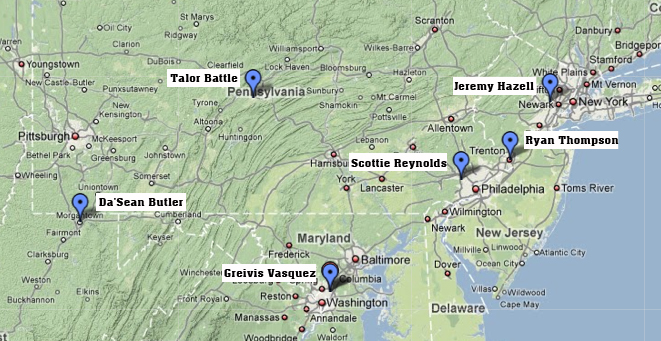
Mid-Atlantic Region  (NYC, NJ, PA, WV, MD, DE)

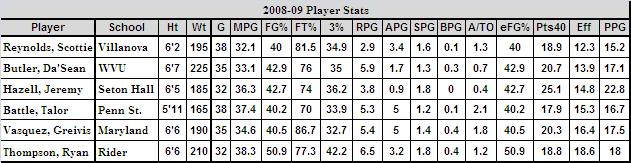
  • Scottie Reynolds – Sr, G – Villanova. There might be players in this region who can score more points or dish out more assists or shoot a higher percentage from the floor than Reynolds.  There might be more physically imposing and athletically gifted players than the 6’2 guard from Northern Virginia.   There could even be a few ‘upside’ guys you’d pick before him if you were starting an NBA franchise.  But is there any player as capable of putting his team on his back and doing this (ok, maybe Vasquez, but he hasn’t done it yet)?  Is there another player on this list who you’d prefer to have the ball in his hands as the clock is ticking down, knowing that he’ll give your team a superb chance to win?  Reynolds is the player that every coach loves to have on his team – he plays heavy minutes, never misses a start, shows great leadership and clearly has a calming effect on his team whenever he’s on the floor.  This is a long way removed from the early days of his career, where the ‘Nova legend has stated that he had trouble seeing the ‘big picture’ due to trust issues with coaches and other players.    There are no such issues now, as everyone in the Big Five (and the Big East, for that matter) understands who the top dog in the Philadelphia area is.  If things come together right for Reynolds and VU in 2009-10, he could look back on a collegiate career that includes three all-Big East nods, an all-american selection, the second-most number of steals (he needs 58), and the most points (Kerry Kittles) in the long history of the Villanova program (he needs 624).  Considering all that, Reynolds will captain the best team in the Big East and may also have another Final Four appearance in his sights.
  • Da’Sean Butler – Sr, F – West Virginia. If there’s a team that should challenge Villanova (on paper) as the class of the Big East in 2009-10, it should be West Virginia.  The biggest reason for that is Butler, the 6’7 wing set to replace Pitt’s Sam Young as the most multi-dimensional player in the conference.  Butler scores (17.1 ppg), rebounds (5.9 per game) and even finds time to play the passing lanes (1.7 spg).  Last season he seemed to really find his groove in the conference slate, as his numbers all rose, culminating in his 43-pt explosion during a blowout win against Villanova on Friday the (Feb.) 13th.  But it was his performance over the summer at the World University Games that really caught our eye – on a team with shooters such as Robbie Hummel and James Anderson, it was Butler who led the squad in three-point percentage (55%) by nailing nearly two per game.  His perimeter shooting has always been solid (~35%), but if his shot improves next season to the 38-40% range to replace Alex Ruoff’s deadly range, Butler’s ability to get to the rim and finish becomes even more of a threat.  With sophomore Honorable Mentions Devin Ebanks’ size and rebounding, Truck Bryant’s scoring and playmaking, plus the addition of two five-star recruits to the roster, it’s clear why WVU looks to improve on last year’s 23-12 record and first round NCAA exit.  Mountaineer fans have an expectation of a top ten team in Morgantown and it’s understandable why they think so – it’ll be up to their star Butler to deliver on those expectations.
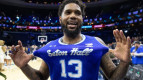
  • Jeremy Hazell – Jr, F – Seton Hall. Jeremy Hazell’s inclusion on our Mid-Atlantic all-region team was the toughest decision we had to make.  There’s absolutely no question that the 6’5 guard/forward who blew up on the Big East last season has talent.  You don’t score 20+ against sixteen Big East defenses without the ability to score the ball from every which way (22.8 ppg).  The primary issue was that it’s difficult to claim to be an impact player if your team isn’t very good, and last year, the Hall finished 7-11 in the conference with all seven of those wins against fellow bottom-feeders.  Nevertheless, we recognize that past results do not necessarily predict future outcomes, and with three impact transfers arriving (Herb Pope, Jeff Robinson and Keon Lawrence) amidst a much leaner Big East landscape, it wouldn’t surprise us if Seton Hall, led by Hazell, made a run at the NCAAs this year.  Getting back to Bobby Gonzalez’s star player, his scoring numbers might actually decrease this season depending on how well the new players orient to North Jersey, but with fewer shots (he took 32% of SH’s shots last year) he could become a more complete player by improving his shooting percentages (43%/36%) and offensive efficiency (28th in the Big East).  Regardless of how this season goes, Hazell is undoubtedly one of the most talented players the nation has yet to hear about.
  • Talor Battle – Jr, G- Penn State. While the electric Penn State point guard Talor Battle may have been known within Big Ten circles and around Happy Valley, national attention wasn’t forwarded his way until one performance on February 1 in East Lansing, MI. The heavily favored top-ten ranked Spartans, a team that would reach the championship game just months later in Detroit, fell to the underdog Nittany Lions, who were 0-16 in their Big Ten history at the Breslin Center. During that game, Battle emerged as one of the top scorers in the conference and the nation. In a league where hard-nosed defense on every possession is the norm, Battle averaged 16.7 ppg, including seven 20+ point performances in conference play. And on that night in East Lansing, Battle scored 29 points on 11-19 shooting and 6-12 from three, leading Penn State to a 72-68 upset win. Battle certainly has some areas to improve – namely shooting 34% from deep and hitting just 70% of his free throws – but the scoring guard truly has the capability to put up 30+ points on any given night. With Jamelle Cornley and Stanley Pringle no longer at PSU, the onus lies almost completely on Battle to lead the way for Penn State and coach Ed DeChellis if they have any hope of reaching postseason play again. Considering such a lackluster supporting cast, one could argue Battle will have the most singular impact of any player in this entire region, as on many nights Penn State will completely rely on Battle’s scoring potential to win basketball games.
  • Greivis Vasquez – Sr, G- Maryland. Love him or despise him with every bone in your body, there’s no denying the talent of Greivis Vasquez. There’s also no denying that Vasquez’ decision to stay at Maryland for his senior season rather than enter the NBA Draft had the greatest impact of any April decision in the country, vaulting the Terrapins from a likely-NIT team to a possible top-six seed and ACC contender. Much like Battle’s performance against Michigan State, one 2008-09 performance from Vasquez defined his season and launched the fiery Venezuelan into Maryland basketball lore – a 35-11-10 triple-double in an 88-85 overtime win against #3 North Carolina in College Park when Maryland was lingering around the bubble. Vasquez backs up his never-resting mouth with impressive play on the court, notably being named to the all-ACC second team for the second straight campaign and, in Oscar-like fashion, leading his Terps in scoring, rebounding, assists, steals and minutes, becoming just the sixth player in ACC history to accomplish said feat. The main knock on Vasquez during his first two seasons in College Park was a recurring propensity to commit foolish turnovers, but that criticism is quieting after Vasquez finished third in the conference in assist/turnover ratio a season ago. There’s no argument against Vasquez making a tremendous impact for Maryland and Gary Williams once again this season.
  • Ryan Thompson (MM) – Sr, G- Rider. In doing research for this feature, I have yet to find one thing that Ryan Thompson does not do well on the basketball court. The younger brother of Kings forward and fellow Bronc Jason Thompson, Ryan is surely creating his own identity as a bona fide NBA prospect.  A first team all-MAAC performer a season ago as a junior, Thompson did it all for Rider: ranking second in the conference in scoring, first in minutes played (he played 40+ minutes in nine games), second in three-point percentage, seventh in assists, eighth in field-goal percentage, eighth in free-throw percentage and eighth in rebounding. That’s right, Thompson can shoot from deep, score inside, rebound, pass and play nearly every minute. While the competition doesn’t always rank with other elite performers in college basketball, one could argue Thompson is the top all-around player in the game this season. He also plays his best when the stakes are high, totaling 57 points and 17 rebounds in two conference tournament games for his Broncs, including a bucket with 3.4 seconds left to knock off Siena last year. The sky’s the limit for Thompson in 2009-10, an already immensely talented individual playing with motivation as Rider has yet to reach the NCAA Tournament in his three seasons in Jersey, and coming off of a rare and disappointing seven points on 2-13 shooting against Liberty in his season finale.
impact players mid-atlantic

Honorable MentionLavoy Allen, Temple.  Sean Baptiste, FDU.  Jamal Barney, Loyola (MD).  Darryl Bryant, WVU.  Jermaine Dixon, Pittsburgh.  Devin Ebanks, WVU.  Corey Fisher, Villanova.  Darrin Govens, St. Joseph’s.  Rodney Green, Lasalle.  Charles Jenkins, Hofstra.  Anthony Mason, Jr., St. John’s.  Herb Pope, Seton Hall.  Mike Rosario, Rutgers.  Damian Saunders, Duquesne.  Corey Stokes, Villanova.  Devin Sweetney, St. Francis (PA).

Share this story

RTC 09-10 Class Schedule: Duke Blue Devils

Posted by zhayes9 on August 27th, 2009

seasonpreview 09-10

Ed. Note: for all of the posts in the RTC 09-10 Class Schedule series, click here.

The ACC has been North Carolina’s league for three straight seasons now. With four prolific stars departing from Roy Williams roster, this could be the year Duke re-claims supremacy in the most fabled conference in college basketball. The loss of athletic swingman Gerald Henderson early to the riches of the NBA hurts, but the late inclusion of a young point guard to compliment two potential blue-chip power forwards and the dynamic duo of Jon Scheyer and Kyle Singler means Duke has the goods to capture their first ACC regular season title since J.J. Redick and Shelden Williams manned the Cameron Indoor Stadium floor.

465081206020_Duke_at_Michigan[1]

Let’s face it: this program hasn’t quite featured the mystique and aura that normally comes with Duke basketball since the heartbreaking loss to UConn in the 2004 Final Four. Duke’s pinnacle has been the Sweet 16 since that crushing blow and critics are lining up over whether coach Mike Krzyzewski‘s Olympic conquests are hurting the program. Still, a top-two ACC finish and an Elite Eight seem like reasonable goals for this Duke team that only lost Henderson, transfer Elliot Williams, quarterback Greg Paulus and glue guy David McClure. Three top-50 recruits and four of the Blue Devils’ top five scorers return for a squad looking to knock an inexperienced North Carolina team off the mantle.

How does everyone’s favorite hoops team stack up schedule-wise? Let’s examine:

Non-Conference Schedule Rank: 8. Duke normally doesn’t back down from challenging their team in non-conference play, so their participation in the NIT Season Tip-Off and neutral/road games against Georgetown, Wisconsin, Gonzaga, Iowa State and St. John’s doesn’t surprise me. The Blue Devils normally excel in November and their only formidable foe in the NIT tournament this year is Connecticut. They’d match up in the finals if Duke can slide past Coastal Carolina, Charlotte and most likely an Arizona State team that lost both James Harden and Jeff Pendergraph. A November 27 final against UConn at MSG would certainly not lack for entertainment. The ACC-Big Ten challenge pits Duke a difficult road game at the Kohl Center, a venue where Wisconsin rarely loses. Neutral floor games against Gonzaga in NYC and Iowa State in Chicago are included, along with a January 30 visit to Georgetown to face a Hoya team that could be a well-oiled machine at that point. Conference USA favorite Tulsa also makes a trip to Cameron in late February, which has the potential to be dangerous for Duke. The non-conference slate certainly presents challenges, and credit Coach K for agreeing to send Duke to places other than Durham for tests that will certainly benefit the Blue Devils come ACC play.

Cupcake City: Only six true cupcakes on the slate for Duke this season as UNC Greensboro, Coastal Carolina (part of the NIT), Radford, Gardner-Webb, Long Beach State and Penn travel to Durham (although I should count Charlotte the way they played last season). A program with Duke’s stature doesn’t have to schedule Gonzaga in NYC or travel to Chicago to play Iowa State, but they do anyway. Unlike Washington, Duke will be battle-tested for conference play and their computer numbers will give the Blue Devils a boost when it comes to seeding debates. Duke is usually in the top-ten in RPI every single season and there’s a reason why.

Read the rest of this entry »

Share this story

07.23.09 Fast Breaks

Posted by rtmsf on July 23rd, 2009

It’s actually been a fairly busy week in the world of college hoops despite the mid-summer lull, so let’s take a look at some of the other key stories coming down the pike…

  • Hoop Dreams, 15 Years Later.  This week in his Hoops Thoughts column, Seth Davis pushed us down memory lane to the grungy days of 1994, a year of Cobain, Madonna’s undies and OJ’s white Bronco, but also of a bedraggled jewel of a documentary called “Hoop Dreams.”  We have a fair amount of younger readers on this site, so if you’ve never seen this movie, stop what you’re doing RIGHT NOW, and rent it on Netflix or your local movie shop.  It is without question the best basketball film ever made.  Davis’ summary of the movie is good so we won’t belabor that here, but even fifteen years later, the movie holds its color, bouquet and taste much better than most items from that era.  We slightly quibble with Davis on his contention that HD was the first reality tv (The Real World says hello) or that the two players featured in the film, William Gates and Arthur Agee, were ordinary people (their extraordinary skills at basketball at a young age is what made them not ordinary), but we completely agree with his fundamental assessment that the authenticity behind these two players’ struggles still resonates today.  The early 90s, when Gates and Agee were documented in the film, was an era at the edge of a precipice in two key cultural shifts that are still impacting the game: 1) the worldwide online revolution of 1995, which has impacted scouting and recruiting in an exponential fashion now that players can be commodified based on Youtube clips and independent assessments from anywhere on the globe; and 2) Kevin Garnett’s decision to go to the NBA straight out of HS in 1995 led to a sea change in how high school players were viewed, pushing scouting (and dreams of riches) earlier and earlier into a player’s development.  From a re-viewing of the movie in 2009, it’s easy to see the seeds of World Wide Wes and his ilk as assembly-line talent evaluator-cum-agents strategically dropping their whispers of fame and fortune into player family’s ears at a young age.  What was once limited to the bigger cities and at a much smaller scale is now ubiquitous; where elite players were once counseled by their coach (as in, their HS coach, not their AAU coach), they now listen to runners and quasi-representatives from shoe companies.  All of the dirty elements that are plaguing today’s amateur player development and the college game are there on display, in a rawer, more transparent form, in Hoop Dreams.  The authenticity of how the system uses these players, only to spit them out when they’re no longer useful, is front and center – how have things changed?  Thanks to Seth for re-awakening everyone to this movie – it’s a must-see.     
  • SEC-TV.  Starting this fall, the SEC announced that it will broadcast an all-SEC sports network as part of its new $2.25B deal with ESPN.  The SEC Network (through ESPN Regional) will syndicate its college football and basketball games to 73 (and counting) markets, but what makes this announcement particularly compelling is how the SEC has strategically decided to move outside its traditional nine-state southeastern footprint for this deal.  Local affiliates in the major markets of New York, Los Angeles and Chicago, as well as the three major Texas cities, are included in this deal, which unequivocally shows that the SEC isn’t playing games in terms of its foray to dominate college sports through national recruiting.  Where this could really pay dividends is not with the Kentuckys and Floridas, but with the Mississippi States and the Georgias of the SEC.  If games involving those teams are on tv in major media markets showing recruits a fun, winning style, they might be more inclined to consider going there over local state U.  How will the other leagues react?
  • F the Gazelle Group.  They’re back again this season with another faux-tournament in the form of the Legends Classic.  Remember our piece shredding them on this last year?  If you don’t, here’s a refresher.  The Gazelle Group got upset when little Gardner-Webb upset Kentucky in Rupp two years ago during a preliminary round game, meaning that the legions of UK fans they expected to buy tickets the next week weren’t showing.  So what’d they do the next year – they fixed the tournament!  Yep, all four of the ‘host’ teams get automatic entry to the Championship Rounds (final four teams) despite what happens in the prelims.  Total asinine garbage.  This year’s four faux-champs?  Michigan St., Rutgers, Florida and UMass.  MSU-Florida could be interesting, and definitely keep an eye on summer hotshot Mike Rosario from Joisey (playing in AC). 
  • Quick Hits.  Anthony Mason, Jr.: back in a Johnnies uni for 09-10.  Jim Calhoun: still going full boreJosh Selby/World Wide Wes: that’s just messed upWooden Classic: Georgetown v. Washington; UCLA v. Mississippi St.  Coach K: are Duke fans mad atchaMurray Bartow: 2-year extension at ETSU.  Dickie V: Summer Rolls-RoycersTop 25 Recruits: broken downGary Parrish: on the summer circuitSix OTs: enjoyAntonio Burks: recovering after robbery where he was shot.  Centenary: downgrading to D3WCC Tourney: in Vegas through 2012 (at least).  2010 Vegas Odds: sell Louisville
Share this story

The NIT Semifinals and Random Encounters

Posted by nvr1983 on April 1st, 2009

Ray Floriani of College Chalk Talk is a contributing writer for Rush the Court.

By Ray Floriani

NEW YORK CITY – First the primary items. Baylor defeated San Diego State 76-62 and Penn State held on for a 67-59 win over Notre Dame in the NIT semifinals at Madison Square Garden.

The final numbers….

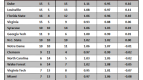
baylor-sdsu

What Baylor did to get to Thursday…Shoot the ball. They literally attacked on the perimeter going an unbelievable 11 of 22 from beyond the arc. LaceDarius Dunn had 23 points including 6 of 9 from three. Baylor’s Curtis Jerrells paced all scorers with 25. Jerrells is a problem for defenses as he is a deft penetrator as well as a perimeter threat. Baylor defended , in three NIT games their defensive PPP was over 1.00, largely be forcing 19 turnovers.

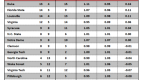
pennstate-notredame

What Penn State did well… Defend and hold on. The first half Notre Dame had a .58 PPP and eFG mark of 26%. The Irish missed shots but credit the tough Penn State defense. The second half ND found the range and Luke Harangody (17 points) came alive. The Irish had what was almost a twenty-point deficit, down to a two possession game in the stretch. Penn State never lost the lead largely due to a big Jamelle Cornley (16 points) jumper with just under four to play.

The fans God love them…We are on the baseline press table. Myself and press row neighbor Jeff Bernstein, a former coach, who loves to talk strategy, get into a conversation with a Baylor fan Ryan Lindsey. He’s here in New York with his wife and young son. Turns out he coached ‘select ball’ AAU in Texas terms and noted, “the worst beatings we got were facing Blake Griffin’s teams when he was in high school. That kid was and is unstoppable.”

The conversation ran the gamut from John Calipari going to Kentucky to what happens at Memphis. Coaching openings were pondered until Scott occasionally gets up to holler “sit down Fisher if Freider didn’t leave you’d be at Ann Arbor junior high” in reference to the San Diego State coach who was disagreeing with the officials.

Scott is knowledgeable about schools and conferences around the nation. He tells us the Texas basketball job is a plum. “They pay over 2 million and just don’t want you to embarrass the school.” Translated, football rules.

The discussion goes on. Baylor is puling away and Scott and family have a few more nights in the Big Apple. “We need to go eat,” he says. “What will ten dollars get us? A pretzel?” he adds laughing. Waco is home but he knows the score in New York.

Finally Jeff says, “St. John’s has to get you on the schedule so you can get back to MSG and visit.” Scott says, “we would love it but out of conference Baylor plays ‘directional’ schools and SWAC schools. We had so many SWAC wins we expected their automatic to the NCAA play in.”

The buzzer sounds Baylor wins. “See you on Thursday”, Scott and his wife say. Undoubtedly they are fully enjoying the moment. As other Baylor faithful are.

Share this story

RTC Bracket Second Round Results: Best Team of the Modern Era (1985-2008)

Posted by rtmsf on April 1st, 2009

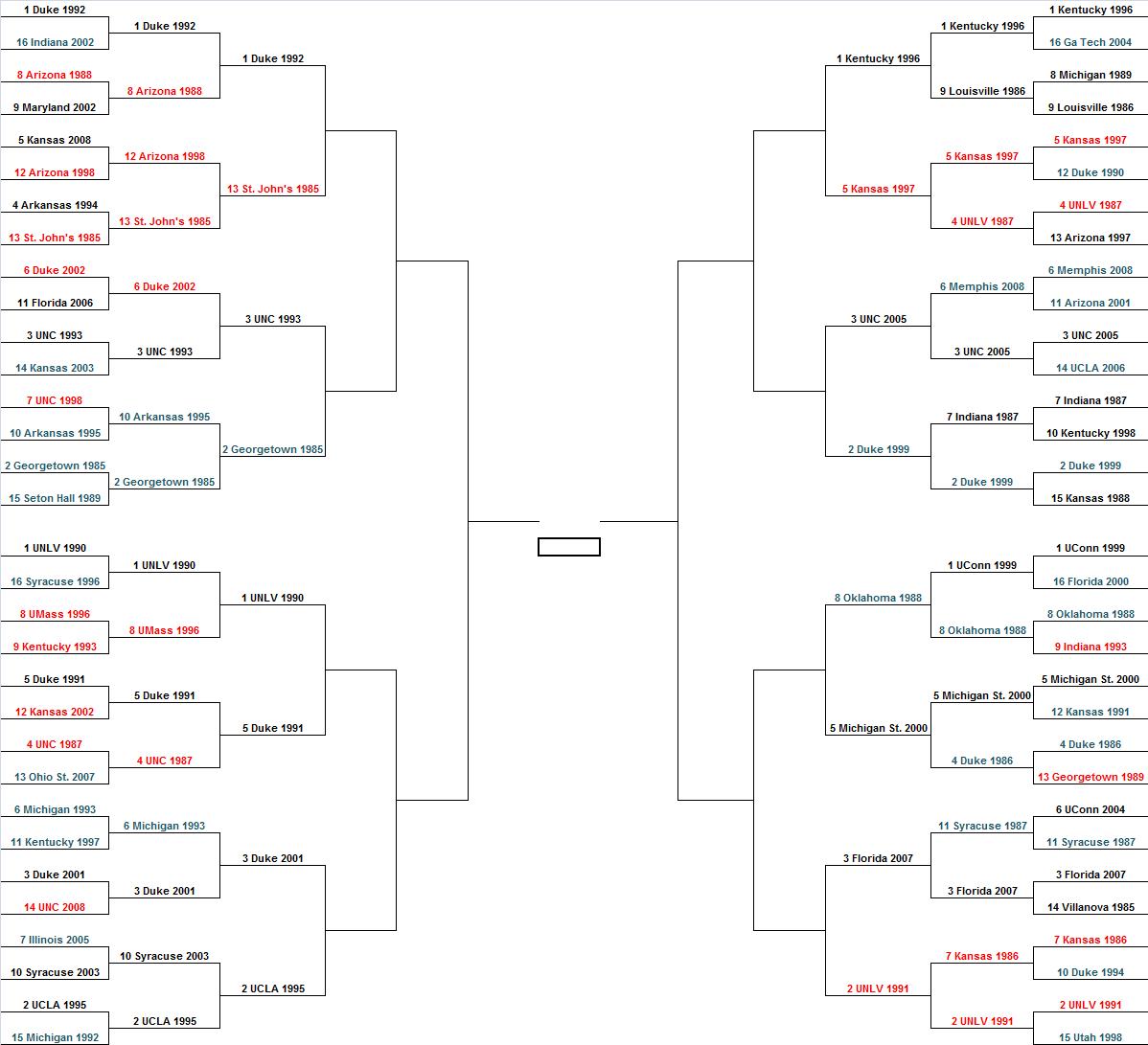
Now we’re starting to get to the good stuff.  Below is our sweetest of Sweet Sixteens in the RTC Modern Bracket.

We have ten national champions still alive, three runners-up and three at-large teams. There were a couple of minor upsets, but one of our #1 seeds has already exited this Dance.

Explanations of each game below the bracket.

ncaa-modern-bracket-r16

Instant Analysis

#1 Duke 1992 def. #8 Arizona 1988 – Lute Olson‘s Wildcats keep this game closer than you might expect thanks to Sean Elliott, Steve Kerr and Anthony Cook, but Coach K’s trio of Christian Laettner, Bobby Hurley and Grant Hill pull away in the last 5 minutes. Against most teams Elliott is a nightmare match-up, but Duke has Grant Hill who while not quite at the level he was at in 1994 still can play some solid defense. In the end, Arizona, like many teams, doesn’t have an answer for Laettner who wills the Blue Devils into Sweet 16.

#13 St. John’s 1985 def. #12 Arizona 1998 – While I’m not sure that either of these teams can be considered a Cinderella, we get our match-up of double digit teams. Lute Olson’s defending champs came into the game supremely confident after having knocked off a very good Kansas 2008 team with their next match-up against a team that didn’t even make the the NCAA title game, but Lou Carnesecca’s Redmen have other ideas. Arizona’s heralded backcourt of Miles Simon and Mike Bibby simply run into a better version of themselves in Chris Mullin and Mark Jackson and the Wildcats have no answer for Walter Berry. Next up for Lou Carnesecca, Coach K and the 1992 Blue Devils.

Read the rest of this entry »

Share this story

RTC Bracket First Round Results: Best Team of the Modern Era (1985-2008)

Posted by rtmsf on March 30th, 2009

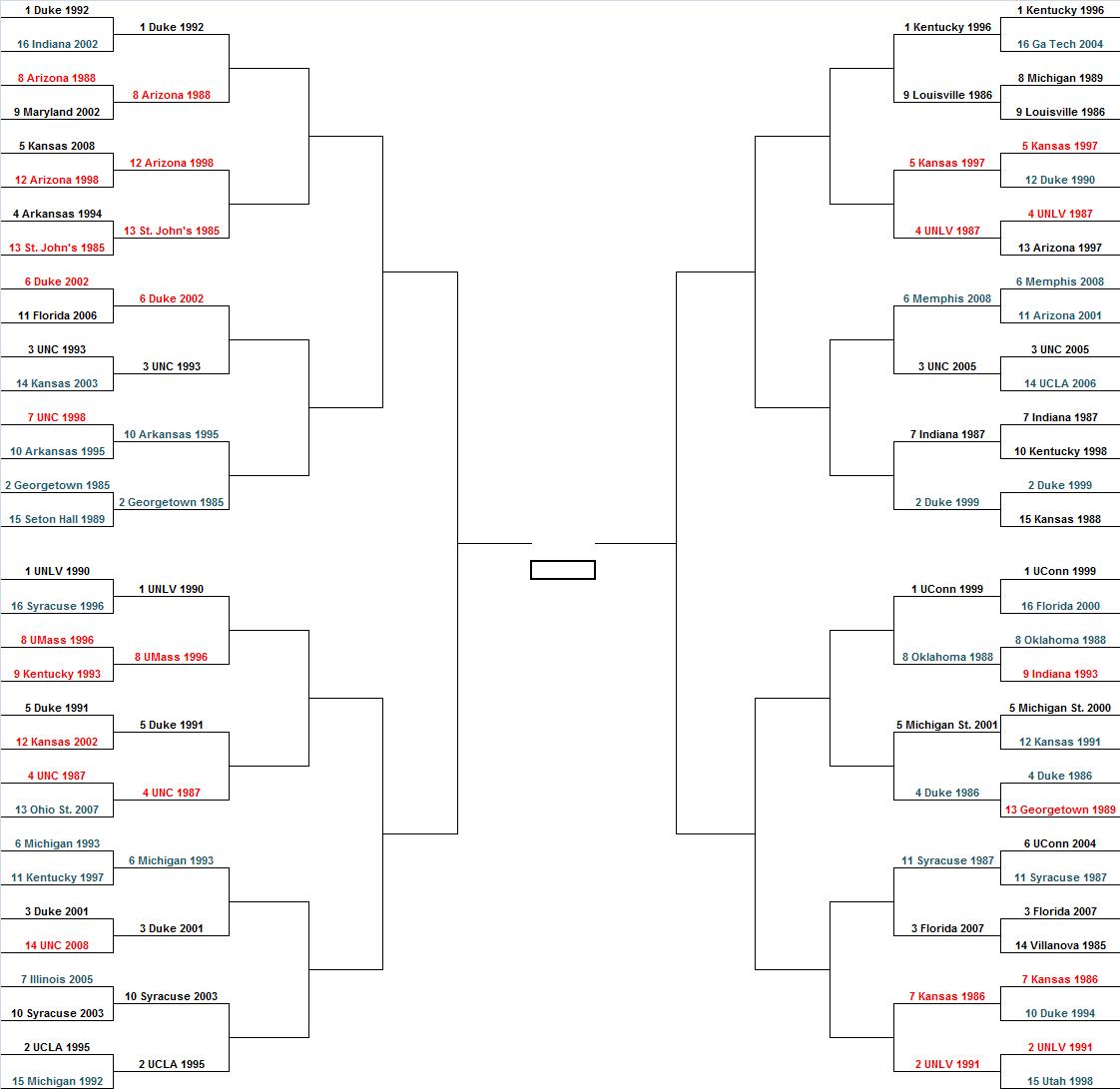
Welcome back.  The RTC Braintrust got together tonight and hammered out our 32 first round winners for the RTC Modern Bracket, one step closer to picking the team that we believe is the very best squad of the last quarter-century.

A reminder: we used resume/body of work to select and seed our 64 finalists, but that criterion now takes a step back to how we think teams would perform in head-to-head matchups.  So if your favorite team won a title but had a relatively weak inside game, don’t be surprised if a runner-up or at-large from another year with superb inside play knocks you out of the bracket.  Yes, we’re looking at you, Illinois fans.

Quick analysis of the numbers: fourteen of our 24 national champions survived the first round, but only eight of our runners-up made it through their first game.  Ten of our sixteen at-large teams also survived.

And now, the updated bracket through the first round of matchups, with brief explanations of how we analyzed each game below.

ncaa-modern-bracket-r32-v2

Instant Analysis

#1 Duke 1992 def. #16 Indiana 2002 – Coach K’s best team picked apart the Cinderella Hoosiers while the two Hills – Thomas and Grant – made life miserable for Jared Jeffries.

#8 Arizona 1988 def. #9 Maryland 2002 –   In a very close contest, Steve Kerr and Sean Elliott got it done from the perimeter despite Juan Dixon’s heroics to keep Maryland in the game.

#12 Arizona 1998 def. #5 Kansas 2008 – Upset Alert!  The defending champs led by Mike Bibby, Miles Simon and Michael Dickerson, took care of a Kansas team that could not bottle up the Arizona guards (think 2.5 Derrick Roses).

#13 St. John’s 1985 def. #4 Arkansas 1994 – Arkansas didn’t want to face a team with a superb PG in this matchup, and they faced one of the best of his generation in Mark Jackson.  Jackson continually hit Chris Mullin and Walter Berry for open looks to pull off the upset over the national champion Hawgs.

Read the rest of this entry »

Share this story

RTC Bracket: Best Team of the Modern Era (1985-2008)

Posted by rtmsf on March 30th, 2009

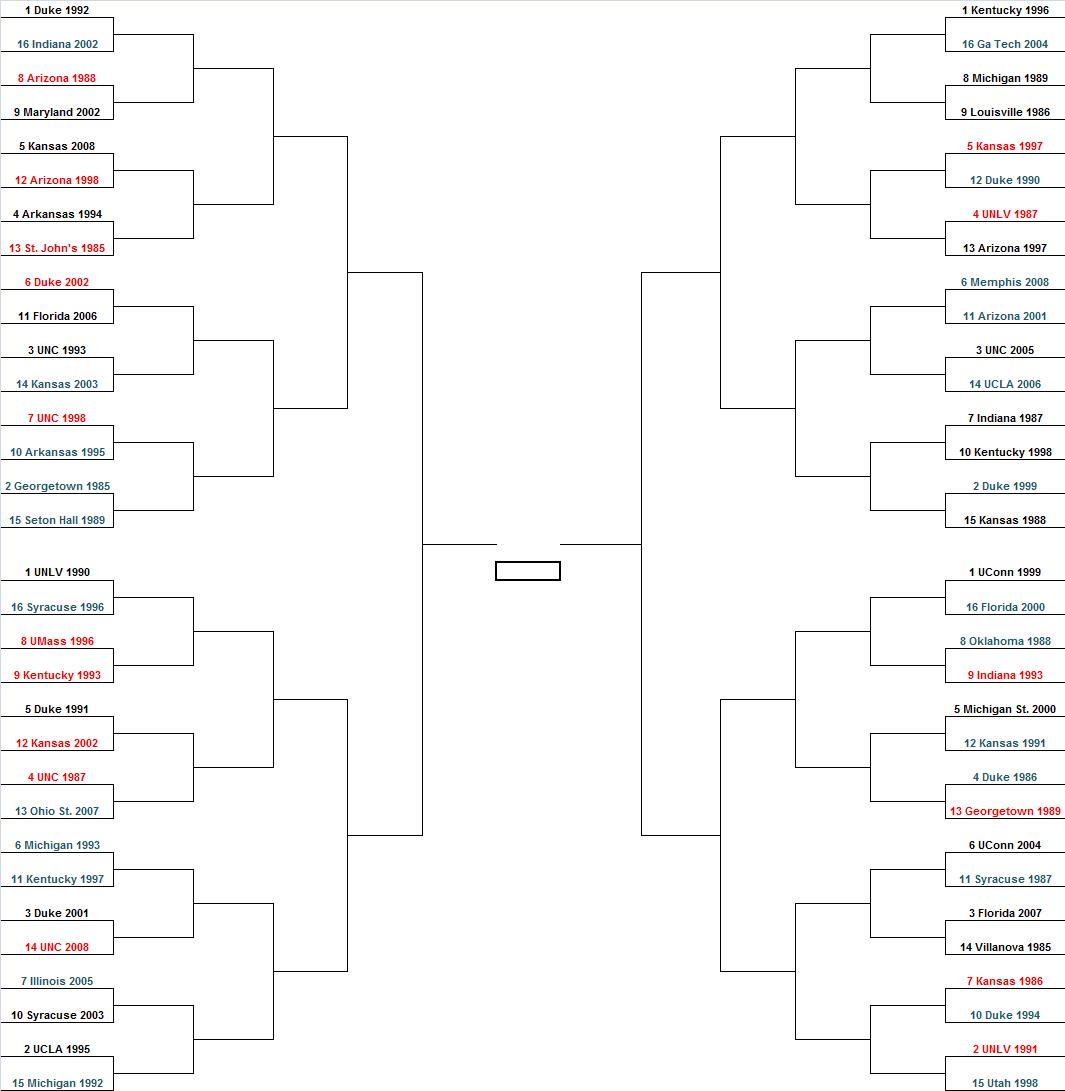
We’ve been sitting on this idea for some time now, and we figured that the relatively quiet week prior to the 2009 Final Four would be the best time to unveil it for your vetting, review and diligence.  So the plan is this: each weekday we’ll advance one round until we get to a Modern Era Final Four on Friday.  On Sunday following the F4, we’ll release our two finalists and the Modern Era champion will be crowned on this year’s Championship Monday.

Let’s get down to it with our criteria for selection of the 64 teams:

  • We selected the 24 national champions (noted in black).
  • Next, we selected the 24 national runners-up (noted in blue-gray)
  • Finally, we selected the 16 best at-large teams of the last 24 years (noted in red).

You’re undoubtedly wondering how we chose the last group of sixteen at-large teams, and that’s a fair question.  There was no single measure (such as making the F4) that guaranteed inclusion to or exclusion from our at-large field, but we considered each team’s body of work in a particular season when doing so.  Criteria such as overall record, conference record, AP poll ranking, NCAA seed, postseason success, general reputation at the time, and team history were included.  Similar to selecting and seeding the field every year, the last few teams looked largely the same on paper and in our memories.  Some of them will without question inspire debate, but that’s ok, because the point of this entire exercise is to do so.

The same is true for how we seeded each team in the field.  As much as possible, we tried to stay away from the Team A would beat Team B analysis (that’s next!), focusing mostly on the team’s full body of work.  Of course, comparing teams between eras and even years is nearly impossible in many cases, so there’s a fair amount of subjectiveness that went into the seed placements.  Bear with us on that.  Additionally, as much as possible, we tried to avoid early-round matchups between the same school and teams from the same season, while still keeping a reasonable amount of competitive balance among the regions.

Enough chatter, here’s our Modern Era bracket.  Please leave us comments below telling us your choices for the first round winners.  We won’t guarantee that we’ll listen, but you’ll likely know something about these matchups that we don’t.  Feel free, and we’ll be back tomorrow with the next round!

Update: here are the First Round results.

ncaa-modern-bracket-field-v5

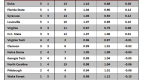
Overall Top Four Seeds:  Duke 1992, Kentucky 1996, UNLV 1990, UConn 1999

Last Four At-Larges: UNC 2008, St. John’s 1985, Georgetown 1989, Kansas 2002

First Four Left Out: UCLA 2008, Arkansas 1991, Michigan St. 2001, St. Joseph’s 2004

Breakdown by School (total, at-large):

  • Duke (8, 1)
  • Kansas (7, 3)
  • North Carolina (5, 3)
  • Arizona (4, 2)
  • Kentucky (4, 1)
  • Florida (3, 0)
  • Indiana (3, 1)
  • Michigan (3, 0)
  • Syracuse (3, 0)
  • UNLV (3, 2)
  • Arkansas (2, 0)
  • Connecticut (2, 0)
  • Georgetown (2, 1)
  • UCLA (2, 0)
  • Georgia Tech (1, 0)
  • Illinois (1, 0)
  • Louisville (1, 0)
  • Maryland (1, 0)
  • Massachusetts (1, 1)
  • Memphis (1, 0)
  • Michigan St. (1, 0)
  • Ohio St. (1, 0)
  • Oklahoma (1, 0)
  • Seton Hall (1, 0)
  • St. John’s (1, 1)
  • Utah (1, 0)
  • Villanova (1, 0)

Be sure to check back on Tuesday morning for the First Round results of the RTC Modern Era bracket.

Share this story

West Region Game by Game Previews – 1st Round (Pt. 2)

Posted by nvr1983 on March 19th, 2009

West Region – by Ryan ZumMallen of LBPostSports

#6 Marquette vs. #11 Utah State
Playing in the Big East must suck sometimes.  The Eagles are currently losers of five of their last six, but lost those five to Louisville, UConn, Pittsburgh, Syracuse and Nova.  The one chance they got against an inferior team during that stretch, they crushed St. John’s by 29.  Give Utah State a chance if you’re brave, but Eagle guards Jerel McNeal and Wesley Matthews will probably prove too much to handle.

#3 Missouri vs. #14 Cornell
The NCAA Tournament is familiar territory to Cornell, entering the Dance as a 14-seed last season.  Missouri, on the other hand, hasn’t been to the Tourney is six years.  So, obviously, Cornell has the upper hand.  Ha!  No, but seriously though, Missouri is as dangerous a team as any in the field, winners of 11 of their last 13 and Big XII Tournament Champs.  Cornell made it here by holding four of their last five opponents to under 60 points, but that won’t happen against the Tigers.

Share this story