Morning Five: 08.31.10 Edition

Posted by rtmsf on August 31st, 2010

  1. Checking in on the latest conference re-re-realignment talk from Utah, the current word is that BYU is still intent on going independent in football but is looking more and more like a candidate to move to the WCC in basketball and all other sports.  Yes, you read that right.  The West Coast Conference, the tightly-knit eight-team conference of tiny private religious institutions that max out at nearly 9,000 students (Loyola Marymount and San Francisco, whereas BYU at 33,000 students is nearly four times that enrollment) and has remained at eight teams for three decades.  Andy Katz makes the case that this move makes sense in basketball, and we can’t really argue with his logic, except for one little thing — you know what makes more sense?  Staying in the Mountain West, where, with recent additions of Nevada and Fresno State to go with San Diego State, UNLV and New Mexico, the league is on the verge of overtaking the Pac-10 for hoops superiority out west.  We should know something very soon — the deadline for BYU to leave the Mountain West is Wednesday.
  2. Getting back to the conference that BYU originally threatened to move to prior to its implosion, the WAC, feeling jilted and unloved after Nevada and Fresno State’s unceremonious dumping earlier this month, is threatening to sue the two schools if each refuses to pay a disputed $5M exit fee each by the October 25 deadline.  Furthermore, the WAC says that they have the contractual right to not release the two renegades until after the 2011-12 academic year, an interesting assertion given that Fresno and Nevada’s stated positions are that they’re leaving next summer.  This is going to get more interesting before it dies down, because there’s no question that this particular tussle has gotten personal among key players at some of these schools.
  3. There’ll be a boatload of these player profiles coming out in the next two months, but it just means that the season is slowly approaching.  Here are a few from the last few days: Texas’ Jordan Hamilton, Mizzou’s Kim English, Purdue’s E’Twaun Moore, and Louisville’s Preston Knowles.
  4. Jeff Jacobs, a UConn columnist at the Hartford Courant, suggests that Ater Majok’s presumed leaving of the program has nothing to do with impending sanctions that may have involved his recruitment, as we wrote could be possible yesterday.  But in the same paragraph, he also says that there have been “whispers” in the program involving Majok, so we’re not sure what to believe here.  UConn is expected to announce its response to the NCAA’s allegations later this week.
  5. Austin Rivers is the #1 prospect in the Class of 2011, according to Rivals, and he showed the skill that he possesses in a recent summer league game where he crossed over and scored on #1 pick John Wall, followed by ripping him clean on defense on the other end.  One blogger makes a reasonable case as to why Rivers will end up playing for Coach K at Duke in the fall of 2011.
Share this story

Making Sense of the Mountain West/WAC Debacle

Posted by rtmsf on August 21st, 2010

Andrew Murawa is the RTC correspondent for the Mountain West and Pac-10 Conferences and an occasional contributor.

When last we left the BYU-instigated MWC/WAC soap opera, the Cougars’ plans to escape the MWC in favor of football independence and a WAC home for all other sports had been thwarted by Fresno State and Nevada’s decisions to leave the WAC for the MWC, leaving the six remaining WAC schools twisting in the wind and BYU, although still a desirable quanitity, undecided as to where it would wind up. In the days since, some of the details of the MWC-induced defections have surfaced, some new rumors have arisen and the futures of the WAC and BYU remain undecided. And so, a recap of the events and whispers of the last few days:

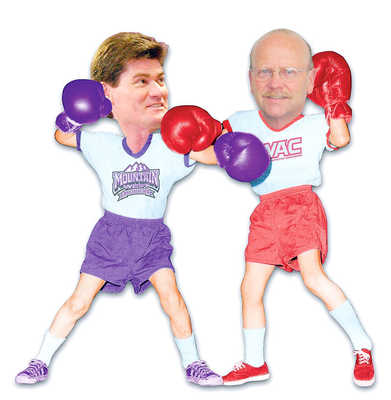
Our Money is on Thompson (left) In This One (Idaho Statesman)

  1. Thursday morning, WAC commissioner Karl Benson gave his first public comments on the Fresno State and Nevada decisions to leave the conference, and he promptly blasted them, saying that their decisions were “selfish acts” that left the conference’s future very much in doubt. He also clarified that Nevada president Milt Glick did not, in fact, sign the agreement that would have levied a $5 million penalty on the institution for leaving the conference, but did give a verbal agreement to the proposition, and Benson expects that the verbal agreement will be binding. Fresno State’s president John Welty, along with the presidents of the other six WAC institutions, signed the agreement. According to Benson, the two institutions will have to pay up within 60 days. Furthermore, because both schools missed the July 1 deadline for filing to leave the WAC, they will be expected to play the next two seasons in the conference before heading to the Mountain West.
  2. It also came out on Thursday that Utah State had also been invited to join the MWC, but had turned it down, partially due to the $5 million buyout and in part because they wanted to be in the same conference as BYU. Since then, it has been reported that Utah State is again in negotiations with the MWC about possible membership, and since Nevada and Fresno State have already left the WAC, the $5 million buyout penalty is no longer in effect. If Utah State winds up leaving the WAC, it will likely be the final nail in the coffin, as the WAC needs six members who have been together for five continuous years in order to retain its automatic bid to the NCAA Tournament. If USU leaves, the WAC would be down to five teams, and it would be the next little domino that would push the remaining WAC schools to plan a different future.
  3. While Utah State looks to take care of itself, Hawai’i is contemplating its own future sans the WAC, and that future may include independence, football-wise. Given the difficult travel logistics in scheduling Hawai’i, they may be better off scheduling a combination of road guarantee-games, a handful of home-and-home series and several games at the ends of seasons welcoming BCS squads as sort of a pre-Bowl bowl game. For other sports, including basketball, Hawai’i is considering perhaps joining a conference like the WCC, although the attractiveness of adding such a geographic outlier to any smaller conference is very much in question.
  4. If, by some stroke of luck, the WAC is able to keep all six of its remaining institutions on board (and about the only reasonable selling point they have now is that they could split the $10 million that may be owed by Fresno State and Nevada among the remaining teams), the WAC is still looking at taking a huge step backwards. With very few desirable FBS football schools in the west as potential targets for the conference, among the schools being discussed as possible additions to the conference are names like Cal Poly, UC Davis, Sacramento State, Texas State and Texas-San Antonio, none of whom have been major factors in Division I men’s basketball.
  5. The biggest outstanding question in all of this mess is at BYU: after triggering this landslide, where exactly do they wind up? Commissioner Benson remains hopeful that BYU will still be coming to the WAC, but at this point that is little more than wishful thinking – there is absolutely no reason for BYU to take its non-football sports to that mess anymore. If football independence is still on the table, the only way that will happen is if BYU agrees to join the WCC for its non-football sports, however BYU has very little in common with the schools in that conference. While all of those WCC schools are religious schools, they are all also very small schools, but BYU has an enrollment of more than 30,000 students. In the end, while nothing is set in stone yet, MWC officials have become more and more confident over the past few days that BYU will wind up back in the MWC, at least until it comes up with a better plan a few years down the road.
  6. One interesting rumor that has been bandied about the past couple of days has been a potential MWC/Conference USA agreement to join forces in some as yet undetermined way. Among the possibilities discussed have been a full merger of the two leagues (23 teams), a combination of the most-desirable teams into something like a 20-team league, an alliance between the two leagues resulting in a championship game between the two conferences with the winner of that game earning a BCS bid, or simply a scheduling alliance between the two conferences. At this point, all of this is conjecture, but there was a “strategic” meeting between officials from both conferences on Thursday, although MWC commissioner Craig Thompson claimed that it was a previously planned meeting that had nothing to do with the events of the previous days.  This claim that should be taken with a grain of salt, given that Thompson also suggested this week that the invitations of Fresno State and Nevada to join the MWC had nothing to do with the rumors of BYU’s plans to leave for the WAC.

So, while there is plenty still to be sorted out here, we presently stand with a Mountain West Conference that looks like this (or at least will look like this in 2012): Air Force, Boise State, BYU, Colorado State, Fresno State, Nevada, New Mexico, San Diego State, TCU, UNLV and Wyoming, with the possibility that the addition of Utah State (bringing the conference to 12 teams) will create a very strong basketball conference of relatively like-minded institutions all reasonably well geographically suited to one another. The fact that the football side of the conference looks solid as well is just an ancillary bonus (at least to this basketball-minded blog). However, even if BYU slinks back to the MWC for a few additional years, they are still very much the squeaky wheel here, unsatisfied with their current crowd. While having their own dedicated cable network, The MTN, is a plus for the conference, there is still the feeling that relying solely on that channel, plus a handful of games on CBS College Sports Network and Versus, the conference is leaving money on the table. However, that television contract is going nowhere soon, as it runs through the 2015-16 season. At some point, BYU is going to find a more suitable partner for its plans, and when that happens, the MWC will be saying goodbye to BYU all over again, this time for good.

Share this story

BYU Sets Off New Wave of Realignment Positioning

Posted by rtmsf on August 18th, 2010

Andrew Murawa is the RTC correspondent for the Mountain West and Pac-10 Conferences and an occasional contributor. 

The Who, What, When, Where and Why

Just when you thought we were done with conference realignment talk, at least for the summer, out of nowhere comes a stunner that rocks the Mountain West Conference and could set in motion a new chain of events that could leave us without what had turned into arguably the best non-BCS conference in the nation.  No official announcement has been made, but as of mid-day on Wednesday, it seemed that BYU would leave the MWC beginning in 2011, play football as an independent and join up with the WAC for all other sports. The Salt Lake Tribune has reported the move as a “done deal,” pending approval by the Church of Jesus Christ of Latter-day Saints, the owner of the school.  However, the Mountain West, fighting for its life, immediately responded by officially inviting Fresno State and Nevada to join the conference, invitations which, if accepted, would pretty much cripple the WAC before BYU even arrived, and perhaps forcing BYU to reconsider the wisdom of such a move.

Maybe BYU Can After All?

BYU has been displeased with the television revenues associated with the Mountain West Conference and their dedicated cable television network, The Mountain, estimated to be somewhere around $2 million last season for football only. Comparatively, Utah, which just received and accepted in June an invitation to join the Pac-10, is expected to take home somewhere north of $15 million a season in football television revenues when it begins play in that league  in 2011. BYU was apparently shocked that it was passed over when the Pac-10 expanded, and shocked again when the Big 12 passed on inviting the school as well, so it began exploring the possibility of taking the matter into its own hands.

BYU already has its own television network, and athletic director Tom Holmoe notes that it has its own state-of-the-art broadcast facility and equipment, including their own HD production truck.  “There is nothing better than that west of the Mississippi. Nothing. For broadcasting,” said Holmoe at a meeting with reports on the BYU campus on July 16, according to Jay Drew of the Salt Lake Tribune. “And it is first class. The things that we can do with that, the opportunities and possibilities. Nobody in the country has that ability.” Aside from the prospect of broadcasting their own games, BYU is reportedly in negotiations with ESPN for its football rights.

Is the Mountain West Kaput?

The invitations issued by the MWC to Fresno State and Nevada make a lot of sense in not only strengthening the MWC but also perhaps killing the BYU defection before it starts.  The specifics of these invitations still need to be sorted out, as the MWC has a couple of things going against it:  (1) the remaining WAC schools reportedly signed an agreement just last week that imposes a $5 million buyout penalty on any school leaving the conference in the next five years; and, (2) the WAC has a television contract with ESPN that may be more attractive (if presently slightly less financially rewarding) than The Mountain. It is unknown at this time whether the MWC in the interest of self-preservation has attempted to sweeten the pot for Fresno State and Nevada by potentially ponying up some cash to pay their buyout fees or if other machinations are in the works. It had been reported earlier in the day that Fresno State and Nevada had already declined offers to join the MWC.

Read the rest of this entry »

Share this story

Summer School in the Mountain West

Posted by Brian Goodman on August 9th, 2010

Andrew Murawa is the RTC correspondent for the Mountain West and Pac-10 Conferences.

Around the MWC:

  • NBA Draft Early Entries: At the end of the season, there were a handful of players around the conference that seriously considered giving up their eligibility to play in the NBA. San Diego State’s Kawhi Leonard committed early on to returning to school for his sophomore season and BYU’s Jimmer Fredette went right up to the deadline before announcing his decision to return for his senior season, but New Mexico was not so lucky, as the 2009-10 Mountain West Player of the Year and third-team All-America selection Darington Hobson left his name in the draft and was taken by the Milwaukee Bucks with the 37th pick in the draft.
  • Trouble With the Law: Likely the biggest story of the summer in the MWC was the arrest of UNLV’s leading scorer, senior Tre’Von Willis, following some ugly accusations involving a domestic disturbance that led to felony charges. Willis has pleaded not guilty, and as of this report is still a full-fledged member of the Runnin’ Rebels, but his status for the upcoming season is still very much in doubt. Teammate Matt Shaw’s future is in less doubt, as he will not be playing for the Rebels this season after dismissal from the team from a failed drug test.
  • Remaking a Roster: After struggling through an up-and-down season last year, Utah hoped to reap the benefits of the time they gave to their young prospects this season. Unfortunately, they’ll have to start all over again as their leading scorer and would-be senior Carlon Brown led an exodus from Jim Boylen’s program. Promising rising sophomore Marshall Henderson was the second big blow, and combo guard Jordan Cyphers and power forward Matt Read round out the list of ex-Utes. In an effort to replace those departed, along with a couple of seniors, Boylen will welcome in eight new players this season, including four junior college transfers.
  • Transfers In – there are quite a few impact transfers in the conference this season, with the biggest splashes at New Mexico, where Steve Alford welcomes 6’9 center Drew Gordon from UCLA (eligible at the semester break) and 6’7 forward Emmanuel Negedu from Tennessee, who is eligible immediately after the Vols would not clear him following his scary cardiac arrest during a workout last September. Negedu has been cleared by New Mexico doctors (although not without plenty of controversy) and is ready to play a big role for the Lobos. Elsewhere, San Diego State will add the services of Santa Clara transfer James Rahon, and he should help bolster the Aztecs’ limited outside shooting. Colorado State will welcome Iowa State transfer Wes Eikmeier after his year off. TCU will get the services of Virginia Tech transfer Hank Thorns, a tiny little jitterbug point, after he sat out last season. For UNLV, forward Quintrell Thomas is now eligible after transferring from Kansas, and the athletic sophomore should be ready to make an immediate impact. The Rebels also welcome UCLA transfer Mike Moser, but he’ll sit out this season. Finally, Wyoming just got a commitment from USC transfer Leonard Washington, who’ll have two years of eligibility remaining when he suits up for the Cowboys in 2011-12.
  • Transfers Out: Although the Lobos have a couple transfers coming in, there are some going out, with point guard Nate Garth headed out on his own volition and center Will Brown dismissed from the team. BYU’s Michael Loyd, who had a huge 26-point game in BYU’s opening round NCAA win over Florida and figured to play a big role in this year’s edition of the Cougars, transferred to Division-II Midwestern State, a move that apparently didn’t exactly leave coach Dave Rose all that upset. San Diego State guard Tyrone Shelley opted for his second transfer in three seasons after losing his starting role at the end of last season. TCU loses point guard Xavier Roberson after a promising freshman season and forward Kevin Butler also moves on.
  • Welcome Back: Colorado State will welcome back point guard Jesse Carr, who started 18 games as a true freshman but missed most of last season with a hip/pelvis injury. San Diego State will have forward Tim Shelton back for his junior year, after his third knee surgery in four years caused him to miss the last month and a half of last season.
  • Mission-Critical: BYU brings back Chris Collinsworth as a sophomore, following an eventful LDS mission. Luckily, Collinsworth is back to full strength and will join his brother, Kyle, for a season on the Cougar roster before Kyle likely goes on his own mission. At the same time, the Cougs lose talented forward Tyler Haws for a couple years as he goes on his mission. Expect him to be back in Provo in 2012-13.

Whether Tre'Von Willis will be cleared to play is one of the MWC's biggest storylines heading into the season.

Power Rankings

  1. San Diego State: The Aztecs return all five starters from last year’s Mountain West Tournament championship team, plus get a couple big fellas (Tim Shelton and senior Mehdi Cheriet) back from injuries. But the biggest improvement awaiting Steve Fisher’s squad may be Leonard’s improvement from his freshman to sophomore seasons. Leonard was always a high-flying rebounder for the Aztecs, but as his rebounding numbers soared down the stretch, so did his offensive game. They’ll need to shore up their free-throw shooting, but this is the most talented starting five in the conference, with senior point D.J. Gay, sophomore guard Chase Tapley, senior forward Billy White and senior center Malcolm Thomas expected to join Leonard in the starting five, and worthwhile depth to boot.
  2. BYU: Jimmer Fredette returns for his senior season as the likely co-favorite (with Leonard) for the conference player of the year. With underrated backcourt mate Jackson Emery giving coach Dave Rose an all-senior backcourt and young frontcourt players like Chris Collinsworth, Noah Hartsock, Brandon Davies and James Anderson all ready to take on bigger roles, the Cougars will be gunning for the conference title. One out of the group of Kyle Collinsworth, returned-missionary Nick Martineau or incoming freshman Anson Winder will need to step into the backup point guard role left by the departed Michael Loyd.
  3. UNLV: While the availability of Tre’Von Willis hangs over the head of coach Lon Krueger and his program, the Rebels have a talented roster either way. Assuming Willis returns, he’ll join Oscar Bellfield in a strong backcourt, with skilled and athletic frontcourt threats like Chace Stanback and Derrick Jasper helping initiate the offense. Junior center Brice Massamba showed drastic improvement, despite continued inconsistency at the end of last season, and any contributions he can bring will be a bonus. Additional young talent such as sophomore wings Anthony Marshall and Justin Hawkins litters the roster. Read the rest of this entry »
Share this story

Morning Five: 08.02.10 Edition

Posted by rtmsf on August 2nd, 2010

With the summer heat frying most of the nation, it only seems like this summer has been interminable.  But over the weekend, the calendar flipped over into August and we’re actually closer to the start of a new college basketball season than we are to the end of the last one.  Savor it.

  1. The Rick Pitino/Karen Sypher trial will continue today and we’ve already had too much fun for a quarter-minute encounter.  Some of the excitement is over now that Pitino has finished testifying but a key question is whether Sypher will actually be convicted as a result of this mess.  KSR examines the possibilities, coming to the conclusion that there’s no slam dunk among the group of charges against her.  They also highlight the top ten moments from last week’s testimony, and make sure, if you read nothing else this week, to read #1.
  2. Third on the Flourishing Five list was a bit of a surprise to us — Ohio State.  We figured that the Bucks would be one of the top two (along with Texas).  Now it seems that Florida will join UT at the top, but which school will end up at #1?  Three or four years ago, UF would have been easily first, but nowadays that’s a tougher case, isn’t it?
  3. BiaH shows off his Excel skills with the consensus top 100 rising seniors coming out of the July evaluation period.  Everybody seems to love Mike Gilchrist long time.  Austin Rivers, the #2 player coming out of the summer, is apparently a chip off the old doc (not our pun).  Seriously, though, if Calipari gets both of these players, it could be Wall/Cousins part two.
  4. We learned over the weekend that the reason for Bob Huggins’ fall that resulted in seven broken ribs and a five-day stay in the hospital was due to him becoming lightheaded after taking medicine on an empty stomach.  Cover story, much?  This article posits that either Huggins is a) injury-prone, or b) has a dangerous medical condition that he should probably get checked out, considering that this was his third collapse in an many years where he hurt himself.
  5. CNNSI’s Andy Glockner takes a look at some of the most prominent expected impact transfers coming into new programs in 2010-11.  Steve Alford’s New Mexico program stands to gain the most, with two high-impact players coming in the form of former Tennessee forward Emmanuel Negedu and UCLA forward Drew Gordon.
Share this story

Morning Five: 07.05.10 Edition

Posted by rtmsf on July 5th, 2010

Here’s hoping everyone had a safe and patriotic ID4 weekend.

  1. Sometime this week — perhaps today, but our bet is on tomorrow — the NCAA will announce that it has decided what to do about the four Play-In Games for next year’s and subsequent NCAA Tournaments.  So far we haven’t caught wind of any leaks from among the Committee (where are ya, Andy Katz?), but we’ll lay odds on each of the three stated options.  1) PiGs populated by #16/#17 seeds (odds – 2:1); 2) PiGs populated by last eight at-large teams (odds – 5:1); 3) mixture of the two (odds – 7:2).  We’re truly hopeful that the Committee will somehow incorporate the last few at-large teams into the play-in mix, but we’re not expecting that to happen.
  2. On Friday, TMZ reported that the NCAA is investigating “two current and two” former Kentucky players for contacts with agents that may have jeopardized their eligibility to play college basketball (note: Sports by Brooks reports one of the players to be John Wall).  Your immediate reaction of “TMZ?” followed by a complete and utter lack of shock that John Calipari’s players would be accused of this, is forgivable?  Well, the truth is that TMZ broke the Tiny Gallon/Oklahoma violation back in March so their credibility on this issue might have more weight than considered at first blush, but it is somewhat disconcerting that the report failed to name anyone as explicitly as they did with Gallon.  UK fans are rightfully skeptical with so few details yet released, but we’re not prepared to dismiss TMZ based on rumor-mongering alone because as far as we know, they’re currently hitting 100% on breaking recruiting violation stories (we know of no other recruiting story they broke that was wrong).
  3. Georgia Athletic Director Damon Evans…  we don’t meant to call you stupid, but you’re all kinds of stupid.
  4. UCLA guards Jerime Anderson and Tyler Lamb had surgeries last week to continue the yearlong injury bug that has befallen the program.  Neither are expected to be out for long, but you never know with the bad luck that the Bruins have experienced lately.
  5. We’re really not sure how we feel about this, but we’re incredibly hopeful that it works out.  Former Tennessee forward Emmanuel Negedu has reportedly been cleared to play next season at New Mexico, providing an immediate lift to Steve Alford’s team as they recover from losing two of the best players in its history this offseason.  Negedu of course collapsed and his heart stopped beating for a while last fall during workouts at UT.
Share this story

Realignment Rumors: On Today’s Pac-10/Big 12 Rumblings

Posted by jstevrtc on June 3rd, 2010

Andrew Murawa is the RTC correspondent for the Pac-10 and Mountain West Conferences and an occasional contributor.

That sound you just heard may have been the proverbial first domino creaking a little. Today, Orangebloods.com columnist Chip Brown reported that, in advance of the Pac-10 meetings which begin this weekend in San Francisco, the Pac-10 is set to invite six Big 12 schools to join in the creation of the first superconference of the new era of college sports. Brown reports that Colorado, Oklahoma, Oklahoma State, Texas, Texas A&M and Texas Tech will be the schools invited, leaving Baylor, Iowa State, Kansas, Kansas State, Missouri and Nebraska behind. All this comes on the heels of the Big 12 meetings, wrapping up on Friday, which opened with a plea by commissioner Dan Beebe for a united front among member institutions and a commitment to the conference. Obviously, this rumor has huge ramifications for the Big 12 and the Pac-10, but the ripple effect of such a move would be felt across the college sports landscape. We’ll take a look here at the specifics of this rumor and how this rumor could affect other conferences around the country.

Why is this man smiling? Beebe has his work cut out for him. (AP/Mike Fuentes)

The Pac-16. Or Big 16. Or the Great New Superconference

According to the Brown article, which cites multiple unnamed sources, the new conference would be divided into two eight-team divisions with the six Big 12 schools joining Arizona and Arizona State in an Eastern or Inland Division and Cal, Oregon, Oregon State, Stanford, UCLA, USC, Washington and Washington State forming the Western or Coastal Division. Then, with the aid of Fox Sports Net, already an operating partner with the Big Ten Network and television partner with both the Pac-10 and Big 12 conferences, the league would create its own cable network akin to the BTN. Perhaps coupled with new television contracts with ABC/ESPN, Fox, CBS, Turner or any other bidders, the projected revenues of the new conference (which would encompass seven of the top 20 television markets in the country) could rival those of the SEC or even the Big Ten.

Read the rest of this entry »

Share this story

Morning Five: 05.18.10 Edition

Posted by rtmsf on May 17th, 2010

  1. From the this-cannot-possibly-be-a-good-idea department, Tennessee forward Emmanuel Negedu — you remember, the Vol who had a freakin’ heart attack last fall during a workout — is transferring to New Mexico because the school will let him play basketball again.  That option had been closed off to him by UT, so he was looking for another school willing to give him a chance.  We certainly understand when Negedu says that not playing basketball made him feel “like he was dead,” but he actually was dead for a little while last fall and we certainly hope that the New Mexico doctors who have cleared him earned their medical degrees away from the Caribbean islands.  Sheesh.  If the NCAA approves his medical waiver, he could play as soon as the 2010-11 season.
  2. This is going to be an ongoing theme all summer long, but the Big Ten is holding its annual meeting for coaches and administrators this week in Chicago and expansion is on everyone’s mind even though it’s not officially on the agenda.
  3. There are reports that everyone’s favorite networker, World Wide Wes, has been quietly contacting NBA teams with coaching and salary cap space about the possibility of bringing John Calipari and LeBron James as a package deal next season.  Our take on this is simple: if Calipari gets a realistic opportunity to coach the best player in the world during his prime the next five seasons, he’s going to take it.  The good news for UK fans is that there are many peripheral issues at play here, and the likelihood of such a package deal actually occurring is not all that high.  Gregg Doyel, for what it’s worth, doesn’t believe the hype.
  4. In a lawsuit pitting former Oklahoma State assistant coach Jimmy Williams against current Minnesota head coach Tubby Smith over a hiring dispute, former OSU head man Eddie Sutton was called as a witness yesterday.  Evidently the folksy coach got very angry under cross-examination when questioned about his time at Kentucky in the 1980s, going so far as to ask the judge whether he could ask the lawyer a question, and ultimately apologizing to the court for his behavior.
  5. Former president Bill Clinton gave the commencement address at WVU Sunday, and Da’Sean Butler was one graduate that impressed the former commander-in-chief, stating that he rooted for the Mountaineers in the Big East Tournament and the NCAA Tournament after Georgetown (his alma mater) was out.  Butler tweeted out afterward:  Met with the Real Pimp C today—-Bill Clinton. Cool dude n knows his basketball. It kinda surprised me. Oh yea I 4got I’m graduating!!!!!!
  6. A bonus this morning: the NBA Pre-Draft Camp list of invitees is out for this season, and 53 players will get a chance to improve their stock later this month in Chicago.  Here’s the complete list:

Solomon Alabi, Florida State
Cole Aldrich, Kansas
Al-Farouq Aminu, Wake Forest
James Anderson, Oklahoma State
Luke Babbitt, Nevada
Eric Bledsoe, Kentucky
Trevor Booker, Clemson
Craig Brackins, Iowa State
Avery Bradley, Texas
Derrick Caracter, Texas El Paso
Sherron Collins, Kansas
DeMarcus Cousins, Kentucky
Jordan Crawford, Xavier
Ed Davis, North Carolina
Devin Ebanks, West Virginia
Derrick Favors, Georgia Tech
Tiny Gallon, Oklahoma
Charles Garcia, Seattle
Paul George, Fresno State
Luke Harangody, Notre Dame
Manny Harris, Michigan
Gordon Hayward, Butler
Lazard Hayward, Marquette
Xavier Henry, Kansas
Darington Hobson, New Mexico
Damion James, Texas
Armon Johnson, Nevada
Wesley Johnson, Syracuse
Dominique Jones, South Florida
Jerome Jordan, Tulsa
Sylven Landesberg, Virginia
Gani Lawal, Georgia Tech
Greg Monroe, Georgetown
Daniel Orton, Kentucky
Artsiom Parakhouski, Radford
Patrick Patterson, Kentucky
Dexter Pittman, Texas
Quincy Pondexter, Washington
Andy Rautins, Syracuse
Stanley Robinson, Connecticut
Larry Sanders, Virginia Commonwealth
Jon Scheyer, Duke
Lance Stephenson, Cincinnati
Mikhail Torrance, Alabama
Evan Turner, Ohio State
Ekpe Udoh, Baylor
Jarvis Varnado, Mississippi State
Greivis Vasquez, Maryland
John Wall, Kentucky
Willie Warren, Oklahoma
Terrico White, Mississippi
Hassan Whiteside, Marshall
Elliot Williams, Memphis

Share this story

What Should the NCAA Do With Its Four Little PiGs?

Posted by rtmsf on May 4th, 2010

This has been discussed repeatedly since the late April announcement that the NCAA Tournament would be moving to a 68-team design beginning in 2011, but we’ve yet to come across a piece that outlines all of the iterations that the new four-PiG format might take.  Hashing it out on the phone with The Kiff (a longstanding member of the Cult of 64) last weekend, we ultimately settled on two major bones of contention — who gets to play in the four play-in games, and how do you structure it so as to maximize interest, revenue and bracketing?  We’ll discuss each of these questions in turn, but first, it’s interesting to read a quote from one prominent member of the NCAA Selection Committee for insights as to what may or may not be on the table here.  Laing Kennedy, the Kent State athletic director who will finish up a five-year term as a member of the NCAA Selection Committee, has this to say about it:

Going from 65 to 68 means four first-round games. Our committee, when we meet in May, will look at some models on how to bracket that. For example, you can have two afternoon and two night games in Dayton, or two games at two different sites.  But the big question to be decided by the committee is which teams should play those play-in games, and how the winners will be seeded into the field.  Speaking individually, I would look at the last eight, and rewarding the AQs [automatic qualifiers].  Those would be highly competitive first games. But those are things we have to look at in May.

Additionally, Greg Shaheen, the NCAA Senior Executive VP who got lit up by the media in the week leading up to the Final Four, said during a radio interview with Doug Gottlieb recently that all options are on the table with respect to logistics but one of the primary considerations of the committee in structuring the new games will be to remove some of the stigma from them.  A noble endeavor, indeed.

How to Avoid the Dreaded Stigma?

With the hope that reasonable minds ultimately will prevail, here are our thoughts on the matter.

Who Plays In It?

This is the part most fans care about, and with good reason — they want to know whether as standard practice they can continue to ignore PiG Tuesday.  As it currently stands, roughly 99.9% of America* fails to so much as recognize that there is a Tuesday night game ostensibly involving NCAA Tournament opponents.  Only the truly anal among us wait until Wednesday to fill out our bracket on the ridiculous off chance that the winner of the PiG is the “right” matchup to give its corresponding #1 team trouble (and you know who you are).  So let’s cut right to it.  For the last ten seasons, there have been only four groups of people who care about this game.

* unscientific sampling of the three guys walking around the office hallway

  1. #16A’s fans, players and families.
  2. #16B’s fans, players and families.
  3. Overly nervous fans of the corresponding #1 seed waiting on an opponent for Friday’s #1/#16 game.
  4. The good citizens of Dayton, Ohio, who keep attending this thing year after year.

Just about six weeks ago, we saw this played out in real time as the “Opening Round” of the NCAA Tournament between Arkansas-Pine Bluff-Winthrop competed directly with the first round of the NIT and several interesting matchups that included UConn-Northeastern, UNC-William & Mary, Texas Tech-Seton Hall and NC State-South Florida.  From that night’s ESPN coverage to the trending Twitter topics and later to the Nielsen ratings, it was painfully clear that on this mid-March evening, the NIT games were the preferred matchups for college hoops fans.  As anyone working at 700 West Washington Street in Indianapolis is surely aware, that should NEVER happen.  Even on its worst night, for an NCAA Tournament game to be overshadowed by another basketball-related sporting event in March should be an impossible achievement, and yet on that particular evening it was not.
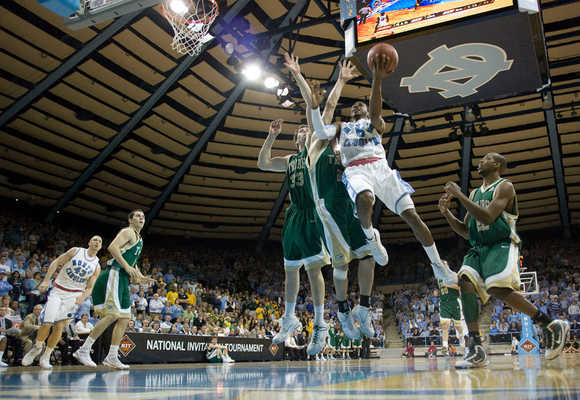
This NIT Contest, Not the NCAA Game, Was the Featured Event of the Night

And therein lies the problem.  Most people, even hardcore college hoops fans like us, don’t consider the Tuesday night PiG to be a legitimate part of the NCAA Tournament.  It involves the two worst-rated teams in the field, which means nobody knows anything about them; and it has zero impact on our brackets, which means there’s no corresponding reason to care to learn about them either.  So the question for the NCAA becomes: how do you legitimize it?  How do you remove that stigma that Shaheen mentioned as problematic?  How do you make people care about the (now) four play-in games on Tuesday so that random NIT games involving struggling national powers don’t take priority over NCAA games on the sports page?  Here are the two viable alternatives as we see them.

Status Quo (x4)

Keeping things as they are now where the #16s play the ‘other’ #16s (or possibly #17s in the new scheme) wouldn’t seem to do much to enhance the legitimacy of the PiGs, but there is precedent for this.  From 1978 to 1985, the NCAA Tournament doubled in size from 32 to 64 teams (can you imagine the outcry in today’s environment??).  There were several fits and starts along the way as it expanded a little more almost every year in-between, but suffice it to say that in 1983, the NCAA invited 52 teams to the ball with the final eight automatic qualifiers slotted as #12 seeds into four play-in games (or the “preliminary round” as they called it then).  In 1984, there were five play-in games with an additional #11 seed added to the mix.  In both of these years, all of the play-in games were played on the Tuesday prior to the first round games, and the teams were sent to PiG sites of Philadelphia’s Palestra or Dayton’s UD Arena depending on relative proximity to the school(s) involved.  The winners advanced to play #5 seeds in the true “first round,” with the one exception of the #11 seed (Northeastern) in 1984 who played a #6 seed in that round.

Read the rest of this entry »

Share this story

Impact Of Undecided Early Entries On The College Hoops Landscape

Posted by zhayes9 on April 30th, 2010

With the NBA Draft deadline moved up to May 8 this year, we’ll be able to formulate next year’s college basketball landscape sooner than ever before. The decision of many on the fence could dramatically alter the style, roster and makeup of everyone from Kentucky to Richmond. For many of these super-talents such as North Carolina’s Ed Davis, the decision was probably made a long time ago. But for those like fellow ACC foe Malcolm Delaney of Virginia Tech, their status is very much up in the air for 2010-11. He’s just one of many upcoming decisions that could change the outlook of an entire conference.

Many columns dealing with early entries dissect whether the decision was smart or short-sighted, whether the choice to enter their name was the proper call for their careers. Personally, I don’t care so much about their personal career paths, but about how their decision affects college basketball. Instead, the focus of this column will be on how each early entry to put their name in the draft changes their respective schools’ chances when winter approaches.

Daniel Orton and Eric Bledsoe (Kentucky)- Many around the Kentucky program believe Orton and Bledsoe are history, but refraining from signing with an agent leaves the door slightly ajar. If one or both return to Lexington, the Wildcats vault ahead of Tennessee as the SEC favorites. Returning to school would be even more beneficial to Orton, a player that didn’t establish himself playing behind Cousins and Patterson, but only showed glimpses of his superb athleticism, defensive prowess and developing low-post moves. Pair Orton in the post with Swiss import Enes Kanter and John Calipari is in business. Put Bledsoe with Brandon Knight, Doron Lamb or Darius Miller and the same holds true. Calipari’s loaded class certainly screams reload rather than rebuild, but the returns of Bledsoe and/or Orton would vault expectations even higher.

Gordon Hayward (Butler)- The “babyfaced assassin” (h/t Gus Johnson) might have the toughest call of any early entry this spring. A relative unknown to casual fans just one year ago, Hayward burst onto the scene with a stellar NCAA Tournament, leading the charge behind Butler’s miraculous run to the national title game. Thanks to a late growth spurt, Hayward possesses guard skills in a 6’9 frame and may even go in the latter half of the lottery should he keep his name in the field. Butler would also drop to a ranking similar to the one they enjoyed in October last year. If Hayward returns, it would be a crying shame if Butler isn’t the #2 team ranked preseason behind Duke. The only starter departing is glue guy Willie Veasley. That’s right: Hayward, Shelvin Mack, Ronald Nored and Matt Howard would all return to school for another March push.

Avery Bradley (Texas)- Sources told Fox Sports’ Jeff Goodman that Bradley was likely to stay in the Draft, and quite honestly I can see why. Teams that are looking for a backup point guard with the ability to defend and attack the basket will be flocking towards Bradley near the mid-first round. Findlay Prep point guard Cory Joseph committing to Texas last week takes some pressure off of Rick Barnes if Bradley should opt to stay in the draft. The Longhorns grossly underachieved with Bradley, Dexter Pittman and Damion James; with all three departing, expectations can’t possibly be sky high for Texas, although Kansas, Texas A&M and Baylor should all take steps back this season. Texas is a top-15 team regardless of last season should Bradley, Joseph, Dogus Balbay, J’Covan Brown and Jai Lucas round out a loaded backcourt. I suspect Bradley has played his last game in burnt orange, though.

Read the rest of this entry »
Share this story