Saturday, March 20 (all CBS)
1:05pm - Villanova vs. St. Mary's
3:20pm - Butler vs. Murray St
3:35pm - Tennessee vs. Ohio
5:40pm - Kansas vs. Northern Iowa
5:45pm - Baylor vs. Old Dominion
5:50pm - New Mexico vs. Washington
8:10pm - Kansas St vs. BYU
8:15pm - Kentucky vs. Wake Forest
Steve Coulter of the Clarion is the RTC correspondent for the Big West Conference.
Regular Season Recap
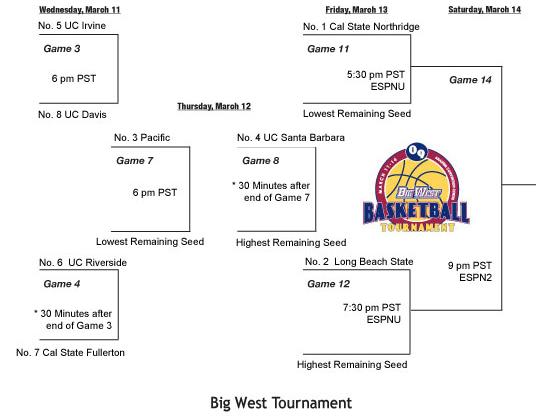
A year after making the NCAA Tournament, Cal State Northridge is the final team to make the Big West Conference tournament. However, it hasn’t been a year of complete surprise, rather just a season of emergence. Depending on who plays in Big West Tournament final game on Saturday afternoon, the Big West could have their conference champion as high as a No. 12 seed come the NCAA tournament. Both Santa Barbara and Pacific have had great seasons and they could be rewarded greatly by if the selection committee if they win the conference crown.
Overall the conference’s bottom four teams—Cal Poly, UC Irvine, CS Northridge and CS Riverside–have had ugly seasons with sub-.500 conference records. Despite this they have produced some of the conference’s best players. The Highlanders’ Kyle Austin would be conference player of the year, and still has a shot, if it weren’t for his team’s last place finish. His back-to-back 35+ point effort against Fullerton and Cal Poly is one of the bigger achievements of the year. Like Austin, senior forward Kenny Daniels has an argument for being player of the year despite the Matadors’ tough season. He scored in double figures in all of his last eight games and finished averaging 15.3 points a game.
Although neither are going to win conference player of the year, the Anteaters’ Eric Wise and Michael Hunter proved to be one of the conference’s more lethal tandems. Hunter, a senior, was a scoring threat for the Anteaters, but his biggest contributions were on the court leadership and defense. He finished the year with 1.4 steals per game. The middle teams—CS Fullerton, Long Beach State and UC Davis–all had back and forth seasons that included both winning streaks and losing streaks. Overall Fullerton had a pretty consistent season, finishing over .500 both at home and on the road. After a three-game losing streak in January, the Titans turned things around in February and almost earned a first round bye. The 49ers had the roughest schedule of any team in the Big West, playing five top 25 teams during the season. Despite their 15-15 overall record, they played through the tough schedule to earn a first round bye. The 49ers biggest conference win came on January 14 when they beat the No. 1 seeded Gauchos by 20 points. The Aggies also had success against the top of the conference, beating Pacific on February 10. Despite Dominic Calegari’s departure after this season, the Aggies return their two top guards in Payne and Harden, which will put them in a position to be conference favorite next season.
The real difference between the league’s elite teams, Santa Barbara and Pacific, and the rest of the conference, is depth. Although the Gauchos have relied on only a few guys for scoring, the teams bench has given valuable minutes. In conference play they have at least four bench players averaging over ten minutes of action a night. As for the Tigers, they are a team that spreads the scoring effort around and does not rely on a single person to lead them each night. The similarities between Pacific and Santa Barbara are clear though, in that they are both teams that like to use their bench and use it effectively. That is why they are atop the conference going into the postseason.
Good day, friends. John Stevens, here, one of your faithful RTC contributors, with a quick reminder. ESPN’s 24 Hours of Hoops Marathon begins tonight at midnight on Monday night/Tuesday morning, and I’ll be live-blogging the whole thing in our famed Boom Goes the Dynamite format. I did this last year during the same event, and once again I’ll be happily disregarding the recommendations — nay, the very pleas — of my family, friends, and internist, and staying up the whole 24 hours, all the while absorbing those tasty rays from my TV and computer screens. I hope you’ll stop by and hit the refresh button a few times, and even lend a comment or two.
Here are the games ESPN is showing:
12:05 am Cal State Fullerton at UCLA
2:00 am San Diego State at Saint Mary’s – RTC Live Simulcast
4:00 am Northern Colorado at Hawaii
6:00 am Monmouth at St. Peter’s
8:00 am Drexel at Niagara
10:00 am Clemson at Liberty
12:00 pm Northeastern at Siena
2:00 pm Arkansas-Little Rock at Tulsa
4:00 pm Temple at Georgetown
5:30 pm Binghamton at Pittsburgh (ESPN2)
6:00 pm Charlotte at Duke (ESPN)
7:30 pm Arkansas at Louisville (ESPN2) – RTC Live Simulcast
8:00 pm Gonzaga at Michigan State
9:00 pm Duquesne at Iowa (ESPNU)
10:00 pm Memphis at Kansas – RTC Live Simulcast
Last year, if I recall correctly — and there’s a good chance that I don’t! — because I had worked a full day beforehand and gotten almost no sleep the previous night, I started hallucinating about 18 hours into this. I look to be a little better rested going in this time, so I anticipate it’ll be a total cake walk. Yeah, we’ll see. The executives here at RTC obviously think so, too, since my written requests for a short-term insurance policy were denied (read: returned to me in paper-doll-chain form). Alas.
Anyway, I hope you’ll join me for as much of it as you can endure. The updates will begin below promptly at midnight tonight. See you there!
11:53pm (11/16): And so here we find ourselves, again, my friends. Welcome to the RTC 24-hour live blog for ESPN’s 24-hour Hoops Marathon. This will be done in our Boom Goes The Dynamite format, meaning this post will update every so often, so keep hitting that refresh button during the time that you’re joining us. When three of us do this during a day’s games during the regular season, sometimes it’ll start with NVR, then I’ll take the baton, and rtmsf will finish the night with the late games. When that happens, I use an old basketball term and call it…the three man weave. I’m the only one who finds that clever, though. But I”ll say it…what we have here is a one man weave. I’ll have help from rtmsf as he goes all RTC Live on us from the San Diego State at St. Mary’s game at 2 am ET, and then again from St. Louis with the Arkansas-Louisville and Memphis-Kansas games later on Tuesday night. But I’m flyin’ solo without a net and I’m going caffeine-free, baby! That’s my pledge to you tonight. I, John Stevens, will be kept awake merely by my love for college hoops. I promise. We’ll get it goin’ with Cal State-Fullerton at UCLA in just a bit. Welcome!!
Ed. Note: the previous posts in this series (Northeast, Mid-Atlantic, Atlantic South, Deep South, Mid-South, Lower Midwest, Upper Midwest and Mountains) are located here.
It’s time for the ninth installment of our RTC 2009-10 Impact Players series, the group of hot, dry, desert-y states known as the Southwest Region. Each week we’ll pick a geographic area of the country and break down the five players who we feel will have the most impact on their teams (and by the transitive property, college basketball) this season. Our criteria is once again subjective – there are so many good players in every region of the country that it’s difficult to narrow them down to only five in each – but we feel at the end of this exercise that we’ll have discussed nearly every player of major impact in the nation. Just to be fair and to make this not too high-major-centric, we’re also going to pick a mid-major impact player in each region as our sixth man. We welcome you guys, our faithful and very knowledgeable readers, to critique us in the comments where we left players off. The only request is that you provide an argument – why will your choice be more influential this season than those we chose?
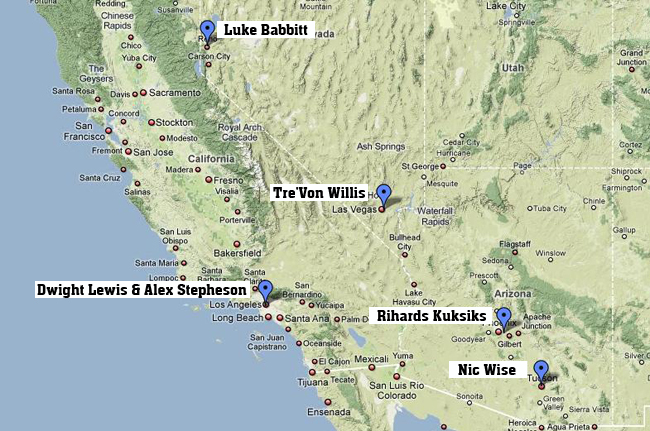
Rihards Kuksiks – F, Jr – Arizona State. Advice to Pac-10 coaches writing up their scouting reports for when they go up against Arizona State this season: when Rihards Kuksiks enters the building, get a man on him. Don’t bother waiting until the game actually starts. You don’t want him getting comfortable, because he’s the kind of shooter who can change a game just that quickly. The guy can touch the ball a few times and the next thing you know you’re down nine before the first TV timeout. Or you get a little comfortable with your late-game lead and after Kuksiks gets a couple of touches the lead is gone and you’re wondering how time can tick so slowly. You want numbers? Fine. Kuksiks is third in terms of returning individual leaders in 3-point field goal percentage (44.3%) in the country among players who hit at least two threes a game and finished 8th in that category last year. A recent article on FoxSports.com by Jeff Goodman reveals some other incredible stats: in games decided by 2 points or less, Kuksiks shot 47% from behind the 3-point line; against ranked opponents he shot 46% from beyond the arc, and in the loss to Syracuse in the NCAA Tournament’s second round last year, he put up his career high in points with 20, with 18 of those coming from long range. In other words, the man steps up during big games. If the numbers don’t interest you, then consider the fact that many of these threes are not from a hair behind the line. They are often from distance. And they are often clutch (ask Arizona about a couple of late ones he nailed in that February game last year). Most importantly, watch the form. It should be an instructional video. He gets good height on his jumper but doesn’t overdo it, and you can see how he gets his legs into the shot. He releases the ball out in front just a little bit, but then the follow-through is a perfect example of that “reach into the cookie jar” that basketball coaches start teaching kids from the moment they can lift a basketball. By the way, he’s 6′6 and more than happy to mix it up in the paint, if needed. My favorite bit about Kuksiks comes from an interview he did for a site called EuropeanProspects.com in which he was asked what kind of player he was. The first words out of his mouth? “I am a sharpshooter.” This is confidence, not cockiness, from the big man from Riga, Latvia. But I think it’s just fine if there actually is a little cockiness there. Long-range shooters are like neurosurgeons. They’re often asked to do the most difficult things in their field…and if I get to the point where I need to depend on one, I want them a little bit cocky.
Ryan ZumMallen of LBPostSports.com is the RTC correspondent for the Pac-10 and Big West Conferences.
Predicted Order of Finish:
Long Beach State (13-3)
UC Santa Barbara (12-4)
UC Riverside (12-4)
UC Davis (9-7)
UC Irvine (9-7)
Cal State Fullerton (7-9)
Pacific (5-11)
Cal Poly (3-13)
Cal State Northridge (2-14)
All-Conference Team:
Mark Payne (G), UCD
Larry Anderson (G), LBSU
Joe Harden (F), UCD
Kyle Austin (F), UCR
Eric Wise (C), UCI
6th Man.Joe Ford (G), Pacific
Impact Newcomer.Michael Wilder (G), UCI
eWhat You Need to Know. The Big West consistently sends one representative to the NCAA Tournament, which is then soundly bounced from competition in the first round; but that shouldn’t take away from the fierce battle that’s being done within conference confines. The conference is riding a wave of improvement, witnessed by a recent flood of top-notch recruits and Cal State Northridge taking #2 Memphis to the wire in the first round of last season’s Tourney. This season, there are shining stars waiting to break out, and most teams have scheduled challenging preseason opponents in a seemingly league-wide strategy to boost the conference’s profile. Long Beach State sophomore Larry Anderson and UC Riverside senior Kyle Austin have the combination of size and pro-level talent that give their teams the chance to beat anyone on any night. Tough schedules and big, athletic guards – does that make the Big West a conference with upset capabilities? No doubt.
Predicted Champion. Long Beach State (NCAA Seed: #12). The 49ers will be the popular pick to win the Big West regular season as well as conference tournament, due to an elevated talent level and difficult preseason schedule that will make the rest of the conference season seem like JV. Because of that difficult preseason schedule – and therefore a favorable RPI – Long Beach State will likely be a trendy upset pick in the NCAA Tournament, especially if they can pull off an upset against Texas, Kentucky or Duke; on a national scale, however, they probably lack the firepower needed to advance to the second round. Only four seniors graduated from last year’s team that earned second place in the conference. The 49ers’ quartet of sophomores will lead the charge – with athletic sixth man Eugene Phelps, darting point guard Casper Ware, crafty forward T.J. Robinson and 2008-09 first-teamer Larry Anderson.
Ryan ZumMallen of LBPostSports is the RTC correspondent for the Big West and SEC Conferences.
The Big West Tournament will kick off tonight at the Anaheim Convention Center, and anyone who claims they know who will be crowned on Saturday is either: (1) lying, or (2) not familiar with the way the season has gone thus far. The fact is that any Big West team is capable of beating any other team, and seeding means little in making your predictions.
Top seed Cal State Northridge won the regular season title outright, but have faced injuries, legal issues and general inconsistencies that made the race a little closer than most expected when the Matadors were chosen as preseason favorites. Long Beach State, the #2 seed, started out on a blazing 5-0 conference start but has alternated between wins and losses for the remaining eleven games. Third-seeded Pacific hasn’t won a road game since January 31, and even lost to lowly Cal Poly early in the season.
This’ll be quick one today because our usual writer is busy inviting a bunch of dudes over to his pad for some game involving another collegiate sport tonight. A sport that tends to have trouble deciding who the most worthy teams are for its championship just about every year. Our opinion of that faux-championship game is below.
When Does Utah Play in the Finals?
As for the rest of your evening, while you’re not watching Oklahoma and Florida throw balls all over the field en route to a 65-63 finish, enjoy a warm post-coital buffet of some college hoops. There’s a surprisingly tasty slate on tap for tonight, with four games involving Top 25 teams.
7pm
- Wright St. @ Butler on ???. Wright St. appears to be coming out of the fog that enveloped its team during the first two months of the season, as they’ve won 8 of 9 games with the only loss coming at #4 Wake Forest. Butler, on the other hand, continues to roll along, but the Bulldogs have had trouble with WSU, losing seven of their last ten against the Raiders including their last two when ranked. The big question is whether this game’s total will outscore the BCS game’s.
- Minnesota @ Iowa on ESPN2. Iowa hasn’t gotten much publicity this season, but the Hawkeyes are 9-0 in their home arena, a place where Minnesota has lost seven of their last eight visits. Minny’s only other true road test was a one-point win over Colorado St., so we’re a little skeptical about the validity of Tubby’s 13-1 record (best start since 1996-97). Still, if Minnesota can get a road win in a place they traditionally don’t play well, it would go a long way toward establishing itself as one of the upper elite of Big Ten teams this year.
8:30pm
- Oregon @ Arizona on FSN Regional. This is a battle between teams who were swept in their first Pac-10 tilts last weekend. The difference is that at least Arizona was on the road in the Bay Area when they went 0-2. Oregon plays defense like most teams enjoy suicide sprints; in other words, not at all. Arizona should have a field day of open looks and easy layups for Chase Budinger, Jordan Hill and others to take advantage of. They just need to make sure that Jamelle Horne is nowhere near the floor at the end of the game.

10:30pm
- Oregon St. @ Arizona St. on FSN. Arizona St. may be without the services of forward Jeff Pendergraph tonight, but that shouldn’t stop you from checking in on Herb Sendek’s team for a quick glance at possibly the most complete guard in America, James Harden (23/6/5 on 55%/44% shooting). OSU is coming off of its first Pac-10 win in nearly two years vs. USC, but that was at home. Still, OSU has been much more competitive this year.

- Stanford @ Washington on FSN Regional. UW is a team that hasn’t been talked about much this year, and why would we? They’re 10-3, but they’ve lost to nearly every good team they’ve played (Portland, Kansas, Florida). Stanford got its comeuppence last weekend when Arizona St. dominated them in Maples. But the Cardinal did recover to beat Arizona, and UW had a nice win over its in-state rival Wazzu, so this could make for an interesting contest. Both teams have low-grade NCAA aspirations, so they need to win these types of games.
11pm
- Cal St. Fullerton @ Cal Poly on ESPNU. The BCS game should be ending around 12:30am due to all the passing and timeouts, so turn this one on for the last five minutes to see CSF’s Josh Akognon play for the first time in your life. His Titans (6-8 ) aren’t very good, so it’s unlikely you’ll see him in March – this might be your last opportunity to see this fantastic collegian while still in school.
Ryan ZumMallen, LBPOSTSports columnist, is the RTC correspondent for the Big West conference.
Predicted Order of Finish:
Cal St. Northridge
UC Santa Barbara
Long Beach State
Pacific
UC Irvine
UC Davis
Cal St. Fullerton
Cal Poly
UC Riverside
What You Need To Know (WYN2K). I know what you’re thinking: no good teams ever come out of the Big West. Oh yeah? What about 2006-07’s Long Beach State 49ers who ran roughshod over their schedule to a 24-8 record and an NCAA berth… losing to Tennessee by 35. Or last year’s three-way tie for first? UC Santa Barbara, Cal State Northridge and Cal State Fullerton each won 12 conference games and two earned postseason berths… one bowing out in the NCAA opener and one in the NIT.
Ok, there hasn’t been much success outside of the conference lately – and last year produced some colossal stinkers – but that doesn’t mean that intense basketball isn’t being played within the Big West’s confines. After a conference flooded with seniors last season, nearly every team is starting anew, making for one of the most wide-open conferences in the country. All you need is one stud to will your team to victory, and if 2007 Fullerton product and recent Sacramento Kings signee Bobby Brown is any indication, it is definitely possible for raw talent to be developed in the Big West. Don’t expect the top teams to feast on the bottom-feeders again – all it takes is one hot hand for any team to have a shot on any night. So let’s get into it!
Bottom Feeders.UC Riverside, Cal Poly SLO and Cal State Fullerton. I mention them now because I shan’t be mentioning them again. All three lost a vast majority of their scoring to graduation, and senior leadership is vital in the Big West. Expect painful rebuilding from these three, although Fullerton’s Josh Akognon (video footage below) will win a few games for the Titans all by himself. The 5’11 guard averaged 20 ppg last year and won Big West Tournament MVP honors, but with only 2 returners and Akognon the only returning starter, it’ll be a long year in the cellar for CSF.
Middle of the Pack.
One team that you can (surprisingly) expect to emerge from that very cellar this year is UC Davis. Yes, the UC Davis that went 2-14 in the Big West last season. Stop laughing. Last year’s Aggies fielded zero seniors and this year’s edition has five. They return a trio of senior starters that scored 28.4% of the team’s points, boast two key transfers in Joe Harden and Todd Lowenthal and look to Big West Freshman of the Year Mark Payne to step us as a sophomore. With all of that, I’ve still got them pegged in 6th because, c’mon, it’s UC Davis.
UC Irvine gets the nod for 5th in the Big West, even after losing their top two scorers who brought in a combined 29.5ppg. They do return their other three starters, though, and while the team is not particularly heavy on seniors or explosive guardplay, last year’s squad won 9 of 12 down the stretch so these guys know how to win. Adding three recruits sized 6’8” or taller does not hurt, either. But the Anteaters could well fall prey to the experience of UC Davis, and certainly neither is worthy of a Top 4 spot.
The Pacific Tigers come in 4th, based yet again almost entirely on the genius of the Big West Conference’s greatest basketball mind, head coach Bob Thomason. Thomason consistently squeezes more productivity out of less talent than any other BW coach, and I’ve learned the hard way not to bet against the Tigers. They don’t have the talent to dominate this year, but the high-flying Anthony Brown enters his senior season, and I am intrigued to see what magic Thomason has worked with the 6’9” forward who wowed us with his potential and now will have to show us what’s been done with it. What wins games in the Big West? Guards. Anyone who gives senior sharpshooter Chad Troyer more than an inch of room deserves to be cut and sent to UC Riverside.
Top Tier.
As we saw last season, the cream of the Big West crop can be extremely competitive. So these next three teams could end up in any of the top spots, or even in a three-way tie for first like the Trio of ’08. They’re clearly the most talent-laden squads and have the best shot at the hardware. At the rear of the triumvirate is – pains me to say it – Long Beach State. Disclosure: I’m a graduate, and last season’s 6-25 campaign was one of my life’s more painful experiences. But we relied heavily on first-year coach Dan Monson’s genius and junior guard Donovan Morris’ magic. This year, we’ll again need plenty of both, but have added more ammunition than a Howitzer tank to back them up. The 6’3” Morris is the only returning All-Big West honoree in the conference, led the Big West in scoring and is the likely preseason Player of the Year. But the 49ers also add three transfers and a four-member freshman class that is oozing with raw talent in one-guard Casper Ware and freakish swingman Larry Anderson. The experience and talent are there after recording barren levels of both last year. My pick is 3rd place and possibly higher – it’s just tough to get past the oddness of picking a 6-win team to win the conference, even if it’s my own.
Here then, we arrive at #2. This team could definitely end the season in a lower position than this, and probably doesn’t have much chance at the top spot due to a lack of real scoring power or explosive guards. But a notoriously stingy defense and hard-nosed hustle, coupled with eight returners (including three starters) earns the UC Santa Barbara Gauchos the second spot. Well-rounded forward Chris Devine begins collecting Social Security this year enters his sixth season with UCSB after being granted another year of eligibility due to injuries. His leadership will be invaluable as the Gauchos look to recapture the magic after being one of the three teams tied for the conference title in ’08. They’ll rely heavily on a suffocating half-court defense that allows few second chances, and will look for junior James Powell on the perimeter after shooting 46.7% from three-point land and averaging 12.3 ppg last season. Experience and guard-play win out, and the Gauchos legendary grit put them in a class above (most of) the rest.
Experience experience experience. The Cal State Northridge Matadors (#16 NCAA) field five seniors and eight juniors on their roster, including last year’s conference leaders in rebounds, assists and blocked shots. They too shared the Big West title and have a great shot to repeat with Tremaine Townsend returning to terrorize Big West post players for yet another season. Townsend led the conference in rebounds with 9.8 rpg, and blocked shots with 1.3 bpg. The Matadors led the conference in team rebounding, and senior guard Josh Jenkins will look to improve upon his conference leading 6.4apg as well. CSUN head coach Bobby Braswell has never won an outright Big West title in 13 years at the helm, but this is his best chance ever to break the streak.
RPI Boosters.
California @ Pacific (11/15/08)
Long Beach St. @ Wisconsin (11/16/08)
Cal St Northridge @ Stanford (11/18/08)
UNC @ UCSB (11/21/08)
Wake Forest v. Cal St Fullerton (11/27/08)
Cal St Northridge @ UCLA (12/7/08)
Long Beach St. @ Syracuse (12/13/08)
65 Team Era. Due to UNLV’s former association with the conference in the late 80s and early 90s, the Big West has a solid overall record for the era (28-30, .483). But if you take out the Rebels, you’re left with a true mid-major level performance (7-24, .226) with only three wins in the last sixteen years. Pacific’s nice run in the 2003-05 seasons accounts for two of those; the other belongs to another former member of the conference, Utah St. in 2001.
Final Thought. Just for fun, let’s throw in the final seconds of Cal St Fullerton’s Big West championship game…
Shamelessly cribbing from last spring’s very clever NBA catch phrase, we here at RTC will present to you the Thirty Reasons We Love College Basketball as we gear up toward the start of the season a little over a month from now. We’ll be bringing you players to watch for this season and moments to remember from last season, courtesy of the series of dump trucks, wires and effluvia known as YouTube.
#19 – Where You Can Paint That Line Wherever You Want Happens
WYN2K. As we continue our ascent up the conference ladder, we once again come to a league where the top clearly consists of mid-major quality programs, but the bottom of the conference weighs it down as a whole and keeps it from becoming a consistent multiple bid performer. As might be expected for a middling league, the Big West has split its OOC games over the past three seasons (142-155, .478), winning the games against the lower leagues and losing to those above (1-13 last year vs. BCS teams). So what we see again this year is a handful of teams near the top that could easily compete in the WAC or Horizon, and an equal number that might be better suited for the OVC or Atlantic Sun (geographical considerations notwithstanding). Yet due to its schizophrenic nature (representative of its Californian makeup, perhaps?), the Big West has only once in the last fourteen years received two bids (2005), and that was solely because upstart Utah St. defeated unbeaten juggernaut Pacific in the conference finals that year.
Predicted Champion. UC Santa Barbara (#13 seed NCAA)is our choice to represent the Big West this year (turns out we’re not very original). Besides being located in one of the most awe-inspiring landscapes the lower 48 has to offer, the Gauchos return four starters from a second-place club including likely POY guard Alex Harris (21.1 ppg, .458 3fg%) and all-conference forward Chris Devine (14.1 ppg, 6.6 rpg).These two, along with a sophomore backcourt (Justin Joyner and James Powell)that made the all-freshman team last year, hold down a formidable defense that has finished second in the league for six consecutive years. Throw in transfer center Nedim Pajevic from Weber St. and UCSB has all the pieces to win its first conference title in six years. The way we see it, the only hurdle against this team’s success are the tasty waves and a cool buzz down on the campus beach (h/t Jeff Spicoli).
Others Considered. Should UCSB stumble just a bit, we like Cal Poly as next in line to pick up the pieces. Despite losing all-conference wing Derek Stockalper, the Mustangs return sufficient talent to build off of their season-ending 10-2 run (including the conference title game). Three other starters return, including all-conference guard Dawin Whiten and inside presence Titus Shelton (#96 nationally in blk%). The other team we like a lot in this league is Cal St. Fullerton, another second-place team from last season that returns three starters, but must deal with the loss of Bobby Brown, the school’s all-time leading scorer. The Titans are most excited about incoming transfer guard Josh Akognon, a lights-out shooter who led Washington St. in scoring during Dick Bennett’s last season there in 2006. As a sophomore, Akognon dropped 25 on UCLA’s vaunted defense in a half, so expectations are obviously high. Pacific had a rough year last season after a run of three straight NCAA Tourney appearances (49-3 in the Big West over that span), but they do return four of their top seven players and still carry a swagger that the rest of the league hasn’t quite forgotten yet. A core group of juniors led by Anthony Brown will spearhead the renaissance for head coach Bob Thomason, so they can’t be dismissed.
Games to Watch. The Big West is back to nine teams after two years at eight, so the round-robin schedule remains intact. Here are the key games to watch for:
UCSB @ Cal St. Fullerton (01.12.08) & Cal St. Fullerton @ UCSB (02.07.08)
Cal Poly @ Cal St. Fullerton (01.10.08) & Cal St. Fullerton @ Cal Poly (02.09.08)
UCSB @ Cal Poly (01.19.08) & Cal Poly @ UCSB (02.14.08)
ESPNU Bracketbusters (02.23.08)
Big West Championship Game (03.15.08) ESPN2
RPI Booster Games. The Big West doesn’t typically play a lot of games against BCS teams, and we’re not sure why that is (perhaps it has more to do with location than anything). Nevertheless, the league was 1-13 (.071) last year, with the sole victory coming from UC Irvine against South Carolina (67-52). Here are this year’s best opportunities for RPI enhancement:
Pacific @ Oregon (11.11.07) ESPN FC
UCSB @ Stanford (11.11.07)
Mississippi St. @ UC Irvine (11.22.07) ESPNU
Cal Poly @ Arizona St. (11.26.07)
UNLV @ UCSB (11.27.07)
Cal St. Fullerton @ Arizona (11.28.07)
Nevada @ Pacific (12.01.07) ESPN FC
UCSB @ UNC (12.22.07)
Cal Poly @ USC (12.22.07)
Odds of Multiple NCAA Bids. Not this year. While UCSB is very good, it’s not so good that it will dominate the league to the level necessary to ensure an at-large bid (as Pacific managed to do in 2005).
Neat-o Stat. Last year’s champion Long Beach St. galloped into the sunset with a conference regular season title as well as the tournament title before getting utterly shellacked 121-86 by Tennessee in last year’s first round matchup. Not only did the program lose its coach Larry Reynolds, it also lost its top nine scorers. The leading returning scorer is guard Artis Grant, who averaged all of 1.9 ppg last season in less than ten minutes of game time. Dan Monson, the architect of Gonzaga basketball in the late 1990s (of which Mark Few gets all the credit), took the job and according to one media report, he’s quite happy with the decision. He may have said that before he saw how thin his roster was going to be this year.
64/65-Team Era. The Big West’s record of 28-29 (.491) is extremely misleading due to the UNLV effect. UNLV was in this league from 1982-1996, and while there the Runnin’ Rebels ran off only 21 wins, 3 F4s and a national championship in 1990. The other seven wins during the era belong to UCSB (1990 – 1), New Mexico St. (1992 – 2; 1993 – 1), Utah St. (2001 – 1) and Pacific (2004 – 1; 2005 – 1). In more recent NCAA history, Pacific has owned the Big East in the NCAAs, beating #5 Providence 66-58 (2004), #9 Pittsburgh 79-71 (2005) and coming very close to beating #4 Boston College (Pacific lost 88-76 in 2OT) in the Eagles’ first year as a member of the ACC. Since 1994 the league has been a one-bid league with the one exception mentioned above in 2005, and its average seed has been a #12.9. If we omit Long Beach St.’s asskicking last year at the hands of Tennessee, we see that the league has performed admirably (if not successfully) in its first round games during this decade. We mentioned Pacific’s three games above, but in the Big West’s other five games its representative lost by an average of only 6.8 pts, showing that these teams play competitive basketball. For now, though, let’s reminisce about Bong Long Beach St.’s championship RTC at the Big West Championship.
Final Thought. The Big West is a league seemingly in continual flux. Every time it seems to be building a cache of solid programs at the top, one of them bolts for another conference (see: UNLV, New Mexico St., Utah St.). As a result, it can never quite get a good enough RPI rating to break through as an annual two-bid league. Regularly reaching into the lowest reaches of D1 to pick up the likes of UC Davis and UC Riverside just to have a full complement of teams only worsens the problem. Who will be next to go if a spot opens in the WCC or WAC – UCSB? Pacific? We shall see.