Welcome to the RTC 2009 Mascot Death Match! We’ll post each round of games as they come available, so check back Friday for Saturday’s Round 2 matches and so forth. Voting will close at the end of each day’s matches.
RTC asked its legion of correspondents, charlatans, sycophants, toadies and other hangers-on to send us their very favorite March Madness memory, something that had a visceral effect on who they are as a person and college basketball fan today. Not surprisingly, many of the submissions were excellent and if you’re not fired up reading them, then you need to head back over to PerezHilton for the rest of this month. We’ve chosen the sixteen best, and we’ll be counting them down over the next two weeks as we approach the 2009 NCAA Tournament.
The Hunter S. Thompson of College Basketball (submitted by Ray Floriani of College Chalktalk)
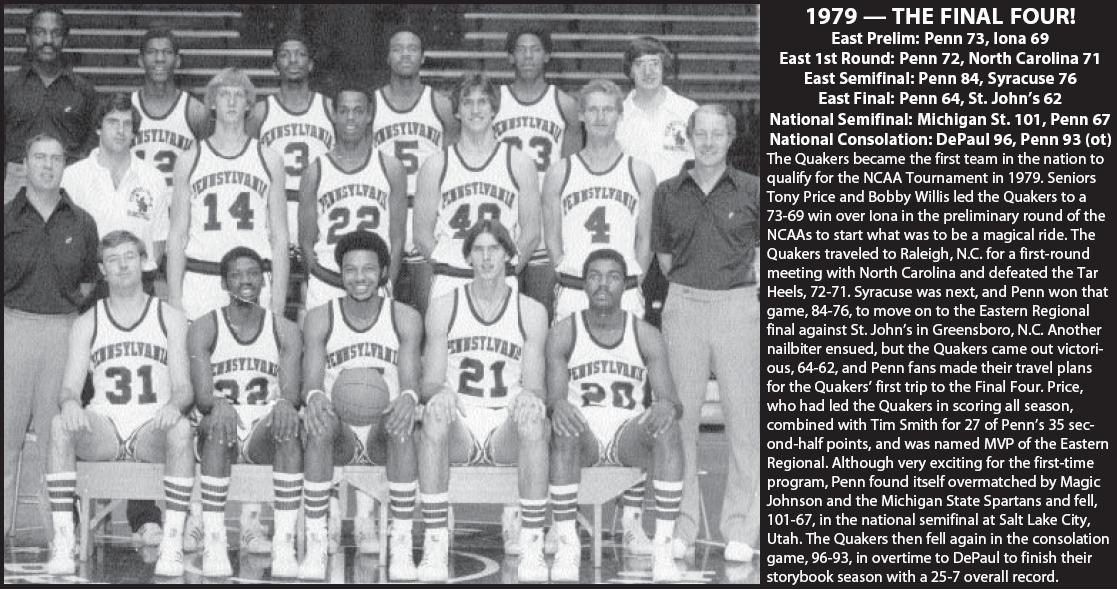
SOUTH ORANGE, NJ – The NCAA tournament in 1979 turned out to be truly memorable. And not simply because of Magic vs. Bird. First, a little background. I was writing and doing some photographic work for Eastern Basketball magazine. EB was produced in the Long Island home of founders Ralph and Rita Pollio and enjoyed a good following. The three of us plus Rita’s brother Ray took a twelve-hour drive to Raleigh for the first two rounds. On Friday evening Penn stopped Iona (coached by the late Jim Valvano) and St. John’s upset a good Temple team. On Sunday it was the day still known in ACC country as “Black Sunday.” Penn upset top ranked North Carolina and St. John’s, who upset Duke in December’s Holiday Festival consolation, made it two straight over the Devils with another upset victory.
The following weekend it was off to Greensboro for the regionals. I traveled with EB writer Happy Fine. An extremely knowledgeable basketball analyst and excellent writer, Happy knew a good number of people and was well connected. We flew to Greensboro, had regular hotel rooms, credentials and ate at good restaurants and covered some memorable games. Greensboro Coliseum was half (or more empty) with no ACC representatives. Even the local papers billed the regionals as the “frost belt four.” For the record, Penn upset Syracuse and St.John’s did the same to Rutgers in the semis. Then Penn edged St. John’s in a thrilling regional final. As the sign Penn fans held in post game celebrations read, “weese going to Utah.”
Now in 1979 there was no Big East. Penn naturally was in the Ivy, but schools like St. John’s were part of ECAC regional affiliations while Rutgers was in the Eastern Eight (now Atlantic Ten). We did not cover the ACC at EB – only the “traditional East.” We had an agreement with the NCAA that if we got a team in we could get a Final Four credential (as in… one credential). As much as Rita tried, we could not secure a second for yours truly. Happy and I would drive to Philadelphia (about 2 hours) and fly on the Penn fan charter – the bad news was that I did not have a ticket nor did we have hotel rooms in Salt Lake City. Talk about “survive and advance.”
We flew out Thursday morning , two days before the semis. Happy secured us a ‘room’ in the suite of SI’s Curry Kirkpatrick. A heavy hitter on SI’s team, I met Curry through Happy in Greensboro and felt him humble and passionate about the game. An hour into the flight, Happy had already secured tickets for me to the semis and finals with the whole cost setting me back only about $30. No complaints, at least I was in. The charter was mostly Penn students and we had a great time discussing basketball with them on the flight out. That night I went to the NABC (National Association of Basketball Coaches) all-star game at the old Salt Palace, where the Jazz played. Pleased to see James Bailey of Rutgers star in the contest which had a number of solid players.
The Final Four was held at the Arena on the University of Utah campus. On Friday at open practice I met with Al McGuire. There was no ESPN back then. NBC televised the tournament and some national games. Eastern teams like Syracuse got maybe a date or two or national TV. McGuire wanted to know more about Penn so Rita arranged for me to meet with him. She prepared a sizable portfolio on the Quakers. After meeting McGuire, quite a thrill since I idolized him and his coaching style since high school, he put the packet aside. In his unique style he jotted down key points about Penn. Their marquee players Tony Price and Bobby Willis. The multi-talented center Matt White. The coaching philosophy of Bob Weinauer. The streamers thrown after the first basket. Even the watering hole, Smokey Joe’s, which had cheap tap brews and great cheesesteaks. We met for about a half hour then McGuire gave me his card. Safe to say, from my vantage point, the McGuire meeting was a highlight of that Final Four (an example of his peculiar eloquence is below).
Got back to the hotel and Happy asked if I wouldn’t mind going to another hotel. No problem, even though I quietly arose at 7 a.m. that morning to go running. Seems Curry had ‘overbooked’ his guests. We arranged for me to stay with Mike Madden of the Boston Globe. I met Mike covering some BC games. We got along well and had no problems with the situation.
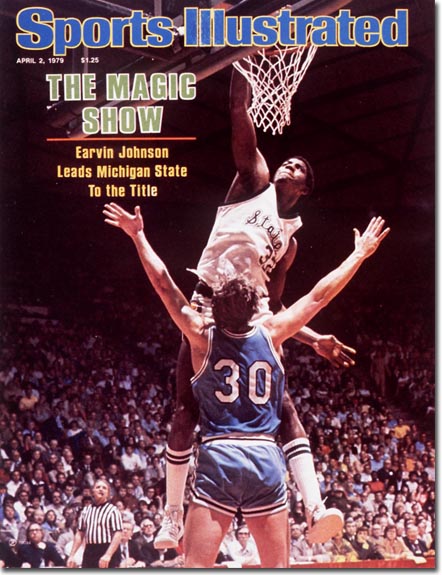
Saturday. Game day. Rode the NABC shuttle to the arena and one coach had a remark that could be etched in stone when he said, “there is no better day in basketball than today.” He’s right because as special as the finals are, the semifinal Saturday gives you four teams all with national championship hopes and dreams. Penn-Michigan State was the first game. The Quakers got inside Michigan State’s patented 2-3 matchup zone, but could not hit a thing, picking the most inopportune time to play their worst game. The margin was in the thirties in the first half as MSU cruised. The second game came down to the final minutes as Indiana State edged DePaul. Thought it was a special story that the same Ray Meyer who coached DePaul to prominence with George Mikan three decades prior was back in the limelight.
Through post game receptions with the NABC and media on Saturday night and into Sunday the talk was over Michigan State dismantling Penn and now Magic vs. Bird on Monday night. They told us Salt Lake City was dry. With the commerce dollars coming in that weekend, the city’s ‘good fathers’ probably looked the other way as the beer flowed like an amber cascade. Made some phone reports to Ralph but his phone was disconnected so we called the neighbor who would run across the street to get him.
Met Basketball Times publisher Larry Donald on Sunday. It’s ironic that about a decade later I would be working for him. Snapped some shots around the picturesque Utah campus and chatted with students. Arkansas coach Eddie Sutton stopped by a media reception on Sunday evening. Sutton’s Arkansas team dropped a heart breaker to Indiana State in a regional final but the coach was cordial and an interesting personality to discuss the game with. Happy and Bob Ryan told Sutton about this young high school player doing some work in Boston, Patrick Ewing.
On Monday I went to a few NABC clinics. As a basketball fanatic I’m always looking for information on the game. Ohio State’s Don Devoe gave a great talk. Really impressed with a coach who would fall afoul to recruiting violations a few years later; New Mexico’s Norm Ellenberger also spoke about the fast break. Back in those days they had a consolation game and Penn was thrilled to go out and prove they belonged. I ‘borrowed’ Happy’s press pass to get some photos on the floor. Penn played well and lost a tough one to DePaul. The Quakers gained back some respect, but unfortunately the game was not televised.
The final saw Magic Johnson’s Michigan State vs. Larry Bird’s Indiana State. A great game. Greg Kelser was an inside factor for the Spartans and, though there was no three point shot, Jud Heathcote had a few good outside shooters that kept the defense honest. Michigan State held about a nine point lead through the second half. That nine felt like eighteen as they were in command throughout. Got on the floor for the post game awards. Snapped some shots then caught some of the post game press conference in a huge area to accommodate several hundred media. Shortly after, Happy and I went to the airport to catch our charter. It was a redeye and as we boarded, a Penn student brought a PENN sign from a side scoreboard at the arena. Why not ?
We flew cross-country in the middle of the night. Penn students slept. At times I stayed awake thinking about it all, wondering will Indiana State stay a major player or was this their “fifteen minutes of fame?” Penn will be a major Ivy player, but was this like Princeton’s ’65 final Four run where everything came together? Magic’s greatest attribute is his ability to raise his teammates’ games, and what a great story the DePaul resurgence was.
As years passed the ’79 final went down as a classic. In truth, for me, the whole weekend was.
John Stevens is a featured writer for Rush The Court.
We love brackets of all types! (photo credit: alibaba.com)
For the next 72 hours you’re going to be bombarded with advice on how to fill out your NCAA Tournament bracket. It’ll be a steady diet of punchy one-liners like “Always pick 12s against 5s!” and “Ones always beat sixteens!” Sure, there’s some good advice out there. Some of it’s pretty obvious. And some of it just blows. I’m not saying I’ve got the market cornered on how to pick a perfect bracket, and you should beware anyone who makes that claim. But I think it’s good to take a quick look at some of what these so-called experts are telling you.
First, there are two things we can accept as axiomatic and move on:
1) One-seeds always beat 16s.
2) All four one-seeds almost never get to the Final Four (we know last year is the exception).
Right. We get it. Anyone who uses one of those as a selling point in their analysis is someone you should ignore. If you’re reading a piece on NCAA tournament bracket-filling advice, it’s certain that you already have those pieces of information. It isn’t news to you. So let’s move on…
ALWAYS TAKE 12-SEEDS
Wrong. This is my favorite piece of bracket-building advice. It’s a fad statement because of how, in the past several years, 12-seeds have almost always scored at least one victory against 5-seeds in a given tournament. Most people take this too far and choose three or even all four 12s to move on in their brackets. But according to BBState.com (a hoops stat nerd’s wet dream — this means you, rtmsf), the all-time record for 12s against 5s is a discouraging 34-83, or about 29%. This means that you’re completely justified picking a single 12-seed that you’ve got a hunch about to score a win over a 5, but leaving the rest alone. If you choose right, great! You showed those punk opponents of yours how it’s done. Worst-case scenario if youre wrong is you drop a couple of points if another 12 that you didn’t select pulls off the upset. Chances are, one 12 will pick up a win. So I wouldn’t leave it alone and take all the 5s. But choose a SINGLE 12-seed, and don’t sweat it if you’re wrong.
2008 Version of WKU. Are they a 12 over a 5 this year? (photo credit: cbc.ca)
THE NCAA TOURNAMENT IS ABOUT UPSETS
That isn’t necessarily an untrue statement, since we all love a good tournament upset unless it’s our alma. Those stories are often what make the event so special and add to its legend. But it does not apply to bracket-building. Notice how most brackets have increasing point values as the rounds progress, i.e. you get a single point for correctly picking a first-round winner, two points for a second-round winner, etc. So if you have a bunch of upset-picks advancing to later rounds, since higher-seeded teams usually end up rising to the top, all you’ve done is penalize yourself in the big-reward games. Some bracket competitions assign even higher point values than I’ve mentioned above (8 points for a correct Final Four pick, 15 for a national champion, and so on) so it’s more important in those systems. The payoff, then — keep the upsets limited to the first round and maybe the second where you can’t get hurt much if you choose wrong. Now, I’m not telling you pick a totally worthless and boring bracket where the “better” seed always wins. That’s the height of douchebaggery. This is indeed about having fun, and it’s fun to pick a couple of mid-major upstarts to stick it to one or two BCS goons for a round or two. It adds meaning to games you might not even watch or care about under any other circumstance. If you’re wrong, and your favorite 10-seed doesn’t make it to the Sweet 16 and that 14 doesn’t score that first-round victory you predicted, big deal. It’s your bracket and you took the chance. But if you care about winning, keep that stuff in the early round games, and fill in your later rounds with more established programs.
CHOOSE A CHAMPION WITH GOOD GUARDS
A generic piece of advice. Otherwise stated as “You have to have good guard play to win the title.” What are you going to do, choose a team with bad guards? Even if the person espousing this really means that you should choose a championship team and/or Final Four teams that are “led” by guards, be careful. Look at every champion crowned in the 2000s. Every one of them has forwards and/or centers who meant just as much or even more to the team than any of their guards. This is why these coaches are out there busting their tails on the recruiting trail. It’s talent at EVERY position that determines success at a program and in the Big Dance. You can’t just have good guards, you need good players. The statement that you have to have “good guard play” as a necessary component for tournament success is a bit of advice that sounds insightful and has therefore spun out of control in recent years as some sage bit of wisdom. Don’t even consider this piece of pseudo-advice when you’re filling in your bracket.
Carmelo Athony. Not exactly a typical guard. (photo credit: enquirer.com)
The best piece of advice you can possibly keep at the front of your mind when building your bracket is to have fun with it. Even if you fill out an all-upset or an all-chalk bracket (bag… of… douche!), it’s your bracket and you should do whatever adds to your enjoyment of the tournament. It’s kind of like playing hardways or snake-eyes at a casino in Las Vegas. True, the insiders and experts might roll their eyes and snicker at you as you reduce your chances of making money with those plays. But, I figure, I don’t get to Vegas too often, so while I’m there I might as well have fun and do what I want. And of course it’s great if it hits! Yeah, it might not be the smartest play, but when I go home and someone asks me “Did you have fun?” I don’t want to say, “No, but at least the experts don’t think I’m an idiot. I think I may have impressed those guys.” Same thing with filling in tournament brackets, as far as I’m concerned. But I think if, as I’ve outlined above, you can put a critical eye on those oft-repeated bits of advice, you’ll be able to maximize both how much fun you’ll have with this and your chances of winning.
When Ben Allaire isn’t drumming up meaningless college basketball statistics, he’s writing about the Virginia Cavaliers over at Dear Old UVa. RTC appreciates having Ben stop over this week to make some numerical sense of this year’s NCAA Tournament field.
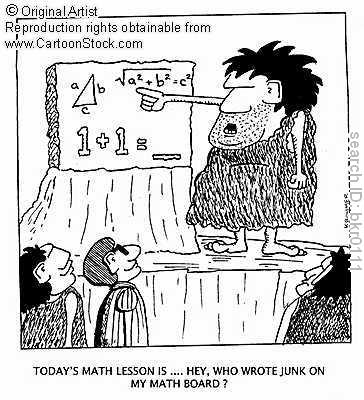
A great man once said, “Our offense is like the Pythagorean theorem: There is no answer.”
Unfortunately, that man was Shaquille O’Neil and it’s funny because he couldn’t be wronger… er, more wrong.
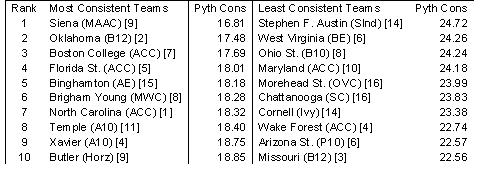
The Pythagorean theorem does have an answer and it’s going to help us examine which teams are most consistent on offense and defense together. Last time, I gave you a scatterplot of all 65 teams’ consistency on offense and defense. Using the Pythagorean theorem (or you might say Euclid distance), I’m calculating the distance between each point on the plot and the origin (0,0). We’ll call this distance: Pythagorean Consistency (PC for short).
This will combine the two measures into one and tell us exactly how consistent a team is. Now, remember as I said last time, this isn’t necessarily a measure of who’s best. If you want that, kenpom.com has a myriad of ways of determining it. It’s a measure of who performs according to expectation.
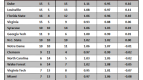
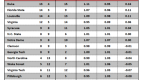
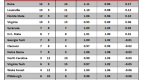
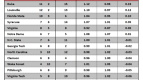
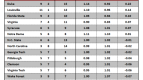
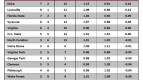
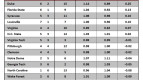
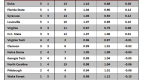
Let’s glance at the top and bottom ten list:
Note: Conference in parentheses; seed in brackets.Data source: kenpom.com
RTC asked its legion of correspondents, charlatans, sycophants, toadies and other hangers-on to send us their very favorite March Madness memory, something that had a visceral effect on who they are as a person and college basketball fan today. Not surprisingly, many of the submissions were excellent and if you’re not fired up reading them, then you need to head back over to PerezHilton for the rest of this month. We’ve chosen the sixteen best, and we’ll be counting them down over the next two weeks as we approach the 2009 NCAA Tournament.
Roadtrippin’ to the Alamo City (submitted by John Stevens)
March 1998.
I was living with two friends at the time in an apartment befitting three guys in various stages of their education: one of us a few years out of college and still not playing it too fast and loose with his new income, most of which was being put toward his upcoming wedding; another fellow who was finding no stimulation in graduate school and was looking to upgrade his life; and me, breezing through the last two easy months before my college graduation, working enough at my cake-walk part-time job to keep me in pizza, beer, and the occasional night out (which usually involved pizza and beer).
It was also tournament time. Our favorite time of year. Feeling the wanderlust that an emerging springtime brings, my grad-school roommate and I decided that instead of watching our favorite event on TV as we’d done for most of the previous two weeks, we’d empty our bank accounts and take a road trip to one of the regionals — say, given the snow outside our window in mid-March, the one in St. Petersburg, Florida. Not exactly a tough sell. Turned out to be one of the best road trips I ever took.
Until the next week.
These F4 Fans Weren't As Lucky As John
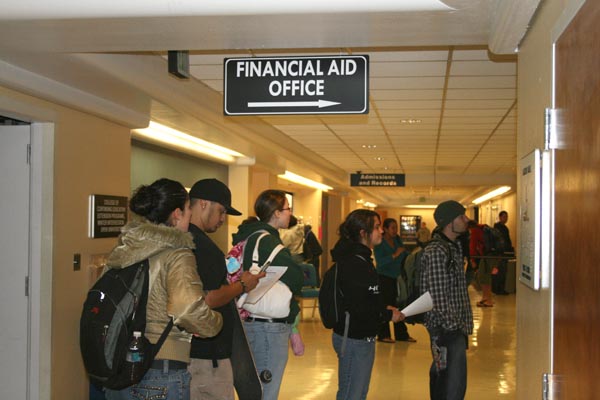
We got home from St. Pete and were going through several days of unopened mail when I noticed an envelope bearing the emblem of my college. Specifically, the Office of Billing and Financial Aid. 99 times out of 100, that means a bill. Not exactly something I wanted, having just blown a wad of cash to travel to an NCAA regional. It was about as welcome as a positive syphilis test.
But wait, what was this? Weeeeell, evidently some of the grant money awarded me many months ago never found its way to my account, so now that the mistake had been found, a check had been cut for me in the amount of $1500. My buddy and I had just spent the last half hour reminiscing on what a great road trip we’d just had, but still sad because we didn’t know when our next one would be. When I opened that envelope and saw that check, I looked at my friend and told him, “Don’t bother unpacking. We’re going to the Final Four.”
He said he couldn’t part with the cash needed for such a trip, but I reminded him that I owed him a few hundred bucks from a previous debt and that we’d sort out the rest later. To his credit, it didn’t take much persuading. The Final Four that year was in San Antonio, a city I’d heard too many great things about, so there was no way I was going to defy fate and pass up this opportunity. I’d never been to Texas, never even been anywhere near that part of the country. And it’s one of my favorite things to do any time of the year, but as the weather gets warm, is there anything better than packing up a bag and a cooler and hitting the open road with a friend?
Three days later, we were doing exactly that. We bought tickets from a newspaper ad, left in the middle of the night, and drove for hours and hours. Nothing on the radio but people talking Final Four basketball. Constant analysis, endless interviews with coaches, former players, etc. The farther south we drove, the warmer it got. We started out wearing sweaters and jeans, and in a few hours we were in t-shirts, shorts and sunglasses. It was one of the ugliest drives I’d ever been a part of. It involved two dudes who reeked from being in a car too long. But in its own way, it was paradise.
We found living quarters (we thought we were going to be shacking as far away as Austin, but avoided that thanks to the generosity of my buddy’s family) and went to find the epicenter of activity for the weekend. We found the San Antonio Riverwalk by following the noise of the crowd, the sounds of mariachis doing renditions of college fight songs, and, um, Dick Vitale’s voice. Every once in a while as you walked this gorgeous underground pedestrian street along the banks of the San Antonio River, you’d see groups of tourists floating by on large rafts, looking back at the walkers who were looking at them. Sometimes the raft drifting by you would contain a school’s cheerleading or dance team squad, or part of its band, or the CBS studio crew (if Bill Raftery’s big smiling mug floating by on a raft doesn’t bring a smile to your own face, you need to visit your local neurologist, because you are officially incapable of smiling), and so on. The biggest crowd response always happened when Dickie V would come floating by, waving and gesturing to the masses like a big kid. I mean, my God, he’s been doing this for how many years? And there’s not a doubt in my mind — he was still having as much fun as we were.
We made our way to the Fan Jam and just owned the two-on-two shootout for a while, calling ourselves The Shammgods — the insiders applauded the name, much respect — and scoring many notable (and even upset) victories, including a single-shot victory over a couple of prepsters from NYC and an absolute trouncing of two cocky 14-year olds from Tennessee. In our eighth — that’s right, you heard me, eighth — game I hit a cold streak and a couple of local college kids got the better of us; I still relive this cold streak in my mind every so often and the blood still boils. We considered it an upset on the level of ’85 Villanova, but at that point I think we were such big favorites in Vegas, it wasn’t worth it any more. We met former College of Charleston coach John Kresse who actually took a few moments from strolling with his wife to talk hoops and take pictures with us. Near the ESPN set, we bumped into Steve Lavin who acted like he didn’t see or hear about our exploits at the two-on-two shootout; both of those guys couldn’t have been nicer. It wasn’t just celebrity-sighting — when talking college basketball with them, they weren’t celebrities any more, just regular guys talking about the thing they love the most.
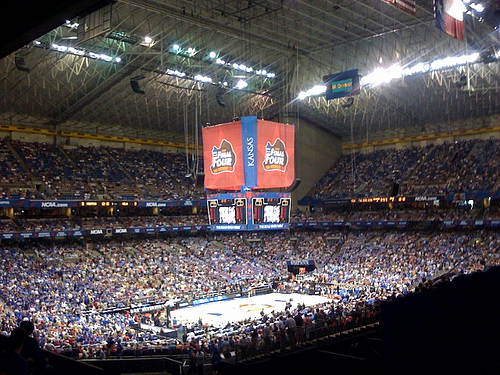
We all know the games from that particular Final Four were fantastic, no matter for whom you were rooting – Kentucky, Utah, UNC or Stanford. There’s simply no way to describe the atmosphere at a Final Four game. The best comparison I can think of is watching the end of a Pink Floyd concert when they’re doing the last number (Run Like Hell) and there are pyrotechnics and lasers like you never imagined and the stage is basically on fire. Imagine that over three days of basketball. The fireworks are constantly taking place on the basketball floor, and the energy and emotion of the crowd is every bit as urgent and electric.
The Alamodome Has Hosted Several F4s
I had fallen in love with college basketball long before this road trip. Even though I never possessed the skill to play it at that level, the sport has been a favorite distraction of mine ever since I’ve had functioning neurons in my brain. But watching those games at the Alamodome and being part of the overall atmosphere of the Final Four that year… well, it was one of those few watershed times in a person’s life, like when you hear a piece of music or meet a person you know from the first nanosecond will always be part of your existence. My friend and I drove the 20+ hours back to the humdrum rhythm of our everyday lives, and as I walked around my campus and worked at my job I saw people who probably once had similar watershed moments in their lives, but whose realities had become relegated to the process of just getting through the days, just surviving things — whatever those sticky, sinister things were. Those were the days when I looked back on my trip as I looked at these people, and I decided — I will never fall victim to those things. Whatever it entails, as often as I possibly can, I’ll always go to be a part of that event. I will always have this in my life.
I’ve often said that the first Thursday of the NCAA tournament is like Christmas for me. So what better time to make a Christmas, err, a March Madness wish list? Here, in no particular order, is what I want as the best three weeks in sports begin:
To hug a stranger at a bar while cheering for a player I’ve never heard of at a school I don’t know anything about.
Anyone who roots against a big underdog for the sake of his bracket to be forced to watch exclusively LPGA tournaments through the rest of March.
Another George Mason to make the Final Four. I’m looking at you, Siena.
A 16 seed to finally win a game, and not just for the free Arby’s burger. (This promotion, though, is sort of funny, especially this quote: “Each year at this time, people crave that Cinderella story – the team that takes everyone by surprise. Our new Roastburgers offer an unexpected change from standard greasy burgers.”)
A brawl between Gary Williams’ sweat and John Calipari’s gel in Round 2 (speaking of greasy things)
A cat-fight between Fran McCaffery’s wife and Rick Pitino in Round 2 (sorry, I must have that mascot brawl on my mind).
A game that goes seven overtimes. Six is nothing.
A buzzer-beater that will make Bryce Drew say, “Now that was impressive.”
A moment so memorable, I’ll always remember where I was when I saw it. (Unless I’m with Jim Calhoun. Wait, why would that happen?)
Someone just as fun as Stephen Curry to become the new Mr. March.
Jonny Flynn to keep doing his Energizer impression
To win my pool, though I’ll settle for keeping my bracket alive past the first day.
To watch my alma mater, Penn, try to win a game. What’s that? The Quakers aren’t in the tournament for the second straight year? And they had one of the worst seasons in recent history? Excuse me while I jump from the Palestra rafters.
Jay Bilas to stop hating on the little guy. How many mediocre schools from BCS conferences to do we need to see before we realize it’s the upsets that make this tourney tick?
To find a new villain other than Duke. How about … let’s see … um …. Oh, hell, I’m sticking with Duke.
The announcers doing the Cornell game to abstain from saying things like “I thought Ivy League kids were smart” after a bad turnover. SAT jokes are a no-no, too.
Players to stop thanking God after wins. I’m OK if Mississippi State’s Jarvis Varnado repeats this gem though: “I’ve got to use my quickness to outquick the opposing opponent.”
Bob Knight to offer a formal apology for once saying, “All of us learn how to write in the second grade. Most of us go on to greater things.” Hey Coach, those words you’re stringing together for your new website with fellow jerk knowledgeable hoops personality Billy Packer. I’m not entirely sure but I think it’s called writing.
Gus Johnson to yell even louder.
Any commentator who says the expression “body of work” more than twice in one sentence to stop getting lessons in awful announcing from Suzyn Waldman.
Gonzaga not to ruin my bracket for the millionth straight year. Please? If I win my pool, I’ll split the money with you, Heytvelt. You can use that cash for your supply of – and moving on!
To hear my stepdad explain the same last-second play he created years ago while lamenting, “No one ever does this.” (It’s March. Everyone’s a coach.)
A team with a great story to rally behind. Cleveland State and North Dakota State seem like good choices, but I’m open to suggestions.
To tune out anything that has to do with the economy, the wars, the demise of newspapers, octomoms and Dane Cook … and get sucked into a world of college hoops for three straight weeks, remembering so many great shots, players and moments that I have enough material to write another column gushing about March Madness 20 years from now.
And, of course, to cry during One Shining Moment. I mean, what?
So that’s my wish list. May Santa, I mean Greg Gumbel, come down the chimney and bring it to me.
Welcome to the RTC 2009 Mascot Death Match! We’ll post each round of games as they come available, so check back tomorrow for Friday’s Matches, and on Friday for Saturday’s Round 2 matches, etc. Voting will close at the end of each day’s matches.
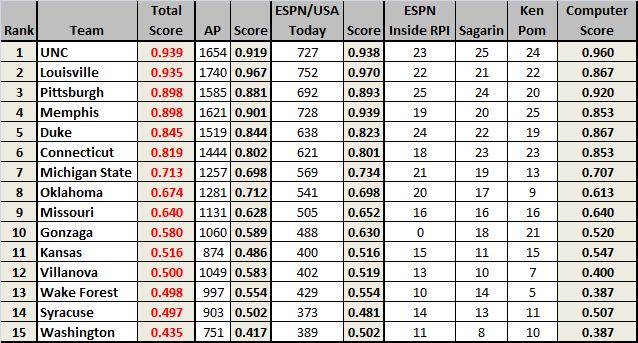
With the release of the brackets on Sunday evening there has been quite a bit of controversy (Arizona over St. Mary’s being the predominant gripe) and there have been some interesting moments with Jay Bilas and Digger Phelps ganging up on Dick Vitale and almost bringing him to tears. However, it was nothing compared to the furor that we saw when the BCS released its final poll that determined the BCS bowl games and more importantly the national championship. We thought it would be a fun exercise to try to make a mock BCS basketball system. I used the AP and ESPN/USA Today polls as the human polls and ESPN.com’s InsiderRPI, KenPom.com, and Sagarin’s ratings as the computer polls. There are a couple polls I excluded for other reasons: Kenneth Massey’s (wasn’t updated yet) and Jerry Palm’s (not free). I did not throw out the high and low computer polls for two reasons: (1) we only had 3 available and (2) they were fairly similar with a few exceptions (Gonzaga in the RPI, but they weren’t going to be a factor anyways because of Memphis). ESPN.com’s InsiderRPI didn’t include the games from Sunday, but after looking at the final results they would not have had any impact on the rankings based on the teams involved. Here are the results:
When Ben Allaire isn’t drumming up meaningless college basketball statistics, he’s writing about the Virginia Cavaliers over at Dear Old UVa. RTC appreciates having Ben stop over this week to make some numerical sense of this year’s NCAA Tournament field.
At its heart, the NCAA Tournament is about consistency. Just about all the teams (OK – maybe not Chattanooga) are qualified to make some sort of a deep run. The key is avoiding that one downer of a game that knocks a team out.
So, how should we look at consistency?
Well, it turns out there’s numerous ways to define consistency. Ken Pomeroy takes it to mean how volatile a team’s winning margin is. John Gasaway has dubbed it “The Winehouse Factor” after the roller-coaster-like life of Amy Winehouse. Joe Morgan uses it as an adjective to describe a baseball player’s fielding abilities, a team’s starting pitching, a hitter’s swing, the running the base paths, Jon Miller’s voice when dressed in drag, and the way his wife makes mashed potatoes.
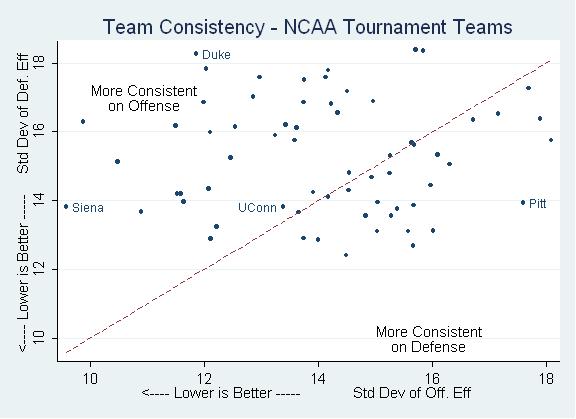
Here’s the definition I’m proposing: when team X steps onto the court, can we expect what we’ve seen previously from team X, on average? Is team X’s offense white hot one night then colder than Jell-o pudding pops on another? Does the defense go through stretches where they stink, then miraculously are dominant?
I’ve taken all 2,126 performances from the 65 teams that have made the NCAA tournament from kenpom.com and plotted the standard deviation of the offensive efficiency versus the standard deviation of the defensive efficiency.