On Friday the Naismith Hall of Fame announced the 12 Finalists for the class of 2013. Almost by definition there are plenty of big names on the list, but three stand out for us as a college basketball site: Guy Lewis, Rick Pitino, and Jerry Tarkanian. Pitino’s induction should almost be a formality with his national championship and being the only coach to lead three different schools (Providence, Kentucky, and Louisville) to the Final Four. We are not sure why Lewis has not gotten in yet with his 592 wins (all at Houston), five Final Four appearances (separated by a generation) as the only thing we can see missing from his resume is a national championship, but it seems like five Final Four appearances would make up for it. As for Tarkanian, we pointed out his omission from the Hall of Fame thus far may be the most notable omission that we can think of. Based on his credentials–729 wins and a national championship–he is more than qualified, but his off-the-court (sometimes in court) issues might make a few voters squeamish. We hope that the voters can look past that and finally put the original Shark (sorry, Mark Titus) in the Hall of Fame.
Many of our younger readers may not be familiar with George Raveling, but those of us who have followed the sport for years are no doubt familiar with his contributions. And on Friday he was recognized for that work as he was awarded the John W. Bunn Lifetime Achievement Award. Named after John W. Bunn, the first chairman of the Basketball Hall of Fame Committee, the award as its name suggests is given to recognize an individuals work in the game of basketball anywhere from the high school to the professional or international level. For those of you who are not familiar with Raveling’s work his website has an excellent biography that is worth checking out including his involvement with Martin Luther King Jr. that led to Raveling owning the original “I Have A Dream” speech.
It seems like we talk about conference realignment and the Catholic 7 too frequently in this section, but John Feinstein’s article detailing the Catholic 7’s expansion plan is one of the better inside looks we have read. Outside of the usual posturing about the relative strength of various conferences Feinstein points out why if the conference decides to stay completely “Catholic” it would mean going from adding Butler to adding Detroit and why Creighton is not even in the discussion at this point. There are also a few interesting notes on the leadership of the budding conference, which may be of interest to those of you into the behind the scenes action that is going on before the conference officially forms.
If you were on Twitter this week you saw a lot of tweets originating from Indianapolis where a group of writers gathered for the annual mock bracket selection. As you can see the from the mock bracket the mock committee had no issues handing the number #1 seeds to ACC and Big Ten. Of course, this may have changed with this weekend’s results from the ACC. One of the most amazing things about the process is the anger it creates in some fan bases that feel that they have been wronged. With one of our co-editors having taken part in this (last year) we can assure you that it is much more complex than in looks. Plenty of people can try to poke holes in the mock bracket for individual teams, but it any move creates a ripple effect and in general it is there for a reason.
This weekend (actually the entire week) was filled with countless articles on Michael Jordan both on the man, his accomplishments, and his impact on the game. Outside of the outstanding inside look at Jordan by Wright Thompson, the one piece that really caught our eye was from Luke Winn, who took a look at Jordan the college player through advanced statistics. One of the things we feel has not been talked about enough is how good of a college player Jordan was. He was obviously an excellent player having won a Player of the Year award, but looking back at the era he was hardly the force that he became in the NBA even early in his career. While Winn’s piece does not exactly answer that question it does provide a better glimpse at the type of player he was in college even if the comparison players may make some critics roll their eyes.
Chris Johnson is an RTC Columnist. He can be reached @ChrisDJohnsonn.
The Weekend’s Lede. A Not So Special Weekend. Not every Saturday is a jam-packed day of must-see top-25 matchups and earth-shattering upsets. This season has deluded us otherwise with an immaculate set of weekend slates, so when you get a day like this Saturday, where – with a few exceptions; college basketball is never actually boring – big-time matchups are hard to come by, disappointment is inevitable. This weekend was not as fun as most in 2013, but at this point in the season, as teams labor for resume points and RPI upgrades, most every game is hugely important. A multitude of teams either buttressed or damaged their NCAA hopes, while others remained in neutral. If those general descriptions aren’t enough (and, really, they shouldn’t be) follow along to get the all the gritty details.
Your Watercooler Moment. Terps Talk The Talk.
Must-win is a fuzzy qualifier this time of year. Can any game honestly be termed a “must” when the conference Tournament always providing a final safety net? What if the bubble unexpectedly softens up, and your previously unqualified resume starts trending in the right direction by virtue of other teams’ misfortunes? Those are always possibilities, sure, but you never want to rely on other teams crafting your NCAA Tournament fate. So Maryland took control of its own by picking up its biggest win of the season over No. 2 Duke Saturday, a win it sorely needed (there, I said it) after an uninspiring 11-point home loss to Virginia last week seemed to suck dry the final remnants of its improbable at-large hopes. The Terrapins have been one of the biggest disappointments in the ACC this season. After loudly and persistently clamoring for national poll recognition throughout November and December based on a gaudy 13-1 record that lacked anything resembling a good win, the Terrapins dropped five of their first eight ACC games, including a three-point home defeat to Florida State. Mark Turgeon’s eminently talented team – Dez Wells and Alex Len are surefire pros, and the complementary pieces are credible assets – looked vastly underprepared (or overrated) for the rigors of ACC play, the Terrapins’ Tournament hopes were evaporating and that hot start UM fans eulogized throughout the nonconference season felt like nothing more than a schedule-crafted mirage. With the exception of a home win over NC State, Maryland had basically played its way out of national relevancy. Canning the Blue Devils will help; storming the court is always fun, right? And I’d love to pencil Maryland in for an at-large berth, or at least provide some assurance with a comforting percentage projection. I just can’t, and I won’t, because I don’t know what to expect from this team in its final six conference games. The next four (at Boston College, Clemson, at Georgia Tech, and at Wake Forest) have to be wins. Get through this stretch, and the Terrapins could (could, not will) be inching toward tourney inclusion.
Your Second Watercooler Moment. Big East Movement.
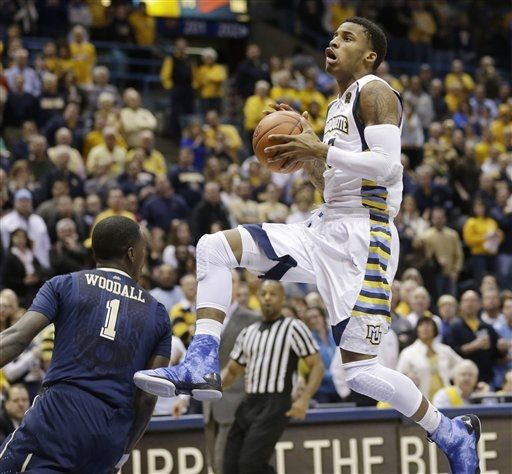
The Golden Eagles are on the rise in the Big East (Photo credit: AP Photo).
At the outset of Big East play, it was easy to look at Marquette and Georgetown and see two good but flawed teams. The Golden Eagles run one of the most efficient offenses in the Big East; even after losing Darius Johnson Odom and Jae Crowder, Buzz Williams’ team gets the most out of every possession by leveraging the superb interior precision of Davante Gardner and the intuitive creativity of Junior Cadougan. The only problem? Marquette isn’t nearly as good on the other end of the floor(The Golden Eagles ranked eighth in the Big East in defensive efficiency heading into Saturday’s game against Pittsburgh). The Hoyas are the complete opposite of Marquette: they play top-five efficiency defense, but rank just inside the top-100 in offense. Offense-defense splits are not uncommon – most teams are demonstrably better at scoring or preventing points. Only the elite of the elite can master both. But as we enter the final five or six games of conference competition, the Golden Eagles and Hoyas (along with Syracuse) find themselves on top of one of the most competitive leagues in the country. How exactly did they get there? The most recent set of results shows Marquette handling Pittsburgh at home Saturday and Georgetown delivering another home loss to Cincinnati (its fifth of the season) Friday night, but both have been playing steady if not spectacular hoops for most of the league schedule. Marquette and Georgetown butted heads last week, with the Hoyas’ superior defense besting Marquette’s superior offense. Which team reaches a higher perch on the Big East pecking order by season’s end, I don’t know. Based on last week’s outcome and empirical results from over the weekend, I’ll cast my lot with Georgetown and that suffocating defense.
Kellen Carpenter is an RTC correspondent. He filed this report after Saturday’s game between North Carolina and Virginia in Chapel Hill.
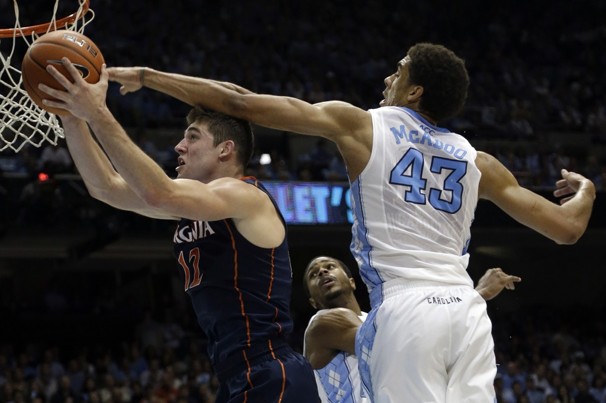
When media members participated in the mock NCAA tournament selection panel, Virginia found itself on just the right side of the bubble, picked to play one of the “First Four” match-ups for one of the last at-large seeds. North Carolina, on the other hand, found itself on the outside looking in. Obviously, no one should draw too much from a fake committee making selections for a hypothetical Tournament, but the bracket that this group managed to draw up reflects the prevailing thought about both team’s NCAA chances: Each team is squarely on the bubble and, at least on Friday afternoon, it seemed like Virginia was the better team.
UVA Found Its Way to the Basket But Still Lost the Game
It will be interesting to see how Saturday’s result, a UNC victory, will influence the real committee. The Cavaliers shot a blistering 58.5% from the field and 57.1% from beyond the arc, with Joe Harris scoring 27 points from all over the court. Yet somehow, North Carolina won this game, and the manner of victory signals an interesting transition for this team’s identity. The Tar Heels won at the free throw line, and while that phrase has been written countless times, there has been little occasion to use it this season. Roy Williams‘ offensive philosophy has historically been largely based around getting his team to the free throw line at a very high clip. Yet this season, his team gets to the line with somewhat dramatic infrequency. The Tar Heels’ free throw rate this season is only 28.5%, good for 331st in the nation — the worst a Roy Williams-led North Carolina team has ever performed in this category. His second-worst season by this measure was last year, where UNC still managed to put up an above average 37.3% rate. In this game against Virginia, the team started to look more like the UNC teams of the past decade. North Carolina went to the line 30 times and converted on 22 attempts from the line. It was a surprising change from the way the team has played for most of the season.
I. Renko is an RTC columnist. He will kick off each weekend during the season with his analysis of the 26 other non-power conferences. Follow him on Twitter @IRenkoHoops.
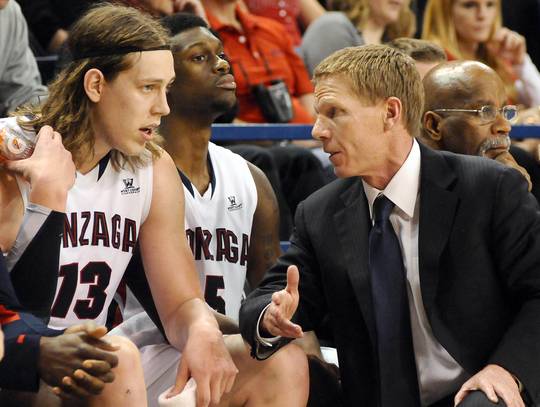
After a 17-point win at St. Mary’s on Thursday night pushed Gonzaga’s record to 24-2 and cleared its biggest hurdle to a regular season record tainted with just two losses, some are wondering whether this is the best team that Mark Few has put together in his 14 years at the helm. It’s a fair question, given the way they’re playing. But the best ever? Sure, not since Adam Morrison was dragged off the court after a heartbreaking loss to UCLA ended his college career, have the Zags had a player with the combination of star power, All-American credentials, and curious hairstyle that Kelly Olynyk has brought this year. And, true, moreso than the Morrison-led team of 2006, this squad is a well-balanced offensive machine, with a multitude of frontcourt and backcourt options. They proved that on Thursday, when Kevin Pangos and Gary Bell, who have deferred most of the scoring load this year to Olynyk and Elias Harris, dropped a combined 38 points on St. Mary’s.
This Gonzaga Team is Good, But Not Mark Few’s Best … Yet (James Snook / USA TODAY Sports)
But Few’s best team ever? They have a ways to go before they can claim such an honor. Take, for example, the 2004 team, which also dropped just two contests heading into the NCAA Tournament. That squad was led by All-American senior guard Blake Stepp, and like Olynyk, he had lots of help. Junior Ronny Turiaf, sophomore Morrison, and senior Cory Violette shared the scoring load, with all four players averaging in double-digits. They coasted through league play undefeated, never winning a game by less than double digits, and ended the season on a 20-game win streak en route to a 2 seed in the Tournament, Gonzaga’s best ever. Their two pre-Tournament losses were to St. Joe’s and Stanford, both of which went on to earn 1 seeds that year. By contrast, this year’s Gonzaga team lost to Illinois, a bubble team, at home by 11 points.
Of course, this year’s squad could prove itself a superior to the 2004 team — or any team that Few has coached — if it can get past the Sweet Sixteen. Since Gonzaga burst onto the college hoops scene 14 years ago with a Cinderella run to the Elite Eight, they’ve yet to get reach the brink of a Final Four, much less a Final Four itself. The ballyhooed ’04 squad was upset by 10th-seeded Nevada in the second round, the ’05 team squandered a 3 seed with a second round loss to Texas Tech, and the ’06 Zags memorably collapsed against UCLA in the Sweet Sixteen (a game to which one cannot refer without remarking that it was perhaps the finest moment of Gus Johnson’s illustrious career). This Gonzaga team stacks up well with those predecessors, but unless it breaks through to the second game of the second weekend, it won’t prove to be their clear superior.
What’s undisputed, however, is that the Zags have been dominant enough to remain at the top of this year’s Top 10. On to that, our Honor Roll, and this week’s games to watch . . .
Deepak is a writer for the Big Ten microsite of Rush The Court. Follow him on Twitter for more about B1G hoops at @dee_b1g.
We have reached the point in the season where it feels like every game has conference implications of some kind, and there’s no better period of time to enjoy them all than Saturday and Sunday afternoon. Weekends through the end of the season will be packed with quality basketball, so let’s take a hard look at this weekend’s slate of games and what’s in store.
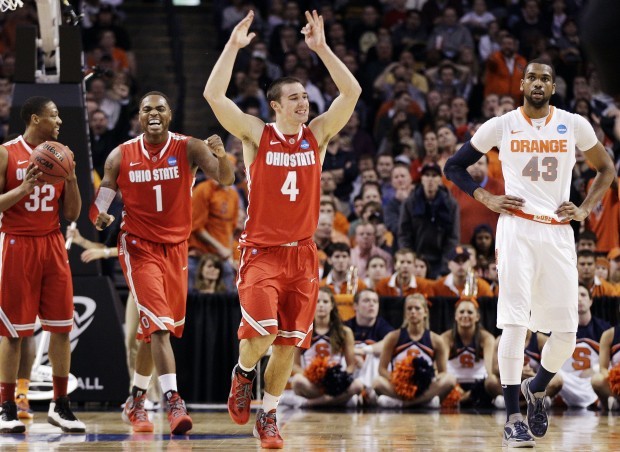
Aaron Craft and the Buckeyes have a tough game against the Badgers in Madison on Sunday.
Purdue @ Indiana (2:00 PM EST on Saturday, ESPN): The Hoosiers might end up winning this one comfortably but the game features an excellent match-up in the low post between Cody Zeller and A.J.Hammons (11.2 PPG). It is easy to forget when you evaluate Zeller’s game that he is only a sophomore and Hammons, a freshman, has shown flashes of brilliance in the paint as well. During the first version of this match-up in West Lafayette, Hammons scored 30 points but picked up two early fouls due to poor defense. But if the Purdue big man can manage to stay on the floor, you could see his strong array of post moves – a hook shot, a 10-foot jumper, a nice turnaround – against Zeller tomorrow. This will also be a good test of Zeller’s defense if the game ends up being relatively close late into the second half.
Michigan State @ Nebraska (8:00 PM EST on Saturday, Big Ten Network): Nebraska head coach Tim Miles continues to motivate his team to compete against the top dogs in the conference despite many tough losses. The Cornhuskers hung tight with the Spartans in East Lansing on January 13, only to lose the game 66-56, but don’t expect them to roll over and hand the game to the Spartans on Saturday night. Gary Harris continues to play through his back spasms and even if Travis Trice suits up, his minutes may be limited because he is still recovering from an injury. Despite these issues, Tom Izzo has enough talent on his team to not let this game slip away on the road as he is trying to make a case for the #1 seed in the NCAA Tournament and win the Big Ten title. Read the rest of this entry »
In this week’s power rankings, we take a look at what each team’s biggest improvement has been this year. Voters this week were Deepak Jayanti, Joey Nowak and Kevin Trahan.
The Spartans are surging after dismantling Michigan on Tuesday. (Justin Wan/The State News)
Indiana Hoosiers — The loss to Illinois last week hurt a little, but Indiana bounced back nicely and was able to hang on to the No. 1 spot in the country (as well the PRs). The Hoosiers took down Nebraska in fairly unspectacular fashion, but were very impressive in a road game against Ohio State. The schedule gets tougher, with games at Michigan and Minnesota coming up, so the Hoosiers have to play well on the road, where they’ve been very inconsistent as of late. However, Indiana proved that when it’s playing well, it is one of the most dangerous teams in the country. Cody Zeller and Victor Oladipo were both very impressive against the Buckeyes and IU was able to pull out a nice win. Most Improved: This is a tough decision. We’ll go with Oladipo because of just how much he’s improved since last year. Cody Zeller has actually improved a lot within the course of the season after a so-so start too, though. Still, Oladipo has been the Hoosiers’ star and has his name in NPOY talk. Who could have guessed that at the beginning of the season?
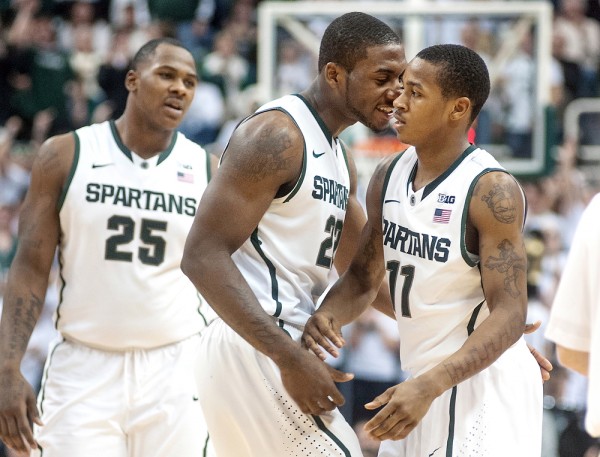
Michigan State Spartans — There’s no team in the conference on a streak like the Spartans (they’ve won 10 of their last 11 with their only blemish coming in a tightly-contested game at Indiana), one of the hottest teams in the country. The problem is, they’re trying to keep up with the one team that dealt them their only loss since 2012. The Spartans are somehow finding a way to get on without Travis Trice, and they’re doing a fantastic job of it. The romp over Michigan was the biggest statement made in Big Ten play this season, but things are going to get really tough on the Spartans now. Indiana comes to town Tuesday, followed by trips to Ohio State and Michigan before Wisconsin hits East Lansing. We’ll definitely get to see what Tom Izzo’s group is made of. Most Improved: On an individual level, this honor would have to go to Denzel Valentine, who has always been one of the Spartans’ most promising young players, but also one who needed to be reined in. But as he’s helped to fill the void left by Trice and cut down his turnovers, the Spartans have improved in the same department. After turning it over 18 times against Indiana, the Spartans have averaged just over 10 per game (including only five against Minnesota and eight against Michigan). This has to be remain the case if the Spartans are to continue this run.
Michigan — The questions about Michigan have started to come up again. Earlier in the season, people questioned the Wolverines’ frontcourt and whether the freshmen could continue to play as well as they did early on. Well, Michigan seems to have hit a little bit of a wall, losing a nail-biter at Wisconsin and then getting blown out at Michigan State. The game against Michigan State was particularly draining, as the Spartans controlled the contest from the opening tip and basically nobody else played well other than Trey Burke and Mitch McGary. The remainder of the schedule is tough — although MSU and Indiana still have to go to Ann Arbor — and Michigan needs to get back on track before things spiral out of control. Most Improved: Over the first part of the season, McGary took a back seat to fellow freshmen Nik Stauskas and Glenn Robinson III. However, he has shown great improvement over the past few games. Michigan needs him to play well down the stretch, especially during Robinson’s current slump. Read the rest of this entry »
Who Won the Week? is a regular column that will outline and discuss three winners and losers from the previous week. The author of this column is Kenny Ocker (@KennyOcker), an Oregon-based sportswriter best known for his willingness to drive (or bike!) anywhere to watch a basketball game.
WINNER: California
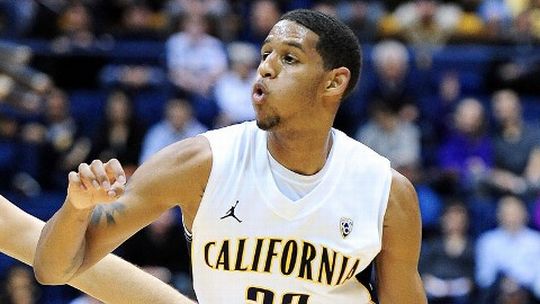
The Golden Bears stormed Tucson on Sunday and came out on the better half of a 77-67 game, with special thanks to the Pac-12’s leading scorer, Allen Crabbe, who poured in 31 points. With 15 points in the first half, Crabbe came up strong again Thursday night as Cal dismantled UCLA in Berkeley to keep its undefeated record at home in Pac-12 play. Despite a four-loss non-conference schedule, the Bears have managed to play themselves back into the discussion for an NCAA Tournament at-large bid. Not bad considering that they were 3-4 fewer than three weeks ago.
Allen Crabbe had a week to remember. (Icon SMI)
(Related winners: Crabbe, who combined for 57 points in the two games; Oregon, which regained the conference lead it lost after a three-game losing streak including a loss to Cal. Related losers: Arizona – see below.)
LOSER: Arizona
After a foot injury to Oregon point guard Dominic Artis derailed the Ducks and led to a three-game losing streak and a gift of the Pac-12 lead to the Wildcats, they decided to give it right back with a pair of bad losses, stumbling at home to Cal before losing the return game against Colorado a month after a controversial buzzer-beater was disallowed and Arizona rolled in overtime to stay undefeated at the time. This time, the Buffaloes left no doubt about who would win, cruising to a 71-58 win. The Wildcats shot at an even 40 percent clip over the week, while Cal shot 59 percent and Colorado 50 percent. So much for having control over the conference.
Jimmy Kelley is an ACC correspondent for Rush the Court. Follow him on Twitter @DevilsInDurham.
There are two awards in each conference that spark the most debate — Player of the Year and Freshman of the Year. While one has many different definitions and, depending on whom you ask, could be given to three or four different players every year, the other is much more objective. The ACC Freshman of the Year is given annually to the first-year player who has had the most outstanding season. Nothing about value, impact or how good the respective player’s team was, just that he had an outstanding season. With this being the generally agreed-upon criteria, the two players who should be at the top of everyone’s watch list this season are Rasheed Sulaimon of Duke and Olivier Hanlan of Boston College.
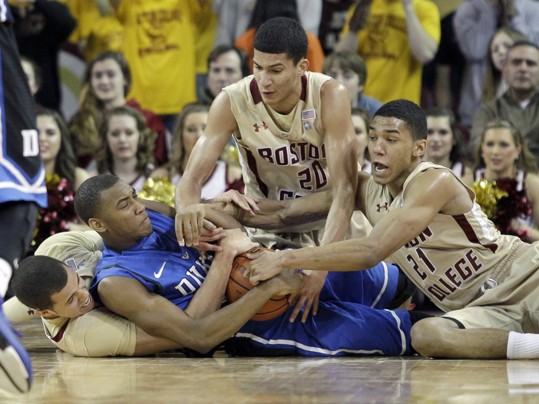
Rasheed Sulaimon (with ball) and Olivier Hanlan (far right) fought for the ball here but who will take the freshman of the year award? (AP Photo)
Let’s start with Sulaimon. A freshman from Houston, he was the all-everything wing player that Duke has always been able to convince to come to Durham. A participant in the Jordan Brand Classic and McDonald’s All-American Game, Sulaimon came in with sky-high expectations and despite a few down games has lived up to them. He’s averaged 11.5 points, 3.3 rebounds, and 2.2 assists per game while shooting 42 percent from the field, 39.8 percent from the three-point line, and providing outstanding on-ball defense that has helped Duke keep some of the league’s best wing players from going off. He has been the perfect complement to Seth Curry, especially given the senior’s injury issues, and he has been able to give Duke a reliable third scorer in the absence of Ryan Kelly. If there was a most valuable freshman award, Sulaimon would take that award home.
Welcome to this week’s RTC Podblast, hosted by Shane Connolly (@sconnolly114). It was a week of big rivalry games from Michigan-Michigan State to Duke-North Carolina to Kentucky-Florida and UConn-Syracuse. We hit on a few of these during this week’s podblast, while also finding some time to discuss the MVC and Creighton and looking ahead to what can only be described as a fairly miserable lineup of games over the weekend. Oh well, there’s always next week… this week’s outline is below.
0:00-7:45 – Sparty Establishes Itself as the State’s Best Team
7:45-10:20 – Syracuse Drops Last Big East Game vs UConn
10:20-12:45 – Creighton Struggling in MVC Play
12:45-15:44 – Thoughts on Randy’s NorCal Night (UCLA-Cal/Gonzaga-St. Mary’s)
15:44-18:55 – There Should Be More Games to Preview This Weekend
Michael James is the RTC correspondent for the Ivy League. You can also find his musings on Twitter at @mrjames2006 and @ivybball.
Looking Back
One For The Record Book – While Yale’s 69-65 victory over Princeton sent shock waves throughout the league, the score itself obscured the myriad storylines, ranging from interesting to bizarre, hidden beyond a cursory glance. The Tigers saw their 21-game Ivy home winning streak come to an end – a run which extended all the way back to the 2009-10 season. The victory helped push the Bulldogs into a tie for third in the league and put Yale back on pace to finish in the Ivy’s upper division for the 13th consecutive season. Also, it marked just the seventh time in the Academic Index era (dating back to 1980) that a team pulled off the back-to-back sweep of Pennsylvania and Princeton on the road. The game itself was very strange, as both teams posted effective field goal percentages over 60% and each offense rebounded over half of its missed shots.
High Octane – After spending most of the non-conference slate struggling mightily to score the basketball, the eight Ivies have experienced a veritable explosion on the offensive end during league play. Every team has seen its offensive efficiency rise, as the 14-Game Tournament has seen Ivy teams score an average of six points more per 100 possessions than they did during the non-conference slate. True-shooting percentage has risen substantially in league play as teams have started getting to the line more and converting a greater percentage of their three-point shots. Dropping threes is a great equalizer for an underdog, and sure enough, the league’s two biggest upsets to this point (Yale over Princeton and Columbia over Harvard) have seen the favorites succumb to a barrage of trifectas from their opponents.
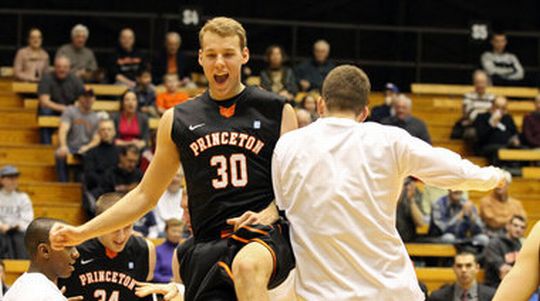
The Tigers continue to roll, but an unbalanced schedule has Princeton playing seven of its final nine on the road.
Power Rankings
Princeton(11-8, 4-1) – While the Tigers look like the most complete Ivy team and have the added benefit of experience going for them, one thing to keep in mind is that the Tigers haven’t played a road game since January 5th and have yet to venture away from Jadwin in league play. With seven of its final nine on the road, Princeton is about to find out just how tough it is out there, starting with its trip to Dartmouth and Harvard this weekend. Over the same timeframe that the Tigers won 21 straight games at Jadwin Gym, they went just 9-7 on the road, losing at five different Ivy venues. Princeton’s home-road splits this season have been pretty much dead even, so there’s no reason to expect any drop off as the Tigers leave New Jersey, and all it would take is one road sweep to make Princeton the prohibitive favorite. Read the rest of this entry »