08.02.07 Fast Breaks

Posted by rtmsf on August 2nd, 2007

August sorta snuck up on us, and with it did the realization that we’re now only about ten weeks away from Midnight Madness. 2007-08 schedules are slowly leaking out (Hey Florida – way to challenge build confidence for your new guys), and students will be back in the school in just a few weeks. We’re getting closer…

  • Speaking of schedules, the four Preseason NIT first/second round sites are: Ohio St., Syracuse, Washington, and Texas A&M. Best chance for a first-round upset? Oral Roberts over TAMU.
  • Wazzu stepped up to the plate to compensate Tony Bennett for his fine first season, although his pay is still below the Pac-10 average.
  • The hits keep coming for New Mexico St. – star forward Tyrone Nelson was dismissed from the team hours after his conviction for the robbery of a pizza delivery man.
  • Over forty institutions were named as allegedly taking part in a student loan kickback scheme that could have affected non-scholarship athletes at schools such as Georgetown, UCLA, Kansas and Auburn. As student loan holders, this is a troubling development.
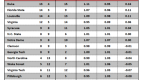
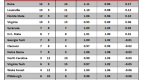
  • March Madness All Season released its midsummer Top 25 – Memphis is #1.
  • Oh, and a while back Dick Vitale released his 07-08 preseason Rolls-Roycers (we prefer Maybachs) with nary a Dookie to be found.
  • Ahh, our friends the Dookies. H/T to The Dude Abides for finding the Duke response to the infamous “This is Why Duke Sucks” vid from earlier this year. There is no way any of the guys in that video actually go to Duke. Also have to mention we love the Audi – is there any car more Duke?
  • Speaking of Duke douchebags, McBob has apparently found his way into the back seat with quasi-reality MTV star Lauren Conrad.   
  • So what you’re saying is that we’re like every other sports blogger, right? Actually this is a pretty cool (although admittedly unscientific) analysis of the typical profile of sports bloggers today.
Share this story

NCAA Tourney Conference Overachievers and Underachievers (1985-2007)

Posted by rtmsf on July 11th, 2007

Today we’re ready to unleash the last installment of our analysis of NCAA Tournament stats of the 65 (64) team era… that is, unless we decide to analyze the coaches too… well, it is over three months until Midnight Madness, so ok, hold that thought.  Anyway, as you hopefully recall, during the weekend we took a look at the raw numbers of the era by conference, and essentially concluded that the ACC has been the most successful conference of the last 23 years, the Pac-10 SWAC/NEC the worst, and that the mid-major conferences may not have been as consistently good as we had hoped over the years.

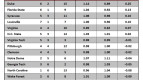
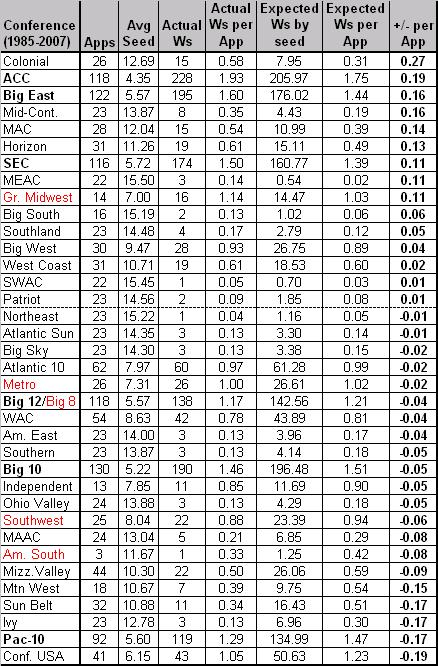
Now let’s take a look at the conferences who have overachieved and underachieved over the 65 (64) team era. In our analysis of this measure by school, you may remember that we looked at two different models – a Standard Model of expected wins by seed (e.g., a #1 seed should win 4 games per appearance), and a Historical Model of expected wins by seed (e.g., a #1 seed has actually won 3.36 games per appearance from 1985-2007). We concluded then that the true value lies in considering the Historical Model foremost because the Standard Model places too unrealistic of an expectation on high seeds and not high enough of one on low seeds, which ultimately skews its results in favor of lower-seeded schools and conferences. Given that condition, we now show the Overachiever and Underachiever conferences of the 65 (64) Team Era using the Historical Model. See Table A below.

Table A. Historical Model applied to 65 (64) Team Era

Notes: the table is sorted by “+/- per App,” which represents the number of games won above or below the expected number of wins for that seed per NCAA appearance (1985-2007). The conferences whose names are in bold are BCS conferences. The conferences whose names are in red are conferences that no longer exist.

NCAA Tourney by Conf v.3

Not Just George Mason. The first thought everyone will have (because we had it too) is that George Mason‘s miraculous run in 2006 accounts for the Colonial Conference’s rather aristocratic pedigree at the top of our list. But looking a little further inside the numbers somewhat mitigates this idea. Sure, the Masonites (as a #12 seed) won 3.52 games beyond its expected value of 0.48 wins per appearance in 2006, but that only accounts for half of the Colonial’s wins beyond expectation during this era. So where are the rest of the wins coming from? Thank David Robinson’s Navy squads of the mid-80s and Dick Tarrant’s Richmond Spiders in the immediate aftermath for the CAA’s perch as the biggest overachiever on our lofty list.

David Robinson

George Mason isn’t the only CAA School to Overachieve

BCStriation. Unlike our previous posting that used standard objective measures (wins, F4s, titles, etc.) to show that the six BCS conferences were without question the top six leagues of the era, today’s posting paints a substantially different picture. A league can be very successful objectively and still considerably underachieve, as in the strange case of the Pac-10 (and to a much lesser extent, the Big 10). Although the Pac-10 was clearly the weakest of the BCS conferences by the raw numbers, we certainly didn’t expect that it would be the second-worst underachiever of the 65 (64) team era – but it unquestionably is. The Pac-10 has won sixteen fewer games than it should have during this period, which dwarfs the negative output of any other conference – next in line for public shaming are Conference USA (7.6 wins fewer) and the Big 10 (6.5). Looking back at our list of chronic underachieving schools, we note that Stanford, Arizona and Cal all fall into the frequent NCAA underachievers list, which should have tipped us off that this was coming.

High Achievers. On the other side of things, the ACC and the Big East fall in line behind the CAA as the biggest overachievers of the era, which proves that you can get great seeds, have tremendous objective success in terms of wins and titles, and still overachieve as a conference. The ACC has won a whopping 22 games and the Big East 18 games beyond expectation; and the SEC isn’t far behind with 13. We also want to nod a tip of the hat to the Mid-Continent (+4.5 wins), MAC (+4 wins) and Horizon (+4 wins) conferences, each of which shows that leagues with consistently low seeds can do some damage on a regular basis in the NCAA Tournament.

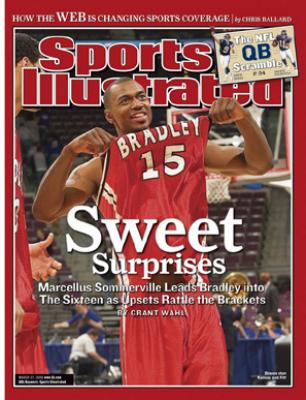
Bradley

Missouri Valley Teams Need to Do More of This

What About…? If anything, these last two posts have opened our eyes to just how traditionally overrated the Missouri Valley Conference has been. For a so-called mid-major who gets multiple teams invited every year, its performance leaves a lot to be desired (4 wins below expectations). We realize that things change – conferences get better and worse over the years – but the MVC is going to have to really start producing in the next 5-10 years to lose our proffered overrated tag. As a comparison, the Horizon and West Coast conferences have performed nearly as well (19 wins each) as the MVC (22 wins) despite earning far fewer NCAA bids and having a slightly worse average seed.

Ivy League Paradox. We suppose that if you asked a hundred college basketball fans whether they believed the Ivy League traditionally overachieves in the NCAA Tournament, 99 of them would likely agree. This is probably due to a memorable upset or two over the years in addition to a common perception that the Ivies are a “tough out” every year. But looking above, we see quite starkly that the Ivy League has been one of the biggest underachievers of this era, earning only three wins versus an expected total of seven. This is largely because the Ivy champs (usually Penn or Princeton) have consistently earned seeds ranging from #11-#13 over the last decade, but haven’t been able to earn a single win during that period. The lesson here, we suppose, is to never take an Ivy team in your brackets (we’ve heard that taking an Ivy team against the spread in the first round is a good bet, however).

Share this story

NCAA Tournament Success in the 65 (64) Team Era by Conference

Posted by rtmsf on July 7th, 2007

Hope everyone had a great 4th of July holiday… although we gotta say this midweek holiday thing kinda sucks. Give us the three-day (or four!) day weekend instead.

Anyway, we’re now ready to unveil the conference follow-up to our June analysis of the Top NCAA Performers of the 65 (64) Team Era. Once again, we’re going to take several different views of the world here. Today we’ll just look at the raw statistics and make some obvious insightful observations. In the next post, we’ll take a look at how conferences have performed versus its seeds during this era, and whether we can draw any broad conclusions from the data about overachieving and underachieving conferences.

Conference

What Kind of Conference is This?

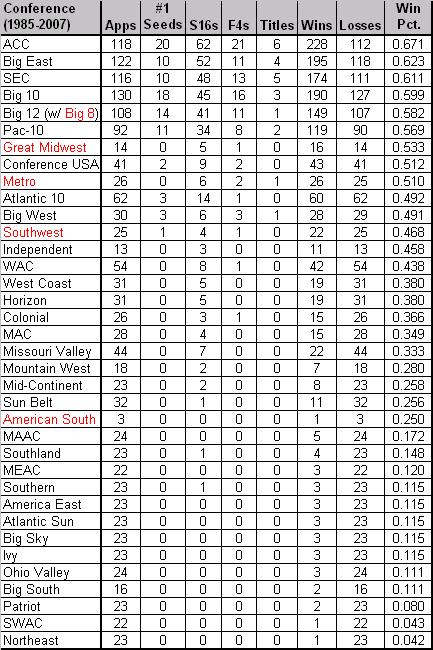
A couple of notes before rolling out the data. First, with only one notable exception, we counted a team’s performance in a given year toward the totals of its conference at the time. For example, Louisville’s 1986 national title counts toward the Metro Conference totals (the Metro disbanded in 1995), not the Big East totals. The notable exception is that all Big 8 totals were subsumed into the new Big 12 conference, since every member of the Big 8 ultimately became Big 12 members. See Table A below.

Table A. NCAA Tournament Success by Conference (1985-2007)

Notes: this table is sorted by winning percentage. The conferences whose names are in red are conferences that no longer exist.
NCAA Tournament Conferences v.5

BCS Conferences. This won’t surprise anyone, but we wanted to show the numbers in context. The following represents the percentage of each category achieved by the six BCS conferences from 1985-2007.

  • 46.4% of all NCAA Appearances
  • 60.9% Winning Percentage
  • 72.5% of all Wins
  • 76.6% of all Sweet 16s
  • 87.0% of all Final 4s
  • 90.2% of all #1 Seeds
  • 91.3% of all Titles

If you’re writing a paper on the correlation between resources, exposure, talent and success in NCAA basketball, the above numbers should be included in your first paragraph. It matters.

Best in Show

Best in Show?

Best in Show. Over this 23-year period, there can be no question that the ACC has been the strongest performer in the NCAA Tournament. This conference leads in every objective category except for appearances, which actually makes their hard numbers with respect to S16s, F4s and Titles look even more impressive. The most shocking finding for us regarding the ACC’s success was that more than half (52.5%) of its participants during this era won at least two games (i.e., made the Sweet 16). This is phenomenal, especially considering that the next-best major conference is the Big East at 42.6%. Of course, when you’re winning greater than two-thirds of your games as a conference, then it shouldn’t be that surprising.

Next Best. From our view, the next tier of conferences include the Big East, SEC and Big Ten – you can pretty much throw them all in a pot and pick any of the three as second behind the ACC. The Big East leads in S16s and winning percentage; the SEC leads in titles and mostly has middle-of-the-pack numbers otherwise; and the Big Ten leads in appearances and F4s. We rate the Big 12 slightly below this group because there seems to be a drop in most categories from the above three, most notably in winning percentage and titles (ouch – only one). But the Pac-10 clearly performs worst over this era, earning the fewest bids, having the worst winning percentage and owning by far the least wins, S16s and F4s.

Mid-Majors. From the numbers, we only recognize four true mid-major conferences during this period – the Metro/Great Midwest/CUSA and WAC/Mountain West hybrids, the Atlantic 10 and the Missouri Valley. What’s interesting is that only the Metro/GM/CUSA teams have a winning record during this period, while of course all of the BCS conferences easily have winning records. This shows once again just how large of a disparity there is between the three levels of college basketball. Remember when during the mid-90s, the A10 was supposedly overtaking the Big East in talent and performance? – the lesson here is to not believe the hype. Within that group, Metro/GM/CUSA has had the most success, led by Louisville, Cincinnati and Memphis. Now that two of those three are in the Big East, we don’t expect CUSA’s success to continue. We were also a little surprised at how low both The Valley and the Mountain West performed here – they have poor winning percentages and the Mountain West in particular has only put two teams (of 18 bids) into the Sweet Sixteen since its inception in 2000 – pathetic for an annual multi-bid league.
Tarkanian

Tark Has This Effect on Everyone

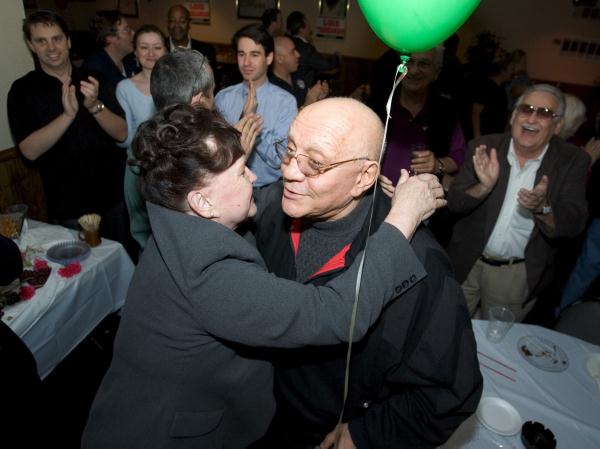
UNLV and Gonzaga Effect. The Big West and West Coast Conference exhibit how one very successful school can make a league look better than it actually is. By the numbers, the Big West looks like a mid-major league, but when broken down further, you quickly realize that the Rebels account for 21 of the conference’s 28 wins over this period. Excluding UNLV, the Big West is only 7-23 (.233) in the NCAA Tournament, which would put it on par with the Sun Belt and the Mid-Continent. The same is true with the WCC – when Gonzaga is excluded, the league is 7-21 (.250) during this period.
NEC

Stay Away from the NEC if you Want to Win in the NCAA Tournament

Low Majors. Picking a best conference among the low majors is a little like picking the prettiest ugly girl in the bar (not that we know anything about that, mind you), but if we have to choose, we’ll take the Southland Conference (note: we consider the conferences on the list above between the Great Midwest and the Sun Belt mid-majors, although the Sun Belt’s one S16 appearance with 32 bids is strong evidence that we might be giving that league too much credit). We choose the Southland because it’s one of only two of these conferences to put a team into the Sweet 16 (Karl Malone’s Louisiana Tech in 1985), and it has a better winning percentage than the others. We realize, of course, that all of these low majors are virtually equal in their NCAA ineptitude – only the Ohio Valley and the MAAC have ever received at-large bids (1987 – Middle Tennessee St.; 1995 – Manhattan) – but that’s our pick here. Our vote for the worst conference in D1 is a tie – the SWAC and the Northeast Conference. Each has the unenviable distinction of only winning one game in the NCAA Tournament during this period. Of course, maybe we’re looking at this the wrong way, and instead we should be celebrating the fact that every single conference has managed to win a game in the Dance during this period.

Final Thoughts. Can anyone catch the ACC? The Big East has a chance to tally significant gains if it continues to put eight teams into the NCAAs, as it did in 2006. But numbers alone probably isn’t enough – after all, the Big 10 has put the most teams in the Tournament since 1985. Rather, the ACC gives the obvious recipe for success by having two dominant programs that over the long haul consistently go deep into the NCAA Tournament (Duke and Carolina). Looking ahead, the Big East has an aging Calhoun at UConn and Boeheim at Syracuse so we’re not sure about its prospects. The Big 10 has Thad Matta the Recruiting Machine at OSU, but Michigan St. has regressed in recent years, and who else can rise up (Weber at Illinois? Beilein at Michigan? Tubby at Minnesota?). We’ll keep looking. The Pac-10 has an obvious supernova developing in Westwood at UCLA, but where else? Arizona will be in what kind of shape after Lute retires? Our choice for the conference to challenge the ACC in the next decade is the SEC. Billy Donovan at Florida has already proved his mettle; and with Billy Gillispie at Kentucky and Bruce Pearl at Tennessee challenging anyone to outwork them, it almost makes up for the coaching lightweights over in the SEC West (you know who we’re talking about). The youthful exuberance of these coaches at several programs willing to put forth the resources for success may give the SEC the best shot at catching the ACC, but the truth will ultimately lie in what happens to Duke after Coach K retires. If Duke manages to keep its dominance intact with their next coach, then it won’t much matter what happens with the other conferences – they’re not going to catch the ACC.

Coming Next: a look at how conferences overachieve and/or underachieve relative to their seeds over the years. Should be interesting stuff. Check back early next week.

Share this story

2007 NBA Draft Musings

Posted by rtmsf on June 29th, 2007

Note:  If you’re looking for the 2008 NBA Draft Musings, look here. 
Some post-apocalyptic draft thoughts for your Friday, as we settle into a long summer of waiting for something to happen…

Oden

Championship or Bust in Portland?

  • One and Dones. These players acquitted themselves quite well in this year’s draft, which means they were getting good information from their schools and representatives. Greg Oden, Kevin Durant, Mike Conley, Jr., Brandan Wright, Spencer Hawes and Thaddeus Young were six of the top twelve players taken. Not coincidentally, five of those were among the top seven seniors of the Class of 2006, according to Rivals (Chase Budinger of Arizona was the lone holdout returning to school, and Conley was rated #18). Javaris Crittenton and Daequan Cook were also selected in the first round, meaning that every college freshman who declared was taken this year. Although it’s arguable whether the one-and-done system worked for college basketball (Ohio State – yes; Washington – no), we assert from a player perspective that it helped them exponentially in terms of marketability and readiness to perform at the next level. Every sports fan in America now knows who Greg Oden and Kevin Durant are – that wouldn’t have been the case prior the one-and-done rule.
  • Gator Rule. As we alluded to yesterday, the Florida Gators were set to greatly increase its all-time count of draft picks last night, and they did so with a flourish (see Joakim Noah‘s getup below), increasing its total from 10 to 15 overnight. Florida’s five entries into the NBA last night – Al Horford, Corey Brewer (who looked like the happiest man alive), Noah, Chris Richard (we figured he’d get a look), and Taurean Green – ties UConn for the most draft picks in one year. What, no Lee Humphrey?!?! The Huskies also entered five in 2006. One question, though. Where was Billy Donovan during this celebration of Pax Floridana? Maybe Christine hasn’t let him out of the house yet.

Joakim Noah Suit

Love the Seersucker, Jo

  • Conference Breakdown. The BCS conferences accounted for 39 of the 60 picks last night. The ACC (9 total; 6 first rounders) led the way, with the SEC close behind (8/3); the Big 10 (6/4), Pac-10 (6/4) and Big East (6/2) each showed moderate success, while the Big 12 fell behind the others (4/3). Considering that there were thirteen international players selected, that left only eight picks for the mid-majors. The highest mid-major player selected was Rodney Stuckey from Eastern Washington at #15; although Nevada also placed two players in the second round (Nick Fazekas and Ramon Sessions).
  • Dumb Declarations. By our count, only four players from D1 schools who stayed in the draft as an early entry candidate were not selected this year (most notably, Shagari Alleyne, formerly of Kentucky). This shows again that players are improving at determining their real value (vs. perceived inflated value) before making the decision to jump.

“Why Didn’t I Go Pro Last Year????”

  • A Year Late, A Dollar Short. Three players from big-name schools were probably kicking themselves for not leaving school early last year, when their weaknesses weren’t as exposed to the scouts. Duke’s Josh McRoberts (offensive skills), LSU’s Glen “Big Baby” Davis (weight issues) and Arizona’s Marcus Williams (headcase) all would have been much higher picks last year. Now each must battle for scraps as second-round selections this time around.
  • Parlez vous français? We always hate to see guys who put in their four years at college and were pretty good players, only to get passed over in the draft for Pau Gasol’s little brother. So a special shout-out goes to Zabian Dowdell (Virginia Tech), JR Reynolds (Virginia), Curtis Sumpter (Villanova), Mario Boggan (Oklahoma St.), Ekene Ibekwe (Maryland) , Brandon Heath (San Diego St.), Ron Lewis (Ohio St.) and Kyle Visser (Wake Forest) for providing wholesome collegiate entertainment over the last half-decade. We were tempted to also include Mustafa Shakur (Arizona) here, but he seemed to disappoint more than inspire during his tenure in Tucson.

SLAM Oden & Durant

Oden Wins Championships; Durant Wins Scoring Titles.

  • Final Thought. Oden vs. Durant was endlessly debated all season long. While we have to agree that we enjoy watching Durant play far more than Oden, that belies our bias against watching post men in favor of perimeter players in general. Still, Oden is the kind of player that championship teams are built around, and the Durants of history are comparitively light in the hardware department. We saw this played out in this year’s NCAA Tournament, where Oden’s team went to the national finals, and Durant’s squad was out (embarrassingly) in the second round. Either way, we wish the best of luck to both of them, as they made college basketball a more interesting game for the year they spent with us.
Share this story

The West Side is the Best Side…

Posted by rtmsf on June 9th, 2007

2Pac

2Pac was right after all

Quite a bit was made last season of a renaissance in the quality of basketball in the Pac-10 conference, as it ended the season as a top three conference in both the RPI and Sagarin ratings in addition to earning a record six NCAA bids for the conference and enjoying the prestige as the only conference with multiple teams in the Elite Eight (Oregon and UCLA). There has always been a surplus of talent on the west coast, especially in the Seattle and SoCal areas, but it was largely characterized by players opting to play for an eastern school just as often as staying home to play for State U. This has been changing over the last five years, however, as new coaches such as Lorenzo Romar at Washington, Tim Floyd at USC, Tony Bennett at Wazzu and Ben Howland at UCLA have endeavored and succeeded in keeping as many of those talents as possible close to home. This is no more evident than in some of the recruiting wars over the last couple of years that resulted in top ten players such as Spencer Hawes (Washington), twins Brook & Robin Lopez (Stanford), Kevin Love (UCLA) and Brandon Jennings (Arizona) signing to play in the Pac-10 (notable exception: Lake Oswego’s (OR) Kyle Singler to Duke).

Steve Lavin

Lavin’s former conference is on the rise

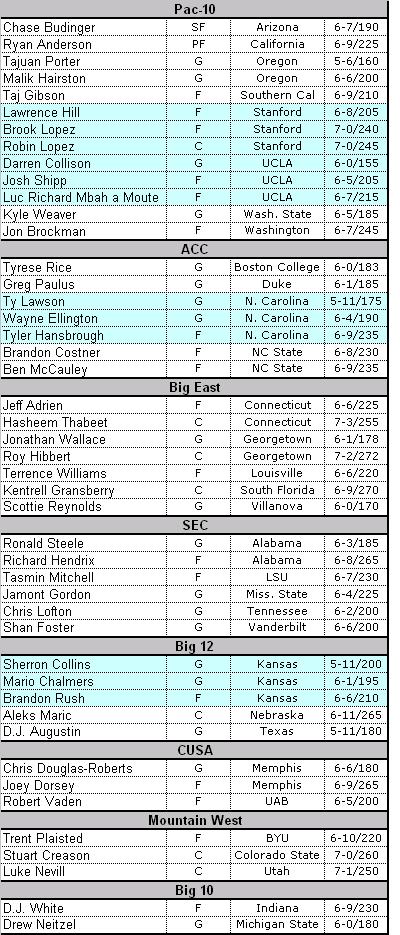
Still, we were a little surprised when Rivals released its top ten players at each position for the 2007-08 season, and the Pac-10 claimed by far the most players, with thirteen of the top fifty. This is especially remarkable given that the league is losing all-conference performers Arron Afflalo (UCLA), Aaron Brooks (Oregon), Marcus Williams (Arizona) and Nick Young (USC) to the NBA next season, while it welcomes likely top fifty players Kevin Love and OJ Mayo (USC) to the league. With talent like this staying on the west coast, we should expect another great season from the Pac-10 conference next year. Somewhere Steve Lavin’s hair gel is celebrating.

The ACC and Big East have seven players each on the list; the SEC has six, and the the Big 12 has five of the top fifty players. The Mountain West and Conference USA both have three of the top fifty, outperforming the Big 10 (again), who only has two. The Colonial (Eric Maynor – VCU), Horizon (AJ Graves – Butler), Missouri Valley (Randal Falker – S. Illinois) and Southern (Stephen Curry – Davidson) conferences each have one top fifty player returning. Below is the list including multiple-player conferences:

Rivals 2007-08 Top 50 Players

You probably noticed that we shaded the teams with three top fifty players returning next season – Stanford, UCLA, UNC, Kansas. It’s certainly no coincidence that three of those will begin next year in the top five of the polls, and the fourth, Stanford, will probably be knocking on the door of the top ten.

Thoughts –

  • Where is all the Big Ten talent? Having less players on this list than CUSA and the Mountain West is cause for alarm, and helps to explain why only one Big Ten team played into the second weekend of the NCAA Tournament last season. Where are the usual stables of talent at Michigan State and Illinois? Aside from the yeoman’s work that Matta is putting into recruting at OSU, the rest of the Big Ten has signed only two top thirty prospects during the last three recruiting cycles – Joe Krabbenhoft of Wisconsin in 2005, and Eric Gordon of Indiana in 2007. An influx of coaching talent has entered the league (Tubby Smith at Minnesota and Kelvin Sampson at Indiana), but without the players to accompany those moves, the Big Ten is going nowhere fast.
  • Nitpicks. We probably would have found a place for the following players: Derrick Low (Washington St.), Edgar Sosa (Louisville), Jerel McNeal (Marquette), and Patrick Beverley (Arkansas). Expect each of these players to be all-conference performers in their respective leagues next season. We also have a sneaky feeling that guys like DaJuan Summers (Georgetown), Deon Thompson (UNC), Derrick Caracter (Louisville) and JaJuan Smith (Tennessee) will make a solid case to be on this list next season.
  • Surprises. NC State’s future looks bright with two young big men, Brandon Costner and Ben McCauley, returning for Sidney Lowe’s team. Alabama should be much improved next year as well, assuming Ronald Steele gets healthy (he was on many preseason all-american teams last year but struggled with tendinitis and ankle injuries that largely derailed Bama’s season). Apologies to the Mountain West, but who are Stuart Creason and Luke Nevill? Their inclusion on this list shows that the depth of talent at the center position in the college game is ridiculously thin.
  • Instant Impact Players in 2007-08. This list next season will be populated by the likes of OJ Mayo, Eric Gordon, Kevin Love, Michael Beasley (Kansas St.), Derrick Rose (Memphis) and Anthony Randolph (LSU).
Share this story

06.07.07 Fast Breaks

Posted by rtmsf on June 7th, 2007

  • Yes, you heard correctly.  The Hair (aka Quin Snyder) is now coaching in the NBDL for the Austin Toros.  No word on whether he’s brought out his master motivational techniques yet. 
  • Clemson’s James Mays withdrew his name from the NBA Draft.  He is exactly who the withdrawal rule was intended for – we’re glad to see it working. 
  • Shocker!  Going to class equals a better GPA for student-athletes?!!?  What will the good folks at Georgia think of next? 
  • According to Justin Young at Rivals, the Big East, led by Syracuse and Villanova, brought in the most talent this year, with seven of the top thirty recruiting classes of 2007.  The Pac-10, led by USC and Arizona, is second, enlisting five of the top thirty classes. 
  • The Orlando Sentinel has a clever take on the winners and losers of the Billy Donovan fiasco.   
  • Finally, we’re taking the Spurs in 5 over Cleveland.  The Witnesses will have to wait another couple of years. 

Share this story

Early Entries: Who has been hit hardest?

Posted by rtmsf on April 29th, 2007

NBA Draft

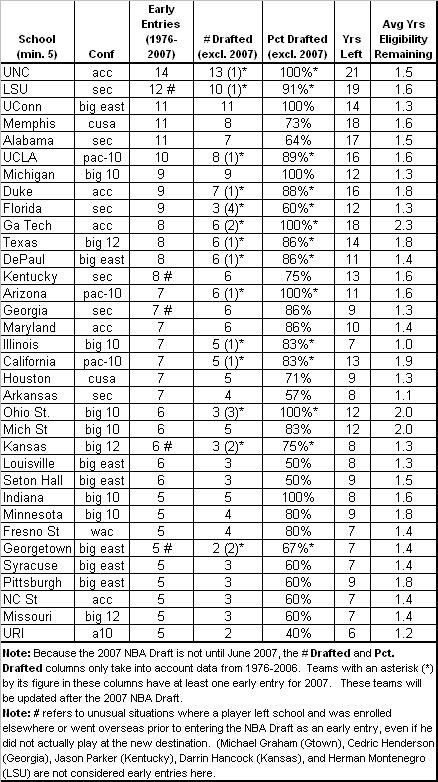
With the early entry deadline now behind us, we got to thinking about what schools and conferences have been hit the hardest over the years in terms of losing guys early to the NBA draft. We already know, for example, that Florida is set to lose four underclassmen one year early (Noah, Horford, Green and Brewer), and that North Carolina may be preseason #1 next year thanks to its good fortune in keeping Lawson, Ellington and Hansbrough around for another year. We reviewed the early entry lists from 1976, the first year after the NBA eliminated its “hardship” application process, to 2007, and here is what we found:

Note: conference stats include all teams currently within that conference (e.g., Texas & Kansas includes stats from both the Big 12 and Big 8 eras).

Early Entries by Univ 1976-2007

Who has been hit the hardest? From our view the ACC and SEC have taken the brunt of early entry punishment over the past thirty years. Six SEC schools – LSU, Alabama, Kentucky, Florida, Georgia, and Arkansas – have lost a combined 54 players to the NBA over the years – nearly ten per team. North Carolina, Duke, Maryland and Georgia Tech have been similarly afflicted, having lost 38 players early to the NBA over the same period. Read the rest of this entry »

Share this story

Who knew Florida International was an NBA breeding ground?

Posted by rtmsf on April 21st, 2007

One of our spring rituals when the NBA playoffs arrive is to analyze the makeup of the teams through the lens of what colleges and conferences the key contributors passed through on their way to the L (assuming they went to college at all). There is talent on every team in the NBA, but it takes more than stockpiled talent to ensure success – experience, competent role players, solid team chemistry, and coaching all come into play. This exercise shows us where the best of the best in basketball are coming from. Are the big conferences over- or underrepresented – and if so, which ones? Which schools are consistently putting talent on the top NBA teams – who is missing? What about the foreign player invasion of the past decade – how is that playing out? To answer these questions and more, we’ll examine both the key contributors and the starters of each playoff team, to see if anything in the results surprises us.

blackboard

The methodology used ensures that we only assessed key contributors on each playoff team. First, we only considered players who averaged at least ten minutes per game this season, figuring that a benchwarmer like Paul Shirley hasn’t contributed much toward the team’s on-court success. Second, each player must have played in at least half of his team’s games (if he was traded during the season, the games with the previous team were included as well). Finally, with respect to selecting starters, we only considered those who were projected to start for their teams during the playoffs (sorry Wiz duo Agent Zero and Caron Butler). This process left us with 168 key contributors and 80 starters spread over sixteen teams. Read the rest of this entry »

Share this story