NBA Draft Picks by School (1949-2006)

Posted by rtmsf on June 26th, 2007

We always believed that it would be cool if someone would take the time to break down the NBA Draft by schools since its inception, figuring there must be a loose correlation between the collegiate powers of the past sixty years and the players that the NBA finds draft-worthy. We’re not saying that a player is talented simply because he’s drafted by the NBA or that he sucks if he isn’t – rather, a player being drafted is solely an imperfect indicator that, at the time, a player’s collegiate career inspired professional scouts to believe that he could ultimately contribute to their team. But it’s also the only consistent indicator we have. To that end, we tried to determine if there was a rational way to determine how much “bang for your buck” having these talented soon-to-be NBA players on a college team’s roster matters over time.

Bang for Buck

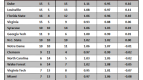
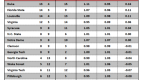
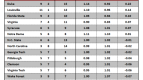
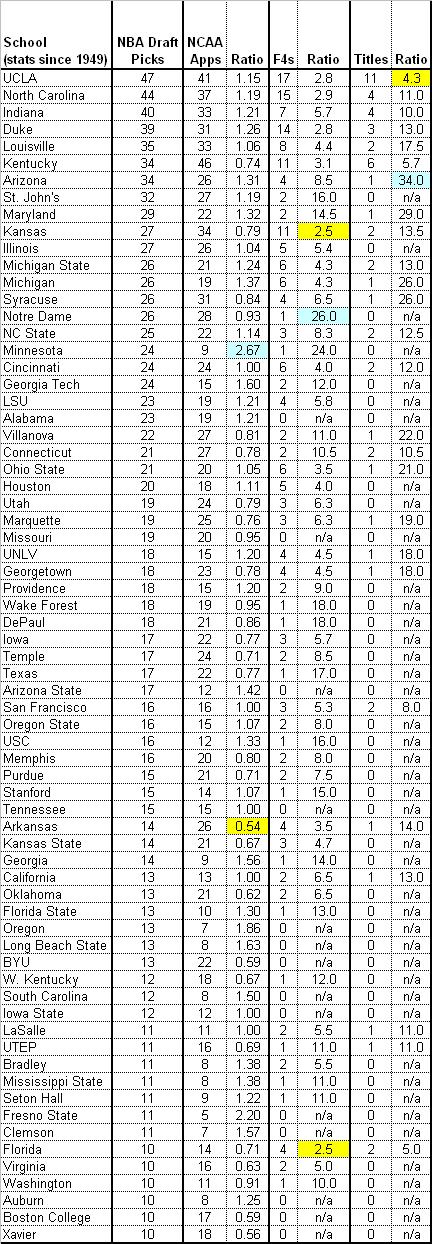
We realize there are many ways to do this analysis and a number of these are meritorious, but for us, it always comes back to NCAA Tournament success – Appearances, Final Fours, Championships. These three measures show that you’re good enough to be invited, you’re good enough to go deep, and you’re good enough to win the title. So in looking at Table A below, you’ll see that the table is sorted by the schools with the most NBA Draft Picks in the first two rounds since 1949 (the first year of the “modern” NBA Draft), and each school also lists those three measures of success next to it (also since 1949). We considered here only the first two rounds of each draft for consistency and the likelihood of a player actually making the parent team.

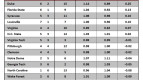
Table A. NBA Draft Picks (first two rounds) From 1949-2006

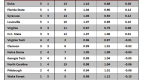
Notes: this table is sorted by the NBA Draft Picks column and is limited to schools with a minimum of ten NBA Draft Picks since 1949. The yellow shading refers to the lowest ratio in that column; the light blue shading refers to the highest ratio in that column.

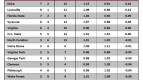
NBA Draft Picks by School - Ratios v.2

Observations.

Talent = Success. Out of the traditional Super Six schools – UCLA, UNC, Indiana, Duke, Kentucky and Kansas – each is among the top ten schools with the most NBA Draft picks. Collectively, these six schools have accounted for over 10% (231 of 2214) of the all-time NBA draft picks, which is fairly amazing if you consider that we’re discussing nearly sixty years worth of college basketball players and hundreds of programs.

Surprises. St. John’s, Maryland and Notre Dame are in the top fourteen of NBA draft picks with 32, 29 and 26, respectively, but their historic success as programs (two F4s each for SJU and Maryland, 1 F4 for ND) is definitely a bit lower than their talent over the years might suggest. They have had numerous good players, but it hasn’t translated into NCAA Tournament success at the same level as their contemporaries on this list. At the other end of the list, Florida‘s recent ascent into the elite company is not (yet) well-represented by its number of draft picks (only 10). However, we’d expect that to change very quickly, hitting as much as 15 after this year’s draft (Horford, Brewer, Noah, perhaps Green & Richard).

Golden gOh-fers. The biggest shocker of all deserves its own paragraph. Somehow the Minnesota Golden Gophers have managed to put 24 players into the NBA Draft over the years – only fifteen other programs have put more – yet nobody would mistake Minnesota for an elite program during any era, considering its paltry nine NCAA appearances and one F4. This disconnect is exhibited by the fact that Minnesota has the highest draft pick/NCAA appearance ratio among the schools listed. Fresno St. (thanks Tark) is the only other school with a ratio greater than 2.0. We think Long Beach St. also deserves a mention, not simply due to its high ratio (1.63), but also because it has produced more draft picks than many major conference teams despite never being much of a power, even within its own conference. On the flip side of things, it was also somewhat amazing to us that Arkansas had only produced fourteen NBA picks despite a substantial amount of NCAA success (26 appearances; 4 F4s; 1 title).

Goldy Gopher

Apparently These Three Gophers Were Drafted by the NBA

Team vs. Individuals. We’re going to be careful to avoid drawing too significant of a conclusion here, but we also found it interesting that among the top ten schools, only Kentucky and Kansas had draft pick/appearance ratios under 1.0, while the other eight schools were above that marker. We wonder out loud if this shows evidence of schools that have traditionally emphasized the team concept to make up for a lack of individual talent over the years; or if UK and KU are simply an anomaly among the most talented teams. There are probably too many variables at play here to make any supportable conclusion.

F4 & Title Ratios. Reviewing the draft pick/F4 ratios, only Indiana is the outlier here, as expected schools such as Kansas, UCLA, UNC, Duke and Kentucky (along with Florida) comprise the six lowest ratios. Considering only the schools with multiple F4 appearances, St. John’s and Maryland have the highest ratios of draft picks/F4s, showing again that they’re producing a lot of good players without as much success to show for it as the others near the top of the list. Along the same lines, considering only multiple titlists, Louisville, Kansas and Duke appear to be getting the least bang for the buck from its talent, as these three schools have the highest draft pick/title ratios among multiple titlists.

Coming Next: now that we’ve looked at the overall numbers, we’ll take a snapshot look at those numbers by decade and by round to see if anything else looks interesting. View Part II (by round) and Part III (by decade) here.

Share this story

06.18.07 Fast Breaks

Posted by rtmsf on June 18th, 2007

With the draft withdrawal deadline looming…

  • Should I stay…  Cal’s DeVon Hardin, Marquette’s Dominic James, Nevada’s Marcelus Kemp, Illinois’ Shaun Pruitt, Texas A&M’s Joseph Jones and GW’s Maureece Rice will stick around another year to play for free.
  • Or should I go?  Georgetown’s Jeff Green, Georgia Tech’s Thaddeus Young, Nevada’s Ramon Sessions, Oklahoma State’s JamesOn Curry have all decided to keep their names in the draft.
  • In case you missed it, Florida guard Brandon Powell was arrested last week.
  • We thought this was kinda cool: Kareem‘s commencement speech at UCLA last weekend.
Share this story

NCAA Tourney Overachievers and Underachievers of the 65 (64) Team Era

Posted by rtmsf on June 15th, 2007

We’ve received a resounding response on the post Tuesday evaluating school performance during the 65 (64) team era, so let’s waste no time in presenting Part II of our statistical profile of the NCAA Tournament during that period. As we alluded to in that post, looking at raw data in a vacuum has its limitations. From that data we got a reasonable sense of which programs have had the most success during the period, but it didn’t really give any insight as to which programs have overachieved, underachieved, or simply performed about as expected.

Ziggy

Which Schools Reach Their Potential?

Today’s post will address that issue. You might want to bookmark this page for next year’s bracket-filling, because we feel that what we’re showing today has significant value in determining those schools that tend to embrace expectations and those that tend to wither in the face of the red-hot lights of March. Stat geeks like ourselves should enjoy this post – hopefully it won’t bore the rest of you.

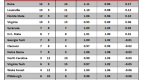
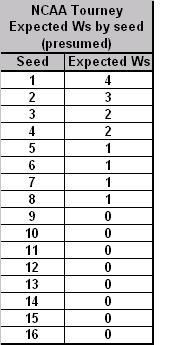
The first consideration in trying to determine which programs have overachieved and underachieved is how to answer that question. Traditionally, you often hear commentators and writers talk about “playing to your seed,” which essentially presumes that a #1 seed should make it to the Final Four, a #2 seed to the Elite Eight, and so on (see Table A below). Using this model, a team that wins any games beyond the expected wins of its seed would fairly be said to have overachieved as to the expectations of the seed (and vice versa).

Table A. Standard Model
NCAA EV by Seed (Presumed)

So let’s try to first answer that question using the Standard Model outlined in Table A. But don’t give up on the post after you review the Standard Model results, as we have another model below it that may bring up new and interesting considerations. The Standard Model as applied to the 65 (64) Team Era is Table B below.

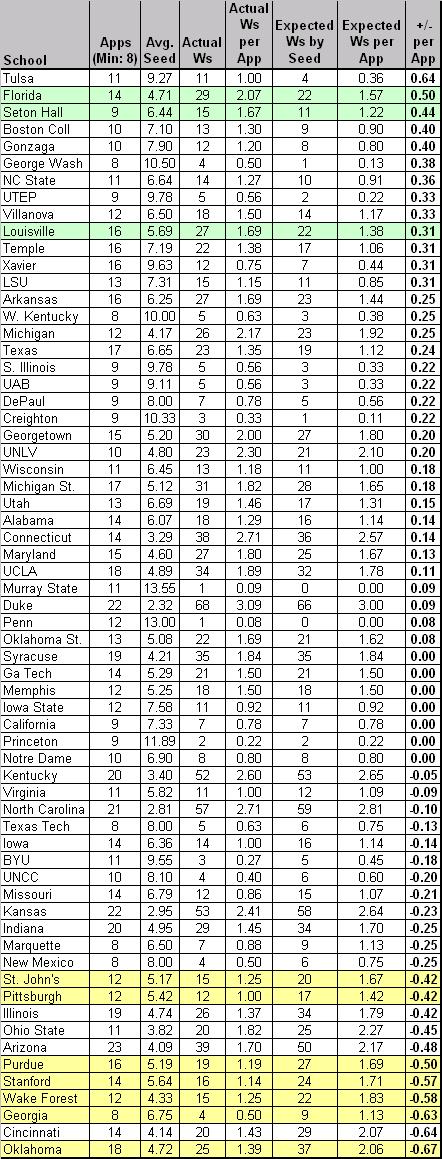
Table B. Standard Model Applied to 65 (64) Team Era

Notes: the table is sorted by “+/- per App,” which represents the number of games won above or below the expected number of wins for that seed per NCAA appearance (1985-2007). The rows colored in green highlight schools that are in the top twelve spots of both Tables B and D. The rows colored in yellow highlight schools that are in the bottom twelve spots of both Tables B and D.
NCAA EV by Seed - Detailed v.3

Inside the Numbers (Table B):

Overachievers. What first jumps out at us using this method is just how (except Florida) there are no big names near the top of the list. Tulsa, Seton Hall, GW, UTEP, Temple? Without taking away from their performance – after all, every one of those teams should be commended for overperforming versus its seed – this immediately suggests to us that the Standard Model often used by the pundits actually favors lower-seeded teams who manage to win a game or two every couple of years in the NCAA Tournament. Using the schools above +0.30 as a natural break point, only Florida, Louisville and Temple have won more than twenty games in the NCAAs during this period, and the average seed of these thirteen schools was 7.0. Are these teams chronically underseeded or are they overachieving as a general rule? Whatever the case, we’re going to think a little harder about picking Tulsa the next time they make the bracket.
Tulsa Logo

Are the Golden Hurricanes the Biggest NCAA Tourney Overachievers?

Underachievers. A brief look at the names at the bottom of the list – Oklahoma, Cincinnati, Wake Forest, Stanford, Purdue, etc. – tells us that we’re on to something here. As our good buddy MK says, “Wake and Purdue can effin’ bite me. They kill my bracket every year.” Or something like that. Using -0.42 as a natural break, the eleven teams at the bottom averaged a seed of 4.8 during this period, which is a marginally better seed than the overachievers on this list. Oklahoma, Arizona and Illinois – what do you have to say for yourselves? Each of you has had at least 18 appearances during this era, averaged a solid if not spectacular seed between #4 and #5, and consistently played below that seed to the tune of -0.42 wins per appearance or worse. This matches Tuesday’s analysis with Oklahoma as a disappointment; but under this model, Arizona and Illinois (second tier elite performers on Tuesday) have some explaining to do.

Oklahoma celebration

You May Want to Avoid These Guys in your Brackets

You’ll See Them Again on the Long Road Back to the Middle. The Big Four from Tuesday – Duke, UNC, Kentucky and Kansas – find themselves in the middle of the pack. It’s notable that Duke averaged a seed of 2.32 during this era and still overachieved by +0.09 wins per appearance relative to seed. UNC and Kentucky are verrrry slightly underachieving, whereas KU’s recent vintage teams (2005 & 2006) probably contribute to its slightly lesser position at -0.23 wins per appearance. UConn should be lauded for overachieving at a clip of +0.14 wins per appearance, which somewhat mitigates their overall lack of F4s – they do win a lot of NCAA Tournament games. Syracuse, Georgia Tech, Memphis, Iowa St., California, Princeton and Notre Dame – all of these programs have played exactly to seed in the last 23 years. Be sure to remember that fact next year when filling out your brackets.

Criticism of the Standard Model. The primary problem with evaluating NCAA Tournament success based on “playing to the seed” is that it puts an unrealistic burden on highly-seeded teams because over time they never play to their seed. In the knockout crucible that makes the NCAA Tournament so exciting, a corollary result of using this criteria is that higher seeds (#1-#4) are largely set up to fail, and lower seeds (#9-#16) are significantly overachieving simply by winning one game. Additionally, we feel that using the Standard Model assumes too much at the squishy margins – that a #4 seed should win two games, a #5 seed should win only one game, and that a #8 seed should always beat a #9 seed – when both teams are probably very similar in ability. For this reason, we now offer an alternative model, one that considers actual historical performance of the seeds.

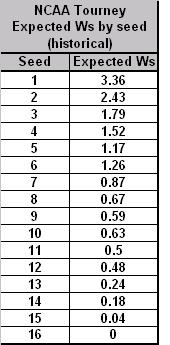
To that end, see Table C below for a historical snapshot of how well each seed actually performed in the 65 (64) team era.

Table C. Historical Model
NCAA EV by Seed - Historical

Considering Table C, we wanted to point out for a moment that we have a couple of thoughts. First, we found it interesting that #6 seeds have traditionally performed better than #5 seeds. This at first seems anathema to conventional wisdom, as a #6 likely has to get past a #3 in the second round, whereas a #5 must only defeat a #4. That is, until you remember that a #5 has the dreaded 5-12 match-up that knocks out so many higher-seeded teams (excepting 2007, of course). Also, it’s interesting that a #10 seed has a better historical expected number of wins than a #9 seed. This shows again that a better draw is to avoid the 8-9 match-up, even if you end up as a lower (but more likely to succeed) #10 seed.

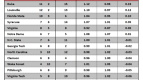
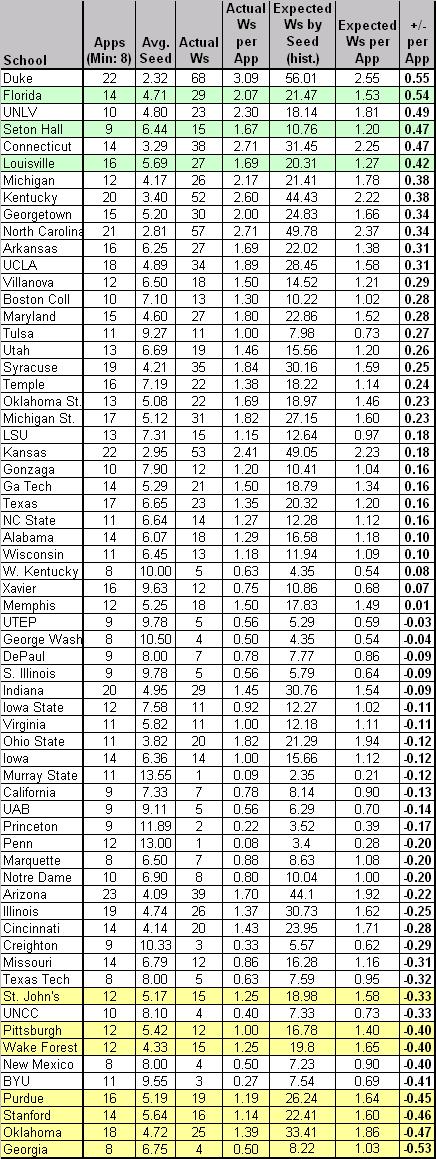
Using the 1985-2007 Historical Model as a baseline expected value for each seed, our list of 64 schools is now featured in Table D below.

Table D. Historical Model Applied to 65 (64) Team Era

Notes: the table is sorted by “+/- per App,” which represents the number of games won above or below the expected number of wins for that seed per NCAA appearance (1985-2007). The rows colored in green highlight schools that are in the top twelve spots of both Tables B and D. The rows colored in yellow highlight schools that are in the bottom twelve spots of both Tables B and D.
NCAA EV by Seed - Hist Detailed 3

Notable Differences. Using the Historical Model, the first thing that strikes us as interesting is that many of the heavy hitters of the era have jumped considerably, including some all the way to the top of the list. In fact, the following schools – Kentucky, UNC, Duke, Kansas, UConn, UNLV, UCLA, Syracuse, Ohio St. – all rose at least fifteen places from where they were situated in Table B. Each of these schools (excluding Kansas and Ohio St.) have overachieved at least +0.25 wins per appearance above the historical performance of their seeds. Since these schools represent a total of thirteen championships and thirty-eight F4s during this era, the Historical Model viewpoint makes more sense than what the Standard Model shows.

Who Dropped? Creighton, George Washington, UAB and UTEP all went from nice-looking overachievers in Table B to slight underachievers using this model. NC State, Xavier and Gonzaga looked fantastic using the Standard Model, but look rather pedestrian using this one. The explanation for this is simple – these teams collectively averaged a #9 seed throughout this era – if we use the Basic Model, they should never win a game, so when they do, it looks as if they’re significantly overachieving. However, using the Historical Model, we see that they actually win NCAA Tournament games roughly commensurate with how a #9 seed typically performs. This again illustrates why we feel this model shows a truer snapshot of performance.

More Importantly, Who Stayed the Same? Now this is where it gets really interesting. The rows shaded in green in Tables B and D represent schools that were in the top twelve in playing beyond its seed using both models. You could accurately say that, no matter how you slice it, Florida, Seton Hall and Louisville are the truest overachievers of the 65 (64) team era. (Incidentally, Florida and Seton Hall are in the top four of both tables, with each school averaging an extra win beyond its seed for every two appearances in the NCAA Tournament.)  These three schools consistently play beyond the actual and historical expected value of the seed that the NCAA Selection Committee gives them.  

The rows shaded in yellow at the bottom of Tables B and D represent the true underachievers. These schools were in the bottom twelve in playing below its seed using both models. What’s peculiar about this statistic is that there appears to be a much greater correlation between the tables with respect to the underachievers than with the overachievers. Whereas the overachievers only had three common schools between the tables, regular NCAA disasters such as Georgia, Oklahoma, Stanford, Purdue, Wake Forest, Pittsburgh and St. John’s find themselves in both at the bottom looking up. If you are at all like us and believe that the weight of history contributes as a predictor of the future, then anyone reading this post should be extremely hesitant picking these schools to play beyond its seed to its seed in the Dance in the years going forward.
Chicken or the Egg

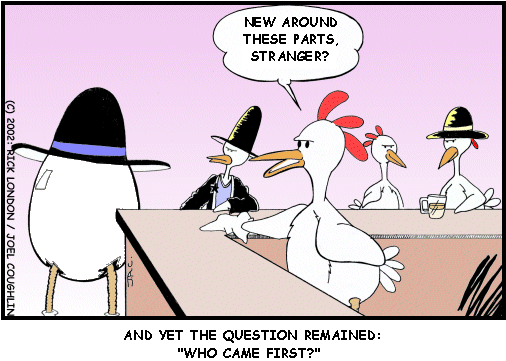
And Now, the Chicken/Egg Argument. Whether you buy into the Standard Model or the Historical Model or neither, we can say without a doubt that some schools appear to consistently overachieve relative to its seed, while others consistently underachieve relative to its seed. The question we want to posit to the readers is what causes this – is this simply a statistical anomaly? Are the overachievers regularly seeded too low by the NCAA committee; or, are the underachievers regularly seeded too high? Is there a self-fulfilling prophecy at work here, where schools that are known as chronic underachievers (ahem, Oklahoma) place so much pressure on themselves that they tighten up in the clutch? Conversely, do the overachievers find their wits amidst chaos to consistently come through under pressure because they are expected to do so? These are questions that we cannot answer, but we figure that there are elements of each at play here. We’d certainly like to hear your thoughts on this and any other topic. Oh, and apologies for the long post today.

Coming Next: We’ll take a look at the raw numbers again, but this time we’ll examine it by conference, which isn’t as easy as it sounds. Do you realize how many conference re-alignments and mergers and dissolutions there have been in the last 23 years of NCAA basketball?



Share this story

Top NCAA Performers of the 65 (née 64) Team Era

Posted by rtmsf on June 12th, 2007

GMU Cartoon

Since there’s absolutely nothing going on this week, this is a good a time as any to start rolling out some of the data that we’ve been hoarding. First, a respectful tip of the hat goes to Florida Gator fan Louis Frank, who allowed us unbridled access to the detailed work in his NCAA Tournament database. Over the next week or so, we’re going to be presenting some descriptive statistics on the 64/65 team era of the NCAA Tournament sliced and diced in various ways.

Our first focus will be on individual team performance, viewed through the raw numbers and then with some analytical twists; then we’ll turn our attention to conference performance using the same parameters. The basic question we seek to answer is which teams and conferences tend to over- and underachieve in the NCAA Tournament since it expanded to 64 teams in the 1985 season? The reason we start with that somewhat arbitrary season is because from that point until now every championship team has had to win six games against seeded teams, with no exceptions. It also provides a tidy way of reviewing the data with a substantial sample of seasons – twenty-three – which also happens to coincide perfectly with the rise in popularity of NCAA basketball and the ESPN era.

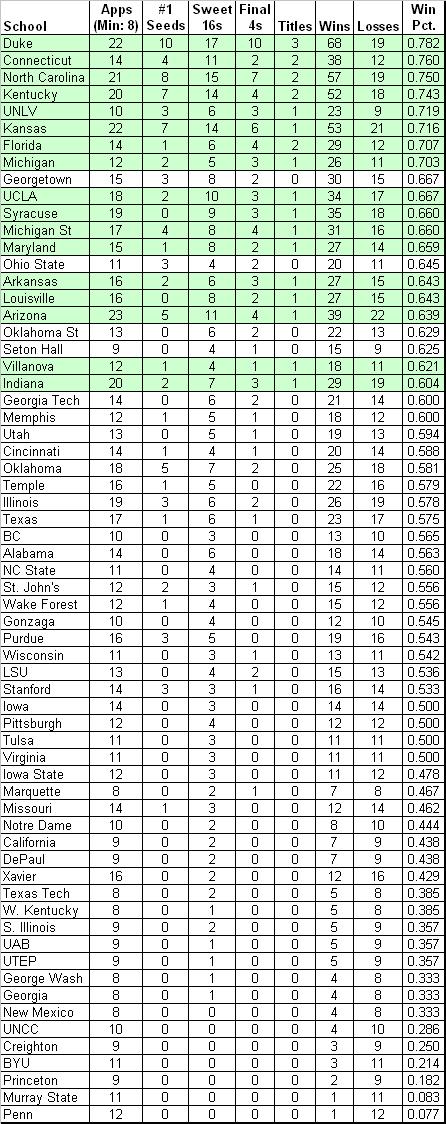
NCAA Tournament Success (1985-2007)

Notes: the chart is sorted by winning percentage (minimum: 8 appearances) from 1985-2007. The green shaded rows represent schools that have won a national title during this period.

NCAA Tournament 1985-2007 v.3

Inside the Numbers:

Elite Eight. Of the 267 schools that have been invited to the NCAA Tournament during the last 23 years, the 64 listed above are the chronic repeat performers, each having made the Dance on at least eight occasions. Thirty-nine of those sixty-four have winning (> .500) records, but only a handful, eight, are elite (> .700 winning pct.). Suffice it to say that those eight elite programs account for 14 of the 23 (61%) national championships and 39 of the 92 (42%) Final Four teams during this era (programs with a national title are denoted above in green shading). These eight programs are: Duke, Connecticut, UNC, Kentucky, UNLV, Kansas, Florida and Michigan. Incidentally, Georgetown is the only school of the top 13 who did not have a title from 85-07, but dumb luck led to its 1984 title team being omitted from this list – apologies to the Hoyas.

Coach K b/w

You Have to Give the Devil His Due

The Krzyzewski Era. This era also neatly coincides with the rise of Duke as a basketball powerhouse – Coach K’s first Final Four was in 1986, and his string of success particularly from 1988-92 exceeds by itself almost every other school’s performance on this list. Duke has the most #1 seeds, the most Sweet 16 appearances, the most Final Four appearances, the most wins, the best winning percentage and the most national titles during this period. In several of those categories it leads by comfortable margins. We’ve made note that the current era of Duke basketball might be slipping a tad, but with numbers like the above to sustain, that may be an impossible task even for Krzyzewski. By these numbers, you’d have to go with North Carolina in second place and Kentucky a close third. Each has very similar statistics (appearances, #1 seeds, sweet 16s, titles, wins, winning pct.) in all but one category, Final Fours. Given the importance that the college basketball community places on reaching the final weekend, Carolina’s seven F4s to Kentucky’s four must trump, all else being relatively equal.

Traditional Powers. With Duke, UNC and Kentucky taking the top three spots by the raw numbers, how do the other three traditional powers of UCLA, Kansas and Indiana fare? Kansas is closest to the top group. The Jayhawks mirror UNC in many categories (including F4s), but its winning percentage is a little lower and it lacks that second national title that would vault it into the top three. UCLA experienced a couple of down periods during this era, but now appears to be on the rise again with two F4s in the past two seasons. Still, its top ten winning percentage (.667) and its national title in 1995 keep it in the second tier of performers over this era. Indiana has largely struggled since Bob Knight was forced out of Bloomington, but their consistency in making the tournament and winning a game or two (.604 winning pct.) – plus that national title in 1987 – probably keeps it in the second tier as well. There should be no question, though – if any of the traditional six powers were slipping in favor of one or more of the nouveaux riche, Indiana would be the choice here.

Bob Knight IU

IU is Showing post-Knight Slippage

Nouveaux Riche. Of the elites, Connecticut and Florida are clearly the party-crashers. Prior to 1985, UConn had four wins and Florida zero wins in the NCAA Tournament. Each now has two national titles and a winning percentage of greater than .700. The question is whether these programs will be sustainable whenever Calhoun and Donovan decide to move on (Calhoun, to retirement; Donovan, as Christine’s full-time house-b*tch). The 64/65 team era is already littered with similar riches-to-rags stories such as UNLV, which fell hard when Tarkanian was indicted retired; and, Michigan, who also dropped out of the college basketball landscape once the gravy train of athlete peddler Ed Martin ended. Arkansas is yet another example – all three programs have a national title and multiple F4s to its credit, but long periods of poor teams and inconsistency places them in the second tier of the era.

Others in Second Tier. Several programs were consistenty excellent over this era, but their numbers weren’t as eye-popping as some of the above schools. Syracuse, Michigan State, Maryland and Louisville all claim a title to go with multiple F4s. Who knew other than Orange fans that Jim Boeheim’s squad never claimed a #1 seed during this era – that seems hard to believe. True, though – Syracuse’s best seeds were five #2s – during the glory days of Pearl Washington, DC, Billy Owens and company – 1986, 1987, 1989, 1990, and 1991. It looked like Michigan State was ready to become a top tier program 6-8 years ago, and they still are an excellent one, but its winning percentage needs to improve a little more to reach that level.

Lute Olson

The Silver Fox has had his Ups and Downs

Whither Arizona? Arizona is the only school that was invited to the NCAA Tournament each year of this era. Yet Arizona’s success in the postseason leaves something to be desired for a program of its stature – multiple F4s and a title, but near the bottom of the championship-level schools in winning percentage. The Wildcats are a team to keep a watchful eye on when we present our over- and under-acheivers list later this week.

Rising Stars. Several programs to observe closely as we go deeper into this era are rising stars Georgetown, Ohio St., Memphis, Texas and Gonzaga. None yet has a title during this era, but each except Gonzaga has been to a F4, and all five are knocking on the door. These programs have the facilities and coaching in place to continue to rise up this list in the coming years.

Disappointments. Again, basing these observations on nothing more than raw numbers, you’d have to say that Oklahoma, Illinois, Purdue and Stanford have been the biggest disappointments. Collectively, these schools have had fourteen #1 seeds with only five F4s to show for it (obviously, zero titles as well). Although most of these programs have been consistently invited to the NCAA Tournament during this era, none has a winning percentage topping .600.

Quin Snyder Norm Stewart

What did these two do to Missouri?

Embarrassments. We’ll leave the mid-majors like Xavier alone here, but we wanted to save special mention for some of the BCS schools who have managed to get invited multiple times, but really didn’t do much when they got there. Georgia‘s one sweet sixteen in eight appearances and its .333 winning percentage doesn’t say much for a program that always seems to be rebuilding; Bob Knight’s Texas Tech doesn’t fare much better (two sweet sixteens). But the real winner of the most pathetic NCAA-caliber program award, in our estimation, has to belong to Missouri. The Tigers have been to the tournament fourteen different times during this era, even once as a #1 seed, and have only managed three sweet sixteen appearances, two elite eights and an overall losing record (.462). Serious congrats are in order for Norm Stewart and Quin Snyder. Mike Anderson has his work cut out for him. The saddest part is that Mizzou traditionally likens itself as a basketball school!

Ivy Sadness. The last word goes to Ivy stalwarts Penn and Princeton, two schools who show up every year (21 of the last 23 NCAA Tournaments) at the right time and venue, battle hard for about thirty minutes against a superior athletic opponent, then go back home and lick their wounds for another year after inevitably wearing down to the size and strength of its opponent. They may be a collective 3-21 (.125) in the Dance, but who will forget when they pull the big upsets, like Princeton 43, UCLA 41 (1996), or Penn 90, Nebraska 80 (1994). Ok, maybe beating Nebraska isn’t a big upset after all, but we still love the UCLA upset.

Coming Next: now that we’ve analyzed the raw numbers of the 64/65 team era of the NCAA Tournament, we’ll next be taking a look at the over- and under-achievers during the same period. After seeing the above, can you project who the best and worst will be? You might be surprised at some of the results.  View Overachievers and Underachievers here.

Share this story

Billy D Epilogue

Posted by rtmsf on June 8th, 2007

Tasty Waffles

Waffles, anyone?

So now that the Billy Donovan saga has finally ended, and everyone on both sides is making nice and saying all the right things, we wanted to comment on any residual effects that may result from this whole fiasco. On the college basketball side of things, critics of Donovan have stated that the man as a coach has put forth an image that he can no longer be trusted, and that this will ultimately manifest in his recruiting. Gregg Doyel at cbssportsline.com writes:

Donovan didn’t just think about leaving. He didn’t just try to leave. He left. He came back, true, but if he was willing to leave Florida once — after promising recruits like Jai Lucas that he wouldn’t leave this offseason — what’s to stop him from leaving again? That’s not just me wondering. That’ll be the subtle spiel of every coach who recruits against Donovan, and I’m not sure that would be categorized as “unfair negative recruiting.” It would be more accurate to call that “reality.”

On the NBA side of things, critics are saying that he’ll be akin to kryptonite should he ever hope to follow his dream to coach in the NBA again. One exec from a Varsity Conference team said:

“It’s not going to leave a good taste in the mouths of a lot of people. People in the league already were asking last week, ‘What did he do to deserve a contract like that?’ And now this; it really casts a doubt about his intentions.”

Harkening back to our long-lost legal education and in the spirit of Donovan’s last seven days, we both concur and dissent with these viewpoints. The NBA issue is a no-brainer – any NBA executive will have to take a long, hard look at whether he wants to risk dealing with Donovan in the future. Thanks to what is effectively a five-year moratorium on Donovan taking another NBA job, however, this will allow ample time for hard feelings and raw nerves to diminish. If the situation arises where a true “dream job” such as the Knicks or Lakers opens after that time, then we’d still expect Donovan to get that call. This assumes, of course, that the next five years at Florida do not turn into some post-apocalyptic disaster where his coaching abilities are called into question as in the early 2000s.

Christine Donovan is much happier today

And what of the University of Florida, who rewarded Donovan’s insouciance today with a contract worth $3.5M per year for the next six seasons (plus an option for the seventh). As much as it may seem elementary to believe what Doyel says about other coaches using this against Donovan in the future, and no doubt they will try, we see another more powerful side to this argument. Instead of worries about whether Donovan will be around at UF in the near future, we now know with near-certainty that he will be in Gainesville for the next five years. He already turned down his dream college job and a near-perfect NBA situation, and is additionally barred from seeking another NBA job. Where else can he realistically go? If anything, this provides an incredible stability around his program that almost no other coach in America can claim. As such, Donovan may actually be returning to Florida in a stronger recruiting situation than he otherwise would have enjoyed had he never left in the first place. How crazy is that? Whether that will translate into more Final Fours and national titles is impossible to know.

Our (hopefully) final thought on the matter is that we’re quite pleased that Billy D was keeping tabs on our blog while he was in his solitary confinement at home the past few days. :)

I said I can’t do this and live with myself for the next two to three years. I don’t know if the press conferences should have been flip-flopped or not (Orlando second and Florida first), but my heart wasn’t into it.

It wasn’t that something happened with my wife, or Jeremy Foley guilt-tripped me or something that the Magic did upset me or there was a problem with (Magic general manager) Otis Smith or the way Christine’s face looked in a photo on the Internet at the press conference.

Everyone wants to put a reason as to why something happened. I’m terribly sorry for what happened, and I take responsibility for it. But this is a Billy Donovan issue, not a Christine Donovan or Jeremy Foley or (Orlando Magic president) Bob Vander Weide or (Magic owner) Rich DeVos issue.


Share this story

NBA Predraft Camp Thoughts

Posted by rtmsf on June 5th, 2007

Thanks to the guys over at draftexpress.com, we’re just getting our first look at some of the height/weight and athletic numbers coming out of the NBA Predraft Camp last weekend in Orlando. We don’t put a lot of stock in drafting players based on these measurements – after all, if a guy can play, he can play (tip of the hat to Jonathan Givony for making this very point perfectly on draftexpress.com) – but it’s always fun to see who wins for the “incredible shrinking” award (aka the Lonny Baxter Trophy) as well as who appears to be the top athletes coming out of college this year. Note we said “appears.”

mj-and-jw.jpg

The Logo and MJ discussing the talent in Orlando

Why wasn’t Maryland better this year?

Guard D.J. Strawberry was rated the top overall athlete this year, and Ekene Ibekwe had some of the most eye-popping big man numbers, featuring a 7’6 foot wingspan and a thirty-nine inch veritical leap. This is yet another example of superior basketball skills and IQ (see: Florida Gators) trumping a stable of athletes. Either that, or Gary Williams was too busy resting on his laurels to teach these kids anything the last four years.

Durant needs to beef up

We realize he’s only eighteen and he can score on just about anyone already… but zero bench presses of 185 lbs. is pathetic. That stat, combined with his surprising lack of speed and agility in the drills, may suggest that he’ll face long obstacles in becoming a solid two-way player in the long run. He’s also going to take a beating on drives into the paint the next few years unless he commits himself to a weight training program to improve his strength.

Perhaps not surpisingly, most of the one-and-dones were weaker than their older peers. Durant, Julian Wright (2), Brandan Wright (2) and Daequan Cook (4) combined for a total of just eight bench presses at the 185-lb. weight. Mike Conley, Jr., (13), Javaris Crittenton (11) and Spencer Hawes (9) did better. Greg Oden sat out that event due to his injured wrist.

Lonny Baxter Award

Corey Brewer. Routinely listed at 6’9 at Florida, he came in at just 6’6.75 by the camp measurements. Lucky for him, he’s not a post man, so this won’t likely affect his draft status too much. Another Floridian, Al Thornton, deserves a nod here too. FSU listed him at 6’8, but the measurements put him at a mere 6’5.75. Considering that Thornton logged significant minutes on the interior, this puts him at a major disadvantage going into the draft.

Who Knew?

Aaron Gray is a legitimate seven feet tall, and Joakim Noah is a solid 6’10.5. We would have guessed both were shorter. ACC bigs Brandan Wright and Josh McRoberts are both 6’8.75 tall, but Wright has the slightly longer wingspan and McBob needs to put… the… coffee cupcakes… down (camp high 13.7% body fat).

Guys who’ll get a look based on their measurements alone

SEC big men Major Wingate and Jermareo Davidson. Both measure in the solid 6’9-6’10 range, have extremely long wingspans (7’4) and solid if not spectacular athleticism. Clemson’s James Mays could be a Renaldo Balkman type – a 6’7 jumping jack with a 37″ vertical and long arms (7’1.5″ wingspan).

Major Wingate and Chris Richard

Wingate & Richard battle in the post

Watch for these guys in a future NBA dunk contest near you

  • Al Thornton – 6’6 with a 7’1 wingspan and a 41-inch vertical – wow!
  • Nick Young – 6’5 with a 7’0 wingspan and a 40.5 inch vertical
  • Jeff Green – 6’8 with a 7’1 wingspan and a 38-inch vertical.

Dis-honorable Mention – Jared Jordan, who managed a standing still 14.5-inch vertical (to be fair, he doubled it to 28.5 inches in the running vertical).

jared-jordan.jpg

Can you outjump this JJ?

Quick bigs and slow guards

  • Greg Oden, Ekene Ibekwe and Chris Richard. We covered Oden yesterday and Ibekwe above, but how about super-sub Chris Richard? He never struck us as very fast. At 6’7.5 he’s a classic tweener, but his length (7’4.5 wingspan) and agility might just get him a spot somewhere eventually.
  • Marcelus Kemp and Sammy Mejia. Both of these guards were slower than big-ass Mario Boggan and a host of other big men at the three-quarter court sprint. Kemp in particular may need to think about heading back to Nevada for another season.

Classic Tweeners

Hard-luck Villanova forward Curtis Sumpter and BC forward Jared Dudley. Both are ferocious rebounders in the paint, but both happen to measure at around 6’6. Their only real chance at the next level is to re-invent their games to face the basket, akin to what Corliss Williamson and more recently, Chuck Hayes, have done.

Share this story

The Christine Donovan Effect

Posted by rtmsf on June 4th, 2007

CD Angry

Mrs. Donovan appears thrilled at the press conference naming her husband the new coach of the Orlando Magic.

Memo to Billy Donovan:

Listen to your wife before you sign the contract next time. As a married man of over a decade, you should have known better. Sure, her lips may have been mouthing “do whatever you want, honey” but the eyes… look at those eyes!!! were saying something completely different.

Because of this egregious infraction in marital comprehension, you now look like a circus clown (isn’t Barnum & Bailey’s college around there too?) and more than a little flakey in front of the basketball universe. Sure, others have been down this road – most recently, Dana Altman (Creighton to Arkansas and back) and Gregg Marshall (Winthrop to College of Charleston and back) – but neither of them were foolish enough to sign a contract prior to backing away. The last person we can remember who actually signed the contract while still employed was Bobby Cremins (Georgia Tech to South Carolina and back), and has he been heard from since? Not really. (Note: Majerus was unemployed/retired/at the trough when he backed out on USC in 2004; and Cremins is now the head coach at College of Charleston in an ironic twist.)

bd-magic.jpg

So let’s be honest, Billy. Despite complete radio silence coming out of Gainesville, and Orlando officials stating publicly that you are still in a “dialogue” with the Magic, we all know that this is simply legal saber-rattling for the sake of saving face. The buyout/settlement that you will pay Orlando will surely be substantial. Wouldn’t that money have been better spent on a new convertible Benz for your wife – which, incidentally, you’re going to have to buy her anyway (look at the eyes). A Benz might actually be getting off easy – imagine all the painstaking interrogations and whispering that is already going on behind her back at the PTA meetings and at the pool’s social committee. Her ears are burning and her eyes are furious.

Actually, Billy, here’s another thought. After you get off the phone with Orlando management, maybe you should call Tiffany’s as well. We heard that diamond earrings look just divine while driving an SL 55 Roadster.

Update: Andy Katz wrote that Donovan started having second thoughts on Friday afternoon at the Florida farewell press conference, and upon waking Saturday morning, he was sure he had made the wrong decision. This dovetails very nicely with the Christine Donovan effect. Who hasn’t gone home thinking a decision is final only to learn that your opinion is far less valuable than you believed when it results on you sleeping on the couch that night?


Share this story

Billy D Flip Flop?

Posted by rtmsf on June 3rd, 2007

John Kerry

John Kerry has nothing on Billy Donovan these days

Shocking news is being reported that Billy Donovan, much discussed on this very blog and many others in recent days because of his skedaddle from Gainesville to Orlando, now wants out of his contract with the Magic and is actively seeking to return to the Gators. Exactly WHAT THE HELL is Jeremy Foley selling down there? That guy could literally convince Brad Pitt that Rosie O’Donnell is a nice trade-in for Angelina Jolie. Absurd.

You have to figure that Orlando will not want to have a coach – even one with Donovan’s stature – if he doesn’t want to be there. And Florida would welcome him back with open arms. Presumably any contractual buyout would involve millions of dollars. Maybe Foley can sweet-talk some UF boosters into putting up the dough.

Who is the most pissed man in America tonight? Anthony Grant. Talk about being left at the altar… His salary was set to at least triple (he made $300k last year at VCU) and he was coming into a tremendous situation with the #1 recruiting class in America awaiting him. Wow. Just wow.

This will be very interesting to track the rest of tonight and into tomorrow. We’ll update as necessary.

Update: As of 2:19am EDT, the Orlando Sentinel is reporting that the Orlando Magic will allow Donovan to return to the Gators.

Share this story

Billy the Kid Fallout

Posted by rtmsf on June 2nd, 2007

Billy Donovan Magic

As expected, the college hoops/NBA blogospheres have been abuzz with thoughts on the reasoning behind Billy Donovan’s decision to leave Florida for the Orlando Magic, as well as speculation as to how well BTK will do when he gets there. As we said on Thursday when the news was breaking, it’s unlikely that Donovan will become an abject failure in the NBA like his mentor Pitino in Boston or several of the other successful college coaches who made that jump – most notably, Carlesimo, Calipari, Tim Floyd, Mike Montgomery and even switching sports with another ex-Gator, Steve Spurrier. The key distinction is that Donovan’s opportunity with Orlando, very much in contrast with most NBA job openings, is a pretty good one. Orlando was a playoff team this season, albeit barely, and they do have a young stud in Dwight Howard to pair with solid PG Jameer Nelson and a surplus of salary cap space. Plus Orlando as a city has long been attractive to free agents because of its warm weather, exclusive neighborhoods such as Isleworth (Shaq and Tiger have homes there) and tax benefit (no state income tax in Florida).

So the question really shouldn’t be whether Donovan will fail in Orlando, it’s whether he will succeed. Can he shrewdly use his eye for talent to build around Howard to make the Magic a 50-60 win team over the next five years, eventually rising to the level of challenging the Lebrons for the JV Conference title? In the NBA, the old adage goes, it’s all about the players. The coaches above failed for many reasons, often including a lack of imagination and management acumen, but the most important reason was they simply had inferior talent. Billy Donovan is in a unique position as a new NBA coach where he should be able to avoid that pitfall, and for that reason, it says here that he’ll have a successful tenure in Orlando.

The media expectedly is falling into two camps on this issue:

Successful:

Kelly Dwyer at cnnsi.com:

From Mike Montgomery to Rick Pitino, John Calipari, Tim Floyd, Lon Kruger, Leonard Hamilton, P.J. Carlesimo, Jerry Tarkanian and Dick Vitale, the NBA landscape is littered with former college coaches who thought they could exhort and prod their way toward NBA glory. And, to a man, each fell well short. Only Pitino, Floyd and Carlesimo were offered second NBA jobs, with only Floyd (the most maligned of the bunch) improving his record in his second stint.

The overriding theme here is respect, and how to earn it from professionals making guaranteed money while the coach tries to sustain a sense of gravitas from training camp in October to, hopefully, a playoff run in the spring. NCAA coaches, who are allowed to wield scholarships and playing time over the head of impressionable youngsters, are able to get away with emptying all their motivational shells in the midst of what, at best, could turn into a 40-game season. NBA coaches tend to hit their 40th game in early February, with a playoff push and possible postseason run still weeks away.

Despite all the historical evidence suggesting failure, each pro team and each coach think their situation could be the one exception — the one marriage of pro team and ex-college coach that actually works. There is some evidence that suggests that Donovan, for all intents and purposes, could be the one who breaks the losing streak.

Ian Thomsen at cnnsi.com (linked yesterday but written on Apr. 9):

“Here’s what I’ve noticed about Billy,” a GM said. “A few years ago he realized he wasn’t very good at coaching defense. He moved one of his assistants — which is very hard to do for a head coach, because in that world it’s all about loyalty and sticking together — and [in 2004] he brought in an old veteran guy, Larry Shyatt, to fix the problem. And that’s why they were able to win two national championships.”

Here’s the picture I should have recognized last week. Donovan has been aiming toward an NBA career, and along the way he’s been humble enough to recognize his weaknesses and fix them. He will have a lot to learn in the NBA, but there is a feeling among his potential employers that he won’t be the typically dictatorial college coach who fails to form a partnership with his richer, more powerful NBA players. Donovan will adapt and grow into the job.

“When he hires his assistants in the NBA, he won’t go the buddy route,” the GM said. “If he perceives he’s not good enough in a certain area, he’ll go and get himself some help. He’ll figure out what he needs to be successful in the NBA, and he’ll put the right guys around him.”

Tony Mejia at cbs.sportsline.com:

Orlando has, in one single move, become relevant again. And even if Donovan fails, conventional wisdom is that he can always return to the college game the way mentor Rick Pitino did. He has had a nice re-birth, no?
But he won’t fail. He’s walking into a wonderful situation and was smart enough to recognize that. The Magic made his choice all the easier by ponying up the jack. I honestly never felt they had it in them. The climate has changed. Orlando wants to be more than mediocre.

The Big Lead:

Plus, unlike many college coaches before him, Donovan can win in the NBA: the Magic are already a playoff team in the East, probably will get Vince Carter this summer, and it looks like a couple teams in the East are going downhill (Miami’s old, Detroit’s aging, and Indiana appears to be on the path to rebuilding).

Failure:

Pat Forde at espn.com:

I sincerely hope Billy Donovan doesn’t wind up like all the others.

I hope he’s not the next Tark, the next John Calipari, the next Tim Floyd, the next Lon Kruger, the next Mike Montgomery. I hope he doesn’t follow the same failed path as his mentor, Rick Pitino. I hope he doesn’t wind up with his wind pipe being massaged by a player, like P.J. Carlesimo.

I hope he’s not just another college coach who, for some reason, couldn’t tolerate living with the happiness and success he built by hand, and chose the misery of losing in the NBA instead. I hope he’s not the next in a conga line of call-up coaches who flop when taken out of their element.

Bob McClellan at yahoo.com:

The NBA is grinding, demanding. It’s four games in a week, not two. It’s hitting the road 41 times, not 10 times like the Gators did last season (and two of those were in-state trips). There are no non-conference cupcakes, although there are two games with the Memphis Grizzlies.

The fact is coaches don’t leave the NBA because they get better gigs. They leave because they get pink slips. They leave exhausted, chewed up and spit out, black and blue.

Orange and Blue would have been the safer choice.

Dan Shanoff as guest blogger at deadspin.com:

And the final insult for any college fan, Florida or anywhere: What, exactly, is the lure of coaching in the NBA? On its face, it sounds like the shittiest job in sports.
Zero job security, with a “when” not “if” inevitability of a bad ending to nearly every coaching hire. (Welcome to Indiana, Jim O’Brien!) Star players who run the team. Financial realities that hamstring moves.

Roughest of all, the “Ring or Bust” mentality. Jerry Sloan is the ideal of NBA coaching longevity, yet he is best known for NOT winning a championship. And most of the coaches who have won a title recently (Jackson, Tomjanovich, Popovich) have enjoyed coaching the greatest players of their eras. Dwight Howard is the best post player in the East — not a bad foundation to build a contender — and they have double-digit cap millions to use (please God: NOT Vince Carter…hmm: Gerald Wallace?) But yeesh, those odds are still ugly.\Meanwhile, Billy D was on track to be one of the Top 5 most successful coaches in college hoops history. His style seemed MADE for college. (His weakness – Xs and Os – will be magnified in the NBA, while his strength – personality – will be mitigated.)

Brian Schmitz’s Magic Basketblog:

If hiring him winds up being the biggest transaction of the summer, it will mean the Magic failed to land a prized free agent or make a trade for the missing piece or pieces. And Billy’s NBA maiden voyage could hit rough water for a team that carries, perhaps, oversized expectations, firing Hill even after he led the Magic to their first playoff appearance since 2003.

Read the rest of this entry »

Share this story

Billy D… isney World?

Posted by rtmsf on May 31st, 2007

Billy Donovan 

Breaking news on all the major sites today is that Billy Donovan has been offered $42M over seven years to leave the University of Florida to become the new head coach of the Orlando Magic.  According to team officials, as reported by the Orlando Sentinel, the wunderkind is expected to take the job.  This comes on the heels of a week-plus of speculation as to why Donovan had not yet signed an extension worth reported $3.5M annually with the Gators.

We’ve been down this road before with Billy D. – a mere six weeks ago, in fact.  But somehow with the ridiculous dollars being mentioned and the “nowhere to go but down” aspect looming at Florida, we think this might be the situation where he makes the jump.  The Magic certainly isn’t in terrible shape, with a young beast Dwight Howard and, lest we forget, JJ Redick, to build around. 

From our perspective, this would also change the balance of power in the SEC in a hurry.  Florida has the #1 ranked recruiting class coming into Gainesville, but it’s apparent that the new blood at Tennessee and Kentucky are hot on its tail.  The big question for us – who would take over for Billy D.?  Would the Gators gamble Stan Heath-style with one-year wonder Anthony Grant from VCU?  Or speaking of Heath, would the Gators make a play for former recruiter extraordinaire and current Arkansas coach John Pelphrey?  Or would they go outside the family and find someone like Gregg Marshall from Winthrop?  Stay tuned… 

Update:  Yahoo.com is now reporting Donovan will be introduced as the Orlando Magic head coach tomorrow morning at 9am.  Terms are $28.5M over five years. 

Share this story