Every March, much of America is glued to their televisions (or computers) watching the NCAA Tournament. As we all know, the NCAA Tournament is big-time business with the newest TV contract selling for $10.8 billion for the right to broadcast the NCAA Tournament for 14 years. Numerous pundits point out that the schools get a significant amount of publicity which helps their reputation nationally as academic institutions (or at least places to watch pretty good basketball for four years) and often leads to spikes in applications. A study by Jaren and Devin Pope in Southern Economic Journal stated that the applications rose the year after a NCAA Tournament appearance by the following amounts:
NCAA Tournament appearance led to a 1% increase
Sweet Sixteen appearance led to a 3% increase
Final Four appearance led to a 4-5% increase
NCAA Championship led to a 7-8% increase
In some cases just making the NCAA Tournament means little to a basketball or academic stalwart like Kentucky or Princeton, respectively. However, for smaller schools they can be a huge boon, as demonstrated by Belmont, which drew in many fans after nearly knocking off Duke in the first round in 2008 and had its largest application pool ever the following year. Since 2006, the first year the Bruins made the NCAA Tournament, to 2011, their applications rose by nearly 70% going from 2,266 to 3,847. An even more extreme example is Butler, which saw its applications rise by 41% after its appearance in the 2010 NCAA Championship game.
How much is the publicity that a Cinderella gets worth?
While the data (both academic and anecdotal) on the increase in applications has become widely accepted and expected, there has not been much research on the actual monetary value derived from the exposure of having a basketball team representing your school on television and the Internet during the NCAA Tournament. Newly released data from a study commissioned by Butler estimates that the school may have generated over $1 billion in publicity from the basketball team’s two runs to the national championship game in 2010 and 2011. The study, which was conducted by Borshoff, a public relations company, looked at the media value of the television, print media, and online media that the school received during the last two NCAA Tournaments.
With the the NBA Draft concluded and the annual coaching and transfer carousels nearing their ends, RTC is rolling out a new series, RTC Summer Updates, to give you a crash course on each Division I conference during the summer months. The latest update comes courtesy of our ACC correspondent, Matt Patton.
Reader’s Take
Summer Storylines
New Faces: That’s right, the ACC will be totally different conference this season. Only five of the fifteen players selected as to the all-conference teams will be running the floor this season, namely four of North Carolina’s five starters (with Miami’s Malcolm Grant keeping the group from being only Tar Heels). Somewhat surprisingly, all of the ACC all-freshman squad will be back in action. Duke’s Kyrie Irving was a prominent frosh, but he didn’t play a single conference game before leaving school and UNC’s Harrison Barnes opted to return for his sophomore campaign. Keep an eye on Wake Forest’s Travis McKie and Maryland’s Terrell Stoglin especially. Both should be the stars on their respective teams.
However, the strength of the conference will rely heavily on the incoming players and coaches. Duke, North Carolina, Virginia Tech and Florida State all bring in consensus top 25 classes according to ESPN, Rivals and Scout. To make a long story short, the rich get richer. Duke’s Austin Rivers (ranked 1st by Rivals, 2nd by Scout and ESPNU) will be expected to contribute immediately, while North Carolina’s James McAdoo (8th by Rivals, 4th by Scout and 5th by ESPNU) and PJ Hairston (13th by Rivals, 20th by Scout and 12th by ESPNU) should be given ample time to find roles on an already stacked team.
Arguably more important, at least in the long term, are the new coaches: NC State welcomes Mark Gottfried, Miami welcomes JimLarranaga, Maryland welcomes Mark Turgeon, and Georgia Tech welcomes Brian Gregory to the conference. The only coach I think is a surefire “upgrade” is Larranaga, who comes with some disadvantages (namely, age). While Gottfried experienced some success at Alabama, the Crimson Tide isn’t known as a basketball powerhouse and he didn’t leave the school on great terms. I also don’t think it’s a great sign that Ryan Harrow left for the bluer pastures of Kentucky. Gregory, though, sticks out as the strangest hire of the four. He had a fairly nondescript tenure at Dayton with many Flyer fans happy to see him leave. I know a tight budget hamstrung by Paul Hewitt’s hefty buyout deal probably kept the Yellow Jackets from going after the sexiest candidates, but the choice still surprised me. Gregory’s biggest disadvantage is his ugly, grind-it-out style of play that will eventually make it difficult to attract top recruits and could possibly alienate the entire GT fanbase (see: Herb Sendek).
North Carolina Navigates Investigation Waters: Finally, it may not be basketball-related, but it’s impossible to mention this offseason without discussing North Carolina’s impending date with the NCAA Committee of Infractions. The story has dominated ACC sports news. To briefly sum things up, the Tar Heels had an assistant coach, John Blake, on the payroll of an agent. If that wasn’t enough, the NCAA investigation unveiled thousands (I’m not kidding) of dollars in unpaid parking tickets and even several cases of academic fraud. The university has come out very firmly saying these infractions only involved the football team** but the scandal has gained national notoriety. (**Author’s note: the one connection with the basketball team is that Greg Little was one of UNC’s ineligible football players. Little was also a walk-on for the basketball team during the 2007-08 season, playing in ten games. North Carolina has said that his infractions occurred after his year with the basketball team, so no win vacations are in the basketball team’s future.)
Somehow, despite academic fraud, ineligible benefits and an agent runner on staff, the Tar Heels failed to get the NCAA’s most serious “lack of institutional control” violation for what appeared to be nothing less thana lack of institutional control. Again, this scandal is confined to football, but it’s one of the many recent scandals that have come to light in big time college athletics in the last couple of years (Connecticut, USC, Ohio State, Oregon, etc). These scandals could force the NCAA to augment its rules somewhat, and even though they may not directly relate to basketball, they may have a very real impact of college sports as we know it over the next few years.
Freshman phenom Austin Rivers is ready for Duke, but how quickly will 2011's top high school point guard perform on the big stage? (Orlando Sentinel)
Imagine if high school basketball games involving elite hoops recruits around the country were put on the Duke Basketball Network, coming to you nightly from December to March on your local cable package (and no, this post isn’t a not-so-subtle shot at ESPN). After the initial uproars from Lexington, Chapel Hill, Lawrence and other basketball hotbeds subsided, imagine then that Mike Krzyzewski, as spokesperson and progenitor of the DBN, gave an interview where he said:
We do not want to use it as a recruiting advantage. We don’t want it tied to [Duke. The DBN carrier] knows we don’t want to violate any NCAA rules and they don’t want to. […] We want to play by the rules. We want everything to be in the open with integrity.
To back up his claims, imaginary Coach K added that the DBN would not be involved in selecting the games and that the word “Duke” would not be attached to the broadcast in any way (you know, except for the fact that you have to tune into the Duke Basketball Network to see the game in the first place). Would you believe it? Isn’t he asking you to undergo a considerable afternoon of mental calisthenics in order to believe there’s absolutely no association between those two things — the players shown and the school’s network?
It’s patently absurd. People make such associations without even thinking, and a removal of some of the associated branding does next to nothing to remove that perception. Will a kid playing on the DBN tomorrow night tell all his friends that he’s playing on Dish Network channel 146 instead? Will fans around the country not automatically assume that a player on their screen has already committed to play for Duke (after all, why would the DBN be showing it?). Of course not. It’s a huge marketing (and, by proxy, recruiting) advantage.
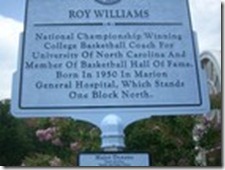
Roy Williams was born in Marion General Hospital in the little town of Marion, North Carolina, just under an hour away from Asheville. If anyone driving near that hospital ever doubted that, they have no reason to do so now.
Dan Wiederer of the Fayetteville Observerwrote on his blog yesterday that on Monday Williams was honored with a highway marker — you know, those brown sign-plaques that stand in front of important places that give you a small bit of history about the location — a block south of the building in which Williams was born. The sign mentions that he’s a “National Championship Winning College Basketball Coach” for UNC and that he was inducted into the Naismith Hall of Fame. And, naturally, it’s Carolina blue.
Duke Fans, Deface This At Your Own Risk (Image: McDowell News)
But will it stay that way? As Wiederer mentions in his article (which you should check out in its entirety), Williams had a few words prepared for the folks who were on hand to mark the occasion. In his comments, the legendary coach mentioned that the people of the town needed to keep a close eye on the sign, adding, “If you ever come in one morning and there’s eggs and some things like that on it, just go arrest the dadgum Duke people in town.”
He was joking, of course. Then again, maybe it was one of those jokes that, after you make it, you dont mind so much if people take seriously. Either way…congrats, coach. Looks pretty sweet.
Sporting News‘ Mike DeCourcy posted a fine summary yesterday of 2012 prospect Myles Davis‘ decision to verbally commit to Xavier, and we also saw that Mr. DeCourcy later tweeted a confirmation that Myles Davis was indeed named after…Miles Davis. This automatically makes him the coolest player in the 2012 class. We hope someone someday challenges Davis about his shot selection in some post-game press conference, so he can reply with something to the effect of, “There are no bad shots, just shots in the wrong places.” If this happens, inasmuch as we can’t reward Davis, we pledge to mow Chris Mack’s lawn on an as-needed basis for the entire off-season next summer.
As MSNBC’s Mike Miller tweeted early yesterday, the fallout from this David Salinas possible Ponzi scheme story will come in the form of a “slow burn of incriminating details” over the rest of the summer. SI.com’s Pablo Torre has the latest on this fiasco, including names of coaches, amounts of money with which they entrusted Salinas, and a list of players who came through Salinas’ AAU program in Houston that, as the author says, “sparks potential questions.” Certainly true, especially when considering what (as the author notes in his article) former Houston coach Tom Penders told The Daily on Monday — that Salinas once offered him the chance to invest $100,000 with him, in the process making “a strong, strong implication” that the 100-large would grease the rails for Penders in terms of access to prospects at Salinas’ program. Yeesh. By the way, the biggest loss from Salinas’ business practices appears to have been $2.3 million (!!) that once belonged to new Texas Tech coach Billy Gillispie.
Kentucky’s Jon Hoodtore his right ACL during a pick-up game on Monday and will likely have to redshirt the 2011-12 season. Surgery has yet to be scheduled as they wait for inflammation around the knee to subside. You might look at Hood’s 0.8 PPG and 4.3 MPG from last season and write this off as an unfortunate incident for the young man and just a minor loss for the team, but beware; Hood is the only rising junior on the team, and Kentucky lost a potential senior when DeAndre Liggins left a year early for the NBA. They still have Darius Miller and Eloy Vargas as returning seniors, but when you’re as heavy on freshmen and sophomores as Kentucky, you’ll take any upperclassmen leadership you can get.
Any coach will tell you that when you take over for another coach at a struggling program, it’s not just about new offenses and new defenses and so on. It often involves a change of the very culture of the place, and sometimes even a re-commitment to basic matters of professionalism by everyone concerned, and the process can sometimes take a couple of years. Coach-turned-announcer-turned-coach Mark Gottfried has a long row to hoe at NC State, but he knows that his first job is to convince his players that success begins with things as elementary as daily off-court habits that have little or nothing to do with basketball.
If the latest “Hoop Thoughts” from Seth Davis doesn’t get your mid-July college basketball juices flowing, we wonder what will. In the latest edition, Davis takes the pulses of nine programs, each based on recent conversations he had with the coaches of those teams. We don’t want to give too much away, but Duke, Louisville, Michigan State, and Ohio State backers should take note. And he leads off with a proclamation of who will be the next official Cinderella in the vein of Gonzaga and Butler.
He has virtually no profile on Scout or Rivals. Just a few days ago, he had a few scholarship offers from small- and mid-major D1 schools. Then came the summer’s first ten-day recruiting period and the Adidas Invitational in Indianapolis. Now Dillon Graham has offers from some of the biggest programs in the game. How does something like this happen? CBS’ Gary Parrish explains how and why Graham is now ascending the recruiting rankings for the 2012 class.
Barclays Center will be the Brooklyn-based home of the New Jersey Nets — or the Moscow Beyonces, or whatever they’ll be called by that time — when it officially opens in September of 2012. The site’s dance card is filling up pretty quickly, and the word on the street is that the first college basketball game to be played there will be a matchup between Maryland and Kentucky. It’s probably no coincidence that the announcement of the involvement of these teams is getting out there right now — that is, right in the middle of a hot recruiting period. Mark Turgeon and John Calipari are certainly cognizant of the cool factor perceived by young prospects that would come from playing the first college game in the massive Brooklyn arena serving as the home of Jay-Z’s team.
Last year, the attendance leader (by percentage of seats filled on an average night) in the Big Sky Conference was…wait for it…Northern Colorado. On an average game night at the 2,734-seat Butler-Hancock Athletic Center, 2,261 fans were there, yielding a rate of 83%. Second place went to Portland State, but the attendance dips all the way down to 64%. The worst average attendance by percentage in the league belonged to the Eastern Washington Fighting Colin Cowherds, whose 6,000-seat Reese Court welcomed just 1,100 basketball fans (18%!!!). Is the sky falling in the Big Sky, or is this just life in a small conference? What can be done to improve hometown (or even on-campus) attendance in a conference that actually produces some pretty darn good hoops? BigSkyBBall.com examines the issue.
You know the guy who arrives at a party and owns it from the very first moment? The guy who walks in like Dangerfield or Rickles and just starts cutting the room to pieces from the word go, gaining both the attention and admiration of everyone there? That’s Jay Bilas on Twitter. Since he arrived last year, he has combined college basketball insights, both self-aggrandizement and self-deprecation, social commentary, and Young Jeezy lyrics (not a typo) into a 140-character-at-a-time tour de force. When Bilas tweets Young Jeezy lyrics, it makes news.
If you take the name “Krzyzewski” and translate it into Chinese characters, it turns out to be something like four letters. The website at China Daily tells us so, as it does with every word on which you freeze your cursor. They’re talking about Coach K there because he’s about to take his 2011-12 Duke team to China in late August. Our favorite quote from the write-up: “According to Coach K, playing in an Olympic venue will help nurture his student athletes’ sense of honor.” Hmm. Well, maybe so. At the very least, we can reasonably assume that playing in such a venue will make playing in, say, Chapel Hill a little less intimidating. And hey, Grant Hill’s going, too!
Tickets to Duke home games at Cameron Indoor Stadium are among the most coveted in college basketball or any sport for that matter. With a capacity of just 9,314 the supply is not nearly enough to meet the demand for tickets. Everybody is aware of Krzyzewskiville (thanks to ESPN) that is used to award students a block of seats. For non-students and those without connections (former players or celebrities) scoring an elusive ticket is nearly impossible unless you are willing to spend several hundred dollars per game and occasionally four figures for the annual UNC game.
A family that brings new meaning to Cameron Crazies (Credit: Kevin C. Cox/Getty Images)
A small portion of the ticket allotment is available for purchase as season tickets, but as Duke’s official site notes they are sold out. The only individuals who are allowed to purchase the tickets (when they are available, which is rarely) are those in the Iron Dukes club (a group of donors/boosters) with the current minimum donation to get a ticket being $7,000 and even that may not get you a season ticket if another Iron Duke with more time on the list has donated a similar amount. Consequently season tickets are a highly coveted commodity and just as season tickets for NFL teams are passed down from generation to generation so are some Duke season tickets.
Unfortunately, sometimes the transition from one generation to the next does not always happen as smoothly as you would hope. The latest example of that is a family in North Carolina that is fighting over their deceased father’s tickets in court. Katrina Dorton, a Duke graduate, filed a lawsuit today against her sister, brother-in-law, and Duke University based on what she claims was a “fraudulent transfer” of her deceased father’s two season tickets. She claims that the transfer occurred without the consent of her father or the other family members.
As a website victim to a similar infringement of trademark, RTC has a particular compassion for other sites and entities subject to cybersquatters and other bottom-feeders around the web. But this example involving Arizona State University is a wee bit funny regardless. It turns out that if you type in thesundevils.com into your browser, you’ll end up where you expected, at the official athletics website of the Pac-12 school located in Tempe. But if you leave off the pronoun “the” and enter (warning: NSFW) sundevils.com, you’ll find something entirely different. Like, as different as Brian Wilson’s leotux at the ESPYs Wednesday night, although equally titillating. ASU has filed suit against the owner for infringement even though the owner claims that he doesn’t know why it is redirecting to his unrelated site and that he’s never heard from anyone at the university about this problem.
Apparently Georgia Tech was under an NCAA investigation in both football and basketball — who knew? On Thursday the NCAA released its report finding GT guilty of several violations, resulting in the football team losing its 2009 ACC football title and the school having to pay $100,000 in penalties. The bulk of the violations involved the football program, but new head coach Brian Gregory on the basketball side will have to endure a slightly lower amount of official recruiting visits (10) for each of the next two seasons as well. The hoops violations related to a handful of impermissible tickets given to recruits, but the bigger issue for the program is that its second major NCAA probation in the last six years. Since Tech found itself in the NCAA’s crosshairs twice in such a short period of time, it was subject to harsher penalties than normal despite the relatively minor initial violation that got the school in trouble in the first place (a football player received some clothing). A cautionary tale, indeed. To read the entire NCAA report, click here.
ACC Sports Journalasks the question: What’s the succession plan for Duke basketball? Everyone knows that Duke head coach Mike Krzyzewski is still probably several years, a couple hundred more wins, and perhaps even a fifth national championship away from retiring, but as he turns 65 next season, it’s a fair question. The national pundits believe that Butler’s Brad Stevens is tailor made for the job, and we agree for the most part. But we also think that Stevens, as a Hoosier born and bred, will settle at one or the other destination job — Duke or Indiana — at some point in the next five to seven years. For fans of either school, it may become a bit of Faustian bargain — IU fans rooting for Tom Crean to ultimately fail (hoping the job opens prior to Duke), and Duke fans rooting for Crean’s success (hoping the IU job won’t open until after K retires).
Louisville head coach Rick Pitinoblogged for the first time in over seven months yesterday, and he found time between complaints about playing at West Virginia for the third year in a row to lay out his idea for how to divide the 17-team Big East into an East and a West division. The only thing is, though, is that we’re having a little trouble following the geography of Pitino, as his suggested layout has DePaul, Marquette and Notre Dame in the East, while Syracuse, Rutgers and Connecticut reside in the West. Not sure what’s going on with that. Anyone? Perhaps we’ll have to wait another half-year to find out.
Finally, we’d be remiss if we didn’t again express our gratitude for SI.com placing us (well, our Twitter feed) on its list of the Top 100 must-reads for “news, information and entertainment from the sports world.” Considering the talent on its staff and its ongoing reputation as the home of the best sports writers in the world, we are honored. Let’s just hope that the extra attention doesn’t make us all self-conscious the next time we fire up the old TweetDeck apparatus…
In a somewhat shocking turn of events at the FIBA Under-19 World Championships in Latvia, Team USA lost 79-74 Friday to Russia in a quarterfinal game where the Yanks simply could not throw the ball in the ocean from outside the arc (0-9). Nor, apparently, could they defend it, as Russia dropped 12 threes on its end, making it virtually impossible for a team lacking much of an inside presence to win the game. The American team regrouped to throttle Poland on Saturday before finishing the tournament by beating Australia, 78-77, Sunday to take the fifth place trophy (USA’s worst showing since 2003, also a fifth place finish). Connecticut’s Jeremy Lamb was the undisputed leader of this team, averaging 16/4 in taking 53 more shots than anyone else on the team, but the surprise of the squad may have been Creighton’s Doug McDermott, the 2010-11 MVC ROY but someone that most national fans haven’t yet heard of. The rising sophomore went for averages of 11/6 in the tournament and proved the only player on the roster capable of reliably hitting threes (39.3%) — keep an eye out for this future March Madness hero in coming seasons.
So what happened to cause a disappointing fifth place finish (Team USA was expected to win gold or silver) in Latvia this year? Luke Winnwrites that the hordes of A-list stars who opted to stay stateside this summer — from UNC’s Harrison Barnes to Ohio State’s Jared Sullinger — had an obvious impact; but he also mentions some of the chatter from NBA GMs and scouts who openly suggested that some of the players didn’t take the competition seriously enough. Whether this is yet another indictment of the infernal AAU system in America, or simply a matter of players foolishly failing to recognize that the rest of the world can play too, we’re not sure. But the fact remains that USA Basketball is nowhere near as fearsome of an entity as it once was — especially at the younger levels.
We always talk about ranking the programs on the measure of how well they put players into the NBA, but that doesn’t always give us the entire picture. For example, a school might have ten players in the League, but they may all ride the pine. Another school might have half that many total players, but three or four of those could be All-Stars. Dollars for Ballers took a stab at this problem by considering player salaries. While @SportsGuy33persuasively argues that NBA salaries are not always commensurate with talent and productivity (hello, Rashard Lewis!), it’s a better proxy than none at all. So given this, would you believe that Michigan State’s five players — Jason Richardson, Zach Randolph, Morris Peterson, Shannon Brown, and Charlie Bell — had the highest salary average at $7.76M than any other school with at least three players? Duke, with its 13 total pros, many of whom have been around for a while, collected nearly $90M in salaries last season. Really, the only way to do this kind of analysis accurately is to tie programs to individual and team outcomes, but this is a decent start.
Some players get tattoos and carve messages into their hair to rep for their families; incoming Kentucky freshman Michael Gilchristdecided to change his name. According to his tweet on Friday afternoon, one of the best freshmen in the country has officially changed his name to Michael Kidd-Gilchrist. He chose to add Kidd to his existing surname to honor his deceased uncle, Darrin Kidd, a mentor who suffered a fatal heart attack on the same day MKG signed his letter of intent last year; and, of course, his father, Michael Gilchrist, Sr., was shot and killed fifteen years ago.
On a sad note, former TCU head coach Neil Doughertydied last Tuesday during a jog in Indianapolis. He wasn’t carrying identification and is not a local resident — he was in town as part of his current job with iHoops, an NBA/NCAA joint initiative — so after passing during the run, his body was kept as a “John Doe” until last Friday when his identity was revealed. Dougherty was a long-time assistant throughout the 80s and 90s, most notably at his home-state school of Kansas under Roy Williams, and his age of only 50 years has many folks in Lawrence and Fort Worth shaking their heads. He leaves a wife, Patti, and three children. RIP, Coach Dougherty.
The big news yesterday was the death of Armen Gilliam, who starred at UNLV and led the 1987 Rebels to a 37-2 record and a Final Four appearance. Gilliam died while playing in a pickup game near Pittsburgh and although initial reports suggested that he had died of a heart attack in fact the cause of death will not be officially determined until an autopsy is performed at a later date. In addition to his playing career at UNLV and in the NBA, Gilliam also coached at Division III Penn State-Altoona. No announcements have been made yet regarding funeral services for Gilliam, but we expect a big turnout like NC State had for Lorenzo Charles this past weekend if the Gilliam family chooses to do so.
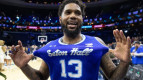
Georgia Tech transfer Brian Oliver announced yesterday that he would be heading to Seton Hall. Oliver, who averaged 10.5 PPG and 4.5 RPG last season as a sophomore including a 32-point outburst against Syracuse. Despite a disappointing end to his season where he missed the last eight games due to a broken thumb, Oliver likely would have remained at Georgia Tech if not for the firing of Paul Hewitt. The Pirates were able to win Oliver’s services over a handful of teams and after he sits out a season they should have a potential All-Big East performer in Oliver.
Apparently one game over .500 in three seasons is enough to get a contract extension in college basketball because Stanford announced late yesterday that they were giving Johnny Dawkins a two-year extension through the 2015-16 season. After a relatively promising 20-14 record in his first season in Palo Alto, Dawkins has seen his Cardinal team fail to break .500 in the past two season and may have worked his way out of one of the top jobs in any sport–head coach at Duke. Perhaps Dawkins can turn things around on The Farm, but he has his work cut out for him in a Pac-10 conference that is no longer as weak as it was a few years ago.
Most of the attention in the US for the U-19 World Championships has been on Team USA and its college stars, but as Luke Winn reports college fans may want to start paying attention to the Australian team as several of their players may be heading to college campuses near you in the very near future. While some schools (St. Mary’s) dominated the Australian recruiting scene in recent years, the players have started to shift their focus to other schools and Winn reports the current favorites for the present group of Australian star U-19 players are Butler, Boise State, and New Mexico.
With the summer circuit heading up Dave Telep has ten major storylines to watch for this month. You will find a lot of talk about all the big names that you are probably familiar with from various recruiting sources online and although we love the big-time showdowns (LeBron James destroying Lenny Cooke is our personal favorite) our favorite part is waiting for the relative unknowns to emerge as major prospects. It was just a year ago when Anthony Davis went from a decent Chicago-area prospect who wasn’t even getting much attention from in-state school to the top prospect in his class in the eyes of many recruiting analysts.