California’s Student-Athlete Bill of Rights Could Lead to More Frequent Government-Backed Forays into NCAA Policy

Posted by Chris Johnson on September 28th, 2012

Chris Johnson is an RTC columnist. He can be reached @ChrisDJohnsonn.

The wave of appeals to change the NCAA’s amateurism model, and increasing scrutiny therein, is not a new phenomenon. Various ethical questions and proposals were raised in different forms and distinctions over the years as the framework of the modern college athletic scape was tested by a series of scandals. Most recently, the organization has come under sharp criticism for its perceived inaction against Duke and North Carolina, two preeminent programs where an overwhelming swath of evidence points to severe allegations – one academic (UNC) and one amateur-related (Duke). The backlash is as much a byproduct of a widespread desire to see the Tar Heels and Blue Devils face punishment as it is a critique of the NCAA’s approach. But for the most part, the public outcry deals not with the organization’s failure to swing around its punitive heft, but the very structure from which it derives its power. There is a general disagreement with the notion that the organization can leverage the competitive product offered by its athletes – by securing lucrative media rights deals and showcasing its athletes on national networks – without actually compensating those athletes. Fundamental moral reasoning is invoked to criticize the revenue-producing college athlete’s inability to advance himself financially (beyond what’s already provided by athletic scholarships). Free market principles, along with appeals to the decades-old literary-conceived “American Dream” concept, are conjured up to blast the NCAA’s apparent limitations. Whatever the origin or direction of their complaints, the NCAA has weathered a diverse range of challenges to its ruling power, challenges that for the most part have fallen on deaf ears.

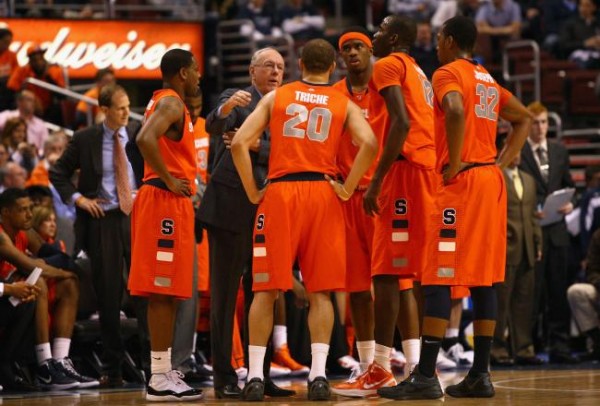
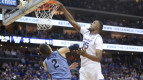
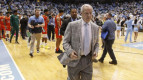
With Brown signing into effect the Student Athlete Bill of Rights, the door has been cracked open for future government intervention in NCAA policy (photo credit: Lucy Nicholson/ Reuters).

For years the organization occupied something of an impenetrable perch of incontrovertible truth, as if its methods and guidelines were beyond reproach. But lately, we’ve witnessed a gradual chipping away of that unquestioned status. The Ed O’Bannon lawsuit, which has the potential to dismantle the NCAA’s amateurism structure once and for all (and is scheduled to go on trial in early 2014), is building considerable momentum in advance of what figures to be the landmark athletics court case of the 21st century. An improved public understanding of the organization’s practices and rules has fanned the anti-NCAA flame. Prominent columnists and sports commentators have made bashing the NCAA a monthly, even weekly, practice. The mounting scorn could soon reach a tipping point. Another authoritative challenge materialized Thursday, this time from a ruling body whose power decidedly trumps that which rules college athletics. California governor Jerry Brown signed into law a powerful piece of legislation devised specifically to address student-athletes at the state’s four Pac-12 schools. It’s called the “Student-Athlete Bill of Rights,” and it connotes exactly what you might expect. Much like the document our Founding Fathers concocted amidst the fight against British tyranny – only slightly less primal, and not nearly as influential, of course – the bill secures fundamental freedoms for student athletes beginning in 2013.

Read the rest of this entry »

Morning Five: 09.28.12 Edition

Posted by rtmsf on September 28th, 2012

  1. And so it begins? The NCAA has fairly or unfairly taken a beating in recent months over its handling of just about everything from its use of player likenesses to academic scandals to jewelry purchases to replacement refs (ok, maybe not the last one). For the most part, the federal and state governments have kept their noses out of it, preferring to let the NCAA as a private organization operate under its own auspices. But with billions of dollars flowing through the nation’s top athletic universities via lucrative sports media deals, and a general sentiment held by the public that the NCAA fosters an environment of exploiting its student-athletes, California governor Jerry Brown on Thursday signed a bill called the “Student-Athlete Bill of Rights.” This new law, which by virtue of their size will only impact the four Pac-12 schools located in the Golden State, will require greater protections for the players at those schools in terms of medical coverage, scholarship guarantees, and due process. The law is the first of its kind in the nation, and other states are no doubt watching closely to determine if they want to follow suit. We’ll have more on this interesting and important topic later today.
  2. Luke Winn has been in his Brooklyn-based math lab crunching the numbers in anticipation of the new college basketball season, and as always, his insights answer questions that most people didn’t even know they had. In his latest piece at SI.com, Winn explores the “exploitable gap” in balancing the scheduling of non-conference games for the purpose of maximum RPI juice while not particularly taxing the team in its bottom line (taking losses). He finds two case studies of “Scheduleball” to illustrate his point — Pittsburgh under Jamie Dixon, and Colorado State under Tim Miles — with each showing how the formula of scheduling top 50 and top 100 opponents and avoiding games against teams in the bottom 100 of the RPI is a key recipe for success. There are other ways to manipulate schedules to your RPI advantage, of course, but as Winn clearly argues, as long as the formula continues to use winning percentage as a proxy for schedule strength, there will continue to be flaws in the RPI system.
  3. While we continue on the theme of smart people doing smart things, the US Supreme Court will reconvene for its October term on Capitol Hill next week. One of the most controversial cases that it will consider next month has gotten the notice of many head coaches around the game because the issue involves the holistic approach of using race as a factor in college admissions decisions. While the cynics out there might believe that the self-interested coaches are merely trying to protect their own players in their defense of affirmative action, the truth is that athletes are usually admitted through other loopholes anyway. But their interest in the law (last upheld by SCOTUS in 2003) is to ensure a diverse campus environment that their players will find welcoming beyond the basketball court. This can play a huge role in recruiting, especially when often dealing with athletes largely from minority communities. Oral arguments will occur on October 10 with a decision due next spring.
  4. Alabama head coach Anthony Grant has gradually improved his Crimson Tide program since arriving in Tuscaloosa just over three years ago. His first team struggled, but he followed that up with an NIT runner-up finish in 2010-11 and an NCAA appearance in 2011-12, the school’s first since 2006. His teams get after it defensively and there’s no reason to believe given this recruiting and coaching abilities that the Tide will drop off from the NCAA level anytime soon. His bosses have noticed, as Grant was rewarded this week with a one-year extension through the 2018-19 season and a raise to $1.9 million per year (ahem, still well below Nick Saban’s  $5.6 million per year deal). With many of the traditional “SEC West” basketball programs still in transition, Grant has a golden opportunity over the next five years to turn Alabama into the top program in that geographic slice of the conference.
  5. We’ll finish with something from earlier this week on Ken Pomeroy‘s site. According to the stats guru, there were only 17 games last season where a team had less than a one percent chance of winning at any point during the game and came back to do so. The only game most of us were likely to have watched finished at #8 on his list — the early February Duke vs. North Carolina game in Chapel Hill — also known as the Austin Rivers shot game. With UNC up 10 points and 2:38 remaining on the clock, Pomeroy’s win probability states that the Blue Devils at that point only had a 0.62% chance to win the game. For those of us more accustomed to Vegas-style odds to make sense of the world, that converts to a 1-in-162 chance. And yet, “Duke would have just five possessions left and went 3, 3, 2, 2, 3 to finish.”  And remember, that game represents only the eighth least likely comeback — get over there to read about the 16 others.

Cincinnati’s Mick Cronin Sees Positive Side in New-Look Big East

Posted by Chris Johnson on September 27th, 2012

Chris Johnson is an RTC Columnist. He can be reached @ChrisDJohnsonn.

There has been no shortage of discussion surrounding the impending basketball decline in the Big East. By now, you’ve surely heard that by 2015, the loaded league we all came to know and love will have lost a sizeable chunk of its upper-echelon talent. I’m talking about Pittsburgh, Syracuse, West Virginia and Notre Dame – four valuable hoops entities who, as is the case with most realignment movement, are chasing more lucrative football-fueled media rights packages (Notre Dame, whose TV contract with NBC is college sports’ most unbreakable bond of broadcast loyalty, is the lone exception). But the Big East itself, the league, the brand, the unit, isn’t going anywhere. Sure, it has settled on some bizarre geographic additions, but Temple and Memphis are valuable upgrades – elite programs that, from a purely basketball-centric perspective, pretty much any league would welcome with open arms. Combined with holdovers Georgetown, Villanova, Marquette, Cincinnati, Louisville and St. Johns, that’s a diverse but promising collection of strong programs. Conference realignment may have staggered the Big East, and it’s unlikely the league will ever regain its status as the nation’s best basketball conference, but the new-look membership is more than passable in the context of power conference hoops. I’d argue it’s still one of the top five leagues in the sport, particularly if SMU’s Larry Brown experiment generates the national attention and relevance that program sorely lacked, and if Central Florida can overcome its NCAA penalties.

With so much turnover in the next few years, Cronin believes the Bearcats are on the rise in the restructured Big East (Photo credit: AP Photo).

For the remaining members, those loyal bystanders who abstained from the massive conference realignment wave, the departures of three historic programs leaves a significant power void at the top of the league’s competitive totem pole. Syracuse, Georgetown, West Virginia and Pittsburgh didn’t just deplete the Big East in the obvious, quantifiable way (the league now has four fewer members). It fundamentally altered the conference’s identity. For decades the Big East served up a steady dose of riveting rivalries, legendary coaches and a unique brand of hard-nosed east coast hoops. The realignment reshuffling has skewed that image, but it also presents a silver lining for the programs who chose to stick around. Cincinnati coach Mick Cronin understands the negative perception hovering around the Big East’s realignment defections, but he sees a rather opportune moment for his program. Long overshadowed by the likes of Syracuse and Pittsburgh and West Virginia, along with a handful of other Big East heavyweights, Cronin sees an opportunity to remold the league’s power structure, with the Bearcats claiming a prime position in the conference hierarchy. SNY.TV, a broadcast affiliate of the storied league, spoke with Cronin over the weekend.

Read the rest of this entry »

Morning Five: 09.27.12 Edition

Posted by rtmsf on September 27th, 2012

  1. Has the interminable fight between the NCAA, the state of North Dakota, and its flagship university over the usage of a nickname finally come to an end? In the latest twist from a saga over North Dakota‘s Fighting Sioux nickname that has spanned decades without resolution, all parties announced on Wednesday that they have come to an agreement that hopefully satisfies everyone involved as well as the affected stakeholders. The NCAA has since 2005  threatened schools like UND with what it deems “hostile and abusive” nicknames, and the state has in recent years gone through considerable legal wrangling and even a ballot measure put to the voters over the divisive issue. This agreement ends North Dakota’s use of the nickname (considered offensive to a local Sioux tribe), but will allow much of the imagery embedded into the school’s sports arenas to remain, at least until father time wears them off. In return, the NCAA will allow the school to host postseason events on its campus, while the university and its alumni get to work deciding on options for a new and more agreeable nickname (they will have three years to think about it ).
  2. It’s extremely rare that we’ll go from a North Dakota blurb to a Montana one, but this is a weird news cycle. Will Cherry, Montana’s best player and the leading candidate for the Big Sky POY in 2012-13, has broken his right foot and will miss as much as the next three months of action. The 6’2″ guard was named last season’s Big Sky DPOY and has shown enough versatility and athleticism to make it onto the radar of NBA scouts searching for the next Damian Lillard. The hope for the Grizzlies is that Cherry, who will not have surgery on the foot, will recover quickly and only have to miss a handful of games at the start of the season. A quick review of the Montana schedule suggests that a return date by the start of conference play on December 19 would be ideal.
  3. Josh Pastner is the kind of coach whom everyone seems to have a very strong opinion about — many folks think his only real talent is salesmanship, an ability to convince potential recruits on the virtues of Memphis basketball so that they sign to play for him. Others think that he’s someone who has perhaps appeared a little green on the sidelines at times, but is a tireless worker whose chops in coaching up young players just needs some time to mature. With news this week that Memphis has received a commitment from elite 2013 east coast prospect Kuran Iverson (The Answer’s cousin), there’s one fact nobody can dispute — the Tigers coach has proven without question that he can leave the Mississippi River watershed to fill out his talented recruiting classes. The next step, of course, is to convert all that on-court talent into postseason success (and nobody cares about Conference USA titles when you’re bringing in these hauls), and, as Mike DeCourcy notes, there is a general sense among those in the know that Pastner is about to turn the corner on building his program and improving his career 0-2 NCAA Tournament record.
  4. DeCourcy must have had his typewriter working overtime yesterday, as he also published a related article on Big East recruiting with the clear thesis that available evidence suggests that the Big East as a basketball conference might not be as ‘dead as in doornail dead’ as many seem to think. According to the Rivals recruiting rankings for the Class of 2013, 16 of the 72 players (22%) in the top 115 who have already chosen schools are headed to the Big East. It’s a fair point, but a closer look at the numbers reveals the devil in the details, which is as of right now, the Big East can boast volume and depth but not much in terms of star incoming talent — of the 24 committed players who are currently ranked in the top 50, only four of those are headed to the Big East (three to Memphis; one to Louisville). By way of a contrast, the ACC and SEC already have four commitments each in the top 30, with more surely on the way once Kentucky and North Carolina are finished.
  5. Here’s a piece of trivia for your Thursday morning: Name the handful of pairs of schools that reside in the same city and also play basketball in the same multiple-bid conference. Most people will get the Pac-12’s UCLA and USC immediately; some will remember that Big Fivers Temple, La Salle and St. Joseph’s have one more season together in the Atlantic 10; if you want to get clever you might even recall Conference USA’s Rice and Houston; but how many folks outside of the Old Dominion State will remember that VCU‘s joining of the A-10 means that a bitter crosstown rivalry with Richmond is about to get realer. Gary Parrish writes that the two schools separated by only seven miles as the crow flies might be near one another in proximity, but they’re worlds apart in style and attitude. All we can say is that the two games scheduled for conference play are going to be must-see television, mid-major style. Can’t wait.

Madison Square Garden Passes Up ACC Tournament: Huge Mistake?

Posted by Chris Johnson on September 26th, 2012

Chris Johnson is an RTC Columnist. He can be reached @ChrisDJohnsonn.

Over the past three years, conference realignment has precipitated a shift of thriving programs away from the Big East into the ACC. Syracuse, Pittsburgh and Notre Dame, three valuable pieces of the Big East’s hoops power hierarchy, saw weakness in the Big East’s deteriorating leadership and declining status in the BCS power structure. They sought greater stability and a more lucrative TV payout in their new conference. The Big East was fracturing, so it was not at all surprising that these programs wanted out. It is hard to fault their move. But like so many of the realignment-related movements of late, their league hop had detrimental consequences on the Big East’s basketball league. For years Syracuse and Pittsburgh have contended for conference titles, played fierce rivalry games and did their part to help make the Big East one of the nation’s most compelling hoops leagues. Notre Dame is, by all accounts, a football school, but had itself risen among the league’s hoops upper-tier under head coach Mike Brey. When these programs announced their departures, it wasn’t just a blow to the league’s membership, but to the Big East brand itself, the very essence of which rested upon such fierce hardwood drama. This was a familiar wave of movement; it wasn’t long ago that the ACC poached Virginia Tech, Boston College and Miami, another football-motivated move that impacted its basketball competition at the expense of the Big East. These six defections over the last decade (Boston College, Miami, Virginia Tech, Notre Dame, Syracuse, Pittsburgh), along with West Virginia’s jump to the Big 12, has conspired to reconstitute the Big East into an amorphous heap of disparate programs, a depleted league robbed of much of its hoops equity.

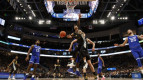
The Big East won’t serve up the same tantalizing display of hoops heavyweights in its conference tournament after the current contract with Madison Square Garden runs out in 2016 (Photo credit: Chris Chambers/Getty Images).

The realignment-powered decline of Big East basketball is nothing new. It is a topic I (along with many other college hoops scribes around the web) have visited before in this space. This latest bit of news counts as a rare positive step for the revamped league, and it was brought to light Tuesday by ESPN.com’s Brett McMurphy. The ACC may have stolen the Big East’s basketball talent, but it can’t take its legendary conference tournament venue! Take that, conference realignment! Madison Square Garden, according to McMurphy, did not submit a bid for hosting rights to the 2016-21 ACC Tournaments. The newly-unveiled Barclays Center, home of the re-branded Brooklyn Nets, also passed up the soon-to-be hoops super-conference’s league tourney. The Big East’s current deal with MSG runs out in 2016, but an extension is in the works to keep the league’s tournament at the historic New York City arena through 2026, according to the New York Post.

Read the rest of this entry »

Morning Five: 09.26.12 Edition

Posted by nvr1983 on September 26th, 2012

  1. Yesterday, the college basketball world received some excellent news when North Carolina announced that the biopsy from the surgical procedure on Roy Williams‘ right kidney came back as an oncocytoma, a relatively rare but benign tumor. Of course, there still is the issue of the unknown mass on his left kidney, which the surgical team now plans to biopsy next week. As many media outlets have reported (presumably regurgitating the UNC press release) there is a “good chance” that it will also be benign, but it is worth noting that the literature on the subject cites a 10% risk of the other kidney biopsy coming back as renal cell carcinoma, a type of malignant tumor. So while we were glad to hear the great news about Williams’ initial biopsy, we remain cautiously optimistic about next week’s procedure as well as concerned about the medical ailment that initiated the work-up that led to the discovery of his renal masses. Everyone around the college basketball community is assuredly crossing fingers for more good news out of the UNC camp next week.
  2. Despite recent news to the contrary, it’s an Apple world and the rest of us are merely technology enablers. The company well on its way to a market capitalization of a trillion dollars has invented and led the wave of iPhones, iPads, and other forms of mobile computing over the past decade. As organizations of all shapes and sizes have jumped on the user-friendly platforms to update their business models, improve outreach, and foster efficiencies, it was only a matter of time before they made their way into sports. Following the recent lead of several NFL and college football teams, Duke has now equipped all of its players with new iPads for the purposes of scheduling, statistic tracking, scouting reports and film work. Given that these are still college students who sometimes get distracted and lose things, each iPad will be equipped with tracking software that will allow those sensitive Duke game plans and evaluations of opponent tendencies to be remotely wiped clean.
  3. We don’t mean to make this an all-ACC M5 today, but it seems to be heading that way with yesterday’s news that neither the venerable old Madison Square Garden nor the spanking new Barclays Center apply to host a future ACC Tournament in the next eight years. Brett McMurphy of ESPN.com reported that bids for the 2016-21 ACC Tournaments came and went with no bids from a New York City venue, raising the much bigger question as to why not? We’ll delve deeper into this topic later today, but a conference tournament with Duke, Syracuse, North Carolina, Notre Dame, Pittsburgh and a host of others wouldn’t make for a viable viewing experience in the Big Apple? Do the Barclays Center owners mean to tell us that the Atlantic 10 Tournament is a stronger draw than the Atlantic Coast Conference Tournament? Something is very much off about these decisions, and we’re not sure what.
  4. It’s been enough time now since Jim Calhoun‘s retirement at Connecticut for folks to take a step back and carefully evaluate whether the way in which the legendary coach “handed” the program to assistant Kevin Ollie just a month before practice begins was the right move. It’s impossible to predict the future now any more than it was when Dean Smith pulled a similar maneuver in 1997 by leaving his bosses no choice but to hire top assistant Bill Guthridge (for all his recruiting troubles, Gut did get two teams to the Final Four in three seasons, including a 2000 squad that had no business being there). Mike DeCourcy writes that despite what Calhoun is saying about the program’s strength — all true things — Ollie is still “deficient” in coaching experience (two years as a UConn assistant) and, in the worst of all possible scenarios, could find himself in way over his head very quickly. It will certainly be an interesting season up in Storrs.
  5. It’s always preseason here in the blogosphere, and so it’s time for the myriad lists of top players, teams, coaches, and so on to begin leaking out in earnest. SBNation‘s Mike Rutherford has put together a list of the top 100 players in college basketball for the 2012-13 season, and some of his results might surprise you. Early NPOY candidate Cody Zeller is his top overall player, but a North Carolina forward who didn’t get a chance to show terribly much last year makes his top five. From a team perspective, Kentucky, Louisville, Missouri and Florida ended up with four players each on his list, with the Cards grabbing a quartet of the top 46 chosen (full disclosure: Rutherford is a Louisville guy). He writes up the top 50 and even if you don’t agree with some of his selections, just perusing through the list will no doubt get your juices flowing. Enjoy.

Conflicting Reports on Harrison Twins Triggers Fan Disagreement

Posted by Chris Johnson on September 25th, 2012

Chris Johnson is an RTC columnist. He can be reached @ChrisDJohnsonn

If you’ve never heard the names Andrew or Aaron Harrison, know this: They might be the best package deal in the history of modern basketball recruiting. Better than the Wear twins at UNC (now at UCLA), better than the Morris twins at Kansas; better than the Lopez twins at Stanford. Yes, the Harrison twins are elite talents who will have lasting impacts on the school that wins the intense bidding war for their services. As of this writing, three programs are in the mix – Kentucky, SMU and Maryland. It’s an eclectic group, but it requires no amount of in-depth background research to make sense of the twins’ final candidates. The Harrisons reside in Richmond, Texas, which makes their inclusion of SMU – a burgeoning program reinvigorated by its recent hiring of Hall of Famer Larry Brown, one of the best basketball coaches of all time, and its impending move to the Big East – completely reasonable. Maryland’s courtship hinges on two elements. The first is Aaron Harrison, Sr., who grew up in Baltimore, played basketball at nearby Patterson High School and is close friends with Terrapins assistant coach Bino Ranson. The second is coach Mark Turgeon, who recruited the Harrisons while he was at Texas A&M before accepting his current position at Maryland. As for Kentucky, well, at this stage of his tenure, John Calipari’s program essentially recruits itself. The Harrisons are expected to announce their decision on October 29, but with various information leaks and contradicting reports from different outlets, the speculative message board war has already begun in earnest.

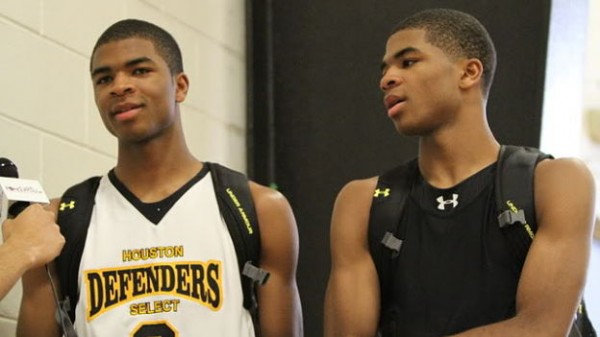
The Harrisons are two of the top players in 2013 (Photo credit: coast2coasthoops.com).

On Saturday, ZagsBlog author Adam Zagoria cited an unnamed source “close to the recruitment” who characterized a difference of opinion on choice between the twins and their father. According to the source, the twins prefer Kentucky, while Aaron, Sr., hopes his sons end up at Maryland. In today’s world of college basketball recruiting, where fan bases frenetically scour national scouting sites, high school and grassroots leagues in the pursuit of knowledge about their programs’ targeted prospects, this kind of news – particularly when it comes in regard to a pair of players as talented and promising as the Harrison twins – sparked a firestorm of digital back-and-forth between rival supporters. A report from InsideMDSports.com amplified the ordeal with quotes from dad, who denied Zagoria’s claim and clarified his position. “Aaron and Andrew Harrison haven’t made a decision, and I want whatever they want for themselves,” he said. “Whatever they want is what I want.” Neutrality, at least from my distant vantage point, seems the more plausible scenario. Even if the twins’ father is partial to Maryland – a likely preference, given his history, ties to the area and relationships with coaches – it stands to reason that the Harrison twins, blue-chip prospects of their own making, would have more influence over their college choice than their father does. But my opinion doesn’t matter. Kentucky fans have already made up their mind. And as you might expect, they fully believe this is a one-horse race, one in which coach John Calipari has already vanquished all competition. UK blogger Truzenuzex at A Sea of Blue puts nail to head:

Read the rest of this entry »

Morning Five: 09.25.12 Edition

Posted by rtmsf on September 25th, 2012

  1. If you’re in the market for an experienced scorer just a few weeks before practice begins and you missed out on the extremely late and unanticipated transfers of Xavier’s Dez Wells and Rice’s Arsalan Kazemi, you might still be in luck. Washington State shooting guard Reggie Moore was dismissed from his team on Monday for an undisclosed “violation of team rules,” effectively ending his career in Pullman and making him an immediate free agent for a team in need of some help. Even if Moore were able to find a school with an open scholarship at this late date, it’s unlikely he’d be eligible for the upcoming season anyway; but, Moore has shown flashes of offensive pop (10.7 PPG) and good play-making acumen (4.4 APG) in his three years at Wazzu. Whether Moore will be able to clean up his act (he was suspended in 2011 for marijuana possession) is another story, but sometimes the incentive of a last, best chance in a new environment is what it takes.
  2. On Monday ESPNU announced its television schedule for this year’s Midnight Madness whirlwind, scheduled to begin at 5 PM on October 12, which, if you’re scoring at home, is a shade over 17 days from now. The broadcast will begin at likely preseason #1 Indiana with an actual nuts-and-bolts practice rather than the fan frenzy Hoosier Hysteria (scheduled for one week later), and will be followed by a studio show peeking in on 12 other prominent programs including Kentucky, Missouri, Baylor, North Carolina, Georgetown, NC State, Syracuse, Murray State, Pittsburgh, Maryland, Florida State and Kansas. While we’re absolutely thrilled to have college basketball in any form coming back in two weeks and change, can we strongly encourage the producers at ESPNU to focus predominantly on the action on the floor at these schools rather than endlessly talking at us in the studio? There will be plenty of time for that as we get closer to the start of the season.
  3. In yesterday’s M5 we mentioned a piece by Gregg Doyel excoriating the NCAA for its presumed lack of interest in aggressively investigating the allegations involving Lance Thomas’ 2009 trip to a New York City jeweler. In the interest of equal time, today it’s North Carolina‘s turn. AOL Fanhouse‘s David Whitley doesn’t break any new ground in his scathing piece against the governing body (and his missive could be premature, depending on what the Martin Report shows), but the way in which he frames the NCAA’s lack of interest in the school’s academic scandal is amusing. Whitley’s best line: “The fact a basketball power like UConn got nailed shows that the NCAA is somewhat serious about putting the student in student-athlete. The fact UNC skated shows that the NCAA is still the NCAA. It wrote the manual on double standards and arbitrary justice. In fact, NCAA officials could teach a course on those subjects. If they taught it at North Carolina, it would be in front of an empty room.” The NCAA is an easy target to pile on — everyone knows that — but its weirdly inconsistent usage of precedent given very similar sets of facts is without question confounding.
  4. With rumors persisting that Class of 2014 superstar prep player Andrew Wiggins will reclassify to the Class of 2013 soon, one of his peers beat him to the idea. Noah Vonleh, a 6’8″ power forward who was considered a top five player in his class, has performed enough academic work at New Hampton School (NH) to reclassify as a senior for the current academic year. ESPN.com‘s Dave Telep reports on the move and says that Vonleh compares favorably with some of the elite players in his new class, rating him as ESPNU’s #7 overall player in the Class of 2013. This is actually the second reclassification for the 17-year old in that this move represents Vonleh’s return to his original class, so let’s hope that he’s finished moving around so that some lucky suitor — Indiana, Ohio State and UNC have recruited him the hardest — will have him in uniform just over a year from now.
  5. It’s nothing new that Butler’s Brad Stevens is a prominent user of advanced statistical metrics as a tool to understanding his team’s strengths and weaknesses. This article by WISH-TV in Indianapolis explains that one of Stevens’ directives for this offseason was for his staff (led by statistical wunderkind Drew Cannon) to determine what kind of RPI the Bulldogs will need heading into conference play to ensure an NCAA Tournament bid now that they’ve moved to the more competitive Atlantic 10. People game the system in all kinds of different ways — some ethical, some not — but we get the feeling that coaches like Stevens and Buzz Williams are so far ahead of their competitors in this regard that it’s astonishing to us that the rest of the coaching lemmings haven’t already fallen in line.

NCAA Investigation Into Saint Mary’s Shows Incentives the Same Regardless of Program Size

Posted by Chris Johnson on September 24th, 2012

Chris Johnson is an RTC columnist. He can be reached @ChrisDJohnsonn.

The list of power-conference athletic programs that have committed recruiting violations is long and wide-ranging. Just in the past five years, we’ve seen Connecticut men’s basketball, Ohio State football, Baylor men’s basketball, Oregon football, USC football and men’s basketball – among many other notable big-time programs – either accused or charged with breaking the NCAA’s strict recruiting codes. These brand-name programs are often hit with crippling sanctions that not only restrict competitive potential, but stain nationally-renowned schools with the stigma of cheat, deceit and fraud. Sometimes, as was the case with USC hoops, there are one or two rogue athletes responsible for their programs’ reckoning. For others it’s a problem embedded within the institution. SMU’s pay-for-play football setup, revealed to the masses more than a quarter century ago, underscores the latter. Still, there is a common denominator at play here. These scandals become national stories, all of them, because of the institutions at which they occur and the negative ripple effects the violations threaten to generate. When news broke of OSU’s “tattoos-for-swag” arrangement, it was the job status of former coach Jim Tressel and the speculation over his replacement that stole back-page headlines. The violations were compelling in and of themselves, but the national appeal stemmed from the long-term implications on the Buckeyes, a legendary, if iconic, football program.

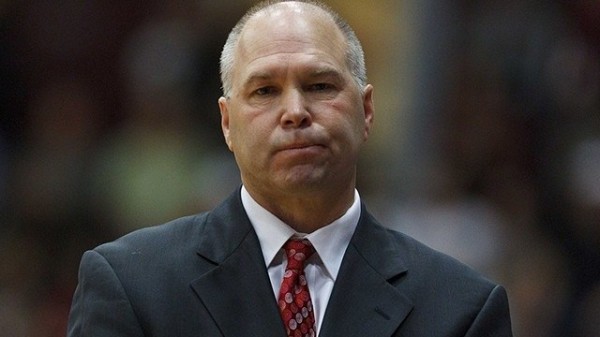
Under Bennett, and thanks to an unusual influx of Australian talent, the Gaels have risen to the upper levels of mid-major competition (Photo credit: Jason O. Watson/US Presswire).

The media attention these stories capture obscures the true breadth and reach of illicit recruiting behavior: NCAA violations, viewed by the layperson through a prism of high-major perpetration, extending to the mid-major ranks. We got the latest example over the weekend courtesy of ESPN.com’s Andy Katz, who reported that the Saint Mary’s men’s basketball program has been subject of an NCAA investigation over the past year for potential recruiting violations. The focus of the investigation remains a mystery, though sources confirmed to Katz that David Patrick, a former Saint Mary’s assistant who was instrumental in the recruitment of several Australian players to the program (most notably Patty Mills), has spoken with NCAA personnel. Program officials, including associate athletic director Richard Kilwein, athletic director Mike Orr and head coach Randy Bennett, have all declined to comment. The Gaels broke Gonzaga’s more than decade-long stranglehold over West Coast Conference hoops last season by claiming the league title outright, the first time since the 1999-2000 season that a team other than the Zags seized solitary ownership of the conference crown. For a program that during Bennett’s tenure has evolved into one of the nation’s premier mid-majors, any punitive measures would represent a major stain in an otherwise sparkling recent history.

Read the rest of this entry »

Morning Five: 09.24.12 Edition

Posted by rtmsf on September 24th, 2012

  1. Andy Katz reported on Friday that the Saint Mary’s men’s basketball program is currently under investigation by the NCAA for potential recruiting violations of an as-yet unknown variety. Few additional details were forthcoming over the weekend, but what little smoke that there appears to exist is surrounding former assistant coach David Patrick (currently an assistant at LSU), an Australian who was instrumental in recruiting former star guard Patty Mills to the campus. The tiny school that is coached by Randy Bennett has become one of the pre-eminent mid-major programs in America in large part due to its Australian talent pipeline — defending WCC POY and Olympian Matthew Dellavedova is only the latest and greatest Gael product of Oz — it makes you wonder if the attraction to Moraga, California, involved incentives beyond a beautiful campus surrounded by verdant hills. We’ll have more on this topic later this morning.
  2. Now that the Billy Gillispie era has officially ended at Texas Tech, the university is left picking up the pieces of its reputation and trying to figure out what to do next. It’s not like there’s a lot of tradition or much fan support for the basketball program anyway, but the danger of making a poor decision now is that it could realistically embed the program at the bottom of the Big 12 for the next half-decade. Nevertheless, the school hopes to name an interim head coach for the upcoming season within the next two weeks, and assistant head coach Chris Walker by virtue of his association with Gillispie’s antics may not be the choice for the permanent job. Andy Katz suggested three viable candidates last week — Rob Evans, Doc Sadler, and Reggie Theus — all of whom have significant and successful head coaching experience along with ties to the region that would help the program transition to a new, and hopefully, better era.
  3. Oregon received great news over the weekend as Dana Altman’s program reportedly has received a transfer commitment from former Rice star Arsalan Kazemi, a double-double machine who will apply for a hardship waiver to play immediately. Kazemi is notable as the first Iranian to play Division I NCAA basketball, but the “Beast of the Middle East” is certainly more than a demographic footnote — the 6’7″, 220-pounder consistently pounds the glass as one of the best defensive rebounders in America, and his free throw rate is annually one of the best in the nation. We’re not sure the basis for Kazemi’s waiver request to play this season, but if approved, an all-senior front line of Tony Woods, EJ Singler, and Kazemi would be one of the best in the Pac-12, if not the nation.
  4. It’s not very often that you’ll read a piece from a national columnist encouraging his readers to rise up as one and not let an issue drop out of the collective consciousness. And yet, that’s exactly what CBSSports.com‘s Gregg Doyel does when he outlines what he calls the “hypocrisy of the NCAA” in predicting that absolutely nothing will happen to Duke as a result of the Lance Thomas jewelry loan situation. Doyel is a flashpoint writer — pretty much every major fan base thinks he has a specific beef with them, when in reality being critical is his style — but he has the status to make something his crusade if he chooses to do so. We’re guessing that many of the enemies he’s made over the years would turn on a dime and become his biggest fans if he actually was capable of nailing the Blue Devil program on this one.
  5. We’re willing to root for Northwestern to finally make the NCAA Tournament as much as the next guy, but the storyline gets a little tiresome when every piece of news surrounding the program is viewed through that particular prism. Still, the weekend news that junior guard JerShon Cobb has been suspended for the entire 2012-13 season because of a violation of team policy has to be disconcerting to Wildcat fans. Cobb has been a part-time starter who offers solid offensive production (career 7.3 PPG) in around 20 minutes per contest; his removal from the lineup changes the complexion of a team already anticipating the replacement of the offense of its former star, John Shurna. In a loaded Big Ten conference where a .500 record is a reasonable goal, Bill Carmody will need to find additional offense from unexpected places if his team is to have any shot at getting the NCAA albatross off its back.