
Top NCAA Performers of the 65 (née 64) Team Era

Posted by rtmsf on June 12th, 2007

GMU Cartoon

Since there’s absolutely nothing going on this week, this is a good a time as any to start rolling out some of the data that we’ve been hoarding. First, a respectful tip of the hat goes to Florida Gator fan Louis Frank, who allowed us unbridled access to the detailed work in his NCAA Tournament database. Over the next week or so, we’re going to be presenting some descriptive statistics on the 64/65 team era of the NCAA Tournament sliced and diced in various ways.

Our first focus will be on individual team performance, viewed through the raw numbers and then with some analytical twists; then we’ll turn our attention to conference performance using the same parameters. The basic question we seek to answer is which teams and conferences tend to over- and underachieve in the NCAA Tournament since it expanded to 64 teams in the 1985 season? The reason we start with that somewhat arbitrary season is because from that point until now every championship team has had to win six games against seeded teams, with no exceptions. It also provides a tidy way of reviewing the data with a substantial sample of seasons – twenty-three – which also happens to coincide perfectly with the rise in popularity of NCAA basketball and the ESPN era.

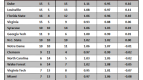
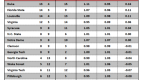
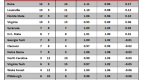
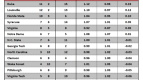
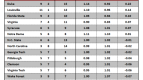
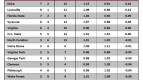
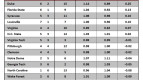
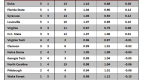
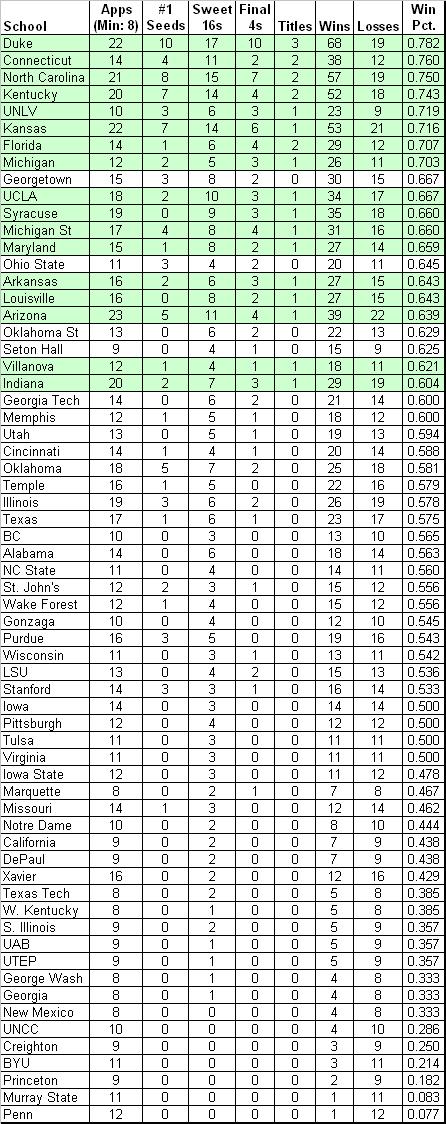
NCAA Tournament Success (1985-2007)

Notes: the chart is sorted by winning percentage (minimum: 8 appearances) from 1985-2007. The green shaded rows represent schools that have won a national title during this period.
NCAA Tournament 1985-2007 v.3

Inside the Numbers:

Elite Eight. Of the 267 schools that have been invited to the NCAA Tournament during the last 23 years, the 64 listed above are the chronic repeat performers, each having made the Dance on at least eight occasions. Thirty-nine of those sixty-four have winning (> .500) records, but only a handful, eight, are elite (> .700 winning pct.). Suffice it to say that those eight elite programs account for 14 of the 23 (61%) national championships and 39 of the 92 (42%) Final Four teams during this era (programs with a national title are denoted above in green shading). These eight programs are: Duke, Connecticut, UNC, Kentucky, UNLV, Kansas, Florida and Michigan. Incidentally, Georgetown is the only school of the top 13 who did not have a title from 85-07, but dumb luck led to its 1984 title team being omitted from this list – apologies to the Hoyas.

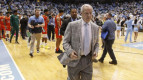
Coach K b/w

You Have to Give the Devil His Due

The Krzyzewski Era. This era also neatly coincides with the rise of Duke as a basketball powerhouse – Coach K’s first Final Four was in 1986, and his string of success particularly from 1988-92 exceeds by itself almost every other school’s performance on this list. Duke has the most #1 seeds, the most Sweet 16 appearances, the most Final Four appearances, the most wins, the best winning percentage and the most national titles during this period. In several of those categories it leads by comfortable margins. We’ve made note that the current era of Duke basketball might be slipping a tad, but with numbers like the above to sustain, that may be an impossible task even for Krzyzewski. By these numbers, you’d have to go with North Carolina in second place and Kentucky a close third. Each has very similar statistics (appearances, #1 seeds, sweet 16s, titles, wins, winning pct.) in all but one category, Final Fours. Given the importance that the college basketball community places on reaching the final weekend, Carolina’s seven F4s to Kentucky’s four must trump, all else being relatively equal.

Traditional Powers. With Duke, UNC and Kentucky taking the top three spots by the raw numbers, how do the other three traditional powers of UCLA, Kansas and Indiana fare? Kansas is closest to the top group. The Jayhawks mirror UNC in many categories (including F4s), but its winning percentage is a little lower and it lacks that second national title that would vault it into the top three. UCLA experienced a couple of down periods during this era, but now appears to be on the rise again with two F4s in the past two seasons. Still, its top ten winning percentage (.667) and its national title in 1995 keep it in the second tier of performers over this era. Indiana has largely struggled since Bob Knight was forced out of Bloomington, but their consistency in making the tournament and winning a game or two (.604 winning pct.) – plus that national title in 1987 – probably keeps it in the second tier as well. There should be no question, though – if any of the traditional six powers were slipping in favor of one or more of the nouveaux riche, Indiana would be the choice here.

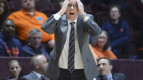
Bob Knight IU

IU is Showing post-Knight Slippage

Nouveaux Riche. Of the elites, Connecticut and Florida are clearly the party-crashers. Prior to 1985, UConn had four wins and Florida zero wins in the NCAA Tournament. Each now has two national titles and a winning percentage of greater than .700. The question is whether these programs will be sustainable whenever Calhoun and Donovan decide to move on (Calhoun, to retirement; Donovan, as Christine’s full-time house-b*tch). The 64/65 team era is already littered with similar riches-to-rags stories such as UNLV, which fell hard when Tarkanian was indicted retired; and, Michigan, who also dropped out of the college basketball landscape once the gravy train of athlete peddler Ed Martin ended. Arkansas is yet another example – all three programs have a national title and multiple F4s to its credit, but long periods of poor teams and inconsistency places them in the second tier of the era.

Others in Second Tier. Several programs were consistenty excellent over this era, but their numbers weren’t as eye-popping as some of the above schools. Syracuse, Michigan State, Maryland and Louisville all claim a title to go with multiple F4s. Who knew other than Orange fans that Jim Boeheim’s squad never claimed a #1 seed during this era – that seems hard to believe. True, though – Syracuse’s best seeds were five #2s – during the glory days of Pearl Washington, DC, Billy Owens and company – 1986, 1987, 1989, 1990, and 1991. It looked like Michigan State was ready to become a top tier program 6-8 years ago, and they still are an excellent one, but its winning percentage needs to improve a little more to reach that level.

Lute Olson

The Silver Fox has had his Ups and Downs

Whither Arizona? Arizona is the only school that was invited to the NCAA Tournament each year of this era. Yet Arizona’s success in the postseason leaves something to be desired for a program of its stature – multiple F4s and a title, but near the bottom of the championship-level schools in winning percentage. The Wildcats are a team to keep a watchful eye on when we present our over- and under-acheivers list later this week.

Rising Stars. Several programs to observe closely as we go deeper into this era are rising stars Georgetown, Ohio St., Memphis, Texas and Gonzaga. None yet has a title during this era, but each except Gonzaga has been to a F4, and all five are knocking on the door. These programs have the facilities and coaching in place to continue to rise up this list in the coming years.

Disappointments. Again, basing these observations on nothing more than raw numbers, you’d have to say that Oklahoma, Illinois, Purdue and Stanford have been the biggest disappointments. Collectively, these schools have had fourteen #1 seeds with only five F4s to show for it (obviously, zero titles as well). Although most of these programs have been consistently invited to the NCAA Tournament during this era, none has a winning percentage topping .600.

Quin Snyder Norm Stewart

What did these two do to Missouri?

Embarrassments. We’ll leave the mid-majors like Xavier alone here, but we wanted to save special mention for some of the BCS schools who have managed to get invited multiple times, but really didn’t do much when they got there. Georgia‘s one sweet sixteen in eight appearances and its .333 winning percentage doesn’t say much for a program that always seems to be rebuilding; Bob Knight’s Texas Tech doesn’t fare much better (two sweet sixteens). But the real winner of the most pathetic NCAA-caliber program award, in our estimation, has to belong to Missouri. The Tigers have been to the tournament fourteen different times during this era, even once as a #1 seed, and have only managed three sweet sixteen appearances, two elite eights and an overall losing record (.462). Serious congrats are in order for Norm Stewart and Quin Snyder. Mike Anderson has his work cut out for him. The saddest part is that Mizzou traditionally likens itself as a basketball school!

Ivy Sadness. The last word goes to Ivy stalwarts Penn and Princeton, two schools who show up every year (21 of the last 23 NCAA Tournaments) at the right time and venue, battle hard for about thirty minutes against a superior athletic opponent, then go back home and lick their wounds for another year after inevitably wearing down to the size and strength of its opponent. They may be a collective 3-21 (.125) in the Dance, but who will forget when they pull the big upsets, like Princeton 43, UCLA 41 (1996), or Penn 90, Nebraska 80 (1994). Ok, maybe beating Nebraska isn’t a big upset after all, but we still love the UCLA upset.

Coming Next: now that we’ve analyzed the raw numbers of the 64/65 team era of the NCAA Tournament, we’ll next be taking a look at the over- and under-achievers during the same period. After seeing the above, can you project who the best and worst will be? You might be surprised at some of the results.  View Overachievers and Underachievers here.

Share this story

The West Side is the Best Side…

Posted by rtmsf on June 9th, 2007

2Pac

2Pac was right after all

Quite a bit was made last season of a renaissance in the quality of basketball in the Pac-10 conference, as it ended the season as a top three conference in both the RPI and Sagarin ratings in addition to earning a record six NCAA bids for the conference and enjoying the prestige as the only conference with multiple teams in the Elite Eight (Oregon and UCLA). There has always been a surplus of talent on the west coast, especially in the Seattle and SoCal areas, but it was largely characterized by players opting to play for an eastern school just as often as staying home to play for State U. This has been changing over the last five years, however, as new coaches such as Lorenzo Romar at Washington, Tim Floyd at USC, Tony Bennett at Wazzu and Ben Howland at UCLA have endeavored and succeeded in keeping as many of those talents as possible close to home. This is no more evident than in some of the recruiting wars over the last couple of years that resulted in top ten players such as Spencer Hawes (Washington), twins Brook & Robin Lopez (Stanford), Kevin Love (UCLA) and Brandon Jennings (Arizona) signing to play in the Pac-10 (notable exception: Lake Oswego’s (OR) Kyle Singler to Duke).

Steve Lavin

Lavin’s former conference is on the rise

Still, we were a little surprised when Rivals released its top ten players at each position for the 2007-08 season, and the Pac-10 claimed by far the most players, with thirteen of the top fifty. This is especially remarkable given that the league is losing all-conference performers Arron Afflalo (UCLA), Aaron Brooks (Oregon), Marcus Williams (Arizona) and Nick Young (USC) to the NBA next season, while it welcomes likely top fifty players Kevin Love and OJ Mayo (USC) to the league. With talent like this staying on the west coast, we should expect another great season from the Pac-10 conference next year. Somewhere Steve Lavin’s hair gel is celebrating.

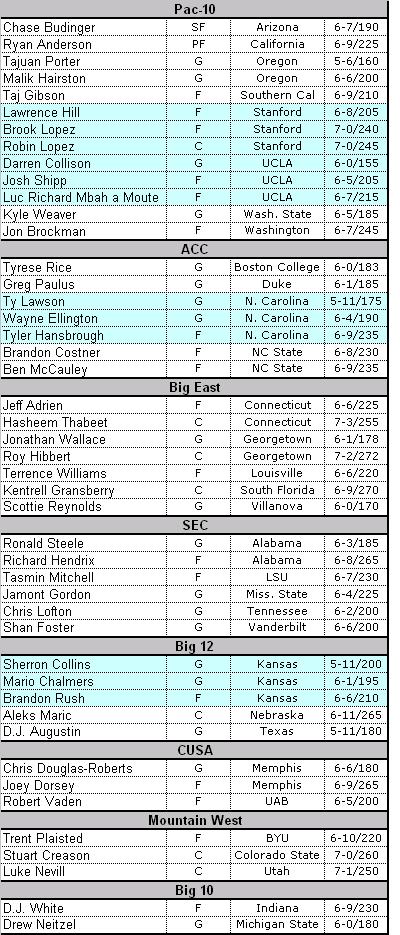
The ACC and Big East have seven players each on the list; the SEC has six, and the the Big 12 has five of the top fifty players. The Mountain West and Conference USA both have three of the top fifty, outperforming the Big 10 (again), who only has two. The Colonial (Eric Maynor – VCU), Horizon (AJ Graves – Butler), Missouri Valley (Randal Falker – S. Illinois) and Southern (Stephen Curry – Davidson) conferences each have one top fifty player returning. Below is the list including multiple-player conferences:

Rivals 2007-08 Top 50 Players

You probably noticed that we shaded the teams with three top fifty players returning next season – Stanford, UCLA, UNC, Kansas. It’s certainly no coincidence that three of those will begin next year in the top five of the polls, and the fourth, Stanford, will probably be knocking on the door of the top ten.

Thoughts –

  • Where is all the Big Ten talent? Having less players on this list than CUSA and the Mountain West is cause for alarm, and helps to explain why only one Big Ten team played into the second weekend of the NCAA Tournament last season. Where are the usual stables of talent at Michigan State and Illinois? Aside from the yeoman’s work that Matta is putting into recruting at OSU, the rest of the Big Ten has signed only two top thirty prospects during the last three recruiting cycles – Joe Krabbenhoft of Wisconsin in 2005, and Eric Gordon of Indiana in 2007. An influx of coaching talent has entered the league (Tubby Smith at Minnesota and Kelvin Sampson at Indiana), but without the players to accompany those moves, the Big Ten is going nowhere fast.
  • Nitpicks. We probably would have found a place for the following players: Derrick Low (Washington St.), Edgar Sosa (Louisville), Jerel McNeal (Marquette), and Patrick Beverley (Arkansas). Expect each of these players to be all-conference performers in their respective leagues next season. We also have a sneaky feeling that guys like DaJuan Summers (Georgetown), Deon Thompson (UNC), Derrick Caracter (Louisville) and JaJuan Smith (Tennessee) will make a solid case to be on this list next season.
  • Surprises. NC State’s future looks bright with two young big men, Brandon Costner and Ben McCauley, returning for Sidney Lowe’s team. Alabama should be much improved next year as well, assuming Ronald Steele gets healthy (he was on many preseason all-american teams last year but struggled with tendinitis and ankle injuries that largely derailed Bama’s season). Apologies to the Mountain West, but who are Stuart Creason and Luke Nevill? Their inclusion on this list shows that the depth of talent at the center position in the college game is ridiculously thin.
  • Instant Impact Players in 2007-08. This list next season will be populated by the likes of OJ Mayo, Eric Gordon, Kevin Love, Michael Beasley (Kansas St.), Derrick Rose (Memphis) and Anthony Randolph (LSU).
Share this story

Does March Madness matter in May and June?

Posted by rtmsf on May 31st, 2007

Mike Wilbon 

Wilbon, as usual, is up in arms. 

Today we wanted to take a moment to examine an idea put forth by the inimitable Mike Wilbon in Monday’s Washington Post.   Wilbon’s essential take (written after game 3 of the Detroit-Cleveland series) was that much of Lebron’s struggles in late-game situations of the NBA playoffs is directly attributable to his lack of “big game” experience, which his predecessors (Magic, MJ, Bird, etc.) honed and developed during the crucible of March Madness.  He wrote:

LeBron’s bigger problem is never having learned how to play these kinds of high-stakes games in college — and now having to learn against a recent champion. Most every iconic player in NBA history, particularly the triumvirate of Magic, Larry Bird and Michael Jordan, learned to play big games during March Madness. For every Kobe (who had Shaquille O’Neal), there’s an Isiah Thomas or Dwyane Wade or Richard Hamilton, guys who learned how to deal with the enormous pressure of big games in college, then successfully transitioned into the NBA playoffs. It’s no coincidence that Tracy McGrady and Kevin Garnett, who also skipped college, struggle so mightily in the playoffs. Without Shaq, Bryant is 0 for 2 getting out of the first round of the playoffs.

Since the high school-to-NBA era began in 1995 with Kevin Garnett, there have been 28 first round picks used on US kids a month removed from their high school graduations.  It’s too early to say for many, but early returns suggest that only seven were definitely worth the pick – KG, Kobe, Jermaine O’Neal, T-Mac, Amare, Lebron & Dwight Howard.  Others such as Shaun Livingston, Al Jefferson, Andrew Bynum and the two Smiths – Josh and J.R. – may end up being stars in a few years, but for now it’s too early to tell.

Of that group of high school-to-NBA superstars, and with the very notable exception of Kobe as first lieutenant second banana to Shaq, how many of that group have led their teams to postseason NBA success?  The struggles of KG (2 playoff series wins in his 12-yr career) and T-Mac (0 series wins in 10 yrs) are well documented, although Jermaine O’Neal (3 series wins in 7 yrs as a starter in Indiana) may soon also warrant inclusion on that list.  Still, Amare (5 series wins in 5 seasons in the NBA – assist to Steve Nash) and Lebron’s (3 series wins in 4 seasons) rather quick starts confound Wilbon’s blanket theory a bit.  It’s too early to say with Dwight Howard.

For now, we think there is some validity to Wilbon’s theory, but it’s not as clear-cut as he suggests.  The NCAA Tournament’s knockout format eliminates pretenders from contenders very quickly, and the teams with gamebreaking talents who can keep their cool and make plays at the end of games are usually the ones last standing.   But where we feel Wilbon’s argument fails is that it’s very difficult to go deep in the NBA playoffs for just about anyone, whether a four-year college player or one who skipped it altogether.  During the era of which we’re speaking (96-07), only five franchises have won NBA titles (Chicago, San Antonio, LA Lakers, Detroit, Miami), and it appears that one of those same franchises will win again this season (SA or Detroit).  History tends to show that only age and collapse from within creates a vacuum by which a different NBA franchise can rise to the top of the heap.

Shaq Graduation Laettner at Duke

Shaq & Laettner have had different degrees of success in college and the NBA.   

With so few historical opportunities for superstars to elevate their teams to the highest level of the sport, we find it somewhat unfounded to correlate the amount of time spent playing in March Madness as an indicator of future NBA playoff success.  After all, didn’t Shaq (4 NBA titles and 123 playoff wins) flame out early every year at LSU, winning a grand total of two NCAA Tournament games in his three seasons in Baton Rouge?  Conversely, Christian Laettner won 21 NCAA Tournament  games at Duke, but his NBA teams only won 11 playoff games where he was a significant contributor (note: he also averaged 2.2 ppg in 11 more playoff wins with the Heat in 2005).  There are undoubtedly other examples that will support both viewpoints.  We tend to believe that the those who are destined to become superstars will ultimately use their talent and drive to work their way to that level, and whether those players learned how to do that in college or on the job in the L  doesn’t really matter.  Tonight Lebron will have his biggest opportunity yet to prove us right.      

Share this story

Jeremy Foley should be fired immediately

Posted by rtmsf on May 29th, 2007

Ahhh… the long weekend is over, and in case you missed it, the College World Series brackets came out this weekend.  This ingenious concept – an on-the-field tournament to crown a college champion – just might catch on after all!  Although this blog is devoted to college hoops, we also recognize that each team is part of a larger athletic program in terms of all the normal considerations – fans, dollars, merchandising, and the derivative feedback loops – which merit occasional reflection beyond the hardwood.

As such, it’s interesting to see which programs had the most successful 2006-07 in a different light than the Stanford Sears Director’s Cup rankings, which the Cardinal dominates every year (twelve in a row going into the 2006-07 academic year).  Recognizing that football and basketball comprise the vast majority of athletic revenues and expenses at Division 1 schools, it still might be interesting and informative to see which programs are also successful at America’s third major sport, baseball.  To start the ball rolling, we took a look at the 2006-07 academic year in the three major college sports. 

Stanford logo

Stanford always wins the Sears Cup, but how does it perform in the big three major sports?

In our analysis, we only considered schools invited to the postseason.  In college baseball and basketball, this is a fair indicator, as roughly 20% of schools are selected for the postseason (NCAA Tournament or CWS) in a given year.  In college football, over half the teams are selected annually for postseason bowls, which skews the definition of “success” somewhat; but we couldn’t figure a way to reliably eliminate some bowls while including others, so we kept them all in.  

Still, even with those rather broad parameters, only six Division 1 schools were invited to the postseason in all three major sports -baseball, basketball and football.  If you guessed large state institutions in (mostly) warm-weather areas, you had a decent chance of naming these six – Arkansas, Louisville, Ohio St., Texas, Texas A&M, UCLA.  Interestingly, Florida won both the football and basketball titles, but was not invited to the College World Series – clearly they should fire an incompetent like Jeremy Foley immediately.  Stanford, who will undoubtedly win the Sears Cup again this year, had a short-lived stay in the NCAA Tournament (for about one tv timeout, as we recall), but did not make the CWS or a bowl game, proving that their emphasis on smaller, non-revenue sports makes all the difference in those standings.

Read the rest of this entry »

Share this story

Is Duke losing its cachet?

Posted by rtmsf on May 18th, 2007

With the news Wednesday that Duke whiffed on PF Patrick Patterson (who opted for Kentucky over Duke and Florida), combined with yesterday’s news that Roy Williams has extended his contract with UNC through the 2014-15 season, we started to wonder if we’re seeing an unusual blip in Durham, or if last season and the presumed immediate future signal a larger problem there.

Duke logo

Be-Deviled?

The last time Duke had such a blip was in the mid-90s. In 1995, with Coach K’s back hurting and Pete Gaudet at the helm for two-thirds of the season, Duke went 13-18 (2-14) and did not make the NCAA Tournament. There has been considerable harping over the years about whose record (K’s or Gaudet’s) all those losses should fall on, but at the time, it wasn’t a leap to see that even when Duke was 9-3 in early January 1995, a team led by the likes of Cherokee Parks and Jeff Capel (as opposed to Grant Hill, Bobby Hurley or Christian Laettner) was flawed. This was especially true in light of a stacked ACC that season (Each of Duncan, Wallace, Stackhouse, Childress and Joe Smith were all-americans in 1995).

The next season, when K was back on the bench, shows just how far the talent level at Duke had fallen. The 1995-96 team only performed five games better than its predecessor, going 18-13 (8-8) and losing both its first round ACC Tourney game and its first round NCAA game (by 15 pts) to… Eastern Michigan? The following year, 1996-97, Duke only got marginally back on track. The Devils finished with a 24-9 (12-4) record and won the ACC regular season, but they flamed out early again in the postseason, inexplicably losing to #8 seed NC State in the quarters of the ACC Tourney and barely scraping by Murray St. in the first round before losing to #10 seed Providence (by 11 pts) in the second round of the NCAAs. Does this sound familiar at all? It should, as Duke just finished its 2006-07 campaign with a 22-11 (8-8) record, culminating in a first round ACC Tourney loss and a first round NCAA loss to… VCU.

Is there cause for concern among Devil faithful, or is last year’s mediocre regular season and short-lived postseason just an anomaly?

Read the rest of this entry »

Share this story

Vegas Odds: Check-In

Posted by rtmsf on May 16th, 2007

Now that the all the recruits in the Class of 2007 have been tidily gift-wrapped for their respective schools (Patrick Patterson, the lone remaining unsigned star of the class, announced for Kentucky today), we can take a look to see how that impacts the public (read: Vegas) perception of how good teams will be in 2007-08. Granted, we won’t have a true snapshot until the early entry withdrawal deadline has passed next month (June 18), but this should give us a bit of insight into how each team is being evaluated in light of their existing losses and incoming classes (for entertainment purposes only, of course).

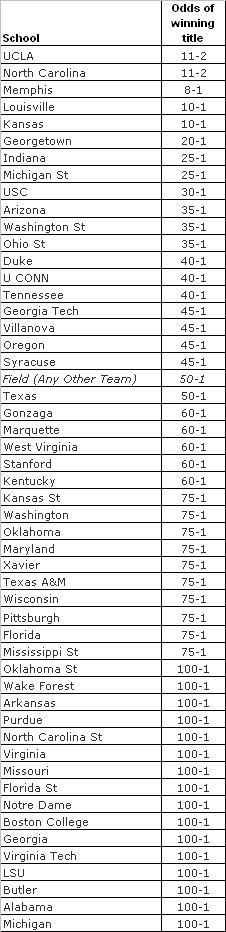
05.16.07 Vegas Odds Source: sportsbook.com

Undervalued – with the two best bets at 11:2, it’s obvious that Vegas doesn’t believe there is a prohibitive favorite at this point. Still, getting those odds on UCLA or North Carolina seems like a solid play – we’d expect both of those to go lower as the season progresses next year. If you’re willing to bet that Hibbert & Green return to Georgetown next year, getting the Hoyas at 20:1 is a steal. Tennessee, with a maturing trio of stud sophomores (R. Smith, J. Smith, Chism) and everyone else – ahem, Chris Lofton, returning, is a joke at 40:1. Same with Oregon at 45:1 – yes, they lost Aaron Brooks, but the core of this elite eight team with Hairston, Leunen and Porter, is back. Texas at 60:1 is another steal – they lost Durant, but they keep a young and very talented nucleus of Augustin, Abrams and James in Austin. A couple of SEC schools – Arkansas and Alabama – also jump out at us at 100:1 because they each return a lot of young talent.

Overvalued – what was first noticeable was Ohio St. at 35:1, even allowing for the possibility that Daequan Cook returns to Columbus. Cook + Lewis and Lighty, even with another top five (but clearly lesser) recruiting class coming in, simply isn’t enough to substantiate odds this low. Duke and UConn at 40:1? Seriously? Yes, they’re both returning a lot and Duke at least has an excellent recruiting class incoming, but did anyone watch these teams this year? – this is a “name” pick all the way. We don’t mean to pick on the Big Ten, but Wisconsin loses several of its starters, including its all-american Tucker, and it’s at 75:1? Sell that one if you can. Same with Florida at 75:1 – no way on earth Billy’s kids make a run next year, but check back in 2009. Virginia Tech lost its best two players and its top recruit – 100:1 seems kind here. Another ACC squad – NC State – Vegas realizes this team was 5-11 in the conference last year, and loses its best player (Atsur), right? Maybe they got confused and were putting odds for NCSU winning the NIT, although I didn’t see South Carolina on the list. And everyone knows that no NIT list is complete without the Cocks. (correction: South Carolina is listed at 200:1 odds for the NCAA, not NIT, championship)

Share this story