The RTC Big Four State Tournament: First Round

Posted by rtmsf on September 1st, 2010

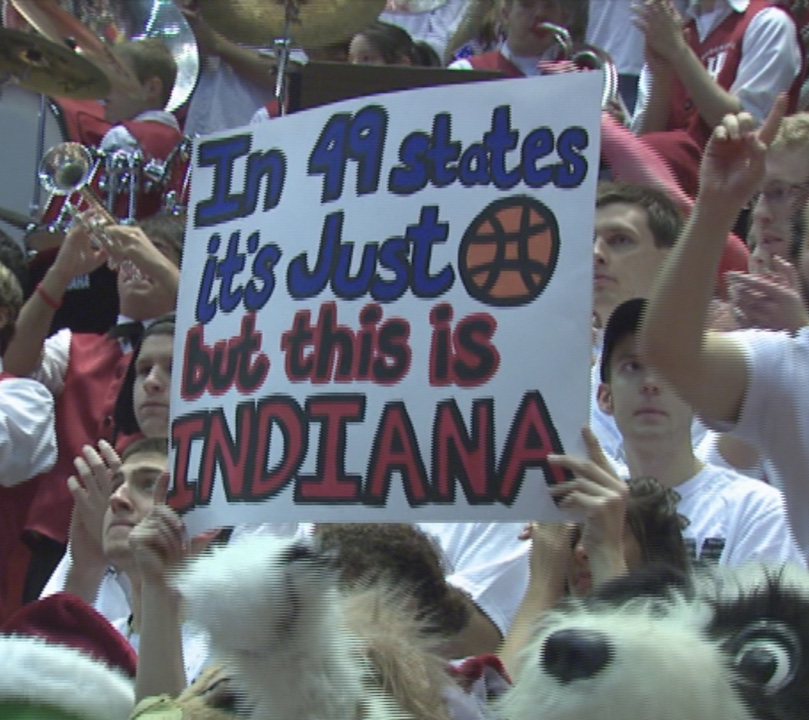
A few weeks ago, the four major college basketball programs in the great state of Indiana announced that they would be starting an annual event called the Crossroads Classic, pitting each school against one of its other state rivals (Indiana, Purdue, Notre Dame and Butler) in an annual basketball orgy of Hoosierness.  We here at RTC loved this idea, and immediately started thinking of other states in the union who could put on a similarly extravagant annual show of hoops.  We were about 99.7% finished with our research when Matt Snyder of Fanhouse published this piece listing the top twenty states that could hold similar in-state classics, causing us to scramble to check the integrity of our passwords (“RTC” doesn’t cut it?) and servers throughout the network.
Indiana's New Crossroads Classic Inspired Us

Seriously, though, Snyder did a great job with the idea; he just beat us to the punch with it.  So we went back to the drawing board and thought about ways to use our research in a constructive way that didn’t rip off the Fanhouse post.  What we came up with is what we’re calling the 2010 RTC Big Four State Tournament.  Here’s how it works.

  1. Similar to the Fanhouse post, we picked the top four programs in each of the 33 states (including DC) with at least that many D1 universities.
  2. We then chose the top sixteen states based on the current status and power of those four programs within each state.
  3. Next, we chose a starting lineup “dream team” of players from those programs in each state, thinking about how to best integrate them by position (three guards & two bigs; or vice versa).
  4. We also chose two subs — one guard and one big man — as well as a head coach.
  5. We limited each school to two starters and one bench player for a maximum of three per team (sorry, Duke).  We also made sure to include at least one player from each of the four chosen programs (hi, Seattle).
  6. Finally, we seeded the sixteen teams into our bracket and analyzed the matchups.  We encourage you to use the polls below to do likewise.

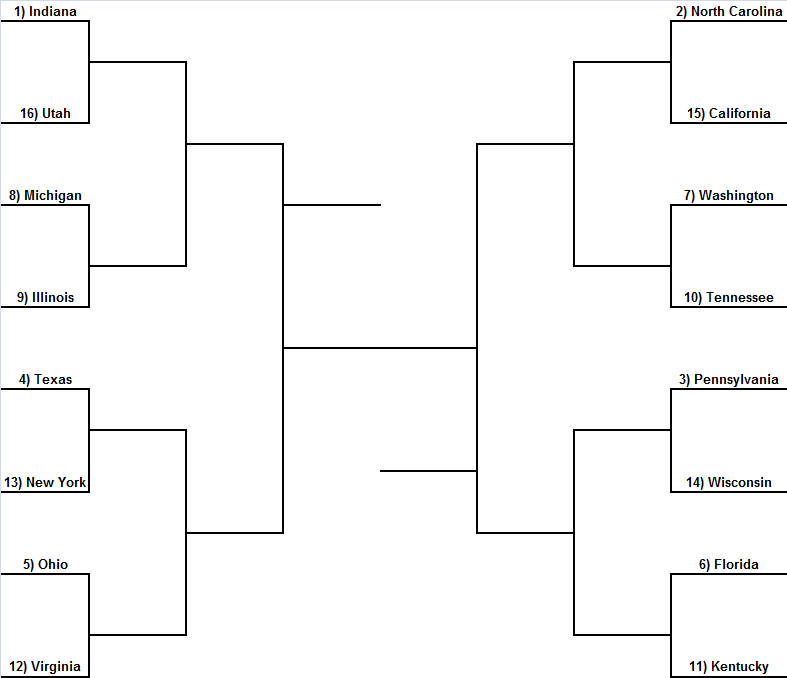
Which state do you think has the strongest cadre of players from among its Big Four programs?  Here’s our bracket:
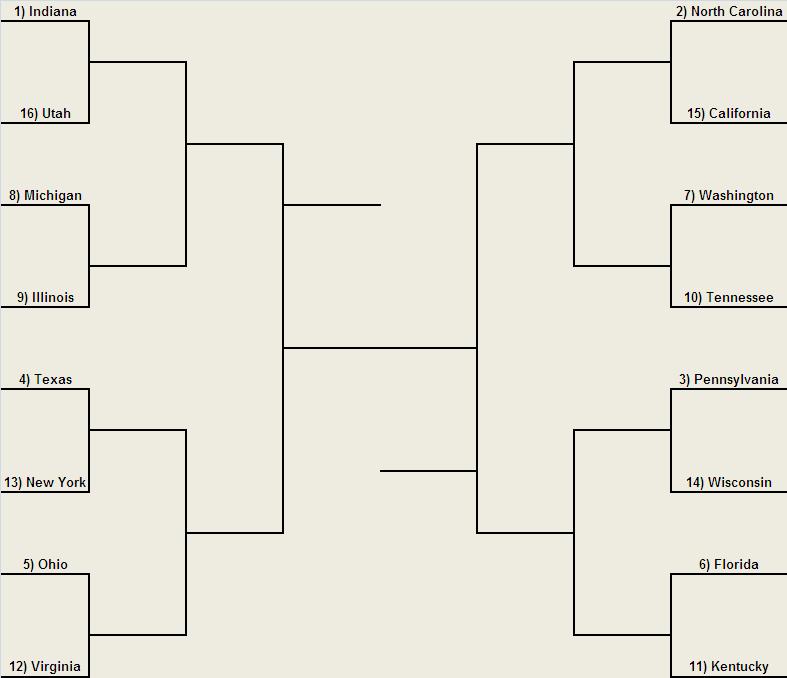
We’ll analyze the left side of our bracket today, and the right side tomorrow.  Make sure to put your choices in the appropriate poll box.

#1 Indiana vs. #16 Utah
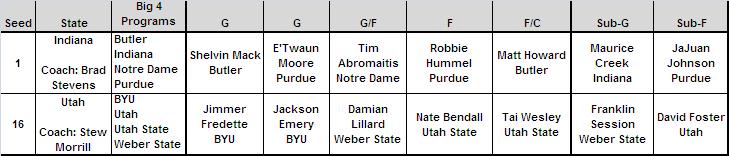
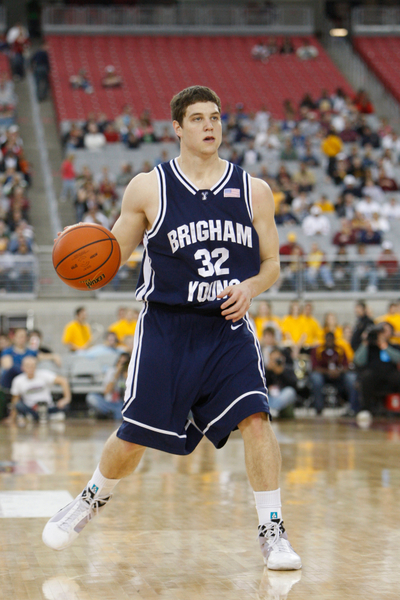
The most lopsided first round battle pits top seeded Indiana against a Utah squad filled with mid-major flavor. For Utah to avoid embarrassing themselves, they’ll need a heroic effort from elite scorer and potential first team All-American Jimmer Fredette. Much like BYU was vulnerable on the rare occasion when Fredette didn’t deliver, this Utah team void of talent from top-shelf Division I programs will need their do-everything point guard to put on his Superman cape. We suspect Fredette will keep Utah competitive for most of the first half. Tai Wesley is crafty enough to lure Matt Howard into foul trouble and, given the season Weber State just concluded, their representatives are far from slouches. In a near carbon copy of BYU’s second round contest with Kansas State, though, it would be a surprise if Fredette didn’t wear down under the intense man-to-man defense of Shelvin Mack and the common double team. Because of our conditions for picking these teams, sure, but an Indiana team loaded enough to bring a talent like JaJuan Johnson off the bench isn’t going to lose to a primarily one-man squad. The Hoosier State representatives pull away and win by 20+.

RTC Choice: Indiana 84, Utah 62.

#4 Texas vs. #13 New York
Read the rest of this entry »

Share this story

BYU Leaves For the WCC in Hoops: Two Perspectives

Posted by rtmsf on August 31st, 2010

We asked two of our best contributors to take a look at today’s news that BYU has decided to go independent in football while joining the WCC in all other sports.  As he’s done all summer, our Mountain West correspondent Andrew Murawa breaks down all the moving pieces here in a simple, understandable way.  Additionally, our WCC correspondent, Michael Vernetti, stops by with a profile of the architect of the biggest coup of realignment summer, WCC Commissioner Jamie Zaninovich.

What Does It Mean? by Andrew Murawa

The wait for the next step in conference realignment is over, as BYU announced today its intention to forge ahead as an independent in football while joining up with the West Coast Conference in most other sports, beginning in 2011-12. In the process, the last hopes for the Western Athletic Conference to remain a viable entity have vanished, and the Mountain West Conference has turned its gaze from perhaps earning an automatic bid to the BCS for its conference champion to simple survival.

Jimmer Fredette Won't Get a Chance to Play in the WCC, but We Savor Future BYU-Gonzaga Matchups

A look at the news from the perspective of all the major entities in this move, BYU, the WAC, the MWC and the WCC:

  1. BYU – it appears all along that BYU was set on going independent in football, and just needed to find a soft landing spot for its other sports. In football, they’re working with ESPN on a deal for their television rights and they’ll make a viable schedule out of the remnants of the WAC (Utah State and Hawai’i are already on the schedule for 2011) and whoever else ESPN can convince to play them.  Regardless, they’re certainly not getting a Notre Dame-style sweetheart deal from the BCS and they’ll likely have trouble filling out a schedule decent enough to regularly put them in BCS contention. As for the move to the WCC, this is an excellent destination for a good basketball program, putting the Cougars into a spot where they should be able to compete with Gonzaga for conference supremacy immediately. Given St. Mary’s steady rise, Portland’s continued improvement, Loyola Marymount’s potential and the success of schools like Pepperdine, San Diego and Santa Clara in the past, the Cougars will definitely find some worthwhile competition there. And given that every other school in the league is a religious institution, BYU at least has something in common with its new conference mates (never mind the fact that BYU has a student body of 33,000, while the biggest school in the WCC has an enrollment of less than 9,000). But, the big key for BYU is getting away from what they found to be a limiting television package in the MWC. Now, they’ll be able to make use of their state-of-the-art media center and use it as a nice carrot to make sure that they are able to reach an agreement with ESPN. And, given that the WCC already has a television deal in place with ESPN for basketball and will reportedly retain broadcast rights for games not aired by the WWL, this is likely a big upgrade in terms of the television package for BYU.
  2. WAC – goodbye. If BYU had agreed to join the WAC in its non-football sports, at least there would have been some reason for the continued existence of the conference, but now standing at six teams with schools like Hawai’i and Utah State already considering other options, this venerable conference is on its deathbed as it approaches its 50th birthday. Right now, about the only reason for the remaining schools to stick together is in the hopes of getting the $10 million in buyout money from Fresno State and Nevada, money over which there will clearly be an epic legal battle. WAC commissioner Karl Benson insists that Fresno State and Nevada will have to remain in the conference through 2011-12, but the schools so far beg to differ. With six remaining members, the conference still holds a claim on an automatic bid to the NCAA Tournament for a couple of years, but the defection of one more school (whether it be Utah State to the MWC or Hawai’i to independence) would be the final nail in the coffin.
  3. MWC – saved from extinction a few weeks back by Fresno State and Nevada’s agreement to join the conference, the MWC is certainly hurt by the loss of BYU but it was going to happen sooner or later anyway. The hope of an automatic bid for its conference football champion to the BCS is now a distant memory and the conference is left with its meager television deal with Versus, CBS College Sports and its own network, The Mtn., now minus the Salt Lake City market  (the regional hub of the conference). In order for the conference to remain a viable entity for the future, it will need to fix its issues with its television contracts, but in the short term, it is still a strong league. However, given that the television contract is locked in until 2015-16, the conference may find itself having to fight off other suitors for some of its strongest members. TCU has already been mentioned as a possible target for the Big 12, and there has even been talk of a merger or some kind of alliance between the Mountain West and Conference USA (talk fueled by meetings between the two conferences in the days after the MWC added Fresno State and Nevada). Finally, there is the possibility that the MWC would be interested in adding more teams. They could certainly finish off the WAC by stealing Utah State (a move that would probably thrill Fresno State and Nevada because it would immediately end the $5 million buyout talk) and maybe even New Mexico State. There have been hopeful rumors of adding some of the western CUSA teams (Houston, Tulsa and UTEP, for example), but the MWC’s television deal probably precludes that, so it will be interesting to see what the next move is for a conference that was very recently thought to be a significant up-and-comer.
  4. WCC – first, you have to wonder what Gonzaga thinks of this. They’ve been the alpha dog in the conference for years as the school casting shadows on the rest of the league, and now, they’re potentially just another tiny school bouncing about in behemoth BYU’s wake. Certainly Gonzaga basketball isn’t going anywhere, but they’re no longer the program that can be immediately penciled in as the favorite in the conference every single year. Looking at it from the Zags’ perspective, the addition of BYU adds a couple more high-quality games during the conference season to bolster its strength of schedule and maintain a high RPI -– perhaps they don’t have to go so nuts with their non-conference schedule anymore. As for the conference as a whole, BYU’s presence in basketball is nothing  but good -– more high-profile games, stronger schedules and a big new market.  The league – now at nine teams with the addition of BYU – will go to a 16-game full home-and-home round robin schedule (although they’ll need to figure out the logistics of that, since there is no longer an easy way to schedule travel partners with an odd number of teams) and they’ll need to rearrange their conference tournament (tournament semifinals have been on Sunday and BYU will not play on Sundays). And there is even the potential for further expansion. Pacific had been considered for possible conference membership in 2008, and the Tigers would be a good fit along with the existing Bay Area schools (St. Mary’s, San Francisco, Santa Clara), but Denver and Seattle have also been mentioned as possible new invitees, given that those schools would add new large markets to the conference.  Denver, in particular, would be a natural travel partner for BYU. All things considered, this is an exciting day for fans of schools all around the WCC, even if the size and particular religious affiliation of BYU may give brief pause.

What’s next?

Read the rest of this entry »

Share this story

Morning Five: 08.18.10 Edition

Posted by rtmsf on August 18th, 2010

  1. It was unsettling kind of day, as two lawsuits involving high-major coaches were settled yesterday.  Perhaps they saw Louisville coach Rick Pitino’s fifteen seconds of infamy and decided to hedge their bets, but former Seton Hall head coach Bobby Gonzalez and current Ole Miss head coach Andy Kennedy both settled their ongoing lawsuits yesterday.  Gonzalez was embroiled in a wrongful termination suit with Seton Hall after getting the axe in March on the heels of a  public blowup with the law school dean, claiming he was owed two more years of salary.  Kennedy settled his defamation suit against a cab driver and valet over a dust-up in 2008 where the pair accused the coach of using racial slurs because the cabbie wouldn’t allow the five people in Kennedy’s group into his vehicle (the max is four).  Details of both settlements were not released, which is just as well for everyone involved.
  2. While on the topic of lawsuits, the Pitino/Sypher saga won’t die in Louisville.  Defense attorney James Earhart now claims that he has new information that specifically leads him to believe that some of the prosecution’s witnesses perjured themselves while under oath.  He’s asking for a 45-day extension to further research these allegations and believes that it will ultimately lead to a mistrial on appeal.  Maybe this is Earhart’s way of saying that it might have been a good idea to call some witnesses who could have impeached their testimony during the trial?
  3. The legacy of John Wooden will live on in the form of the contents of his den — all the hundreds of pieces of memorabilia that the Wizard held onto over the years — which will be moved en masse over to the UCLA campus for fans to enjoy as a virtual Wooden terrarium.  We’ve already got plans to visit UCLA’s JD Morgan Center later this year to see this.
  4. We had the privilege of seeing all six of Butler’s NCAA Tournament games live last year, and in each game more than the last, we came away impressed with the poise and abilities of the Bulldogs’ Shelvin Mack.  Luke Winn writes that Mack, more than any other player on the summer circuit of camps and USA Basketball, has elevated himself to the point where he’s getting rave reviews from veteran guards in the League.  Case in point: Mack was chosen over quite a few big names for his spot on the USA Select team, players such as Scoop Jardine, Scotty Hopson, Jacob Pullen and Jimmer Fredette.  Could Mack, Ronald Nored and Matt Howard propel Butler toward another Final Four next year?  They may be closer than conventional wisdom says even after losing star forward Gordon Hayward.
  5. Fanhouse put together a cool idea — figuring out who should make up the College-Forever team.  Using the general criteria of great collegiate players who barely earned a cup of coffee in the NBA (or none at all), who would populate your top three teams of the modern era (1985 to present)?  We only saw one major omission, and that was Arkansas’ Scotty Thurman, who despite a brilliant college career never logged a single second in the NBA.  Nevertheless, he was an absolute assassin for Nolan Richardson’s “40 Minutes of Hell” Razorbacks, winning multiple games with his smooth stroke in late-game situations, most notably from the wing over Duke in 1994.  He should have been on the first-team over Ed Cota, and at worst second-team.  Cool concept, though.
Share this story

Summer School in the Mountain West

Posted by Brian Goodman on August 9th, 2010

Andrew Murawa is the RTC correspondent for the Mountain West and Pac-10 Conferences.

Around the MWC:

  • NBA Draft Early Entries: At the end of the season, there were a handful of players around the conference that seriously considered giving up their eligibility to play in the NBA. San Diego State’s Kawhi Leonard committed early on to returning to school for his sophomore season and BYU’s Jimmer Fredette went right up to the deadline before announcing his decision to return for his senior season, but New Mexico was not so lucky, as the 2009-10 Mountain West Player of the Year and third-team All-America selection Darington Hobson left his name in the draft and was taken by the Milwaukee Bucks with the 37th pick in the draft.
  • Trouble With the Law: Likely the biggest story of the summer in the MWC was the arrest of UNLV’s leading scorer, senior Tre’Von Willis, following some ugly accusations involving a domestic disturbance that led to felony charges. Willis has pleaded not guilty, and as of this report is still a full-fledged member of the Runnin’ Rebels, but his status for the upcoming season is still very much in doubt. Teammate Matt Shaw’s future is in less doubt, as he will not be playing for the Rebels this season after dismissal from the team from a failed drug test.
  • Remaking a Roster: After struggling through an up-and-down season last year, Utah hoped to reap the benefits of the time they gave to their young prospects this season. Unfortunately, they’ll have to start all over again as their leading scorer and would-be senior Carlon Brown led an exodus from Jim Boylen’s program. Promising rising sophomore Marshall Henderson was the second big blow, and combo guard Jordan Cyphers and power forward Matt Read round out the list of ex-Utes. In an effort to replace those departed, along with a couple of seniors, Boylen will welcome in eight new players this season, including four junior college transfers.
  • Transfers In – there are quite a few impact transfers in the conference this season, with the biggest splashes at New Mexico, where Steve Alford welcomes 6’9 center Drew Gordon from UCLA (eligible at the semester break) and 6’7 forward Emmanuel Negedu from Tennessee, who is eligible immediately after the Vols would not clear him following his scary cardiac arrest during a workout last September. Negedu has been cleared by New Mexico doctors (although not without plenty of controversy) and is ready to play a big role for the Lobos. Elsewhere, San Diego State will add the services of Santa Clara transfer James Rahon, and he should help bolster the Aztecs’ limited outside shooting. Colorado State will welcome Iowa State transfer Wes Eikmeier after his year off. TCU will get the services of Virginia Tech transfer Hank Thorns, a tiny little jitterbug point, after he sat out last season. For UNLV, forward Quintrell Thomas is now eligible after transferring from Kansas, and the athletic sophomore should be ready to make an immediate impact. The Rebels also welcome UCLA transfer Mike Moser, but he’ll sit out this season. Finally, Wyoming just got a commitment from USC transfer Leonard Washington, who’ll have two years of eligibility remaining when he suits up for the Cowboys in 2011-12.
  • Transfers Out: Although the Lobos have a couple transfers coming in, there are some going out, with point guard Nate Garth headed out on his own volition and center Will Brown dismissed from the team. BYU’s Michael Loyd, who had a huge 26-point game in BYU’s opening round NCAA win over Florida and figured to play a big role in this year’s edition of the Cougars, transferred to Division-II Midwestern State, a move that apparently didn’t exactly leave coach Dave Rose all that upset. San Diego State guard Tyrone Shelley opted for his second transfer in three seasons after losing his starting role at the end of last season. TCU loses point guard Xavier Roberson after a promising freshman season and forward Kevin Butler also moves on.
  • Welcome Back: Colorado State will welcome back point guard Jesse Carr, who started 18 games as a true freshman but missed most of last season with a hip/pelvis injury. San Diego State will have forward Tim Shelton back for his junior year, after his third knee surgery in four years caused him to miss the last month and a half of last season.
  • Mission-Critical: BYU brings back Chris Collinsworth as a sophomore, following an eventful LDS mission. Luckily, Collinsworth is back to full strength and will join his brother, Kyle, for a season on the Cougar roster before Kyle likely goes on his own mission. At the same time, the Cougs lose talented forward Tyler Haws for a couple years as he goes on his mission. Expect him to be back in Provo in 2012-13.

Whether Tre'Von Willis will be cleared to play is one of the MWC's biggest storylines heading into the season.

Power Rankings

  1. San Diego State: The Aztecs return all five starters from last year’s Mountain West Tournament championship team, plus get a couple big fellas (Tim Shelton and senior Mehdi Cheriet) back from injuries. But the biggest improvement awaiting Steve Fisher’s squad may be Leonard’s improvement from his freshman to sophomore seasons. Leonard was always a high-flying rebounder for the Aztecs, but as his rebounding numbers soared down the stretch, so did his offensive game. They’ll need to shore up their free-throw shooting, but this is the most talented starting five in the conference, with senior point D.J. Gay, sophomore guard Chase Tapley, senior forward Billy White and senior center Malcolm Thomas expected to join Leonard in the starting five, and worthwhile depth to boot.
  2. BYU: Jimmer Fredette returns for his senior season as the likely co-favorite (with Leonard) for the conference player of the year. With underrated backcourt mate Jackson Emery giving coach Dave Rose an all-senior backcourt and young frontcourt players like Chris Collinsworth, Noah Hartsock, Brandon Davies and James Anderson all ready to take on bigger roles, the Cougars will be gunning for the conference title. One out of the group of Kyle Collinsworth, returned-missionary Nick Martineau or incoming freshman Anson Winder will need to step into the backup point guard role left by the departed Michael Loyd.
  3. UNLV: While the availability of Tre’Von Willis hangs over the head of coach Lon Krueger and his program, the Rebels have a talented roster either way. Assuming Willis returns, he’ll join Oscar Bellfield in a strong backcourt, with skilled and athletic frontcourt threats like Chace Stanback and Derrick Jasper helping initiate the offense. Junior center Brice Massamba showed drastic improvement, despite continued inconsistency at the end of last season, and any contributions he can bring will be a bonus. Additional young talent such as sophomore wings Anthony Marshall and Justin Hawkins litters the roster. Read the rest of this entry »
Share this story

Morning Five: 05.10.10 Edition

Posted by rtmsf on May 10th, 2010

  1. We hope to have a post up later today evaluating the winners and losers from the NBA Draft early entry withdrawal deadline on Saturday, but for now, here’s what you need to know.  Leaving: Dee Bost (Mississippi State), Eric Bledsoe (Kentucky), Daniel Orton (Kentucky), Dominique Jones (South Florida), Darington Hobson (New Mexico), Willie Warren (Oklahoma), Jordan Crawford (Xavier).  Staying: Malcolm Delaney (Virginia Tech), Ravern Johnson (Mississippi State), Talor Battle (Penn State), Lavoy Allen (Temple), Jimmer Fredette (BYU), Alex Tyus (Florida), E’Twaun Moore (Purdue), JaJuan Johnson (Purdue), Demetri McCamey (Illinois), Mike Davis (Illinois), Kevin Anderson (Richmond).
  2. The fact that former Baylor coach Dave Bliss — you remember, the guy who tried to posthumously frame his murdered player as a drug dealer to save his own arsecan get a job teaching young men about the value of hard work, ethics and morality at Allen Academy in Texas proves that we are a very forgiving society.  Wow.  Just, wow.
  3. Tony Barbee has hit the ground running at Auburn, and has very high hopes for his program there.  With a new arena and a fertile recruiting base, AU could be poised as a sleeping giant for the right coach, but the uniform lack of interest in roundball at the school makes things very difficult.  Here are a couple of recent interviews with him about how he plans to handle life in the SEC West.
  4. Arizona’s new law dealing with immigration (SB 1070) may impact the recruiting of international student-athletes to the major D1 schools in the state, according to this article.  It makes sense, given that opposing schools will use anything to make a competitor look bad in comparison, and especially if out-of-state students are passing on Arizona schools based on the law.
  5. Bob Knight gave the commencement address Saturday to the graduating students at Trine University, a small private school in northeastern Indiana.  How a school nobody has ever heard of got a hold of him we’ll never know, but we assume it involves some hunting buddy with a connection to Trine.  If you’re into this kind of thing, his entire speech is embedded below (in five parts).

Share this story

Re-assessing the Early Entry Withdrawal Deadline

Posted by rtmsf on May 5th, 2010

Andrew Murawa is the RTC correspondent for the Pac-10 and Mountain West conferences and an occasional contributor.

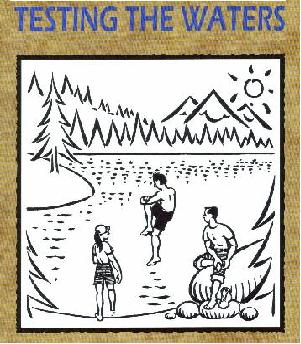
Just over a year ago, the NCAA Legislative Committee voted to scale back the amount of time that players who apply for early entry to the NBA Draft have to withdraw their names from the draft and retain their college eligibility, a change that went into effect this season. Where last year undergraduates who had not hired agents had until June 15 to pull back out of the NBA draft, this year the limit for such a decision is May 8, a deadline that, among other things, also conflicts with academic responsibilities (including finals) for many of those 80 U.S. collegiate undergraduates who have declared for the draft. With NBA teams only allowed to begin working out draft prospects beginning on April 29 and with undergraduates needing to come up with a final decision by May 8, many of the benefits of “testing the waters” rule have been eliminated.

Yes, Let's Make It Harder for Players to Get Informed

The theory behind the rule that allows for undergraduates to declare for the draft and then reconsider and return to school has been that the players will get a chance to work out for NBA teams, talk to general managers and scouts and get a feel for how the NBA perceives their game — what are their strength and weaknesses, what can they work on, and, perhaps most importantly, where they might get drafted. However, with the window for these players to get input from NBA teams reduced to just over a week, players may only get a chance or two to meet with NBA teams, if at all. According to an ESPN poll released last week, of the 19 NBA teams that responded, only two – the Lakers and the Blazers – had any plans to hold workouts for potential draftees prior to the May 8 deadline. And according to BYU head coach Dave Rose, whose star guard Jimmer Fredette is among those still weighing his draft options, “A lot of teams told us they’re going to start working out guys on the ninth of May,” the day after the deadline. Quite simply, for the players among the list of early entrants who have not yet hired agents and who are looking for a little guidance from NBA scouts on their decision, there is little or no help coming.

So, why was this rule even put in place? According to the NCAA, the extension of the deadline into June was “intrusive on academic performance during the spring and increased the potential for outside individuals to have a negative influence on the well-being of student-athletes.” However, for a player like Butler forward Gordon Hayward, who took final exams on Friday, Saturday and Monday, he had exactly four days to gauge the level of interest of NBA scouts. His plans: meet with a couple of agents to figure out the whole process and work out with a trainer in Indianapolis to get a little stronger. For Hayward, he is likely a first-round lock regardless of whether he does or does not work out for any NBA teams, but the point of the rule in the first place is to give guys like him an opportunity to gather as much information as possible in order to make his decision. Giving the kid four days directly after his finals wrap up neither eliminates the potential intrusion on his academics nor decreases outside influences from having a negative impact on his decision. In fact, it would seem that the limit on the amount of interaction that these players have with NBA talent evaluators would be more likely to have a negative impact, giving them less of a realistic look at their NBA chances and perhaps allowing them to fall back on the accolades of less-established talent evaluators (i.e., their family and friends) telling them that they are superstars.

We Thought the NCAA Wants Student-Athletes to Graduate?

The change in the rule began with a recommendation from ACC coaches last year, and coaches are the ones who this rule change benefits the most (although, frankly, it doesn’t really even benefit them much). The theory goes that if coaches can get a definite answer from players on the fence about going to the NBA, they can better plan for the next year, possibly recruiting additional players to take the place of early departees.  However,  even by May 8, the pickings for coaches that lose players early to the draft are slim at best. At this point, just five of the Scout’s Top 100 recruits for the 2010-11 season are still unsigned (two of whom, Terrence Jones and Luke Cothron have verbal commitments elsewhere, and at least one of the remainders, Kadeem Jack, now appears headed to prep school). Even if a coach gets bad news in late May that an undergraduate will indeed be staying in the draft, they’re not typically going to be able to replace a player with that kind of talent so late in the game. Andy Kennedy, the Ole Miss head coach whose Terrico White is among the early entry candidates, confirmed such a notion, saying “the shortened window isn’t going to help regardless” of whether he remains in the draft or not.

Read the rest of this entry »

Share this story

Impact Of Undecided Early Entries On The College Hoops Landscape

Posted by zhayes9 on April 30th, 2010

With the NBA Draft deadline moved up to May 8 this year, we’ll be able to formulate next year’s college basketball landscape sooner than ever before. The decision of many on the fence could dramatically alter the style, roster and makeup of everyone from Kentucky to Richmond. For many of these super-talents such as North Carolina’s Ed Davis, the decision was probably made a long time ago. But for those like fellow ACC foe Malcolm Delaney of Virginia Tech, their status is very much up in the air for 2010-11. He’s just one of many upcoming decisions that could change the outlook of an entire conference.

Many columns dealing with early entries dissect whether the decision was smart or short-sighted, whether the choice to enter their name was the proper call for their careers. Personally, I don’t care so much about their personal career paths, but about how their decision affects college basketball. Instead, the focus of this column will be on how each early entry to put their name in the draft changes their respective schools’ chances when winter approaches.

Daniel Orton and Eric Bledsoe (Kentucky)- Many around the Kentucky program believe Orton and Bledsoe are history, but refraining from signing with an agent leaves the door slightly ajar. If one or both return to Lexington, the Wildcats vault ahead of Tennessee as the SEC favorites. Returning to school would be even more beneficial to Orton, a player that didn’t establish himself playing behind Cousins and Patterson, but only showed glimpses of his superb athleticism, defensive prowess and developing low-post moves. Pair Orton in the post with Swiss import Enes Kanter and John Calipari is in business. Put Bledsoe with Brandon Knight, Doron Lamb or Darius Miller and the same holds true. Calipari’s loaded class certainly screams reload rather than rebuild, but the returns of Bledsoe and/or Orton would vault expectations even higher.

Gordon Hayward (Butler)- The “babyfaced assassin” (h/t Gus Johnson) might have the toughest call of any early entry this spring. A relative unknown to casual fans just one year ago, Hayward burst onto the scene with a stellar NCAA Tournament, leading the charge behind Butler’s miraculous run to the national title game. Thanks to a late growth spurt, Hayward possesses guard skills in a 6’9 frame and may even go in the latter half of the lottery should he keep his name in the field. Butler would also drop to a ranking similar to the one they enjoyed in October last year. If Hayward returns, it would be a crying shame if Butler isn’t the #2 team ranked preseason behind Duke. The only starter departing is glue guy Willie Veasley. That’s right: Hayward, Shelvin Mack, Ronald Nored and Matt Howard would all return to school for another March push.

Avery Bradley (Texas)- Sources told Fox Sports’ Jeff Goodman that Bradley was likely to stay in the Draft, and quite honestly I can see why. Teams that are looking for a backup point guard with the ability to defend and attack the basket will be flocking towards Bradley near the mid-first round. Findlay Prep point guard Cory Joseph committing to Texas last week takes some pressure off of Rick Barnes if Bradley should opt to stay in the draft. The Longhorns grossly underachieved with Bradley, Dexter Pittman and Damion James; with all three departing, expectations can’t possibly be sky high for Texas, although Kansas, Texas A&M and Baylor should all take steps back this season. Texas is a top-15 team regardless of last season should Bradley, Joseph, Dogus Balbay, J’Covan Brown and Jai Lucas round out a loaded backcourt. I suspect Bradley has played his last game in burnt orange, though.

Read the rest of this entry »

Share this story

Morning Five: 04.20.10 Edition

Posted by rtmsf on April 20th, 2010

  1. Whew, things aren’t slowing down much in comings and goings.  Colorado filled its open head coaching position with Tad Boyle, the Northern Colorado coach who took a transitional D1 program to 25 wins and second place in the Big Sky this season.  Appalachian State is reported to be filling its open position vacated by Buzz Peterson with another former UNC player, Jason Capel.  The 30-year old Capel has only one season of experience as an assistant under his belt, but he clearly has the name recognition in the state of North Carolina that should help with recruiting.  Washington’s Lorenzo Romar parlayed his run to the Sweet Sixteen into a ten-year contract extension (through 2020), which shows again how important March has become.  On the NBA Draft side, Richmond’s Kevin Anderson will test the waters to see what he needs to improve upon for next season, and BYU’s Jimmer Fredette will do likewise.  Neither player will sign with an agent, leaving open the possibility of a return to school next season.  Fredette is currently projected as a late first/early second round pick, while Anderson is likely undrafted at this point (which means he should return).
  2. The Fred Hill saga at Rutgers has finally ended, with the embattled head coach agreeing to a settlement with the school worth $850,000 to resign his position.  This was an embarrassing week for the State University of New Jersey, but the school can now get back to the more important issue of finding a coach to save this moribund basketball program.  Eddie Jordan, Fran Fraschilla and Jim O’Brien are reportedly on the short list.
  3. Meet Zach Lipson, the next Kentucky equipment manager, and one of the neatest stories you’ll read about keeping your head up and having faith in your abilities.
  4. This is an incredible column.  First, we’d been wondering why we hadn’t seen Bill Walton on any NBA/NCAA broadcasts for a while, and this explains why.  But second, it now puts the notorious UCLA loss to Notre Dame in 1974 to end the 88-game winning streak in a completely new light.  The Big Redhead played with broken bones in his back — take that Evan Turner!
  5. From yougotdunkedon.com, This is a fun mix of some of the best dunks of the 2009-10 season.  Which is your fav?  For our money, it’s Travis Leslie… wow!
Share this story

John Legend Digs The Buckeyes (Plus Many Others)

Posted by jstevrtc on March 23rd, 2010

How far-reaching is the NCAA Tournament?  Check out these tweets from famous people in other walks of life — actors, musicians, mostly athletes — who have nothing to do with this year’s tournament but are just fans of a particular school, a player, or college hoops in general.  We like that John Legend is diggin’ Ohio State.  Not surprising, since he attended Penn but was born in Ohio.  But given Evan Turner’s versatility, we wonder if a duet with Legend could be in the works.  Anyway, other than one spot where we xxx’d out an innocent person’s Twitter ID, every tweet here is presented exactly as it was found on each user’s account, and none of them are re-tweets. We think it’s pretty cool — you never know who’s watching.

Dara Torres (American Olympic swimmer, gold medalist x 4) — U guys watchn college hoops?? Kinda dig when there’s upsets…except not when it happens to the Gators!! Hehe!

Joel McHale (ex-Washington, and star of NBC’s Community and E!’s The Soup) — Holy crap.  Way to go Northern Iowa.

Pete Yorn (musician) — Wow! Kansas. [Ed. note — posted moments after KU’s loss to UNI]

Conan O’Brien — Hey sports fans, here’s my NCAA pick: bet it all on the Savannah College of Art & Design. Go Fighting Acrylics!

Unless you WANT to be told on, Ms. Banks...

John Legend (musician) — Great day today. Ohio St going to the Sweet 16. I had a great show in Miami Gardens. And the health care bill passed. Happy Sunday

Elizabeth Banks — No, dummies. I didn’t go to Cornell. I went to Penn (*cough* better school). But def pulling for the Ivy League team. Big Cornell win!

Read the rest of this entry »

Share this story

Boom Goes The Dynamite: Second Round 03.20.10 Edition

Posted by jstevrtc on March 20th, 2010

Now it’s a party.  The first round is done.  The next 48 hours of games will define which big-time teams can handle the pressure cooker that is the Big Dance, and it will identify the Cinderellas we’ll be talking about for years.  If you’re a double-digit seed, winning one game is nice, but you don’t receive your wicked stepsisters, pumpkin coach, and glass slipper until you at least reach the Sweet 16.  Oh, you’re a big-conference bigwig?  Then the next round is still probably less than what was expected of you.  People don’t remember Second Rounders.  They remember teams that make the Sweet 16 and beyond.  The first round was fun.  But it’s over.  Here are the teams vying for the Sweet 16 on Saturday:

  • #2 Villanova vs #10 St. Mary’s
  • #5 Butler vs #13 Murray State
  • #6 Tennessee vs #14 Ohio
  • #1 Kansas vs #9 Northern Iowa
  • #3 Baylor vs #11 Old Dominion
  • #3 New Mexico vs #11 Washington
  • #2 Kansas State vs #7 Brigham Young
  • #1 Kentucky vs #9 Wake Forest

We’ll be here all day, watching the games with you.  We hope you’ll join us, and we definitely look forward to seeing you in the comments section as we all climb in to ride this rollercoaster for the third time.  See you right here about fifteen minutes before the first tip!

12:55: Here we go!  For the Sweet 16, gentlemen…let’s play!  Some interesting matchups throughout the day.  Looking especially forward to Baylor vs ODU and KSU vs BYU.  To me those look like the more intriguing games.

1:05: St. Mary’s off to a quick start!  The inside battle between Omar Samhan and Mouphtaou Yarou and/or Maurice Sutton is gonna be fun to watch.  God, Samhan looks bigger every time I see him.

1:15: I guess Jay Wright’s “minor teaching point” is over.  Samhan could not have asked for a better start to this game.  Eight points on 4-6 shooting.  SMU does not look intimidated early.  I fact, Villanova still looks like they’re getting over whatever hangover they were nursing that caused them to almost get beaten by Bob Morris.

1:26: Samhan just rooked with that second foul.  I agree with Raftery.  That should have been a no-call.

Read the rest of this entry »

Share this story