Syracusean Thoughts

Posted by rtmsf on August 4th, 2008

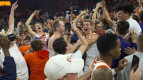
A post today from the most entertaining Syracuse sports blog Troy Nunes is an Absolute Magician got us thinking about a couple of seemingly disparate things today. 

First, is there any more difficult impossible charge for a college athlete to shed than that of some kind of sexual assault?  Similarly, is there any more difficult impossible charge for an institution and the police to prove than that of some kind of sexual assault (eliminating the outright rapes involving DNA, of course)?  Usually all that anyone can seem to agree upon is that something happened involving a player and an unnamed woman.  How far that something went and whether it was consensual or a simple misunderstanding often involves convolution that would make Robin Lopez’s lafro look stick-straight in comparison.
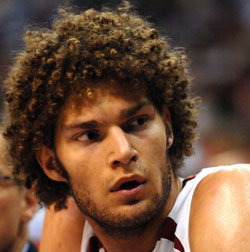
How Twisted and Convoluted?

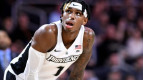
We can think of a couple of recent examples where the he-said/she-said repartee ultimately resulted in a slightly uncomfortable exoneration of a player’s name, where everyone sorta shrugs their shoulders, looks around and wonders exactly what the hell happened while simultaneously hoping that it doesn’t impact next year’s team.  Kentucky’s Chuck Hayes is but one example.  Kansas’ Sherron Collins another.  Need we even mention Kobe Bean’s douche d’amour  in Eagle, CO?  And now we encounter the trio of Syracuse’s Jonny Flynn, Scoop Jardine and Rick Jackson, each of whom was accused of playing a role in a sexual assault on the Syracuse campus last fall.  Flynn is arguably Cuse’s top returning player, and Jardine/Jackson are both contributors whose roles should increase next season.


Come On Ladies, It Was Only a Kiss…

Reading through the grand jury account (filtered through the Syracuse Post-Standard’s news report) is a lot like watching hockey on tv – you know the puck is down there somewhere, but you can’t really follow it until it hits something.   Depending on who you ask, the accuser is a) not seeking criminal prosecution; b) seeking criminal prosecution; c) is no longer claiming she was a victim of sexual assault; d) is claiming that she was a victim of sexual assault; e) being treated as a pawn amongst her mother and the university.  In other words, about as clear as Mudd.

Ultimately there was a grand jury proceeding, and the accuser testified at the hearing. She must have apparently been laughed out of the room due to the fact that, according to the old legal adage that a grand jury will indict a ham sandwich, the accuser’s story did not rise to ham sandwich level.  According to Troy Nunes, Syracuse University will continue with its own internal disciplinary proceedings in this matter (on what evidence, we’d love to hear).

Juli Needs to Put the Screws to Jim Again

The other thing that this post got us thinking about was Jim Boeheim’s program in general.  We’ve a notion that Boeheim should be called Mail It In-heim for the way he’s been handling the Orange in the years since his only Carmelo-led championship.  With his hot MILF wife and his secure ring finger, does Jimmy B. have the drive to push beyond mediocrity anymore (we were going to compare him to Gary Williams at Maryland, but realized quickly that GW deserves his own category of underachievement)? 

Consider: 

  • Three of Boeheim’s eleven 10+ loss seasons in 32 years as a head coach have come in the last three years (12, 11, and 14 losses, respectively).   Last year’s 14 losses were the most for a Jim Boeheim-coached team EVER. 
  • Before last year, the 1980-81 and 1981-82 seasons were the last period where Syracuse had not gone to the NCAAs in consecutive years.  (granted, Cuse got screwed royally in 2006-07, but they were still a bubble team)  It could have been three in a row if not for G-Mac’s miraculous Big East Tourney title run in 2006. 
  • In fact, Syracuse hasn’t won an NCAA Tournament game since 2004, its longest streak of such misery since prior to Boeheim’s arrival in 1976.      
  • Boeheim’s winning percentage from 1976-2003 is .743.  His percentage from 2004-present is .694, and that includes four bogus NIT wins played in the friendly confines of the Carrier Dome. 
  • Honestly, the only highlights of the last five seasons since the national championship were the 2005 and 2006 Big East Tournament titles.  That’s great and all, but it’s not how Syracuse basketball built its name (both of those were Cinderella runs). 

Perhaps this is old news for Syracuse faithful, but it really surprised us when we took a look at the numbers.  With an eligible Jonny Flynn and Paul Harris in addition to a healthy Eric Devendorf, there is potential for Syracuse to break its stranglehold on an NIT bid this season; but we’re not sure that Boeheim is getting as much from his players as he once did.  We’ll definitely be keeping a closer eye on upstate New York this year. 

Share this story

2008 One-and-Dones – Was It Worth It?

Posted by rtmsf on July 1st, 2008

Happy Fiscal New Year, everyone! 

Along with the turn of the fiscal calendar, July 1 also represents the turn of the academic calendar.  This is particularly appropriate for hoopheads, as the NBA’s season has ended and the draft madness that dominated bandwidth for the last two months after the Mario Miracle has died down to a whimper (well, there’s always 2009, right?).  All there really is to look forward to until October is the Ego Known as Kobe Bryant’s attempt to restore American hegemony in the international (read: Olympics) hoops realm.  That comes in August. 

So now is as good a time as any to take a look back at the 2007-08 season and once again review how the NBA’s one-and-done rule worked out for the schools that enabled it.  You might recall that we took a look at this last year and concluded: Ohio St., UNC, Texas… good.  Georgia Tech, Washington… not so good.  We also mentioned that several schools – Stanford, Tennessee, Arizona and Kansas included – were hanging onto players who could have been one-and-dones, but weren’t.  With the exception of the often comatose Arizona team, the other three as a result had fantastic squads last year. 

To start it off, let’s refresh ourselves with who the Rivals Top 20 recruits were coming into 2007-08.  As you can see below, we added a few columns that outline the player’s freshman numbers (pts/rebs/assts or blocks) and his team’s record as well as whether he went into the draft or is returning next season. 

So was it worth it?  Our takes:

Kansas St.  – Well Worth It.    K-State rode the best.freshman.ever Michael Beasley and sorta-but-not-really one-and-done Bill Walker (he was a medical redshirt in 06-07) as far as it could, which included a third-place finish in the competitive Big 12, a second-round NCAA tournament appearance and the first home win in twenty-four years over its rival and eventual national champion Kansas Jayhawks.  In other words, K-State’s best season in a generation.  The important aspect of Beasley and Walker’s one-and-dones for KSU head coach Frank Martin is to capitalize on future recruiting from the good will and national notoriety mustered by these players while on campus.  If he does not do so, and it’s soon back to the bottom of the Big 12 barrel for K-State, then the potential positive impacts of these stars passing through Manhattan, KS, were missed. 

Memphis – Well Worth It.  This too is a no-brainer.  #1 overall pick Derrick Rose converted a competitive yet incomplete team that would consistently flame out prior to the Final Four against other elite teams into a team that probably should have won the national title.  Rose led Memphis to a 38-2 record and had the Tigers in the argument for the most dominant season in the post-Wooden era before its epic free-throw meltdown in the championship game.  Even only as a runner-up, a Memphis fan would be hard pressed to find much else wrong with the 07-08 season, and as such, the one-year stopover by Derrick Rose was well worth it. 

Memphis Would Take A Rose Every Year (AP photo/Seth Wenig)

UCLA – Worth It.  This was a tough one, because UCLA came into the 07-08 season already having been to the last two Final Fours.  Anything short of that measure was going to be a disappointment (although Bruin fans might argue anything less than a national title is a disappointment).  We’ll argue, however, that Kevin Love brought a toughness and star-quality to Westwood that had been lacking on Ben Howland’s previous teams.  Not to mention that UCLA last season at 35-4 was simply a better team than the ones led by backcourt players (Afflalo and Farmar).  More than anything, Love’s presence solidifed UCLA again as a marquee destination for top-notch recruits, as Howland has penned five of the Rivals Top 50 in the Class of 2008. 

Arizona – Worth It.  It’s quite possible that Jerryd Bayless last season saved Arizona from breaking its NCAA Tournament streak of 24 consecutive appearances.  Arizona certainly didn’t have a great year amidst all the Lute Olson divorce and feud with Kevin O’Neill turmoils, but with a final record of 19-15, you have to figure that Bayless’ fantastic freshman year was worth a few wins that put the Cats back into the field of 65.  But that’s about all it was worth.  It certainly didn’t make Arizona into a contender of any kind, and it’s doubtful whether there will be any residual effects from Bayless’ time in Tucson.   

Indiana – Worth It.  Eric Gordon‘s arrival in Bloomington was worth it if for no other reason than it gave Hoosier fans something to be excited about for approximately three months (Nov-Jan).  Now that the wheels have come completely tumbling off of the Indiana program, we have to wonder just how long their fans will covet and remember the halcyon days when IU was 16-1 and ranked #7 in the AP Poll.  Of course, E-Giddy was partially responsible for Indiana’s subsequent collapse (18.2 ppg on 37.2% FG/25.3% 3FG shooting in the last 13 games (8-5)), but we put most of that on the ultimate dismissal of Kelvin Sanctions whereupon the entire team simply quit playing.  So in our view, this one-and-done represents the last great season that Indiana will have for a while.  Too bad it couldn’t have worked out better for everyone involved. 

Gordon Left More than a Bloody Tooth in His Wake (photo credit:  Bloomington Herald-Times)

USC – Not Worth It.    For a while during the season, it appeared as if the OJ Mayo one-and-done situation might just work out for Tim Floyd and the Trojan Nation.  Similar to K-State, USC hadn’t seen this much hoops attention in years – with Mayo as the headliner, USC played numerous national television games, beat UCLA at Pauley, and ended up tied for third in the rugged Pac-10.  Of course, the wheels came off when USC failed to show up to its hyped battle against K-State in the first round of the NCAAs and the propriety of Mayo’s eligibility was called into question by ESPN soon thereafter.  Throw in Davon Jefferson (a one-and-done from the Class of 2006 who went to prep school for a year before enrolling at USC) and his foolish decision to enter this year’s draft (undrafted) and we’re not sure just how successful USC can claim 2007-08 was.  After all, the 2006-07 edition of the Trojans, led by Nick Young and Gabe Pruitt, also finished third in the Pac-10 but had a better overall record (23-11) and played into the second weekend of March Madness (giving Carolina all it wanted in the process).  Finally, with another uber-recruit, Demar DeRozan, coming to USC next year, Floyd needs to be hyper-vigilant about those nefarious agents and runners in light of the Mayo debacle because more eyes will be watching.   

NC State – Not Worth It.  Hey, remember all the preseason talk about how NC State was the third best team in the ACC, and a definite NCAA Tournament team?  Yeah, we don’t either.  Actually, we do, and few of the pundits will own up to the fact that it was a terrible prediction.  For the record, NC State ended up 15-16, but the Wolfpack were 4-12 in the ACC (worse than the previous year’s 5-11 campaign that inspired such foolishness) and lost their last nine games.  So what did JJ Hickson’s presence in Raleigh bring to the team?  Other than team chemistry problems, of course?  It doesn’t appear that he brought much else than an ability to get himself drafted.  NC State will likely be significantly better without him next season. 

What Chemistry Problems? 

LSU – Not Worth It.  While we’re in the business of ripping bad teams with one-and-done players, we shouldn’t overlook the LSU Tigers.  LSU seems to have one of these guys about every other year anyway, so it probably doesn’t matter much in terms of long-term effects, but a 13-18 record with a loss at Tulane calls into question the value of Anthony Randolph’s tenure on campus in Baton Rouge.  Certainly the mail-it-in coaching style of Mr. Misty Champagne didn’t help things out much, but even with John Wooden coaching that team, we’re not sure how much Randolph could have lifted the Bayou Bengals.

Others.  These teams all had one-and-dones of questionable efficacy.  Put another way, these teams probably wouldn’t have been much better nor worse had these players gone elsewhere.  Exhibit A is Texas A&M‘s DeAndre Jordan.  TAMU was a tourney team anyway, led by Joseph Jones and Josh Carter, and it’s doubtful that Jordan’s four double-figure points games and two double-figure rebounds games in the Big 12 had much of an effect on A&M’s successful season.  Not Worth It.  Syracuse fans may disagree with us here, but despite Donte Greene‘s exceptional first-year numbers, we find it hard to believe that the Orange would have been any less average than they already were last year (21-14, 9-10 Big East).  After all, Jim Boeheim could take five schoolgirls and make them competitive – he just wouldn’t win the title with them (unless Carmela Anthony was on the team).  The question is whether Syracuse fans are pleased with a third-round NIT appearance, and we all know the answer to that – a resounding no.  For a school with multiple F4s and a recent championship banner, missing the NCAAs completely is a failing season, no matter the reasonable expectation.  Not Worth It.  Finally, we look at Ohio St., who took Kosta Koufos to replace last year’s one-and-donest, Greg Oden.  The answer here once again comes down to the question of expectation vs. reality of the situation.  Without Oden, Mike Conley and Daequan Cook, it wasn’t realistic for Thad Matta to make another run at the F4; but the bar has been raised so high at Ohio St. under Matta that a 24-13 season leading to an NIT championship must necessarily be viewed as less-than-stellar.  Winning the Capital One Bowl doesn’t match the Rose Bowl, does it, Buckeye fans?  We’ll call this one a Push.   

Final Thoughts.  With so many freshmen leaving this year from the top 20 Rivals list, we’d guess only Florida with Nick Calathes and Chandler Parsons returning may be a team to really watch closely next year.  Otherwise, keep an eye on UCLA, Wake Forest and UConn, each of which has multiple top twenty players coming onto campus next year. 

Share this story

Let’s Go Orange!!

Posted by rtmsf on October 20th, 2007

Ok, so the Cuse doesn’t know which end is up with respect to its next coach

Fine.

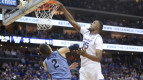
But at least they know how to bust a backboard on the break. Sweet sweet glass shards.

[vodpod id=ExternalVideo.435764&w=425&h=350&fv=]

Share this story

10.19.07 Fast Breaks

Posted by rtmsf on October 19th, 2007

More news and notes from a busy first week of practice.

  • Everyone is piling on Kelvin Sampson for his phone indiscretions.  AOL Fanhouse looks into the poor cell phone service excuse, while DeCourcy takes shots at IU’s compliance office.  One blogger wrote an open letter to Kelvin Sampson asking him to just go away.  Yesterday Sampson resisted talking about the issue at his press conference.
  • Speaking of Indiana coaches causing trouble, the NCAA instituted a point of emphasis this year on abusive behavior by coaches on the sideline.   M2M has the definitive take on this.
  • More IU-related content:  Bob Knight felt the need to talk about the MLB playoffs during his presser this week.
  • Basketball Prospectus is up and running (woohoo!) – the first post that captured our attention was this one on what makes an assist an assist?
  • MJ expects to watch his son sit the bench play at least once this year in Champaign.
  • On Monday it was official that Mike Hopkins would succeed Jim Boeheim at Syracuse upon his retirement; by Tuesday, it wasn’t official anymore.
  • So what really went down in practice between OJ Mayo and Daniel Hackett?  Was it an errant ‘bow or a flat-out haymaker to the schnozz?
  • One of the underrated coaches at an underrated program, Randy Bennett at St. Mary’s got a two-year extension (through 2013). 
  • Katz dissects the budding UCLA-USC rivalry, comparing it to UNC-Duke.  What he fails to mention is that SoCallers don’t care about college hoops nearly as much as the NCers.  That’s a Laker area, through and through.
  • Injuries, Suspensions, etc.
    • Is Brook Lopez planning on playing this year?  He’s already out for the first nine games – now he’s indefinitely suspended for breaking team rules, which means he can’t even practice. 
    • Wisconsin starter Michael Flowers is going on a leave of absence for the cryptic reason of “medical problems.” 
    • Notre Dame super-soph Luke Harongody will miss 3-6 weeks with damage to his thumb ligaments. 
    • Mizzou senior forward Darryl Butterfield was arrested for domestic assault and suspended indefinitely by the team.
    • Remember our pal Frank Tolbert?  The good state of Alabama did not agree with local prosecutors that Tolbert was drunk while stealing driving his SUV away from the towing lot.  He is not expected to miss any games.
    • A bunch of UK players are injured in various ways.  Oh, and Alex Legion isn’t hurt, but his mom is some kind of prophet.     
  • And more preseason chatter from various sources.
    • MSNBC has its preseason top 25 out (UNC #1).
    • Luke Winn spent the week slurping up whatever they’re selling in the RTP these days. 
    • Meanwhile, Jeff Goodman did a Tennessee three-step – Memphis, Vandy & UT
    • SEC:TGTBTD has it’s all-SEC teams ready – 3d Team, 2d Team, 1st Team (Chris Lofton, Jamont Gordon, Patrick Beverly, Richard Hendrix, Shan Foster).
    • Gary Parrish has his all-american teams + 10 ready (we like his balls to put Derrick Rose on the first team).   
    • Big 12 talk – apparently K-State is loading up on players, while KU is striking out on recruiting.  Yahoo asks if the Big 12 will ever win a title again, and oh yeah, Tom Osborne is the new AD at Nebraska.
    • Will Florida even make the NCAA Tourney this year?  Billy D. isn’t sure. 
    • Can UConn’s AJ Price stay away from the computer lab this year?  Jim Calhoun thinks he can. 
Share this story

09.26.07 Fast Breaks

Posted by rtmsf on September 26th, 2007

Some news flotsam and jetsam we’ve accumulated this week…

  • It was an expensive week for Ohio State paying its head coaches, as Thad Matta got a $500k raise (to $2.5M per annum) and contract extension through 2016.
  • Tennessee forward Duke Crews has been suspended indefinitely for violating team rules. How long is “indefintely?”
  • We mentioned it briefly above, but it deserves its own note. Former Hawg PG Corey Beck was shot Sunday morning during a robbery attempt – he is listed in good condition.
  • Free Shoes University is embroiled in another cheating scandal – the question is which sports are involved?
  • Porsches, Polo & Ponies. SMU basketball avoids NCAA sanctions – wait, SMU still has a basketball program? Oh, right. Matt Doherty. So the answer is no.
  • Plissken at the Buzzer gives a thorough and interesting breakdown of Memphis’ schedule (following up on Andy Katz’s top 10 last week) and how that will affect the Tigers’ NCAA seed next March.
  • Melo is giving back to Syracuse, as Jim Juli Boeheim convinced him to fork over $3M toward a new practice facility for the Orange.
  • Injury Report – Louisville freshman Clarence Holloway will miss the entire season after open heart surgery (!!), and NC State’s PG Javier Gonzalez will miss the next twelve weeks with a shooting thumb injury.
  • BC’s success in the ACC on the gridiron and hardwood have increased its applications from traditionally ACC country.
  • Construda still loves Luke Recker, oh these many years later…
  • We guess Shawn Stockton isn’t as good as his uncle John.
  • According to Jeff Goodman, 2008 #1 player Greg Monroe has narrowed his list to LSU, Kansas, Duke and Georgetown. Although Gary Parrish disputes this in a meandering article about Monroe’s eight finalists.
  • Speaking of Parrish and Goodman, the former riffs on Bama’s point guard situation after losing Ronald Steele, and the latter notes that Bruce Pearl is in search of outside shooters and Arizona is looking at possible successors for Lute Olson.
  • It’s NEVER too early for a projected field of 65.
  • MascotLove: College Hoops Heaven takes a look at the top 15 mascots.
Share this story

Top NCAA Performers of the 65 (née 64) Team Era

Posted by rtmsf on June 12th, 2007

GMU Cartoon

Since there’s absolutely nothing going on this week, this is a good a time as any to start rolling out some of the data that we’ve been hoarding. First, a respectful tip of the hat goes to Florida Gator fan Louis Frank, who allowed us unbridled access to the detailed work in his NCAA Tournament database. Over the next week or so, we’re going to be presenting some descriptive statistics on the 64/65 team era of the NCAA Tournament sliced and diced in various ways.

Our first focus will be on individual team performance, viewed through the raw numbers and then with some analytical twists; then we’ll turn our attention to conference performance using the same parameters. The basic question we seek to answer is which teams and conferences tend to over- and underachieve in the NCAA Tournament since it expanded to 64 teams in the 1985 season? The reason we start with that somewhat arbitrary season is because from that point until now every championship team has had to win six games against seeded teams, with no exceptions. It also provides a tidy way of reviewing the data with a substantial sample of seasons – twenty-three – which also happens to coincide perfectly with the rise in popularity of NCAA basketball and the ESPN era.

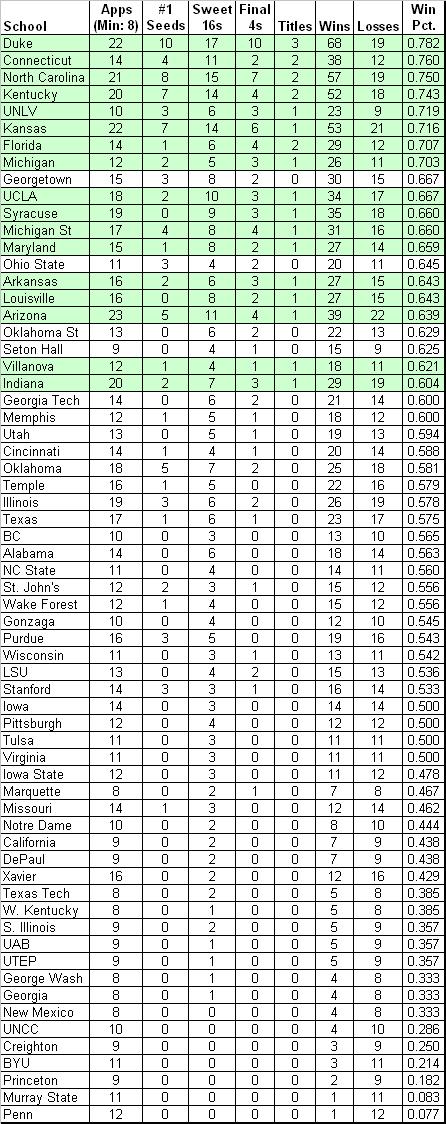
NCAA Tournament Success (1985-2007)

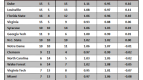
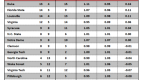
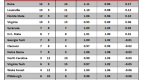
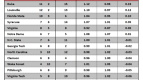
Notes: the chart is sorted by winning percentage (minimum: 8 appearances) from 1985-2007. The green shaded rows represent schools that have won a national title during this period.

NCAA Tournament 1985-2007 v.3

Inside the Numbers:

Elite Eight. Of the 267 schools that have been invited to the NCAA Tournament during the last 23 years, the 64 listed above are the chronic repeat performers, each having made the Dance on at least eight occasions. Thirty-nine of those sixty-four have winning (> .500) records, but only a handful, eight, are elite (> .700 winning pct.). Suffice it to say that those eight elite programs account for 14 of the 23 (61%) national championships and 39 of the 92 (42%) Final Four teams during this era (programs with a national title are denoted above in green shading). These eight programs are: Duke, Connecticut, UNC, Kentucky, UNLV, Kansas, Florida and Michigan. Incidentally, Georgetown is the only school of the top 13 who did not have a title from 85-07, but dumb luck led to its 1984 title team being omitted from this list – apologies to the Hoyas.

Coach K b/w

You Have to Give the Devil His Due

The Krzyzewski Era. This era also neatly coincides with the rise of Duke as a basketball powerhouse – Coach K’s first Final Four was in 1986, and his string of success particularly from 1988-92 exceeds by itself almost every other school’s performance on this list. Duke has the most #1 seeds, the most Sweet 16 appearances, the most Final Four appearances, the most wins, the best winning percentage and the most national titles during this period. In several of those categories it leads by comfortable margins. We’ve made note that the current era of Duke basketball might be slipping a tad, but with numbers like the above to sustain, that may be an impossible task even for Krzyzewski. By these numbers, you’d have to go with North Carolina in second place and Kentucky a close third. Each has very similar statistics (appearances, #1 seeds, sweet 16s, titles, wins, winning pct.) in all but one category, Final Fours. Given the importance that the college basketball community places on reaching the final weekend, Carolina’s seven F4s to Kentucky’s four must trump, all else being relatively equal.

Traditional Powers. With Duke, UNC and Kentucky taking the top three spots by the raw numbers, how do the other three traditional powers of UCLA, Kansas and Indiana fare? Kansas is closest to the top group. The Jayhawks mirror UNC in many categories (including F4s), but its winning percentage is a little lower and it lacks that second national title that would vault it into the top three. UCLA experienced a couple of down periods during this era, but now appears to be on the rise again with two F4s in the past two seasons. Still, its top ten winning percentage (.667) and its national title in 1995 keep it in the second tier of performers over this era. Indiana has largely struggled since Bob Knight was forced out of Bloomington, but their consistency in making the tournament and winning a game or two (.604 winning pct.) – plus that national title in 1987 – probably keeps it in the second tier as well. There should be no question, though – if any of the traditional six powers were slipping in favor of one or more of the nouveaux riche, Indiana would be the choice here.

Bob Knight IU

IU is Showing post-Knight Slippage

Nouveaux Riche. Of the elites, Connecticut and Florida are clearly the party-crashers. Prior to 1985, UConn had four wins and Florida zero wins in the NCAA Tournament. Each now has two national titles and a winning percentage of greater than .700. The question is whether these programs will be sustainable whenever Calhoun and Donovan decide to move on (Calhoun, to retirement; Donovan, as Christine’s full-time house-b*tch). The 64/65 team era is already littered with similar riches-to-rags stories such as UNLV, which fell hard when Tarkanian was indicted retired; and, Michigan, who also dropped out of the college basketball landscape once the gravy train of athlete peddler Ed Martin ended. Arkansas is yet another example – all three programs have a national title and multiple F4s to its credit, but long periods of poor teams and inconsistency places them in the second tier of the era.

Others in Second Tier. Several programs were consistenty excellent over this era, but their numbers weren’t as eye-popping as some of the above schools. Syracuse, Michigan State, Maryland and Louisville all claim a title to go with multiple F4s. Who knew other than Orange fans that Jim Boeheim’s squad never claimed a #1 seed during this era – that seems hard to believe. True, though – Syracuse’s best seeds were five #2s – during the glory days of Pearl Washington, DC, Billy Owens and company – 1986, 1987, 1989, 1990, and 1991. It looked like Michigan State was ready to become a top tier program 6-8 years ago, and they still are an excellent one, but its winning percentage needs to improve a little more to reach that level.

Lute Olson

The Silver Fox has had his Ups and Downs

Whither Arizona? Arizona is the only school that was invited to the NCAA Tournament each year of this era. Yet Arizona’s success in the postseason leaves something to be desired for a program of its stature – multiple F4s and a title, but near the bottom of the championship-level schools in winning percentage. The Wildcats are a team to keep a watchful eye on when we present our over- and under-acheivers list later this week.

Rising Stars. Several programs to observe closely as we go deeper into this era are rising stars Georgetown, Ohio St., Memphis, Texas and Gonzaga. None yet has a title during this era, but each except Gonzaga has been to a F4, and all five are knocking on the door. These programs have the facilities and coaching in place to continue to rise up this list in the coming years.

Disappointments. Again, basing these observations on nothing more than raw numbers, you’d have to say that Oklahoma, Illinois, Purdue and Stanford have been the biggest disappointments. Collectively, these schools have had fourteen #1 seeds with only five F4s to show for it (obviously, zero titles as well). Although most of these programs have been consistently invited to the NCAA Tournament during this era, none has a winning percentage topping .600.

Quin Snyder Norm Stewart

What did these two do to Missouri?

Embarrassments. We’ll leave the mid-majors like Xavier alone here, but we wanted to save special mention for some of the BCS schools who have managed to get invited multiple times, but really didn’t do much when they got there. Georgia‘s one sweet sixteen in eight appearances and its .333 winning percentage doesn’t say much for a program that always seems to be rebuilding; Bob Knight’s Texas Tech doesn’t fare much better (two sweet sixteens). But the real winner of the most pathetic NCAA-caliber program award, in our estimation, has to belong to Missouri. The Tigers have been to the tournament fourteen different times during this era, even once as a #1 seed, and have only managed three sweet sixteen appearances, two elite eights and an overall losing record (.462). Serious congrats are in order for Norm Stewart and Quin Snyder. Mike Anderson has his work cut out for him. The saddest part is that Mizzou traditionally likens itself as a basketball school!

Ivy Sadness. The last word goes to Ivy stalwarts Penn and Princeton, two schools who show up every year (21 of the last 23 NCAA Tournaments) at the right time and venue, battle hard for about thirty minutes against a superior athletic opponent, then go back home and lick their wounds for another year after inevitably wearing down to the size and strength of its opponent. They may be a collective 3-21 (.125) in the Dance, but who will forget when they pull the big upsets, like Princeton 43, UCLA 41 (1996), or Penn 90, Nebraska 80 (1994). Ok, maybe beating Nebraska isn’t a big upset after all, but we still love the UCLA upset.

Coming Next: now that we’ve analyzed the raw numbers of the 64/65 team era of the NCAA Tournament, we’ll next be taking a look at the over- and under-achievers during the same period. After seeing the above, can you project who the best and worst will be? You might be surprised at some of the results.  View Overachievers and Underachievers here.

Share this story