Morning Five: 09.15.10 Edition

Posted by rtmsf on September 15th, 2010

  1. If you ain’t cheatin’, you ain’t tryin‘ is a quote that’s tossed around a lot in the NCAA, but it may have come to an offseason head yesterday as no fewer than three separate reports came out in the world of college basketball that has us wondering… is anybody clean anymore?  Anybody at all?  Or has the sport been so dirty for so long that now that the NCAA actually has an investigative arm with some sharp teeth and halogen flashlight, we’re finally seeing all the roaches scurrying around underneath the mat?
  2. The biggest news was that another allegation came to light with respect to Tennesssee’s Bruce Pearl, merely four days after he begged forgiveness in front of the world for misleading NCAA investigators in their investigation into his recruiting practices.  CBSSports.com reported on Tuesday that Pearl initially told the NCAA that he never hosted recruits Josh Selby (currently at Kansas) and Aaron Craft (currently at Ohio State) at his home during their junior-year visits to Knoxville, but apparently the NCAA had in its possession a rather probative piece of evidence — a photo of Craft standing with Pearl in the coach’s living room.  If that’s not a smoking firearm from hypocrisyville, we’re not sure what is.  Pearl owned up to it in a second interview with investigators, but if this is the misleading piece of information that he was referring to last week, but we openly wonder why he wouldn’t have been more forthright about it then.  The final question on everyone’s minds, though — how did Jimmy Collins sneak inside the Pearl household sight unseen with a digital camera?
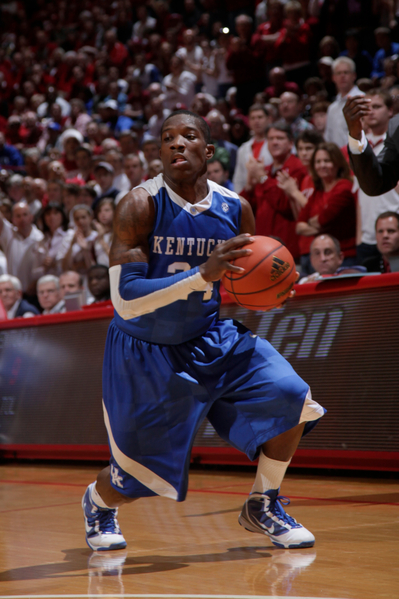
  3. Moving down a state to Alabama, another report that came out on Tuesday from the Birmingham News revealed that there may have been tomfoolery going on with respect to former Kentucky guard Eric Bledsoe’s high school transcript.  We already know that the NYT’s Pete Thamel unearthed suspicious circumstances back in May in Bledsoe’s academic career, but yesterday’s news suggests that the suspicious circumstances may have risen to the level of grade-fixing so that Bledsoe would be eligible to play college ball.  If the NCAA finds that Bledsoe was never eligible and Kentucky is held to the same standard of strict liability that it held Memphis to in the Derrick Rose scandal, then UK’s 35 wins in 2009-10 could be completely erased from the record books.  Thamel anonymously spoke to three compliance officers in light of this latest information, and all three thought that was a realistic possibility.
  4. And next, we move out west to Oregon, where new head coach Dana Altman may have walked into a situation in Eugene quite a bit more complicated than he bargained for.  According to OregonLive.com, recently-departed center Michael Dunigan and at least four other former players may have been involved in receiving improper benefits over the last two seasons at the school.  This is especially hilarious considering just how bad the Ducks have been during that period, but we’re sure that the NCAA is already involved and has the 2-0 and rather dominant-looking football program feeling a little nervous.
  5. Whew.  What a Tuesday.  Well, we may disagree with incoming NCAA president Mark Emmert in other ways, but at least he’s already talking tough about levying harsh penalties on cheaters.  And finally, we’re actually talking about big-time schools in big-time conferences with slaughterhouses full of cash cows at their disposal.  The game is only at its greatest when the playing field is level, and there’s no way to approximate that when the moneyed schools can do whatever they want with reckless abandon.  This could be Emmert’s greatest accomplishment if he has the will and buy-in to do so.

WAC Fires a Shot Across Bow of Nevada & Fresno State

Posted by rtmsf on September 15th, 2010

Andrew Murawa is the RTC correspondent for the Pac-10 and Mountain West Conferences and an occasional contributor.

The standoff between the Western Athletic Conference and the Mountain West Conference over Fresno State and Nevada has come to the next logical stopping point: a lawsuit, perhaps just the first in a string. WAC commissioner Karl Benson confirmed today in a conference call that last week the league filed suit against Fresno  and Nevada in an effort to prevent the schools from joining the MWC for the 2011-12 athletic seasons. Benson and the WAC contend that WAC bylaws require a school to give notice to the conference by July 1 if it plans to leave the conference in the next two years. Both schools accepted the MWC’s offer of membership on July 18 of this year. However, there is a discrepancy between the conference bylaws and the WAC Code Book which claims that the deadline to withdraw from the conference is instead September 1. The MWC is included in the suit in an attempt to prevent the conference from adding either school to its 2011-12 scheduling. All parties named in the suit have 30 days to respond after which the Jefferson County District Court in Colorado will likely issue a ruling within another month.

Fresno & Nevada Are Gone, But at What Cost?

According to Benson during today’s teleconference, “the WAC is simply seeking to protect its interests and insure that all member institutions are protected from a potential and threatened violation of the bylaws. Such inappropriate action would make it impossible for member institutions to schedule athletic events and thereby would adversely affect the WAC, the WAC member institutions and the student-athletes.” Benson specifically cites the difficulty the remaining WAC institutions would have in filling out its 2011 football schedule, the potential impact on the conference’s bowl agreements, the negative effect on its existing television contract and the impact on the WAC basketball tournament as areas that would be damaged by Fresno State and Nevada leaving after this coming season.

For Fresno State and Nevada’s part, they still seem determined to leave the conference after this season in order to play in the MWC in 2011-12. If they were to remain in the WAC for an additional year, they would forfeit their shares of any postseason money earned by the conference because of their lame duck status. They’ll lean heavily on the discrepancy between the conference bylaws and the WAC Code Book in an effort to bolster their claim that they are allowed to leave the conference without penalty after the 2010-11 season.  The MWC being included in the suit seems more of a scattershot inclusion, a hail mary attempt to prevent the conference from making any scheduling plans involving the two schools, although the likelihood of the MWC having to play by the WAC bylaws seems untenable at best.

A completely separate issue still remains: the possibility that Fresno State and Nevada will each owe a $5 million buyout fee for their decisions to leave the WAC. Both schools were given 60 days notice that payment was due and when that deadline expires on October 18, another lawsuit featuring liquidated damages is likely.  With actual games being played on the field and with college basketball practice just a month away, this courtroom drama rightly takes a backseat to more athletic competitions, but this should remain an interesting story throughout the fall as we learn the fate of the WAC, Fresno State and Nevada. In the end, this likely gets settled out of court between the three main parties with some compromise agreement likely allowing the two schools to head to the MWC in 2011-12 while paying somewhere south of the $5 million buyout.

Bledsoe, Kentucky, And The NCAA’s “Strict Liability”

Posted by jstevrtc on September 14th, 2010

The online arm of the Birmingham News, AL.com, reported earlier today that former Kentucky guard Eric Bledsoe’s official high school transcript and the “grade reports” from two of his Algebra III courses showed differing final grades. Specifically, the transcript states that he earned a grade of A in both sections of two nine-week long Algebra III courses, but the grade reports from those sections of the course show that Bledsoe was credited with a C in the first section and a B in the second. The reason this is a problem is, as the AL.com article explains, if you calculate Bledsoe’s GPA using the grades on his official transcript (the A’s), you get a 2.5, which makes him NCAA-eligible. If you calculate it with the C and B from the grade reports, Bledsoe’s GPA comes out to a 2.4375 — just short of the minimum score required for qualification.

If this grade discrepancy is true, the NCAA will want to know who knew about it, and when.

This allegation evidently comes ahead of a report that’s supposed to surface soon from an independent law firm hired by the Birmingham school system to investigate Bledsoe’s eligibility, and specifically the documentation of his academic performance at two high schools in the area. We’ll obviously have a lot to say about that when it appears. For now, though, we feel this new information brings up a few interesting questions:

  1. What is a “grade report?”
  2. How and when could there be a discrepancy?
  3. Is Kentucky (or any other school) expected to go beyond looking at official school transcripts of players when assessing their eligibility, and should the school be punished if information later emerges that implicates the player?

Read the rest of this entry »

The RTC Big Four State Tournament: Final Four

Posted by rtmsf on September 14th, 2010

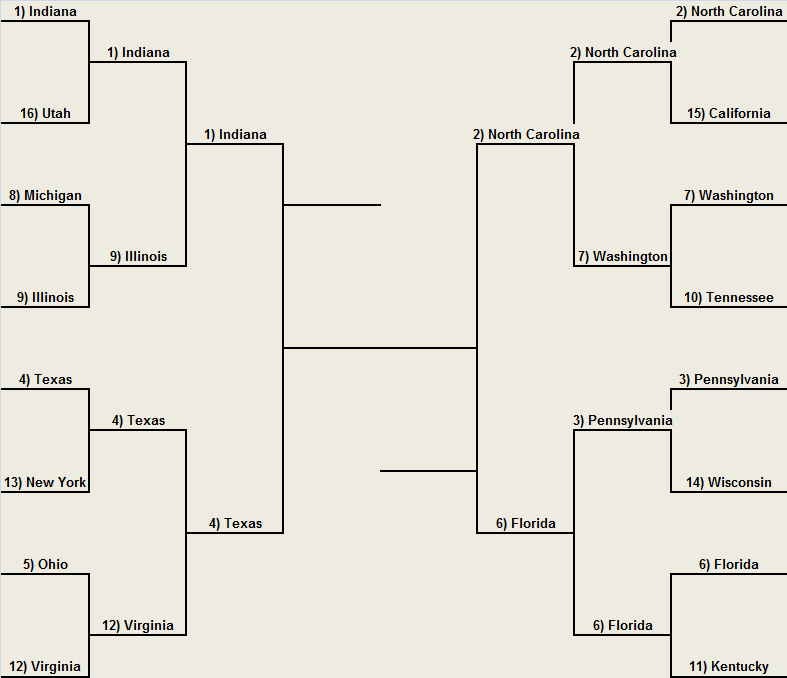
We’re now down to the Final Four of the RTC Big Four State Tournament.  Last week was the quarterfinal round, and we saw as three of the favorites (#1 Indiana, #2 North Carolina, #4 Texas) advanced to the Final Four while #3 Pennsylvania was downed at the buzzer by upstart #6 Florida.  There was a very strong public consensus among the top two seeds advancing (85% and 90%, respectively), while the fan vote was a little less confident in Pennsylvania (70%) and Texas (72%).  Of course, we here at RTC had the Sunshine State (with afternoon rain) squad coached by Billy Donovan springing the upset over PA, so it’ll be interesting to see how far we think they can continue to their run.  Here’s our current bracket, with the F4 breakdowns below. 

Final Four Matchups (Quarterfinal fan vote pct. listed)

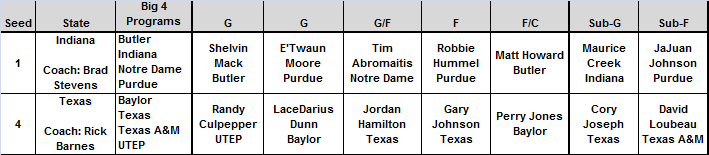
#1 Indiana (85%) vs. #4 Texas (72%)

Nitpicking is the only way to find weaknesses on the rosters of Indiana and Texas, two hoops-loaded states with a great deal of pride on the line in this anticipated semifinal matchup. The raw talent level of Texas should prove Indiana’s stiffest challenge thus far in the tournament. From the Nate Robinson-style leaping ability of UTEP’s Randy Culpepper to the physicality and shooting prowess of Texas’ Jordan Hamilton to the Kevin Garnett comparisons that Baylor’s Perry Jones is receiving before he makes his Bears debut, Indiana’s status as tournament champion favorite is in serious jeopardy. This especially rings true when Texas comes out of the gates sprinting up and down the floor, boosted by the red-hot shooting of LaceDarius Dunn, the preseason Big 12 Player of the Year candidate and the school’s all-time leader in threes made. Gary Johnson takes Robbie Hummel to the hole on a spin move and the foul. Dunn throws an alley-oop to Jones that gets the crowd on their feet and forces Indiana to use a timeout. Culpepper races from end to end for the flush. A ten-point halftime lead gives the top seed a moment of pause in the locker room.

Here’s the point where Indiana’s senior-laden roster and big-game experience becomes a factor. The collected demeanor of Brad Stevens in the locker room calms his troops, the gameplan is slightly tweaked to force Texas into a halfcourt game, the physicality of Indiana’s Shelvin Mack and Hummel is asserted, and Indiana slowly but surely drains the deficit. The steady and levelheaded Mack leads the force, hitting clutch mid-range jumpers as the shot clock winds down. Just when Texas is about to corral the momentum once again, a JaJuan Johnson rejection of Jones effectively punks the youngster. As the score inches closer and the pressure mounts on such a monumental stage, it’s Texas taking their fair share of poor shots while Indiana lives at the free throw line, led by Hummel at 90%. His four consecutive makes seals the deal and Indiana escapes by a slim margin for a spot in the finals.

RTC Choice: Indiana 68, Texas 65

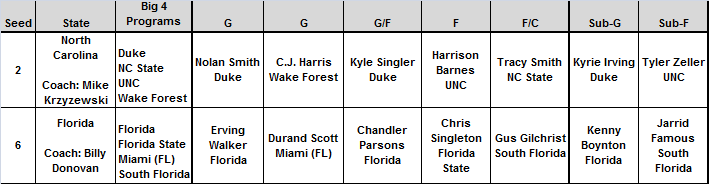
#2 North Carolina (90%) vs. #6 Florida (30%)

In an all-too-familiar situation when a Cinderella makes a run to the national semifinals, they usually come up against a seasoned, experienced and talented team who expected to be there all season long.  The result is not often pleasant for the underdog, who quickly realizes that it’s in over its head and needs to make hasty plans for a return flight later that evening.  This is what Billy Donovan’s team faced in matching up against the boatload of NBA lottery pick-level talent that North Carolina threw at them.  Predictably, the game was over in the first ten minutes.  The offensive firepower of Kyle Singler, Harrison Barnes and Tracy Smith got off early inside the paint, but it was a quick whistle (actually, series of whistles) on Florida’s Chris Singleton that set the tone early.  Three quick fouls meant that the inside defensive presence that Florida was relying upon to slow down the North Carolina bigs was no longer available.  Gus Gilchrist and Chandler Parsons, while capable offensive players, are not known for their ability to stop people, especially players the caliber that NC brings to bear. 

By halftime, Florida was already down 22 points and not only looked demoralized but also emotionally and mentally exhausted from their previous nailbiters in this tournament.  From that point on, Coach K put his guys into a cruise control situation, running clock but finding their spots, as Florida tried desperately to cut into the lead.  A couple of times Donovan’s team had cut the margin down to a 12-point game, only to watch helplessly as Nolan Smith or CJ Harris drained a three or Barnes slashed his way to another dunk.  There was no confusion as to who the better team was in this particular game, and North Carolina moved on to the tournament finals to play the top overall seed Indiana in an upcoming battle of epic proportions.  Coach K vs. Brad Stevens; Nolan Smith vs. Shelvin Mack — where have we seen that before? 

RTC Choice: North Carolina 77, Florida 62.

RTC State Tournament Championship: Thursday 9/16

Morning Five: 09.14.10 Edition

Posted by rtmsf on September 14th, 2010

  1. Delving into the phone call issue in the wake of Bruce Pearl’s self-reported violations last week, Gary Parrish anonymously interviewed ten NCAA coaches across the spectrum, and guess what, they all admitted to making impermissible calls themselves.  We certainly understand the point that several in the article make about the difference between fifteen and two hundred impermissible calls, but with so many of the coaches also agreeing that the calls make little difference in the recruit’s ultimate destination, why do they continue to do it?  Someone in this game once said not to mistake activity for achievement, and we think it might appropriately apply here.
  2. That didn’t take long.  On the Monday immediately following Wake Forest center Tony Woods’ arrest for various kinds of assault, the school suspended him indefinitely.  If the allegations against him are even remotely true, it’s doubtful we’ll ever seen him in the ACC again.
  3. Former UCLA underachiever J’Mison Morgan will be eligible to play at Baylor this winter after the NCAA approved his waiver to be closer to his ill grandmother, his legal guardian.  Normally, a player transferring in who averaged a grand total of two points and one rebound per game over two seasons wouldn’t be cause for celebration, but few players bring the high school pedigree of the 6’10 Morgan — he was a top 25 recruit in the class of 2008 and has the physical tools to be a very good player.  If the new environment suits him and he can get his head out of the clouds, Morgan could legitimately become a major contributor on a very talented Bears front line along with Perry Jones and Quincy Acy in 2010-11.
  4. Steve Lavin is settling in nicely at St. John’s, as this article from the LA Times examines from the perspective of a California boy gone east.  Maybe we’re just suckers for the boyish good looks and eloquence of Lav, but we think he’ll actually be quite successful in NYC.
  5. Would you believe that March Madness darling Northern Iowa could be on the verge of a decision to eliminate all of its D1 sports?  Mere months after the greatest moment in the school’s athletic history (Farokhmanesh!), president Ben Allen stated on Monday that with additional anticipated cuts to the athletic program budget, the school could find itself unable to compete in Division I and would consider such a seemingly drastic move.  It all comes down to dollars (always), but it’s hard for us to believe that a school with a strong basketball program and a nationally competitive football program in 1-AA would be in such dire straits.  Let’s hope the Panthers avoid armageddon on this one.

Da’Sean Butler’s Short Story, Now In Living Color

Posted by rtmsf on September 13th, 2010

This thing was floating around last week, but we never got around to posting it.  Originally, former WVU star and postseason tragic hero, Da’Sean Butler, delivered a series of tweets to tell a children’s story that could only be described as equal parts terrifying and genius.  After all, it’s not often that you read a story about a 22-year old “young boy” named Da’Sean who befriends a purple dinosaur named Barney, only have to it all come crashing down when Barney leaves a giant pile of scat on the kitchen table.

The entire bizarre story is reprinted below (h/t Sun-Sentinel via Deadspin), but the good people at Tauntr have done us one better.  They’ve come up with an animated version of Butler’s fairy tale.  We don’t have the video embedded, but if you click the image below it will take you to their site, where you can watch the entire two-minute production.  Strangely, when reading the story for the first time, this is almost exactly who we envisioned it in our heads.  Enjoy.
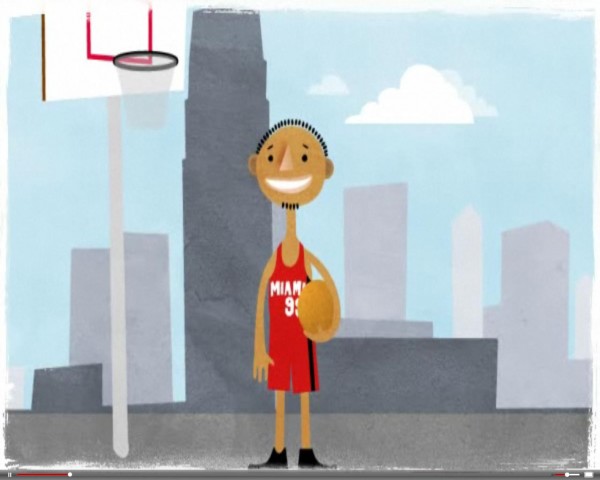
Click the Image to View the Video (credit: Tauntr)

”A SHORT STORY,” by Da’Sean Butler

Once upon a time there was a young boy named Da’Sean. Da’Sean was 22 years old and lived in Newark, NJ. While walking home from school one day, a Purple Dinosaur jumped out from behind a Brick Wall and tackled Da’Sean to the ground. But just when he was about to let out a scream for help, Da’Sean realized that the Purple Dinosaur was only licking his face, not trying to bite it off. At that moment, Da’Sean decided to keep the Purple Dinosaur as a pet. And on the way home he decided to name his pet Purple Dinosaur “Barney.”

When Da’Sean and his new pet finally got home, guess who was standing on the front porch? That’s right, it was Da’Sean’s mother, Koreena. And boy was she surprised to see a Purple Dinosaur following Da’Sean into the yard! “What in world is that?” shouted Koreena. “It’s a Purple Dinosaur,” answered Da’Sean. “Dah, I can see that, Da’Sean, but what on earth is it doing here?” said Koreena. “It’s my new pet!” answered Da’Sean. “Oh you think so do you?” remarked Koreena. “I wouldn’t get your hopes up. You know how your father hates Purple Dinosaurs. But, well, I suppose you can keep him until your father comes home.” And with that Da’Sean grabbed Barney by the scruff of the neck and led his new pet into the house–even though he knew his father was probably going to disapprove.

Once in the house, Da’Sean and Barney played and played, that is until Da’Sean’s favorite television show, “Family Guy,” started. At that point Da’Sean forgot all about Barney having an unsupervised run of the house. That is until half way through “Family Guy,” when Da’Sean was brought back to reality when he heard his father shout, “OMG!! Da’Sean! Get your whoopie cakes in the Kitchen…NOW!!” With that Da’Sean rushed into the Kitchen to see what all the fuss was about. When he entered the Kitchen, there stood his father, Da’Sean Butler, pointing toward the Table. “Will someone please explain that?” asked his father. Then, as Da’Sean followed his father’s finger to where it was pointing, he instantly knew what his father was so upset about. There, smack dab in the middle of the Table, the biggest pile of Dinosaur doo-doo he had ever seen! “I don’t EVEN want to know how that got there,” said Da’Sean Butler. “But you had better get it cleaned up now! And you had better get rid of whatever it is that could have done such a thing!”

Well, knowing his father as well as he did, Da’Sean knew there was no sense even asking his father if he could keep Barney for a pet. So without hesitation, Da’Sean set out to find where Barney was hiding. After a few minutes of looking, Da’Sean discovered Barney crouched beneath the table that Da’Sean did his Playing X-Box and reading books.

“Come on, Barney, it’s time to find you a new home. And hey, don’t look at me that way, I’m not the one who did the dirty deed on the Table!” scolded Da’Sean. “Thanks to you I’ll never get to have my own pet Dinosaur!! And with that Da’Sean led Barney out of the house and down to the local Game Stop. They had a pet section and Da’Sean knew the owner would find Barney a good home. Da’Sean cried a deep cry. he had lost his only friend in the world.

So after saying good-bye to Barney, and thanking the owner of Game Stop, Da’Sean walked backed home and attempted to drowned his sorrows by slamming down a half dozen Root Beers. But Da’Sean’s pity party came to an abrupt end when his father reminded him about the mess he had neglected to clean up. And low and behold, midway through the clean-up, Da’Sean suddenly became thankful that someone else was going to have to do it from now on.

The End.

Moral of the story: Sometimes you best friends can get your “whoopee cakes” in a lot of trouble be sure to listen to your parents they know what’s best.

College Basketball’s Unmentionable: the Issue of Point Shaving?

Posted by rtmsf on September 13th, 2010

It’s not often that we stumble across academic research papers these days, but last week we happened upon one from the Department of Economics at Temple University in Philadelphia entitled, “Point Shaving in NCAA Basketball: Corrupt Behavior or Statistical Artifact?”  In the paper, Professors George Diemer and Mike Leeds use various statistical analyses to conclude that not only does point shaving regularly occur in college basketball, but it occurs in two specifically defined situations.  Their conclusion builds upon prior work by Professor Justin Wolfers at Penn’s Wharton School, who found a few years ago that approximately 1% of lined NCAA basketball games fell into an outlier suggestive of gambling-related corruption (the math works out to approximately thirty games per year).

This is the Only Shaving the NCAA Wants to See

Using data from a comprehensive sample of 35,000+ lined games from 1995-2009, Diemer and Leeds confirmed Wolfers’ underlying finding — statistical indicators suggest that point shaving in college basketball exists — while giving us a richer explanatory context of when it happens.  So when does it happen?  According to the authors, the data shows that the higher a point spread goes, there is greater statistical evidence of an increased incidence of point shaving.  In other words, there is a greater likelihood of favorites shaving off a few points when they’re favored by twenty points than there is when they’re favored by fifteen, ten or five points.  The intuitive logic behind this premise is that in games with large point spreads, the favorite (a far better team) can afford to give up a couple of meaningless buckets to its opponent at the end of the game because it will not impact the primary outcome — the favorite still gets the win, regardless of whether it wins by nineteen or fourteen points.  Conversely, in games with  increasingly smaller point spreads, players (or coaches, or referees) trying to shave points would have to walk a very fine line between trying to still win the game while simultaneously staying under the point spread threshold.  Given the thousands of confounding factors facing any one person trying to manipulate a final score in such a way at the close of a game, this scenario would seem much more difficult to pull off.

The second qualifier that Diemer and Leeds found was that the statistical tendency for the incidence of point shaving to increase along with the betting line only holds during regular season games; during the postseason (conference tournaments, the NIT, and the NCAA Tournament), there is no such effect.  The logical premise supporting this contention is similar to the above —  in postseason games, there is a much greater level of importance from all parties involved (not to mention public attention) to perform at peak capacity from start to finish throughout the game.  During the regular season, where presumably every team lives to play another day, this underlying motivator is less so.
Economists Are Better At This Than Us

You’re probably wondering how the authors can know something is fishy simply from looking at a bunch of excel spreadsheets of point spreads and game results over fifteen years.  After all, it’s not like they can show specific instances of point shaving by anyone in particular (such as Toledo’s Sammy Villegas), nor can they isolate which individual games were the most likely candidates of corruption.  They can only tell us that, given a normal expectation of how data aggregates in a gambling market, there are some trends that cannot simply be explained by random chance.  Similar to determining that numerous Chicago public school teachers were helping their students cheat on standardized exams or any number of other economic studies to explain human behavior at the macro level, the answer is that this is what economists do.

Obviously, just because it’s their job doesn’t make it sacrosanct.  Anticipating some criticism of the study, we asked Diemer and Leeds specifically about two possible issues with their findings.  First is whether the concept of line shading — when bookmakers move their betting lines one way or another to maximize their own profits — impacts their findings.  After all, if the assumption is that a gambling marketplace seeks to establish equal wagering from bettors on both sides of the point spread, then movement away from that magical 50/50 nexus could sway performance (i.e., the point spread doesn’t represent the true market odds).  The authors refute this by suggesting that if bookmakers were manipulating the line in such a manner, then the data would still represent as a symmetrical distribution — but it doesn’t.  No matter where the data falls on the curve, it shows the same result: as point spreads increase, there is a greater incidence of point shaving.

Read the rest of this entry »

Recruiting Rumor Mill: 09.13.10 Edition

Posted by nvr1983 on September 13th, 2010

Which way will Quincy Miller go?

Morning Five: 09.13.10 Edition

Posted by rtmsf on September 13th, 2010

  1. We can’t prove it statistically, but anecdotally it seems like every year at the start of the fall semester players just can’t help themselves from getting into all kinds of trouble.  Wake Forest’s Tony Woods is the latest knucklehead, as the 6’11, 250-lb. center was arrested late last week on charges of assault inflicting serious injury, assault on a female and assault with a minor present (his 1-year old child).  According to the official statement from his girlfriend/victim, he allegedly pushed and kicked her on Labor Day, resulting in a fractured spine and a probable loss of his freedom if these claims are substantiated.  Woods was once a highly-regarded (top 25) recruit of whom great things were expected, but he’s been relatively slow on the uptake, averaging only 5/3 in thirteen minutes per game last (sophomore) season.  If these allegations are true, he’s slow in more ways than one, and we hope he doesn’t see a junior or senior campaign at Wake or anywhere else.
  2. St. Mary’s is set to add a key transfer piece to its backcourt, as sources tell us that SMU transfer Paul McCoy is enrolled and already taking classes at the tiny school in Moraga, California.  The 5’11 guard from Portland was an all-CUSA freshman two seasons ago, averaging 13/4/3 APG as a full-time starter, but tore his ACL in February last season and missed the remainder of his sophomore year.  McCoy will be eligible to play in 2011-12, conveniently exactly when SMC will need a seasoned point guard to take over for the departing starter, Mickey McConnell.
  3. According to Commissioner Larry Scott, the Pac-10 does not expect Colorado to join Utah in its new twelve-team configuration for the 2011-12 academic year due to financial considerations.  He gave the possibility a less than 50/50 chance, but said that if the league has eleven teams next year, they will retain the name Pac-10 until the twelfth team, CU, shows up in 2012-13.  One other interesting note from this article: much like the Big Ten, the league does not anticipate a split into two divisions in sports other than football.
  4. As we wrote about on Friday night when the news hit, Tennessee announced self-imposed sanctions on its basketball program, including specific restrictions on Bruce Pearl and his top assistants leaving campus to recruit and sizable givebacks (~$2M) from their salaries.  The issue, of course, wasn’t as much the illegality of numerous phone calls to recruits as much as the fact that Pearl  lied to NCAA investigators about something during the investigation.  As Michael Rosenberg discusses in his article, that’s a serious transgression that could have gotten many less successful coaches fired.  Pearl appears that he will survive, and two players in his 2011 recruiting class — Chris Jones and Kevin Ware — have already re-affirmed their commitments. This is understandable given they’re already sold on the program; the concern for UT fans will be what impact having Pearl out-of-sight/out-of-mind on the recruiting trail during the next year might bring.  And then there’s the question of whether these sanctions could satisfy the NCAA — according to Gary Parrish, it could actually get worse.
  5. For what it’s worth, at least one head coach (and undoubtedly many others) has no sympathy for Pearl’s current plight, especially given that he dropped dime on Illinois twenty years ago over the recruitment of hotshot high schooler Deon Thomas.  In the late 1980s, recently retired Illinois-Chicago head coach Jimmy Collins was an assistant for Lou Henson’s Illini, and it was he who bore the brunt of Pearl’s allegations with the NCAA.  Even though Collins was ultimately cleared of wrongdoing, he remained stigmatized by the incident, and he felt that Pearl’s holier-than-thou attitude was irresponsible and baseless.  We’re certain that Collins watched Pearl’s mea culpa (below) with a certain amount of satisfaction.

<a href="http://msn.foxsports.com/video?vid=e71e3e3c-fce5-40e8-985a-ea8c8be4ec01" target="_new" title="">Fire alarm doesn&#8217;t faze Pearl</a>

Tennessee Hits Bruce Pearl Where It Hurts (His Wallet)

Posted by nvr1983 on September 10th, 2010

While most of the college basketball world has been focused on the ongoing Enes Kanter saga at Kentucky, the  first real punishment of off-season was handed out today to the Wildcats’ SEC rival in Knoxville where the Tennessee administration determined that Bruce Pearl lied to NCAA investigators about excessive recruiting calls made by the Volunteer coaching staff. According to Pearl’s statement, he lied to NCAA investigators during a meeting they had in June about those phone calls (like Kelvin Sampson at Indiana), but due to overwhelming remorse he came to the Tennessee administration with the truth the following month. Upon hearing these revelations the Tennessee administration decided to take preemptive action, as many programs have, in an attempt to lessen NCAA penalties against them. Along with the usual punishments like decreasing the number of official visits recruits can make and limiting recruiting by the staff, they also took the unusual measures of banning Pearl from recruiting off-campus for a year (from September 24, 2010 through September 23, 2011) and essentially taking back $1.5 million of his salary over the next five years, as well as reducing the salary of three assistant coaches by 25% and banning them from recruiting off-campus for anywhere from three months to one year (official document with penalties here).

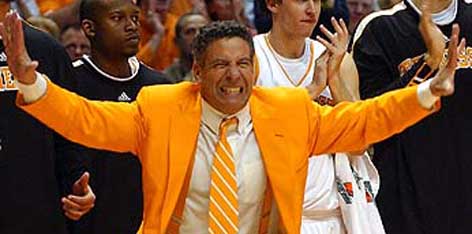
Bruce just realized that he lost a lot of money

While this doesn’t mean that the NCAA won’t take additional action against Tennessee, the move is somewhat refreshing in that a major university has finally gone after a coach’s salary for his egregious errors instead of nebulous concepts like rescinding 1-2 recruiting visits per year, although Pearl won’t be on a street corner begging for money any time soon, as he is still scheduled to collect $1.4 million from coaching in 2011 (plus whatever else he gets from endorsements and speaking engagements). The bigger problem for Tennessee’s program will be the off-campus recruiting ban which should have a marked effect, assuming he doesn’t start racking up the cell phone minutes again (the thing that got him into this mess in the first place). Fans of rival programs are understandably giddy at this news, particularly with Pearl’s reputation as a “snitch,” having turned in Illinois for allegedly paying recruit Deon Thomas (full memos here) while Pearl was an assistant at Iowa. Although the Illini were never found guilty of any wrongdoing related to Thomas, the ensuing investigation led NCAA officials to unearth several other violations that led to recruiting restrictions and a one year postseason ban for the Illini. Since that time, Pearl has carried the negative stigma as a “snitch” around with him and many believe it is what prevented him from getting a prominent job for such a long time. As you can imagine, many fan bases will be more than happy to remind Pearl of his wrongdoing and his penalties when the Volunteers are on the road this season.