










Behind the Numbers: The Coming Decline
Posted by KCarpenter on December 15th, 2010
So, let’s play a game. I tell you that I’m going to flip a coin (let’s say a 2009 U.S. quarter) exactly thirty times. Your job is to guess how many times that the coin is going to come up “heads.” Very cleverly, you notice that that typically a coin comes up heads about 50% of the time, so you should guess that, in this game, you will get heads about fifteen times. Okay, so I flip the coin the first five times and, surprise of surprises, I end up getting heads four out of five times. Does this mean you were wrong? Does this mean that the coin will continue to turn up heads at a 80% clip? Of course not. It’s just that variance is “magnified“ in small sample sizes. If we flip the coin the full thirty times, it’s almost certainly going to turn up heads less than 80% of the time.
Obviously, we are here not here to talk about flipping coins, but rather college basketball. So, what’s the relevance? The relevance is that right now, we are about a third of the way through the college basketball season and people are pointing to extraordinary statistics and acting as if they are going to hold up through March and April. The coin won’t turn up heads 80% over a big enough sample size, and Pittsburgh won’t continue to grab 47.9% of offensive rebounds against its opponents. Some of the extraordinary stats in college basketball are simply due to small sample size. Some teams tasting truly rarefied air in December are destined to fall back to Earth come March. Who’s due for a decline?
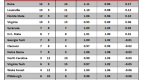
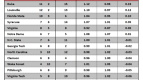
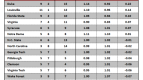
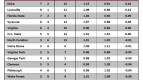
Glad you asked. What I’ve done is checked up on who was the leader on the offensive and defensive ends of the court in regards to each of Dean Oliver’s Four Factors at the end of the 2009-10 season. Then, I checked Ken Pomeroy’s rankings to see which teams were currently performing better than the very best team from last year. The logic is simple (and admittedly a little simplistic): It’s unlikely that many teams this season are going to perform too much better than what the best team in a given category did the year before. Unsurprisingly, at this point early in the season, there are quite a few teams performing better than any team performed last year. Let’s break it down category by category and figure out which teams are cruising for a bruising. Or a decline in efficiency. One or the other.
Effective Field Goal Percentage
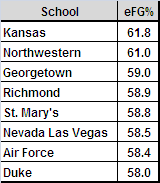
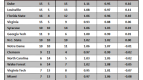
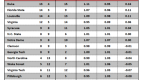
None of these teams are shooting that much better than 2009-10 Denver (57.9%), but still, betting on Kansas or Georgetown’s shooting to cool off isn’t a bad bet. It’s a little early to predict Duke’s shooting to decline, but if Kyrie Irving’s absence isn’t explanatory enough for you, here’s another reason.