


Arizona Week: Wrap-Up
Posted by AMurawa on July 1st, 2012Our look at the Wildcat basketball program is all wrapped up, but if you missed anything, you can find all of the posts here.



Our look at the Wildcat basketball program is all wrapped up, but if you missed anything, you can find all of the posts here.
Our first matchup of the summer pits top seeded David Piper (Addicted to Quack) up against the eight seed, Jack Follman (Pacific Takes). Below are the rosters, followed by commentary from the respective owner:
David Piper
Head Coach – Pete Newell, California
Guard – Terrell Brandon, Oregon
Guard – Harold Miner, USC
Guard – Andre Miller, Utah
Guard – Aaron Brooks, Oregon
Forward – Luke Jackson, Oregon
Forward – Greg Ballard, Oregon
Forward – Keith Van Horn, Utah
Forward – Adam Keefe, Stanford
Center – Sidney Wicks, UCLA
Center – Brook Lopez, Stanford
David’s Take:
Obviously, all of these teams are filled with great players, but none are as versatile as mine. At the guard spots, I have two of the best all-time scorers at guard in Terrell Brandon and Harold Miner, who both averaged over 27 PPG a game, but Brandon and Andre Miller are also two of the better distributors in league history, while Aaron Brooks is lightning quick and has unlimited range. Miller and Brandon, two of the better all-around guards not only in college, but in the NBA over the last two decades, are both fantastic defenders as well. In the frontcourt, three of the forwards are 20/10 guys while the fourth is one of the best all-around forwards in league history. Keith Van Horn nearly won a national title at Utah, and has the ability to go inside out, while Adam Keefe was a physical banger at Stanford who went for 26-12 his senior year. Greg Ballard’s was the equal of Marques Johnson, drafted two rounds earlier, he just didn’t have the name “UCLA” on his jersey, and Luke Jackson was a triple-double waiting to happen who could score from anywhere on the floor and once had 39 straight in a game. At center, Sidney Wicks was a national player of the year who won a national title at UCLA while, Brook Lopez is a 20/10 seven footer. My team has four first-team All-Americans (Miller, Van Horn, Jackson, and Wicks) and two national players of the year (Wicks and Van Horn).
But, most importantly, there isn’t a thing this team cannot do. I can put out guard combinations that score at the rim, from three, or distribute. I can put in posts who will score back to the basket, or hit jump shots. Only Brooks isn’t a great rebounder or defender; everyone else is plus in both areas. Oh, and they are coached by national champion Pete Newell, who, if not for health reasons, would be the greatest coach ever (and is the only coach in conference history to have a winning record over John Wooden).
We been all around the Arizona basketball program this week, but we’ve got one last post to go, the one in which we step way back and look at the big picture of the program, not just looking at what the next season holds, but the overall trajectory of the program. Given the stunning success the program enjoyed under legendary head coach Lute Olson, it is no secret that the last few years have been sub-par. Two NCAA Tournaments missed in the last three years is especially galling to a program that ran off 25 straight appearances, but that’s in the past now. What should – and what will – the next decade or more of Arizona basketball look like?
Following Lute Olson’s Unprecedented Run Of Success In Tucson, The Expectations In Tucson Will Always Be High
Prior to Lute Olson, Wildcat basketball was an afterthought on the national scene. But after 11 Pac-10 titles in 25 years, with 11 Sweet 16s, four Final Fours and a national title mixed in there, Arizona is without a doubt an elite program, a solid #2 program in their conference (for evidence of how strong a program Arizona is, watch some of their fans take offense at being referred to as the #2 program in the conference). Olson established Tucson as a legitimate landing spot for elite recruits from around the country. Further, upgrades to the basketball facilities which began under Olson have continued under new head coach Sean Miller. Between the McKale Center and the Richard Jefferson Gym, the Wildcats enjoy excellent facilities, even if the 41-year old McKale is no longer exactly state-of-the-art, a fact more than made up for by the consistent fan support that building houses.
As for Olson’s replacement, despite the two missed NCAA tourneys in Miller’s first three seasons, the new head man has a history of success, taking Xavier to four tournament appearances in his five seasons there, including two Sweet 16s. And the Elite Eight run in his one NCAA appearance at UA has not only earned him time, but it has earned him the confidence of his fanbase and the trust of recruits, who saw Derrick Williams rise from an afterthought as a recruit to the second overall pick in the 2011 NBA Draft. In short, Miller has credibility not only for those close to the UA program, but for the recruits who he’ll need to entice to the desert to get the ‘Cats back to their perch atop the Pac-12.
And really, those are the rightful expectations for the Arizona program: consistently competing for and winning conference titles, regularly advancing deep into the NCAA Tournament and occasionally landing in the Final Four. A national title every decade or two wouldn’t hurt either. Lute Olson set a high bar for the program, and while his run of success is the exception, rather than the rule, over the long arc of the program, it is, for better or worse, the standard for the modern-era of Arizona basketball. Basketball fans around the nation expect the Arizona program to be an unfailing national force, playing ridiculously tough regular season schedules, making NCAA Tournaments annually, pipelining players to the NBA. It is a realistic goal for the program because it has been done before. And barring a major change in culture, that is the expectation for all future head coaches at UA. There will likely be coaches in the future who are not up to that challenge, just as UCLA, Kentucky and North Carolina, for instance, have made missteps in hiring for the head seat. And the leash that those coaches get will not always be long. But, forever and anon, the expectations in Tucson will be vast. As they should be.
We’ve spent the week with the Wildcats, and if you’ve followed along, you’ve likely got your own opinions about what the 2011-12 season will hold in store for Arizona. Can Mark Lyons strike the right balance between distributor and scorer at the point? How quickly can the three freshmen bigs make an impact? Which, if any, of Nick Johnson, Kevin Parrom or Angelo Chol will have a breakout year? And can this Wildcat team lay the foundation for another long run of consecutive NCAA Tournaments? If you’re anything like us, I’m sure you can’t wait to find out the answers, but for now we’re going to have to settle for a glance into RTC’s quite imperfect crystal ball. From what I can glean, here’s how the Arizona season plays out.
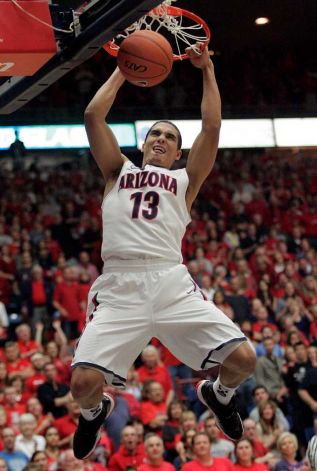
Nick Johnson Could Be The Wildcat Most Poised For A Breakout Season (Willy Low, AP)
As we head toward closing out our coverage of the Arizona basketball program in our third of a summer-long series of in-depth looks at Pac-12 schools, we’re inviting Adam Butler of Pachoops back in to give us his thoughts on the big questions facing the Wildcats in 2012-13. Adam gave us a hand yesterday with our Burning Question of the week, and we hope to have him back from time to time to add his unique perspective. Without further ado, here’s what we came up with:
RTC: Let’s dig right in here Adam, starting from the top of the program. So, in 29 seasons since Lute Olson took over the Wildcat program, the team has missed the NCAA Tournament exactly three times: Olson’s first year, and then two of the three years under current head coach Sean Miller. Yet, it seems there is a confidence around the program that not only do they have the right coach, but that big things are on the verge of happening again in Tucson. Do you hold that view as well? And why or why not?
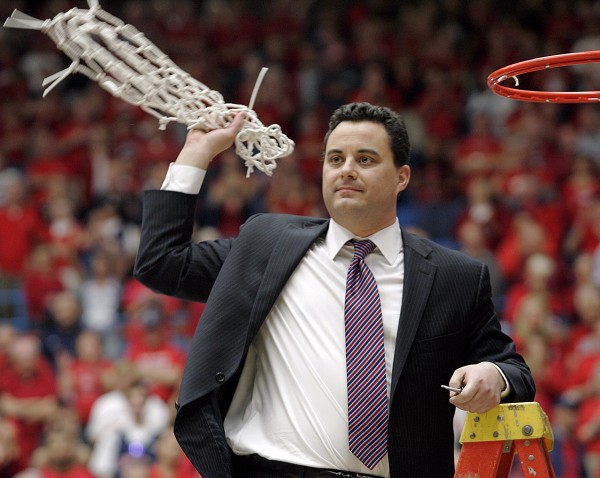
Arizona Has Missed The NCAA Tournament In Two Of Sean Miller’s Three Seasons In The Desert, But Arizona Fans Still Have Faith In Their Head Coach (AP Photo)
AB: Oh the Lute years were sweet. Arizona was no worse than a five-seed for 16 straight tournaments. Do you realize how awful March 2010 was for me? I literally fled the country. But I’ve digressed. Yes, I think Sean Miller is on the verge of very big things. He’s a phenomenal coach and has already demonstrated such in very short order. He took a bare cupboard and turned that into an Elite Eight; and before we get too far down the road talking about how that 2009 class fell into his lap, it did fall into his lap and those kids could’ve gone anywhere. But they chose Miller for a reason. And my impression of that reason is that he’s piecing together a very special something in the desert. I like to use Indiana’s rebuilding as a barometer and if you look at where they are following Kelvin Sampson bottoming them out, Tom Crean is in year five with the top team in the country in the preseason. Last season – year four – was their first taste of big success again. Arizona has essentially followed the same trajectory (2010-11 was a glorious anomaly), and finds itself with a very sound roster here in Miller year four and project to have a filthy year five. Here, let me pass you the Kool-Aid.
RTC: While the 2012-13 version of the Wildcats will have five returnees from last season, all of whom should get some run, it is a group of four highly touted freshmen and incoming transfer Mark Lyons who give the program the most cause for optimism. Let’s start with Lyons. He’s not a true point, is more of a shoot-first guy and his most recent head coach, Chris Mack, didn’t seem all that sad to see him transfer. Can he really be the type of point guard to help meld together some talented returnees with a frontcourt-heavy freshman class?

Who’s Got Next? is a weekly column by Josh Paunil, the RTC recruiting guru. We encourage you to check out his website dedicated solely to college basketball recruiting, National Recruiting Spotlight, for more detailed recruiting information. Once a week he will bring you an overview of what’s going on in the complex world of recruiting, from who is signing where among the seniors to who the hot prospects are at the lower levels of the sport. If you have any suggestions as to areas we are missing or different things you would like to see, please let us know at rushthecourt@yahoo.com.
Lead Story: Class of 2013 Point Guard Monte Morris Commits To Iowa State
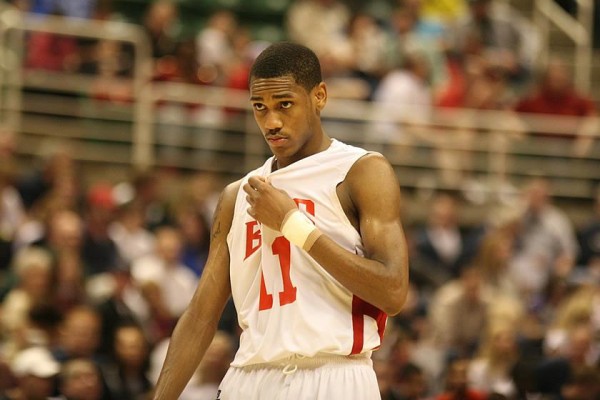
Floor General Monte Morris Is Iowa State’s Second Top-100 Guard For the Class of 2013.
Point Guard Gives Cyclones Second Top 100 Guard in Class of 2013. The only person who may have enjoyed Class of 2013 point guard Monte Morris‘ 17th birthday Wednesday more than the Michigan native is Fred Hoiberg as the four-star floor general committed to Iowa State. Morris is Iowa State’s second top 100 guard commitment in the Class of 2013, joining shooting guard Matt Thomas. Morris spurned offers from the likes of Indiana, Georgia Tech and USC to play at a less prestigious school although the Cyclones’ national profile has been improving because of Royce White (who in RTC’s NBA Draft Profile projects as a late first round pick) and Hoiberg’s success in the Class of 2012 with power forward Georges Niang (#52) signing. Morris is a big-time pick-up because of his ability to create scoring opportunities for both himself and his teammates. He is a smooth floor general with a good basketball-IQ and pretty good range beyond the three-point line. He has been improving his mid-range game as well but Hoiberg is turning Iowa State into a legitimate player for top 100 prospects year in and year out.
What They’re Saying
The 2012 NBA Draft has come and gone in what was a fairly quiet night in terms of trades around the league, but Thursday could also become an historic draft given how deep the pool of talent was. We may look back on this draft as one of the great ones in recent history, but that remains to be seen. For now we can take a look at the immediate winners and losers, and we’d like to run down which schools made the biggest hits and suffered big misses on draft night. For instance, which teams sent multiple lottery picks or were responsible for the biggest risers in the draft? Which teams saw their prospects slip out of the first round or not get drafted at all? Here’s our list of the top five winners and losers last night from the college game.
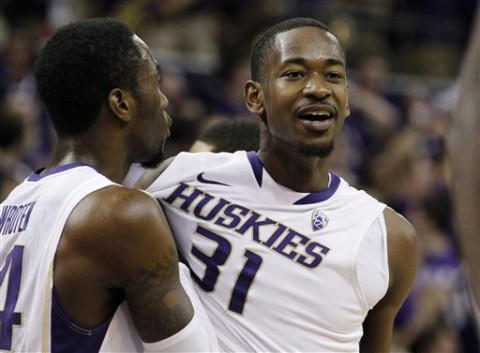
Tony Wroten, Jr. and Terrence Ross (right) from Washington were both selected in the NBA Draft’s first round (AP Photo)
WINNERS

We took you through the picks of round one earlier this month, and now it’s time to look at the entire draft as a whole. 88 selections of the best ever Pac-12 coaches and players have been made, the rosters have been filled out, and voting is set to begin later this week. But first, here’s a look at rounds 2-11:
Round Two
#1 – Terrell Brandon, Oregon
#2 – Ed O’Bannon, UCLA
#3 – Marques Johnson, UCLA
#4 – Kevin Love, UCLA
#5 – Slats Gill, Oregon State
#6 – Don MacLean, UCLA
#7 – Gail Goodrich, UCLA
#8 – Byron Scott, Arizona State
Round Three
#1 – A.C. Green, Oregon State
#2 – Walt Hazzard, UCLA
#3 – Lute Olson, Arizona
#4 – Isaiah Thomas, Washington
#5 – Jason Terry, Arizona
#6 – Andrew Bogut, Utah
#7 – Damon Stoudamire, Arizona
#8 – Greg Ballard, Oregon
Round Four
#1 – Keith Van Horn, Utah
#2 – Shareef Abdur-Rahim, California
#3 – Mike Montgomery, Stanford/California
#4 – Russell Westbrook, UCLA
#5 – Chauncey Billups, Colorado
#6 – Brandon Roy, Washington
#7 – Miles Simon, Arizona
#8 – Detleff Schrempf, Washington
Round Five
#1 – Kevin Johnson, California
#2 – Ike Diogu, Arizona State
#3 – Jamaal Wilkes, UCLA
#4 – Kiki Vandeweghe, UCLA
#5 – James Harden, Arizona State
#6 – Mel Counts, Oregon State
#7 – Mike Bibby, Arizona
#8 – Harold Miner, USC
Round Six
#1 – Adam Keefe, Stanford
#2 – Todd MacCulloch, Washington
#3 – David Greenwood, UCLA
#4 – Tracy Murray, UCLA
#5 – Baron Davis, UCLA
#6 – Christian Welp, Washington
#7 – Ron Lee, Oregon
#8 – David Meyers, Washington
In this week’s Burning Question, along with the usual suspects from your friendly neighborhood RTC Pac-12 microsite, we’ve invited Adam Butler of Pachoops to weigh in on this week’s big question about the Arizona program. Without further ado, here it is:
Mark Lyons arrives in Tucson, along with a heralded freshman class. In the absence of other enticing options at the point guard, can Lyons earn a spot among the great names in Point Guard U’s history? Or is he merely a stopgap solution on the way to something else?
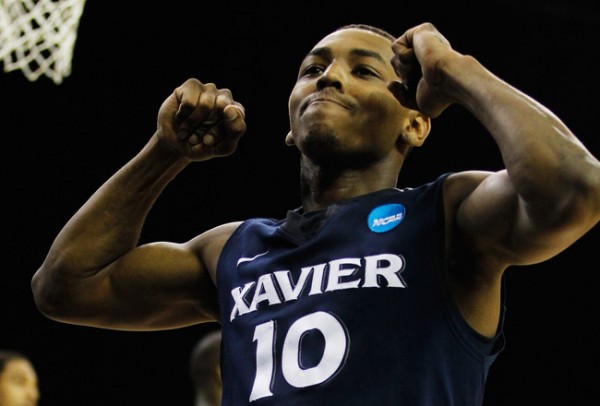
We Know Some Of What Mark Lyons Can Do, But Can He Run A National Championship Contender? (Streeter Lecka, Getty Images)
Adam Butler: As stop gaps go he’s certainly a better option than Curtis Painter but let’s dive deeper. The kid’s already been to four NCAA Tournaments and three Sweet Sixteens; he’s won three conference titles (counting his redshirt season) and twice been an All-Conference performer. His resume speaks for itself as he’s coming off a 15/3/3 season. But here’s what you aren’t going to read in his player bio: he’s playing for the coach he initially committed to; he’s finally getting a shot to prove he’s a worthy PG; and it’s his last opportunity to demonstrate that he’s not a disruptive malcontent. So what am I getting at? It’s do or die for Mark Lyons who controls his own destiny into PGU-lore. He and Arizona have somewhat serendipitously found one another in their respective time of point guard need and I have to think both parties will thrive. By some accounts Lyons is going to step onto this roster as the most talented player and – as previously stated – he’s stepping onto a pretty talented one. But what I believe makes Lyons more than a stopgap player is the toughness, swagger, grit, that je ne sais quoi that was so glaringly missing from the Wildcats’ 2011-12 team; an imperative component to any Sean Miller squad. Because of this I think Lyons’ role is bigger. He’s some version of a tone setter, helping to re-cement exactly what Arizona Basketball is. Of course all of my aforementioned high reward doesn’t come without high risk. He very well could be a disruptive malcontent on a formative and youthful team. His immediate emergence as starter and primary ball handler could cause discontent amongst the returners. His ballyhooed toughness may upset a team perceived as soft. So as all things high risk/high reward go, we’ll wait and see. Should be a good watch.




 Overnight 5: February 16, 2023
 2021-22 Rush The Court Preseason All-America TeamsRTC 16: 2021-2022 Pre-Season Rankings
 Preseason Stock Report: Buy Now
 Preseason Stock Report: Bear Market
 2020-21 Rush the Court All-America Teams and Yearly AwardsEight Questions for the Final FourEight Key Questions for the Sweet Sixteen16 Questions For First Round Saturday of the NCAA Tournament16 Questions for First Round Friday of the NCAA Tournament