










Winners & Losers From Conference Realignment (so far)

Posted by rtmsf on June 18th, 2010

Andrew Murawa is the RTC correspondent for the Pac-10 and Mountain West conferences and an occasional contributor.

With the news on Thursday that Utah has received and accepted the invitation to become the 12th member of the Pac-10, it looks like the college sports realignment apocalypse has been averted for the summer. There may be further movement on down the line, but all signs point to a relative period of calm after weeks of frantic scrambling from all corners of the country. While it was a pale substitute for actual on-court play, we did have plenty of intrigue and suspense, action and strategy, and winners and losers. Now it’s just a matter of sorting out who was what.

The Greatest and Still Champion

Texas

A Lot to Be Happy about in Austin These Days

Texas definitely fits in the “winner” category, but I think lumping them in with these other schmucks below would be selling them short. And I’m sure they would agree. The Longhorns played this about as well as could be played, and they got everything they wanted out of it. The Big 12 keeps their television deal with ESPN (which doesn’t expire until 2016), but only has to share the proceeds among ten schools rather than twelve. The conference received a promise from Fox for a new deal when their current deal expires, with exponential increases in revenue on tap. And, on top of all that, Texas retains the right to sell local television rights and is free to explore its plans for a Longhorn television network. Bonus: in the process of trying to keep the Longhorns in the Big 12, there are reports that the neediest institutions in the bunch agreed to a plan that sent all of the money that Colorado and Nebraska owe the conference in buyout fees (reported to be somewhere between $10 and $40 million, depending on the source) to Texas, Texas A&M and Oklahoma. So, in the span of a week, without losing any of their traditional rivals in the Big 12 South, Texas goes from generating somewhere in the $12 million range in television revenues to earning an estimated $20-25 million annually. And, that’s not even the best of it. In the process, it became painfully obvious that Texas is the big dog in the conference and the other schools (aside from Texas A&M) are in some manner, just riding coattails. Schools like Oklahoma and Texas Tech made it clear that they were just going to do whatever Texas did, while others, like Missouri, Kansas, Iowa State and Baylor, had their futures twisting in the wind, reliant on Texas to save them. If the Longhorns had gone to the Pac-16, they would have just been one of the sixteen there. By staying at home, they are clearly the kings of their conference.

The Winners

Texas A&M

The Aggies showed themselves as the one school in the conference that had plans of their own regardless of Texas. While Oklahoma and others were happy to just do whatever Texas decided, A&M talked to the SEC, and by all reports, actually had an offer to join that conference. But, in the end when they could have run off and forced Texas’ move west, the Aggies agreed to stick around and share in the league’s windfall, excellent news for an athletic department that was $16 million in debt, and even better for a school whose once proud football program has fallen on hard times in the past decade.

Big 12 Basketball

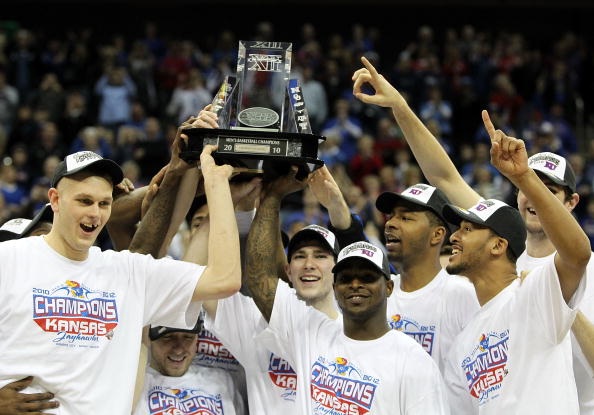
Without a doubt, the Big 12 became a better basketball conference overnight. Over the last nine years, both Colorado and Nebraska have had an average finish of around ninth in the conference. Nebraska has never won an NCAA tournament game. Colorado has only had two NCAA tournament berths in the last 40 years. So as far as the basketball side of the equation goes, this is addition by subtraction at its finest. As the conference makes the transition to an 18-game schedule in which each team will play a full home-and-home round-robin, they will no longer have to worry about games against the Buffs or Huskers dragging down their RPI. Every night in the conference will be tough sledding, but every team in the conference will also have a better chance to build their resume for postseason play.
Watch Out, Big East and ACC...

Chip Brown and Orangebloods.com

Chip Brown has been the point-man on conference realignment for about two weeks now. He broke the original story about Texas dragging five other Big 12 schools to the Pac-10, and when Texas blinked in the 11th hour, it was Brown who had that story first as well, even in the face of ESPN reporting the opposite. In the process, Brown, a former writer for the Dallas Morning News, has seen his Twitter followers increase exponentially, and the profile of Orangebloods.com, a Longhorn Rivals site of which he is part owner, has jumped from something that was only known amongst the most attentive Longhorn fans to an important resource for those of us following this story.

Utah

The Utes received just $1.2 million in television revenue from their association with the Mountain West Conference. Presently Pac-10 schools earn somewhere in the $10-$12 million neighborhood from their television contracts, and with the Pac-10 set to negotiate a new television deal which will begin the 2011-12 season, the Utah athletic department stands to make a nice chunk of change for very little trouble.  While the basketball program is going through a rough patch presently, it wouldn’t surprise anyone to see the Utes be right in the thick of things in the Pac-10 football chase immediately.

ABC/ESPN and Fox Sports

Both networks stepped in to help save the Big 12. ABC/ESPN agreed to keep their current contract with the Big 12, allowing the ten remaining members to split the revenues that had previously been divided amongst twelve. Fox Sports also agreed to large increases in their agreement with the Big 12 which expires next offseason. If Texas had bolted for the Pac-10 along with five other Big 12 members, both ESPN and Fox Sports would have had a major bidding war on its hands for the rights to the new Pac-16 conference television deal. The breakup of the Big 12 would likely have meant other moves by the Big Ten or SEC or ACC, moves that could have resulted in their contracts needing to be reworked. In the short term, both entities probably overpay for the Big 12 rights, but they saved themselves plenty of cash in the long term.

Big Ten

While it may have appeared to be the first rat on the way out before the ship went down, Nebraska’s move to the Big Ten makes a lot of sense, at least football-wise. Adding the Huskers gives the Big Ten four iconic football programs, the ability to hold a championship game and a fanbase that will eat up anything Huskers on the Big Ten Network. And, passing on Missouri is probably the right move as well. Picking up one Big 12 team brings the Big Ten to 12 schools, and allows them to take their time with any additional expansion they may be interested in, while getting the benefits of the 12th team. If the Big Ten chooses to pursue further expansion, it will be mostly focused on Big East teams, including the great white whale, Notre Dame.

The Losers

Missouri

Read the rest of this entry »

Share this story

Thanks, But No Thanks — Texas Sticks

Posted by jstevrtc on June 14th, 2010

More on this later this evening from our man out west, but ESPN and several other outlets are now reporting that Texas (and evidently Texas A&M, as well) has officially turned down the Pac-10 and will stay in the Big 12, a conference whose headquarters just outside of Dallas had vultures circling over it as recently as yesterday.

Now that Texas is staying, it seems like conference realignment has been a lot of flirting and -- as far as college hoops fans are concerned -- minimal action of any importance.

If the current reports are true, with Nebraska headed to the Big Ten, Colorado moving to the Pac-10, and Boise State bolting to the Mountain West, the biggest college basketball-relevant change of conference might be — who would have guessed? — Utah, expected to join the Pac-10 at any moment.  Indeed, across all sports, it might just be the case that all of this conference realignment talk and the predicted death of leagues might end up just being like a bachelorette party that got a little out of hand:  some quick decisions that led to a couple of broken relationships, and some very serious flirting by the others that almost led somewhere dangerous.  But, in the end, everyone wound up back home where they belong.

Share this story

Mr. Toad’s Wild Ride — Just Beginning…

Posted by rtmsf on June 12th, 2010

Andrew Murawa is the RTC correspondent for the Pac-10 and Mountain West conferences and an occasional contributor.

When we first started looking at all the possible ramifications of Big Ten expansion and the ensuing conference realignment, we knew this was going to be crazy. This week, as the first dominoes have officially fallen, we’re getting a better feel for just how crazy it is, as new rumors fly by the hour and every move that gets made signals another set of decisions that need to be discussed and everybody’s got an opinion about what could happen, what should happen, and what will happen.

Today, another couple dominoes fell, as Nebraska officially announced its agreement to join the Big Ten and Boise State officially announced its intention to join the Mountain West. Not only do both announcements end days, weeks, even months of speculation and at the same time trigger a whole new round of speculation, each comes with something of a surprised attached.

First, Nebraska, the biggest domino (at least until Tuesday). While the announcement was expected today after a wild week, there were plenty of surprises tied in with the announcement, the biggest and boldest being that rather than begin play in the Big Ten in 2012, they hope to kickoff the 2011 season playing in the Big Ten, meaning next year may well be the last year of existence of the Big 12, and likely a wild and emotional one at that. Other surprises include the fact that according to what was said today, it was Nebraska that first approached the Big Ten about membership, rather than the other way around, and the comment by Big 12 commissioner Dan Beebe that Big Ten commissioner Jim Delany said that they weren’t likely to be interested in any further Big 12 schools. While that last little bit of BCS-conference commissioner gossip may be little more than game-of-telephone talk, it cannot do anything to comfort Missouri, who more and more looks like they will be left out of the Big Ten when the wheeling and dealing is done.

Nebraska’s move will likely trigger the full-fledged collapse of the Big 12, as Texas drags most of the rest of the Big 12 west to the new Pac-16 superconference, something we saw as a possibility six weeks back, but perhaps never really believed. There are still questions as to who else beyond Texas will make it to the Pac-16, as Texas A&M is in serious talks with the SEC regarding a new home for the Aggies there, possibly with Virginia Tech, although other schools ranging from other Big 12 schools to ACC football powers could still be in the mix there. Oklahoma has also been tied to SEC rumors, but their athletic director Joe Castiglione said yesterday that they would be following Texas’ lead and the Oklahoman reported today that OU and OSU are definitely heading west, although they will wait until Texas makes their decision official to follow suit. As of right now, it looks like Texas will announce on Tuesday their intention to join the Pac-10, and sometime after that, Oklahoma, Oklahoma State and Texas Tech will follow, with the 16th spot going to Texas A&M if they are willing to take the leap. If not, Kansas and Utah seem to be the most likely candidates. Also note that with the Nebraska announcement that they will begin play in the Big Ten in 2011, it is possible that the Pac-16 will also be in effect that same year, one year earlier than expected.

Speaking of Utah, they are, for the time being, conference mates with Boise State in the Mountain West, a move that makes an already strong conference even stronger, at least football-wise. (As an aside, we’ve talked about how this conference realignment action really shows that basketball is the red-headed step-child to football, and just to drive that point home, the first three dominoes in the chain reaction, Colorado, Nebraska and Boise State, are all complete non-factors in college basketball). The Boise State announcement was originally expected on Monday, but after last weekend’s eruption of rumors regarding the Pac-16, et al, both the Mountain West Conference and Boise State found it prudent to take a step back and re-assess their position in the case of the Pac-16 becoming a reality and the Big 12 dissolving. Clearly, they found that as the rumor became reality this week, the dissolution of the Big 12 did not hurt the conference, and in fact, may provide the conference the opportunity to grow. Teams like Baylor, Iowa State, Kansas, Kansas State and Missouri may be within reach for the Mountain West, with Kansas being the most attractive target, but also perhaps the least likely get. Baylor would be a very good fit for the conference as a regional partner for TCU, but all of the Big 12 leftovers will at least get a look from MWC commissioner Craig Thompson. Thompson confirmed on Friday that he has already been in contact with some Big 12 institutions and sees this as an opportunity for the MWC to get better.

What’s next?

Read the rest of this entry »

Share this story

Colorado Starts The Chain Reaction

Posted by jstevrtc on June 11th, 2010

Andrew Murawa is the RTC correspondent for the Pac-10 and Mountain West conferences and an occasional contributor.

Following yesterday’s whirlwind of activity surrounding the Big Ten, Pac-10 and Big 12, today was a relatively mild day. All that happened, was, you know, the first actual confirmed move of a school from a conference to another, as Colorado and the Pac-10 announced their agreement to have the Buffaloes begin play in the Pac-10 conference beginning in the 2012 academic calendar. While rumors continue to fly that five additional Big 12 teams will be invited to join the Pac-10 (at least that’s still the name of the conference right now) and that Nebraska and the Big Ten will formally announce their union tomorrow, the Colorado move is still the only move that is signed, sealed, delivered and announced.

Seen here in their heyday, the Bigtwelveosaur and Bigeastosaurus were blown into extinction by the conference realignment asteroid of 2010.

Pac-10 commissioner Larry Scott also mentioned on Thursday that his conference will not necessarily add any more teams after Colorado, a comment that is seen as little more than a smokescreen before further announcements come.

Read the rest of this entry »

Share this story

The First Domino: Nebraska?

Posted by rtmsf on June 10th, 2010

Andrew Murawa is the RTC correspondent for the Pac-10 and Mountain West conferences and an occasional contributor.

On a busy day in the sports world (Steven Strasburg, NBA Finals, USC sanctions, World Cup, Izzo to Cleveland, etc.), the most chatter throughout the land was about Nebraska either with one foot already in the Big Ten – or not, depending on who you ask.

Nebraska the First Domino to Fall?

Once again, Orangebloods.com and their columnist Chip Brown are leading the way on this, and he is reporting that this is close to a done deal. A quick run-down of his reporting:

  1. Nebraska’s Board of Regents has informally agreed to join the Big Ten and that would become official with an announcement on Friday.
  2. There is, in fact, an invitation from the Big Ten for Nebraska.
  3. Sources from Texas, Texas A&M and Texas Tech have intimated that if Nebraska leaves the Big 12, the conference would be beyond help.
  4. Texas president William Powers and athletic director DeLoss Dodds informed Texas coaches today that their attempts to save the Big 12 were unsuccessful.
  5. The Pac-10 will invite the six teams reported first last week — Colorado, Oklahoma, Oklahoma State, Texas, Texas A&M and Texas Tech — and those invitations will likely be accepted, with the new conference alignment going into effect in 2012-13.
  6. Officials from Texas and Texas A&M will meet on Thursday to confirm their plans in the event of the dissolution of the Big 12.
  7. Missouri, which has burned bridges with the rest of the current Big 12 members while attempting to garner an invitation to the Big Ten has been “getting the cold shoulder from the Big Ten” according to a Big Ten athletic director and could be on the outside looking in.
  8. Joe Schad of ESPN reports that the Big Ten remains interested in Notre Dame, and with Nebraska added, its fourteenth member is likely to be either Maryland or Rutgers.
  9. There is in fact a deadline of June 14 for Colorado, Missouri and Nebraska to commit to the Big 12.
  10. Baylor, which had been rumored as a possible Pac-10 invitee in lieu of Colorado, is off the table due to the objections of some Pac-10 administrators towards adding a religious institution.

Elsewhere, ESPN’s Chris Mortensen is reporting that Nebraska athletic director Tom Osborne has informed staff members that a move to the Big Ten is imminent. And Nebraska’s move has been reported as finalized by Teddy Greenstein of the Chicago Tribune. Greenstein also quotes Big Ten commissioner Jim Delany as saying that the Big Ten could “act and act again,” read as that while the Nebraska invite appears to be the only imminent move, there could be additional moves by the Big Ten down the line. And Chris Dufresne of the Los Angeles Times reports that the Pac-10 invitations to the six current Big 12 schools are “locked and loaded.”

Osborne has since denied that there is any final decision made, has denied that he told his staff that the move was coming, no member of the Nebraska Board of Regents has gone on record confirming any of this, officials from both Texas and Nebraska have denied these reports and there has been no word from the Big Ten that an invitation has been extended to Nebraska. But, while there is no official, on-record confirmation of any of this at this point, there is an awful lot of smoke here for there to be no fire. It looks like the first domino has been pushed over, and the remaining dominoes could fall very quickly from here on out.

Nebraska

Starting with Nebraska, this is a huge move for an athletic department that prides itself on tradition. In making this move, they are cutting themselves off from their entire history. It has been more than 80 years since Nebraska has competed in a conference that did not include Iowa State, Kansas, Kansas State, Missouri, and Oklahoma, but if they accept entry into the Big Ten, that link is over. While it still remains possible that Missouri could follow as well, the other four schools are clearly not bound for the Big Ten. From its administrators on down to its die-hard fan base, this move could not have been an easy one to make, certainly one that has been looked at from every angle before a decision was made. But if the decision has been made, Nebraska is just the first big stone in what looks like an avalanche to come.

For the college hoops fan, the Nebraska move is only important in terms of the other moves it triggers. Let’s face it, Nebraska is one of the weaker basketball schools historically of the current BCS conference schools. In their history, they have made the NCAA tournament six times, the last time 12 years ago. They have never won an NCAA Tournament game. Beyond that, they’ve made 16 NIT fields. That’s it, the sum total of Cornhusker success in basketball. But their impact on the way the sport’s landscape will look beginning in 2012 cannot be understated, something the Mayans clearly knew when they made their calendar.

Big Ten

For the Big Ten, this move is likely just the first in a series of moves, and one forced by timing. If the Big 12 had not issued their ultimatum, things could have played out a lot slower and the Big Ten may have been able to announce all their moves at once. But if serious talks were already ongoing between the Big Ten and Nebraska (and there is no reason to believe they weren’t), the ultimatum made Nebraska get assurances from the Big Ten that if they were to leave the rest of the Big 12 hanging, they would indeed get an invite.

The news about Missouri being ignored by the Big Ten is nearly as interesting as the news that Nebraska is going. Just a week ago it was assumed, by me at least, that Missouri and the Big Ten were a foregone conclusion and that Nebraska might be left out in the cold. Now there are reports that the only way Mizzou gets an invite to the Big Ten is if they decide to go all the way to 16, and even then, Missouri may have to fight off teams like Connecticut, Pitt and Syracuse to get the invitation.

Notre Dame still remains the Big Ten’s priority, even more so than Nebraska. However, the Big Ten is reported to have given Notre Dame a deadline to make its decision. Giving Notre Dame a deadline could spook the Irish if they feel like the Big Ten would raid the Big East for teams like Rutgers, Pittsburgh, Syracuse and/or Connecticut, effectively gutting the Big East and killing off the football side of the equation there. It may be up to ND to call the Big Ten’s bluff if they figure (probably rightly) that the Big East basketball-only schools will remain together even if the football league dissolves.

And then there’s Pitt, rumored all along to at least be in the running for a Big Ten invitation. However, Jim Delany commented on Sunday that expanding the Big Ten’s presence in Pennsylvania is not a priority for the conference in expansion, despite the fact that 17 percent of the state does not have access to the Big Ten Network, the largest percentage of any state in the conference’s footprint. While that isn’t the last word on the subject, it looks like Pitt is running behind.

Pac-10 or Pac-16

For the Pac-10, the Nebraska move goes a long way toward turning it into the Pac-16. With Nebraska gone, Missouri looking for anywhere else to go, and Colorado already California dreaming, if Texas is sufficiently spooked about the long-term prospects of the Big 12, they’ll be headed west with the rest of the Big 12 six. Then, presumably, the Pac-16 creates its new cable network and….. profit! Along the way, the only remaining major conference with a full football round robin AND a full home-and-home basketball round robin expands to 16 and has to come up with some sort of plan to create a reasonable schedule in both sports, not an easy task.

Read the rest of this entry »

Share this story

Boise State-us Quo, Baylor, And The Ultimatum: The Expansion Latest

Posted by jstevrtc on June 7th, 2010

Andrew Murawa is the RTC correspondent for the Pac-10 and Mountain West Conferences and an occasional contributor.

On the heels of recent rumors regarding the Pac-10’s plans to invite six Big 12 schools to leave their current home for a new superconference, the Big 12 is looking for assurances that all of its current members are committed to the conference. At the Big 12 meetings in Kansas City this week, nine of the 12 schools gave their commitment to the Big 12, but the three schools with the likeliest chances of invites elsewhere – Colorado, Missouri and Nebraska – declined to do so. As a result, the remaining Big 12 schools have issued an ultimatum to all three schools, mostly focused on Nebraska, to either commit fully to continued membership in the Big 12 or else be ready to watch it dissolve. While there is no reason that any commitment these schools give to the Big 12 would be in any way binding and there is no “or else” necessarily specified, reading between the lines it looks like if the six schools tied to the Pac-10 rumors do not get assurances from Nebraska that they will remain Big 12 members, those six schools will pursue their opportunities with the new Pac-10 superconference.  So, while the Big 12 feels that can withstand the loss of Missouri and that Colorado isn’t going anywhere without other members of the conference, if Nebraska is not ready to commit to the rest of the conference and foreswear possible Big Ten membership, the invited six are ready to join up with the Pac-10.

In a related story, there is also news that the Texas state legislature is at it again, mixing it up in inter-collegiate sports in an attempt to save Baylor from being left behind. Orangebloods.com is reporting that there is a group of Texas lawmakers trying to make a push to force the Big 12 to take Baylor instead of Colorado, by doing something like not allowing Texas to leave the Big 12 for the Pac-10 if Baylor is not invited as well.  Also, it seems that rather than deal with a big legal and political hassle, the Pac-10 would be willing to substitute Baylor for Colorado, despite the desire for the lucrative Denver television market. This, of course, has happened before with Baylor. When the Southwest Conference broke up in the mid 90s, Texas, Texas A&M, Texas Tech and Baylor were offered invitations to join the Big 8 schools, creating the Big 12. It was then-Texas-governor Ann Richards, a Baylor alum, who insisted that Baylor be included in any plan with Texas state universities joining the Big 8 schools. This time around, it may be new Baylor president Ken Starr (yes, THAT Ken Starr) who is leading the charge to keep Baylor tied to the hips of the other Big 12 Texas schools.

Read the rest of this entry »

Share this story

Realignment Rumors: On Today’s Pac-10/Big 12 Rumblings

Posted by jstevrtc on June 3rd, 2010

Andrew Murawa is the RTC correspondent for the Pac-10 and Mountain West Conferences and an occasional contributor.

That sound you just heard may have been the proverbial first domino creaking a little. Today, Orangebloods.com columnist Chip Brown reported that, in advance of the Pac-10 meetings which begin this weekend in San Francisco, the Pac-10 is set to invite six Big 12 schools to join in the creation of the first superconference of the new era of college sports. Brown reports that Colorado, Oklahoma, Oklahoma State, Texas, Texas A&M and Texas Tech will be the schools invited, leaving Baylor, Iowa State, Kansas, Kansas State, Missouri and Nebraska behind. All this comes on the heels of the Big 12 meetings, wrapping up on Friday, which opened with a plea by commissioner Dan Beebe for a united front among member institutions and a commitment to the conference. Obviously, this rumor has huge ramifications for the Big 12 and the Pac-10, but the ripple effect of such a move would be felt across the college sports landscape. We’ll take a look here at the specifics of this rumor and how this rumor could affect other conferences around the country.

Why is this man smiling? Beebe has his work cut out for him. (AP/Mike Fuentes)

The Pac-16. Or Big 16. Or the Great New Superconference

According to the Brown article, which cites multiple unnamed sources, the new conference would be divided into two eight-team divisions with the six Big 12 schools joining Arizona and Arizona State in an Eastern or Inland Division and Cal, Oregon, Oregon State, Stanford, UCLA, USC, Washington and Washington State forming the Western or Coastal Division. Then, with the aid of Fox Sports Net, already an operating partner with the Big Ten Network and television partner with both the Pac-10 and Big 12 conferences, the league would create its own cable network akin to the BTN. Perhaps coupled with new television contracts with ABC/ESPN, Fox, CBS, Turner or any other bidders, the projected revenues of the new conference (which would encompass seven of the top 20 television markets in the country) could rival those of the SEC or even the Big Ten.

Read the rest of this entry »

Share this story

The Big 12 And Pac-10 — An Alliance?

Posted by jstevrtc on May 12th, 2010

Andrew Murawa is the RTC correspondent for the Pac-10 and Mountain West Conferences and an occasional contributor.

Much has been made of the Big Ten’s interest in expanding beyond their current 11 teams and all the consequences that such expansion could have on other conferences throughout the country. But, given that the other BCS conferences are multi-million dollar organizations and that the continued competitiveness and even existence of these organizations may depend on their actions both before and after the Big Ten comes to its decision, it should come as no surprise that conference commissioners and athletic directors of their respective member institutions are considering their options in a game of moves and countermoves. It is probably no coincidence that the first speculative report to surface indicating that the Big Ten has made its choices and offered up its first invitations came on the heels of reports at the end of last week that the Big 12 and Pac-10 had met to discuss a possible alliance, a big innovation that makes a lot of sense for both conferences.

Big 12/Pac-10

Representatives from the two conferences met in Phoenix last Wednesday in what Big 12 commissioner Dan Beebe described as “an informal meeting” to discuss a possible alliance. The two main planks of this possible alliance are rumored to be scheduling preferences in the future and, most importantly, joint television negotiations and ventures. As rumors have swirled of the Big Ten and possibly SEC poaching some Big 12 teams, and with the Pac-10 exploring its own expansion options, a “strategic alliance,” between the two conferences, as Pac-10 commissioner Larry Scott put it, could be a boon to both.

The conference generals will do what they have to do in the spirit of self-preservation.

Aside from the potential benefits that an alliance between the conferences could bring, there is a lot of common ground between the two, as they are the only two BCS conferences made up entirely of member schools located west of the Mississippi and Pac-10 deputy commissioner Kevin Weiberg was Beebe’s predecessor at the Big 12. Weiberg was also instrumental in helping launch the Big Ten Network, a bit of experience that may come in handy as these two conferences discuss possibly launching a network of their own, a joint venture between the two that would allow them to show more (or potentially all) of their football and basketball games that don’t get picked up by national or regional networks.

Read the rest of this entry »

Share this story

Morning Five: 05.12.10 Edition

Posted by rtmsf on May 12th, 2010

  1. And the newest youngest head coach in Division 1 college basketball is… 29-year old Andy Toole, who takes over Mike Rice (departed for Rutgers) after three years as an associate coach at Bob Morris.
  2. Here are some additional NBA Draft withdrawal deadline takes from Gary Parrish and DraftExpress’ Jonathan Givony.  Both have good takes but come at it from different angles.
  3. Jeff Goodman has a take on Jim Calhoun’s recent contract extension, but at least one local writer has a problem with Calhoun getting a raise based on recent performance.  He knows that UConn went to the Final Four as recently as 2009, right?
  4. Did you ever wonder about the numerical impact on things like applications and general fan interest that a Final Four appearance for a lesser-known school such as Butler or George Mason earns?  Try these numbers on for size from Mason’s run in 2006: “[GMU] found that requests for information about GMU jumped by 350 percent. Applications from out-of-state students swelled by 40 percent and all freshman year applications increased by 22 percent. Computer-generated applications rose by 52 percent and alumni interest in the school jumped by 25 percent. Page views on the sports division’s website soared by 503 percent and unique viewers by 702 percent. Almost everything that had to do with GMU’s sports division rose drastically.”
  5. Now that Nebraska basketball has a new home with yesterday’s voter approval of the soon-to-be-built 16,000-seat Haymarket Arena, the only remaining question is whether the Huskers will be playing Jayhawks and Sooners or Buckeyes and Hawkeyes in it.

Nebraska's New Digs

Share this story

On Conference Realignment and the Consolidation of Power

Posted by rtmsf on April 27th, 2010

Andrew Murawa is the RTC correspondent for the Pac-10 and Mountain West Conferences and an occasional contributor.

Overview

College sports fans dodged a major bullet last week when the NCAA announced that the men’s basketball tournament would only be expanding to 68 entrants, rather than the 96-team field that had been widely rumored. However, the face of college sports as we know it is still in jeopardy, as the specter of widespread conference realignment still looms, with the much-speculated-upon expansion of the Big Ten as the key domino that could start a wave of changes leaving the college sports landscape drastically altered.

The elephant in the room issue is the consolidation of power away from the existing six BCS conferences and into a smaller number of “superconferences” with the possibility looming that once any realignment sorts itself out and we’ve got four 16-team conferences, those conferences break away from the NCAA and form their own structure. As Kansas athletic director Lew Perkins puts it: “At some time, the major conferences are going to have their own quasi-NCAA. They’re going to do their own thing.” Former Syracuse AD Jake Crouthamel was even more specific, saying that eventually the Big Ten, ACC, SEC and Pac-10 would expand and ultimately leave the NCAA, even to the point of forming their own competing basketball tournament: “If you look at the history of what’s been going on for the last decade, I think it’s leading in that direction.”

We Promise It Won't Get This Complicated

The potential expansion of conferences detailed below is not the first shot fired in the consolidation of power, but the next step in an already-existing series of moves that has widened the financial gap between the biggest athletic departments and the rest of the supporting cast. And, as those at the top get bigger and bigger, the underdogs not only fall behind in terms of funding, but they may ultimately be left completely behind: no more Boise State and Utah to steal BCS bowl spots from big-money institutions during the winter, and no more Butler and George Mason sneaking into the Final Four in the spring. While that type of doomsday scenario is still several decision points down the line, what happens in the Big Ten over the next twelve months or so could be the monumental tipping point to drastically move things in that direction.

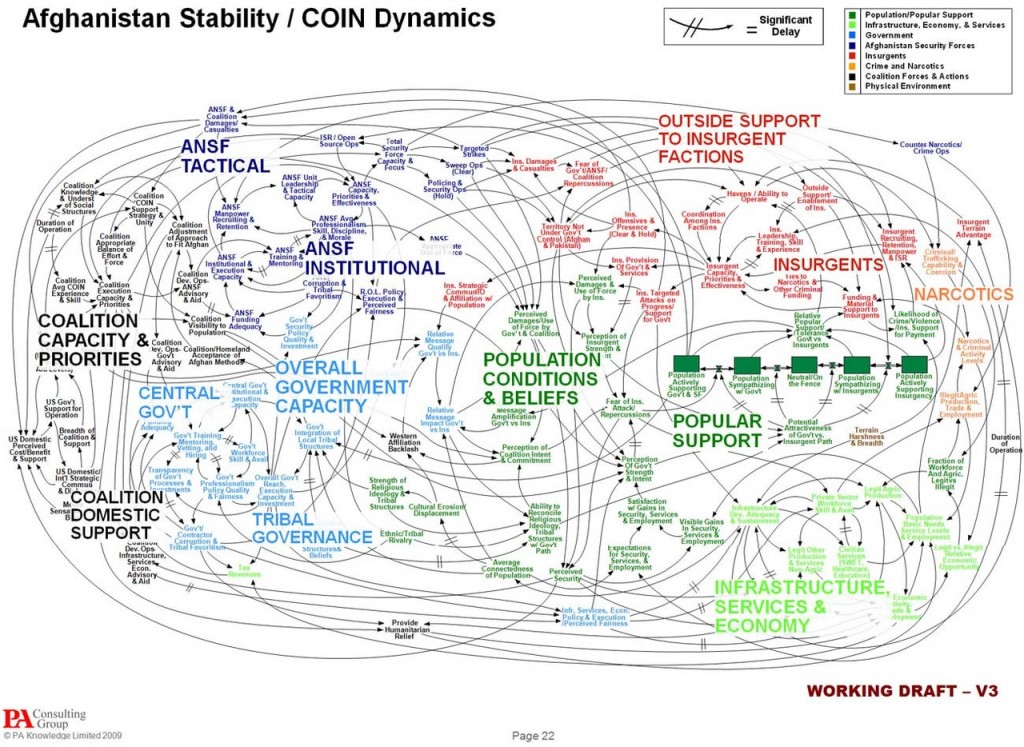
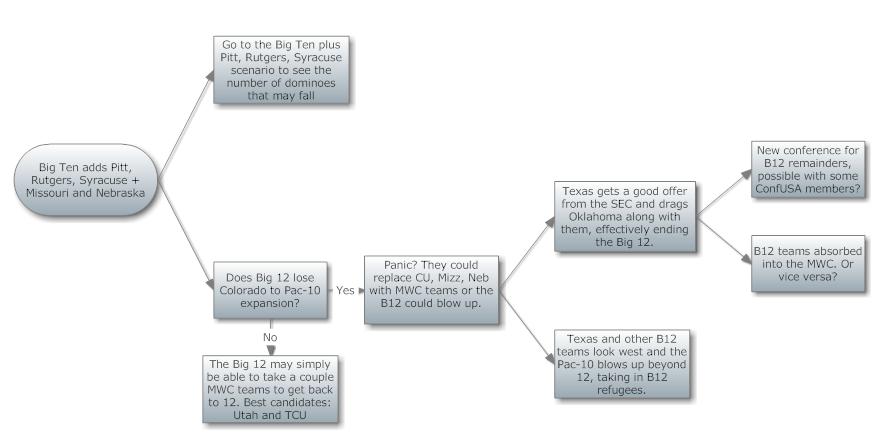
At present, the most widely rumored targets for Big Ten expansion are Pittsburgh, Rutgers and Syracuse from the Big East and Nebraska and Missouri from the Big 12, although as always occurs when the Big Ten thinks about expansion, Notre Dame is in the mix and likely their number one choice. With the Pac-10 also in the midst of contemplating expansion within the next year, these moves could send a ripple effect throughout all of the Division I conferences causing some conferences to get bigger, others to contract, and even some to disappear.  While the specifics remain conjecture and speculation at this point, there are enough common-sense scenarios out there to fuel theories to create one of the most helter-skelter flowcharts ever seen. We’ll take a look conference-by-conference at what could happen, and what kind of fallout might be created by each move, starting with our eleven midwestern friends.

Big Ten

Big Ten commissioner Jim Delany confirmed last Wednesday that his conference is considering not only expanding to 12, but also perhaps even 14 or 16 teams. While some of the rationale for the expansion would be the addition of a football championship game for more revenue, the accumulation of more content and more markets for the Big Ten Network is probably more important to their plans. Delany noted that while discussions for this expansion are ongoing, the 12-18 month timetable that was originally announced in December is still the current framework.

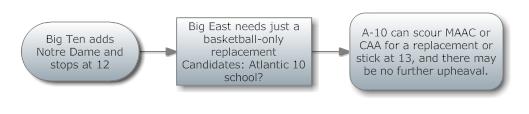
Starting with the first domino, there is little doubt that the Fighting Irish would be the Big Ten’s first choice and the most logical fit for the conference, in terms of geography, academics and, frankly, football. Notre Dame and the Big Ten have flirted with each other many times in the past, but there is likely a greater chance that they will consummate their relationship this time around than any time before. For the Big Ten, the attraction is obvious: a huge fan base in historic “Big Ten country,” a ton of athletic history, and excellent academics. For Notre Dame, however, the question is a lot tougher. The Irish have been a football independent throughout their history and current athletic director Jack Swarbrick recently said that their “highest priority is maintaining football independence.” Notre Dame is currently in the middle of a television contract with NBC for the rights to broadcast home football games, a contract that runs through 2015 and an issue that will need to be confronted somehow if the Irish are eventually invited and accept Big Ten membership. The amount of the NBC deal (about $15 million annually) is not prohibitive enough to prevent them from considering membership in the Big Ten, whose member schools currently receive about $20 million annually from their television contracts. It is even possible that if the Big Ten and Notre Dame can come to an agreement, all this expansion talk will end right there: Notre Dame joins up, the Big Ten stops at 12 teams, the Big East poaches a team from CUSA like Central Florida as an additional football school and geographic partner to South Florida or a basketball-only school from the A-10 like Rhode Island or Massachusetts and the end-of-the-world scenario is averted. At present, however, it is being reported that Notre Dame is not being considered in the Big Ten’s expansion plans (a report that nobody in their right mind believes), but if Notre Dame is interested, the Big Ten will certainly be interested as well.

Figure 1: Big Ten Best Case Scenario

However, it is also realistic that with or without Notre Dame, the Big Ten is aiming for 14 or 16 teams to become the first superconference. While the addition of teams such as Missouri and Nebraska makes the most geographic sense, this expansion thing is not really about logic but about dollars, and Delany seems most interested in all the potential viewers that the bigger east coast markets present — notably Rutgers and Syracuse, but also Pittsburgh and potentially Connecticut. Adding three or even all four of those schools would effectively kill Big East football as we know it and potentially damage the Big East basketball enough to persuade a fence-sitting Notre Dame to leap off onto the Big Ten side as well. Swarbick himself admitted in March that “there are things that are large enough to challenge our ability to remain independent and remain in the Big East.” All four (or even three) of those flagship Big East programs bolting for the Big Ten could be one of those “large enough” things.

Read the rest of this entry »

Share this story