WYN2K. On its surface, the Southland appears to be an improving league. Over the last three seasons, the league has won progressively more games against OOC D1 opponents (26/33/41) for an overall record of 100-212 (.321) during this period. Additionally, while the league has been a #16 seed in six of the last eleven NCAA Tourneys, it has earned a higher seed five of the last six years (#14/#15/#16/#15/#14/#15). The #14 seed in 2006 (Northwestern St.) paid off with one of the biggest upsets of that year’s tournament, as the Demons defeated #3 Iowa 64-63 in miraculous fashion (see below). We think that the competitive balance among the top of the league this year will allow the Southland to continue to earn a higher seed than #16.
Predicted Champion. Sam Houston St. (#15 seed NCAA). There are five teams who we figure can win this league, but out of the group, we like SHSU’s experience returning along with POY candidate Ryan Bright. Bright is a stat sheet stuffer extraordinaire – he finished in the top 250 players nationally last year in several categories, including eFG% (183), dReb% (120), blocks% (161) and steals% (178). The Bearkats were poised to challenge Texas A&M-CC last year before a first-round conference tournament upset at the hands of Lamar.
Others Considered. Texas-Arlington is a rising program, returning everyone of consequence from a team that won eight of its last eleven games last year. Still, we’re not completely sold on a team that had a losing record (13-17). Lamar is another intriguing team, as they return four starters and have brought in a couple of juco PGs to battle over that position, but again, they only went 15-17 last year. Texas A&M – Corpus Christi lost nearly everyone from a team that gave Wisconsin a huge scare last year in the NCAAs (Tx A&M-CC was up 25-7 at one point), but the one key player they return (7’0 Chris Daniels) was last season’s conference POY and tournament MVP. Northwestern St. can’t be counted out either, as they always seem to find themselves in the conference mix, having been to five of the last eight Southland title games.
Games to Watch. Again, only one Southland game will be on the national radar.
Southland Championship Game (03.16.08). ESPN2.
RPI Booster Games. The Southland hasn’t shied away from scheduling BCS teams, with 34 on the agenda this season. Last year the conference defeated three BCS bottom-dwellers (Texas A&M – CC over South Florida; SE Lousiana over Oregon St. and Penn St.), and there are some similar opportunities this year.
Northwestern St. @ Stanford (11.10.07)
Texas Tech @ Sam Houston St. (11.14.07)
Lamar @ Mississippi (11.16.07)
Northwestern St. @ LSU (12.15.07)
Mississippi St. @ Texas A&M – CC (12.21.07)
Texas A&M – CC @ Auburn (01.02.08)
Odds of Multiple NCAA Bids.Slim to none. Had Texas A&M-CC not lost just about everyone, we could have made an argument for their inclusion as an at-large and likely 26-4 team, but that’s not the case. This is a one-bid league.
Neat-o Stat.Nicholls St. apparently believes in stomping on its players’ throats and eviscerating their spleens trial by fire, as its nonconference schedule last year was rated #17 by Pomeroy and it is on target for that level of difficulty again. Last year the Colonels played Mississippi St., Northern Iowa, Washington, Pepperdine, LSU, Texas, Ole Miss, Auburn and Vanderbilt, losing every game. This year NSU will play the likes of Florida St., California, LSU, Alabama, UNC, Minnesota and UNLV – all on the road, all before the new year, and all likely Ls. Hard to build much confidence that way.
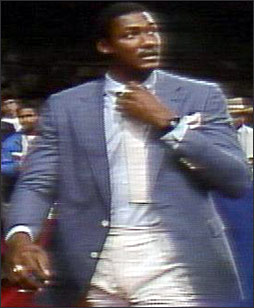
64/65-Team Era. The Southland is 4-23 (.148) in the era, but those four wins are a little misleading – two of the wins were from Karl Malone’s Louisiana Tech team in 1985 that went to the Sweet 16, and one of the wins is from the PiG in 2001 (Northwestern St. defeated Winthrop 71-67). The only other first-round win was mentioned above – Northwestern St. over Iowa in 2006.
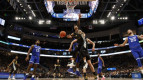
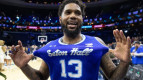
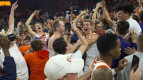
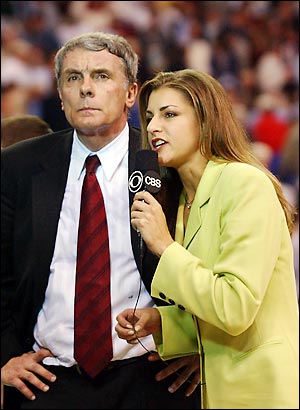
We’ll Take Any Excuse to Bust Out this Pic
Final Thought. The champion of this league is a team to watch next March. Last year, Texas A&M – CC gave Wisconsin all it wanted for 30 minutes. The previous year we know what happened to Iowa at the hands of Northwestern St. And in 2005 #2 Oklahoma St. struggled against #15 SE Louisiana before pulling away to win 63-50. The championship-caliber teams that come out of this league can play, especially against the Big 10 (it seems)!
WYN2K. The OVC is a league that has been incredibly up-and-down depending on a given year. In the last five years its RPI has hovered between the 19th and 25th best conference, and its Sagarin rating between 16th and 26th. As a testament to its herky-jerkiness, no league champion has received the same seed as the prior year’s champion for the last eight years (13/15/14/13/12/15/14/16). But if there is one trend worth noting, it is that the league’s overall profile appears to be dropping. After a seven-year period from 1998-2004 where the league champion averaged a #12.7 seed, the last three seasons have resulted in an average of #15.0. This is supported by the reality on the court, as no OVC team has won an NCAA Tourney game since the 80s, when Austin Peay (1987), Murray St. (1988), and Middle Tennessee St. (1989) comprised a three-year string of first round upsets.
Predicted Champion.Austin Peay (#15 Seed NCAA). This was the easiest pick of the previews yet. “Let’s Go Peay” returns all five starters (including OVC POY Drake Reed) from a team that was the regular-season champion in 2007, but who lost on a buzzer beater to Eastern Kentucky in improbable fashion. 6’5 forward and resident muscle man Fernandez Lockett is likely another first-team all-OVC selection.
Others Considered. Eastern Kentucky was the second-best team in the OVC last season, and Jeff Neubauer’s methodical style (310th in tempo nationally) led to EKU rankings near the top of the nation in effective FG% (18th) and two-point FG% (8th). In other words, the Colonels consistently take and make good shots. If any team is ready to supplant Austin Peay again, it’s likely to be EKU. Murray St. is always in the mix in this conference (20 straight winning seasons), and we expect this year to be no different. The Racers finished strong in 2007 winning eight of their last ten, and return many of their key players from last season. Another team that finished very strong last year was Tennessee Tech, who won twelve of their last fifteen games as their coach Mike Sutton continued to arduously work his way back from Guillain-Barre Syndrome.
Games to Watch. If they OVC Championship game is anything like last year’s, then it should most definitely be on your March viewing calendar.
OVC Championship Game (03.08.08). ESPN.
RPI Booster Games. Last year the only BCS opponent that the OVC managed to defeat was Northwestern (by Tennessee Tech) at a neutral site. Otherwise, the league was 0-20 against BCS teams. We’ve identified several opportunities for an OVC squad to pull an upset this year to help the league’s overall RPI.
Tennessee Tech @ Rutgers (11.09.07)
Austin Peay @ Vanderbilt (11.10.07)
Georgia Tech @ Tennessee St. (11.11.07)
Murray St. @ Mississippi St. (12.01.07)
Samford @ Florida St. (12.02.07)
Tennessee Tech @ Oregon St. (12.16.07)
Odds of Multiple NCAA Bids. Absolutely no chance.
Neat-o Stat. Reigning OVC Player of the Year Drake Reed was the first sophomore to win the honor since Popeye Jones did so back in 1990 at Murray St. It’s unclear whether Reed is related to Jones (see below).
64/65-Team Era. The OVC has gone 3-24 (.111) over the era. As mentioned above, the glory days were the late 80s, when the OVC won a first round NCAA game each year from 1987-89. The league hasn’t won a game since, although it has had a couple of very close calls (#2 Duke 81, #15 Murray St. 78 – 1997; #1 Michigan St. 75, #16 Murray St. 71 (OT) – 1990).
Final Thought. The OVC is definitely a top-heavy league this year. There are three or four teams that can realistically win the NCAA bid, while the others are fairly noncompetitive. Even with the lack of a balanced league, there is likely only one team with the experience and talent for us to consider it as possible first round upset material – Austin Peay. But as we saw last year, even with the best team in the OVC, there’s no certainty that the Governors can win the conference tournament in its own back yard (47 miles from Clarksville, TN, to this year’s site again, Nashville, TN).
But first, have you heard that Stanford’s Brook Lopez can’t pass calculus? He’ll be out until he figures out derivatives (presumably Dec. 19, after nine games).
Along the same lines, the NCAA cleared Marquette big man frosh Trevor Mbakwe to play this season.
New Mexico swingman and all-Mtn West selection Tony Danridge had surgery on his broken left leg, and is expected to be back by January 2008. Arkansas forward Sonny Weems is due back from his hand injury within the next couple of weeks.
A hoops pollster explains why college football polling is misguided.
CSTV claims Louisville and UConn have the top 2008 Big East recruiting classes so far.
We already know why George Mason will get an at-large bid next spring – one name: Tom O’Connor.
DeCourcy goes with Chris Lofton as his preseason POY, but there’s no way we think he’ll win it.
Catching up with coaches… Parrish looks at how Dan Monson is adjusting to life at Long Beach St. Katz examines how Jim Calhoun is recovering from his worst season ever. And the AP reports on John Beilein not knowing what to expect at Michigan.
Luke Winn also has an interesting Q&A with Jerel McNeal, defensive dynamo at Marquette.
Finally, the offense that’s taking over the nation – Memphis’s AASAA.
We’ve let the news accumulate for a while, so without any further delay…
Tom Izzo porked the media by putting them through a “typical” 2-hr MSU practice last week.
Ben Howland got a hefty raise and an extension through 2014 coaching his self-professed dream job.
If you haven’t heard, Jim Jones’ grandson Rob Jones will be playing for the University of San Diego this year. There have been multiple takes on this, but we like Extra P.’s at STF best.
Hoops Weiss has a scathing analysis of the Jim Calhoun / Holy Cross Coaches vs. Cancer situation.
Kyle Whelliston contributed a really insightful article on espn.com about high majors playing road games at mid-major schools this year.
Hard luck- former McD’s all-american Mike Williams ruptured his achilles tendon in a workout at Cincinnati last week and will the entire season (he sat out last year as a transfer from Texas). USC’s Daniel Hackett broke his jaw (on OJ Mayo’s elbow) last week and will miss up to six weeks. Vandy’s JeJuan Brown has withdrawn from school for personal reasons.
Speaking of OJ, this video of him playing in summer league is making the rounds.
NCAA Hoops Today continued its analysis of last spring’s HS all-star games with the Roundball Classic and the Jordan Classic.
The Big Ten Network’s twelve viewers will get to see several Midnight Madnesses next Friday, including Illini Madness, Hoosier Hysteria, Midnight Madness (MSU), Tubby’s Tipoff and Night of the Grateful Red.
Gary Parrish lists his top points and combo guards (Derrick Rose – Memphis), top shooters and wings (Chris Lofton – Tennessee), and top bigs (Tyler Hansbrough – UNC) in the nation. He really likes freshmen.
And continuing our edification of various offensive and defensive schemes, here’s an explanation of Bo Ryan’s Wisconsin swing offense and a John Beilein-esque 1-3-1 trap.
WYN2K. The Atlantic Sun has been an up and down league over the past decade. It spent much of the late 90s and early 2000s as a league hovering at the top of the low-majors (#19-#23 ranked conference most years). But the last two seasons it has fallen hard, finishing as one of the bottom four conferences in the computer rankings both years. Its OOC record (70-174, .287) the last three years is standard for a league at this level. Still, the NCAA typically shows some love to the conference champion, having given the A-Sun only five #16 seeds in 64/65-team era (and two of those were when the league received multiple bids) and peaking with a #11 seed in 2001 (Georgia St. defeated #5 Wisconsin in the first round). The league has earned a #14 or #15 seed each of the last six years, and we see no reason for this to end.
Predicted Champion. East Tennessee St. (#15 Seed NCAA). We see Murray Bartow’s ETSU squad (16-2 last season in the A-Sun) as the team to beat here. They return league POY Courtney Pigram and bring in former juco D2 POY Kevin Tiggs, a combo guard from whom big things are expected immediately. As a program, ETSU is no stranger to the NCAA Tournament, having made the Dance two of the last five years (as a member of the Southern Conference) and seven times overall.
Others Considered. The A-Sun North division is clearly the class of the league, containing two-time defending tourney champion Belmont and rising Lipscomb. Belmont is a system program predicated on efficient ball movement (#21 nationally in eFG%) and tight defense (#5 nationally in eFG% defense), but the loss of their two best post men (Boomer Herndon and Andrew Preston) makes it difficult for us to pick them again. Lipscomb is another intriguing choice if for no other reason than they’re hosting the conference tourney this year – oh, and they’re 24-2 at home during the last two seasons. Jacksonville engineered one of the all-time greatest turnarounds last year, going from one win in 2006 to fifteen in 2007, and while they won eight of their last eleven regular season games, we’re not ready to push them past the more experienced teams just yet.
Games to Watch. There’s likely only one A-Sun game probably worth watching this year.
Atlantic Sun Championship Game (03.08.08).
RPI Booster Games. The A-Sun has thirty games against BCS opponents scheduled this year, and hopefully it can perform a little better than last year when it was 0-34. There are some opportunities against lower-tier BCS teams, however, in the following list of games:
Belmont @ Cincinnati (11.09.07)
ETSU @ Georgia (12.21.07)
Lipscomb @ Vanderbilt (12.08.07)
Campbell @ South Carolina (11.28.08)
Jacksonville @ Florida (12.03.07)
Alabama @ Mercer (11.13.07)
Kennesaw St. @ Auburn (11.13.07)
Odds of Multiple NCAA Bids.<5%. It’s extremely unlikely that this is a two-bid league, but if any team was going to make it so, it would be ETSU. It would require domination of the league as well as a scintillating non-conference record before they lose in the conference tourney – we don’t see that happening.
Neat-o Stat. We have a couple for the A-Sun. First, North Florida last season enjoyed the dubious distinction of having the least efficent offense in the nation, scoring a mere 79.6 pts per 100 possessions. Secondly, Florida Gulf Coast (one of four transitional schools making the jump to D1 in the A-Sun) is the youngest D1 university in America, having opened its doors to students in 1997.
64/65-Team Era. In 26 appearances, the Atlantic Sun is 3-23 (.115) over the era, scoring the #11 over #6 upset mentioned above, #12 College of Charleston defeating #5 Maryland in 1997, and #14 Arkansas-Little Rock defeating #3 Notre Dame (Digger!) in 1986. That UALR team then took NC State to double OT in the next round before succumbing – that is the closest the league has gotten to the Sweet 16 in its history.
Final Thought. Belmont has gotten destroyed by Georgetown (80-55) and UCLA (78-44) in the last two years in the first round of the NCAA Tournament. It doesn’t appear that their style of play is conducive to pulling off an upset against a bigger, more athletic team. The league would have a much better chance at the first round upset if an uptempo, athletic team like ETSU earns the automatic bid.
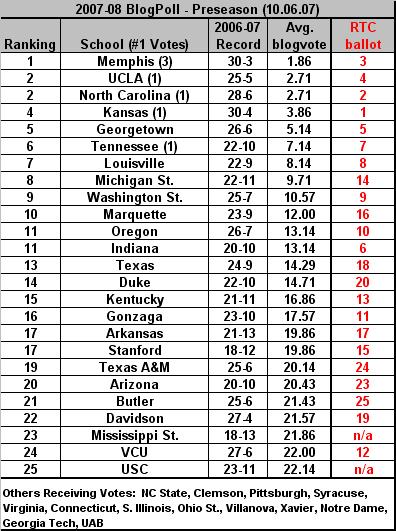
We’ll delve further into the reasons why we voted the way we did as the season preview moves along this month, but suffice it to say that we don’t have many major beefs with the way the preseason blogpoll turned out. We generally think Michigan St., Marquette, Texas and Duke are a little overvalued, while Indiana, Gonzaga and VCU are undervalued, but we were pretty much in lockstep with the group as to who the collective best five teams are.
FYI – our two ranked teams that were left on the outside looking in were Syracuse (#21) and Southern Illinois (#22).
This should be a lot of fun – we can’t wait to get the season started.
With respect to yesterday’s story about Gary Williams’ 0% graduation rate, Maryland has since responded with a press release stating that all ten of its players that qualified under the latest GSR ratings left school before graduation to pursue professional basketball careers. These players include:
Chris Wilcox (left after two seasons for the NBA draft)
Juan Dixon (four-year player)
Lonny Baxter (four-year player)
Steve Blake (four-year player)
Terrence Morris (four-year player)
Tahj Holden (four-year player)
Drew Nicholas (four-year player)
Byron Mouton (transfer who completed eligibility at Maryland)
Jamar Smith (transfer who completed eligibility at Maryland)
Ryan Randle (transfer who completed eligibility at Maryland)
In response, Gary Williams stated, “These people are very successful people. If you go to school to improve yourself economically, where have they failed? They make more than the average college graduate. Far more. If you’re judging them just based on getting a degree, then OK, they haven’t gotten a degree.”
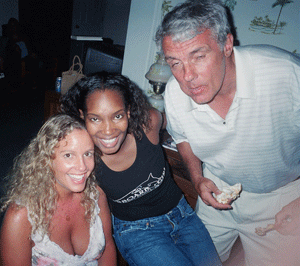
Betcha Bonnie Bernstein Got Her Degree
While we’re perfectly willing to hear GW out here, the fact of the matter is that only one of the above players left school early for the guaranteed millions (Wilcox). The other nine players exhausted their playing eligibility, and yet none of them graduated within the six-year window. Gary doesn’t see a problem with this?
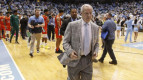
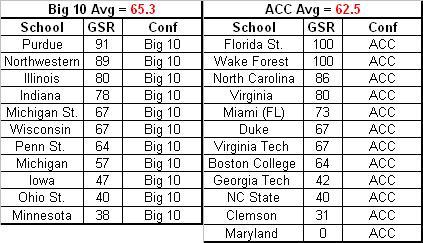
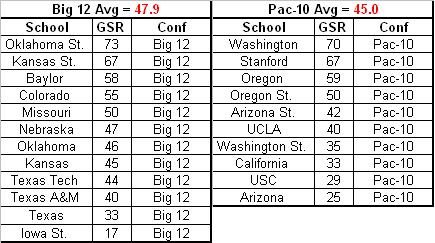
He acts like Maryland was the only school to have its players move on to successful professional careers, whether here in the US or overseas. Sure, the Terps had some nasty teams in 2001 & 2002, but so did its archrival down on Tobacco Road (Duke) who still managed to graduate 67% of its players despite losing several to the League. Same thing with Michigan St. (67%), who went to three straight F4s from 1999 to 2001. Arizona (25%) and UConn (22%) were also loaded squads (Arizona – 1997 and 2001; UConn – 1999 and 2004), and yet neither of them pulled an aught – at least they graduated somebody.
Sorry, Gary, while we recognize that Maryland has improved its graduation rate in the interim (Maryland reports that four of last year’s six seniors graduated, and both of this year’s are on pace), we also have to recognize the reality that the program on your watch has consistently finished at the bottom of the ACC in this regard. It may not be at 0% for the duration of your career in College Park, but it’s painfully evident that your program places minimal emphasis on getting a degree. Shame on you.
Yesterday the NCAA released its latest graduation rate figures for all D1 athletes who entered school in the classes of 1997-2000. Unlike the federally-mandated graduation rate, the GSR (Graduate Success Rate) is more realistic for athletes – it gives each player six years to complete his degree and it does not count transfer students against a school (reflecting the reality of athlete puddle-jumping for playing time in D1).
The latest GSR figures show that 77 percent of student-athletes who began college from 1997-2000 graduated within six years. That four-year graduation rate is unchanged from last year’s data and up from 76 percent two years ago.
The Graduation Success Rate for men’s basketball rose from 55.8 percent in 1995 to 63.6 percent in 2000, a 7.8 percent increase. Football increased from 63.1 percent to 66.6 percent for teams competing in the Bowl Subdivision and from 62 percent to 64.7 percent for teams competing in the Championship Subdivision. Baseball increased from 65.3 percent to 67.3 percent.
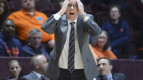
Gary is Too Busy to Worry About Graduation Rates
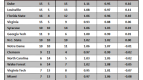
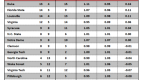
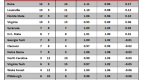
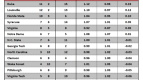
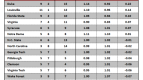
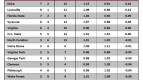
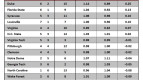
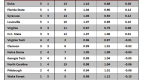
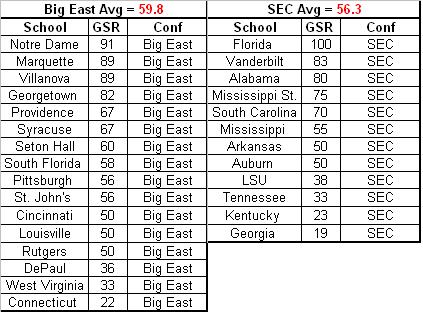
Since the NCAA doesn’t provide a sortable database of team information (or at least we can’t find it), we decided to quickly throw together some tables showing how the BCS schools performed in this cohort. Gary Williams should be especially proud of himself. Seriously, Gary, the best you can do with those Juan Dixon/Lonny Baxter teams is zero?!?Not even ONE player???
Thoughts.
At the high end, Florida St. at 100% makes us wonder if any of these stats are credible. Then again, Florida is also at 100%, and these numbers are around 2000, so maybe there was a hanging chad issue or something. We’re also amazed that Eddie Sutton’s band of merry criminals men led the Big 12.
At the low end, Jim Calhoun at UConn, Lute Olson at Arizona, Tim Floyd/Larry Eustachy at Iowa St., Ron Jirsa/Jim Harrick at Georgia, and the seediest of all, Clem Haskins at Minnesota, join Gary Williams in the dregs of their respective conferences. What a list of slimy characters there.
The Pac-10 is surprisingly low, given that Stanford, Cal, UCLA and USC are all great schools. Especially Stanford – how can Mike Montgomery justify graduating only 2/3 of his players? Guess he doesn’t have to at this point – or does he? And the SEC is surprisingly high, with Alabama, the Mississippi schools and South Carolina doing well.
We may have more thoughts on this later, but we’re heading for the airport at the moment, so it’ll have to wait.