Inside the ACC Numbers: Volume II

Posted by Brad Jenkins (@bradjenk) on January 25th, 2018

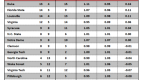
Here is the latest edition of our weekly view at the current ACC standings with a focus on which teams are playing better or worse than their conference records may indicate. We will also delve into some advanced metrics to share a few interesting notes on teams, statistics and trends around the conference. This week we will look at the upcoming heavyweight match-up between Duke‘s potent offense and Virginia‘s stingy defensive unit. Finally, we will forecast how the final ACC standings may look given current efficiency margins, and what that may mean for teams’ ultimate postseason aspirations.

Note: All numbers are current for games played through Tuesday, January 23.

Current Standings

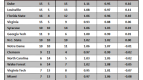
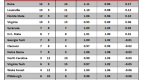
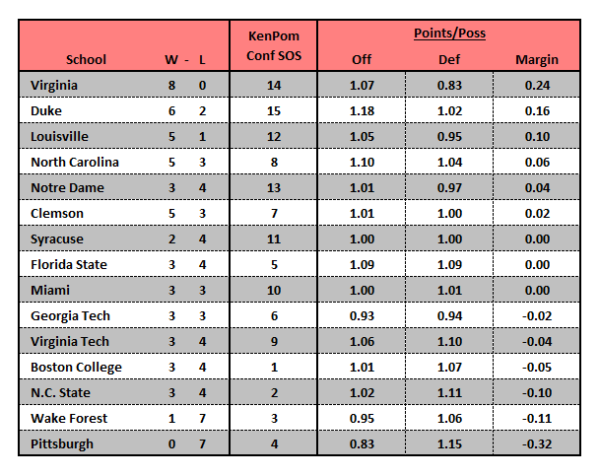
Virginia continues to steamroll through the ACC in dominant fashion. Since its one-point win over Boston College in their conference opener, the Cavaliers have pummeled seven straight ACC opponents by an average score of 66-49. The always effective pack-line defense reached a new level of excellence on Tuesday night when Virginia held Clemson to a meager 0.58 points per possession in a suffocating 61-36 win. At this point in the conference schedule, one extreme result can have a huge impact on the points per possession margin (PPM) rankings. For example, if we remove Notre Dame’s 88-58 blowout of N.C. State from the data set, the Irish (-.03) and Wolfpack (-.04) would have almost identical PPM during league play. The huge margin of victory in that single game is really the only thing that prevents almost perfect alignment between the current ACC standings and the PPM rankings.

Read the rest of this entry »

Share this story

SEC Stock Watch: Volume II

Posted by David Changas on January 25th, 2018

As we approach the halfway mark of SEC play, it’s time for this season’s second installment of Stock Watch.

Trending Up

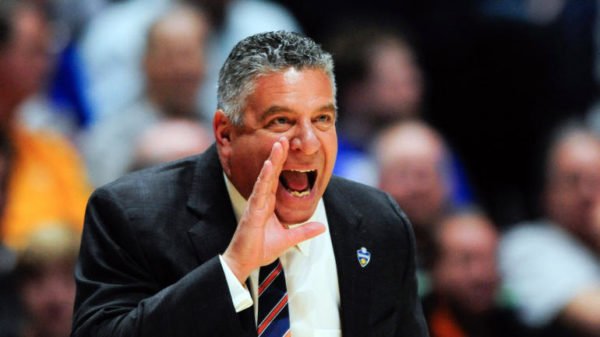
It’s been an unusual season for Bruce Pearl, who has Auburn in first place in the SEC (Joshua Lindsey-USA TODAY Sports)

  • Auburn as Regular Season Champion. With Wednesday night’s win at Missouri, Auburn is now 6-1 in the SEC with three road wins and a favorable schedule ahead. The Tigers are without question the biggest surprise in a league with quite a few of them, and there is no reason to think that they’ll fall apart anytime soon.
  • An Eight-Bid League. For a conference that submitted only three of its 14 teams into the Big Dance just three years ago, the fact that so many of its members are still reasonably in the hunt for a bid in late January is remarkable. Right now, Florida, Tennessee, Auburn, Kentucky, Texas A&M and Alabama all appear to be safe bets to make the field, while Arkansas, Missouri, Georgia and South Carolina are in the running. Whether any of these 10 teams can do any damage once they get there remains to be seen, but there is no doubt that times around the SEC have changed.
  • Yante Maten. The Georgia senior has not disappointed in his final campaign. He leads the SEC in scoring (19.9 PPG), ranks second in rebounding (9.4 RPG), and is almost single-handedly keeping the Bulldogs in the NCAA Tournament conversation. If they can make a run to .500 or better in the second half of conference play, Maten might be looking at SEC Player of the Year honors.

Flat

  • Bruce Pearl. It might seem odd for Pearl to land here given the remarkable job he has done with a team that has surged to a great start without the services of two expected elite talents, Danjel Purifoy and Austin Wiley. But it is the reason that those two aren’t playing that puts the fourth-year Auburn coach in this category. As long as the specter of the FBI investigation hangs over the program, no one on the Plains will get too comfortable regardless of how well things are going on the floor.

Read the rest of this entry »

Share this story

ACC Stock Report: Volume IV

Posted by Matthew Auerbach on January 23rd, 2018

By week’s end, the conference slate will be at the halfway point for the majority of the league. And with that milepost will come some clarity, as unbeaten Virginia, which sits alone atop the ACC standings, is facing its toughest week to date. The Cavaliers’ difficult stretch commences tonight with a home tilt against Clemson and culminates with a trip to preseason favorite Duke on Saturday. Virginia’s modus operandi is painstakingly familiar, with an elite defense bogging down the opposition at a far stingier clip than any of Tony Bennett‘s previous teams in Charlottesville. Syracuse’s 61-point outburst against the Cavaliers two weeks ago represents the most points Virginia has allowed since its only loss, a seven-point road defeat to West Virginia coming at the beginning of December. Virginia’s style of play isn’t for everyone, but it is a pleasant reminder that the only numbers that truly matter in the era of advanced metrics are the ones on the scoreboard when the clock reads zero. Credit Bennett’s team for already knocking out three ACC road wins so far this year.

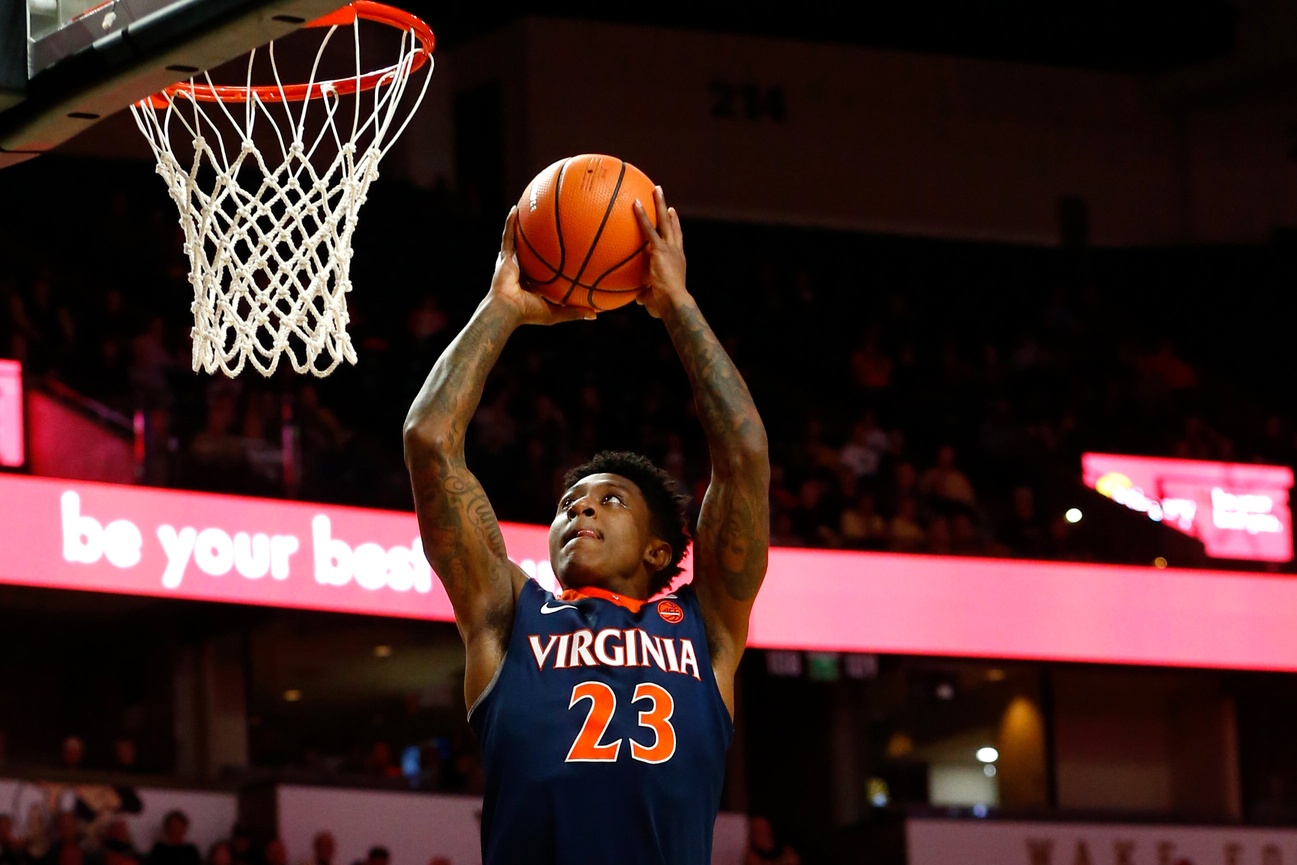
Virginia Basketball Does Not Go Away Quietly (USA Today Images)

Stock Up

Part of my reticence in buying into Virginia this season has been assuaged recently by the development of burgeoning prospect De’Andre Hunter. Just one short season ago, I scoffed at the love the computer rankings showed to the Cavaliers in large part because I couldn’t find a difference-maker on the roster in the mold of Mike Scott, Joe Harris, Justin Anderson and Malcolm Brogdon. That same critique fostered my negativity on Virginia heading into this season. But Hunter is a game-changer. The redshirt freshman is undoubtedly still raw, but his athletic potential and certain skill development under the tutelage of Bennett should make him a contributor on an NBA roster in the near future. After going scoreless in his first career ACC game, Hunter has posted double-figures in five of his last six outings while converting at a 59 percent clip. While the senior leadership of Devon Hall and Isaiah Wilkins along with the sharpshooting of Kyle Guy have represented the foundation for this team, it is a player like Hunter who can be carry Bennett through to his first Final Four. If Virginia can navigate the perilous waters that await this week, then it’ll be time to eat my crow and jump aboard the crowded Wahoos bandwagon.

Read the rest of this entry »

Share this story

Diagnosing a Broken Seton Hall Offense

Posted by Justin Kundrat on January 23rd, 2018

Put simply, Seton Hall‘s season to date has been a roller coaster. After opening the season with impressive wins over Texas Tech and Louisville away from home, the Pirates put up a stinker at Rutgers. They then reeled off five straight victories and held full control of first place in the Big East with an early 3-0 mark. What has followed in the ensuing two weeks has been a 1-3 stretch featuring three of the team’s worst offensive performances of the season. To put that into greater context, here are Seton Hall’s per-game performances, measured by offensive efficiency:

While two of the Pirates’ three recent conference losses have come on the road and none were bad by any means (all were to projected NCAA Tournament teams), it was the way in which the Pirates wallowed that was concerning. There are a number of recent issues with the team’s play, from continued reliance on isolation scoring tactics to slow development of freshmen to opposing defenses pushing center Angel Delgado away from the low post. But the most confounding concern for Seton Hall has been the play of pseudo-point guard Khadeen Carrington.

Read the rest of this entry »

Share this story

Five O26 Coaches Doing Great Jobs This Season…

Posted by Tommy Lemoine on January 23rd, 2018

From major turnarounds to borderline miracles, let’s take a look at some of this season’s best coaching jobs across the mid-major landscape.

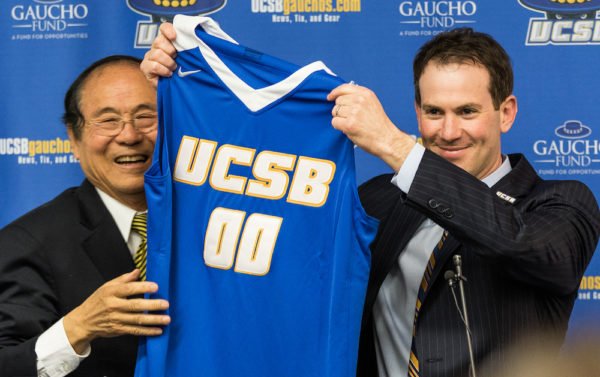
Joe Pasternack is doing a masterful job at UC Santa Barbara. (JC Corliss / Noozhawk photo)

  • Joe Pasternack — UC Santa Barbara. It’s difficult to overstate just how quickly Pasternack has turned things around at UC Santa Barbara. The Gauchos were 6-22 last season — finishing dead last in the Big West — under longtime head coach Bob Williams. Their offense was especially bad, ranking 343rd nationally in efficiency and 350th (second-to-last) in effective field goal percentage. Williams was ousted after a mostly successful 19-year run, and in came Pasternack. In less that one full season, the longtime Arizona assistant — with the help of some key transfers — has completely revamped the Gauchos’ offense. Santa Barbara now ranks 41st nationally in offensive efficiency and boasts an effective field goal percentage (54.1% eFG) that is 12 points better than a year ago, helping Pasternack’s team get off to an incredible 14-5 (3-2 Big West) start. UC Santa Barbara’s KenPom ranking is up to 97th nationally after finishing 331st in 2016-17, while sophomore guard Max Heidegger (21.4 PPG) has turned into a front-runner for Big West Player of the Year. Despite understandably low expectations, the Gauchos are now the team to beat in the Big West.
  • Steve Forbes — East Tennessee State. The Buccaneers lost four of their top five scorers from last season’s NCAA Tournament team, including First Team All-SoCon guard T. J. Cromer (19.1 PPG). No matter. Instead of taking a step back — and despite middle-of-the-pack expectations — all East Tennessee State has done is jump out to a 16-4 (7-0 SoCon) record and rise from 114th nationally in adjusted efficiency margin to 58th. Much like his former boss, Gregg Marshall, Forbes has built a deep, defensive-minded roster seemingly impervious to personnel turnover. He’s also proving to have a keen eye for quality transfers and JuCo prospects, enabling him to reap immediate contributions from players like Texas Southern transplant Jalan McCloud (11.7 PPG). With a lineup that runs 10 deep and one of the 40 stingiest defenses in America, there’s no reason to think Forbes’ group can’t again reach the Big Dance — and maybe even win a game when it gets there.

Read the rest of this entry »

Share this story

Trae Young Wasn’t Oklahoma’s Problem on Saturday

Posted by Brian Goodman on January 23rd, 2018

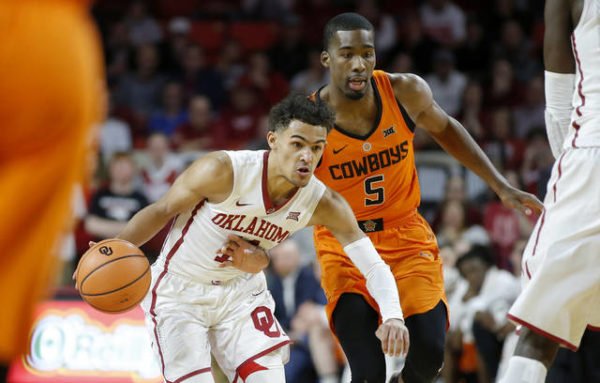
As the final horn sounded on Oklahoma’s 83-81 overtime loss to Oklahoma State on Saturday afternoon, the takes started flying nearly as frequently as Trae Young‘s three-pointers. The freshman phenom is too selfish. He doesn’t get his teammates involved. He turns the ball over too much. But as usually tends to be the case with instant reactions based on limited observation, most of the comments about the spectacular point guard were silly. While Young’s record-breaking afternoon — 48 points on 14-of-39 shooting and eight assists — wasn’t perfect, a closer inspection of the most common criticisms of his game renders them flat.

Trae Young drew more ire than he deserved following Oklahoma’s loss to Oklahoma State.
(Bryan Terry/The Oklahoman)

Young clearly struggled to get in a groove in the first half as the Cowboys made a priority of containing him, but it was clear early that Brady Manek and Christian James, the freshman guard’s two most reliable supporting cast members, might not have it either. In allowing Oklahoma State to jump out to an early 25-6 lead, the pair struggled to shoot a combined 1-of-6 from distance and failed to attack the Cowboys’ closeouts to find better looks.

As the Sooners went to work on a 12-point halftime deficit, Young realized that he was unlikely to get much more help. As a result, he did what most elite players do in that situation — he put on his blinders and tried to carry his team to a rivalry game victory. It nearly worked, as his offensive performance in the second half was flat-out remarkable. He gave the ball away just three times over the final 25 minutes (versus seven miscues in the first half) while scoring 34 points on 24 shots with a stellar 61.8 percent true shooting percentage, slightly above his season mark of 60.8 percent. By contrast, Young’s teammates shot a paltry 8-of-25 from the field after the break, and the takeaway was that Young should have been the one shooting less frequently?

Read the rest of this entry »

Share this story

ACC Weekend Review: 01.23.18 Edition

Posted by Brad Jenkins (@bradjenk) on January 23rd, 2018

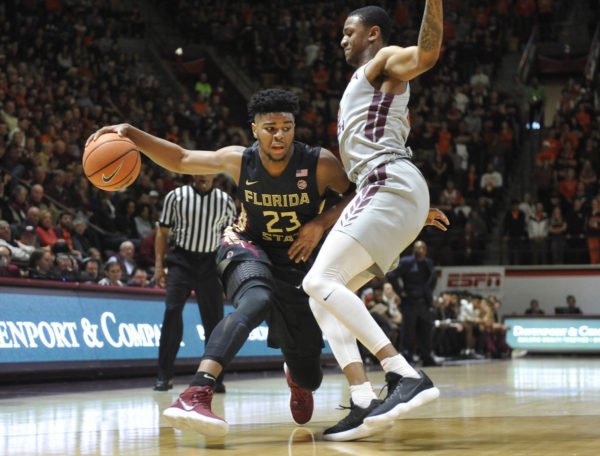
It was a good weekend for traveling ACC teams from the Sunshine State as both Florida State and Miami picked up a couple key road wins. On Saturday, the Seminoles raced past Virginia Tech in Blacksburg and the next day the Hurricanes held off NC State in Raleigh. In other league action, Virginia (6-0) maintained its unbeaten mark and conference lead by taking care of Wake Forest in Winston-Salem on Sunday evening, while Louisville (5-1) remains right behind the Cavaliers after defeating Boston College on Saturday afternoon at the KFC Yum! Center. Here are the highlights from this weekend’s action around the ACC.

Sophomore M.J. Walker came off the bench to lead Florida State past Virginia Tech in a tough home loss for the Hokies on Saturday. (Michael Shroyer/USA TODAY Sports)

  • Best Win: Jim Larranaga‘s team was in clear need of a big ACC win and the Hurricanes got it by taking down a surging NC State team in Raleigh on Sunday. Miami leveraged its best offensive performance in league play to date (1.23 points per possession) in beating the Wolfpack, getting particularly hot from the perimeter (10-of-19 3FG) and snapping NC State’s three-game home winning streak.

Read the rest of this entry »

Share this story

The Big Ten’s Biggest Early Surprises

Posted by Tommy Lemoine on January 19th, 2018

Now that we’re roughly one-third of the way through the Big Ten slate, let’s take a look at the biggest surprises and storylines taking shape in the Midwest.

Who had Ohio State pegged as a Big Ten title contender? (Joe Maiorana-USA TODAY Sports)

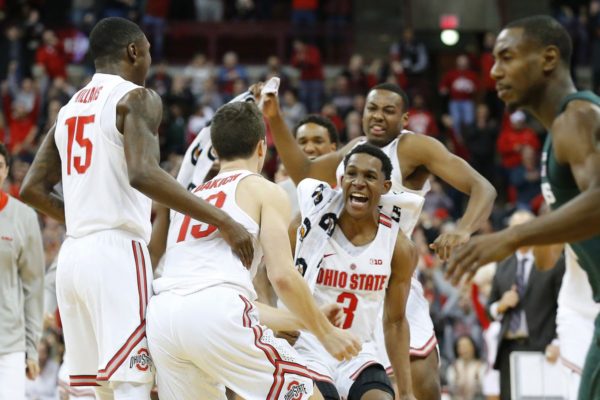
  • Chris Holtmann, Keita Bates-Diop, and the Buckeyes. Forget the Big Ten for a moment — Ohio State might be the biggest surprise in the entire country. The Buckeyes began the season ranked 74th overall by KenPom and picked to finish 11th — yes, 11th — in the conference. And after getting blasted by Gonzaga in the PK80 on Thanksgiving Day, those projections appeared to make sense. That is, until Big Ten play rolled around. Since losing to Clemson on November 29, Ohio State has gone 11-1 overall and 5-0 in league play, including a 25-point road drubbing of Wisconsin and dominant win against top-ranked Michigan State. Its KenPom ranking has skyrocketed as a result to 12th overall nationally. Junior forward Keita Bates-Diop (19.8 PPG, 8.8 RPG) has emerged as the frontrunner for Big Ten Player of the Year — highlighted by a 32-point effort against the Spartans — while his coach, Chris Holtmann, may be on track for conference (if not national) honors in his own right. Perhaps Ohio State athletic director Gene Smith put it best: “None of us, including me, expected to be here.”
  • Purdue is the clear Big Ten favorite. Who would have expected to be saying that in mid-January? It’s not that Purdue wasn’t expected to be good — the Boilers were picked to finish second, after all — it’s just that Michigan State was supposed to be that much better. Roughly one-third of the way through Big Ten play, however, that’s clearly not the case. Whereas Michigan State has lost two of its last three games, both by double-figures, Matt Painter’s club has been on an absolute tear. Since November 24, Purdue is 14-0 (7-0 in Big Ten play) with eight wins by 25 or more points — including wins against Arizona, Minnesota and Wisconsin. The Boilermakers rank among the top six nationally in both offensive and defensive efficiency while boasting the third-highest three-point shooting mark (42.6%) in America. 7’2″ center Isaac Haas has been more efficient than ever (122.7 ORtg); sophomore guard Carsen Edwards (17 PPG) has been the breakout player some thought he could be; put simply, Purdue has looked infallible. With home games against Ohio State and Michigan left, Painter’s group is in great position to win the conference outright — even if it were to stumble in East Lansing on February 10.

Read the rest of this entry »

Share this story

ACC Weekend Preview: January 20-21

Posted by Mick McDonald on January 19th, 2018

The slate admittedly feels a little light this weekend around the ACC, but that is usually when chaos reigns. We’ll take a look at a monster game in Blacksburg and the team at the top of the ACC standings trying to win its second road contest in a row.

Saturday, January 20

Can the Close Game Maestro Keep It Going?(USA Today Images)

Florida State (#27) at Virginia Tech (#49). This is exactly the kind of game Virginia Tech needs to win if it realistically wants to make the NCAA Tournament this season. The Hokies’ best win so far this year is… Washington? At Ole Miss? At Wake Forest? There is basically nothing very compelling on a resume that also includes a neutral court loss to Saint Louis (#170). The key for Buzz Williams’ team in this game is for the Hokies to find their shooting stroke from three-point range. It was their identity earlier this season, but they are making just 31.3 percent from long distance through five ACC games. No player has seen their shooting plummet more than senior Justin Bibbs. The normally sweet-stroked southpaw has never shot worse than 41 percent from distance during his career, but he stands at just 23.1 percent in ACC play so far this season.

Notre Dame (#25) at Clemson (#13). The Irish have now dropped three straight games, including a brutal, double-overtime home loss to Louisville on Tuesday night. While the team is still without the services of star forward Bonzie Colson, they did get point guard Matt Farrell back in the lineup on Tuesday. If the Irish are going to rally through the rest of the ACC schedule without Colson, Farrell has to be the star for Mike Brey‘s team. This weekend he will match up with another star guard who doesn’t get enough recognition for his excellent play: Clemson’s Marcquise Reed. The junior is shooting nearly 41 percent from three-point range this season and 86 percent from the line. He was excellent in the Tigers’ recent close loss at North Carolina, scoring 21 points on 7-of-14 shooting, including 4-of-6 threes. With both teams playing excellent defense throughout, the gunning guard that gets hot down the stretch could decide this game.

Read the rest of this entry »

Share this story

Inside the ACC Numbers: Volume I

Posted by Brad Jenkins (@bradjenk) on January 18th, 2018

With approximately one-third of conference play now in the books, it’s time to take a look inside the ACC numbers. This is the first edition of our weekly view at the current ACC standings with a focus on which teams are playing better or worse than their conference records may initially indicate. We will also delve into some advanced metrics to share a few interesting notes on teams, statistics and trends around the conference. Finally, we will forecast how the final ACC standings may look given current efficiency margins, and what that may mean for teams’ ultimate postseason aspirations.

Note: All numbers are current for games played through Tuesday, January 16.

Current Standings
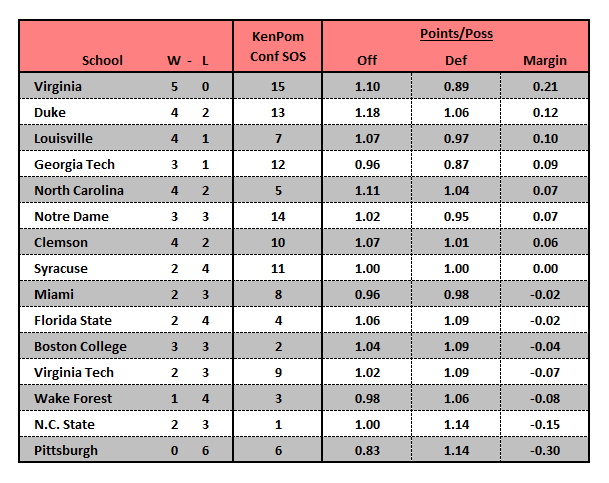
Boasting a large lead in points per possession margin (PPM) to go along with an undefeated record, Virginia clearly looks like the ACC’s top squad to date. And what is it with Josh Pastner? For the second consecutive year, Georgia Tech is off to a surprisingly good start in league play after a woeful non-conference performance. It isn’t odd to see some striking differences in win-loss records versus PPM performances this early in conference play, but that is not the case so far this year — the current PPM numbers match up pretty well with existing ACC standings.

Advanced Stat of the Week: 3FG% Defense
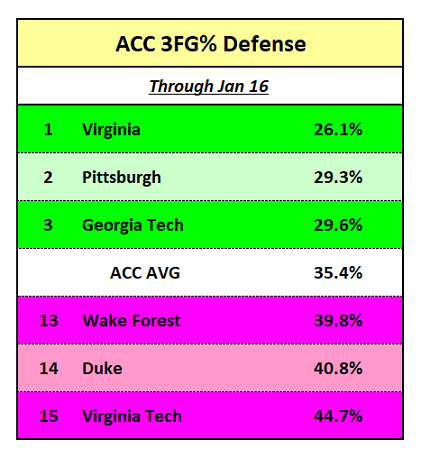
One of the things we like to look at early in league play is to identify which teams have experienced both good and bad fortune with their opponents’ performance. A useful metric for this is opponents’ three-point field goal percentage. Although defenses have some role to play in limiting wide-open looks, it is the offense that for the most part controls accuracy from deep. So when a team’s opponents are hitting threes at an extremely high or low rate over a small sample size, we can expect a regression to the mean to occur down the line. With this in mind, expect Virginia Tech’s defense to look better once its opponents cool down from three-point land, much like Duke’s defense has correspondingly improved lately. In their first three ACC contests (two losses), the Blue Devils were blitzed from deep to the tune of a combined 48.6 percent. But during its current three-game winning streak, Duke’s opponents have made just 32.9 percent from long-range. Likewise, expect Virginia’s vaunted defense to look a bit more vulnerable once the other side sinks a few more threes against them.

As a whole, the ACC is attempting more three-pointers than ever (37.1% 3FG rate in ACC play), but making fewer of them than a year ago. After a record-setting accuracy rate of 37.2 percent in 2017, the league is sinking 35.4 percent of its deep tries this conference season. That number is almost identical to the NCAA average of 35.1 percent nationally, so we should expect the ACC’s success rate from deep to remain pretty close to its current pace while individual team defensive three-point percentage normalizes.

Future Forecast
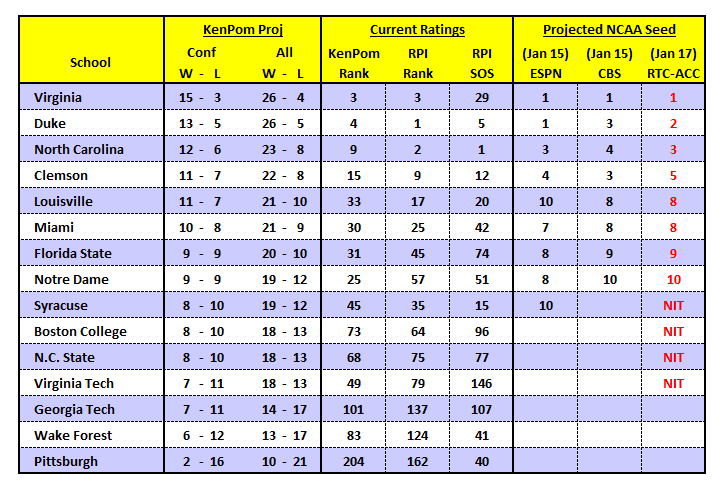
The above table shows predicted order of finish with final regular season records based on KenPom’s current win probabilities for each team. Also included are a few comparative rankings that are mentioned frequently when evaluating NCAA Tournament potential, as well as projections from two bracketology experts — ESPN‘s Joe Lunardi and CBS Sports‘ Jerry Palm. Note that while they project the field as if it was to be named tomorrow, we make our projections based on the final KenPom projected records.

It’s clear that the ACC is not as strong at the top as it was a year ago when the league offered six schools that were seeded #5 or higher. Interestingly, the ACC looks particularly strong in the RPI and normally that results in being awarded seeds that appear higher than deserved — using computer power ratings and opinion poll rankings. But with the Selection Committee’s stated desire to modernize its criteria for selection and seeding, will high RPI metrics still drive its decision-making? If the RPI’s influence is in fact lessened this year, it could hurt the NCAA’s chances for the bulging middle of the ACC — the five schools projected with either eight or nine wins.

Share this story