Morning Five: 08.24.12 Edition

Posted by rtmsf on August 24th, 2012

  1. You know you’re doing something right in a lawsuit if the defendant’s attorneys start attacking the plaintiff’s ringleader long before the discovery phase ends. According to this report from The Birmingham News, the NCAA and its licensees maneuvered hard against marketing guru Sonny Vaccaro in an attempt to discredit him prior to a ruling by a federal court in California about whether the so-called Ed O’Bannon likeness case will become a class action suit. It’s no secret that Vaccaro has encouraged ex-players who feel wronged by the perpetual and ongoing usage of their faces and likenesses to join the suit, but the NCAA questioned whether his financial motives were too inextricably tied to the players to render him prejudicial. The NCAA had requested voluminous records of his communications for years, but ultimately, the two sides agreed that Vaccaro would turn over “custodial records from Vaccaro’s three organizations, communications with the plaintiffs, camp/tournament documents using players’ likeness, and payment records to or from players.” The court plans on making a decision on the class action later this fall, and without question that ruling could have a monumental impact on the future financial solvency of the NCAA.
  2. Thursday was an assistant coach kind of weekday as a number of high-profile schools announced comings and goings among their coaching support staff. Kentucky, a school whose media relations department must work a ridiculous amount of overtime, announced that former Wildcat center Marquis Estill will join the team as an undergraduate student assistant while he finishes his degree. Estill left school early in 2003, after receiving all-SEC honors after his junior season. Meanwhile, across the continent in Seattle, Washington announced that it was adding former Arizona State assistant Lamont Smith to its staff as a top recruiter mere days after adding another new assistant, former D-II head coach Brad Jackson (Western Washington). The key word in the previous sentence is former, as Arizona State lost not only Smith but also Scott Pera, who is leaving the desert to coach closer to his home at Pennsylvania. As Herb Sendek said about the twin departures this week, “the timing isn’t ideal.” More on ASU in a post later today.
  3. Much has been made recently about the Big East’s 60-day window to negotiate a new television deal with ESPN that begins on September 1, but it isn’t the only conference looking forward to making waves with a brand new broadcasting deal. Big 12 commissioner Bob Bowlsby told media on Wednesday that the league expects to sign a 13-year deal with FOX and ABC/ESPN worth $2.6 billion and will provide “unprecedented” exposure in a much more “widely distributed” manner. Or, in other words, what everyone else says about these deals. From a financial perspective, if this deal turns out to be true, a distribution of over a quarter-bill to each of the 10 member institutions doesn’t sound very bad after all. As Bowlsby suggests, perhaps 10 schools is the right number after all — leagues have been pushing each other out of the way to expand, but maybe they should start thinking about strategic contraction instead?
  4. One school not reaping the tens of millions of dollars that the schools located nearby it are is Creighton, but that isn’t stopping the hot mid-major basketball school from investing in its future while things are going well on the court. Plans were announced earlier this week that the school will build the Fighting McDermotts a brand spanking new 35,000 square-foot practice facility to match what some of its MVC peers have already done. Perhaps more importantly, the school seeks to match what a certain Big Ten school an hour to the southwest is doing — even though Creighton is clearly the more successful basketball program than Nebraska, the spectre of all those BTN dollars at NU certainly keeps the Joneses over in Omaha looking over at their neighbor’s lawn. With possibly two more years of Doug McDermott as a Bluejay, this practice facility could be the recruiting carrot that Creighton needs to bridge its current and pending success with a strong recruiting future.
  5. Last summer the story of Lamont “Momo” Jones‘ transfer from Arizona back home to Iona was a hot topic. The question of how it would ultimately impact both schools was a common refrain, and as it turned out, it was his new school that played in March Madness (losing to BYU in the First Four), while his old school was shipped to the NIT (losing to Bucknell). Jones enjoyed his best season statistically in 2011-12, going for 16/3/3 APG while shooting a career-high 46% from the field. More importantly to the rising senior, though, he spent what he characterizes as the best of year of his life near his family — especially his ailing grandmother in the Bronx — and even became a first-time father of a boy, Jace’, in May. With all the negative stories surrounding college basketball these days, this piece by Dan Greene is one that will send you into the weekend with a smile on your face.
Share this story

Oregon State Week: Players Not Returning

Posted by Connor Pelton on August 22nd, 2012

Last year the Beavers only had one senior on the roster, seemingly ensuring that the 2012-13 roster would be made up of the same guys. But one early entry to the NBA and two transfers later, Craig Robinson is indeed losing four players from last year’s squad. Below we’ll break down those four players in roughly the order of the degree to which they’ll be missed.

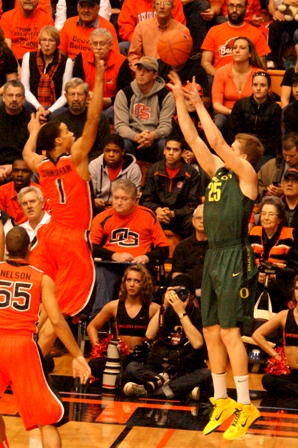
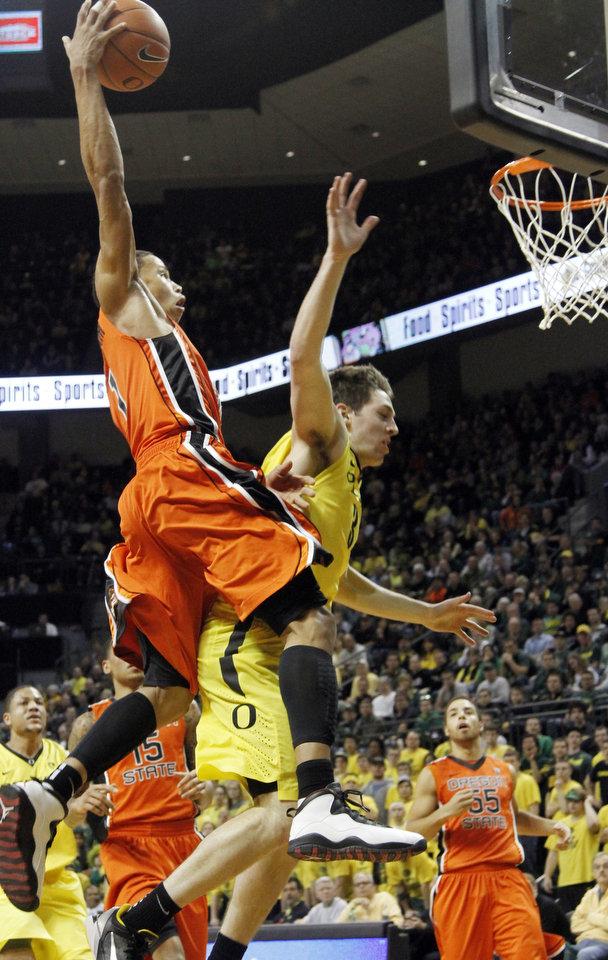
Jared Cunningham – Despite earning offers from basketball powerhouses San Diego State and California (among others), Cunningham decided to leave his home state and go north to Corvallis. Three years later, he leaves as arguably the most talented player to don a Beaver uniform since Corey Benjamin’s single season in 1997-98. Cunningham instantly played major minutes as a freshman, and by the end of the season was starting regularly and scoring in double figures. As a sophomore, with Seth Tarver graduating, his role and production increased. He started 29 of the 30 games he played in, missing only the third-to-last game of the year for reportedly blowing curfew. That year was when people nationally began to take notice of the athletic shooting guard at OSU. Cunningham averaged 14.2 PPG and 2.8 SPG as a sophomore, and had the top dunk of the year in a game against Arizona. Last season, he led the Beavers to 21 wins with 17.9 PPG and 2.5 SPG. At the end of the year, Cunningham announced he was leaving early for the NBA, a decision that raised some eyebrows around town. Sure enough, however, he was drafted in the 1st Round by the Dallas Mavericks last June.

Cunningham’s Athletic Ability Led To Many Spectacular Dunks, Including This One Over Oregon’s Garrett Sim (credit: AP)

Kevin McShane – After grey-shirting the 2007-08 season at Clackamas Community College, McShane had a rough start to his Oregon State career. The walk-on forward overslept for the first two 5:00 AM practices of the 2008-09 season, which left new head coach Craig Robinson wondering if he even deserved a walk-on spot with the team. But McShane impressed the coaching staff with his work ethic and hustle, making him a fan favorite whenever he entered the game. The years rolled by with McShane only playing garbage minutes or the not-so-rare instance when Gill Coliseum was so sleepy, Robinson decided to throw him into the mix just to liven things up. With an open scholarship available, McShane was the first in line to get one during his senior season. He responded by averaging 1.6 PPG, the highest total of his Oregon State career.

Read the rest of this entry »

Share this story

Oregon Week: What To Expect

Posted by Connor Pelton on August 12th, 2012

We’ve gone through the Oregon roster and told you about the returnees and the newcomers, but let’s put it all together today: What does the 2012-13 season hold for the Ducks? Just how good will returnees like E.J. Singler, Tony Woods, and Carlos Emory be, and which of the newcomers will emerge as major contributors? And most importantly, can these Ducks match or improve upon last year’s NIT appearance? Let’s break out that old crystal ball again and see what it says.

Singler’s A Small Forward That Can Knock Down The Three (credit: Andy Wooldridge)

UO’s Leading ScorerE.J. Singler. With Devoe Joseph now out of the picture, Singler will get all the touches he can handle in the Duck offense. That can be both good and bad as opponents will surely key in on the senior until another consistent scorer emerges. Singler is an athletic three who is able to get open on the wing, so he needs a good point guard to get him the ball. Johnathan Loyd will start the season there and showed flashes of brilliance last season. Incoming freshman Dominic Artis will back him up, a slashing one-guard who can use his small frame to cut through seams in a defense.

UO’s MVPCarlos Emory. Emory emerged as a major scoring threat towards the end of 2011-12 and will be the go-to guy in the post this season. Emory can play both the three and four, but due to a serious lack of scoring big men on the roster, he’ll spend most of his time as a power forward.

Read the rest of this entry »

Share this story

Ranking the 2012 ESPN “College Gameday” Match-ups

Posted by Chris Johnson on August 9th, 2012

Christopher Johnson is an RTC columnist. He can be reached @ChrisDJohnsonn.

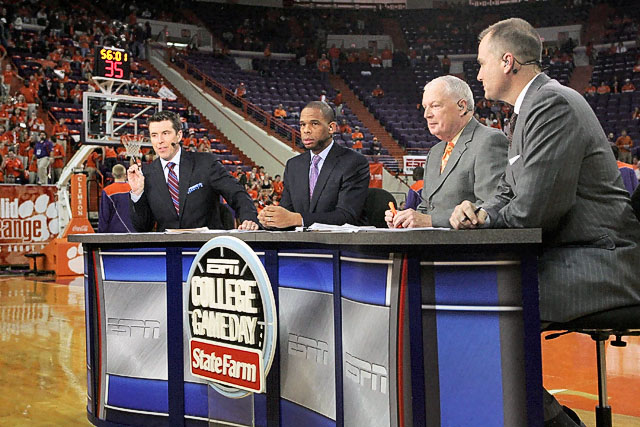
For college hoops fans, winter Saturdays are an overwhelming blur. With so many games spaced out throughout various networks, sitting down and selecting an optimal day-long viewing experience can be somewhat bewildering. When in doubt, the consensus gravitates towards ESPN, where the “College Gameday” crew doles out a constant flow of college hoops action, providing insightful commentary along the way. Starting at 10 AM ET with a studio show staged at that week’s featured game site, a raucous crowd howling in the backdrop, the panel lays out the day’s action, capped with a late-show pick ‘em segment which invariably has the effect of inciting the avid supporters on hand. Then it’s a day’s long succession of enticing fixtures, spanning different leagues, time zones and intrigue levels. The crew — Rece Davis, Digger Phelps, Jay Bilas and for the first time this year Jalen Rose, plus whoever else graces the courtside stage in any given week —  puts a bow on the day’s action with an hour-long recap show, which leads into that week’s marquee matchup. There are few things better than a “Gameday” Saturday: a highly entertaining and energetic crew of college hoops enthusiasts sandwiching a whirlwind of hoop with enlightening breakdowns and analysis about the day’s happenings.

Loved or Hated, Everyone Watches Gameday

In this early-August college hoops lull where the happenings on the gridiron seem to take precedent at most every power conference university, we long dearly for those delightful, couch-side Saturdays. Fortunately, ESPN provided a sneak peak of just how magnificent those Saturdays might be. The network released its “Gameday” schedule Wednesday, and the lineup – at least as far as I can tell from a rather distant August viewpoint – is the best I’ve seen in quite a long time. Maybe ever. The bad news is that January 19, the first Saturday of viewing, seems a pretty long ways away. Not to worry. Before you know it, Midnight Madness will arrive, November and December will slide by and the eight-week selection of action-packed Saturdays will commence. To pique your interest, I’ve put together a ranked list of the eight featured games. There’s no hard and fast criteria here; take this as a simple preferential ordering of which match-ups I feel carry the most appeal. Longstanding rivalries, interesting venues and conference/national title implications will all factor into this 100%-for-fun exercise. On paper, it’s hard to find fault with the selected games. But between now and January, a bad start or two could dampen the hype factor around some of these games. All we can hope is that the scheduled contests maintain their outwardly riveting stature throughout the winter months.

Note: All game times ET.

1. March 9: Syracuse at Georgetown (12 PM), Duke at North Carolina (9 PM)

Read the rest of this entry »

Share this story

Oregon Week: Evaluating The Recent Past

Posted by Connor Pelton on August 7th, 2012

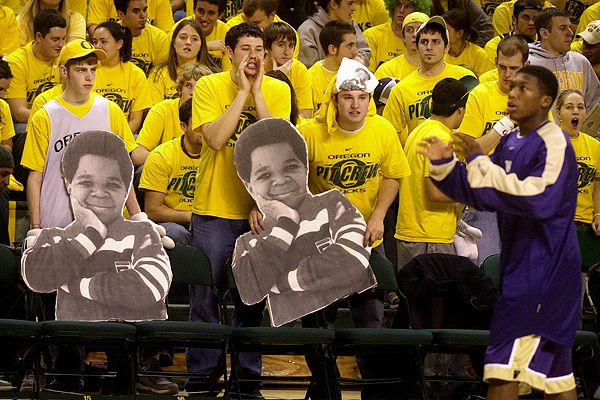
In what could be considered one of the top few-year spans in recent Pac-10/12 history, Oregon was right in the thick of it from 2006-08. Ernie Kent led the Ducks to back-to-back NCAA Tournament appearances in those two seasons, the first of which included a run to the Elite Eight. That season was one that many would consider the most successful in Oregon history. Led by star players Aaron Brooks, Malik Hairston, Tajuan Porter, and Maarty Leunen, the Ducks won 18 of their first 19 games, then finished the year by winning nine in a row before falling in a tight game against top-seed Florida. Along the way they won at Georgetown, #8 Arizona, and Washington State, and knocked off Nebraska, #1 UCLA, and Washington State in Eugene. The Pit Crew made McArthur Court into one of the toughest gyms in the nation and excitement was at an all-time high surrounding the program. Building off of that excitement, the Ducks added one of the top freshman centers in the nation in Michael Dunigan and notched road wins against Kansas State and Arizona en route to a second straight NCAA bid, just the third time ever that had happened in program history. Then, the wheels fell off.

McArthur Court Would Get So Loud That At Some Points The Baskets And Overhead Scoreboard Would Begin Shaking. Here, The Pit Crew Taunts Washington Guard Nate Robinson With Chants And Posters Of Gary Coleman. (credit: Chris Pietsch)

With Brooks, Hairston, or Leunen nowhere to be found, the Ducks limped all the way to an 8-23 finish in 2008-09. They won just six nonconference games that season and finished dead last in the conference by four games. At one low point, Oregon was only four games away from finishing the year without a Pac-10 victory before they beat Stanford. Despite some grumblings throughout Eugene, Kent held on to his job for another year. 2009-10 wasn’t much better, though, and despite finishing with a .500 record, the Ducks only beat one nationally ranked opponent all year long. Kent was soon fired, and after a lengthy coaching search that resulted in many candidates turning down the job, Creighton’s Dana Altman signed on.

Read the rest of this entry »

Share this story

Morning Five: 08.07.12 Edition

Posted by rtmsf on August 7th, 2012

  1. We mentioned in yesterday’s M5 that Connecticut head coach Jim Calhoun was recovering well after surgery to repair his hip from a cycling accident suffered over the weekend. According to an orthopedic surgeon not affiliated with Calhoun’s treatment, the standard recovery time for this surgery ranges between eight to 12 weeks. Basketball practice begins in earnest in nine weeks, so there’s a strong possibility that the beginning of a rebuilding season in Storrs is already off to a rough start. As Mike Decourcy writes, Connecticut as a program faces a number of long-term issues with the 70-year old Calhoun undoubtedly reaching the end of his career soon — his latest health dust-up only serves to complicate those very important issues.
  2. It’s probably not often that we’ll choose a valuable M5 blurb to write about a player who only averaged a half-point and 1.8 rebounds per contest last season. But UCLA’s Anthony Stover dismissed from the team Monday for academic problems — is a statistical anomaly of sorts — the 6’10” rising junior only saw eight minutes a game in Ben Howland’s system, but he still managed to block shots at a higher rate in limited time (18.2%) than Kansas’ Jeff Withey (15.3%) and Kentucky’s Anthony Davis (13.8%). Of course, for every block Stover registered last season (38), he also recorded a foul (37), so there’s clearly a learning curve he must still conquer. Still, for a mid-major willing to work with the young man in the classroom, the potential (at least on the defensive end) is there.
  3. Quiet among all the other newsworthy things the NCAA has done lately, the governing body has implemented a number of new player eligibility standards that will be phased in by 2016. So why is this important now? As Dana O’Neil explains in this wide-ranging piece, high school freshmen for the Class of 2016 will report to their freshman years at high school in the next few weeks. The new requirements increase the number of core curriculum courses to 16 (10 of which must be completed in the player’s first three years of high school, and seven of those must be in math, science, or English classes), raise the minimum GPA from 2.0 to 2.3, and generally scare the bejeezus out of college coaches everywhere. According to the NCAA, 43 percent of players who entered college basketball in 2009-10 would not have been eligible to play as freshmen under these new standards. Well, that solves the fake coursework problem — now, on to the AAU problem.
  4. More on this later today, but the Legends Classic released its faux-bracket yesterday, and we could be in for quite an early season treat in the new Barclays Arena during Feast Week if things work out. This event is one of those preseason “tournaments” where the semifinal teams are prospectively placed regardless of what happens in the earlier rounds, but if both Indiana and UCLA beat their semifinal opponents (Georgia and Georgetown, respectively), we could be treated with an epic neutral site showdown between two of the nation’s top five teams. Both IU and UCLA boast talent aplenty, and if you believe CBSSports.com’s recent report that IU star Cody Zeller and UCLA star Shabazz Muhammad are the two most coveted players in college basketball by other coaches, then this potential match-up represents the best that November will likely have to offer.
  5. Next season cannot get here soon enough, but SI.com’s Andy Glockner is helping us fill the summer time off with his second annual Twitter-style State of the College Hoops Union piece where he breaks down 53 of the nation’s best teams in 140 characters or less. There’s some good stuff there, so we’d encourage you to stick with the article after reading Arizona’s blurb and his first of more than a dozen awful hoops-related puns. Out like a Lyons in March? Yeah, we meant awful as in good. Somewhere in a lair under a golf course, Jim Nantz is stealing many of Glockner’s better quips.
Share this story

Washington State Week: Q&A With CougCenter

Posted by Connor Pelton on August 5th, 2012

As part of our Washington State week, we wanted to reach out to the guys at CougCenter for their takes on the upcoming Cougar basketball season. Kyle Sherwood was kind enough to spend some time with us and give us his thoughts.

Rush The Court: How do the Cougars plan on replacing players like Marcus Capers, Abe Lodwick, and Faisal Aden?

CougCenter: Easier than you’d think. Capers, Lodwick and Aden were all high-character guys and great team leaders, but for the most part they were all one-dimensional  players. Those players meant a lot to WSU, but I think this current roster is the first one that really fits into how Ken Bone wants to play. The 2012-13 team is loaded with athletic wings who can create space and hit shots from long-range, so we’re going to replace those guys by running…and running…and running..?

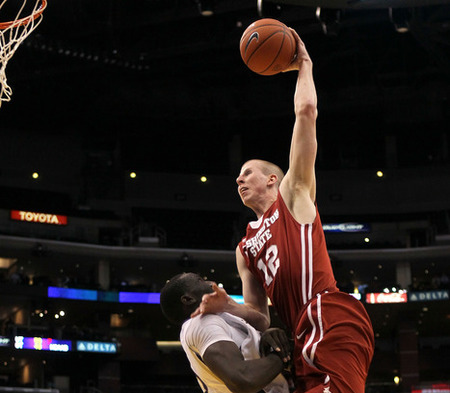
Look For The Fast Cougars To Have Many Transition Opportunities That End With Dunks (credit: Stephen Dunn)

RTC: CBI time! Washington State played four games in three different tough road environments (well, as tough as CBI crowds can get), and ended the tournament with a 4-2 record and runner-up finish. Overall, was this a good experience for the team?

CC: Well, Capers and Lodwick meant so much to the program that it was worth playing as long as they wanted to keep going. The team had really turned a corner around the beginning of February, but it wasn’t showing up in the win column. When they started advancing in the CBI, it wasn’t just that they were winning, it was how dominating they looked. It was nice for the players to see the work they had put in to turn their season around pay off with such lopsided scores. I think we all would’ve liked a tournament win (because you know WSU would hang a flippin’ CBI banner), but the team got what it needed from its success in the first four games.

Read the rest of this entry »

Share this story

Washington State Week: What To Expect

Posted by Connor Pelton on August 4th, 2012

We’ve gone through the Washington State roster and told you about the returnees and the newcomers, but let’s put it all together today: What does the 2012-13 season hold for the Cougars? Just how good will returnees like Reggie Moore, DaVonte Lacy, and Mike Ladd be, and which of the newcomers will emerge as major contributors? And most importantly, can these Cougs improve upon last year’s CBI appearance? Let’s break out that old crystal ball again and see what it says.

Motum Will Lead The Cougars In Scoring For The Second Straight Year

WSU’s Leading ScorerBrock Motum. No reason we shouldn’t think the Pac-12’s leading scorer in 2011-12 wouldn’t lead his own team in his senior year. With Motum’s ability to score from anywhere on the floor and the fact that he touches the ball so many times on each possession, this is the only pick here. Even with a pair of confident newcomers like Royce Woolridge and Demarquise Johnson who will take a way some of his looks, Motum will still be the go-to guy.

WSU’s MVPRoyce Woolridge. This is a tad bold, but we don’t want to give two awards to Motum even if he may deserve it. Players and coaches called Woolridge the best player on the practice court last season, and the word out of Pullman is that he’s not afraid to shoot the ball. If he can give the Cougars 12 points a night, four rebounds, and maybe a couple steals here and there, Woolridge and Motum will make quite the one-two punch.

Read the rest of this entry »

Share this story

Pac-12 Basketball Fantasy League Voting: Semifinal #2

Posted by Connor Pelton on July 26th, 2012

Our last semifinal pits two seed Adam Butler (Pachoops) up against the fourth seed, Connor Pelton. Below are the rosters, followed by commentary from the respective owner:

Adam Butler

  • Head Coach – Ralph Miller, Oregon State
  • Guard – Damon Stoudamire, Arizona
  • Guard – Mike Bibby, Arizona
  • Guard – Michael Dickerson, Arizona
  • Guard – Salim Stoudamire, Arizona
  • Forward – Sean Elliott, Arizona
  • Forward – Ed O’Bannon, UCLA
  • Forward – Shareef Abdur-Rahim, California
  • Forward – Chris Mills, Arizona
  • Center – Todd MacCulloch, Washington
  • Center – Bison Dele, Arizona

Adam’s Take:

Oh, pardon me! I was still chuckling at Connor’s lineup. Allow me to explain.

Indeed, a team centered by Steve Johnson is a formidable one. Anyone who shoots 75% from the floor for a season must be taken seriously. Conversely, anyone who looks like Sideshow Bob should not. That’s Robin Lopez. Besides, Todd MacCulloch just set the high score on The Simpsons: Pinball in Springfield at six different Canadian bars, and somewhere a piece of Lopez dies.

Moving our way out of the deep frontcourt we can look at the forwards on Team Pelton. I’m inclined to dismiss Jon Brockman because hustle only counts in real basketball. In fantasy drafts, hustle is just cute. Which is why I suppose Klay Thompson gets a fantasy nod because numbers count in fantasy ball and softness is cute. Please, Chris Mills just sneezed to block a Thompson jumper. I of course have love for Richard Jefferson, but if you’re a forward from Arizona and your name isn’t Elliott, you’re still not going to win this one. The fourth opposing forward’s name is Kiki, in which I rest my case.

Guard play, as you noticed, is Team PacHoops’ strength and not Team Pelton’s. Sure, there’s some talent, but no rings. I thought college hoops was all about solid guard play. You’re telling me none of these guys could garner one championship? Wait, wait, between these four guards they mustered at best a Sweet Sixteen? Woof (not for you, IT). Reggie and Chauncey appeared in the NCAA Tournament just once each? Does Spike Lee know this? None of that sounds fun. Fun sounds more like never missing an NCAA Tournament and winning it all. That’s who I like on my team. Got ‘em.

At the helm, Ralph Miller Court sits inside of Gill Coliseum. I can give that and I’ll be the first to admit that it’s indisputably the most badass possible thing to have a coliseum with your name on it. But look, I know you saw Batman Begins and if you didn’t, well, you’re missing out. Point being, Bruce Wayne didn’t just become Batman. He needed mentorship to become the fearless defender of Gotham he would become. Enter Ra’s Al Ghul, the sensei who salvages Wayne from a Chinese prison. Protégé, meet mentor. But the relationship goes sour and the two part ways; Wayne to his seemingly playboy life, Al Ghul to what appeared to be his death (theme?). Alas, the end of the film gives us Al Ghul’s villainous return to Gotham and Batman’s heroic and final takedown of the mentor. In the ultimate flipping of the script, Al Ghul and all his wisdom and skill is no match for the noble monster he created.

So, what the hell am I getting at? I’m saying that if the greatest hero (or certainly superhero trilogy) of our time could defeat his mentor, so too can Ralph Miller and defeat his Oregon State predecessor, Slats Gill. Miller won more games and was twice National Coach of the Year. Goodness I love me some Ws.

Have I made a stretch here? Perhaps. But you also just got to read college hoops and Batman so you’re welcome. Vote PacHoops.

Read the rest of this entry »

Share this story
Stanford Week: A State Of the Program Address

Posted by Connor Pelton on July 22nd, 2012

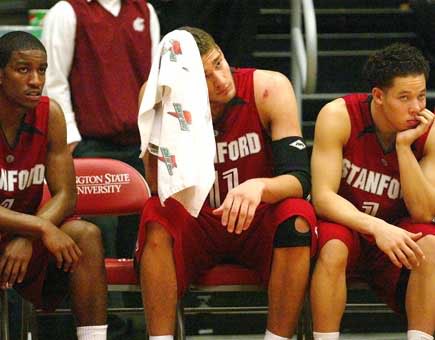
We’ve been all around the Stanford program in the past week, but we’ve got time for one more post. At the end of every week we like to take a step back and look at the overall state of the program – not just how the team performed last year or is expected to perform next year, but what the long-term prognosis for the program is. At Stanford, while the short-term future appears to be bright (no pun intended), things could take a turn for the worse quickly. As we pointed out earlier this week, before current head man Johnny Dawkins took over in 2008-09, the Cardinal had made 13 out of the last 14 NCAA Tournaments. They haven’t gone dancing since, but the pieces are there to make it back soon enough. The problem in the past four seasons have been mid-season losing streaks. Not only do they usually kill all excitement around the team, but it ruins any chance at gaining an at-large entry into the Big Dance. Let’s take a look at some of these mid-season collapses:

This Photo May Have Been Taken Prior To The 2008-09 Season, But It’s A Scene That Fans Have Seen Many Times In The Past Four Years (credit: Roundball Nuts)

  • 2011-12 : Started out the season 15-3, including double-figure victories against Colorado State and Oklahoma State. Then immediately dropped five of their next six, all by double figures.
  • 2010-11 : It wasn’t going to be an NCAA Tournament year anyway, but dropping five out of seven games from early January to early February put all postseason dreams to rest.
  • 2009-10 : The Cardinal lost five of six games from late January to mid-February, putting a footnote on Dawkins’ worst season on the Farm.
  • 2008-09 : By far the worst collapse of Dawkins’ tenure came in his first season. Stanford started out the season with an 11-1 record, picking up home victories against Colorado, Northwestern, Texas Tech, and Arizona, while going on the road and beating Colorado State and Santa Clara. Then, out of nowhere, disaster struck. An NCAA Tournament season became a “scrape-your-way-into-the-CBI” campaign after dropping eight of 10 contests in more than a month-long span.

Terrible. Just terrible. And it happens like clockwork every year.

Read the rest of this entry »

Share this story