Morning Five: 05.08.13 Edition

Posted by rtmsf on May 8th, 2013

morning5

  1. The biggest news of the day on Tuesday, and a subject on which we’ll have more later this afternoon, is that the NCAA Tournament’s marquee event, the Final Four, is headed to cable giant TBS beginning in 2014. CBS and Turner Sports have jointly held the broadcast rights to March Madness for three years now, and it was well-known that TBS would have the right to begin airing the Final Four next season, but the choice of Turner Sports to exercise that option shows just how valuable the company thinks the property has become. As to specifics, the two entities will split things next season, with each getting two games of the Elite Eight, Turner taking the Final Four, and CBS the national championship game. The same situation will apply in 2015, but in 2016 Turner will take the entire final weekend before rotating it back to CBS the next year and alternating each season after that (the Elite Eights will remain split). At first blush, this seismic broadcasting shift may appear to be a downgrade from network television, but as Mike DeCourcy writes, cable television is nearly as ubiquitous as the networks nowadays, and the additional revenue brought in from the partnership with Turner allowed the NCAA Tournament to avoid the nuclear option of a horrifying expansion to 96 teams.
  2. So the Final Four might be moving to a new broadcast format next year, what about some prominent players hoping to get there? A couple of rising seniors were on the move yesterday, with UNLV’s Mike Moser settling on a destination for his final collegiate season — Oregon — and Tennessee’s Trae Golden seemingly on the outs with his coaching staff as he has decided to leave Knoxville. Moser had been rumored to be considering Washington and Gonzaga, but the Portland product ultimately was swayed by the success that Dana Altman has shown with several of his transfers (most notably Arsalan Kazemi last season). Moser was a preseason All-American at UNLV last year who struggled with injuries and his role in a lineup that featured freshman wunderkind Anthony Bennett as well as a number of other talented players. The Moser transfer makes sense under the graduate exception, but Golden is a lot tougher to figure. After a successful junior season where he had made it publicly known he was pleased with the direction of the program (and why not, he was the only point guard on the team), he has decided to leave Knoxville; and if you read the tea leaves among some of his UT buddies, it may not have completely been his decision. He too will try to employ the graduate transfer option next season, but it’s at this point unknown where he is headed.
  3. From players on the move to programs, two more schools are jumping conferences in the timeless yet endless pursuit of greater glory somewhere up the food chain. Davidson‘s Stephen Curry may own the NBA Playoffs at this point, but he never owned the A-10! At least that’s the logic behind the tiny school’s jump from the SoCon (where it has been a member for the better part of 80 years) to the Atlantic 10 beginning in July 2014. The school has arguably had a move like this on its agenda for a while, because it turned down an invitation to the CAA last year, presumably expecting a bigger and better offer to come soon enough. One of the residual effects of all the football-driven conference realignment nonsense is that there has been a bit of an unanticipated pooling of talented mid-major basketball programs as a result. Along the same lines, Oakland University (remember, it’s in Michigan, not California) announced that it would be joining the Horizon League starting this summer. Even though Butler is now gone from the HL, Oakland brings a solid program to the fold led by Greg Kampe that has been to the NCAA Tournament in two of the last four seasons (2010, 2011).
  4. We missed this one yesterday, but it’s a fascinating piece published by David Steele that looks at the story behind one of this year’s 46 early entries into the NBA Draft — a guy by the name of Joshua Simmons. It’s not newsworthy in the sense that seemingly every year there are a few guys who forgo their eligibility who have no business doing so (and a few others who do so as a publicity stunt), but Simmons’ situation is really one of no other viable basketball options. It’s not that anyone he’s played for thinks he’s a bad apple or couldn’t potentially claw his way onto a professional roster someday, it’s that he simply ended up on a difficult path that led from a Division II school to a junior college to, well… nowhere. That’s why he’s on the early entries list, and that’s why he’s simply hoping for an invitation to the pre-draft camps and ultimately, the summer league. It’s certainly not a well-worn path to the NBA, but it’s the only one he has.
  5. By now we’re all sick of hearing about Andrew Wiggins, right? The precocious Canadian wing who has been compared to everyone from Michael Jordan to Kobe Bryant is the top player in the Class of 2013, and every major school on his list still thinks it has a great shot at landing him. His quartet of suitors are Kansas, Kentucky, North Carolina and Florida State, but according to this article from the Louisville Courier-Journal, the wait should be ending soon. He expects to make his decision within the next “week or so,” which means that the message boards, blogs, and the commentariat at all four schools will be working overtime in the interim. In the meantime, he plans on moving back to Toronto, going to prom with his grade school friends, and generally trying to live the rest of his spring out as a normal teenager graduating high school would — in other words, an impossible feat for someone as closely watched as Wiggins.
Morning Five: 03.07.13 Edition

Posted by rtmsf on May 7th, 2013

morning5

  1. The beauty of advanced quantitative analysis in sports is that, when done correctly, it can validate things that you already inherently know. Trey Burke as the best player in America? It sure felt like it while we were watching him lead Michigan past Kansas and Florida on the way to the Final Four. Rick Pitino as the best coach going right now? Considering how his Louisville Cardinals were essentially the same cast of characters from a surprise 2012 Final Four run and became recognizably better on the offensive end (especially out of timeouts) in 2013? Sure seems like it. Of course, there are limitations — Florida rated tops in KenPom’s efficiency ratings for most of the season, but the Gators were merely a good team filled with good players, not a great one. SI.com‘s Luke Winn keeps us interested by doing what only he has proven he can do — sifting through terabytes of efficiency data and video clips to come up with his second annual Data-Based Coaching/Player Awards. Lots of good information in the piece, but perhaps the neatest has to be his quantification of Oregon’s Arsalan Kazemi as the nation’s best all-around defender. 
  2. Speaking of Pitino, the guy continues to get a surplus of positive press in the wake of his second national title. Several outlets had a Pitino/Kentucky Derby story coming out of the weekend, but ESPN.com‘s Dana O’Neil wrote the quintessential story about the man she calls “the Derby King.” The crux of the story is that regardless of whether Pitino’s horse “Goldencents” finished first, 10th, 17th or somewhere behind the barns in Saturday’s Derby, the 60-year old tattooed grandfather owns the town of Louisville and everything in it. Including Millionaire’s Row. It’s not the kind of read you see much of anymore in the instant-gratification world of online writing, but that makes it even more worth your time.
  3. This news is circumstantial and ultimately may not mean anything at all, but the possibility that it could mean something is really disturbing given recent events. Dennis Dodd at CBSSports.com reported on Wednesday that Missouri head coach Frank Haith has filed a petition in federal court to determine how the NCAA got its hands on what appears to be microfiche copies of his personal bank records. According to the report, some of Haith’s Bank of America records were voluntarily turned over as part of the NCAA’s investigation into the Nevin Shapiro violations at his former school, Miami, but those records did not include the more detailed microfiche copies which Haith seems to believe that the NCAA has in its possession. The gigantic elephant in the room, of course, is that the NCAA already admitted missteps in this case by offering payment to certain witnesses for testimony, but an as-yet unfounded assertion that the organization may have illegally solicited bank records to bolster its case could set off yet another firestorm surrounding the organization. Stay tuned on this one.
  4. If there’s one thing we love about college sports, it’s when former stars come back into the fold as a coach at their alma mater. The Arizona Star-Republic reported on Monday that “Mighty Mouse,” former Arizona star and current Memphis assistant, Damon Stoudamire, is returning to Tucson to join Sean Miller’s staff as an assistant there. For those who don’t remember him at Arizona, he was a three-time all-Pac-10 guard, an All-American in 1995, and, along with backcourt mate Khalid Reeves, led the Wildcats to Lute Olson’s second Final Four in 1994. He’ll fit in great on Miller’s staff, focusing on work with the guards, a role he has fulfilled with Josh Pastner the last couple of seasons.
  5. One other significant coming and going from Monday was out of Florida, as the second Gator in a week announced his transfer out of the program. Last week it was freshman Braxton Ogbueze who say the writing on the wall with two top 10 recruits and Rutgers transfer Eli Carter entering the program; this week it is Devon Walker, a freshman wing who saw just a handful of minutes in 25 contests this season. The Gators are coming off three straight Elite Eight appearances, but none of those three teams were loaded with NBA talent (Bradley Beal’s freshman year was the lone exception). With Kasey Hill and Chris Walker both headed to Gainesville next season, though, the Gators could actually boast more elite talent in 2013-14 than it has the last several years.

Ben McLemore Allegations More Fodder For a Monotously Grating Debate

Posted by Chris Johnson on May 6th, 2013

Chris Johnson is an RTC Columnist. He can be reached @ChrisDJohnsonn

Maybe the most important question is, “is anyone even the least bit surprised?”

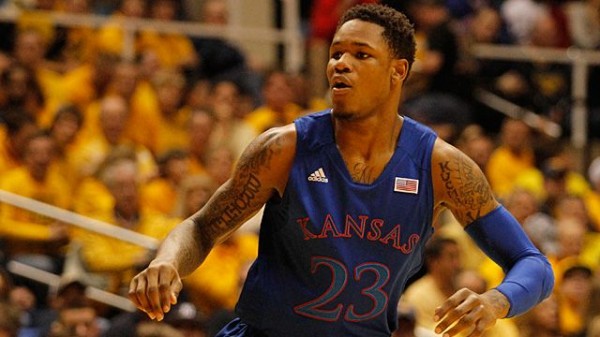
That was the first thought that jostled around my frontal lobe after reading Eric Prisbell’s expose in Saturday’s USA Today detailing St. Louis-area AAU Coach Darius Cobb’s admission to receiving multi-thousand cash payments and free-expenses paid trips in exchange for perceived influence and access to Kansas star and likely top-three NBA draft pick Ben McLemore. Cobb reportedly met with various sports agents and financial advisers looking to steer McLemore to the professional ranks after his redshirt freshman season. Even a cursory knowledge of NCAA protocol would lead you to make the following conclusion without much in the way of deep introspective thought: An investigation of Kansas’, and by extension McLemore’s, alleged impropriety could result in the Jayhawks not only losing their Big 12 title and Sweet Sixteen appearance, but having its entire 2012-13 season expunged from NCAA historical accounting. Everything McLemore touched during his college career could be in danger of sheer obliteration. There would be protest and angst and complaints. It would get ugly.

The NCAA ultimately may not be able to find any wrongdoing on behalf of Kansas or McLemore (Getty Images).

The NCAA ultimately may not be able to find any wrongdoing on behalf of Kansas or McLemore (Getty Images).

Or maybe it won’t: thanks to some quick analysis on the matter at hand from John Infante, the internet’s resident NCAA bylaw expert and author of the famous Bylaw Blog, a completely blood-free resolution of the case seems entirely plausible, even historically prudent. Kansas can look through the superficial ugliness of its star freshman shooting guard and nefarious AAU-circuit go-betweens and financial impropriety, yearn for a punishment-free future and not feel totally nervous about the whole thing. The NCAA, as is all too often the case in high-profile impermissible benefits cases (and as was made glaringly evident in the resolution of the Lance Thomas jewelry fiasco), has no legal means by which to force Cobb, alleged McLemore-invested runner Rodney Blackstock or even McLemore himself, now that he’s declared for the NBA Draft, to discuss his muddy past. The only looming repercussion is if Cobb or Blackstock qualifies as an “agent,” which could very well be the case under the NCAA’s new expansive definition, or – as Infante details in much greater and clearer nuance – if McLemore is proven to have had knowledge and willing acceptance of Blackstock’s (or whoever else was involved) services.

Read the rest of this entry »

Morning Five: 05.06.13 Edition

Posted by rtmsf on May 6th, 2013

morning5

  1. The NCAA approved legislation on Friday that will allow the first official practices to start two weeks earlier next fall, essentially meaning that we might see Midnight Madness events tipping off in late September rather than the usual mid-October commencement date. The rule allows for 30 days of team practices over a 42-day window, backing up from the date of the first regular season games of the season (next year: November 8). While we’re fully in support of more preseason practice time so that teams have sufficient opportunity to field a good product during the marquee early events, we’re not sold on the idea of having a bunch of Midnight Madnesses while college football is still getting under way, the NFL is only three weeks into its season and the MLB playoffs haven’t even begun yet. It’s not the worst thing in the world if college basketball fans are getting excited about Big Blue Madness, Late Night With Roy, and the rest, for a sliver of a crowded September sports schedule, but if we had been the NCAA, we may have written a clause into the draft that allows for the earlier practice time while mandating that public events cannot go off until the usual mid-October date. 
  2. This article from the LA Times‘ Bill Plaschke isn’t a college basketball piece, per se, but it does start and end with examples relating to the sport. The topic is the difficulty of head coaching positions in the Los Angeles sports scene, and UCLA men’s basketball in particular is featured prominently. He cites the fact that there’s already a Facebook page dedicated to firing new Bruins’ head coach Steve Alford, and of course he makes time to mention former head coach Ben Howland’s three Final Fours during his decade in Westwood. The restlessness that appears to infect the LA sports and entertainment scene is probably not much different than anywhere else — perhaps a bit more hyperactive there because of the importance of style over substance — but Plaschke is absolutely correct when he notes that a certain former head coach went a phenomenal 16 seasons before “finally” winning the first of his 10 national championships. No doubt if John Wooden had coached in today’s era of immediate expectations and returns, he may not have ever gotten the chance to make his unprecedented run.
  3. We’ll have more on this topic later today, but news from USA Today‘s Eric Prisbell over the weekend suggests that the former AAU coach of former Kansas star Ben McLemore took money and benefits from an agent named Rodney Blackstock in an effort to “deliver” the possible overall top draft pick to him. The report revealed three regular season KU games where Blackstock received a complimentary guest pass from McLemore, but as is so often true in these situations, it’s nearly impossible to prove the player or the school knew any such impropriety as alleged by the coach actually occurred. As Gary Parrish at CBSSports.com points out, the NCAA could use Bylaw 12.3.1.2 to declare McLemore ineligible based on what it already knows, but to do so flies in the face of what it just concluded in the Lance Thomas/Duke situation, and begs the tried-and-true question of whether schools should be held responsible for things it simply cannot control in this messed-up system that exists well outside the reach of the NCAA. Gregg Doyel makes a similar argument in this piece, taking the tack that whether we’re talking about the possible ineligibility of Marcus Camby, Derrick Rose or McLemore, the head coach shouldn’t be held responsible unless, you know, he actually had knowledge of, or should have had knowledge of, the events that caused the ineligibility in the first place. Makes sense, right?
  4. There was one notable transfer over the weekend, as Western Michigan’s Darius Paul, the MAC Freshman of the Year last season after averaging 10/6 for the Broncos, tweeted that he would transfer to Illinois after attending older brother Brandon’s postseason awards banquet. He had several high-major offers on the table, but it is becoming clear that John Groce’s fun playing style feeds into a recruiting strategy focused on bringing in a healthy mix of talented freshmen and successful mid-major transfers such as Paul, Illinois State’s Jon Ekey, Seton Hall’s Aaron Cosby, and several others. Paul will sit out next season per NCAA rules but will be ready to contribute in the post for the Illini beginning in 2014-15.
  5. Rick Pitino has had a pretty good spring, but he didn’t add Kentucky Derby champion to his list of 2013 accomplishments. The horse in which Pitino owns a five percent stake, Goldencents, had some trouble getting early traction in the Saturday evening race at Churchill Downs before easing up down the stretch to finish in 17th place. Still, we’re certain that simply having quite literally a horse in the race was good enough for Pitino in this event, as the 60-year old has spent his entire life chasing basketball rather than race track glory. SI.com‘s Pete Thamel interviewed Pitino in this piece that published Friday, and it’s abundantly clear that the two-time national championship head coach thinks he has a great shot at doing it again in 2014.d

More TV Money for the Nation’s Most Powerful Conference: Surprise, Surprise…

Posted by Chris Johnson on May 3rd, 2013

Chris Johnson is an RTC Columnist. He can be reached @ChrisDJohnsonn

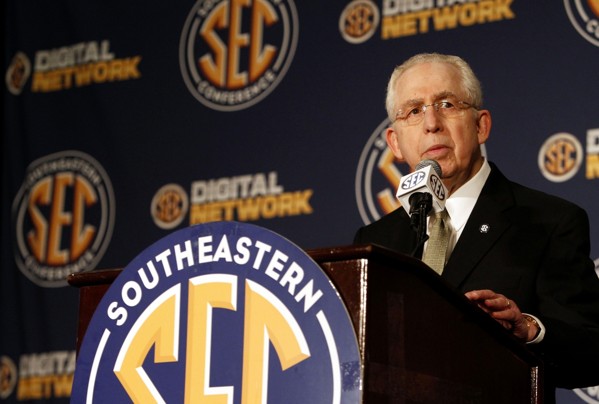
Because once-meaningful concepts like academic and cultural similarity, geographical proximity and longstanding tradition no longer control how or why college athletic conferences exist, and because television, you know, does – Thursday’s news out of SEC headquarters is a very big deal, both for  league directly involved, the SEC, along with every other college sports conference. The South Eastern Conference announced a 20-year agreement with ESPN Thursday to air a 24/7 all-encompassing sports network beginning in 2014, with programming that includes 45 football games and more than 100 men’s basketball games annually, plus “selected events” from non-revenue sports and other important offseason dates such as football pro-days and national signing day.

An expansive new TV contract will grow the SEC's already monumental annual financial take (AP Photo).

An expansive new TV contract will grow the SEC’s already monumental annual financial take (AP Photo).

This is a very big deal. It is not mars-landing breaking news. Here’s why: the SEC exists in an entirely different plane of football competitiveness and import, stuffed to the hilt with NFL-bound talent and a fervent pigskin culture not seen in any other league across the country, but they were a step or two behind on this conference-specific television fad. The Big Ten and Pac-12 networks already have their own networks, which promise (alongside nonstop league-centric coverage) exorbitant annual sums, serve to expand the otherwise lesser profile of lower-tier programs and clearly represent the way of the future in a bountiful college sports television frontier.

The more subscribers there are in different regions of the country, the more fans that are eager to watch Washington State play Utah on a Thursday night, for example, the more money falls into league coffers and the more other schools – we’re looking at you, AAC – want a piece of the pie. These were the logistical league-hopping dynamics behind much of the recent conference realignment wave (go watch Maryland’s astonishingly candid introductory Big Ten press conference), and they will continue to drive the ship in league membership decisions, even if the ACC’s recent grant of rights deal appears to have ensured at least temporary realignment calm among the major conferences.

Read the rest of this entry »

Morning Five: 05.03.13 Edition

Posted by nvr1983 on May 3rd, 2013

morning5

  1. Yesterday was not a good day if you like to defend the NCAA as it released its annual financial statement (sort of like a corporation) and it showed that the NCAA had a record $71 million profit in 2012. As you would expect this figure brought out quite a few comments asking how the NCAA could justify not sharing the profits with the student-athletes. We believe that paying student-athletes (and the economics behind it) are far more complex than most writers have made it out to be, but the numbers are pretty impressive. Our favorite part of what has been released from the report is their analysis of their current legal cases: “The NCAA and its legal counsel are defending against lawsuits and claims arising in the normal course of its day-to-day activities. The NCAA does not believe the ultimate resolution of these matters will result in material losses or have a material adverse effect on the consolidated financial position, change in net assets or cash flows of the NCAA.” We have a feeling that we could be recycling this quote if the Ed O’Bannon case goes against them.
  2. It was about a year and a half ago that Taylor Branch published his epic piece on the NCAA and its curious mission in The Atlantic. The latest piece in The Atlantic about the NCAA will not generate the same interest, but it probably might lead to an equal level of disgust from readers as Meghan Walsh examines the (lack of) healthcare coverage provided by schools for its student-athletes. We tend to take many of these anecdotes with a grain of salt since they are only one side of the story since the schools often decline to say anything of any substance on the allegations, but they should make recruits and fans think a little bit more about the schools and programs that they commit to or choose to root for in the future.
  3. One of the many criticisms of the NCAA is that they tend to move at a glacial pace and yesterday’s decision to suspend the previously accepted chances to recruiting communications only reaffirms that. This suspension will not affect basketball because the rules have already been in place for nearly a year (and why would the organization have similar rules for all of its sports?) so we may not see much of a change. The actual decision to at least temporarily hold on the rules change is not that remarkable, but the fact that they can pass a rule (at least temporarily) that such a large percentage of its member institutions oppose is always alarming.
  4. Last month, Jerry Tarkanian was elected to the Basketball Hall of Fame and it appears to have set in motion a chain of events that are bringing increasing notoriety to Tarkanian’s impressive and underappreciated career. The latest such tribute is a statue of Tarkanian that was unveiled as part of UNLV‘s Jerry Tarkanian Project. The school plans on not only placing a bronze statue of Tarkanian (complete with a towel in his mouth) outside the Thomas & Mack Center, but also establishing a scholarship fund in his name. The project is still in the fundraising stages and they are soliciting donations now so it may take a while before it is complete (we have no idea how much it will take or how far away they are), but it should help reestablish a sense of tradition in a program that is just returning to national relevance after nearly two decades in the shadows.
  5. Joining the ranks of the Big Ten and Texas among others, the SEC is set to launch its own 24-hour network. The network, which will be run with ESPN, will debut in August 2014 and is part of a 20-year deal. The key to this deal is clearly SEC football, but it will mean more than 100 extra SEC basketball games broadcast nationally, which could be good or bad depending on which games they show, but it will also provide additional exposure for many of the programs on a national level. We are not sure how much it will do for the football programs as their level of play should be enough to entice any recruit, but it could help basketball programs particularly the lower-tier ones attract talent on a more nation-wide level than they are used to.

College Basketball on the Verge Of Making Another Smart Addition to Its Season-Opening Slate

Posted by Chris Johnson on May 2nd, 2013

Chris Johnson is an RTC Columnist. He can be reached @ChrisDJohnsonn

With each passing season, college basketball moves closer and closer to staging a truly definitive opening day. The goal, for obvious reasons, is to eliminate the brushed-aside nonchalance with which the general sports populace typically treats college basketball’s opening tip. The time slot is hazardous  (The NFL is the law of the land, basically, and college football after that) and aside from a few marquee events in recent years – the Champions Classic, the Ramstein Air Base adventure, the epic aircraft carrier overindulgence of last season – the non-conference season commences in a way that captures the common fan almost exclusively in non-NFL, college football-time slots. College hoops is a fallback at that time of year, an OK-because-nothing-else-is-on ordeal. All of these ambitious season-opening endeavors comprise an attempt to make it the main attraction.

If the event comes to fruition, college basketball will have improved its often overlooked nonconference season (Ardas Photography).

If the event comes to fruition, college basketball will have improved its often overlooked non-conference season (Ardas Photography).

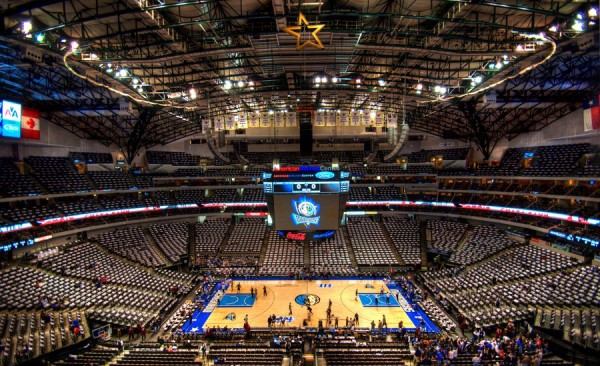
Another such opportunity was brought to our attention late Tuesday night by ESPN’s Jason King, who reported that event management firm bd Global is working with the American Airlines Center in Dallas to stage a headlining “multi-game event featuring some of the nation’s top teams.” The AA Center stuck its toes in the college hoops realm last season when it hosted Texas and UCLA’s ugly December 8 clunker in front of meager crowd support and only a passing glance of national media attention.

This year’s proposed event would be better theoretically, and astutely planned practically. Why? The arena just so happens to be situated a mere afternoon drive’s distance (18 miles, to be exact) away from the modern sports fiefdom known as Jerry World, the site of the 2014 Final Four. Placing this event – which could include up to four games and, in lieu of more enlightening details, should feature a large contingent of Big 12 teams – near the Final Four host site will stoke local excitement in the sport and its nearby teams well in advance of the time of year casual fans typically turn their eyeballs and acknowledge college basketball’s actual existence: March.

Read the rest of this entry »

Morning Five: 05.02.13 Edition

Posted by rtmsf on May 2nd, 2013

morning5

  1. Over the past five years or so, the college basketball puppet-masters have made heroic if not completely successful attempts to spice up the early November opening of the season. Between the ESPN 24 Hours of Hoops Marathon, the Champions Classic, the Armed Forces Classic and the various aircraft carrier games, there have been some hits and some misses, but if nothing else these events suck a small percentage of the oxygen out of a sports media universe dominated by the pigskin at the time. According to ESPN.com‘s Jason King, there may be another entry into a crowded opening week on the horizon. bd Global is reportedly putting together the final touches on a multi-game event that would take place in Dallas’ American Airlines Arena, just 20 minutes away from Cowboys Stadium, the site of next year’s Final Four. The concept, of course, is that this event — which would include some prominent semi-local Big 12 schools and other national programs — would bookend the 2013-14 season in exciting fashion, while calling attention to the site of next year’s (and future years’) championship weekend. We’re all for it, but is it too much to ask that the event organizers hold this on the actual opening day of college basketball?
  2. There were a couple of prominent transfers Wednesday, with the announcements that Kansas State’s Angel Rodriguez will land at Miami (FL), and Arizona’s Angelo Chol is leaving Sean Miller’s program. There was some speculation originally that Rodriguez may follow his former coach Frank Martin to Columbia, South Carolina, but because of a family health issue, he sought a location relatively close to his home in Puerto Rico and Miami is about as close as he can get. Rodriguez also played his prep basketball in South Florida, so he’s already familiar with the area. If he manages to receive an NCAA family health waiver to suit up next season, he can step right in at the point guard slot vacated by Shane Larkin and would immediately become the team’s best player. Chol found himself in a big man logjam last season in Tucson, averaging a couple points and rebounds per game in only about nine minutes per outing. Even with Grant Jerrett’s decision to leave for the pros factored into next year’s playing time calculus, the addition of top five prospect Aaron Gordon meant that things were unlikely to improve much for Chol in that regard. The San Diego native is likely to give San Diego State a good, hard look as a possible destination.
  3. With everyone providing their post-draft deadline Top 25s for next season, CBSSports.com‘s Gary Parrish and Jeff Goodman went one step further with their predictions of how the preseason All-America teams are likely to look in November. Keeping in mind that players who are consensus locks in the preseason sometimes have a tendency to fall completely off the list by March, their selections generally make good sense at this time. Marcus Smart, Doug McDermott and Russ Smith are easy selections, and Mitch McGary probably is a good choice for a fourth. Their wildcard selection, however, is where you just never know… Andrew Wiggins is everyone’s rising superstar du jour, but it wasn’t that long ago that Harrison Barnes was a two-time lock for First Team All-American (he made zero major AA teams at UNC) and Anthony Davis was on a clear track to become the next Bill Russell (Damian Lillard instead was the NBA’s consensus Rookie of the Year). We say this not to point out specific mistakes because everyone makes them, but really to highlight the extreme fallibility of predictions such as these (by anyone).
  4. If that’s not enough to get you hyped for next season, ESPN.com‘s Dana O’Neil backs these guys up with her argument that the 2013-14 season, with a tremendous group of returnees buttressed by an equally impressive group of newcomers, is shaping up to be something special. Frankly, it’s a really tough argument to make. The 2011-12 season trotted out the same argument with the returns of rising stars Harrison Barnes, Perry Jones and Terrence Jones, to name a few, but that season was mostly marked by a clear delineation that Kentucky and North Carolina, when fully healthy, were the best two teams in America. For our money, a season like 2012-13 was actually more exciting simply because there were more legitimate contenders to the crown — Indiana, Gonzaga, Michigan, Duke, Kansas, Florida and even Miami (FL) looked like they had the chops at one time or another — before Louisville crowned an exciting NCAA Tournament with a storybook run to the title with a likable group of players. Hey, we’re ready for next season right now — let’s tip it off regardless of who is around to play the games — but we for one don’t think parity in college hoops is at all a bad thing. It works for the NFL, why not us?
  5. When RTC was just getting started several years ago, we had a somewhat quaint notion that if we asked nicely and didn’t show up looking like Russell Brand on a 72-hour bender, we might be able to convince a few schools to allow us to cover games as members of the credentialed media. The first school that gave us such an opportunity was Boston College, and the SID who allowed it to occur was Dick Kelley. This week SI.com‘s Pete Thamel wrote a tremendous story describing the unbelievable depth of positive impact that Kelley has had on a school’s athletic department in so many more ways than simply handling media requests. For the last two years, Kelley has been battling Lou Gehrig’s Disease, and at the time of Thamel’s piece, he has lost the use of both his arms and legs and can no longer speak. Yet he still attended basketball practices and all but one of BC’s home games this season. The story is an inspirational one, and sometimes it’s difficult to get emotionally attached to someone most readers have never met. But for us, not only was he willing to give a couple of part-time bloggers a chance to become legit, he also helped open the door for RTC (and so many others in our wake) to cover high-level Division I games in a professional way. Literally hundreds of games, dozens of conference tourneys, and three full NCAA Tournaments later, we will always remember how we were initially treated by a class act in every sense of the phrase. Take care, Dick.

Lance Thomas Case Ends With A Whimper – Don’t Act Surprised

Posted by Chris Johnson on May 1st, 2013

Chris Johnson is an RTC Columnist. He can be reached @ChrisDJohnsonn

Recent high-profile enforcement foibles have done nothing to enhance the NCAA’s reputation as an objective arbiter of student-athlete compliance. From the perceived power trip smack down leveled at Penn State in the wake of last year’s Jerry Sandusky sex abuse scandal to the organization’s admitted screw-up in the Nevin Shapiro case and president Mark Emmert’s long-winded obfuscating filibuster at his annual Final Four news conference – the NCAA ‘s reputation has been tossed through the public relations grinder more often than ever in the past year or so. Anything short of a leadership change or, more likely, a complete overhaul of the amateurism-based economic model, the ethical verbal take downs will pile on each and every time the slightest bit of controversy creeps up.

An uneventful closed-door  on the Lance Thomas case promises even more NCAA scrutiny (US Presswire).

An uneventful closed-door on the Lance Thomas case promises even more NCAA scrutiny (US Presswire).

Tuesday’s news offered another critical entry point. If fans and media were already skeptical of the NCAA’s enforcement imperatives, the sneaking suspicions that certain distinguished programs are given more leeway in how their violations are monitored, the completely inconclusive resolution of former Duke forward Lance Thomas’ jewelry case adds more kerosene to the proverbial skepticism hype machine.

At the start, everything appeared to be lining up for a textbook impermissible benefits  smack down. Thomas, a forward on Duke’s 2010 national championship team, reportedly made a $30,000 down payment in December 2009 during a non-conference road trip at glitzy New York Jeweler Rafaello & Co., and was simultaneously extended a $70,000 line of credit to pay off the rest of his almost $100,000 bling spree. There were questions to be asked – where, exactly, does a college senior get 30 grand of spending money? Did Thomas use his influence as a Duke basketball player to secure financial assistance? How on earth did a reputable New York jeweler agree to spot the better part of ¾ of Thomas’ nearly six-figure swag money-drop with no obvious recourse to get to the bottom of them/ Those questions were answered Tuesday, and that answer, via a statement released by university officials to The News & Observer, was a big collective sigh of Blue Devils relief: no sanctions, no recruiting wrist slaps, no anything. Guilt-free.

Read the rest of this entry »

Morning Five: 05.01.13 Edition

Posted by rtmsf on May 1st, 2013

morning5

  1. One of the problems with the NCAA is its stark lack of investigative power. Sometimes what is obvious to everyone cannot be properly investigated and proven because the organization is a private entity, and as such, does not possess subpoena power. In short, they can’t make people do much of anything that would help punish wrongdoers. They pretty much have to depend on folks stepping forward of their own volition or some kind of whistleblower situation where they are provided clear evidence of illicit activity. Enter Duke and Lance Thomas. Even though it is abundantly clear that Thomas received a loan for jewelry where it was unclear how he could pay for it while still enrolled at Duke, the NCAA was unable to get anybody — Thomas, the jeweler, his dog — to talk about the situation. No proof equals no violation, and if you follow it out to its logical conclusion, that means no negative consequences for Duke — especially for the 2010 national championship team (of which Thomas was a starter). Is it fair that such a clear NCAA violation is unprovable? At what point is it acceptable to apply a standard of strict liability where the preponderance of the evidence is greater than what can be proven? These are the kinds of questions that the NCAA really needs to clarify if it ever wants to be taken seriously by the media and public at large when it comes to these situations. Until then, people will continue to assume an agenda-driven basis for how it metes out punishment, and that’s never a good thing.
  2. The NBA Draft deadline was Sunday night and we here at RTC found time to release our post-deadline Top 25 yesterday. We weren’t the only ones. SI.com‘s Luke Winn came up with his post-deadline Power Rankings, and go figure, but our top four is exactly the same as his. Of course, the big difference is that you’ll learn more about TJ McConnell, Shabazz Napier, and Luke Hancock than you ever knew was possible. As we start to hit the long, dry desert of college basketball news from now until October, make sure you read this one as one of your jumping-off points into the summer.
  3. While on the subject of next season, ESPN.com‘s Fran Fraschilla gives us his take on what some of the more prominent returnees can improve their overall effectiveness next season. From probable preseaseon NPOY Doug McDermott to All-America candidates Jahii Carson, Glenn Robinson III, and Gary Harris, the ex-coach evaluates what these players need to do to maximize their collegiate careers. If you said that Carson needs to figure out his left hand, Robinson should understand screens better, and Harris needs to work on ball control, then you’re well on your way to working for the WWL someday.
  4. The last time a prominent player headed south from Rutgers to Florida, it worked out pretty well for the Gators. Mike Rosario headed to Gainesville two summers ago, and in the interim, he learned the difference between scoring and shooting, found that the game works a little better when he passes the ball on occasion, and became a much more effective and efficient all-around player in fewer minutes per game. Can lightning strike twice from New Jersey to Gainesville? Rutgers’ Eli Carter announced on Tuesday that he too was transferring to Florida, and the current Scarlet Knights gunner (14.9 PPG on 31.0% usage) is hoping to find the same uptick in his game after the transfer. Carter will face a similar backlog in backcourt talent but Billy Donovan has shown that he’s more than willing to give players like him a chance to succeed.
  5. And then there’s this from Lexingtonia. Ships passing, man; ships passing. Next year is going to be some kind of awesome.
Hmmm...

Hmmm…