With the completion of the NBA Draft and the annual coaching and transfer carousels nearing their ends, RTC is rolling out a new series, RTC Summer Updates, to give you a crash course on each Division I conference during the summer months. Our latest update comes courtesy of our Big South correspondent, Mark Bryant.
Reader’s Take
Summer Storylines
New Kids On The Block: The most obvious changes from last hoops season to the one upcoming are the new faces in the Big South Conference. First and foremost, there’s a whole new team to account for this year, as the Campbell Fighting Camels have returned. CU was a founding member of the Big South in 1983, but left in 1994. Now the boys from Buies Creek are back where they belong, nestled in among more geographic rivalries and familiar old foes. And while it’s not as dramatic as a whole new team, plenty of eyes will be on the new head man at Radford, where Mike Jones will be in charge of a rebuilding process for the Highlanders.
Old Faces, New Places: And while every conference sees plenty of shuffling among assistants from year to year, the Big South had a couple notable arrivals–particularly for those who have followed SEC hoops in the past. Charleston Southern added former South Carolinastandout B.J. McKie to the coaching staff. McKie joins coach Barclay Radebaugh, who was on the USC bench in BJ’s days as a guard to be reckoned with. Meanwhile, up the beach from Charleston, Coastal Carolina and head coach Cliff Ellis have added their own familiar name in Mamadou N’Diaye, who played at Auburn for Ellis before launching his NBA career.
Changes of Scenery: Big South basketball locales will take on different looks both at home and away this year, as UNC Asheville and Coastal Carolina are putting the finishing touches on entirely new facilities, while several schools are hitting the road less traveled and going abroad. Summer trips will take Presbyterian College to Italy, Gardner-Webb to the Bahamas, and Libertyto Belgium and France, plus once the season begins, we will see Winthrop head off to the Virgin Islands.
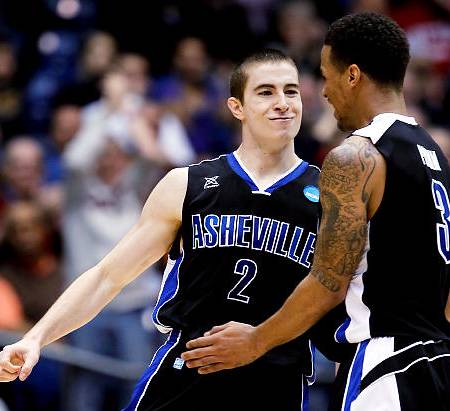
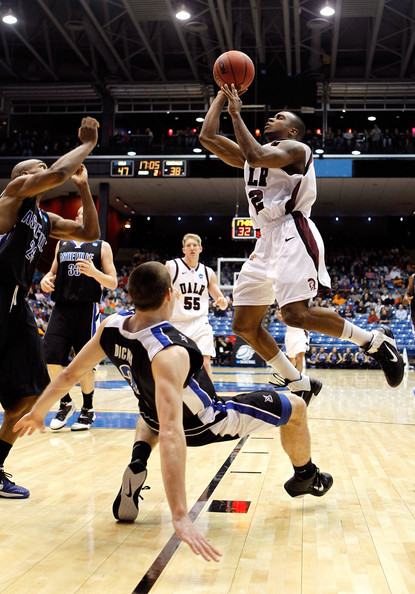
What do Asheville's Matt Dickey (2) and JP Primm have in store for an encore after last season's NCAA Tournament bid?
With the completion of the NBA Draft and the annual coaching and transfer carousels nearing their ends, RTC is rolling out a new series, RTC Summer Updates, to give you a crash course on each Division I conference during the summer months. Our latest update comes courtesy of our Big 12 correspondent, Evan Pfaff.
Reader’s Take
Summer Storylines
Round Robin Scheduling – For the first time since the Big 12 was formed, the conference will implement full round-robin scheduling, meaning each school will play a home-and-home with each of the other nine schools in the conference. In the past, schools played the teams in their division in a home-and-home, but only played schools in the other division once per season, switching home courts every year. That meant the epic battles between the Texas Longhorns and Kansas Jayhawks happened only once per regular season, and whichever school hosted the game had a monumental advantage over the other. With a full round-robin format, not only will each school play two additional conference games, but seeding will be based more on outcomes on the floor than the scheduling fates.
Reloading Talent – The Big 12 is used to replacing an enormous amount of talent. In 2010, ten Big 12 players were taken in the NBA Draft. Two months ago, the Big 12 cupboards were once again raided, as seven players heard their names called. The conference should again be stacked and we might hear as many as ten names called on draft day 2012. From incoming freshmen like Baylor’s Quincy Miller, Texas’ Myck Kabongo and Oklahoma State’s LeBryan Nash, to returning stars like Kansas’ Thomas Robinson, Baylor’s Perry Jones III and Texas A&M’s Khris Middleton, the Big 12 should again be a breeding ground for NBA rosters.
New Coaches… EVERYWHERE. Change is inevitable in college athletics, but stability at the top usually translates into success on the floor. So it is eye opening that from Mike Anderson and Mark Turgeon leaving to Pat Knight and Jeff Capel being shown the door, the Big 12 had a 40% coaching turnover this summer. Now with FrankHaith, BillyKennedy, BillyGillispie and LonKruger roaming Big 12 sidelines, the conference has some questions to answer. Can Missouri conform to a set offense? Can A&M meet high preseason expectations under new management? Do Billy Clyde Gillispie and Lon Kruger have another run left in them?
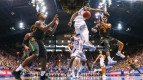
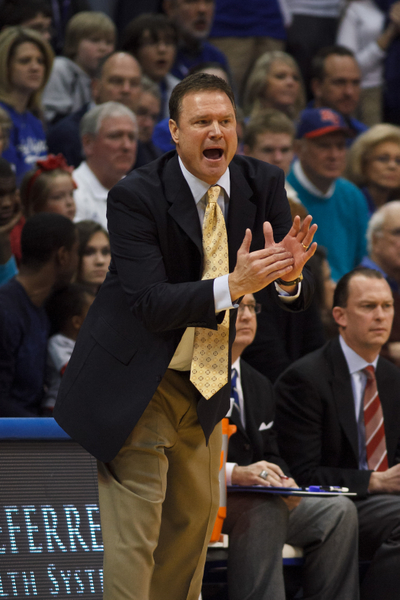
Kansas head coach Bill Self has a tall task in front of him after losing most of the punch from last season's potent lineup.
With the completion of the NBA Draft and the annual coaching and transfer carousels nearing their ends, RTC is rolling out a new series, RTC Summer Updates, to give you a crash course on each Division I conference during the summer months. Our latest update comes courtesy of our Ohio Valley Conference correspondent, Catlin Bogard. You can read more of Bogard’s work at OVC Ball.
Reader’s Take
Summer Storylines
Movin’ On Up: Two teams will feature former assistant coaches in new roles in 2011-12, although each school took a much different path to the same decision. In March, StevePayne was named the new head coach at Tennessee Tech for the retiring Mike Sutton. The longtime Golden Eagles assistant had coached the team previously, as Sutton was sidelined with a horrible health condition that threatened his immune system. Over at Murray State, Steve Prohm will head the Racers after an offseason that saw former head coach Billy Kennedy’s name come up in at least three job searches before he eventually accepted the head coaching job at Texas A&M. The late-season coaching change didn’t leave Murray without options, as former Racer and current NBA assistant Popeye Jones’ name was one of many mentioned for the opening before the Racers eventually named Prohm as Kennedy’s successor.
Ten-Man Class: Morehead State lost its biggest player when Kenneth Faried graduated and was drafted by the Denver Nuggets, but coach Donnie Tyndall is cashing in on the Eagles’ success last season by signing ten players for the 2011-12 season, including three juco transfers. The cupboard wasn’t exactly bare for the Eagles either, with ten players scheduled to return for Tyndall, so how he slices his rotation is something well worth monitoring for any Eagles fan.
Transition Period: Quite possibly the biggest news of the offseason will not even affect the OVC until next season. Belmont will join the conference in the 2012-13 season, leaving the Atlantic Sun after ten years of dominance. Also in 2012-13, SIU Edwardsville will become a full member of the conference, making the OVC a 12-team league. This year, the Cougars will play a full OVC regular season, but will be ineligible for postseason play as they continue their transition into Division I. How long it will stay a 12-team conference is up in the air, though. Jacksonville State is openly searching for a FCS football conference to move to, and Tennessee State was recently offered a chance to rejoin the SWAC.
Faried Will Be Missed in the OVC (But Not By His Opponents)
With the completion of the NBA Draft and the annual coaching and transfer carousels nearing their ends, RTC is rolling out a new series, RTC Summer Updates, to give you a crash course on each Division I conference during the summer months. Our latest update comes courtesy of our Big Ten correspondent, Will Green.
Readers’ Take
Summer Storylines
Sully’s Back, But With Demands – In the year 2011, in the age of ‘now,’ in a profit-first educate-yourself-later society, amidst a flittering of teenage NBA draft picks, ferocious freshman phenomenon Jared Sullinger decided to stay in school. How quaint. Of course, there’s absolutely nothing quaint about Sullinger, his (rightly) assumed sense of on-court leadership, his brutally physical style of play, or that Ja Rule–esque snarl that makes him look like a squirrel who just ate a questionable nut. But seriously, it’s highly unlikely that anyone other than Jordan Taylor will stand in the way of Sullinger winning the Big Ten Player of the Year Award, and rightfully so. He has spent the better part of the off-season slimming down and getting faster. The best player on the best team in the conference simply can’t suffer a slump; he’s worked too hard and has clearly made a commitment to improving his game before leaving for the pros. The question is less about what Sullinger’s level of performance will be than it is about the effect his performance will have on other members of his team. Last year, his 17 /10 were a reflection of consistent contribution that was also part of a greater team-wide cohesion. Jon Diebler, David Lighty and even Dallas Lauderdale each had pronounced and vital roles on last year’s team. They’re all gone now. While some of the supporting cast and several new stars-in-the-making will join Sullinger, will increased reliance upon him make OSU more of a one-man show? Or will the Buckeyes continue to roll out a team-focused squad with four scorers in double figures and a core group of five guys who notch 30 minutes a game? Whatever happens, Sullinger will be back and he will be better than last year. Consider yourself warned.
Welcome, Nebraska – On July 1, Nebraska officially joined the B1G, an acronym whose ludicrousness we continue to subconsciously validate by pronouncing it ‘Bih-one-ggg’. If you’re scoring at home, UNL’s entry makes for 12 teams in the Big Ten, a conference that shouldn’t be confused with the Big 12, which only has ten teams now since Nebraska left it. Now that we’ve all scratched our heads for second, we should pause to consider how massive the amount of potential football revenue must have been to persuade the intransigent Big Ten to alter its ranks. The Cornhuskers’ inclusion marks only the second change in league makeup since the 1950s. So how will the other 11 schools adjust to the adjustment? Football-wise, they should all watch their backs. On the basketball court, though, it probably won’t have a big (or should we say, a ‘B1G’) impact. Sadly for Husker fans, their roundball team loses two of their top three scorers and has some major offensive issues to solve in a league whose tempo of play limits even the country’s very best offenses. Head coach Doc Sadler continues to recruit a healthy mix of transfers and high school players, but over his five-year tenure nine of them have left due to reasons other than matriculation or the NBA. Nebraska has had some encouraging moments in recent years, including a five game improvement in Big 12 play from 2009 to 2010 (from 2-14 to 7-9). The team’s defensive efficiency would’ve finished fourth and it’s adjusted tempo would’ve finished fourth slowest in last year’s Big Ten. In some respects, Nebraska feels like a perfect match for the conference. And yet, for many of those same reasons, it might be a little out-matched in its first few years.
Ed DeChellis Leaves For Navy – Nowadays, stories like these are rarer than that bloody slice of carpaccio you once had at a fancy restaurant: a coach leaving a higher paying, higher-infrastructure, higher strength-of-schedule situation for a middle of the pack team in a unambiguously low-major conference. Make no mistake: Ed DeChellis didn’t become the new head coach at Navy. He stopped being the head coach at Penn State. Unless they’re ousted via scandal or especially egregious results you simply don’t hear about power six coaches voluntarily leaving for a “lesser” job. And yet, that’s exactly what happened. Or is it? The answer to that question centers around just how much “less” of a job the Navy coaching position really is, and if anything DeChellis might have done warranted the move. The wink-wink nudge-nudge consensus is that while DeChellis didn’t necessarily knock anyone’s socks off, the school refuses to take basketball seriously. Some have lambasted the athletic department’s commitment to DeChellis and the program overall at a school that’s known best for intense linebackers and an 84 year-old Italian-American man. It will be interesting to observe new head coach Patrick Chambersin his first few seasons and see whether or not he runs into a similar set of struggles as DeChellis did during his tenure. If the holistic drawbacks of coaching in University Park really outweigh the benefits to the extent that someone would walk away from the position, then PSU has bigger problems to fix than figuring out how to win in the Big Ten this season. But if anyone can overcome whatever said “drawbacks” may or may not be, it’s Chambers.
The Buckeyes, led by big man Jared Sullinger, are easy favorites in the Big Ten.
With the completion of the NBA Draft and the annual coaching and transfer carousels nearing their ends, RTC is rolling out a new series, RTC Summer Updates, to give you a crash course on each Division I conference during the summer months. Our latest update comes courtesy of our Atlantic 10 correspondent, Joe Dzuback. You can read more of his in-depth writing and analysis at Villanova By The Numbers.
Reader’s Take I
Summer Storylines
Bobinski to Chair NCAA Selection Committee: While the conference again sent seven teams, half of its membership, to the postseason — three to the NCAA, one to the NIT and three to the CBI, the Final Four runs by Butler (Horizon League) and Virginia Commonwealth (Colonial Athletic Association) overshadowed a showing, Xavier’s loss to Marquette excepted, that exceeded 2010’s NCAA results. The NCAA announced that Xavier Athletic Director Mike Bobinski will succeed Connecticut’s Jeff Hathaway as Chairman of the 2012 NCAA Tournament Selection Committee. Bobinski just completed his third year of a five-year term on the Selection Committee. While the Atlantic 10 has been the most successful non-BCS conference in placing teams in the tournament field (with 20 NCAA bids allotted to six teams since 2004), its representatives have tended to draw the short straw when it comes to seeding, and Bobinski will likely lobby hard for that cause.
The Coaching Carousel: The conference had two coaching vacancies during the early phase of the coaching carousel. If the 2010 offseason saw coaching turnovers due to firings, the 2011 offseason saw suitors come to call on the Atlantic 10 coaching fraternity. Tennessee, having fired Bruce Pearl on March 21, made its first call to Xavier to talk with Chris Mack. Mack reportedly turned aside an offer of $2 million per year to coach the Volunteers in favor of staying in Cincinnati with the Musketeers. Richmond’s Chris Mooney signed a 10-year contract extension, his second extension in two years, ending Georgia Tech’s courtship. Mooney’s decision triggered a spate of articles (see “Old coaching assumptions are fading” by Dana O’Neil for example) about non-BCS coaches who pass on BCS offers to stay with their programs. The Yellow Jackets turned their attention to Dayton’s Brian Gregory, who succumbed to the lure of the BCS and packed his bags for Atlanta on March 28. Dayton conducted a six-day search and hired Archie Miller, brother of former Xavier head man Sean Miller, away from Arizona to succeed Gregory. In late April, George Washington’s Athletic Director, Patrick Nero, fired 10-year veteran Karl Hobbs. Nero, who succeeded retiring AD Jack Kvancz on June 30, was hired on April 20, and wasted no time in turning over the men’s basketball staff. Nero reached into his old stomping grounds, the American East Conference, and hired the league’s premier head basketball coach, MikeLonergan of Vermont, on May 6 to replace Hobbs. The resignation of Penn State head coach Ed DeChellis on May 24 (DeChellis took over the Navy program) triggered a few tense days among the Duquesne faithful as coach Ron Everhart landed an interview for the Happy Valley position. The Dukes exhaled on June 1 when Everhart withdrew his name from consideration in favor of staying with the Pittsburgh school next season.
Media Coverage: The Atlantic 10 and ESPN renewed their deal to have eight games (selected by ESPN) televised on either ESPN or ESPN2 in each of the next two seasons. The ESPN networks are committed to broadcasting the Women’s Championship and up to 32 appearances in each of the next two seasons.
With the completion of the NBA Draft and the annual coaching and transfer carousels nearing their ends, RTC is rolling out a new series, RTC Summer Updates, to give you a crash course on each Division I conference during the summer months. Our latest update comes courtesy of our Mountain West correspondent, Andrew Murawa.
Reader’s Take I
Summer Storylines
A New Look League: In the aftermath of last summer’s conference shake-ups, the Mountain West is a slimmer volume this year than last, and will look even different next year. Last year’s regular season champion, BYU, is off to pursue football independence, with membership in the West Coast Conference for basketball and some other sports a byproduct of that decision. Secondly, Utah jumped at the opportunity to become a member of the new Pac-12 conference. In the 12 years in which the two Utah schools were a part of the MWC (okay, since its unveiling of their new logo in July, the league office wants the conference to be abbreviated as MW, rather than MWC, and we’ll try to do that from here on), they won a combined five outright regular season titles between them (BYU three, Utah two) and twice shared the regular season titles. However, the MW did not sit idly by and let its conference dissolve when the Utah schools left. It snapped up Boise State to give the Mountain West eight teams in the 2011-12 campaign, with Fresno State and Nevada due to join in 2012-13 just as TCU departs for the Big East. In the long run, the three losses are bigger than the three additions, but the newcomers are strong enough to keep the MW chugging along.
Coaching Shuffle: We knew heading into the offseason that there would be at least one new coach in the conference, as Wyoming pulled the trigger on firing Heath Schroyer during the middle of the conference season. In late March they announced the hiring of Larry Shyatt, an associate head coach at Florida, back for his second stint as the head man in Laramie. But when Lon Kruger announced a day later that he had accepted the head coaching job at Oklahoma, arguably the most attractive job in the conference opened up at UNLV. Ten days later, UNLV announced the hiring of Dave Rice, most recently the associate head coach to Dave Rose at BYU, but previously a player and assistant coach under Jerry Tarkanian in Vegas. With Rice’s brother, Grant Rice, the head coach at Las Vegas Bishop Gorman High – not coincidentally the high school of 2012 top ten recruit Shabazz Muhammad – the hiring opens further inroads for the Rebels with local recruits. To tie everything up in a nice little bundle, Schroyer was hired by Rice as one of his new assistants, along with former Rebel star Stacey Augmon and former SDSU assistant Justin Hutson.
Transfer Hotbed: Every year, the Mountain West seems to be the landing spot for some big transfers, guys who have struggled in their first stop in a BCS conference and who are ready to start over a rung down the ladder. UCLA as a feeder school for the conference is a well-worn path, having sent Chace Stanback to UNLV and Drew Gordon to New Mexico in recent years. This year, another former Bruin will be active in the MW, with forward Mike Moser joining Stanback in Las Vegas for the Rebels. No less than five other former-Pac-10 players will show up on MW rosters this season, with Drew Wiley (formerly of Oregon) joining Boise State, Demetrius Walker (formerly of Arizona State) joining New Mexico, and Xavier Thames (formerly of Washington State) joining San Diego State, all of whom will be eligible this season. Arizona’s Daniel Bejarano and USC’s Bryce Jones also announced transfers to Colorado State and UNLV, respectively, but neither will be eligible until the 2012-13 season. UNLV also welcomes former Marquette point Reggie Smith to compete with incumbent point guard Oscar Bellfield this season, while CSU inked former Minnesota center Colton Iverson, eligible in 2012-13. Then there’s the Aztecs, who signed Utah transfer J.J. O’Brien and St. John’s transfer Dwayne Polee. While O’Brien will sit out a year, Polee, who attended Los Angeles’ Westchester High, has applied for a hardship waiver, given that his mom is suffering from an undisclosed medical condition. While these waivers aren’t often granted, if it happens in this case, Polee could be a big boost for the Aztecs’ 2011-12 hopes.
Steve Fisher maxed out an experienced team in 2011, but will need former role players to step up this season. (Kent Horner/Getty Images)
With the completion of the NBA Draft and the annual coaching and transfer carousels nearing their ends, RTC is rolling out a new series, RTC Summer Updates, to give you a crash course on each Division I conference during the summer months. Our latest update comes courtesy of our SEC correspondent, Gerald Smith. This season he will be covering the NCAA Basketball with zeal, nerd-culture references and a fistful of silliness at halftimeadjustment.com. You can also follow him on Twitter (@fakegimel).
Reader’s Take
Summer Storylines
One Big, Mostly-Happy Conference: After several years of divisional lopsidedness in conference scheduling and tournament seeding – to the dismay of programs like Alabama — the SEC has merged the West and East divisions for basketball. A 16-game conference schedule, consisting of the same pairings within and across old divisions, remains for the 2011-12 season. Starting with this year’s SEC Tournament, teams will be seeded and awarded first-round byes by their overall conference record. The most vocal dissenter against peace, conference unity and love was Mississippi State coach Rick Stansbury. He argued unsuccessfully that divisional championships create excitement for the fans. MSU athletics must have sold some awesome merchandise for Coach Stansbury’s six SEC West Division championships.
Too Much of a Good Thing? – Stansbury also argued that a united 12-team conference won’t produce a true champion unless each team plays a full 22-game home and away conference schedule. In July’s coaches’ conference call, some SEC coaches (South Carolina’s DarrinHorn & LSU’s TrentJohnson) agreed, but wonder if such a schedule is feasible. Other coaches (Kentucky’s John Calipari & Alabama’s Anthony Grant) believe that teams should worry more about strengthening their non-conference scheduling and RPI ratings. Increasing the schedule to at least 18 games would placate athletic directors and the SEC’s broadcast partners, but would add further scheduling imbalance and hysteria.In meetings, the decision to increase the number of conference games was postponed until after the 2011-12 season. The SEC coaches will meet again later in August to debate their options.
Missouri Newbies – Two coaches previously employed in the Show-Me State join the SEC during this period of conference remodeling. As an assistant under former Arkansas coach Nolan Richardson, new Arkansas coach Mike Anderson became very familiar with the “40 Minutes of Hell” system (and Coach Richardson’s snakeskin boot collection). After stops with UAB and Missouri, Anderson returned to Fayetteville to replace John Pelphrey.
Caught lying to cover-up his impermissible BBQ — mmmm… impermissible BBQ… *gurgle noise* — Tennessee was forced to fire Bruce Pearl. Missouri State’s CuonzoMartin was hired to fill Pearl’s vacated orange blazer. With his athletic director resigning and additional NCAA penalties applied to his program, Martin may long for his past days in Springfield.
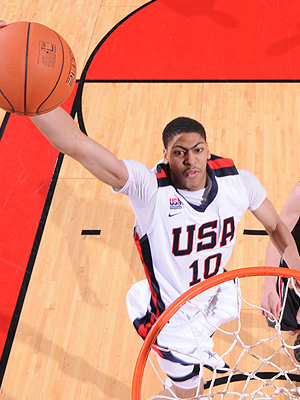
A major growth spurt led to a similar shoot up the 2011 high school rankings for Kentucky's Anthony Davis. (Sam Forencich/USA Basketball)
With the the NBA Draft concluded and the annual coaching and transfer carousels nearing their ends, RTC is rolling out a new series, RTC Summer Updates, to give you a crash course on each Division I conference during the summer months. The latest update comes courtesy of our MVC correspondent, Patrick Marshall.
The summer has been a busy one for the Missouri Valley Conference. They are hoping the 2011-12 season will be one that sees the conference become a multiple-bid league again. They haven’t had multiple bids to the NCAA Tournament since the 2006-07 season.
Reader’s Take
Summer Storylines
Coaching Changes: The MVC only had two coaching changes in the offseason. First, after leading Missouri State to its first MVC regular season title, CuonzoMartin was lured away from the Bears to Tennessee. He was replaced by Purdue assistant PaulLusk, who weeks earlier might have been in line to succeed Matt Painter had Painter left Purdue to become the new head coach at Missouri. He has Valley ties as a player at Southern Illinois in his college days, where he helped the Salukis to three straight NCAA Tournament appearances. On the flip-side, Bradley head coach JimLes was fired after nine seasons with the Braves. After taking Bradley to the Sweet Sixteen in the 2005-06 season, he had trouble getting the team back to that level. Les was replaced by Kent State head coach Geno Ford. These moves have caused a bit of a frenzy as Kent State filed a lawsuit against Bradley due to the way they hired Ford. Les has since been named the new head coach at UC Davis (where his son currently plays), and he too has filed a lawsuit of his own against his former school disputing the settlement he was paid from his dismissal. Wichita State’s GreggMarshall and Northern Iowa’s BenJacobson were speculated for many jobs over the summer, but they both chose to stay with their respective schools.
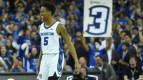
Creighton’s International Duo: Creighton’s Doug McDermott and Gregory Echenique have had a summer to remember. McDermott spent the end of June through the middle of July playing for the Team USA U-19 squad helping the team to a fifth place finish in Latvia. McDermott led the team in three-pointers made, was second in minutes, and third in scoring for the American team during the FIBA Championships. McDermott’s frontcourt counterpart Echenique is currently in Venezuela as a member of his nation’s national team. Echenique and his teammates will try to qualify for the 2012 Olympics in Argentina at the beginning of September before he returns to Creighton for the fall semester.
League Talent: There have been several different examples of decisions made by the league’s top talent this offseason. First off is the 2011 MVC Player of the Year, Kyle Weems. Weems earned his degree from Missouri State, and with a year of eligibility remaining, he could have easily decided to transfer to a different school to play right away, especially with a new coach coming into town. Instead, he decided to stay in Springfield for his senior season. In an opposite move, Bradley’s SamManiscalco was a senior last season for the Braves, but he spent much of it recovering from an ankle injury. Early last season it was decided that he would shut things down and apply for a medical redshirt, which he received. Then came the firing of Les. During Maniscalco’s redshirt season, he was able to complete his degree. With a year of eligibility still remaining and a new coach coming to town, the all-MVC player decided to transfer and finish his college career at Illinois. Finally, you have Drake’s RavonteRice. A runner-up for the MVC Freshman of the Year last season, Rice has not kept it secret that he isn’t necessarily happy at Drake, but that he isn’t going to transfer… at least not yet. This is a pivotal year for the Bulldogs, as two years worth of the conference’s best recruiting classes are now sophomores and juniors that have had marginal success. How Drake does this year could determine whether Rice stays or goes.
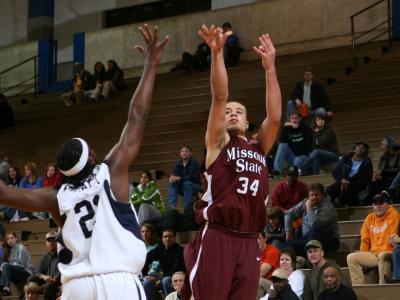
Despite a coaching transition going into his senior year, 2011 MVC Player of the Year Kyle Weems will stick it out for the Bears. (Missouri State University)
With the completion of the NBA Draft and the annual coaching and transfer carousels nearing their ends, RTC is rolling out a new series, RTC Summer Updates, to give you a crash course on each Division I conference during the summer months. Our latest update comes courtesy of our Sun Belt correspondent, Danny Spewak.
Reader’s Take
Summer Storylines
Staying Put: Not a single head coach in the Sun Belt changed jobs this summer. That fact is especially noteworthy in Bowling Green, a city that nearly chased Western Kentuckycoach Ken McDonald away during a mid-season losing streak. Athletic director Ross Bjork chose to retain McDonald, and he gave a fascinating interview to Nick Baumgardner about his decision. Down south in the state of Texas, Johnny Jones will return to North Texas after rumors linked his name to a few power-conference job openings. The folks over at ESPN Dallas saw asilver lining to UNT’s underachieving regular season and loss in the finals of the SBC Tourney. Jones interviewed at Auburn prior to last season, so although he’s in Denton for now, his name may keep popping up on the national radar.
They Don’t Count: Kentucky coach John Calipari made headlines this summer when NCAA officials asked him to apologize for holding a ceremony in February celebrating his 500th career victory. After all, due to vacated wins at Massachusetts and Memphis, some of Calipari’s wins don’t count in the formal record books. Turns out, Florida Atlantic’s Mike Jarvis is getting the same message from the NCAA—just without the media coverage. Reporters at FAUOwlAccess.com did some serious investigative reporting by obtaining a letter sent to FAU, telling the school not to count Jarvis’ vacated victories at St. John’s. School officials say they have no objections to the NCAA’s request.
Big-Time Transfer: Games between Louisiana-Lafayette and Louisiana-Monroe just got a little more interesting. Vanderbilttransfer Darshawn McClellan announced in May he will transfer to ULL, and that means coach Bob Marlin picks up a 6’7″ forward who averaged more than 14 minutes per game during his first two years in the SEC. But more importantly, it means he’ll play against his brother, Steven McClellan, a sophomore forward who averaged 5.1 points per game last season. Who will the family root for?
Solomon Bozeman shot the UALR Trojans into the NCAA Tournament before falling to Akron in the first round (Gregory Shamus/Getty Images).
With the the NBA Draft concluded and the annual coaching and transfer carousels nearing their ends, RTC is rolling out a new series, RTC Summer Updates, to give you a crash course on each Division I conference during the summer months. The latest update comes courtesy of our Pac-12 correspondent, Andrew Murawa.
Reader’s Take #1
Summer Storylines
The More, The Merrier: The Pac-10 is dead. Long live the Pac-12. The conference welcomes in Colorado and Utah for their first season in the conference, the first expansion in the West Coast’s premier conference since Arizona and Arizona State were added 33 years ago. Along with the new teams comes a new schedule – gone is the full home-and-away round robin. While there won’t be divisions in basketball like there are in football, each team will play an 18-game schedule with home and away games against its traditional rival, with six other rotating home-and-away series and four additional single games against the remaining teams. For instance, Colorado and Utah will only play the Southern California schools and the Washington schools once each, while they will play the remainder of the conference twice. While neither of the new schools are expected to make a big splash immediately in the conference, their arrival, coupled with other changes around the conference, such as the huge new $3 billion TV deal with ESPN and Fox that begins in the fall of 2012, makes it an exciting time to be a Pac-12 fan.
Is There A Draft In Here?: Last summer, a big story around the conference was the dearth of Pac-10 players picked in the NBA Draft, as just two players from the conference were selected by NBA teams in 2010. After the 21 players that were picked in the conference between the 2008 and 2009 drafts, that was a precipitous fall. And, back before the season started, there didn’t seem to be a whole lot of future high draft picks on the horizon. However, the conference had six players picked in the NBA draft, including three first-rounders and two lottery picks. Derrick Williams, the 2010-11 conference player of the year, led the way, getting snapped up by Minnesota with the #2 overall pick. Unfortunately for teams around the conference, 12 seasons of eligibility were left on the table between those six picks and the two early entries who went undrafted: Stanford’s Jeremy Green and Washington State’s DeAngelo Casto. And as a result, what had looked like a potential big-time bounce-back season for the conference now sees somewhat diminished expectations. Perhaps no team was hit harder by early defections than UCLA, who had Tyler Honeycutt and Malcolm Lee leave a total of three years of eligibility behind to go get second-round NBA draft picks (and the absence of guaranteed contracts that goes with them) at a time when the NBA labor situation is highly in doubt, but Washington State’s loss of Casto and lottery pick Klay Thompson also leaves the Cougars’ situation fuzzy at best.
Replacing Production: Between the early entries to the NBA Draft and departed seniors, the Pac-12 loses its top seven scorers from last season, and 11 of its top 20. Likewise, ten of the top 20 rebounders are gone. However, as always, a new batch of youngsters is ready to show up on campuses this fall and begin contributing immediately. While the Pac-10 inked only nine of the ESPNU top 100 recruits, seven of those players are exciting young guards, all ranked in the top 60 on that list. Arizona leads the way, signing point guard Josiah Turner (#14 overall, according to ESPNU) and Nick Johnson (#21), to go with a couple solid frontcourt signees (Angelo Chol and Sidiki Johnson, #60 and #91, respectively). But Washington (Tony Wroten, Jr., #16), Oregon (JabariBrown, #25), Arizona State (Jahii Carson, #49), UCLA (NormanPowell, #51) and Stanford (ChassonRandle, #59) all have their own big backcourt recruits ready to provide a burst of energy.
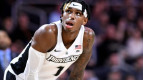
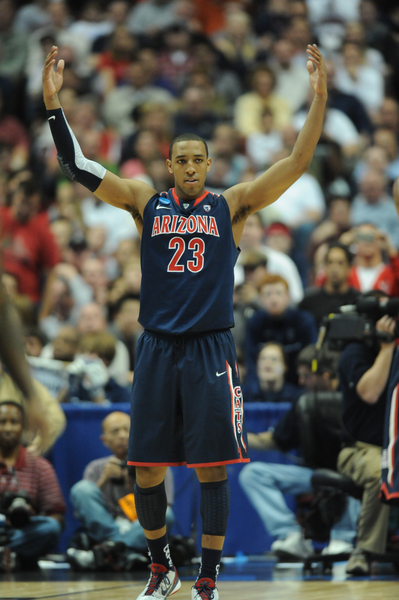
Derrick Williams' performances were one of the highlights of the 2010-11 season.