Morning Five: Columbus Day Edition

Posted by RTC on October 14th, 2013

morning5

  1. The month of Midnight Madness celebrations continued over the weekend, with a number of schools choosing to reveal their 2013-14 teams to the public on Friday night. The most prominent basketball school of this weekend’s group was Marquette, entertaining some 4,000 fans at the Al McGuire Center for Marquette Madness. The event trotted out the tried-and-true Madness standards: a three-point shooting contest (won by Jake Thomas), a dunk contest (won by Deonte Burton), etc., but one unique aspect of this version was that the school also handed out a “Lifetime Achievement Award” as part of the proceedings. Chris Otule, a Golden Eagles center who has played a full season in only two of his five years in Milwaukee and was recently granted a sixth year of eligibility by the NCAA, was the recipient (see the tribute video here). Otule earned substantial national recognition in 2010 when it was learned that he was playing major college basketball with only one working eye (he’s been blind in his left eye since birth), but he also has become something of a hard-luck case due to the three significant injuries (two broken feet and a torn ACL) that he has suffered during his career at Marquette. By all accounts a genuinely nice guy, let’s hope that his final year in Marquette is productive and injury-free.
  2. News came out last week that longtime Texas athletic director, DeLoss Dodds, will retire from his post overseeing the wealthiest athletic department in all of college sports. The 76-year old’s decision to retire, though, comes at a time when the school’s revenue-producing programs — football, basketball and baseball — are all suffering through relatively tough times. Notwithstanding the football Longhorns’ upset of unbeaten Oklahoma on Saturday, the team had lost badly to BYU and Ole Miss earlier this season, and rumors are swirling about the security of Mack Brown’s head coaching job there. Similarly for basketball, Rick Barnes’ Longhorns were just picked to finish as the eighth-place team in a 10-team league (only ahead of the hoops disasters known as Texas Tech and TCU), raising significant questions as to how a program and coach who makes so much money and has access to so much local talent could have gotten itself in such a mess. Brad Townsend of the Dallas Morning News examines the political and operational realities of Dodds’ retirement, ultimately concluding that the new AD will certainly have some hurdles to overcome upon arrival at his new job. And apparently, Louisville’s Tom Jurich is not interested.
  3. While on the subject of athletic directors, the AP reported on Friday that a group of 65 ADs attached their names in support of a nine-page memorandum sent to a legal team convening in Chicago later this month to discuss updating the Uniform Athlete Agents Act (UAAA). Tired of dealing with agents, runners and other interested hangers-on associating with student-athletes in their revenue programs, the group requests that the penalties attached to violations of the UAAA contain higher fines and additional prison time. Specifically, they ask that changes to the law must “increase the incentives for and ease of prosecuting violators,” offering a number of recommendations to make it easier to catch the wrongdoers. Perhaps the strongest part of this proposed legislation is the idea of classifying someone as an agent for purposes of the law regardless of whether they are registered as one — although difficult to implement, this could help with the runner/go-between problem that has become all too familiar in recent years.
  4. Connecticut head coach Kevin Ollie may have jumped the gun in revealing his school’s latest APR score on Friday, but who can blame him given that his team was forced to miss the NCAA Tournament last season because of prior years’ academic troubles. The second-year coach proudly told the media: “We got a thousand. If you want to wait until May, you can find out in May. But it’s a thousand.” The “thousand” he mentions equates to a perfect score on the APR metric, which basically means that all of UConn’s student-athletes in the basketball program are in good academic standing and on track to graduate. According to Ollie, the program has emphasized the importance of education through accountability (i.e., players run if they miss class, etc.), which of course is all fine and well. But perhaps more than anything else, this improvement to a perfect score shows that the APR can be gamed like any other arbitrary metric if a school simply takes it seriously and correspondingly incents the players to do the bare minimum in the classroom.
  5. One of the interesting aspects to the NCAA’s new rule allowing practice to start in September is that coaches are limited to only 30 practice sessions in those 42 days between September 27 and November 8. Not only does the extra time between sessions let coaches ease into their practice plans and teaching points a little more thoughtfully, but it also allows teams to do some other character-building exercises that they simply wouldn’t have had time for under the old model. Case in point: Duke‘s four-day trip to New York over the weekend. On Saturday, Coach K transported his charges to West Point, his alma mater and site of his first head coaching job, allowing the Blue Devils to take in the pride and spectacle of the school responsible for educating the nation’s future military leaders. By all indications the players loved the experience, and one might suspect that if the Blue Devils go on to enjoy a great upcoming season, they’ll reflect often on this preseason trip to New York as the bonding experience where things started to come together. Have a great holiday, everyone.
Share this story

Morning Five: 10.02.13 Edition

Posted by rtmsf on October 2nd, 2013

morning5

  1. The drumbeat of pay-for-play continues echoing through the chambers of college athletics. The latest and greatest: Jay Bilas tweeted out an article last night called “Money Madness: Why and How NCAA Athletes Should Be Paid” from Duke Political Review, a piece that probably wouldn’t have otherwise been seen by anyone beyond a small group of policy wonks. Zach Gorwitz argues that the free market should allow for college football and basketball programs to pay its players a reasonable salary beyond the cost of a full scholarship — he suggests $10,000 to $60,000 for football players, as an example — limited by an NCAA-wide salary cap and organized through negotiations with a players’ union. It’s an interesting idea, for sure, if for no other reason than it provides specific ideas beyond the “they should be paid without consideration of cost” crowd. Expect more. This is only just beginning. Meet Jeff Kessler.
  2. Wake Forest is one of the forgotten schools in the new-look ACC. Aside from a single Orange Bowl trip in 2008, the Deacs are not a regular football power like Clemson or Florida State; nor are they a basketball power like Duke or North Carolina (or Syracuse; or Pittsburgh; etc.). Since a brief but halcyon stretch in early 2009 when Wake hit #1 in both major basketball polls, it’s been mostly downhill on both the hardwood and gridiron ever since. The football team hasn’t had a winning season in five years and the hoops program has reached a level of moribundity under fourth-year head coach Jeff Bzdelik that it hasn’t seen in nearly three decades. As such, Wake alumni and fans are none too happy with their athletic director, Ron Wellman. After sowing their oats with an anti-Bzdelik billboard/publicity stunt at last year’s ACC Tournament, they are now planning to attack this coming weekend with a an aerial banner assault circling over the school’s football stadium during a game with NC State. The details, should you choose to consider them, are posted on a public Google Doc that was sent to us by a concerned Twitter follower. Best of luck with your endeavor, Wake fans. You are a forlorn lot.
  3. As we mentioned on the national site, Oregon State’s Craig Robinson announced suspensions on Tuesday for two of his most prominent returnees, Eric Moreland and Devon Collier. For unspecified internal reasons, Moreland will sit out half of the team’s regular season games (14), while Collier will only miss one. The two forwards represent the bulk of the Beavers’ returning frontcourt this season (with both players averaging more than 25.0 MPG), and thus their benchings is quite the gamble for a head coach who might be on the hottest seat in all of major D-I college basketball. Moreland in particular is an elite rebounding presence, ranking fifth in the nation in defensive rebounding percentage last season (27.5%) and more than holding his own on the offensive window (10.5%). Luckily for Robinson, he expects to have both back at full strength in time for the bulk of the Pac-12 season in early January, and the non-conference schedule other than a trip to Maryland and a mediocre field at the Diamond Head Classic does not appear terribly daunting.
  4. One of the players that Robinson had hoped to have returning this season was former guard Ahmad Starks, a 5’9″ whirlwind of a player who took care of the ball, made free throws, and knocked down long-range shots for the Beavers. The Chicago native headed back east in May to play at a school closer to his ailing grandmother, hoping that the NCAA’s transfer exception would allow him to play immediately at his new, closer destination. He ultimately decided to play for John Groce at Illinois but, according to ESPN’s Andy Katz, the NCAA on Tuesday denied his waiver, citing the distance in mileage from Champaign to Chicago (roughly 135 miles) as too far to justify the exemption. It’s been somewhat rare for the NCAA to deny these waiver requests, so this is a peculiar turn of events given that Starks is realistically only a couple-hour drive away from his grandmother. Katz cited a “100-mile” standard that perhaps signals that the NCAA is going to use for future adjudications of these decisions, which although an arbitrary distance, would still create some much-needed clarity to the rule. Let’s see if they stick to it in future iterations of this decision. Tough break for Illinois too, seeking to replace much of its backcourt this season after the losses of Brandon Paul and DJ Richardson.
  5. Although we still find preseason material to be a bit too early for prime time on this early October date, that hasn’t stopped the college hoops writing cabal from putting in some work. We’ll mention some of the more interesting items as we get closer to the traditional time for Midnight Madness in a couple of weeks, but here are a couple of things you should see now. First, The Dagger‘s Jeff Eisenberg released his preseason Top 25 yesterday, with his top five,  in order: Kentucky, Louisville, Duke, Michigan State, and Kansas. For each team he lists both their best-case and worst-case scenarios, and by our count, he lists those five teams as the group with enough upside to win the national title. Over at Sporting News, Mike DeCourcy lists seven key players who have something to prove this season. As always, the dreaded slideshow format is mitigated by strong writing and analysis by the longtime hoops scribe. Give both a look.
Share this story

Morning Five: 09.30.13 Edition

Posted by nvr1983 on September 30th, 2013

morning5

  1. It didn’t take long for Appalachian State to turn the tables after the media began to attack the school for not releasing Devontae Graham from his National Letter of Intent. Graham, who recently shot up the recruiting rankings, was a lightly regarded recruit when he signed with Appalachian State and now is at Brewster Academy. Now that Graham is more highly regarded he is looking to be released from the Letter of Intent to look at more high-profile schools. After receiving a great deal of media criticism for not complying with Gardner’s wishes the school issued a release accusing North Carolina State of tampering. On the surface we might question the accusation, but when you consider that Graham played with Mark Gottfried’s son the accusation becomes a little more interesting. Oh, and the two schools play each other on November 8. That should be a fun post-game handshake.
  2. It seems like we are writing more about “pay-For-play” than any other topic these days, but it seems like that is the major topic that everybody seems to be focused in on. Two of the better takes on the issue over the weekend came from Michael Rosenberg, who says “Pay-for-play is not the issue”, and Gary Walters (Princeton AD and former member of the NCAA Tournament Selection Committee), who says the debate over stipends obscures the bigger issues within sports. Most of the analysis that we have linked to and provided has focused on the pure economics of the issue, but if you want to read nuanced takes on the philosophical dilemmas surrounding the NCAA these are a great place to start.
  3. As we mentioned last week, Sports Illustrated‘s Andy Glockner was making his way through the top 20 current college programs. On Friday, Glockner concluded with his top five programs. The five programs (in order)–Kansas, Kentucky, Duke, North Carolina, and Michigan State–should not come as any surprise and we don’t have any issue with the order either although we can understand how some people may have issues with Kentucky and North Carolina given their inconsistency lately. It was an issue that we dealt with back in 2009 when we complied our Team of the 2000s rankings and was the primary source of debate at the time. Looking back on our rankings and what Glockner came out with it is interesting to see how much some programs moved up (Kentucky didn’t even make honorable mention–hello, Billy Gillispie) while others have fallen off considerably (particularly Maryland), but for the most part the order has remained relatively constant.
  4. One of the things we love about rankings is the methodology used to create them. We already discussed Andy Glockner’s college basketball program rankings and as we said we don’t particularly have any major issues with his rankings, but we do with the National College Scouting Association “Power Rankings”. The NCSA, which as far as we can tell is a recruiting agency, put together a ranking list of the top college programs by averaging their US News & World Report ranking, Learfield Sports Directors’ Cup ranking, and graduation rate. Their selection of Duke is not particularly notable (although it led one assistant coach at Duke to proudly announce it)but the methodology seems deeply flawed. Aside from our issues with the US News & World Report rankings, which mirror most of what you have read about those rankings over the past decade, the use of graduation rates, which can be played with, and comparing Division I programs to Division III programs in terms of athletic performance seems debatable at best. The equal weighting of the different rankings creates some interesting outcomes particularly when Florida comes in at 240th in graduation rates bringing them down the 82nd overall despite coming in 2nd in the Directors’ Cup rankings. And then there is Colorado School of Mines coming in 39th overall despite a fairly unimpressive US News & World Report ranking and a mediocre graduation rate thanks to a 10th place showing in the Division II Directors’ Cup.
  5. Over the past few years we have witnessed many cases of devastating diseases taking away many coaches and their family members. Still the news that Mark Fisher, the son of San Diego State coach Steve Fisher, had been diagnosed with amyotrophic lateral sclerosis, a debilitating progressive neurodegenerative disease more commonly known as Lou Gehrig’s disease. According to reports, those within the program have known about Fisher’s condition for over two years, but possibly with the progression he has had his role reassigned from being assistant coach to assistant to the head coach while several other members of the staff shift up a spot to fill his void. Neither the school nor other members of the team provided much more detail on Fisher’s condition or what prompted the announcement/change so as always in these situations we will simply wish Fisher and his family the best as they deal with this condition.
Share this story

Morning Five: 09.27.13 Edition

Posted by nvr1983 on September 27th, 2013

morning5

  1. When the NCAA announced that it was reducing its penalties against Penn State our first thought was that it was the right move as it rectified (to a degree) the NCAA greatly overstepping its mandate. Our next thought was that it would open the floodgates for other schools looking to reduce their NCAA-sanctioned penalties. Yesterday, we had our first school–USC–announce that it was in talks with the NCAA to have its previously determined penalties reduced. USC might be the first school to pursue this route, but they certainly will not be the last. For all of our qualms about the NCAA we have to say we have a hard time equating any other NCAA ruling to its decision on Penn State as the latter was so far outside of the NCAA’s jurisdiction that not even the NCAA’s staunchest supporters could defend. As such we would be very surprised to see the NCAA follow-up with any similar reductions.
  2. As we mentioned on Tuesday package deals (two recruits not a coach with a recruit) seem to be quite popular this recruiting season. The most significant of these package deals with the one involving Cliff Alexander and Tyus Jones, who are both ranked top-5 overall in the class of 2014. So when Jones announced that he was cancelling his visit to Kentucky it is a pretty big blow to the Wildcats recruiting effort even if they already have a commitment from Tyler Ulis and Jones was considered a long shot for the Wildcats coming in. However, with Alexander also the line it is still a blow to the Wildcats, who will probably still end up with the #1 overall class. Based on what we have heard the leaders for this pair remain Kansas and Duke with Alexander favoring Kansas and Jones favoring Duke.
  3. Eddie Jordan’s efforts at rebuilding Rutgers in the wake of the Mike Rice follow-out appear to have been much more successful than we ever imagined. Thanks to a spate of hardship waivers Rutgers appears to be on the verge of being competitive in the American Athletic Conference. First there was the much-debated waiver granted to Kerwin Okoro and yesterday J.J. Moore was granted a hardship waiver too. Moore, who averaged 8 points and 3 rebounds per game last season as a junior at Pittsburgh, transferred to be closer to closer to his ill grandfather. His presence should only bolster a Scarlet Knight team that should be much better than anybody expected back in April.
  4. College sports might be big business, but try telling that to college students, who are staying out of college stadiums for all, but the biggest games. As The Wall Street Journal noted even in the football-crazed SEC large portions of the student section go unfilled for all, but the biggest games. As you might expect this issue is not isolated to college football as even college basketball programs as prominent as Michigan are having trouble filling their student section. As a result, Michigan is using the opportunity to potentially sell student tickets to the general public. While we understand the appeal of being able to stay at home and watch multiple games at home with quick access to (cheaper) food and beverages, it seems like many of these students are missing out on one of the most significant parts of college basketball: the in-game experience.
  5. Yesterday was a big day for EA Sports. Not only did they announce that they were not going to produce NCAA Football 2014. They (along with College Licensing Company) also reached an agreement with the plaintiffs in the Ed O’Bannon lawsuit. The actual terms of the agreement are confidential, but what this announcement boils down to is that the players will be compensated. The amount of money that each player will receive will vary (no idea how they will determine that) and the overall pot might never be known. The big takeaway from this though is that the O’Bannon vs NCAA portion of the case is still open. As you would expect, the details and effects of a confidential lawsuit can be challenging to tease apart so if you want a more detailed explanation, Michael McCann’s column explaining the ruling and the ramifications is a good place to start.
Share this story

2013-14 RTC Class Schedule: Arizona Wildcats

Posted by BHayes on September 26th, 2013

Bennet Hayes is an RTC columnist. He can be reached @HoopsTraveler. Periodically throughout the preseason, RTC will take an in-depth look at the schedules of some of the more prominent teams in college basketball.

Sean Miller’s fifth season in Tuscon could easily turn out to be his best. Despite the graduation of key seniors Solomon Hill (a first round pick in the 2013 NBA Draft), Mark Lyons, and Kevin Parrom – in addition to the surprising departure of freshman Grant Jerrett to the professional ranks, Miller has assembled the most talented roster that Arizona has seen in quite some time. A solid Pac-12 conference and challenging non-conference schedule will challenge the Cats’, but a nice blend of returnees and newcomers should give the man at the helm ample leeway to steer this storied program deep into March.

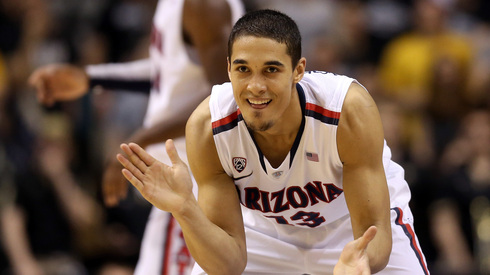
Nick Johnson will be asked to do more -- both on and off the court -- for this young but talented Wildcat team

Nick Johnson will be asked to do more — both on and off the court — for this young but talented Wildcat team

  • Team Outlook: This will be a new-look Arizona team, as last year’s squad was built around departed seniors Lyons and Hill. Some familiar faces will be back and poised to fill leadership roles this time around, with junior Nick Johnson (11.5 PPG, 3.2 APG, 1.9 SPG) most prominent among them. The athletic two-guard shot the ball better from three-point range as a sophomore (39% after 32% as a freshman), and should also serve as the Cats’ best perimeter defender in 2013-14. Sophomores Kaleb Tarczewski (6.6 PPG, 6.1 RPG, 22.2 MPG) and Brandon Ashley (7.5 PPG, 5.3 RPG, 20.5 MPG) return to anchor the frontcourt, with each likely seeing a slight minutes increase, despite the arrival of a duo of freshman studs in the same frontcourt. Both Aaron Gordon and Rondae Hollis-Jefferson were McDonald’s All-Americans last spring, and immense immediate contributions from both freshmen would surprise no one. Gordon especially shapes up as a good candidate for a jump to the NBA after a season of stardom in Tuscon, as he is currently projected as a Top-20 pick in the 2014 draft on NBADraft.net. Gordon’s production will be one of the keys to this Wildcat season, but he may not be Sean Miller’s most important player. Duquesne transfer T.J. McConnell (11.4 PPG, 5.5 APG, 2.8 SPG in 2011-12) will be filling Lyons’ shoes and running the show in Tucson this season. McConnell was an efficient lead guard in the Atlantic-10 and should quickly acclimate to the Pac-12, but the absence of proven ball-handlers elsewhere on the roster means his transition has to be a smooth one for Arizona to be successful. He will be a welcomed change-of-pace for teammates used to the shoot-first Lyons dominating the ball, and his steal % of 4.7 (12th best in the nation in 2012) is ample indication of a dedication to both ends. The talented youngsters around him will keep expectations low for McConnell individually, but don’t be shocked if he emerges as the leader of this club. Read the rest of this entry »
Share this story

Morning Five: 09.18.13 Edition

Posted by nvr1983 on September 18th, 2013

morning5

  1. New Jersey’s effort to legalize sports gambling within the state took a hit yesterday as a federal appeals court upheld a prior ruling that New Jersey’s proposed legalization of sports gambling conflicted with current federal law. As we have mentioned before in this space the heart of the issue is the 1992 Professional and Amateur Sports Protection Act that only allows gambling on sports in any form in just four states–Nevada, Delaware, Oregon, and Montana. New Jersey has questioned the constitutionality of this law on several levels and although they lost the appeal 2-1 they appear to be encouraged (at least publicly) by the lone dissenting vote, which they claim is the first public vote against the law. We still are not sure what the overall outcome will be and what the NCAA’s response will be (it has threatened to stop allowing NCAA postseason competition in the state), but with the huge amount of money on the line we have no doubt that this case will drag on for years as New Jersey Governor Chris Christie has already stated that the state will appeal the case to the US Supreme Court.
  2. The report that opposing coaches were using Billy Kennedy‘s battle with Parkinson’s Disease against him on the recruiting trail has generated plenty of criticism for the unidentified coach(es). While we understand that the approach will make almost everybody uncomfortable and would be classified as distasteful by nearly everybody we have a hard time finding it quite as offensive as many others have. Although few media members are willing to publicly acknowledge it, the health of a coach, who is theoretically going to be one of the guiding forces in your life the next four years, is something that should be under consideration for any recruit in the same way that the likelihood that the coach is going to leave the school for another job–NCAA or NBA–should be a consideration. Kennedy’s health issues, which are a private matter on some level, are made into a public one because of his job whether the fans and media like it or not.
  3. We have no idea why the Jalen Steele‘s departure from Mississippi State had to be so messy, but given the recent history of the program it should not come as a surprise. Early yesterday, the school put out a release stating that Steele would forego his senior year at Mississippi State to focus on graduating. On the surface this appeared to be nothing more than an unfortunate end to Steele’s injury-plagued college career. That is before Steele went off on the program on Twitter. Mississippi State later attempted to clarify the issue by saying it was an issue of open roster spaces for the 2014-15 season as Steele was wanted to redshirt this season and come back next season. Unfortunately, Mississippi State supposedly had already filled all of its roster spots for next season meaning that Steele was left on his own to try to move on to another school (Hello, transfer waiver!), which is a situation that clearly did not sit too well with Steele.
  4. Terry Lanier’s commitment to VCU on Monday may not have made major headlines, but it is another sign of how far VCU has come as a program since making it to the Final Four in 2011. This might seem like a fairly straightforward association that players want to play for successful teams, but as Borzello notes it has not necessarily been the case for other teams that have made surprise runs to the Final Four recently. There are multiple potential explanations for this–the most obvious one and also the most politically touchy–is that Shaka Smart, an a young, well-educated African-American, appeals more to recruits, who are predominantly African-American than his two Caucasian counterparts (Jim Larranaga and Brad Stevens), who also happened to both leave the schools they led to the Final Four. Whatever the reasons for his recruiting success are, Shaka Smart’s ability to continue to build on that Final Four run is another reason why he is among the most coveted coaches in college basketball.
  5. The NIT may have fallen off in terms of prestige for early season tournaments, but we have to give them credit for being one of the few that still requires you to win to advance to the showcase rounds. This year’s NIT field will be headlined by Arizona and Duke with the two schools hosting the opening round games along with Rutgers and Alabama. Looking through the fields Arizona, Duke, and Alabama should advance fairly easily, but the road for Rutgers appears to be much more challenging. One other interesting aspect of NIT Season Tip-Off is the fact that it includes two schools–Metro State and Stillman–that are not even Division I schools. Although we doubt that this tournament will be interesting until the championship game, we have to give them credit for making it a real tournament unlike most of the other ones out there.
Share this story

Goodbye Old Rivals, Hello New Ones — Five New Rivalries To Keep An Eye On

Posted by BHayes on September 17th, 2013

Bennet Hayes is an RTC columnist. He can be reached @HoopsTraveler.

One of the many consequences of the past half-decade’s conference realignment frenzy has been the loss of cherished rivalries. Two seasons ago we saw our final Big 12 Border War, as Missouri bid farewell to old rival Kansas en route to the SEC. Last season we witnessed the final edition of Georgetown-Syracuse in the Big East, as the Orange split for the greener pastures of the ACC. And while the ACC will benefit from the arrival of Syracuse, Pitt and Notre Dame, the conference will still be losing what could be considered their rivalry of this century, as Maryland heads for the Big Ten next year, in the process leaving behind their bitter feud with Duke. Oh, the memories! And while many of these divorcees have vowed to reunite in non-conference series down the road, it’s hard to always take their word for it (although Georgetown and Syracuse are starting to sound pretty serious…). So goodbyes there have been, but what about the hellos? We have been made acutely aware of every dying rivalry (jumping conferences tends to elicit just a little bit of emotion from rival fan bases), but seemed to have forgotten that the reshuffling allows for the potential of plenty of new ones to emerge. Circumstance will have its way in molding many new rivalries (who, besides the man capable of seeing overtime before it happens, could have foreseen Louisville and Notre Dame carving out a nice little rivalry in the Big East?), but here’s a shot at five new conference match-ups with a shot at becoming annual headliners.

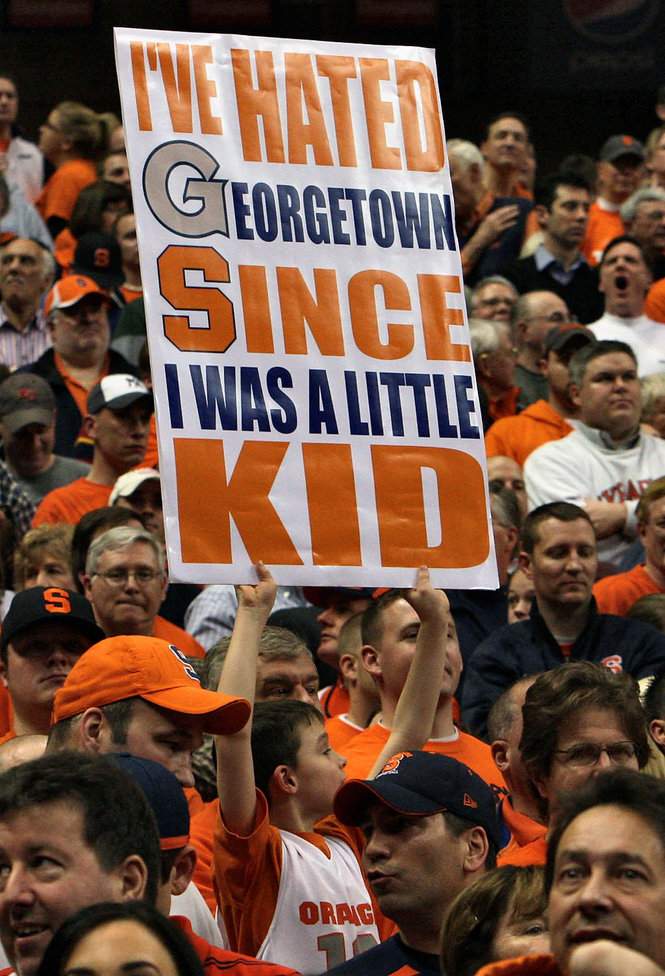
While Syracuse Bids Old Rival Georgetown Goodbye, Many New Rivalries Loom On The ACC's Horizon For The Orange

While Syracuse Bids Old Rival Georgetown Goodbye, Many New Rivalries Loom On The ACC’s Horizon For The Orange

Syracuse-Duke: Little explanation needed here. Two of the most decorated programs in the game led by two of the most iconic coaches in the sport’s history, and two teams that have been an annual factor in the national title chase for most of the last decade.  This season’s two favorites in the ACC should take an immediate shine to each other, and for some added fun, how about the contrast in home floors at play here? Needless to say, cozy Cameron Indoor will offer a slightly different stage for the match-up than the cavernous Carrier Dome will.

Read the rest of this entry »

Share this story

Coach K Is Not Interested In Playing Maryland Anymore, But He Should Be

Posted by Chris Johnson on September 17th, 2013

Chris Johnson is an RTC Columnist. He can be reached @ChrisDJohnsonn.

Sometimes conference realignment is unforgiving. When the motivation is to get paper now, or position oneself better in a changing FBS football landscape, or cash in on a lucrative television deal, switching leagues is the obvious move to make – no matter how much long-standing tradition or geographical or cultural common sense gets bulldozed in the process. This is the brutal calculus schools were forced to assess in the latest round of realignment moves, and the result – for college hoops, at least – wasn’t always a happy ending. When Missouri left the Big 12 for the SEC, it ended one of college sports’ best rivalries (with Kansas). Texas A&M’s move to the same conference ended a great annual football game (with Texas), and an underrated and desultorily good hoops match-up. Syracuse’s leap to the ACC closed the curtain on its decades-old Big East feud with Georgetown. Fortunately, it appears the Hoyas and Orange are on the cusp of locking in a home-and-home series to continue one of the sport’s great games outside of its traditional Big East-tethered form. The two schools came together, understood their games were just too bitterly competitive, and too fun, to simply give up just because football and TV money forced them to part ways. Syracuse and Georgetown will benefit, because it adds another quality opponent to one another’s non-conference schedules, and college hoops as a whole will benefit, because the Hoyas and Orange typically play some of the most entertaining, hotly-contested, dramatic games in any given year. Perhaps other schools can take Syracuse and Georgetown’s lead, work through whatever logistical hurdles exist and spark up their rivalry hate in this post-realignment world. Keeping these sorts of rivalry games churning across newly configured leagues is important for the long-term health of the sport.

Kicking aside the Duke-Maryland rivalry is a huge disappointment (AP Photo).

Kicking aside the Duke-Maryland rivalry is a huge disappointment (AP Photo).

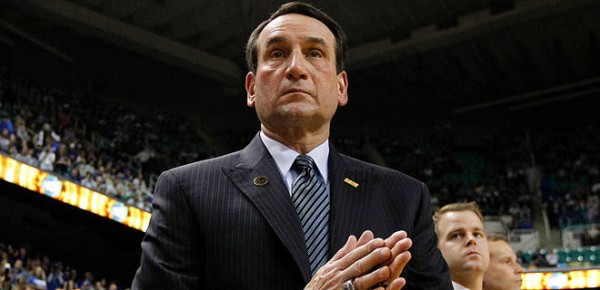
Or you can be like Duke coach Mike Krzyzewski, who apparently wants nothing to do with future Big Ten member Maryland, who will only play the Blue Devils once in the regular season this year before leaving for its new league. Kryzewski spoke out against Maryland’s motivations for leaving the ACC when the news broke last fall. He expressed many of the same concerns most college sports purists do when lamenting the products of realignment: an attack on tradition, prioritizing monetary gain over cultural and geographical fit, the destruction of rivalries. None of that is particularly novel, but coming from Kryzewski, it felt like one of the stronger harangues we have heard against the recent whirlwind of shifting league allegiances. Maryland was completely frank about its move to the Big Ten – its athletic department, struggling to stay afloat financially, saw an avenue to steady its economic future through a broadcast rights windfall, and predictably jumped at the opportunity. It was the smart financial move for Maryland, and probably the best hope for curing its still-unenviable financial state, but that doesn’t mean the rest of the ACC welcomed the switch with rousing acclaim. Duke, a team Maryland has waged some truly memorable conference games against in recent years, won’t even think about scheduling the Terrapins as an annual non-conference fixture.

Read the rest of this entry »

Share this story

2013-14 RTC Class Schedule: Kansas Jayhawks

Posted by BHayes on September 16th, 2013

Bennet Hayes is an RTC columnist. He can be reached @HoopsTraveler. Periodically throughout the preseason, RTC will take an in-depth look at the schedules of some of the more prominent teams in college basketball.

We have seen rapid and successful overhauls in Lawrence before, but perhaps never on this scale. Kansas is short five starters from a year ago, and in their wake arrives a decorated freshman class headed by a once-in-a-generation talent. Commitments from top-50 recruits Joel Embiid, Wayne Selden, and Conner Francamp had Jayhawk fans believing a quick rebuild was possible, but it was the May signing of Andrew Wiggins, the top player in the high school class of 2013, that has turned hope into belief. Another Big 12 championship and a return to the Sweet 16 would no longer constitute a brilliant coaching job by Bill Self, a man who has crafted many of them. Wiggins’ presence on campus has not only turned those achievements into mere expectations, but also transports hope to Lawrence that the ultimate prize – a National Title – is again a realistic possibility.
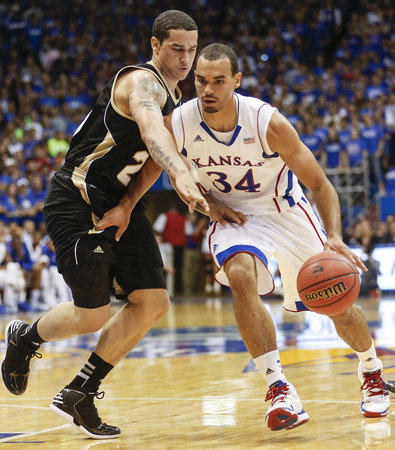
Could Perry Ellis Emerge As The Most Important Jayhawk Not Named Andrew Wiggins This Season?

Could Perry Ellis Emerge As The Most Valuable Jayhawk Not Named Andrew Wiggins This Season?

  • Team Outlook: Wiggins’ talent and projected impact has been well-documented, but even if he becomes the star he is expected to be, the Jayhawks will still need to develop the supporting cast around him. Perry Ellis (5.8 PPG, 3.9 RPG) is the one returnee that will almost definitely be a key part of that equation, but Nadiir Tharpe (5.5 PPG, 3.1 APG) and Jamari Traylor (2.1 PPG, 2.1 RPG) should also see minutes. We have seen Jayhawk role players emerge into key contributors after an offseason before, but no matter what happens with that trio, Bill Self will surely be relying on newcomers not named Wiggins to carry the load. Prime among them are freshmen Wayne Selden and Joel Embiid, who are expected to take over starting duties at shooting guard and center, respectively. Like Wiggins, both are projected as top-ten picks in next year’s NBA draft, so it’s a distinct possibility that this could be their lone rodeo in Lawrence. That being said, both need to add significant polish to their games, and despite the top-ten ranking recruiting gurus bestowed upon him, Embiid even drags the “project” title with him to Kansas. Freshmen guards Conner Frankamp and Brannen Greene are also consensus Top-100 recruits, and both will have the opportunity to compete with Tharpe and Selden for minutes in the Kansas backcourt. Rounding out the frontcourt rotation is Memphis transfer Tarik Black (8.1 PPG, 4.8 RPG) and redshirt freshman Landen Lucas. Black’s addition was another significant coup for Self this offseason, as he provides the Jayhawks with a player who has actually been through it all before at the college level. Black, like nearly every Jayhawk outside of Wiggins, could end up as a thirty-minute a game starter, a marginalized bit player, or nearly anything in between. There is tons of talent in Lawrence and a superstar to headline the show, but much of the onus for the destination of this Jayhawk campaign rests on Bill Self and how he fits all the pieces together – something Jayhawk fans should feel pretty good about. Read the rest of this entry »
Share this story

Morning Five: 09.16.13 Edition

Posted by nvr1983 on September 16th, 2013

morning5

  1. The NCAA has taken a lot of criticism, but we have to give them credit for coming to their senses and granting Kerwin Okoro a hardship waiver after transferring from Iowa State to Rutgers. The NCAA has managed to make plenty of highly questionable decisions over the years, but Okoro’s struck a chord due to callousness of it. We have questioned the NCAA’s at times over the top willingness to grant family hardship waivers to players who had some distant relative who was sick or a father who lost or quit a job as a coach. In the case of Okoro, the NCAA denied his request to transfer to be closer to his family after his father and brother died within a span of three months presumably because they were already dead (I know stupid). In the end, the NCAA corrected itself so Okoro will get what he deserved in the first place.
  2. Before we start to sound like NCAA homers, we should point out that we don’t agree with their decision to ban college coaches from attending practices at schools that are not underneath a governing body. The decision appears to target two schools–Findlay Prep and Huntington Prep–that produce an abundance of Division I talent so we suspect that coaches will be after the NCAA to reverse this. We can certainly understand the NCAA’s desire to cut down on diploma mills (not calling either of these programs that), but we are not sure what this accomplishes. The coaches will still be able to watch the recruits in games. This just makes it more difficult for recruits to catch the attention of a coach and slows down the process of recruitment. We also are not sure why they singled out these two schools as the ruling opens up a huge can of worms. Our best guess is that this ruling will get amended very quickly.
  3. Although they missed out on Emmanuel Mudiay, Kentucky got a nice consolation prize in Tyler Ulis, a four-star point guard, who committed to Kentucky on Friday night. With Andrew Harrison a likely one-and-done player it was essential that Kentucky get a point guard to replace him and after missing out on Mudiay it appeared that they were essentially down to Ulis or Tyus Jones, who is believed to be a Duke lean at this point. Kentucky beat out Michigan State and Iowa for Ulis’ services. The one catch with Ulis is his size, or lack thereof, as he measures just 5’9″ and around 150 pounds. We would never doubt John Calipari’s eye for talent (or at least his ability to recruit it), but this will certainly be something to watch for when Ulis presumably comes in as Wildcats starting point guard in 2014.
  4. It turns out that there is one more elite point guard in the class of 2014 who is still up for grabs after Louisville commit JaQuan Lyle backed out of his verbal commitment. Lyle is the second top point guard prospect to decommit from Louisville since July as he is following Quentin Snider, who backed out of his commitment from Louisville to commit to Illinois. It appears that the primary reason for Lyle’s decision was concern over playing time in a crowded Cardinal backcourt. We are a bit surprised that a player who is a top-25 overall recruit would be that worried about getting playing time on a team that admittedly has plenty of talent, but is not loaded with first round talent. Although Lyle has listed several teams, Kansas is the clear leader if they are willing to extend Lyle a scholarship.
  5. On Friday we mentioned the very real possibility that Syracuse and Georgetown would restart their rivalry even after they moved to different conferences. We hoped that they would serve as an example for other schools that had abandoned rivalries due to conference realignment. Based on a recent radio interview with Mike Krzyzewski it appears that it is unlikely that Duke will resume playing Maryland anytime soon. In between criticizing conference realignment, Krzyzewski essentially said he did not think that the two schools would play unless they were paired against each other in the ACC-Big Ten Challenge (this is your chance, ESPN). We understand the logistical challenges of  scheduling non-conference opponents with the increasing size of conference schedules, but there are certain match-ups that we think should happen on a not infrequent basis and this is definitely one of them.
Share this story