Morning Five: 05.16.13 Edition

Posted by rtmsf on May 16th, 2013

morning5

  1. It’s now been nearly two days since the Andrew Wiggins Sweepstakes was won by Bill Self and Kansas. Reactions have run the gamut and we ran down a number of the better ones in yesterday’s M5. One we missed was this fantastic piece by Sam Mellinger at the Kansas City Star, who writes that everyone in the media and greater college basketball community needs to be very careful with the hyperbole when discussing Wiggins next season as the “Best High School Prospect Since Lebron.” Mellinger breaks down each of the best prep players in the last 10 years since Lebron, and the truth is that most of them can’t even sniff an NBA All-Star Game at this point. Some guys continue to progress, while others level off, and it’s a lesson worth remembering. Then he finishes things off with a fantastic anecdote about the humility of prep Lebron. Well worth a read.
  2. Once the ACC raided the Big East to lock up prized programs Syracuse, Pittsburgh and Notre Dame, it appeared inevitable that the league would eventually move its showcase event — the ACC Tournament — to Gotham in short order. Those premonitions seem to be coming true, as ESPN.com reported on Wednesday that the league is “thoroughly investigating” a move to the World’s Most Famous Arena at some point in the next several years. The ACC Tournament is scheduled to be in Greensboro in 2014 and 2015, but the options are open afterward, while the new Big East has contractually obligated MSG to hold its postseason tournament there until 2026. The crux of the matter is that the Big East will need to meet certain benchmarks to keep its deal with The Garden alive, and given just how shaky the league has become in the interim, many ACC insiders believe that the “legal ramifications” to move its own event will get worked out as a matter of course. Brooklyn’s Barclays Center is also an option too, of course, but make no mistake, the ACC Tournament will eventually reside at least part-time in NYC.
  3. While on the subject of the Atlantic Coast Conference, the league is holding its spring meetings in Amelia Island, Florida, this week and SI.com‘s Andy Staples caught up with commissioner John Swofford to get the inside scoop on how he pulled off “the most chaotic reorganization in the history of major college sports.” It’s somewhat wonky and process-oriented, but it gives a true insider’s perspective on the importance of the Maryland defection and how the perceived likelihood that the Big Ten would seek to continue moving south (Virginia, North Carolina, Georgia Tech) had Swofford failed to get his schools to agree to the media grant of rights deal in April. Although conference realignment has been disastrous to college basketball in some ways, we’re hoping like everyone else who loves the sport that this particular initiative holds steady and removes the incentive for continued raids for a good long while.
  4. Yesterday was a busy day on the transfer wire, as quite a few prominent names announced that they are on the move. The most surprising name was perhaps Penn State’s Jermaine Marshall, who was projected to be a key cog in the Nittany Lions’ resurgence next season but has instead decided to leave school to pursue professional options. The least surprising decision was that Arizona State’s Evan Gordon announced that he is headed to Indiana, where as a graduate transfer he will be eligible to play immediately for Tom Crean. A few other notables: Minnesota’s Joe Coleman is leaving the Gophers; Tulane’s Josh Davis will land at San Diego State; and, Florida’s Braxton Ogbueze will resurface at Charlotte. Davis will be eligible to play immediately at SDSU under the graduate transfer exception.
  5. Perhaps seeing a bit too much of Rick Pitino in the media lately, Kentucky head coach John Calipari held his own press conference yesterday to discuss the state of his program. And since we’ve already addressed the subject of hyperbole above, why not let Coach Cal bring us full circle: “We’re chasing perfection. We’re chasing greatness. We’re chasing things that have never been done before in the history of this game.” The perfection he refers to of course is the elusive-since-1976 undefeated season by a Division I men’s basketball team. Since Bobby Knight’s Indiana Hoosiers ran the table 37 years ago, no team has won the national title with fewer than two losses (including Calipari’s 38-2 championship squad in 2011-12). Look, we’re never going to say never because as soon as you do something like that, a Florida Gulf Coast goes to the Sweet Sixteen. But there have been an awful lot of great teams pass through the years without a sniff of a perfect season, and the concept that a team led by a bunch of freshmen — even freshmen as good as UK’s group will be — can bring the noise every single night for up to 40 games next year is nothing more than fantasy. Still, the players don’t know that, so it’s another great marketing/strategic ploy from the master salesman living in Lexington. For what it’s worth, the Wildcats sit as a 4:1 (20%) or 5:1 (17%) favorite in Vegas to win next year’s title.

What a Post Wiggins-Decision College Basketball World Should Look Like

Posted by Chris Johnson on May 15th, 2013

Chris Johnson is an RTC Columnist. He can be reached @ChrisDJohnsonn

The few generational prep superstars that surface every so often, the rarefied air not only of their own one-year classifications but of a decade of college and NBA basketball, are special tent posts in the historical arc of individual hoops stars. You know them when you see them (Kevin Durant, Carmelo Anthony, and so on), from the incipient middle school grumblings, to the mind-numbing AAU mix tapes, to the frenetic recruiting buildup, to the actual, final, conclusive, decision date. Wiggins reached that final stage like few players of his ilk ever have before him. Everyone you talked to – all manners of basketball insiders and friends and his own future coach and, reportedly, even his parents – was completely in the dark about his decision. Wiggins had four schools left on the board, all of them variously qualified to welcome the greatest prep basketball prospect since LeBron James to their campus for a brief six-month season, and beyond that – beyond maybe a slight communal leaning that Wiggins would wind up at Florida State – nobody really knew. At 12:15 PM ET yesterday, the college basketball world stood on the brink of an utterly season-revolutionizing event, and Wiggins’ opaque signals and shrouded inclinations leading up made it one of the most exciting sports-related things ever to follow live on Twitter. It was suspenseful. Titillating. Unnerving. It was every stomach tingly-feeling, hands-sweating, acute-attentioned sensation imaginable, and all of it was couched in a thick cloud of uncertainty.
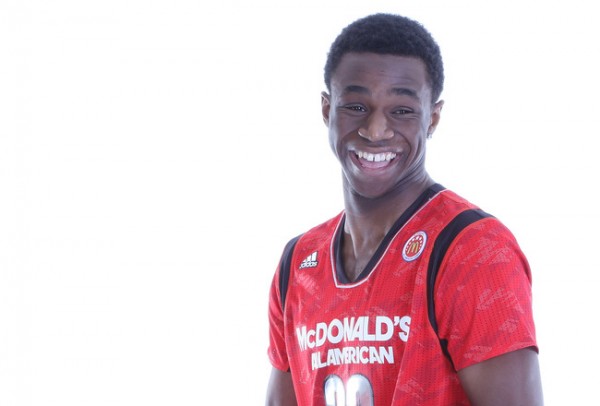
Recruits as talented and as hyped as Wiggins are not yearly luxuries (Getty).

Recruits as talented and as hyped as Wiggins are not yearly luxuries (Getty).

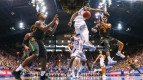
One simple tweet announced the news. Next came the firestorm. I’m not talking about the angry folks on Twitter, the myopic blockheads who can’t possibly fathom why the best high school basketball player in the country would ever decide against attending the school they support. I’m talking about predictive articles like this and this. The exalted leaders of this diffuse college hoops writing profession took it upon themselves to write “Post-Wiggins Top 25’s,” as if one player, sitting on a faux-erected dais in the middle of a high school gym, and a few simple words, could disrupt the entire established elite tier of the 2013-14 college basketball season. Kansas is clearly better now than it was at 12:14 PM Tuesday afternoon, but the rest of college basketball’s projected top teams – a group that, even discounting Wiggins, features at least three (Duke, Michigan State, Kentucky, Louisville, Arizona, etc.) guaranteed national title aspirants, with bundles of future NBA lottery talent to go around – had to be shifted into new relative locations. Wiggins’ decision was that big, that impactful, that not only would Kansas immediately enter the preseason Final Four discussion, everybody else would need to make room for the Wiggins-equipped locomotive and Big 12 frontrunner. Wiggins didn’t just change Kansas; he shifted the tectonic plates of college basketball’s one supra-conference organizing principle: competitive equity.

Read the rest of this entry »

Morning Five: 05.14.13 Edition

Posted by rtmsf on May 15th, 2013

morning5

  1. Yesterday was Andrew Wiggins Day in college basketball, as the precocious Canadian wing who some have claimed is the best prep player since LeBron James came out of Akron in 2003, made his collegiate choice. You’ve undoubtedly heard by now that Wiggins is headed to Kansas to play for Bill Self, so let’s take a look at some of the reactions from around the country. The Kansas head coach himself was ecstatic, saying that Wiggins “brings athleticism, length, scoring ability and […] an assassin, an alpha dog’s] mentality to his game. Mike DeCourcy emphasizes that not all #1 players are created equal (a true statement), and breaks down some of the most heated recruitments of the modern era (from Ewing to Oden), while also arguing that if Wiggins really sought to shun the glare of a white-hot spotlight, he probably should have gone elsewhere because the pressure will be on him in Lawrence. On the other hand, during the SVP & Rusillo radio show Tuesday, Andy Katz said that Wiggins is walking into a near-perfect situation where he join a team with enough talent around him to win but where there is no question who will be the top dog on campus. So where does this put the Jayhawks next season? The Dagger‘s Jeff Eisenberg thinks that KU is now a title contender, while at least one writer believes the Jayhawks should be elevated into the post-recruitment top four of next year’s power rankings. Twitter of course weighed in as it tends to do in these situationswhile one national writer thinks Wiggins made a mistake in going to college at all. It’s all very exciting stuff, because Wiggins’ decision to join KU balances out the ridiculous incoming class at Kentucky along with the returning talent at places like North Carolina, Louisville, Duke and Arizona. The game is in solid shape for 2013-14, that’s for sure. What’s next for Wiggins? According to Self, perhaps a summer spent playing for Team Canada in some international events. Let’s just cross our fingers that he remains healthy.
  2. Lost amid all the Wiggins news yesterday was that the SEC and Big 12 announced a new basketball challenge in light of the transitions that hit the Big East which makes it no longer an attractive interconference option for something like this. The SEC/Big 12 Challenge will begin on November 14 with a yawner of a game between Alabama and Texas Tech, and will continue on for the next five weeks with highlighted contests including Baylor vs. Kentucky at Cowboys Stadium on December 6 and Kansas vs. Florida in Gainesville on December 10. Look, we love the idea conceptually. The SEC and Big 12 are very similar leagues and this sort of match-up makes a lot more sense than the Big East/SEC event ever did. But the Big 12 tried the same thing with the Pac-10 a few years ago and it was a failure because nobody knew when the games were happening — they were simply too spread out. For events like this to work, they must (capital MUST) be confined to a tight spacing of games so that fans can actually invest in the concept and keep up with how each league is doing. To have games literally spread out over more than a month like they’ve done here is incredibly short-sighted and incomprehensible. As an aside, Missouri will take part in the Challenge, but they’ll play West Virginia, the school that replaced them after leaving the Big 12 last year.
  3. Something ugly appears to be going down at Tennessee involving the bizarre Trae Golden dismissal/transfer that occurred last week. According to numerous published reports, the rumors of Golden’s academic issues in Knoxville may have involved more than originally met the eye after the school terminated its head of judicial student affairs, Jenny Wright, late last week. We’re not going to speculate as to what exactly may have happened here until more information is released, but as Andy Glockner notes in SI.com, the merging of possible academic impropriety with unprofessional relationships in the context of a judicial student affairs setting isn’t one to take lightly. And certainly nothing that the school needs after already suffering through the Bruce Pearl and Derek Dooley foibles in their two revenue sports.
  4. From the world is a strange and sometimes awful place department, Brown guard Joseph Sharkey, a sophomore who averaged about 12 minutes per game last season for the Bears, was approached and struck in the face by a random stranger over the weekend, putting him into the hospital where he is in critical condition. As CBSSports.com‘s Jeff Goodman writes, the attack appears to have been completely unprovoked and ultimately resulted in the young man’s head hitting concrete as he fell down. It sounds like a horrible story and one that we hope doesn’t have a lasting negative outcome for the player. We’re wishing him well on his recovery from this senseless crime.
  5. Finishing up with some comings and goings, Andrew Wiggins must be scaring the rest of the Big 12, as not one but two Baylor players are leaving the program — most notably, Deuce Bello, along with LJ Rose — and Texas’ Julien Lewis, the top returning scorer for the Longhorns, is also on his way out. Lewis is the most accomplished player of the three, averaging 11/3 APG in his sophomore season in Austin, but Bello probably has the most name-brand recognition from his prep days when he was considered the most athletic player in his class. Bello has only seen about 10 minutes per game of action in his two seasons in Waco, but perhaps a change of scenery will allow him to develop his game beyond occasional Highlight of the Night quality dunks. Already more than 400 players are on the transfer wire this offseason, averaging out to a little more than one player per D-I team. Wow. We hope these guys find what they’re looking for.

Morning Five: 05.14.13 Edition

Posted by nvr1983 on May 14th, 2013

morning5

  1. We are not that familiar with the finances of the city of Chicago, but we have a hard time believing that it has a lot of money to spend on a new arena for DePaul. Still it appears that Chicago Mayor Rahm Emanuel is expected to announce his plans for an (at least partially) funded $300 million arena for the school that is part of a bigger project that the city is undertaking. There is still a lot of speculation on what this will involve including how much taxpayers will be expected to contribute and reports vary widely so we will hold off on commenting on the situation too much other than to say we have a hard time believing this will pass without a huge fight. The other interesting aspect of this proposal is the possibility that a casino could play a prominent role in the area. We doubt that being a NCAA Tournament site would be a major deal to a city the size of Chicago, but it could be an issue for whatever conference DePaul ends up in by the time the project is completed.
  2. The ever-growing transfer list appears to have added one of its biggest names as it appears that Deuce Bello will transfer from Baylor. Bello, who was a highly touted recruit coming out of high school thanks in large part due to his dunking ability, has never really blossomed as a college player averaging just 2.4 points and 1.4 rebounds per game last season as a sophomore. Given his production we wouldn’t expect him to be that highly recruited, but his athleticism and the fact that he has been “coached” by Scott Drew the last two seasons will probably lead several top programs to take a look at him.
  3. You know a program has made it when other schools begin to raid its bench for head coaches. Such is the case for VCU (if you didn’t already know they had made) it as Chattanooga hired VCU assistant Will Wade to be its new head coach. We are always hesitant to give an assistant too much credit for their program’s success as Chattanooga is attempting to bill Wade as the driving force behind the success of both VCU (citing him as a driving force behind the “Havoc” defense) and Harvard (landing a top 25 recruiting class and helping mold Jeremy Lin into the player he is today–or make that last year actually). Outside of that we do not have much to add on Wade’s hiring (we will give it some time–a few years–before grading the hire), but will point out that it is kind of cute how the school starts off the press release by mentioning a public reception for Wade tomorrow that everybody is invited to attend.
  4. We are not sure who got in Kyle Vinales ear today, but he or she certainly had a pretty quick impact as the Central Connecticut State transfer backed out of his commitment to transfer to Toledo hours after announcing it. Vinales is one of the top transfers available in terms of his scoring ability and should have the ability to score at almost any Division I level and certainly would have at the bottom of the MAC. The question is how far up he can go. The ability to put the ball in the basket is certainly a universal skill, but at some point the athleticism of the players you are playing against limits your ability to score. Vinales certainly has the ability to play at a higher level than Toledo, but in doing so he should be careful not to go to such a high level that his minutes decrease significantly as we have seen with several transfers.
  5. We do not have much information about Brown sophomore Joseph Sharkey, who is in critical condition after being assaulted early on Sunday morning. According to reports, Sharkey was walking with a group of women when a man approached Sharkey and punched him in the face in what has been described as an unprovoked attack. To be frank at this point the details of the report and what led to the incident are not particularly important. Instead, we will focus on Sharkey and his health while wishing him the best in his recovery.

Framing the Andrew Wiggins Hype on the Brink of Decision Day

Posted by Chris Johnson on May 13th, 2013

Chris Johnson is an RTC Columnist. He can be reached @ChrisDJohnsonn.

Top-rated prospects are not created equal. Each and every recruiting class features a different No. 1 player with a different skill set and different ceiling and varying amounts of pro potential. You get seasons like 2012, when Nerlens Noel joined Kentucky with every iteration of defensive scouting recommendation and eulogistic praise imaginable. He was a specialist, a defensive savant with a merely “developing” offensive game. Noel would turn out to be an undisputed star and – even after tearing his ACL against Florida in February – maybe the best bet to be taken No. 1 in this summer’s NBA Draft, but Noel’s hype was built more on potential, on unparalleled size-to-position athleticism, on a work ethic that would one day allow him to put everything together into a devastating offensive and defensive force of nature. Andrew Wiggins is not Nerlens Noel, or even Anthony Davis, and certainly not anything like Harrison Barnes, the freshmen preseason All-American that wasn’t, whose under-performance has spawned – and not unjustifiably so – some level of unease about the boundless expectations surrounding Wiggins’ immediate impact at the college level.

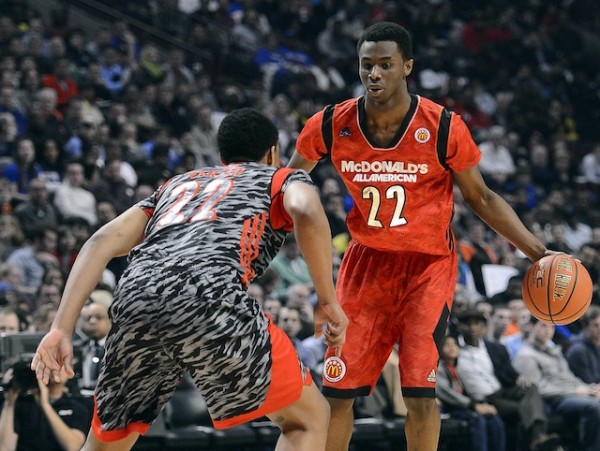
The reverberations of Wiggins' decision will be felt throughout all of college basketball (USA Today Sports).

The reverberations of Wiggins’ decision will be felt throughout all of college basketball (USA Today Sports).

When we talk about Andrew Wiggins, we’re not just talking about a No. 1 recruit and a likely top overall NBA Draft pick. Wiggins is one of the distinguished few prospects that – according to pretty much any scout or talent evaluator or Youtube frequenter you speak to – offers not only the potential to lift a college team’s one-year baseline to new heights, but the promise of franchise-altering skills in the NBA. So, basically, think Kevin Durant, or LeBron James, or Tim Duncan. While we’re on the subject, the LeBron comparisons are not completely unfounded. A direct prep-to-pros LBJ parallel was invoked on the cover of Sports Illustrated just last year, with a glorifying cover story and headline that read, “The Best High School Basketball Player Since LeBron James Is…”, featuring a 2013 prospect whose name was not Andrew Wiggins. That illuminating SI edition was a tribute to Chicago high school star and future lottery pick Jabari Parker, written and published before Andrew Wiggins realized he was just plain clowning everyone on the high school level and best be reclassifying to expedite his passage to professional basketball. Now that headline seems sort of outdated, or factually incorrect, because a quorum has been reached: Wiggins is better than “the best basketball player since LeBron James.”

Read the rest of this entry »

Morning Five: 05.13.13 Edition

Posted by nvr1983 on May 13th, 2013

morning5

  1. It seems like Rutgers cannot get anything right. Even the hiring of Eddie Jordan, which seemed like a no-brainer, has turned into a public relations disaster as Jordan never graduated from college. This is not at the level of George O’Leary and his fake degree with at an institution that never existed, but it is still an ugly mark against an institution that has already been dragged through the mud with its handling of the Mike Rice situation. From what the school is saying Jordan never represented himself as a graduate of the school and it was simply a media relations error. If that is in fact true and the school claims that it does not require its coaches to have college degrees (Who cares since they do not count against the APR, right?), this issue will probably be swept under the rug, but we imagine that opposing coaches will use this to recruit against Jordan by pointing out that if he did not bother to complete his college degree it seems a little less credible that he would make sure your son ends up with a college degree when his basketball career is over.
  2. It appears that the recruitment of Andrew Wiggins, the #1 high school player in (North) America, will be coming to a close as he is expected to announce his decision at 12:15 PM today. Many fans and several analysts have voiced their displeasure with Wiggins taking so long to announce his decision, but with the way that schools get put on probation and players or coaches leave it makes sense for the top player in the country (or any coveted recruit for that matter) to wait as long as possible to make their decision. Wiggins is set to decide between Florida State, Kansas, Kentucky, and North Carolina. If Wiggins winds up in Lexington, you can be sure it will set off another round of hysteria about Kentucky’s incoming class. Interestingly, the most frequently cited destination we have seen from college basketball analysts is Florida State. If that were to happen, Wiggins would make the Seminoles a legitimate NCAA Tournament team and would create some very interesting match-ups against Duke and Jabari Parker.
  3. The Miami investigation is the mess that never seems to go away. The latest update is that Frank Haith‘s petition to question Bank of America employees on whether they gave unauthorized access to his bank accounts (allowing the NCAA to analyze his accounts) was denied by a federal judge in Miami on Friday. Based on what has been released about the case it appears that Haith will still be able to get the information if he decides to file a lawsuit, which he may be doing in the near future. If the NCAA did in fact illegally obtain Haith’s financial records it could be dealing with a very messy legal case and one that it cannot rely on its own jurisdiction to help it evade substantial penalties.
  4. Georgia Tech lost a pair of players over the weekend. The most significant was Julian Royal, who is headed to George Mason (announced via that Instagram picture) and will finally get to play for Paul Hewitt after Hewitt recruited him to Georgia Tech before moving to George Mason. On the surface, the addition of a player who was the odd man out in Georgia Tech’s rotation may not seem like a big get, but coming out of high school Royal was considered the best player in the state of Georgia and a player that Hewitt thought fit his system so perhaps playing for Hewitt in his system (and new scenery) will help Royal realize his potential. The other move from Georgia Tech was Brandon Reed‘s decision to transfer after his junior season. Reed, who averaged 5.2 points per game on 38.4 percent from three-point range last season, will graduate this summer as he also sat out a year after transferring from Arkansas State. As a result Reed will be able to transfer again without having to sit out a year if he picks an appropriate graduate degree program.
  5. We are still waiting on a few recruits from the class of 2013 to commit (see the big one in bullet #2), but a pair of highly rated recruits in the class of 2014 appear to have already made their choices. The more firm of the two commitments comes from Daniel Hamilton, a top 30 recruit, who verbally committed to play at Connecticut. The addition of Hamilton should give the Huskies a very potent backcourt for the 2014-15 season (when Rodney Purvis is eligible) as they will be looking to replace more experienced players. The other quasi-commitment comes from Chris Chiozza, who is a top-100 player, and appears to be headed to Florida with a formal announcement tomorrow. The news on Chiozza is not particularly noteworthy except for the fact that he is a high school teammate of Leron Black, a top-20 player in the junior class so perhaps Chiozza’s decision will offer some clue as to where Black is headed.

Morning Five: 05.10.13 Edition

Posted by rtmsf on May 10th, 2013

morning5

  1. In yesterday’s M5, we linked to an LA Times article exploring how new USC head coach Andy Enfield is taking to his new environs in Hollywood. What’s been forgotten amid all the buzz surrounding Enfield is the school that allowed him to become a household name in the first place — Florida Gulf Coast. According to the Fort Myers (FL) News-Press, new head coach Joe Dooley has been adjusting to the job through a whirlwind of recruiting trips, a national search for an assistant coach, and getting to know his returning players. One interesting idea put forth in the article is that Dooley appears to be looking at graduating seniors with another year of eligibility as a quick solution to gather some quick elite-level talent. It’s not a bad thought, especially considering that the brand recognition of FGCU is likely to give the program a number of marquee non-conference games next season, a nice selling point for players at bigger schools who might be looking to trade down for one year.
  2. Mike DeCourcy is back with his Starting Five column this week, and he took some time out from his trip to the British Isles to tackle several interesting subjects: notably, Andrew Wiggins, Andy Enfield, and our favorite, RTCing. On the subject of Wiggins and where he thinks he’s headed (or should head) next season, he couldn’t have been more politically savvy, writing 200 words on the “prediction” without actually answering his own question! With respect to Enfield, he gives the new USC head coach a puncher’s chance at making Trojans basketball a hot ticket, but we’re in agreement with him that the focus of the school on football makes it a very tough place to become truly relevant. Finally, he also attacks the practice of RTCing as a “massive potential liability,” and of course he’s right on that point — but it’s also incredibly fun for the students involved, and love it or hate it — ahem, we fall in the love category — it’s one of the few unique traditions that college basketball can claim as its very own, and we hope that it remains part of that fabric of the sport for as long as we’re around.
  3. Yesterday’s transfer news includes a couple of good players looking to take advantage of the graduate exception to play their final season immediately at their new location. Florida State forward Terrence Shannon announced that he will enroll at VCU for his last campaign, giving Shaka Smart’s already-talented Rams a big and athletic post player who can team up with Juvonte Reddic and Treveon Graham in an outstanding frontcourt next season. Out west, Arizona State’s Evan Gordon has been granted his release and is rumored to be considering a transfer closer to his home in Indiana for his last season. The obvious choice for Gordon would be Tom Crean’s Hoosiers, given that older brother Eric played in Bloomington a few years ago, and the personnel losses that IU faces this offseason. As players around the country move toward graduation and recognize the immediate value of this exception, we expect to see quite a few more of these free agency situations before the month is out. Somewhere up in Wisconsin, Bo Ryan just kicked his dog.
  4. One of the best movies of all-time is the documentary Hoop Dreams, a Chicago prep basketball saga that follows the high school careers of William Gates and Arthur Agee through their many ups and downs. Both Gates and Agee have reached middle age by now, but they remain quasi-celebrities by virtue of their affiliation with the movie and the raw reality of the stories they told. The Dagger‘s Jeff Eisenberg tells the story of William Gates, Jr., Gates’ son, who as a high school senior at Samuel Clemens High School in San Antonio, just recently accepted a scholarship offer to play Division I basketball at Furman. Anyone who struggled with the disappointments that the elder Gates suffered after blowing out his knee in Chicago two decades ago has to love this story of a family’s redemption. Great piece of work here.
  5. Finally, in a sad testimony of just how far the industry of journalism has fallen (and the end seemingly nowhere in sight), the New York Daily News laid off longtime college basketball scribe Dick “Hoops” Weiss. A mentor to many in the business and a true gentleman admired by everyone privileged to have met him at MSG or one of his 40+ trips to the NCAA Tournament, we surely hope that he will find a comfortable landing spot somewhere else. It’s a shame that someone so influential to the game of college basketball for nearly a half-century can be thrown out like yesterday’s news, but as we’ve said many times before, the modern era of reporting and sports writing seemingly will not stop itself in its vulgar race to the very bottom.

Another Important Transfer Pick Up For Oregon: Can Mike Moser Re-Emerge In Eugene?

Posted by Chris Johnson on May 9th, 2013

Chris Johnson is an RTC Columnist. He can be reached @ChrisDJohnsonn

The transfer market didn’t betray the Oregon Ducks last season, so they gave it another shot this week. They went after coveted former UNLV forward Mike Moser, who instantly became one of the hottest transfer pieces on the market this offseason following his release from the Rebels. Moser could play right away thanks to the graduate transfer exemption, and he could have chosen any number of teams — who wouldn’t want to add an athletic and imposing 6’8” power forward to bolster their frontcourt? Washington, Oregon and Gonzaga had emerged as Moser’s most likely landing spots in recent weeks, and on Tuesday, Moser finally settled on his home state school.

Adding Moser is not an unfamiliar move for the Ducks, who have liberally welcomed transfers in the past (Getty Images).

Adding Moser is not an unfamiliar move for the Ducks, who have liberally welcomed transfers in the past (Getty Images).

The Portland native instantly raises Oregon’s chances of competing in a winnable Pac-12. That is the most conspicuously plain reaction to Moser’s news, and it’s probably right. Moser makes Oregon better. Elucidating the scope of that description – how much better? – requires a quick revisiting of Moser’s two-year career to date. In 2011-12, Moser was an absolute force. He played 77.1 percent of the available minutes, posted a top-10 defensive rebounding rate, a top-100 steal percentage, and showed promise on the offensive end. Moser’s athletic skills and instinctual defensive and rebounding work made him an obvious All-America candidate heading into last season. He was big and athletic and skilled, and just beginning to scratch the surface of his immense potential – Moser seemed like one of safest bargains on the table. Not only would he shine individually, Moser would power a talented UNLV group, built on the back of a highly-ranked freshman class that included likely lottery pick Anthony Bennett, to an easy MW title. Moser’s monster season was pre-scripted. He was a virtual lock for stardom.

Read the rest of this entry »

Morning Five: 05.09.13 Edition

Posted by rtmsf on May 9th, 2013

morning5

  1. As CBSSports.com‘s Jeff Goodman reported yesterday, the NCAA Rules Committee is meeting in Indianapolis this week and as of now it appears unlikely that the governing body will recommend a change to the 35-second shot clock. Given that scoring has reached its lowest point in over a half-century of college hoops, many have been clamoring for the pace of the game to increase through a shortened clock. What those rabble-rousers of course fail to realize is that because of advanced scouting and technology, defensive strategies are vastly more robust than they were even 10, or certainly 20 or more years ago. The game is also significantly younger than it was when the shot clock was first introduced, which creates a likely devil’s potion of unintended consequences whereby a shortened clock will simply lead to more rushed (read: ugly) possessions that will not at all improve the overall level of play across the game. Good on the NCAA to recognize this and keep the wolves at bay. Some of the other anticipated rules changes are to mimic the NBA’s achievement in using the monitors at the end of games to get possession, time and score calls correct, while also placing a much-needed emphasis on the removal of hand-checking and bumping on cuts through the lane. Hopefully these measures will help to make the game a bit more free-flowing, because the NBA’s product right now in that regard is fantastic and the collegians could stand to learn from it.
  2. The match-ups for the 15th annual ACC/Big Ten Challenge were released yesterday and everyone is giving their takes on which games stand out as the best. Perhaps the most interesting aspect of next year’s event, of course, is that the three new ACC schools — Syracuse, Pittsburgh, and Notre Dame — will be a part of the action next December 3-4. The Orange will take on Indiana in a rematch game from this year’s Sweet Sixteen; the Panthers will host rising program Penn State in a Keystone State battle; and, Notre Dame will travel to Iowa to face another Big Ten team hoping for big things next season. As for longtime ACC teams Wake Forest, Clemson and Virginia Tech? Welcome to your new reality — there are three newer and prettier girls moving to town. For what it’s worth, the Big Ten has won three of the last four events, with last year ending up as a 6-6 tie.
  3. The national runner-up, Michigan, will travel to Cameron Indoor Stadium in the marquee game of the first night of the Challenge, which brings back great memories of the days when Chris Webber, Jalen Rose and the Fab Five would knock antlers with Bobby Hurley, Grant Hill and the rest down in Durham two decades ago. While on the subject of Michigan’s most famous player, Webber’s 10-year ban from association with UM as part of his punishment for taking hundreds of thousands of dollars while in school there, is now over. Technically, this means that if Michigan someday wants to honor him with a jersey retirement ceremony or some other shrine in Crisler Arena, they will be allowed to do so. Whether Webber ultimately wants something like that is open for debate — he’s reportedly remained very cool in his relationship with the university (and some argue that he’s right to be angry) — but it says here that Webber is a sensitive guy who was very hurt by many of the things said about him within the Michigan community, but as evidenced by his attendance at the National Championship game last month, he’ll never stop loving the school that made him famous. He’ll be honored there within the next five years.
  4. By now everyone knows and has an opinion on the mercurial rise of wunderkind head coach Andy Enfield from Florida Gulf Coast to USC. Now that he’s been on the job for a few weeks in Troy, the New York Times caught up with him to see how he’s handling the transition from the low-density glare of Fort Myers, Florida, to the red-hot limelight of Hollywood. No stranger to hard work, Enfield has been putting in 16-hour days getting organized in everything from recruiting strategies to travel plans, all from the relatively comfortable haven of his nearby Raddisson hotel room. As the article notes, the Fighting Enfields are already focusing very hard on dominating the Los Angeles talent scene, a sentiment that is going to be very interesting with Steve Alford just a few miles away in his new digs mapping out the very same plan. USC may not ever become a basketball school, but there’s really no excuse for it to be awful, either. Enfield might just be the guy to make USC basketball relevant again.
  5. SI.com‘s Andy Glockner has been beating this drum for a while now, but we’re not sure he’s ever done so outside the conversation-friendly auspices of Twitter. The idea? A college basketball Champions League arrangement, first espoused by Bylaw Blog‘s John Infante, which would essentially use the non-conference friendly months of November and December to create non-stop excitement by crafting big game after big game between talented teams before heading into the heart of conference season and, ultimately, March Madness. We’re not smart enough with respect to the nuances of the Champions League format to determine whether this sort of thing might be feasible, but if the ultimate goal is to improve the game as a whole through more compelling match-ups when most sports fans are generally only worried about football, then we’re all for it. Glockner does an excellent job explaining how the pairings would work as well as rebutting some of the arguments that are sure to arise — it’s well worth a read and some consideration.

So What If Turner Broadcasts the Final Four? 68 Beats 96 Any Day…

Posted by Chris Johnson on May 8th, 2013

Chris Johnson is an RTC Columnist. He can be reached @ChrisDJohnsonn

Whenever someone brings up the possibility of a 96-team NCAA Tournament, reaction is unanimously predictable. Folks cringe, unnerved at the idea of seeing the regular season devalued at the expense of more Tournament games involving fewer quality teams. Bubble discussion would cease to be anything remotely close to riveting; when losing conference records and +100 RPI figures (and even uglier tempo-free profiles) are perfectly qualified for at-large admission, the enterprise breaks down. Opening-round byes for top seeds would feel inauthentic. Nobody wants a 96–team NCAA field. Maybe the NCAA, for strictly monetary purposes, but that’s it. The consensus is uncompromising. We bended our backs for 68, but the line of resistance is taut anywhere beyond that.

Next season's Final Four will have a different TV provider.

Next season’s Final Four will have a different TV provider.

If it weren’t for Turner Broadcasting System, the famous sports and drama-bearing cable network otherwise known as TBS or “Turner,” we might just be talking about 96 in harrowing certainty rather than lamenting the distant possibility of a hugely expanded field. That’s the way Sporting News’ Mike DeCourcy sees it — that Turner, in co-bankrolling a deal with CBS in spring 2010 to keep the NCAA Tournament set at 68 teams, essentially “saved all of college basketball.”

The truth is that 68 saved everyone from 96. The truth is that 96 would have been the worst thing ever to happen to college basketball, robbing teams of incentive to excel in the regular season and fans from investing any emotion or interest in how it developed. And the truth is Turner’s cable wealth—it receives income from both subscription fees and advertising, whereas network channels receive only the latter—is the reason the NCAA was able to hold the line at a 68-team field.

In one of the few instances where television contracts actually didn’t ruin something totally awesome about college sports, Turner deserves a hearty round of applause each and every year we watch Greg Gumbel on Selection Sunday list off 68 teams and then stop dead in his tracks. No more, no less. That’s the number the NCAA, Turner and CBS has settled on and – whatever your feelings on the “play-in” games – I kind of like things the way they are. This setup works. The number creates enough competitive balance to evoke truly compelling bubble cut-line angst, while remaining inclusive enough to allow any and all measurably deserving teams to play their way in. Win a few non-conference games, play .500 ball in your power league (smaller leagues have less margin for error), don’t lose to Old Dominion and Delaware in the non-conference (ah, Virginia), and you’re ticket to bracketland is as good as punched. It really is that simple. Could you imagine how much simpler it could have been with a 96-team threshold? I know what the depths of a 96-team bracket looks like. It’s called the CBI, which is a euphemistic way of saying, 96 teams is a dark and scary place.

Read the rest of this entry »