While conference realignment has been almost entirely football-centric, there are also major ramifications for the Big East‘s non-football playing schools as well. Washington Post‘s Liz Clarke spoke with Jay Bilas, Bill Raftery, and Jim Boeheim about the future of the Big East and the direction that the basketball schools should take. Jay Bilas described schools like UCF, Memphis, and Tulane as not passing “the straight-face test” while Raftery and Boeheim think that the schools should move forward with the new additions and make the best of it, saying that the conference still has accomplished programs and could be viable going forward.
While Peyton Siva and Gorgui Dieng garnered most of the preseason accolades for Louisville, Rick Pitino has gotten irreplaceable performances from players who almost didn’t make it with the program. At different times, Pitino told both Russ Smith and Stephan Van Treese that they may have been better off to go to other schools where they could see ample playing time. However, both stayed, and Smith seems to be having a break out season, while Van Treese has been filling in admirably for the injured Dieng. In the Cardinals’ close 69-66 edging of Illinois State over the weekend, Smith and Van Treese led the team in minutes.
Cincinnati helped contribute to the Big East’s drubbing of the SEC in this year’s SEC/Big East challenge with a win over Alabama Saturday, but the Bearcats still aren’t content with where they are as a team this season. Cashmere Wright was able to cash in on a buzzer-beating jumper to defeat the Tide, but Mick Cronin found plenty to work on in the win: “Obviously, we’ve got a lot of areas we’ve got to improve… Offensively we have to get more ball movement, more assists, get more touches on the ball. We stand around too much They did a good job keeping us off the break.Once again we get a 13-point lead and start looking around instead of continue with the pace of play that we want to play at for 40 minutes.”
Just when we think we’re done with the Bernie Fine case, something pulls us back in. This week, Syracuse police chief Frank Fowler stated that he believes that the first two Fine accusers — Bobby Davis and Mike Lang — are credible, as well as the fourth accuser, Floyd Van Hooser, who had last publicly recanted his accusations against the former assistant coach. The last bit of Fine news had come a few weeks ago, when the federal investigation of him had closed without any charges or arrests. With so many variables and chapters in this case, it is unlikely that we will ever have full closure, especially with the passing of the statute of limitations at the state level.
The Providence Friars may be the walking wounded these days, but that didn’t prevent them from getting in on the Big East win party this weekend. The Friars came out on top against Mississippi State, 73-63, at the Dunkin’ Donuts Center on Saturday, and currently own a 6-2 record. The Friars entered the game with two injured players – freshman standout Kris Dunn and star senior Vincent Council – and lost point guard Bryce Cotton late in the first half. Using only six players in the second half, the Friars played effective defense and were able to hold the Bulldogs to 35.9% shooting from the floor and just 2-22 from three-point range. Junior forward Kadeem Batts paced Providence with a career high 32 points in the win.
We usually don’t like to blame the actions of college students on a coach or the administration, but when you have the issues that Hofstra has had recently you start wanting to ask questions. On Friday, four players on the team (sophomore Shaquille Stokes and freshmen Jimmy Hall, Dallas Anglin, and Kentrell Washington) pleaded not guilty to their involvement in a series of six burglaries between October 4 and November 5. While this could be seen as an isolated series of incidents, these events come after the team already had two players miss the first two games of the season due to violation of unspecified team rules. We aren’t saying that it is head coach Mo Cassara’s or Hofstra’s fault that these serious accusations are flying around, but somebody within the institution needs to step up and get things under control there.
Years ago we used to wonder if a player would be headed to college or would bypass it completely to enter the NBA Draft. With the NBA’s one-year rule in place we don’t have that discussion any more, but in the case of elite class of 2013 recruit Jabari Parker we are awaiting a similar major decision — whether he would go to college next season or begin his two-year Mormon mission. On a local ESPN radio show Parker announced on Friday that he would be going to college before going on his Mormon mission. While this may seem like a no-brainer to most people there have been plenty of prominent Mormon athletes (including basketball players) who took time off during college to complete their mission. We are not sure if Parker will delay some part of his basketball career to do so himself, but we certainly would not rule it out.
We came across an article that appeared in The New York Times last week discussing whether a college diploma was as important as people claim it is. We found the argument intriguing and think that it relates a little to the issues regarding basketball players attending school to pursue their professional dreams. Obviously there are some significant differences here, primarily that graduation rates are focused more on the athletes who are not going to have professional sports careers where they make enough money to last their family for several lifetimes. For us the more important connection here is for individuals who are talented enough to pursue lucrative careers without the safety net of having a college degree. There are some important differences (namely the fact that athletes aren’t saddled with significant college tuition debt), but it is an interesting discussion whether you consider it from a traditional student’s perspective or from that of a student-athlete.
Federal officials may have dropped the Bernie Fine case, but local authorities do not appear to be convinced of his innocence as Onondaga County DA believes that some of his accusers are “highly credible.” This flies in the face of actions made by federal prosecutors a few weeks ago in closing the case investigating Fine, citing insufficient evidence to bring charges against the longtime Orange assistant coach. What does this all mean? Not much, as the statute of limitations on the DA bringing charges against Fine has already passed, but maybe in some strange way these statements serve to validate the accusers who came forward and encourage those who are silent in similar situations to realize that sharing their story can be worthwhile.
Chris Johnson is an RTC Columnist. He can be reached @ChrisDJohnsonn.
This Weekend’s Lede. Rick Majerus’ Passing Looms Over Action-Packed Weekend. This space is typically reserved for a general overview of the weekend’s on-court action. Common practice won’t suffice this weekend, not after college basketball witnessed the passing of a true coaching legend. Rick Majerus was one of the brightest basketball minds of his generation. Anyone with even the faintest knowledge of recent college hoops history will mourn the loss of not only a sideline legend and master strategist. They will forever long to appreciate the inexplicable character traits, the brusque disposition, the measured charisma, the almost juvenile passion for the game – they’ll seek to understand all of it. In truth, no one will every truly encapsulate Majerus’ legacy, though many brilliant reactions were penned following Saturday night’s news. (Here’s my brief take). The best we can do is pay homage and seek to remember the many ways in which he impacted the sport we love. So as we move to recapping the weekend, take a moment to appreciate the legacy of one of college basketball’s most unique individuals. Know that Majerus, if healthy and able, was not ready to slide away from the sport’s center stage. Majerus was a grand attraction unto himself; his lasting work, cut short by heart problems, will forever be remembered as unfinished business. RIP.
Your Watercooler Moment. An Unforgettable Majerus Moment.
The personal side of Rick Majerus was always a divisive subject. Stories of his abusive and demeaning behavior towards players tarnished his legacy. His grizzled disposition wasn’t for anyone; many players transferred away from his programs. More often, you hear coaches and players talk about how much Majerus loved the game, how many players he helped and how his sideline eccentricities were all part of the Majerus coaching experience – the sometimes inexplicable measures he took to get the most out of his players. Whether you briefly remember this highly emotional press conference following the Billikens’ Round of 32 loss to Michigan State in last year’s NCAA Tournament, or if you’re just seeing it for the first time, let it serve as a poignant snapshot of the emotional grip Majerus forged with his players. He was about so much more than Xs and Os, and Saint Louis senior Brian Conklin hammers that point home with this passionate postgame speech. Conklin teared up not just because his team lost, but because it was his last chance to play for Majerus. Keep some tissues nearby.
Also Worth Chatting About. The End of Kentucky’s Home Win Streak.
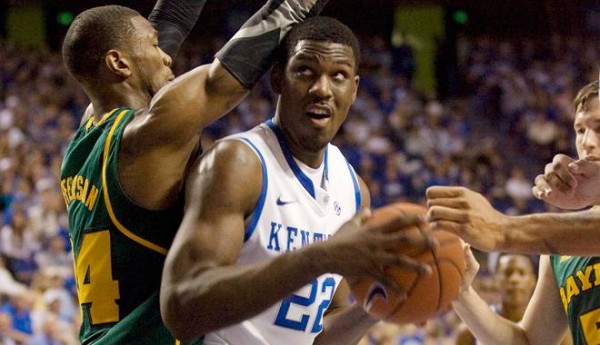
It’s unrealistic to expect another run of national dominance from this Kentucky team (Photo credit: US Presswire).
The idea that John Calipari could reboot his team for another dominant national championship season always felt like a bit of a stretch. The similarities between this year’s UK team and last year’s transcendent group aren’t all that difficult to make out. The 2012-13 Wildcats are, crazy as it seems, normal freshmen. Last year’s Anthony Davis-led cast were legendary talents that, when assembled, somehow projected greater collective value than the sum of their individual blue-chip credentials suggested. Of course this season’s one-and-doners fly near the top of every recruiting ranking and NBA Draft board projection, just like last year’s team. But this group is not impervious to the typical rigors of college hoops first-year players. They can’t block out brutal road environments – as Notre Dame proved Thursday night. They aren’t talented enough to create offense on the fly. They aren’t selfless enough to accept defined scoring roles this early in the season. And they most certainly are not good enough to overcome a 29.6 percent shooting night, not even at unassailable Rupp Arena. Baylor went into Lexington and stunned the blue and white diehards, a feat unachieved thus far during the Calipari era. That’s a monster-sized win, no doubt. But this was just as much about Kentucky’s shooting woes as it was Baylor’s disciplined defense. This is a bad mark for Kentucky, but it’s not time to sound the alarms in Big Blue Nation just yet. Maybe this won’t be another dream season, but the Wildcats will round into form. It’s just going to take longer this time around – after all, they’re just freshmen.
Chris Johnson is an RTC Columnist. He can be reached @ChrisDJohnsonn.
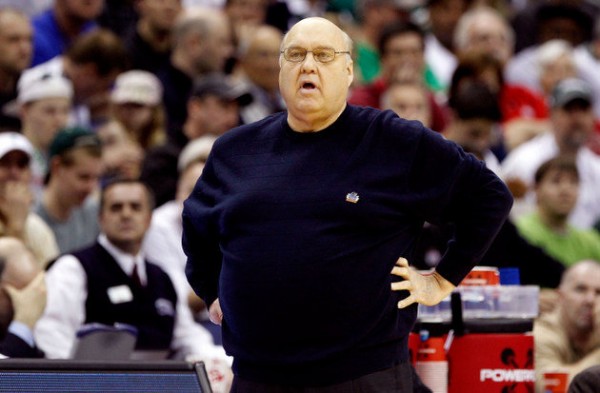
The stylistic permissiveness of college basketball is one of its best qualities. Unlike the professional game, talent does not always trump tactical wisdom. Athleticism and depth advantages are often negated by disciplined defense and judicious offense. Contrary to what last year’s Kentucky might lead you to believe, you don’t always need the very best players to win. What you need is simple: a comprehensive knowledge of offensive and defensive principles; a brazen disregard for the formalities of coaching etiquette, and an undying thirst to live, breathe and absorb every last bit of college basketball information into your memory. Just ask Rick Majerus.
Few coaches impacted the college game like Majerus did (Photo credit: Getty Images).
When I heard that Majerus, 64, had passed away after a long and well-documented struggle with heart problems – problems that caused him to take a leave absence from St. Louis prior to this season and announce his resignation from the Billiken program weeks after the word – I grieved the loss of not only one of the most entertaining sideline bosses of my sports-watching childhood, but of the greatest technical wizard I have ever seen coach a college basketball game.
Michael James is the RTC correspondent for the Ivy League. He filed this report after Saturday’s game between Bucknell and Columbia.
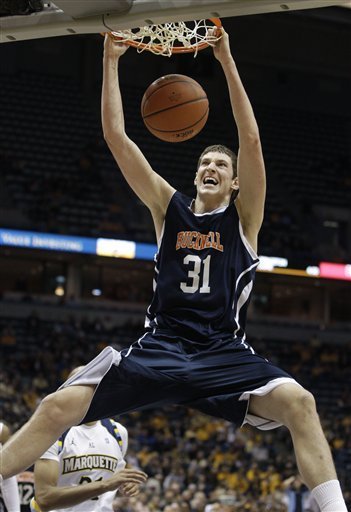
They don’t yet make a stat for a Mike Muscala. Sure, 29 points and 18 rebounds hint at greatness, as does an offensive rating that continues to hover in the stratosphere. None of those can truly capture or quantify what Muscala did to Columbia last night. The Lions led by 17 points in the first half of a game that Bucknell would ultimate win by eight. While the points that the Bison’s 6’11″ senior scored played a huge role in avoiding the minor upset, it was the points that Columbia couldn’t score that mattered far more. Lions center Mark Cisco was dominant early, scoring all 10 of his points in the first half. Cisco’s failure to score after the intermission wasn’t necessarily the product of great defense from Muscala, but quite simply because it’s impossible to score points from the bench.
Mike Muscala is an Outstanding Patriot League Player But He and His Team is Overshadowed By Lehigh and CJ McCollum
That’s where the Bison big man sent Cisco with three fouls in the first half. Cisco’s backup Cory Osetkowski would join him in foul trouble early in the second. Then, undersized forward Zach En’Wezoh picked up three fouls in a five minute span while holding on to Muscala for dear life. Columbia guard Brian Barbour and forward Alex Rosenberg did their best to provide enough offense to stay in the game, but without the senior Cisco, the Lions were just weren’t the same squad. More than the points or the rebounds, it was that Muscala had made Columbia a completely different team that encapsulates the greatness of his impact. He is a match-up nightmare – too big for undersized fours and fives to guard and too quick for bigger, burlier post players. Inevitably, massive numbers of fouls follow, evidenced by Muscala ranking 17th nationally in fouls drawn last season according to Ken Pomeroy.
Andrew Murawa (@amurawa) is the RTC correspondent for the Mountain West and a Pac-12 microsite writer. He filed this report after Saturday night’s John Wooden Classic between UCLA and San Diego State in Anaheim.
When asked Saturday night following San Diego State’s nine-point win over UCLA at the Wooden Classic whether the Aztecs’ 26-game winning streak over teams from the state of California was proof that, for now at least, SDSU is the best college basketball program in the state, Bruin head coach Ben Howland was not about to play ball. “There are a lot of teams in California,” he said before changing the subject. When Jamaal Franklin was asked a similar question just minutes later, he wasted no time answering in the affirmative, with one caveat: “We are the best, but I’m not saying we’re the best forever.” And whether UCLA’s Howland (or USC’s Kevin O’Neill, or Cal’s Mike Montgomery, or Saint Mary’s Randy Bennett, or any other head coach of a California team whose scalp SDSU has taken recently) are ready to publicly admit it, it is hard to argue the point. Right now the Aztecs are ranked higher than anybody else in the state, and in recent history, they’re the team that has had the most success. The lone Sweet Sixteen appearance by a team from California in the past three years belongs to SDSU; arguably the most accomplished current player in the state (Franklin, the reigning Mountain West Player of the Year) calls SDSU home; and as is rapidly become clear, the Aztecs have the best fan support of any team in the state this side of the Lakers.
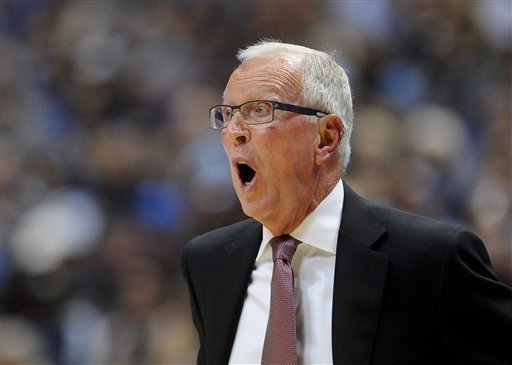
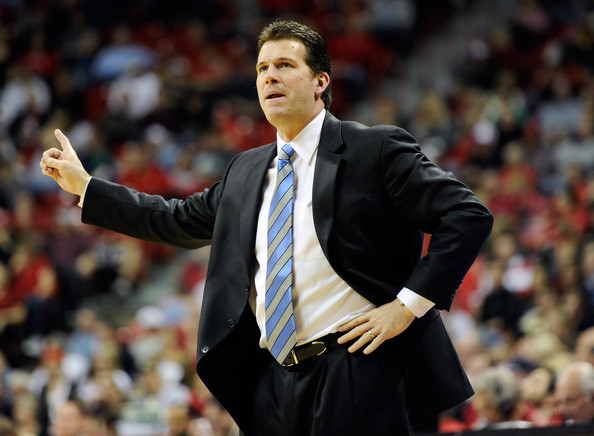
Steve Fisher Has Taken A Program That Was Once a Non-Factor And Turned It Into The Best In the State (AP Photo/Gus Ruelas)
When Steve Fisher agreed to become the head coach for SDSU 14 seasons ago, the announcement was little more than a curiosity. Having taken Michigan to the mountaintop in his first six games as head coach of that program back in 1989, and then following that up with the fabled Fab Five recruiting class, Fisher was unceremoniously run out of Ann Arbor for his tenuous connection to the scandal that resulted in a vacated Final Four appearances. When he showed up in San Diego, he was taking over a program with zero history that had gone 4-22 the previous season. Two years into the job, he had a .500 ballclub on his hands, and now, in the past seven seasons, his team has racked up a 177-63 record, including the Sweet Sixteen appearance in 2010-11. But perhaps the biggest feather in Fisher’s cap has been the explosion of fan interest in the Aztecs. There was a time when this team played in the sterile and crumbling San Diego Sports Arena in front of a handful of diehard fans and maybe a small group of students. Nowadays, Viejas Arena (opened just in advance of Fisher in 1997) is regularly packed to the gills and roaring loud, in part due to its large and vocal student section, The Show. And, as Aztec fans proved Saturday night, they’re ready and willing to go on the road and change any venue within striking distance into a temporary home court; on Saturday night, of the 17,000-plus at the Honda Center, a clear majority of the fans were there to support SDSU.
Kellen Carpenter (@kellenlc) is an RTC correspondent and ACC microsite writer. He filed this report after Saturday’s game between North Carolina and UAB in Chapel Hill.
In North Carolina’s Saturday win over UAB, the difference between this team and Roy Williams’ teams of the past became readily apparent. Gone are the days of dominant interior scoring powered by Sean May, Tyler Hansbrough, Tyler Zeller, and John Henson. For nearly 10 years, North Carolina has followed a simple blueprint for success: an up-tempo, forward-centric offense that draws fouls and scores from the free-throw line. Hansbrough, naturally, was the epitome of this approach, a bruising big man who set the NCAA record for the most made free throws over the course of his collegiate career.
The Power Game of UNC Past Isn’t Apparent This Season
This year’s incarnation of the Tar Heels is distinct from those of the recent past. In the second half of Saturday’s game, North Carolina fueled its separation from UAB with a barrage of threes launched by a small lineup that featured 6’5” P.J. Hairston at the power forward position. The team shot 10-of-23 from the arc, and 18-of-21 from the free throw line. However, of the 18 made free throws, only two of them came from North Carolina’s post players. This team is simply different. By going small and spreading the floor, North Carolina opens up space in the lane for attacks off the dribble while also maintaining the threat of a potentially deadly perimeter game.
I. Renko is a DC-based correspondent for Rush the Court. You can follow him on twitter @IRenkoHoops. He filed this report after Friday night’s game between Georgetown and Tennessee in the SEC/Big East Challenge.
Those of us who arrived at the Verizon Center in D.C. on Friday night were not expecting a shootout between Georgetown and Tennessee. When you mix Cuonzo Martin’s grinding style with John Thompson III’s patient offense and zone defense , it’s a fair bet that you’ll get a low-scoring game. But no one in the building predicted this.
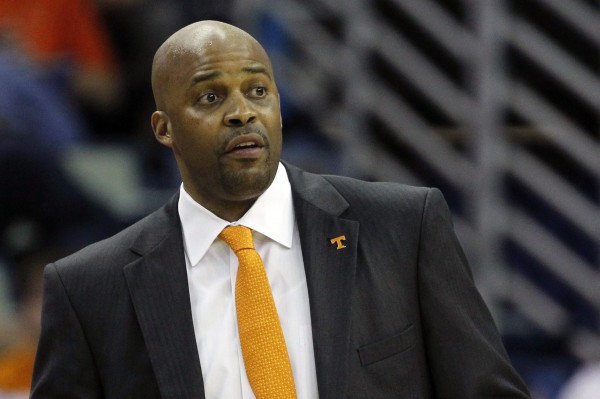
Cuonzo Martin’s Vols Struggled to Unlock the Hoyas’ Zone Defense (AP Photo/Dave Martin)
In the ugliest game of the year to date, the Hoyas scraped their way to a 37-36 victory. How brutal an offensive night was this? This brutal:
The last points of the game were scored with 4:09 left in the game, when Markel Starks hit what would prove to be the game-winning jumper.
Georgetown shot 36.4 percent from the field and 44.4 percent from the free throw line.
But they were not as bad as Tennessee, which managed to shoot 32.6% from field — which in turn was not as bad as the 27.3% the Vols shot from the charity stripe.
Each team shot worse than 20 percent from the three-point line: Tennessee at 18.8% and Georgetown at 14.3%.
No single player scored in double figures.
Jarnell Stokes had more rebounds (nine) than any player had points.
Yet both coaches seemed nonplussed about the whole lurid affair. Listening to Martin’s post-game press conference, you could have been forgiven for thinking that the final score was 67-66, not 37-36. After providing a terse and banal summary of the contest (a “competitive, physical game”), Martin dismissed the notion that he was unhappy with how the game was played: “Oh that doesn’t bother me at all. At the end of the day, you’re trying to get out with a W. I don’t need anything to be pretty. … If you get a W, leave the scene. How we win it doesn’t matter to me.” That may not be what Tennessee fans, who had grown used to Bruce Pearl’s up-and-down style, wanted to hear. But Martin’s grinding style is what made him a success at Missouri State, and it’s that success in the win column that landed him in Knoxville.
Walker Carey is an RTC correspondent. He filed this report after Saturday afternoon’s game between New Mexico and Indiana State.
New Mexico improved to 8-0 Saturday afternoon with a hard-fought 77 -68 road overtime victory over Indiana State in a Mountain West/Missouri Valley Challenge contest. While the Sycamores are far from the most talented team on New Mexico’s non-conference schedule, the victory signified another step towards an unbeaten non-conference slate. Prior to this afternoon’s victory, the Lobos had already scored impressive non-conference wins over Davidson, George Mason, and Connecticut. The latter two victories were earned in The Paradise Jam, a tournament which was won by New Mexico.
Steve Alford’s Team Keeps Rolling Along
While the Lobos lost standout forward Drew Gordon to graduation last spring, Steve Alford‘s squad is packed with returning talent from last season’s team that advanced to the third round of last season’s NCAA Tournament. Junior guard Kendall Williams was named to the Preseason All-Mountain West team and he has so far backed up the preseason accolade by averaging just a shade under 13 points a contest. Junior guard Tony Snell has emerged as the Lobos’ leading scorer, putting up close to 14 a contest, while his 27-point outburst against George Mason helped his team to a one-point victory. The Lobos have also seen two sophomores step up their level of play. Australian guard Hugh Greenwood has provided scrappy play all season long on both ends of the court and big man Alex Kirk has developed into a nightly double-double threat.
In case you missed the Big Ten Microsite over the last few days or just want to catch up on some reading about the conference, check out the below links to some of our featured posts over the last week or so.