Team USA Will Not Regret Its Decision to Keep Coach K For Another Olympic Run

Posted by Chris Johnson on May 23rd, 2013

Chris Johnson is an RTC Columnist. He can be reached @ChrisDJohnsonn

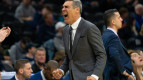
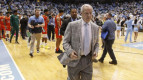
Coaching the biggest basketball superstars on planet earth into one cohesive group with a compacted practice schedule and unflinchingly mountainous expectations, among other obstacles, is not as easy as it seems. With minimal exceptions, every player is accustomed to being “the guy” on his own NBA team, where the frequency and type of shots taken are, for better or worse, monitored liberally – superstars are going to get their shots up whether you like it or not. When you mash these egos together on one, putatively dominant, practically unwieldy Team USA squad, vast philosophical and schematic adjustments melding is required. Ego-massaging is another part of the gig. Reduced shots and individual credit-basking glory is part of the cost of doing business. It’s an entirely different style and breed of basketball, this quirky thing we like to call international play, and without the right head coach in place, things can get out of hand pretty quickly. Matter of fact, Before Duke coach Mike Krzyzewski arrived on the scene, they did: In 2002, a George Karl-coached Team USA became the first American team composed of NBA players to lose in international competition when it fell to Argentina in the preliminary rounds and finished sixth at the FIBA World Championships in Indianapolis. Two years later, then under Larry Brown, team USA lost a convincing semifinal game to Argentina at the 2004 Athens Summer Olympics. The days of Dream Team dominance and universal hoops royalty were slipping away. USA basketball needed a new face and culture and identity to offer a different spin on the stale and out-of-touch approach demonstrated by previous NBA coaches. It needed Duke head coach Mike Krzyzewski.
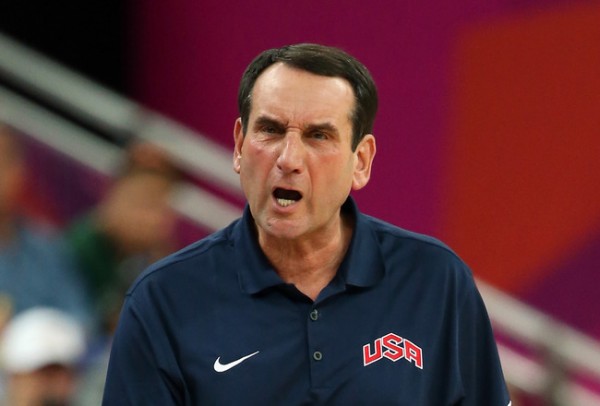
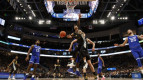
Making another run at Olympic glory, and picking up Coach K to lead the charge, is a wise move by Colangelo (Getty Images).

Making another run at Olympic glory, and picking up Coach K to lead the charge, is a wise move by USA Basketball chairman Jerry Colangelo (Getty Images).

You know the rest: after an initial bronze medal toe-stub at the 2006 World Championships, USA polished off two Olympic gold medals and a 2010 FIBA World Championship with a second-tier layer of then-rising stars, not once losing a game over four years. Coach K has accomplished everything he set out to do during his reign as USA Basketball’s transformative leader – blend a group of ball-dominant stars into one functioning whole not once or twice but for three sizably important world events, restore the rightful preeminence of the red, white and blue’s international hardwood stature, forcefully remind the rest of the world that yes, there is good basketball being played in Europe and China and South America, but no, you don’t have Kevin Durant ripping threes on the wing, and LeBron James guarding centers and point guards on the same possession, and Chris Paul whipping cross-court passes with pinpoint accuracy. This is USA Basketball, unbeatable and dominant and good. Mostly just good. Beijing 2012 restored the customary USA-headed international hoops hierarchy, and Coach K – who still, in case you forgot, kind of has a pretty good thing going right now in Durham – had ground off every bit of tread on the international tires. It was time to move on. Pass the torch. Recruiting and leading Duke to annual national championship contention is prohibitively exhausting on its own; the added onus of Team USA must have been a terribly draining, but hugely fulfilling, experience. Enough was enough.

Read the rest of this entry »

Morning Five: 05.23.13 Edition

Posted by rtmsf on May 23rd, 2013

morning5

  1. The Cleveland Cavaliers won the NBA Draft lottery for the second time in three years on Tuesday night, which means that the team that selected rising superstar Kyrie Irving #1 overall in 2011 will get a chance to pair another potential star next to him. Will it be Kentucky’s Nerlens Noel, Kansas’ Ben McLemore, Georgetown’s Otto Porter, Indiana’s Victor Oladipo, or some other prospect who hasn’t yet risen up the draft boards? Whoever it is, and this is a solid mock with explanations from NBADraft.net, keep one thing very much in mind. If you redrafted the 2010 NBA Draft right now — just three years later — the top overall pick would probably be an overlooked athlete from Fresno State who never so much as sniffed a winning season in two years in the Central Valley, Paul George. So no matter what anyone says between now and June 27 (including ourselves), take it with a healthy dose of NaCl. 
  2. While on the subject of George and his Indiana Pacers, his head coach Paul Vogel took quite a bit of heat last night for removing center Roy Hibbert from the game in the closing seconds, allowing the freight train known as LeBron James to power his way into the lane for an easy layup to win the game (beating George badly to his left, incidentally). Still, Vogel appears to be a rising star himself with the way he has developed this Pacers group, but we’re betting that you didn’t know that his dream job was actually to become a college basketball coach. He got his first start by basically begging then-Kentucky coach Rick Pitino for a spot on his staff as a student manager in the mid-1990s, eventually becoming UK’s video coordinator and alighting to the NBA ranks when Pitino left Lexington for the Boston Celtics. It’s a rags-to-riches underdog sort of story, and one well worth familiarizing yourself with. If Vogel continues to play his cards right in the NBA, he may find that elusive major college head coaching job available to a guy like him after all.
  3. It was open secret for most of the week, but SI.com confirmed on Wednesday that Duke head coach Mike Krzyzewski will in fact return as the captain of the Team USA men’s basketball ship for the next three years (which includes the 2014 World Championships and the 2016 Summer Olympics). We’ll have more on this decision later today in a separate post, but while on the topic of international basketball, USA Basketball invited 24 rising freshmen and sophomores to try out for its U-19 team that will compete later this summer in the World Championships in Prague. The most recognizable candidates who will battle for one of 12 roster spots next month are Oklahoma State’s Marcus Smart, Duke’s Rasheed Sulaimon, Tennessee’s Jarnell Stokes, and Oregon’s Damyean Dotson. Notably missing from the two dozen players are any of Kentucky’s impressive haul from the Class of 2013, several of whom already have had international basketball experience. But John Calipari says that the group as a whole is itching to get to Lexington and would rather spend their summer months working out to prepare for what everyone believes could be a phenomenal year.
  4. Last week we mentioned that a Brown University player named Joseph Sharkey had been assaulted on the street and put in the hospital with critical head injuries as a result. As of yesterday he remained in a Providence hospital, but the better news is that local authorities have arrested a suspect for the brutal crime, a reserve Marine who served in Afghanistan named Tory Lussier. We’re in no way going to loft unfounded accusations at this “hero” without a full accounting of the details of the night in question, but it’s worth noting that Lussier was already under suspicion for assault of an elderly person from an incident in a Connecticut parking lot last fall. Whether this is the guy who committed such a senseless crime or it was someone else, we really hope that justice is served in one way or another.
  5. There were a couple of notable comings and goings yesterday. In some bad news, Florida’s Will Yuguete had his right knee scoped on Wednesday and is expected to miss the next four months of action. The French wing had suffered numerous injuries during his career in Gainesville, so the hope here is that this particular course of treatment and rehabilitation will allow him to have a strong, injury-free senior season in 2013-14. Up the coast a bit in Storrs, Connecticut announced on Wednesday that center Enosch Wolf‘s suspension for an on-campus domestic dispute has ended. He is cleared to return to the team if he likes, but here’s the catch — he no longer has a scholarship. With the school’s announcement this week of the transfer of GW’s Lasan Kromah, there simply isn’t an available spot left. Funny how things like this work themselves out. Wolf expects to make his decision in the coming weeks.

Kansas Adds Former Memphis Big Tarik Black, Tidying Up a Gold-Striking Offseason

Posted by Chris Johnson on May 22nd, 2013

Chris Johnson is an RTC Columnist. He can be reached @ChrisDJohnsonn

In professional sports, the offseason is when most teams proactively set out with clearly defined roster goals, scour the personnel grapevine and come up with intricate ways to improve their respective outfits within the limiting constructs of salary cap barriers. Teams dangle mid-level exceptions and veteran minimum deals in the hopes of discovering that year’s market inefficiency. LeBron James goes on national television, announces his decision to join the Miami Heat, generating millions of dollars for local Boys & Girls Clubs charities in the act, and immediately transforms into some variation of demonic NBA anti-Christ. That is, in its most polarized narrative rendering, the very essence of free agency – player movement, buzz, flash, improvement, cost-cutting, not-five-not-six-not-seven-championships-type stuff. It’s a complex system that involves a tsunami of minor contingencies and rules, each sport offering its own unique guidelines to control the same underlying concept: free player movement.

Landing Black, after landing Wiggins, makes Kansas the Big 12 frontrunner in 2013-14 (AP Photo).

Landing Black, after landing Wiggins, makes Kansas the Big 12 frontrunner in 2013-14 (AP Photo).

College sports are different. The nomadic tides of inter-team player voyages is much easier to follow, the stipulations and legislative jargon more streamlined and simply understood. There are two primary ways teams go about acquiring new players. The first is the transfer, which is complex only when coaches and players make it so – but the idea is simple. A player leaves one school, finds a new one, and begins his career in a new and hopefully more personally gratifying location. The more common mechanism underpinning the constant churn of the player-eligibility cycle is recruiting. First year players replace last year’s first year players, moving up the ladder and burning eligibility along the way, right up until the clock runs out and careers come to a screeching halt. Kansas used both avenues to improve its perennially dominant basketball program this offseason. If you live under a rock, or somehow happened to gloss over the fact that the best high school prospect of the past decade announced his college choice last week, the name Andrew Wiggins probably remains something like an ethereal, distant, fairy-tale concept. If you’re up to snuff on even the most nebulous outer fringes of  the college hoops news cycle, the name should ring a bell. Wiggins did announce his intention to play his (assumed) one season of college basketball at Kansas, and on Monday night KU learned its bullish offseason fortunes were only just beginning.

Read the rest of this entry »

Morning Five: 05.22.13 Edition

Posted by rtmsf on May 22nd, 2013

morning5

  1. Perhaps feeling green with envy that Louisville’s Rick Pitino (championship, tattoo, Derby) and Kentucky’s John Calipari (recruiting, NCAA) were receiving all the offseason college basketball attention, Duke’s Mike Krzyzewski got himself back into the conversation this week with his comment to SI.com‘s Pete Thamel that he is considering a return to coach USA Basketball’s men’s national team again in 2014 (Worlds) and 2016 (Olympics). We’re kidding about the jealousy bit — sorta — but coaches gotta coach, and everyone has trouble stepping away from doing the thing they love most. Mike DeCourcy writes that the numerous Duke haters who simply cannot endure anything associated with the four-time national championship head coach miss the point — Coach K (and certainly Jerry Colangelo) made the concept of preparing and competing for Team USA cool again. Prior to their involvement, players showed up and expected to win simply because, well, because they thought they could. Miserable performances in the 2002 Worlds (sixth) and 2004 Olympics (third) led to the system we now have in place, and for that Krzyzewski should absolutely be lauded and celebrated by every American who cares about USA basketball.
  2. It certainly doesn’t have the ring or cachet of its predecessor at the Garden, but the inaugural AAC Tournament is beginning to look a lot like the old Conference USA Tournament (and the old Great Midwest Tournament; and the old Metro Tournament) in that it may be headed to Memphis. Don’t get us wrong, the city of Memphis has a tremendous local fan base that loves college basketball and will fill the FedEx Forum with their beloved Tigers now in the new league. But can we liven this thing up a little bit in its first go-round — how about slotting in the top four seeds into the conference semifinals and leaving it at that? A semifinal round of Louisville, Cincinnati, Memphis and Connecticut next March wouldn’t be awful, and we’ll even allow you to throw in Temple in place of Cincy if the Bearcats falter. Deal?
  3. We’re a big believer in second chances, especially when someone who has done wrong can show that they’ve learned from their previous mistakes. Still, we believe there should be limitations to those reprisals, and we’re having a little trouble swallowing the Zay Jackson story at Murray State. You remember Jackson — he was the Racer guard who rather infamously ran over a man with his car in a Walmart parking lot last September — according to Andy Katz’s report earlier this week, after serving 49 days in jail for hit-and-run, MSU’s athletic department has decided to allow him back on the team. The school apparently (?) did not have a protocol to deal with situations like these, but how about a protocol of redemption and common sense? Again, we support the concept of a second chance. The young man served his time and by all indications hasn’t caused any problems since his release. But wouldn’t this be a situation where both parties would be better served by shaking hands with each other and walking away? Wouldn’t Jackson want to have a fresh start at another school? Does Steve Prohm really want to endure the endless mocking and jeering his team will suffer as a result of this decision? At a minimum, how about ensuring that Jackson can keep his nose clean for an entire year (just school and practice) before allowing him the privilege of playing college basketball again? Poor form here, we’re afraid.
  4. Depending on whom you ask, the voluminous and growing number of transfers is destroying the integrity of the collegiate game or finally shifting the balance of power back to the producers of all that money flowing to the schools — the players. But the coaches still have several dirty tricks up their sleeve when needed, and the power to “block” transfers from alighting to certain schools is one of the more nefarious ones. Sometimes the notion derives from a misguided but legitimate attempt to protect “trade secrets,” but more often it just seems that the coaches are vindictively limiting the players simply because they can. Vanderbilt head coach Kevin Stallings’ blockage of freshman Sheldon Jeter from transferring closer to his hometown school of Pittsburgh has the look and feel of exactly that. Pitt and Vandy are not in the same league, nor are they scheduled to play next season; in fact, they haven’t played in over two decades. So what’s the deal here? Why on earth would Vanderbilt care if a mediocre freshman wanted to play closer to home for the rest of his career — what possible reason could Stallings have other than “because he can.” Remember, college athletics is about the student-athletes.
  5. Remember the San Diego/Brandon Johnson bribery incident a couple of years ago? That’s OK, nobody else does either. For something that supposedly destroys the very integrity of a sport by its very existence, it sure seems as if incidents like these are quickly reported and summarily swept right on under the rug so as to not get in the way of moving right along. As this FBI narrative reports, Johnson was convicted of point shaving during four games in the 2009-10 season, and he was ultimately outed when the criminal enterprise that had recruited him was investigated for drug trafficking. The FBI report states that “tampering with sports events strikes at the integrity of the games; this kind of betrayal is not merely disappointing—it is criminal and worthy of prosecution,” but the greater public has largely not seemed to care all that much. They still attend and watch games, fill out brackets, and enjoy all the other accessories of being a college sports fan. Maybe we’re all so ambivalent to scandal that we’ve become accustomed to it — as a sort of new normalcy. Oh hey, IRS. How’s it going?

Pac-12 Commissioner Larry Scott Makes A Lot Of Money: Are You Surprised?

Posted by Chris Johnson on May 21st, 2013

Chris Johnson is an RTC Columnist. He can be reached @ChrisDJohnsonn

Lavish contracts of conference commissioners and university presidents and whopping cable rights deals lie at the nexus of most any modern-day ethical and moral-based anti-amateurism rant. People see massive salary figures and television revenues, look the other way and see student-athletes making not a dime over what’s guaranteed from one-year, renewable, merit-based grant-in-aid scholarships, and wonder how anyone could ever allow such a system to take root. They get angry, and furiously shout denunciatory things at their computer and television screens (theoretically, anyways). They read updates about the impending Ed O’Bannon lawsuit, and how its sweeping implications have the potential to completely uproot the NCAA’s long-unimpeachable amateurism ruling model. They envision a future where collegiate athletes are granted what their physical talents and revenue-generating abilities rightly deserve – in an Olympic-style model where bylaw 785947.23 doesn’t exist and where the financial stakes aren’t so egregiously stacked against the very athletes who generate all this money in the first place. They see the injustice, and slowly, surely, more and more people are getting behind the idea that the popular clichés about “pure athletic joy” and “for the love of the game” are really nothing more than an ingenuously contrived shield against legitimate takedowns of a broken system.

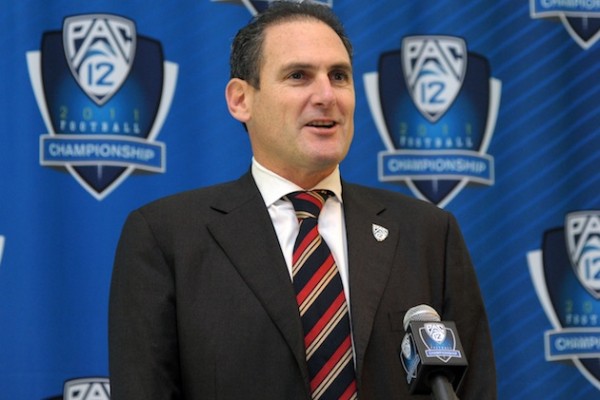
Four years as leader of the nation's premier D1 West Coast athletic conference has earned Scott huge financial bonuses on top of an already sizable base salary (U.S. Presswire).

Four years as leader of the nation’s premier D1 West Coast athletic conference has earned Scott huge financial bonuses on top of an already sizable base salary (U.S. Presswire).

Some folks are still split on the idea of a new college sports world order, which probably means they didn’t really react much at all to Monday’s Wall Street Journal report that Pac-12 head Larry Scott is, according to recent tax documents, the richest conference commissioner in all of college sports. In the four years since taking over his current post, Scott has amplified the Pac-12’s financial value with such groundbreaking developments as the Pac-12 Network, a $3 billion broadcast rights deal with ESPN and FOX, the additions of Colorado and Utah and, to tie everything together, a convenient and numerically-pertinent branding tweak – goodbye Pac-10, hello Pac-12. For those moves, along with his typical everyday conference commissioner work – whatever that actually entails (I think we’d all love to know) – Scott’s total take in 2011-12 rounded off somewhere north of $3 million. Not far off was Big Ten commissioner Jim Delany, who took home $2.8 million that same year. SEC commish Mike Slive barely made half of Scott’s number, totaling $1.6 million.

Read the rest of this entry »

Morning Five: 05.21.13 Edition

Posted by nvr1983 on May 21st, 2013

morning5

  1. Kansas has made a rather rapid transition from a contender for the Big 12 title (just because they win it every year) to  an interesting potential Final Four team. The obvious big move was the addition of Andrew Wiggins last week, but yesterday’s addition of Tarik Black as he announced his transfer from Memphis to Kansas could make the Jayhawks a more formidable team in March. The biggest part of the transfer is that Black will be able to play next year for what is expected to be Wiggins’ only year in Lawrence. Although Black’s numbers last year–8.1 points and 4.8 rebounds per game coming off the bench–will not blow anybody away, but he was one of the most coveted available transfers because there are very few players of his size with his numbers that are looking to transfer. The big question for Black and the Jayhawks is whether Black can regain the form that he had early in his career or if he will continue the downward trend his college career has had recently.
  2. One of the interesting aspects of conference realignment is how players are able to transfer between schools that used to be considered conference rivals. One such case is that of Deuce Bello, who will be transferring from Baylor to Missouri in a move that was made significantly easier with the Tigers move to the SEC. Bello has been an Internet sensation since high school thanks to his ridiculous dunks, but his on-court production has been meager at best as averaged just 2.4 points last season as a sophomore. Several writers have speculated that the change in scenery may bring out Bello’s potential, but we are not quite sure that athleticism necessarily translates into potential.
  3. Speaking of conference realignment, it may significantly affect the earning power of many conference commissioners, but at least for now Pac-12 commissioner Larry Scott appears to come out on top in terms of compensation. Thanks to a generous compensation package that included a $1,376,000 bonus for the 2011-12 year, Scott’s total compensation exceeded $3 million narrowly beating out Big Ten commissioner Jim Delaney and nearly doubling SEC commissioner Mike Silve. This payout preceeds the basketball officiating scandal, which probably will not affect Scott’s salary although it oculd theoretically affect his job down the road. It will be interesting to see how conference realignment affects the salaries over the next few years.
  4. Isaiah Canaan might be headed to the NBA (hopefully), but Murray State appears to have found his replacement in Zay Jackson, who was released from jail in April and allowed to return to the team. Jackson was kicked off the team following his ridiculous hit-and-run incident in September and sentenced to 49 days in jail before being released in April. While we understand the idea of giving a player a second chance, but in Jackson’s case we have our reservations so we will be interested in hearing what Murray State has to say about the situation.
  5. It seems like NBA Draft combine numbers used to be a lot more interesting when top prospects participated, but the numbers from this year are still interesting. As the article mentions these numbers are not considered nearly as valuable among NBA teams as the comparable numbers are for NFL teams. The biggest surprises to us were Shane Larkin and Cody Zeller even though we both knew they were athletic. We just didn’t realize how athletic they were especially Zeller who was competing against everybody else without factoring in his size. If you are looking for a good way to kill some time, we suggest taking a look at the DraftExpress historical database and see how some notable recent prospects stack up.

Ben McLemore Wants to Talk About Third Party Allegations: Where Does This Go Next?

Posted by Chris Johnson on May 20th, 2013

Chris Johnson is an RTC Columnist. He can be reached @ChrisDJohnsonn

Last time Ben McLemore’s name whirled its way into the national sports consciousness, it was for entirely undesirable reasons. We weren’t talking about McLemore’s immense redshirt freshman season, or his sweet shooting stroke and rising NBA draft stock. We were talking about the NCAA, and the possibility of McLemore leaving Kansas in a scurrilous amateurism-violating lurch after USA Today’s Eric Prisbell brought to light comments from the former Kansas star’s AAU coach detailing his alleged acceptance of money and travel benefits from a purported agent. A web of important questions were raised: did McLemore take impermissible benefits? Did he have even the slightest inkling his AAU coach, Darius Cobb, was receiving money and free trips to Los Angeles behind his back? And if he did, what were the punitive repercussions for Kansas’s proud basketball program? Was the NCAA’s biteless enforcement mechanism unequipped to tackle a situation like this? Would McLemore eventually give his side of the story? Could he even stomach the idea his former AAU coach and friend would take a potentially damning impermissible benefits case to the most widely-circulated newspaper in the country?

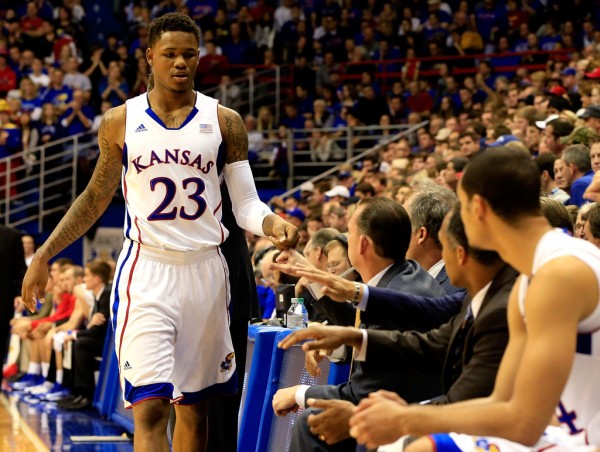
More clarity on Cobb and Blackstock's malfeasance could be on the way if McLemore speaks with the NCAA (Getty Images).

More clarity on Cobb and Blackstock’s malfeasance could be on the way if McLemore speaks with the NCAA (Getty Images).

Some of those questions were answered last Thursday at the NBA Draft combine in Chicago, where Sports Illustrated’s Seth Davis got McLemore on the record. McLemore didn’t mince words – the allegations cited in Prisbell’s report are, true or not, completely over his head. “I didn’t see no money going around. My mom hasn’t seen no money going around. We don’t know nothing about it,” McLemore told Davis. “So it was kind of new to me.”

Read the rest of this entry »

Morning Five: 05.20.13 Edition

Posted by nvr1983 on May 20th, 2013

morning5

  1. It looks like Mike Krzyzewski might not be done adding championships to his impressive resume and we are not talking about Duke. After insisting that he was done coaching the national team it appears that Krzyzewski is now  considering a return to Team USA. With the 2014 World Championships in Madrid just around the corner the Team USA brass will need to start assembling a team (around LeBron) fairly soon and the logical first step would be getting a coach who the players would decide to play for. With his success on both the college and international level as well as his ability to get along with several key players Krzyzewski would appear to be the obvious choice. Now that Krzyzewski is apparently pointing toward the next cycle of international play it seems reasonable to expect him to stay at Duke until that period is complete.
  2. With how Duke was saved  avoided any potential NCAA sanctions as the result of the Lance Thomas jewelry controversy when both Thomas and the jeweler refused to talk with the NCAA we are a little surprised that Ben McLemore has come out and said that he would talk with the NCAA about allegations by his AAU coach than a runner had paid the coach $10,000 to steer McLemore to certain agents. This is not to necessarily say that McLemore had anything to do with it, have any knowledge of it, or that Kansas could be implicated in any way. In fact, based on what we have heard we doubt that any of those are true, but we do not see what McLemore or Kansas have to directly gain by having McLemore talk although as it stands the NCAA could penalize Kansas because the payment would have made McLemore ineligible so perhaps McLemore thinks he could protect Kansas by clearing his name by talking to the NCAA.
  3. After several months of bickering about the terms of his contract buyout Steve Alford and New Mexico have agreed in principle to terms with Alford paying $300,000 in cash and forgoing $325,000 in bonuses that Alford would have been set to receive. For their part UCLA raised some objection to the e-mail release particularly the figure of $625,000 being used since Alford had already agreed to forgo the bonus money. In reality it appears that Alford is set to pay $300,000 instead of the $1 million the school was seeking and the $200,00 that Alford intiailly offered to pay them. As is often the case both sides will try to claim victory, but in reality the best thing may be for two sides to reach a deal before this thing gets any more complicated.
  4. Kansas State fans are going to have a completely different roster next season having lost three players to graduation and three players to transfer, but they are bringing in some new talent including five recruits and now a pair of transfers. The latest addition is Brandon Bolden, who is transferring from Georgetown to Kansas State. Bolden only played in four games as a freshman so we would not expect him to contribute immediately in Manhattan, but there are not many 6’10” centers floating around with three years of eligibility remaining so it could be a productive pick-up in the long run for the Wildcats. So although next season might end up being a rough transition year for Kansas State they should be rebounding relatively soon.
  5. Lipscomb, the team best known for going 12-18, but managing to beat Florida Gulf Coast twice last season, named Casey Alexander as its new head coach on Saturday to replaces Scott Sanderson, who was 222-201 in 14 seasons, but saw his team’s play drop off significantly culminating in last season’s 12-18 mark. Perhaps the most interesting aspect of the hire is that Alexander left Stetson, which finished 11-7 in the Atlantic Sun, to take over at Lipscomb, which finished at 7-11 in the Atlantic Sun. We have no idea how well-financed those two athletic departments are, but we would expect that Lipscomb pays quite a bit more for Alexander to take a step down like that.

Morning Five: 05.17.13 Edition

Posted by nvr1983 on May 17th, 2013

morning5

  1. It appears that Eddie Jordan never did directly claim to be a Rutgers graduate although his methods of saying so may be interpreted as being deceptive. Yesterday, CBS released the biography that Jordan had provided the school as part of his application. It does “absolve” Jordan of a majority of the blame and does point out that even if Jordan is not a college graduate he understands semantics well enough to utilize the phrase “alma mater” to his advantage when applying for a job there. The bigger question is why Rutgers a school with access to its own records did not bother checking into the statement a little more closely.
  2. One of the most painful aspects of conference realignment (outside of having to reorganize our microsites) was the loss of traditional rivalries due to heavier conference schedules. One of the bigger non-conference rivalries that appeared to be on the chopping block was Memphis and Tennessee. Now it appears that fans of those two schools may be getting an early Christmas present as the schools appear to be on the verge of continuing their series. There are still several issues to work out before the deal is finalized, but moves like this help restore our faith in the idea that schools are about more than just making money.
  3. One of the many issues that people have been advocating for reform at the NCAA level is the idea of multi-year scholarships rather than the one-year renewable scholarships that can be pulled by schools without any penalty to the school. The latest such example of the downside of this appears to be former St. Louis freshman Jared Drew who after redshirting his freshman season was told by the coaching staff that his scholarship would not be renewed as he did not fit with the direction they were going in. We have no idea if there were other issues going on in the background (academic or disciplinary) that may have led the school to make that decision, but with nothing stated or public it appears that the new coaching staff simply felt that they could get better players. Perhaps some news will come out explaining another reason for why Drew was let go, but at this time it makes St. Louis look bad and probably will not help them on the recruiting trail.
  4. Even though gambling is still illegal in much of the country so this only applies to a very small part of the country and for the rest of the country it can just be viewed as an interesting academic exercise in statistics Andy Glockner took a look at some of the post-Andrew Wiggins decision championship odds and found some intriguing values. The odds on the teams listed all appear to be pretty good values, but the one that sticks out the most to us would definitely be Louisville. For a defending champion to be returning that many key pieces and have one of the best college basketball coaches ever and still have 12-1 odds to win the title seems off even if their in-state rival has what many media members are hyping up as the greatest recruiting class ever.
  5. Dick Vitale may be a controversial figure for some, but there are two things about him that nobody can argue about–his love of college basketball and his passion for raising money for cancer awareness. With his 8th Annual Dick Vitale Gala he is expected to cross the $10 million mark in funds raised for cancer research. As you would expect the guest list for the event is pretty impressive and is projected to break last year’s record of $1.8 million raised. We wish Dick the best in his work in raising money for research, but more importantly we wish anybody affected by this devastating condition(s) the best in what they are going through.

The Big 12/SEC Challenge Needs to Rethink Its Scheduling Principles

Posted by Chris Johnson on May 16th, 2013

Chris Johnson is an RTC Columnist. He can be reached @ChrisDJohnsonn.

The beauty of early non-conference tournaments exists in their compressed schedules. Teams with different capabilities and ceilings typically meet up in a tropical locale, stage a raft of competitive games in a compacted two or three-day window, a champion is crowned and, fin. That is how non-conference events should be: quick, clean, blurringly thrilling, a drive-by snapshot of prospective NCAA Tournament match-ups, a winter sampling of the sport’s crowning postseason event. Think Feast Week, or the Champions Classic, or Maui. The accumulation of quality teams and coaches and players gives each event its own unique brand of entertainment value each and every year, but the timeless temporal convenience of rapid-fire completion is what we value most. It calls upon the spirit of March in November, with more equalized match-ups, less auto-birth low-majors and coaches in ridiculous Hawaiian floral shirts. These cute little early-season gauntlets don’t need fixing. Make more of them. Invite better teams.

Two weak leagues and a scattered set of games could push this season's Big 12-SEC challenge into the abyss of early-season tournaments.

Two weak leagues and a scattered set of games could push this season’s Big 12/SEC Challenge into the abyss of early-season tournaments.

Whatever you do, non-conference scheduling lords, do not take any cues from the new Big 12/SEC Challenge. The leagues announced their 2013 lineup Tuesday, and at least two of the match-ups belong in the apex of this season’s partially uncovered non-conference slate. On Friday, December 6, Kentucky and its intergalactic force of indomitable freshmen will take on Baylor, who returns one of the more athletic and imposing frontcourts (Isaiah Austin, Cory Jefferson, Ricardo Gathers) in the country. Four days later, Kansas will take its Andrew Wiggins-equipped squad (an aside: You have no idea how great it feels not to have to include the standard “we don’t know where he’s going” disclaimer every time I type Wiggins’ name. Wiggins, Kansas, got it.) to Gainesville for a meeting with five-star freshmen Kasey Hill, Chris Walker and a respectable supporting group. Those are two excellent December match-ups, spaced just four days apart, stuffed with freshmen intrigue and NBA lottery talent and future Hall of Fame coaches. They are the kinds of games everyone lives for in college basketball’s fluff-filled non-conference season.

Read the rest of this entry »