Here we go… headfirst into another season heralded by our 2013-14 edition of Thirty Reasons We Love College Basketball, our annual compendium of YouTube clips from the previous season completely guaranteed to make you wish games were starting tonight. For the next three weeks, you’ll get two hits of excitement each weekday. We’ve captured what we believe were the most compelling moments from last season, some of which will bring back goosebumps and others of which will leave you shaking your head in astonishment. To see the entire released series so far, click here.
#19 – Where Loved, Hated, But Never Ignored Happens.
This is not the first time Dana Altman, Oregon’s fourth-year head coach, has used a one-year transfer to improve the Ducks’ roster. It happened in 2011-12, when guard Devoe Joseph and forward Olu Ashaolu, formerly of Minnesota and Louisiana Tech, respectively, combined to average 27 points and nine rebounds to help lead the Ducks to a 24-10 record. It happened last season, too, when former Rice big man Arsalan Kazemi gave Oregon a tough frontcourt complement to its deep backcourt while leading the nation in defensive rebounding percentage (29.0%). Using one-year transfers on a yearly basis might not seem like a viable long-term strategy, but it doesn’t have to be. At some point, Altman ostensibly hopes, Oregon will have won enough games and wooed enough elite high school basketball players with its glimmering facilities and Nike-sponsored “Tall Firs” court, that it won’t need to tap the transfer market to repopulate its roster with top-end talent. It can just recruit those players straight out of high school, because Oregon will be a destination program, because prospects will value the campus in Eugene as harboring one of the top programs in the country. Altman is pushing Oregon in that direction, but the Ducks aren’t there yet. So in the meantime, the former Creighton coach will continue to welcome one-year transfers with open arms.
The addition of Young makes Oregon one of the top contenders in the Pac 12 (AP).
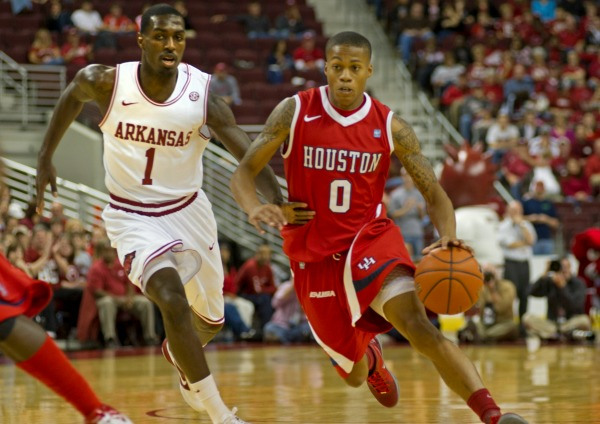
The latest additions are former UNLV (and UCLA) forward and Portland native Mike Moser, former Detroit guard Jason Calliste and former Houston guard Joseph Young. All three should play a big role in helping Oregon push Arizona at the top of the Pac-12 this season, and two of them, Calliste and Moser, knew they’d be able to play for the Ducks right away this season thanks to the NCAA’s graduate transfer clause. Young was a different story; he needed the NCAA to grant a hardship waiver – based on the claim that his father, Michael Young, a member of Houston’s great Phi Slama Jama teams from the early-1980s, was reassigned from his position as director of basketball operations with the Cougars, a decision that prompted his departure from the program. Joseph argued that his father’s exit was a “hardship” sufficient to forgo the one-year holdover penalty most undergraduate transfers face – in order to play for the Ducks this season. On Friday, two days after the governing body settled one of the most baffling transfer waiver cases in recent memory, the NCAA declared Young eligible for the upcoming season. In 32 games for Houston last year, Young averaged 18.0 points, 3.5 rebounds and 2.5 assists per game while shooting 42 percent from three, 87.5 percent from the free throw line, and posting a 124.1 offensive rating, which ranked one spot outside the top-25 such marks in the country. He joins what was – already without Young – one of the best backcourts in the country, as point guard Dominic Artis, wing Damyeon Dotson and Calliste form a deep and athletic group. Young and Calliste’s additions also address one of the Ducks’ main flaws from last season: three-point shooting. Oregon shot just 33.3 percent from deep, a number Altman’s two backcourt transfers – and possibly Moser, if he can shoot more like he did two years ago (33.1 percent) than last season (26.7) – should improve.
There’s a reason that no college basketball team has finished a season undefeated since Indiana in 1976. Throughout an entire season, the daily grind exposes flaws. Some are correctable while others prove to be a lasting problem. At the beginning of each season, each of the roughly 350 teams in Division I has something to address. Let’s check out the top five teams from the preseason ESPN/USA Today poll and see which flaws will cost certain teams some non-conference games if they don’t get their issues corrected.
Chane Behanan’s suspension is one of the bigger stories of the top-tier teams this season. (AP)
We start with #5 Arizona and will work our way to the top. The Wildcats don’t seem to have many flaws on paper. With returnees like Nick Johnson, Kaleb Tarczewski and Brandon Ashley joining a crazy-talented recruiting class of Aaron Gordon, Rondae Hollis-Jefferson and Duquesne transfer T.J. McConnell, there will be plenty of talent in Tucson. But, with Solomon Hill (13.4 PPG, 5.3 RPG), Kevin Parrom (8.3 PPG, 4.9 RPG, 48.3 percent FG) and Mark Lyons (team-leading 15.6 PPG) all gone, the Wildcats will need a new offensive leader. All that scoring would have helped when the Wildcats willplay Michigan in Ann Arbor. Gordon is a leaper with decent offensive game, but therein lies the problem. Johnson will be the veteran leader, but he hasn’t shown a penchant for consistent scoring, finishing last season with only one 20-point game. So which Wildcat steps up and takes control when the pressure mounts on the road?
At #4, Duke welcomes back a number of veterans and an elite freshman class headlined by Jabari Parker. So their scoring will be there, even if Seth Curry, Mason Plumlee and Ryan Kelly (47.5 PPG last season combined) have exhausted their eligibility. But looking past the inevitable replacement of the scorers, rebounding will be something the Blue Devils will have to improve upon or suffer with. The leading returning rebounder is Quinn Cook’s 3.9 boards per game. A number of teams on the Blue Devils’ non-conference schedule could take advantage of that, particularly Kansas, with Memphis transfer Tarik Black and Joel Embiid patrolling the post for the Jayhawks.
Here we go… headfirst into another season heralded by our 2013-14 edition of Thirty Reasons We Love College Basketball, our annual compendium of YouTube clips from the previous season completely guaranteed to make you wish games were starting tonight. For the next three weeks, you’ll get two hits of excitement each weekday. We’ve captured what we believe were the most compelling moments from last season, some of which will bring back goosebumps and others of which will leave you shaking your head in astonishment. To see the entire released series so far, click here.
With just over a week remaining before bona fide games tip off, the NCAA is releasing decisions on player eligibility with gusto. Last week it was Georgetown receiving the good (and astonishing) news that former UCLA center Josh Smith would be eligible to play immediately; Oregon got similar news on Friday when the NCAA cleared Houston transfer Joseph Young to play immediately for Dana Altman as well. Young is an exceptional scoring guard who averaged 18.0 PPG last season and brings to Eugene the 26th-best offensive rating in college basketball (124.1 last season). In a now-loaded backcourt featuring Dominic Artis, Damyean Dotson and Young to go along with transfer Mike Moser in the frontcourt, the Ducks are suddenly looking like one of the top two or three teams in the Pac-12 again. Interestingly, transfers Young and Smith will face each other in their first game of the season between the Ducks and Hoyas in South Korea on November 8.
Just a few days after Tim Floyd revealed that Kentucky and UTEP were exploring a 2016 game to celebrate the 50th anniversary of their Brown vs. Board of Education national championship match-up, word came out that John Calipari’s program is seeking to spearhead another Champions Classic-style event involving the nation’s top basketball schools. According to ESPN.com‘s Andy Katz, Kentucky, UCLA, North Carolina and Ohio State are negotiating a three-year event that would mimic the Champions Classic with each team rotating through the others in alternate years. The unnamed event would begin in 2014-15 and would move between Brooklyn, Indianapolis and Las Vegas during the first three-year window. When the Champions Classic was first developed, we wondered if some of the other all-time great basketball schools such as UNC and UCLA would ever have a chance to participate; with this new event now in the pipeline, we’ll just about have it covered. Serious question, though — with a combined 24 national titles among this group, shouldn’t the new event supersede the other for rights to the name “Champions Classic?” And what happened to Indiana (five titles compared with Ohio State’s one)?
The Miami/Nevin Shapiro scandal has come and gone with Frank Haith getting off relatively easy (a five-game suspension) and the Hurricane basketball program moving forward in decent shape. But, as the Miami Herald reports, former assistant coach Jorge Fernandez’s professional life has been destroyed as a result of admitted violations relating to providing free airline tickets to players and later lying to the NCAA about it. The article correctly points out that it is often the low-level assistants in these scandals who suffer the brunt of the punishment, as Fernandez notes that a two-year ‘show cause’ penalty has shut him out of the coaching profession and caused the matter of providing basic needs for his family very difficult. Some coaches around the country have rallied around him throughout his ordeal, but many others have not, and it’s uncertain if or where he will be able to land after his penalty has ended. It’s another one of those stories that makes people shrug their shoulders at the stark inequities built into the NCAA’s byzantine system of enforcement and punishment.
It got lost in the late week news cycle, but some big news relating to the Ed O’Bannon case against the NCAA was released on Friday afternoon. Federal district judge Claudia Wilken denied the NCAA’s motion for dismissal, paving the way for O’Bannon and the other plantiffs to move forward and eventually receive a trial on the merits of the case. The primary issue here was the relevance of language in a 1984 case from former Supreme Court justice John Paul Stevens that, while not part of the holding of that lawsuit, has been relied upon by the NCAA to retain its amateur model: “In order to preserve the character and quality of the [NCAA’s] ‘product,’ athletes must not be paid, must be required to attend class, and the like.” Wilken rejected the notion that Stevens’ language represented any particular binding precedent, and in so doing, has removed a major procedural barrier assuring that the plaintiffs will get their day in court. Wilken will next rule on class certification of the case, potentially allowing thousands more plaintiffs to sue the NCAA and correspondingly raising their potential liability well into the billions of dollars.
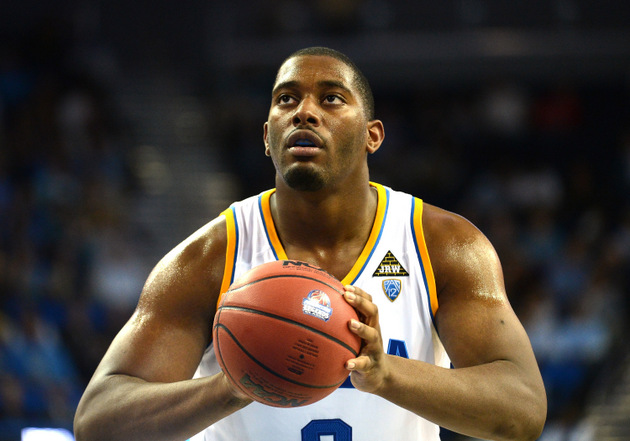
When news broke Wednesday of Josh Smith’s accepted waiver and immediate eligibility for Georgetown, the bulk of the media reaction constituted pure shock. After all, without any known medical issues or hardship concerns facilitating the transfer, there was no indication that Smith would recoup two full seasons of eligibility after playing in six games as a junior at UCLA. The decision marks the latest puzzling chapter in the transfer waiver saga that unfolded over the offseason, and has left nearly everyone (outside the NCAA offices – or maybe not?) as confused as ever about the process – including CBSSports.com’s Gary Parrish. The folks at Georgetown may or may not be surprised by the news as well, but they are surely excited to have their big man ready for the season opener. As for the rest of us, the state of confusion we currently find ourselves in is understandable, but perhaps it’s time to give the NCAA the benefit of the doubt. They may have finally figured out that more leniency with the transfer policy benefits both the kids and the sport. Increased transparency from the governing body will be necessary at some point, but for now, I’ll take Smith’s immediate eligibility as a sign of changing times.
Thanks To A Generous NCAA Ruling, Josh Smith Will Be On The Court When Georgetown Kicks Off Their Season In Seoul, South Korea On Nov. 8 (Harry How/Getty Images)
When the NCAA overturned its own decision to deny Kerwin Okoro’s waiver request a month ago, we had to know then that the organization was finally beginning to hear the vitriol of fans and media surrounding the transfer issue. The Smith ruling may be a more subtle version of that phenomenon. Jay Bilas tweeted that the Smith ruling was “not objectionable,” but that what is objectionable is that “the NCAA rejects so many others, with no coherent policy.” Agreed, and while we have no coherent policy in place, the Smith decision certainly feels like the waving of the white flag. If the NCAA is going to set such a clear precedent with a case like Smith’s – after all the discussion on the waiver issue this offseason – we have to assume enough self-awareness on the part of the NCAA to presume that they are going to be taking a far softer approach to the issue. We can hope for a definitive public stance on the issue before next offseason, but the blatant nature of this case should mean we are headed for fewer denied waiver requests, and eventually, perhaps none.
Here we go… headfirst into another season heralded by our 2013-14 edition of Thirty Reasons We Love College Basketball, our annual compendium of YouTube clips from the previous season completely guaranteed to make you wish games were starting tonight. For the next three weeks, you’ll get two hits of excitement each weekday. We’ve captured what we believe were the most compelling moments from last season, some of which will bring back goosebumps and others of which will leave you shaking your head in astonishment. To see the entire released series so far, click here.
Seven Sweet Scoops is a weekly column by Sean Moran, the RTC recruiting guru. Once a week he will bring you seven notes from the high-stakes world of college basketball recruiting. We also encourage you to check out his contributions at The Intentional Foul, dedicated to recruiting coverage and analysis. You can also follow Sean at his Twitter account @Seanmohoops for up-to-date news from the high school and college hoops scene. If you have any suggestions as to areas we are missing or different things you would like to see, please let us know at rushthecourt@yahoo.com.
Where will Okafor and Jones be playing together next year?
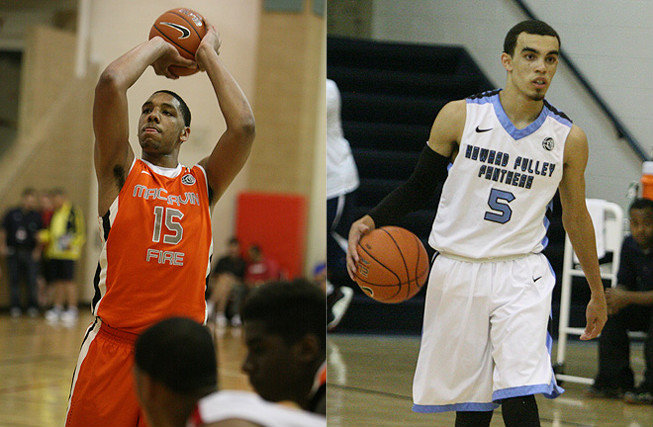
The much anticipated weekend has arrived for Coach K and Duke. The top-ranked center and point guard in the class of 2014 are taking their official visits to Durham, North Carolina, today. Package deals in college basketball are often talked about but rarely come to fruition, especially one involving such star power. Jahlil Okafor, a 6’11” center out of Chicago, is the top ranked player in the country, and his buddy Tyus Jones, a 6’1” point guard out of Apple Valley, Minnesota, is the fourth-ranked player in the country. Both seniors have indicated that they will attend college together and have whittled their list of potential suitors down to three. Last week Kansas played host to the duo, but this week Duke gets to take its crack at selling the duo on moving east. With Okafor’s size and strength he is almost unguardable in the low post and would provide Duke with its best low post presence since the Carlos Boozer days. Jones would provide Duke with its best point guard since Jason Williams and he has long been discussed as the overall best point guard in high school basketball dating back to his sophomore year. Along with these two players, five-star small forward Justise Winslow (#9 overall, #3 SF) from the class of 2014 will also make the trip. His recruitment was discussed last week. All in all, it’s a huge weekend in Durham.
2. Cliff Alexander Makes His Last Official Visit
Cliff Alexander, a five-star power forward from Chicago, is staying in-state this weekend and making the two-hour drive south down to Champaign for his last official visit to Illinois. Alexander is a 6’8” manchild who is currently the No. 5 prospect in the class of 2014 and eerily reminiscent of L.A. Clipper DeAndre Jordan. Over the past few weeks Alexander and his family have taken in the sights and sounds of Midnight Madness at Memphis and Kansas. A decision is expected in November with Illinois, DePaul, Arizona, Kansas, Memphis, and Michigan State all receiving interest. Expect John Groce and the Illinois coaching staff to pull out all the stops this weekend for Alexander. While the Illini already have a strong recruiting class in 2014 with four-star power forward LeRon Black (#46 overall, #9 PF) and four-star point guard Quentin Snider (#31 overall, #7 PG) committed, Alexander would be the crown jewel. He can run the floor, block shots and dunks everything around the basket. His offensive skills outside the paint are rapidly improving and he put himself in the conversation for the number one player in the country. Not only would Groce get a player with future NBA talent, he would also lay claim to Illinois becoming a major player for all that Chicago talent.
Here we go… headfirst into another season heralded by our 2013-14 edition of Thirty Reasons We Love College Basketball, our annual compendium of YouTube clips from the previous season completely guaranteed to make you wish games were starting tonight. For the next three weeks, you’ll get two hits of excitement each weekday. We’ve captured what we believe were the most compelling moments from last season, some of which will bring back goosebumps and others of which will leave you shaking your head in astonishment. To see the entire released series so far, click here.
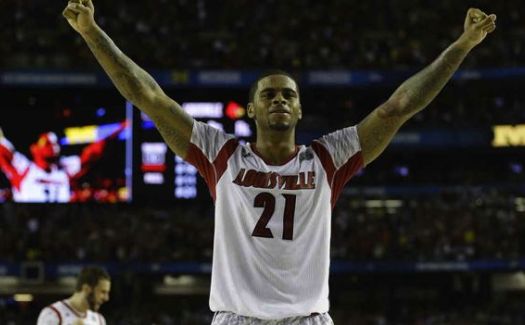
Just one week after saying that Chane Behanan was no longer on the Louisville team and would suspended for a “long time”, Rick Pitino reversed course saying that Behanan should be back “in a short period of time”. The supposed impetus for Pitino’s change of heart is that Behanan “told the truth” regarding whatever he did to get himself kicked off the team a week ago. Like many we expected Behanan to return to the team eventually and most likely before they played Kentucky on December 28 and we don’t know what “a short period of time” means, but the sudden aboutface by Pitino is pretty stunning even by his standards with the first game of the season still a few weeks away.
Like basically everybody else we are baffled by the NCAA’s decision to grant Josh Smith a waiver to play at Georgetown immediately. Surprisingly that might not even be the most confusing transfer case that we have heard of recently as Old Dominion reportedly received a decision from the NCAA regarding a transfer waiver for Trey Freeman, who left Campbell to be closer to his mother, several weeks ago, but is not disclosing the NCAA’s decision. Now we all know that Old Dominion has its issues with the NCAA and the way that it handles eligibility decisions (see Donte Hill), but we have no idea why the school would not disclose the NCAA’s decision one way or the other. If the story that is being published about Freeman’s reasons for transferring are correct, we would be shocked if the NCAA actually turned down Freeman’s waiver given the way that they have been handing out waivers these days. The decision is of particular importance to Old Dominion as Freeman would like be the team’s best player after averaging 14.4 points and 5.8 assists per game last season.
Khadeem Lattin‘s announcement that he was committing to play for Oklahoma might move the needle in Norman and in recruiting circles. To be sure, the addition of a 4-star recruit is a significant one for almost any program. However, to us the bigger topic of discussion is Lattin’s background as he decided to spend his sophomore year in Spain making him the first elite recruit to spend a high school season playing in Europe outside of the professional ranks before returning to Houston to be home-schooled. As you would expect, Lattin’s decision to go overseas was controversial and he likely slipped in the recruiting rankings temporarily as a result, but we will be interested to see how his time in Europe translates to the college game.
Yesterday, the NCAA released the most recent recommendations for proposed rule changes during the 2013-14 season. The headline stories will be about the change in when colleges can begin actively recruiting, but since it doesn’t pertain to basketball or football it probably will not resonate (particularly not here). The one thing that does jump out at us is the proposal to allow student-athletes to be given the highest meal plan available at a school. Now that may seem like a mundane thing especially to our older readers, but with the way that many schools have meal plans that provide money for use at off-campus restaurants as part of their meal plans it seems to suggest that this could be a step towards the cost of attendance measures that many have been advocating for the past few years.
Earlier this week we discussed how Ken Pomeroy was tweaking his rating system to try to make it have better predictive outcomes. It turns out that he is not the only member of the advanced metrics community who has been adjusting his formulas as Dan Hanner announced yesterday morning that he had adjusted his lineup-based prediction model for the upcoming season. The details regarding the adjustments are fairly complex, but they essentially boil down to the following things: simulating a season 10,000 times to give best-case, median-case, and worst-case scenario; predicting variance based on player background; including more player evaluation data (including that of JUCO players and non-top 100 high school recruits; and a few other minor tweaks. We will be interested to see how Hanner’s projections pan out given the unpredictability of projection how many of the incoming recruits will do in their new environments.