

Weekly Pac-5: Freshman Efficiency

Posted by RJ Abeytia on January 9th, 2017

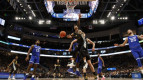
It’s very much a Year of the Freshman in college basketball and the Pac-12 has followed suit. As we now find ourselves through two weeks of conference play, it’s a good time to check in on the headlining freshmen in the Conference of Champions. Washington’s Markelle Fultz is the Pac-12’s leading scorer and the front-runner as the top pick in the 2017 NBA Draft, but there are a number of other high-scoring freshmen in the league. In fact, we could probably just list the top five scorers in the Pac, slap the top five freshmen label on them, and call it a day. Here’s what the list would look like if we did just that.
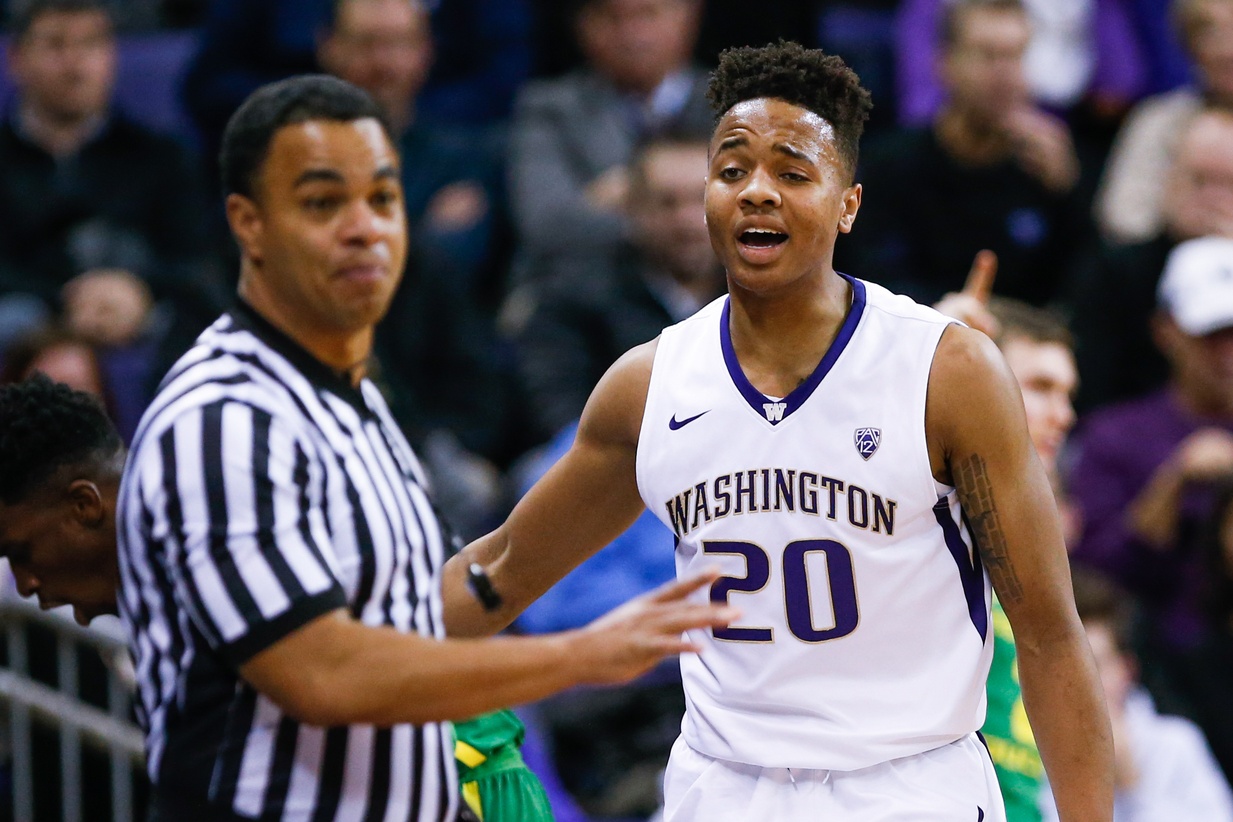
Markelle Fultz is the Presumptive #1 Pick in the 2017 NBA Draft (USA Today Images)

  1. Markelle Fultz, Washington – 22.1 PPG
  2. TJ Leaf, UCLA – 17.4 PPG
  3. Lauri Markannen, Arizona – 15.9 PPG
  4. Charlie Moore, California – 15.2 PPG
  5. Lonzo Ball, UCLA – 14.7 PPG

Pretty good, right?  Those are your top five freshmen by scoring average. They’ve all played enough minutes for us to trust in the validity of their averages, but what happens when you rank these five players based on offensive efficiency?  Here’s where things start to get interesting.

Player ORtg
TJ Leaf, UCLA 134.3
Lauri Markannen, Arizona 132.3
Lonzo Ball, UCLA 131.0
Markelle Fultz, Washington 119.4
Rawle Alkins, Arizona 107.7


Well then.  First, we see that Markannen, whose shooting splits are insane, vaults to the top of the group. California’s Moore gets voted off the island altogether; Arizona’s Rawle Alkins jumps into the picture; and Fultz slides down to fourth in our rankings. This is why efficiency is important to consider when judging players. Does Offensive Rating make Markannen a better player than the others? No, but it does clearly identify him as the most
efficient offensive player regardless of draft potential. That’s all well and good, but what about defense? For that we turn to defensive efficiency, an admittedly noisy statistic compared with individual Offensive Rating, but still a useful and informative metric. Limited strictly to defense, here’s how the top five freshmen scorers in the conference.
Read the rest of this entry »

Share this story

ACC Weekend Review: 01.09.17 Edition

Posted by Brad Jenkins (@bradjenk) on January 9th, 2017

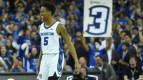
After one of the craziest opening weekends in ACC history, things calmed down considerably in the second weekend of conference play. In fact, all seven ACC games were won by the favored squad, and only one of those contests was decided by fewer than 11 points. Even if the games weren’t all that scintillating this weekend, there were still a couple takeaways heading into this week. First, in an unanticipated surprise, the two remaining unbeaten schools in conference play are Florida State and Notre Dame — the Seminoles handled visiting Virginia Tech while the Irish rallied to defeat Clemson in South Bend. And then there’s the continued injury misfortunes for Duke — in the Blue Devils’ first game without head coach Mike Krzyzewski (back surgery), stalwart center Amile Jefferson suffered a first half foot injury and never returned. Early reports suggested that the team captain may miss substantial time, meaning even further interruption to a “dream season” that has been anything but smooth to this point. Here are the highlights from the weekend around the ACC.

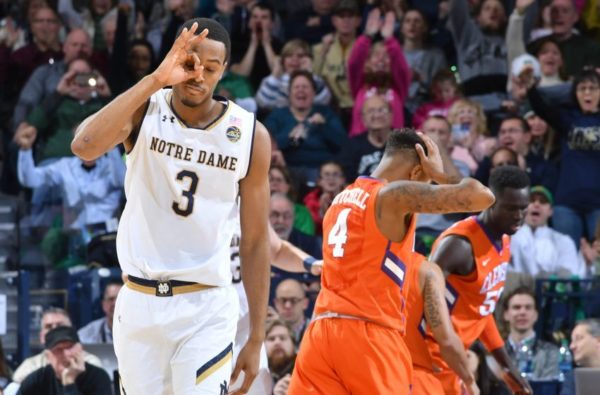
V.J. Beachem’s six three-pointers helped Notre Dame defeat Clemson and remain unbeaten in the ACC. (Photo: slapthesign.com)

  • Best Win I: Notre Dame trailed Clemson by seven points at halftime, but the Irish prevailed by five to move to 3-0 in league play. Senior forward V.J. Beachem led the way, making six threes en route to 22 points. Bonzie Colson pitched in with 13 points and 12 boards — his third straight double-double performance to open league action. Notre Dame now faces a very daunting part of its schedule — a stretch of five games in just 13 days, with the first three on the road — beginning with a trip to Miami (FL) this Thursday.

Read the rest of this entry »

Share this story

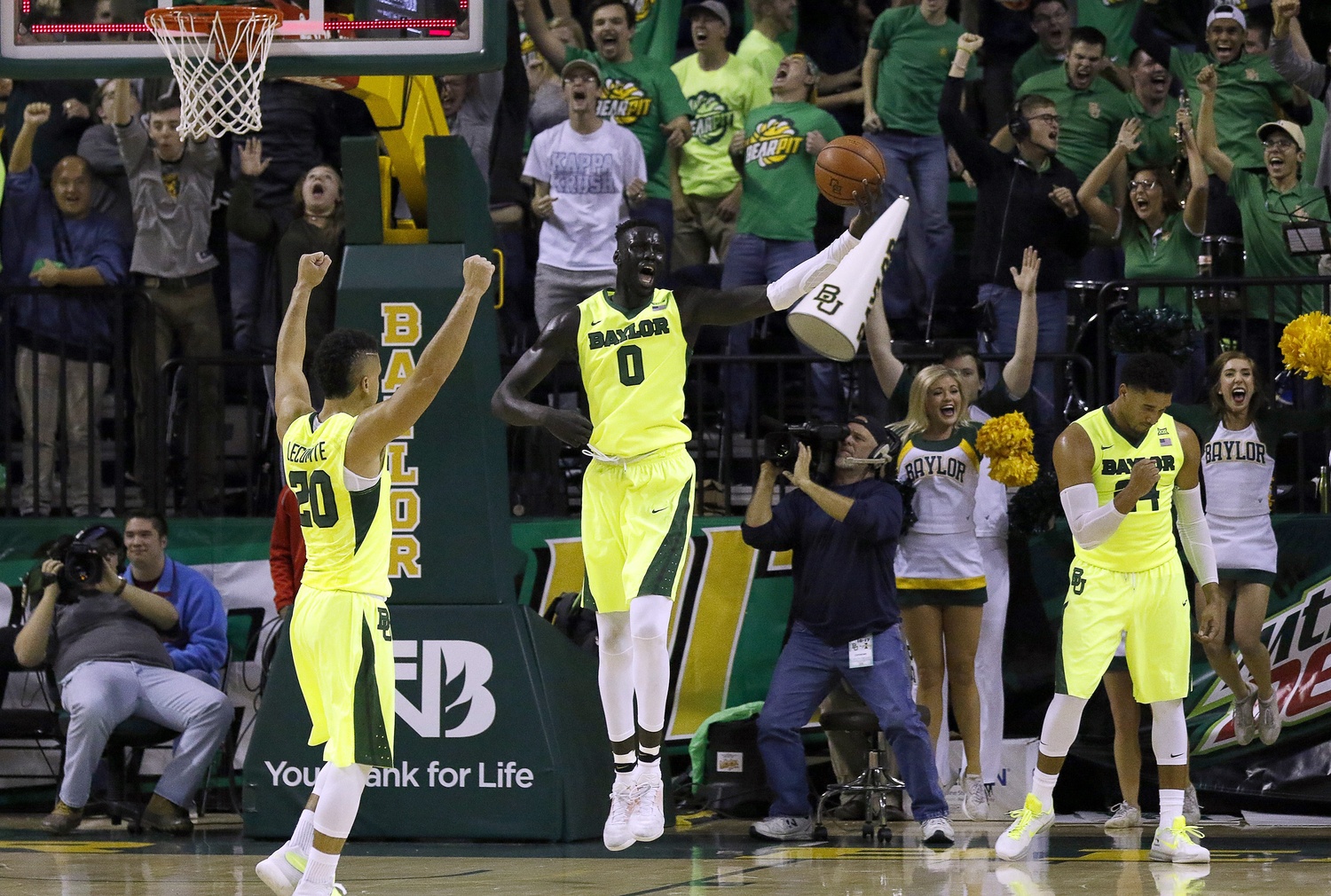
Baylor: The Team Nobody Saw Coming…

Posted by Justin Fedich on January 7th, 2017

It’s only January 7, but with Baylor going into tonight’s game against Oklahoma State as one of two remaining unbeaten teams in college basketball, many are wondering where this team came from. The Bears started the season with a grand total of zero votes in the AP preseason Top 25, but through 14 games against an excellent schedule, no opponent has been able to touch them. Under longtime head coach Scott Drew, Baylor has never made the Final Four but his teams have gotten close. During a three-year stretch from 2010-12, the Bears made two Elite Eights but had the misfortune of playing the eventual National Champion on both occasions (Duke – 2010; Kentucky 2012). This year, Baylor is better equipped to make its first Final Four in school history, but it’s not because expectations in Waco will be high. On the contrary, it’s because expectations are not high, which is exactly how Baylor has thrived to this point of the season.

Baylor is Off to One of Its Best Starts Ever (USA Today Images)

Baylor is Off to One of Its Best Starts Ever (USA Today Images)

Baylor had plenty of question marks coming into this season. Senior forward Johnathan Motley was a preseason All-Big 12 pick, but beyond that was mostly unknown. The most notable concern was how Miami transfer Manu Lecomte would fare in his first season with the Bears. The answer is so far, so good. Lecomte is leveraging his additional time in Drew’s lineup by averaging 5.1 assists per game, ranking among the nation’s top 60 in assist rate at 32.3 percent. As outstanding as the possible Big 12 Transfer of the Year has been, he hasn’t even been the most pleasant surprise on the team. Junior center Jo Lual-Acuil Jr. has gone from relative anonymity to averages of 11.0 points and 7.6 rebounds per game, pairing with Motley to create a formidable frontcourt that no team in the Big 12 — not even Kansas — wants to face. The starters have been exceptionally consistent to this point, and a bench of which little was expected continues to get better as the season rolls along. Sophomore wing Jake Lindsey contributed his first double-figure game of the season against Iowa State on Wednesday night.

Read the rest of this entry »

Share this story

Digging Through the Low Mids For Possible At-Large Bids

Posted by Shane McNichol on January 7th, 2017

The path to the NCAA Tournament for any mid-major starts out simply: Win the conference tournament. The alternative is to build an impressive non-conference resume and cross your fingers on Selection Sunday. Ask last year’s Saint Mary’s team that went 27-5 and was relegated to the NIT. As the Gaels learned a year ago, the Selection Committee places the bar exceptionally high and scheduling is a significant factor. A lackluster non-conference resume meant that St. Mary’s two regular season games against Gonzaga held great value (which it swept), but a pair of losses against an uninspiring Pepperdine squad sealed the Gaels’ fate. The exact recipe for an at-large bid can be hard to determine because the committee changes every year, but the following teams in traditional one-bid leagues could have a shot at an at-large bid if they falter in their conference tournaments.

Randy Bennett Found Out the Hard Way How Important Scheduling Is (USA Today Images)

Randy Bennett Found Out the Hard Way How Important Scheduling Is (USA Today Images)

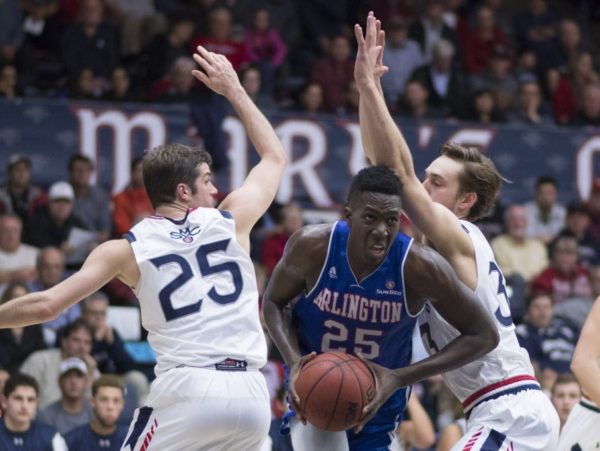
UT-Arlington

The Mavericks have three losses on the season, all of which came against respectable opponents in a span of five days on the road. Aside from that, no low-major can top their pair of excellent wins that came at Texas and St. Mary’s. UT Arlington holds a top-50 RPI, but recent history does not appear to be on its side. The Sun Belt has earned only one at-large bid in the last eight NCAA Tournaments, and that bid went to Middle Tennessee State in 2013 (which has since moved on to Conference USA — more on the Blue Raiders below). UT Arlington could at least make things interesting by running the table until the conference tournament semifinals, which would give it 30 wins prior to Selection Sunday. Read the rest of this entry »

Share this story

Freeze Frame: Kentucky’s Early Offense

Posted by Brian Joyce on January 6th, 2017

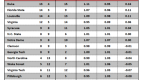
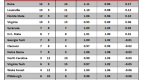
During this week’s television broadcast of the Kentucky-Texas A&M game, viewers could hear Wildcats’ head coach John Calipari yell “Go! Go! Go!” at the top of his lungs seemingly every time the Wildcats touched the ball. Calipari is simply exhorting his team to play to its strength, which, as you may have noticed, seems to be working. The Wildcats are currently the ninth-fastest team in college basketball (average possession length of 14.0 seconds), but what Calipari knows is that his team runs much better offense the faster it goes.

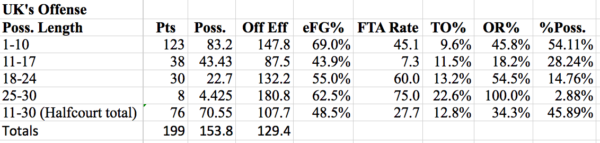
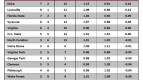
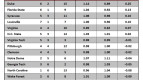
Kentucky’s early offense in SEC play.

As the above table shows, when Kentucky shoots the ball in the first 10 seconds of the shot clock, its offensive efficiency comes in at a blistering 147.8 points per 100 possessions (over the 153 total possessions I have charted during conference play). However, if the Wildcats’ offense runs past the 10-second mark on the shot clock — effectively dropping back into the half-court offense — it drops to an an offensive efficiency rating of 107.7; effective field goal percentage drops over 20 percentage points; turnover percentage increases; offensive rebounding percentage decreases; and, free throw trips drop. In other words, outcomes are a lot better for the Wildcats when they get a shot up within the first 10 seconds. In this edition of Freeze Frame, we analyze Kentucky’s offensive efficiency by possession length.

Read the rest of this entry »

Share this story

Weekly Pac-5: Rim Protection

Posted by Adam Butler on January 6th, 2017

Basketball, as we’ve discussed in previous Pac-5s, is a simple game. Score more than your opponent by playing better offense, defense or some sort of hybrid. In looking at the most effective ways to achieve this outcome, defensively speaking, rim protection is high. Let’s keep our opponent away from the shots that are most commonly and easily made: the layup and dunk. This key facet to the game is often attributed to the effort of big men — the lurking paint protectors threatening to put shots into the bleachers. And by that logic, we might consider rim protection quantifiable by a team’s propensity to block shots. It’s not wrong. Blocking shots is a tried and true means to protecting the rim. It also looks cool. But it’s not a comprehensive measure of rim protection. There’s also a team’s — or individual’s — ability to limit dribble penetration, force long jumpers, limit transition offense and so forth. Defense is a team effort and therefore to note that Oregon has the nation’s top block rate (20%) doesn’t necessarily mean they do the best job of protecting the rim (also of note: it doesn’t hurt the Ducks’ ability to limit layups and dunks).

Even Following A Lost Weekend By The Bay, The Ducks Are In Good NCAA Position (AP Photo/Chris Pietsch)

Defense is the name of the game for Oregon big man Chris Boucher, right. (AP Photo/Chris Pietsch)

In this week’s top-5, we’ll look at the Pac’s five best rim protecting teams. We’ll qualify this list by noting the five teams with the fewest total made shots at the rim. This does not take into account pace, unfortunately, which will dilute the total number of shot attempts against a defense. What I wanted to capture, however, was a team’s holistic approach to rim protection. By looking at the total number of made layups or dunks against those teams, we account for field goal defense and the propensity to limit overall shots (again, pace is a big component of this but also cannot be ignored as a strategy). A brief, contextualizing anecdote: Oregon owns the nation’s top block rate, yet teams still shoot 66 percent at the rim against them (fifth highest in the Pac-12) and allow the second highest percentage of shots at the rim. This perhaps suggests that Dana Altman’s team is content in allowing penetration to the rim, daring opponents to challenge Jordan Bell and Chris Boucher when they get there. The defensive risks then taken by Bell and Boucher could, perhaps, lead to drop off passes or putbacks, yielding a higher field goal percentage at the rim and consequently a slightly less effective rim defense. Here are the Pac-12’s five best rim protecting teams as measured by fewest layups and dunks allowed.

Team FGM at the rim Rim dFG%
1. California 109 54.5%
2. Arizona 124 56.6%
3. Utah 138 50.6%
4. Oregon 145 49.4%
5. UCLA 146 51.3%

In effect, each team exacts a different strategy to protect its rim. Be it through the collective or with a particularly lengthy big man, it remains a critical facet of the game.

Share this story

Oregon’s Tyler Dorsey Appears Poised to Break Out… Again

Posted by Mike Lemaire on January 5th, 2017

Last night in Washington, a 6’4” combo guard showed off a dizzying array of skills, set Twitter ablaze and almost certainly turned the heads of the numerous NBA scouts watching on ESPN2. In other news, the Huskies’ Markelle Fultz scored 22 points on 16 shots. Oregon sophomore Tyler Dorsey had, in the words of his coach Dana Altman, “one of those games,” unleashing a scoring flurry as good as any you will see in college basketball this season. With Dillon Brooks straddled with foul trouble in the second half and Washington threatening to hang around, Dorsey hit a three-pointer off a pass from Brooks and didn’t stop shooting until the game was over. When he was finished, he had made six consecutive buckets (five from downtown) in scoring 17 points in fewer than 12 minutes. His eight made three-pointers were three more than his career-high and his 28 points represented a career-high against a Power 5 opponent. But it wasn’t just the sheer number of three-pointers that made Dorsey’s performance so impressive last night, it was the variety in which he got those points that was notable.

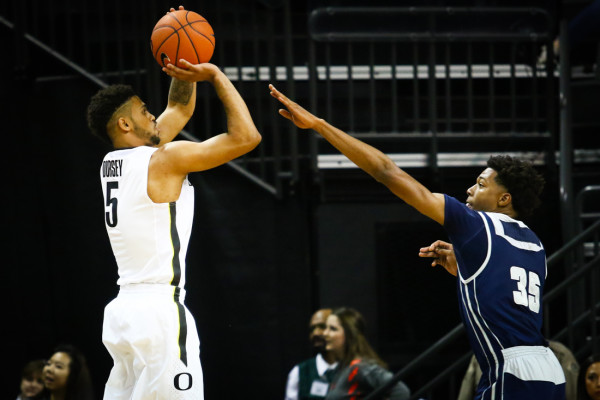
Tyler Dorsey Put On A Show Last Night, But Can He Keep It Up?(Samuel Marshall/Daily Emerald)

Tyler Dorsey Put On A Show Last Night, But Can He Keep It Up? (Samuel Marshall/Daily Emerald)

Dorsey wasn’t just camping on the perimeter waiting for a kick-out pass. He was swishing shots in transition, pulling up effortlessly off the dribble and putting on a catch-and-shoot clinic. No stranger to 20-point games during his collegiate career, Dorsey looked as confident as ever in his touch last night. You’d be hard-pressed to find one of his second-half shots that even hit the rim. The question now becomes whether his performance against a lackluster Washington defense is a sign of things to come for the Los Angeles native, or just another tantalizing tease of his vast offensive potential. Remember that this was supposed to be a breakout season for the sophomore, the kind of emergence capable of making an already elite Ducks’ offense completely unstoppable. Oregon is still waiting for that breakout.

Read the rest of this entry »

Share this story

Who is the Big 12’s Fourth-Best Team?

Posted by Brian Goodman on January 5th, 2017

It didn’t take long for the Big 12 hierarchy to crystallize, at least at the top of the standings. Kansas took the early driver’s seat, as expected, and despite a few noticeable flaws that could ultimately snap The Streak if left uncorrected, the Jayhawks are still the team to beat. Just a notch under them, Baylor and West Virginia are both capable of chasing down the Jayhawks, but no other teams are in that camp. Below the Bears and Mountaineers but above Oklahoma State, Texas and Oklahoma is the murky middle, where the differences between teams at the top and bottom of this tier is tough to discern and could come down to a mere handful of possessions, if the first week of conference action is any indication. With two league games under each team’s belt, here’s how the race for fourth place in the Big 12 is shaping up.

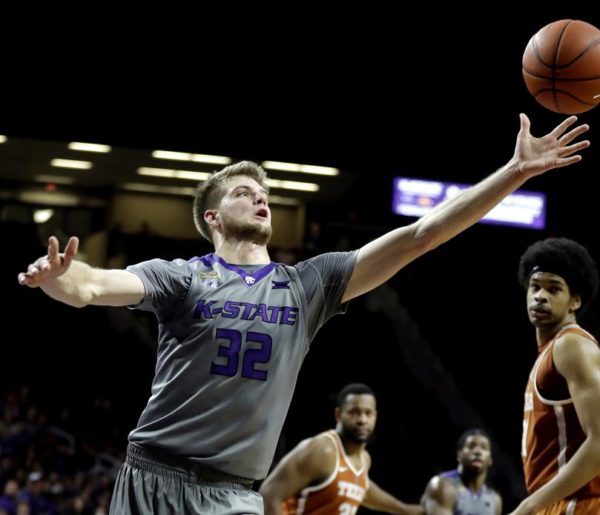
Kansas State center Dean Wade gives the Wildcats an early edge on the middle of the Big 12 pack. (Statesman.com)

Kansas State center Dean Wade gives the Wildcats an early edge on the middle of the Big 12 pack. (Statesman.com)

  • Kansas State — Lost in the aftermath of all the traveling jokes and memes from Tuesday night’s game against Kansas is that the Wildcats came up with a truly impressive offensive performance. Bruce Weber’s team posted 1.22 points per trip at The Phog, marking one of the best outputs by a Jayhawk opponent in recent years. The Wildcats appear to be gelling, but one reason why the last couple seasons in Manhattan have been so disappointing is because they’ve had a tendency to play inspired ball in marquee games only to go flat in subsequent efforts, so consistency will be a key. Still, judging solely from the first six weeks of the season, nothing from this team’s resume suggests that Kansas State isn’t capable of pulling it off. Fourth-place probability: 40%.

Read the rest of this entry »

Share this story

Does Non-Conference Scheduling Matter?

Posted by Will Ezekowitz on January 5th, 2017

As we transition into the first full week of the conference season, commentators and pundits alike will be heard discussing how the toughness of a team’s non-conference schedule prepared them for the rigors of conference play. There is a long held prevailing belief in college basketball circles that a difficult non-conference schedule forces teams to improve on the fly. The premise is that those teams, having faced several opponents of equal or better acumen, are better prepared — “battle-tested,” if you will — for the early weeks of conference play. We can call this the Long Beach State Theory, as Don Monson’s team has ranked among the nation’s top five in non-conference strength of schedule (per KenPom), since 2010. Clearly he believes that a tough schedule in November and December readies the 49ers for Big West play. But is it really true?

Dan Monson Clearly Believes in a Tough Non-Conference Schedule (USA Today Images)

Dan Monson Clearly Believes in a Tough Non-Conference Schedule (USA Today Images)

In order to test this assumption, KenPom helpfully ranks the difficulty of every team’s non-conference slate. If the teams with the most difficult non-conference schedules consistently see their overall ratings rise during conference play, then we will know that those teams have improved over time relative to the rest of college basketball. We limited our sample to mid-majors exclusively, for the simple reason that it’s easier to gauge actual improvement over time from the middle of the national pack (e.g., Montana playing the 14th-toughest non-conference schedule last season and raising its KenPom rating by 35 spots during conference play). In reviewing the last six years of teams finishing among the top 40 non-conference schedules, 150 mid-majors qualified for our analysis.

Read the rest of this entry »

Share this story

O26 Power 13: New Year, New Order, Same Teams on Top

Posted by Tommy Lemoine on January 4th, 2017

With 2017 now upon us and conference play ramping up, let’s take a step back and reexamine the best of the best across the O26.

1. Gonzaga (14-0) West Coast. Despite its cast of untested newcomers, chemistry and balance have not been an issue for Gonzaga this season. The Bulldogs have cruised to a 14-0 start behind a lineup whose top six scorers all average between 9.3 and 13.8 points per game. In fact, only two players—Nigel Williams-Goss and Przemek Karnowski—get more than 30 minutes per night, thanks largely to the effectiveness of bench players like Zach Collins (10.5 PPG, 5.2 RPG) and Killian Tillie (4.6 PPG). Mark Few’s club has been equally excellent on both sides of the ball, ranking among the top 12 nationally in both offensive and defensive efficiency. That well-roundedness helped the Zags notch three neutral court victories over KenPom top-30 opponents, giving them a non-conference resume that should hold up very well in mid-March. A win or two over Saint Mary’s would only strengthen the cause. The Zags are once again a legitimate Final Four contender.

UT Arlington surprise win at Saint Mary's opened eyes across college basketball. (AP Photo/Ben Margot)

UT Arlington surprise win at Saint Mary’s opened eyes across college basketball. (AP Photo/Ben Margot)

2. Saint Mary’s (12-1) West Coast. Since its jarring, 14-point home loss to UT Arlington on December 8, Saint Mary’s has held five straight opponents under 0.90 points per possession. That’s a positive sign for a unit that has often struggled to win games when its offense goes cold. The Gaels—with victories at Dayton and Stanford—have also proven their ability to win on the road, which is not something they could claim last season (the NCAA Selection Committee took notice). With one of the nation’s elite point guards (Emmett Naar) and a center, Jock Landale, who currently ranks second in KenPom’s Player of the Year standings, it’s hard to imagine this team slipping much in WCC play. January 14, Saint Mary’s first tilt with Gonzaga in Spokane, can’t come soon enough.

3. Wichita State (12-3) – Missouri Valley. The Shockers’ 100-66 dismantling of Bradley on New Year’s Day perhaps best captures this team’s identity. Sixteen different players saw action (Wichita State leads the country in bench minutes); ball movement was crisp (25 assists on 34 made baskets); and the physicality was unrelenting. Put simply, Wichita State is going to pummel a whole bunch of inferior opponents in Missouri Valley play. With an already-tenuous at-large resume, however, one major question remains: can the Shockers avoid losing more than one or two games in the conference? With Illinois State and Missouri State both surging, nothing is guaranteed.

Read the rest of this entry »

Share this story