Oregon State Week: Running Down The Returnees

Posted by Connor Pelton on August 23rd, 2012

Six significant Beavers return for Craig Robinson this season, a group that will be called upon to quickly meld with four freshmen and a newly eligible transfer. Below we’ll break down those returnees in order of their per-game scoring averages last season.

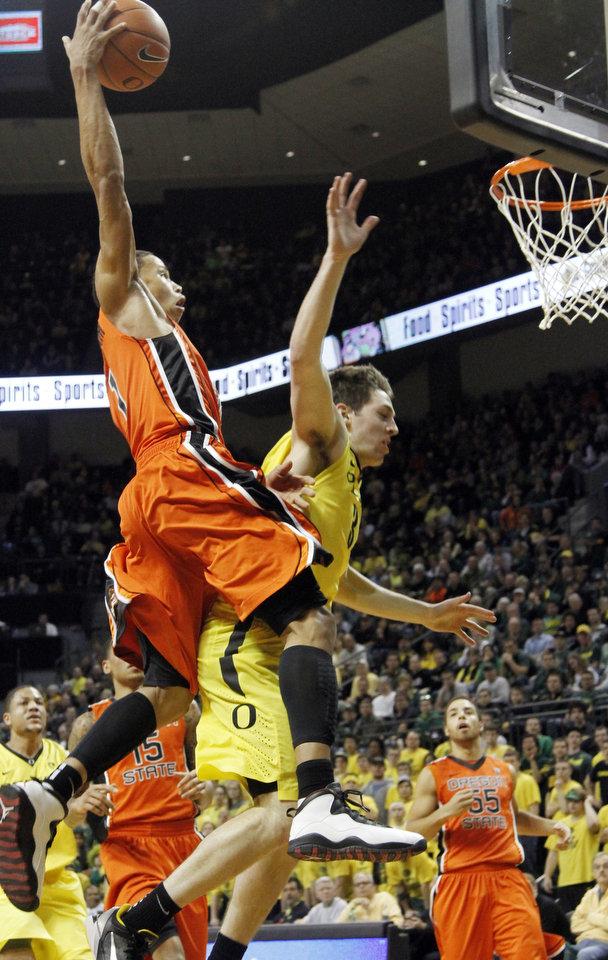
Devon Collier, Junior, Forward (13.1 PPG, 5.9 RPG, 1.3 BPG) – Collier graduated from starting all but seven games as a freshman to all but just three as a sophomore. His scoring totals nearly doubled in 2011-12, going from 7.0 PPG to 13.1 PPG. He was by far the team’s best scoring option in the post, and at times when Jared Cunningham couldn’t find his jumper, the best option, period. The next step on the road to becoming an all-conference performer is to finish more of his opportunities off the glass. That should come as he makes the transition to an upperclassman, and he already showed some improvement in the Beavers first European Tour game, going six-for-six from the field against Saint Charles Basketball Club. If he can continue anywhere near that kind of production, he has a solid passer in Ahmad Starks to get him the ball on the block. Collier can also run the court and is a great dump-off option in transition. On the other end of the court, Collier’s defense will be just as important to Oregon State’s success this season. The combination of Eric Moreland and Collier’s long wingspans made it nearly impossible for opponents to have any success in the lane, with Devon himself having one four-block game and three three-block outings.
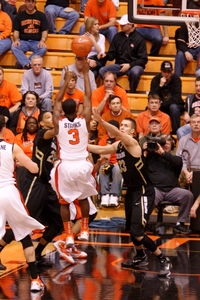
Once Starks Begins To Get Going, There Isn’t A Better Shooter In The League (credit: Andy Wooldridge)

Ahmad Starks, Junior, Point Guard (12.1 PPG, 2.3 RPG) – Along with Collier, Starks is the only other player from Robinson’s 2010 freshman class still with the team. Starks is a shoot-first point guard, the best of his kind in the Pac-12. Despite only standing a generous 5’9″, he is able to get up and make shots consistently with his unique fadeaway jumper. Starks was the main reason for Oregon State’s late success in 2011-12, as the Beavers went 6-2 in their final eight games. With Cunningham struggling to put down his three-point shot, Starks averaged 11.3 PPG in the seven games he played during that stretch. Not surprisingly, Oregon State’s two losses came in games where Starks scored only four points or sat out. The guard is at his best when he catches the ball on a wing or is able to create separation by stopping on a dime, pulling up, fading away, and shooting. More of this, and less of the jacking up random shots outside of the offensive flow, will result for more offensive production for both Starks and the Beavers.

Read the rest of this entry »

Share this story

Big 12 Weekly Five: 08.23.12 Edition

Posted by dnspewak on August 23rd, 2012

  1. Uh oh. The only true point guard on Oklahoma State’s roster, Cezar Guerrero, announced this week of his intention to transfer closer to home. His mother is sick in Los Angeles, so the decision is perfectly reasonable. However, the point guard position continues to plague Travis Ford. He lost two point guards to transfer last winter, and Keiton Page — already playing out of position there a year ago — graduated. Although that article actually claims the coaching staff may have wanted to play Guerrero off the ball in 2012-13, he was the only player on the roster with true point guard skills. Freshman Marcus Smart will probably have the ball in his hands a lot, and Markel Brown might get a chance to run the point too. But they’re a lot more effective as scorers, and it would have been a whole lot easier for Guerrero to take the reins and facilitate the offense. Now that he’s gone, it’s also important for Ford to get JuCo point guard Kirby Gardner cleared. He’s entirely unknown at this point and his signing came out of nowhere, but he does seem like more of a natural point.
  2. Make that seven freshmen now for Bill Self. Less than a month after the NCAA cleared Milton Doyle to play for Kansas, the freshman decided to leave the school before ever playing a game, which cuts a dent in Self’s abnormally-sized 2012 recruiting class. Although Self and Doyle’s mother, Lisa Green, both spoke in vague terms about his departure, it appears as though Doyle wanted to earn more minutes and make more of a major impact right away instead of waiting his turn. Neither Self nor Green spoke ill of each other, though, so it’s now time for Doyle to find another school — it’ll be his third already after originally committing to Florida International before the firing of Isiah Thomas. From the Jayhawks’ standpoint, they’re already loaded, especially after learning of top-100 freshman guard Rio Adams’ eligibility for 2012-13 earlier this month.
  3. We’ve written at length about Cameron Clark on this microsite, odd considering he’s never even averaged double figures in scoring during his first two years at Oklahoma. But we’ve written about him because his potential is so obvious to the naked eye, and he’s the type of sleeping giant that could take the Sooners to the next level in Lon Kruger’s second year. Everything about Clark screams “big-time scorer.” He’s got the size and wing skills at 6’6”, and he’s simply the kind of guy that has the ability to get the ball in the bucket on any given night. That consistency has not yet materialized, which is why we’re often writing about Clark’s potential as opposed to his actual production. With Wyoming transfer Amath M’Baye joining the team this year and the return of every key scorer from a year ago, there’s still not a ton of pressure solely on Clark. Still, his growth as a junior could be a critical piece of Kruger’s NCAA Tournament hopes.
  4. Poor Kansas State. Scheduling conflicts forced the Wildcats to return home early from their trip to Brazil, meaning its now back to reality after a vacation in South America. First-year coach Bruce Weber still got an early look at his new team, even if it wasn’t all that encouraging. Kansas State finished 2-2 on the trip, including a loss in which the referees ejected Weber from the game. It’s hardly the time to freak out about a few exhibition losses, but it’s at least encouraging that point guard Angel Rodriguez led the team in scoring on the trip. He was one of Frank Martin’s favorites last season, and he’ll likely earn that same sort of praise from Weber as long as he continues to progress.
  5. The legal process may have ended in the Darrell Williams rape case this summer, but the questions still linger about the former Oklahoma State forward. A jury convicted Williams based on the testimony of two women who said he groped them at a party, and he’ll now face serious prison time for the offense. As Mary Mitchell points out, though, prosecutors had no physical evidence to show the jury, and the identification was also troublesome because several other players had the same OSU warmup suit on at the party. The Huffington Post also called out the jury for convicting Williams, claiming 80 percent of errors in sexual assault cases happen because of misidentification. And there’s another aspect to this, too: “So let’s summarize. Williams, an honors student with an unblemished record, was convicted by a jury with no black people on it of an interracial crime that lacked independent witnesses or physical evidence and was based on a notoriously flawed method for identifying suspects.”
Share this story

The Eligibility of Nerlens Noel and Shabazz Muhammad: Much Ado About Nothing?

Posted by Chris Johnson on August 23rd, 2012

Christopher Johnson is an RTC columnist. He can be reached @ChrisDJohnsonn.

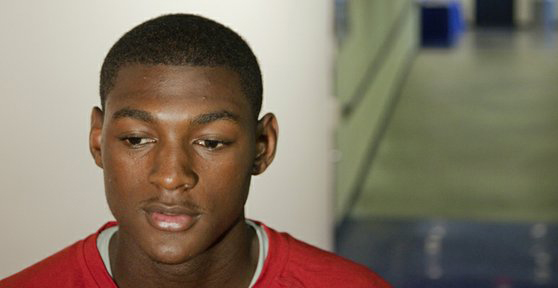
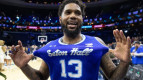
On the first day of college basketball’s spring signing period, the two highest-ranked recruits in the Class of 2012 went public with their decisions. First, Bishop Gorman product Shabazz Muhammad confirmed most every pre-commitment prediction by pledging to Ben Howland at UCLA. Then Nerlens Noel, a 6’ 10’’ shot-blocking force from the Tilton School (NH), kept his top three suitors (Kentucky, Syracuse and Georgetown) on their toes by tweeting one day earlier that he was “Gon shock the World!!” before ultimately – and not at all unpredictably – announcing his intention to join the Wildcats. Noel and Muhammad marked two momentous pickups for each program, a pair of one-and-done talents who over the next 365 days could dominate Division I competition, garner huge amounts of national attention, and rise to rarefied status within their respective fan bases before joining the professional ranks as lottery picks in the NBA Draft. That’s the narrative most everyone expects, and rightly so: From Anthony Davis to Kevin Love to Derrick Rose, truly elite high school prospects use the college game as a one-year springboard for their professional futures. Only it now seems Muhammad and Noel’s paths to NBA stardom may not proceed quite as smoothly.

Questions remain over Noel’s eligibility as Kentucky prepares to begin its Title defense effort (Photo credit: Getty Images).

In the months since making their commitments, both players’ recruitments have come under NCAA scrutiny. CBSSports.com reported in February that the NCAA had begun looking into Muhammad’s recruitment, with a specific emphasis on his relationship with financial advisers Ken Kavanagh and Benjamin Lincoln. The issue was put to rest – at least temporarily – before word leaked last week that Muhammad had not yet been cleared by the NCAA to travel with UCLA on its summer exhibition tour to China. The eligibility spotlight shifted its focus yesterday to Noel, when SI.com’s Pete Thamel brought to light recent developments on the NCAA’s ongoing probe over Noel’s recruitment. According to Thamel, NCAA enforcement officials, including UK chief compliance officer Sandy Bell, traveled to Tilton in early August to ask questions that “focused on the cast of characters that surrounded Noel’s recruitment and how Noel paid for his unofficial visits.” A former NCAA investigator indicated that Noel’s case appears to be more than a simple background check, citing the presence of Bell and two NCAA enforcement officials as signs pointing to further investigation. Neither player has been implicated in any wrongdoing, so UCLA and UK fans can hold their breath – for now. The ongoing queries have yet to produce any truly damaging implications, but the continual speculation dampens the excitement level for two teams with designs on deep NCAA Tournament runs in the upcoming season. For two players expected to have prominent roles within their teams’ offensive and defensive game plans, the ongoing uncertainty – even at this early stage – counts as a legitimate concern. Noel is faced with the unfortunate challenge of replacing one of college hoops’ most dominant defensive players of recent memory, Anthony Davis, while Muhammad is expected to ignite Ben Howland’s trudgy half-court system with perimeter scoring punch and dribble penetration. Even for players as talented as Muhammad and Noel, the high school-to-college leap requires an adjustment period, and any missed practice time could stall their development.

Read the rest of this entry »

Share this story

Morning Five: 08.23.12 Edition

Posted by rtmsf on August 23rd, 2012

  1. It seems like all we talk about in these M5s are player eligibility issues, but something new is released almost every day. The latest release involves the other half of the top two players in the incoming freshman class (depending on whom you ask). With UCLA”s Shabazz Muhammad sitting in Westwood yesterday as his team flew off to China without him, SI.com‘s Pete Thamel published a piece revealing that the NCAA is taking a closer look at the recruitment of Kentucky big man Nerlens Noel, visiting his former high school for the second time in three months to inquire about some of the associations he has with various prep basketball hangers-on, and specifically, how Noel paid for some of his unofficial recruiting visits. As expected, Kentucky fans have been quick to play the victimization card by their media public enemy #1, Thamel, but the truth of the matter is that this is becoming NCAA standard operating procedure for elite recruits in today’s environment. Just this offseason, Noel, Muhammad, Providence’s Ricardo Ledo and NC State’s Rodney Purvis have been more carefully vetted by the NCAA, and in the era of players frequently jumping high schools, more and more powerful AAU basketball, and vast coteries of agents and runners looking for a piece of the action, these careful evaluations of elite recruits is going to continue.
  2. It was therefore superb timing on CBSSports.com to release another of their Critical Coaches series Wednesday asking a question along these lines. They asked their coaching contacts which player’s recruitment from the last decade was perceived (there’s that word again) to have been the dirtiest? Recall that a couple of weeks ago, John Calipari, Scott Drew and Ben Howland were perceived to be the biggest cheaters in the sport — among the group of players named in this follow-up question, the top four named and six of the top 10 were recruits under either Calipari or Howland. Interestingly, none of Drew’s guys — from Quincy Miller to Isaiah Austin to Perry Jones — were named in this poll. But boy, both Calipari and Howland’s guys sure were — the top four: Shabazz Muhammad, Anthony Davis, John Wall, and Kyle Anderson. The next two on the list? OJ Mayo and Derrick Rose — two players who, you know, were proven to have committed serious violations during their recruitments. A number of other players received votes but it’s clear that, with nine of the 24 players named (Terrence Jones, DeMarcus Cousins, Enes Kanter, and J’Mison Morgan were also named), the Kentucky and UCLA head coaches are perceived to be playing a different game than everyone else.
  3. Sigh… While on the subject of the shamelessness of some of the questions in this Critical Coaches series, would it be too much to ask the CBSSports.com gentlemen — all of whom are good and capable dudes — to follow up with some of the hundreds of coaching contacts they have and do the proper journalistic legwork to prove (or disprove) these perceptions? If Shabazz Muhammad’s recruitment is perceived to be the dirtiest in the last 10 years of college basketball (or Anthony Davis’… or John Wall’s… or Kyle Anderson’s… you get the point), how about spending some of that energy nailing the people responsible; or, alternatively, clearing those mentioned from that perception? It all just feels a bit too US Weekly, which as John Clay suggests, is fine if that’s what the site wants to be — but unlike most college basketball portals, that group has the resources, the time, and quite clearly the contacts to find out where the bodies are buried. Instead of pure sensationalism, how about digging up a few bones here and there along the way?
  4. Let’s continue a theme with today’s M5 by mentioning that UNC has “quietly” moved its director of academic support services for athletes into another position at the university. Specifically, Robert Mercer, the department’s leader for 10 years, has become a “special assistant for operations” at the school’s Johnston Center for Academic Excellence (where everyone who wants an A, gets an A!). Sorry. UNC of course went to great pains to lay blame at the feet of Mercer for the problems that occurred under his watch, but it’s clear to anyone watching that he’s falling on the sword in return for an opportunity to keep his job (current salary: $81,900 + bennies). One note on this story — outside of Tobacco Road, it’s not well-known just how much vitriol exists between NC State and North Carolina. Take a read at some of the 15 pages of user comments under this Raleigh News & Observer article, and you’ll understand very quickly that the hatred between those two fan bases runs very, very deep.
  5. Back to basketball. One of the best ongoing columns if you’re looking for insightful information about the sport is Mike DeCourcy‘s Starting Five piece. If you can get past DeCourcy’s floating head at the top of each article, it’s really an excellent read, and this week was no different. He doesn’t get cute with it, but the insight is that the questions he answers are often a step or two beyond the typical “how do you see XYZ next year?” type. In this installment, he discusses the paucity of elite point guards in college basketball, Keith Clanton’s loyalty to UCF, and the possible upside for a number of non-power conference teams, among other things. There are few regular offseason columns that we’d describe as must-reads, but DeCourcy’s Q&A is definitely worth a few of your minutes each week.
Share this story

Oregon State Week: Players Not Returning

Posted by Connor Pelton on August 22nd, 2012

Last year the Beavers only had one senior on the roster, seemingly ensuring that the 2012-13 roster would be made up of the same guys. But one early entry to the NBA and two transfers later, Craig Robinson is indeed losing four players from last year’s squad. Below we’ll break down those four players in roughly the order of the degree to which they’ll be missed.

Jared Cunningham – Despite earning offers from basketball powerhouses San Diego State and California (among others), Cunningham decided to leave his home state and go north to Corvallis. Three years later, he leaves as arguably the most talented player to don a Beaver uniform since Corey Benjamin’s single season in 1997-98. Cunningham instantly played major minutes as a freshman, and by the end of the season was starting regularly and scoring in double figures. As a sophomore, with Seth Tarver graduating, his role and production increased. He started 29 of the 30 games he played in, missing only the third-to-last game of the year for reportedly blowing curfew. That year was when people nationally began to take notice of the athletic shooting guard at OSU. Cunningham averaged 14.2 PPG and 2.8 SPG as a sophomore, and had the top dunk of the year in a game against Arizona. Last season, he led the Beavers to 21 wins with 17.9 PPG and 2.5 SPG. At the end of the year, Cunningham announced he was leaving early for the NBA, a decision that raised some eyebrows around town. Sure enough, however, he was drafted in the 1st Round by the Dallas Mavericks last June.

Cunningham’s Athletic Ability Led To Many Spectacular Dunks, Including This One Over Oregon’s Garrett Sim (credit: AP)

Kevin McShane – After grey-shirting the 2007-08 season at Clackamas Community College, McShane had a rough start to his Oregon State career. The walk-on forward overslept for the first two 5:00 AM practices of the 2008-09 season, which left new head coach Craig Robinson wondering if he even deserved a walk-on spot with the team. But McShane impressed the coaching staff with his work ethic and hustle, making him a fan favorite whenever he entered the game. The years rolled by with McShane only playing garbage minutes or the not-so-rare instance when Gill Coliseum was so sleepy, Robinson decided to throw him into the mix just to liven things up. With an open scholarship available, McShane was the first in line to get one during his senior season. He responded by averaging 1.6 PPG, the highest total of his Oregon State career.

Read the rest of this entry »

Share this story

Kansas Freshman’s Early Transfer Adds Another Layer of Drama to Offseason Transfer Craze

Posted by Chris Johnson on August 22nd, 2012

Christopher Johnson is an RTC columnist. He can be reached @ChrisDJohnsonn.

The volume of conversation on transfers and the culture surrounding the widespread practice has dominated this college basketball offseason. A rash of in-season moves first prompted the discussion, but a public transfer power struggle elevated the dialogue to national headlines. The heated April saga involving former Wisconsin guard Jared Uthoff and head coach Bo Ryan, in which Ryan was demonized for restricting Uthoff’s potential landing destinations and interrogated on America’s most popular national sports talk radio show, brought the issue to a head and seemed to pivot the axis of public opinion in favor of the player. Ryan was painted as an unrelenting tyrant with little concern for his player’s best wishes while the ultimate outcome – Uthoff ended up transferring to Iowa, his home state – was roundly cheered as a momentous victory for Uthoff. The topic gained more steam when SI.com’s Luke Winn penned an informative piece on the transfer epidemic that brought to light the recent rise in players jumping to better teams and conferences, what he calls “up-transfers.” Whereas most players typically switch schools to find more playing time,  better academic opportunity or a more favorable location, “up-transfers” move for competitive reasons in a bid to showcase their talents on a more prominent level. By Winn’s definition – up-transfers go “from a mid-major to a major”, “from a less-decorated major to a recent national champ,” or “from an off-the-map school to an elite mid-major” – there are 25 “up-transfers” with eligibility to play next season, several of whom could have conference and national championship implications.

The early departure of Doyle raises the question of whether the NCAA needs to impose tighter controls on transfer timing (Photo credit: Mike Yoder/KUsports.com).

The “up-transfer” distinction provided some qualitative clarity for the transfer trend. It also made absolute sense: With an increase in transfers that affect national brand-name programs, fans are bound to catch word of player movement in greater frequency. But it was only after laying eyes on this NCAA Q & A that the scope of college hoop transfers truly hit home. Among other interesting transfer-related queries, the interview revealed that “40 percent of men’s basketball student-athletes will not be competing at their original school by the end of their sophomore year.” That’s a startlingly high number. To no surprise, NCAA is looking into the matter: vice president of academic and membership affairs Kevin Lennon recently told ESPN’s Dana O’Neil that the NCAA is seeking ways to improve the transfer policy. There are several factors to consider here. The NCAA wants a system where players have ample opportunity to better their situations, whether for basketball purposes or an academic change of heart or some combination therein. The concern is that loose regulation will encourage players to switch schools and destabilize the coach-player relationship by enabling a quick get-away if players aren’t content with their current location. It’s a precarious balancing act that requires respecting players’ abilities to change schools – particularly as it applies to the undergraduate hardship waivers that allow players to change locations based on extenuating circumstances such as ill family members or financial distress – while preventing a borderless interschool infrastructure with little or no deterrence for transfers.

Read the rest of this entry »

Share this story

Morning Five: 08.22.12 Edition

Posted by rtmsf on August 22nd, 2012

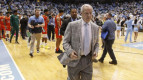
  1. From the time-on-his-hands department, we move to the curious tweeting of former North Carolina, Florida Atlantic and SMU head coach, Matt Doherty. The former Tar Heel — both as a player (1980-84) and coach (2000-03) — took to the Tweether on Tuesday to defend one of his former players, Julius Peppers. Of course everyone reading this by now knows the context under which Peppers has become a hot topic in the college basketball community, but most folks have lost track of Doherty, a disastrous hire seemingly everywhere he’s been. No worries, though, as the erstwhile coach makes clear in this tweet, he is currently getting “paid for not working!” Funny, that’s what UNC fans were screaming at the top of their lungs around a decade ago. Still, the entire series of semi-abrasive and tweets makes you wonder if Doherty plans on ever working in this business again.
  2. Is it every too early to start breaking down the juiciest match-ups in the non-conference schedule for the upcoming season? No argument here, as CNNSI.com’s Andy Glockner in mid-August has already put together his list of the 25 best pre-conference games (nearly all of these are in November and December). As it should be, the list is very top-heavy, with annual favorites Kentucky, Indiana, Louisville and North Carolina representing seven of the 10 spots in the top five games. It’s hard to quibble with lists like these because so much of it comes down to a matter of taste, but for our money, the best game on the agenda is the Champions Classic match-up between Kentucky and Duke. Sure, Louisville and UK are the bitterest of rivals and the storylines between Calipari and Pitino are too many to count. But we just played that game a few months ago in New Orleans, and we have it at least one other time per season. Instead, give us the Wildcats and Blue Devils, a pair of teams that somehow and shockingly have not played each other in ELEVEN WHOLE YEARS (Duke won in the 2001 Jason Williams overtime classic at the Jimmy V — check the Youtube clips here). How is this possible? How can Kentucky and Duke not see each other at least once every few seasons? All in all, though, if Glockner’s list doesn’t get your juices pumping, we can’t help you.
  3. One of Glockner’s juiciest 25 games is the annual Crosstown Shootout game between Cincinnati and Xavier, and regardless of the players on the floor, he’s 100% correct in that this game is always worth a viewing. Xavier, the big winner in last year’s brawl game, lost quite a bit of its production to graduation but was expected to bring back fourth-leading scorer (9.8 PPG) and TSN A-10 Freshman of the Year, Dez Wells. No longer. The school expelled Wells yesterday for a serious violation of Xavier’s student code of conduct.” XU would not provide additional details about the violations, but it’s safe to assume that his transgression fell on the side of worse than pushing a UC player causing an embarrassing fracas. The question we now have is: Who doesn’t need a scoring and rebounding big guard who will have three years of eligibility remaining after a one-year transfer layoffs. We’re betting that the over/under on calls to Wells by this morning is somewhere in the neighborhood of 30 schools.
  4. With a new commissioner and a new lead negotiator in tow, the Big East is battening down all the hatches before its television negotiation window opens up in a bit over a week from now. The latest news that shows the league is putting its absolute best foot forward for its TV masters of the universe is that the conference is very close to securing a 10-year extension to its existing deal that will keep the Big East Tournament at the Mecca, Madison Square Garden, through 2026. This is very important to the future of the league for a number of reasons, but perhaps the weightiest is that it will serve to keep the encroaching ACC (with new members Pittsburgh and Syracuse) out of Manhattan for a good while. Furthermore, even though nearly everyone agrees that football drives the financial bus of the power conferences, the Big East’s Mike Aresco and the ACC’s John Swofford seem to recognize the value in their specific basketball products. The Big East Tournament on Seventh Avenue between 31st and 33d Streets is a big part of that value, so it’s great to see that Aresco and his team clearly understand that.
  5. Finally, we have no idea what to make of this news, but it’s bizarre and worth mentioning as we close things out nonetheless. Kellogg’s announced that it will release a series of Pop Tarts the company calls “printed fun” with five different flavors coinciding with the following schools: Arkansas, Georgia, Florida, Michigan, and North Carolina. As this responding article at Hoopsworld shows, Twitter may have had more fun with this meme than Doherty enjoyed all by lonesome on Tuesday. Somewhere in Lubbock, Texas, Billy Gillispie reportedly kicked over a case of delicious Pop Tart goodness with the release of this news. Alas.
Share this story

Oregon State Week: Evaluating The Recent Past

Posted by Connor Pelton on August 21st, 2012

It’s taken four seasons, but excitement has finally been infused back into a program that lost 20 straight games to close out the 2007-08 season. Craig Robinson, the man charged with rebuilding Oregon State hoops following that infamous campaign, has brought in a feisty defense, up-tempo offense, and good recruiting class after good recruiting class. The Beavers haven’t ranked lower than 34th in the country in the steals category since Robinson has had his own recruits, and they finished fifth and sixth in the last two seasons, respectively. Former guard Jared Cunningham, who was selected in the first round in this summer’s NBA Draft (a first for Oregon State since Corey Benjamin in 1998) led the conference in steals in 2010-11 and 2011-12. Last season saw the Beavers finish in the top 15 nationally in offensive tempo, leading to a Pac-12 leading 78.9 PPG. Along with Cunningham, Robinson has brought in highly touted recruits such as Jarmal Reid, Angus Brandt, and Roberto Nelson. Needless to say, basketball is fun again at Oregon State.

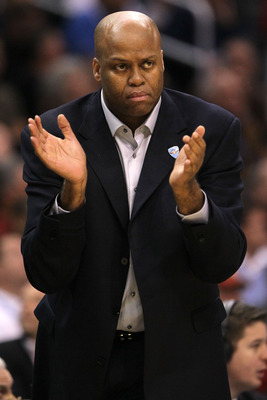
Craig Robinson Has Made Basketball Fun Again At Oregon State. The Next Step Is An NIT or NCAA Tournament Bid. (credit: Bleacher Report)

And while basketball is fun, it could be a lot more fun. Despite all of the things we talked about above, the Beavers have yet to make an NCAA Tournament under the guidance of Robinson. Heck, they haven’t even made the NIT. And there’s some reasons for that. Robinson straddles a line between fun basketball and strong, fundamentally sound basketball. Oregon State finished 328th in the nation last season in three-point defensive field goal percentage, which is one of the main reasons you’ll see losses to conference bottom-feeders and mediocre WAC teams. Robinson and his staff have elected to go with a gambling, trap-based defense, which is fun to watch and works against opposing point guards that freeze up when they are trapped in a corner. But against upper-level Pac-12 teams or even lesser opponents with a solid one man? The Beavers get burned, and they get burned often.

Read the rest of this entry »

Share this story

UAB Fines Athletes to Improve Academic Standards; Slippery Slope?

Posted by Chris Johnson on August 21st, 2012

Christopher Johnson is an RTC columnist. He can be reached @ChrisDJohnsonn.

Earlier this year, Connecticut was one of 10 college basketball teams to receive a one-year postseason ban for not meeting the NCAA’s minimum four-year Academic Progress Rate (APR) threshold of 900. The Huskies filed an appeal, arguing that recent reforms had produced increased scores over the past two years. In the end, though, the NCAA stuck to its guns and reaffirmed its initial ruling. And so it was that UConn – a program that has experienced a rapid rise into the college hoops elite under coach Jim Calhoun – just one and a half years removed from winning a national championship, was banned from the sport’s pre-eminent postseason tournament. The Huskies probably won’t feel any measurable downturn in recruiting success or national cachet as a result, but the sentencing proved that even the sport’s marquee brands are vulnerable to the NCAA’s increased academic standards.

After struggling to keep up with the NCAA’s APR standards, UAB is going new lengths to improve its academic standing in the coming years.

A one-year postseason ban in men’s basketball doesn’t come close to the sort of multi-faceted, crippling atom bomb the NCAA dropped on Penn State.  Alabama-Birmingham is nonetheless determined to avoid a UConn-esque fate, and it’s adopting a unique approach to work toward that end. The program has endured a rough history of keeping up with the NCAA’s academic reforms. During the last measured four-year APR period (2003-07), UAB had six teams fail to meet the minimum mark and was the second-most penalized program in the nation for its academic shortcomings. With that spotty track record, it comes as no surprise that the Blazers are seeking new ways to enforce academic responsibility. In a formal Q & A with the Birmingham News, athletic director Brian Mackin outlined his plan to keep UAB’s various teams above the APR cutline. Along with increased academic support, study time and access to student-athlete advisors, UAB has laced its academic compliance code with monetary disincentives.

Read the rest of this entry »

Share this story

SEC Transition Basketball: Arkansas Razorbacks

Posted by Brian Joyce on August 21st, 2012

It’s hot out there, and to many of us, college basketball is the last thing on our minds. But here at the SEC Microsite, we’re going to be rolling out mid-summer resets of each of the (now) 14 basketball programs in our league. We’re calling it Transition Basketball, and you can expect we’ll cover three or four teams a week until we’re done. By that time, we’ll actually start to be turning the slight corner into the fall, and from there it’s a smooth slope down to Midnight Madness in mid-October. Today’s update: Arkansas.

State of the Program

In year one of the homecoming of Mike Anderson, he had the Razorbacks on the brink of returning to the NCAA Tournament as they stood 16-6 on February 1 with an RPI inside the top 50. The final month doomed the squad, however as they won only two of their final 10 games. After starting 16-1 at home, they limped in with a 1-3 record in front of the home faithful, defeating only bottom-dweller South Carolina in that stretch. Inexperience and untimely injuries proved too much for the Razorbacks to overcome.

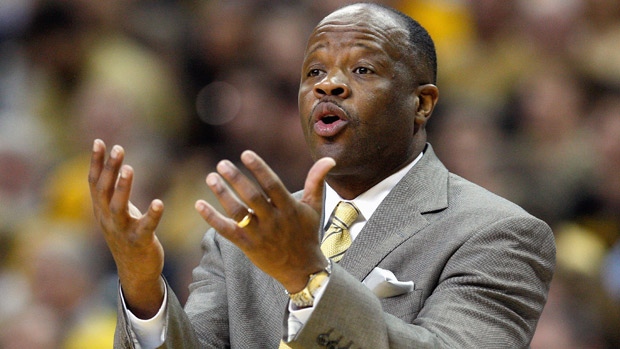
Mike Anderson is back in Fayetteville with enough talent to make the Razorbacks a contender in the SEC

The young Hogs return eight players from last season’s team including junior Marshawn Powell, who was averaging 19.5 points and 6.0 rebounds before suffering a season-ending knee injury, and second-team All-SEC sophomore guard B.J. Young, who led SEC freshmen in scoring.  The Razorbacks return 69 percent of their offense and 55 percent of their rebounding from a year ago. Returners made 125 of the 160 starts with only Marvelle Waithe (eight starts) and Michael Sanchez (27 starts) graduating. Many thought that Arkansas’ talent and new style could push the Razorbacks into the surprise team of the SEC last season. While the Hogs never made that push, the secret is out, and they won’t be sneaking up on anybody this season.

Read the rest of this entry »

Share this story